CONSEQUENCES OF SANITATION PROBLEMS AS PERCEIVED BY THE RURAL FARM WOMEN
MST. TASMINA AKTER
DEPARTMENT OF AGRICULTURAL EXTENSION & INFORMATION SYSTEM
SHER-E-BANGLA AGRICULTURAL UNIVERSITY DHAKA-1207
JUNE, 2021
CONSEQUENCES OF SANITATION PROBLEMS AS PERCEIVED BY THE RURAL FARM WOMEN
BY
Mst. Tasmina Akter Reg. No. 19-10065
A thesis
Submitted to the Faculty of Agriculture Sher-e-Bangla Agricultural University, Dhaka In partial fulfillment of the requirements for the degree of
MASTER OF SCIENCE (MS) IN
AGRICULTURAL EXTENSION SEMESTER: JANUARY-JUNE, 2021
APPROVED BY:
(Md. Wali Ahad Setu) Supervisor Associate Professor
Dept. of Agril. Ext. and Info. System Sher-e-Bangla Agricultural University
(Dr. Md. Sekender Ali) Co-Supervisor
Professor
Dept. of Agril. Ext. and Info. System Sher-e-Bangla Agricultural University
Prof. Mohammad Zamshed Alam Chairman
Examination Committee
Department of Agricultural Extension and Information System Sher-e-Bangla Agricultural University
Sher-e-Bangla Nagar, Dhaka-1207
CERTIFICATE
This is to certify that the thesis entitled “CONSEQUENCES OF SANITATION PROBLEMS AS PERCEIVED BY THE RURAL FARM WOMEN” submitted to the department of Agricultural Extension and Information System, Faculty of Agriculture, Sher-e-Bangla Agricultural University, Sher-e-Bangla Nagar, Dhaka in partial fulfillment of the requirements for the degree of Master of Science (M.S.) in Agricultural Extension, embodies the result of a piece of bona fide research work carried out by Mst. Tasmina Akter, Registration No. 19-10065 under my supervision and guidance. No part of the thesis has been submitted for any other degree or diploma.
I further certify that any help or source of information, as has been availed of during the course of this investigation has been duly acknowledged by the Author.
Dated:
Dhaka, Bangladesh Md. Wali Ahad Setu Associate Professor
Supervisor
Department of Agricultural Extension and Information System
Sher-e-Bangla Agricultural University Sher-e-Bangla Nagar, Dhaka-1207
i
ACKNOWLEDGEMENT
At first the author expresses her gratefulness to Almighty Allah who has helped her to pursue her higher education in agriculture and for giving the potency of successful completion of this research work.
With deepest emotion the author wish to express her pious gratitude, indebtedness, felicitation, sincere appreciation to her research Supervisor Md. Wali Ahad Setu, Associate Professor, Department of Agricultural Extension and Information System, Sher-E-Bangla Agricultural University, Dhaka, Bangladesh for his discursive guidance, intense supervision and continuous encouragement during the entire period of research work.
The author also highly grateful and obliged to her research Co-Supervisor Dr. Md.
Sekender Ali, Professor, Department of Agricultural Extension and Information System, Sher-E-Bangla Agricultural University, Dhaka, Bangladesh for his continuous encouragement, innovative suggestions, and affectionate inspiration throughout the study period.
The author expresses sincere respect Prof. Dr. Mohammad Zamshed Alam, Chairman, Department of Agricultural Extension and Information System, Sher-e- Bangla Agricultural University, Dhaka for providing valuable advice and sympathetic consideration regarding to the research.
The author is also grateful to all the teachers of Department of Agricultural Extension and Information System, Sher-e-Bangla Agricultural University, Dhaka, Bangladesh for their continuous encouragement and innovative suggestions.
Sincere thanks are additionally communicated to the Upazila Agriculture Official and SAAO of Sundarganj upazila in the study territory for their altruistic assistance and collaboration in information assortment period. The scientist is particularly appreciative to all the respondents in the study zone for their participation and help in achieving the targets of this exploration work.
ii
The special communicates genuine thanks and true thanks to all other departmental and out of departmental teachers of Sher-e-Bangla Agricultural University for their assistance and support. Last but not the least, the author expresses her immense indebtedness, most profound feelings of appreciation to her cherished guardians, sibling and relinquished all their bliss during the entire examination time frame particularly during her MS study.
At last, the desires, genuine thanks and appreciation to reach out to every one of her family members, well-wishers particularly companions for their motivation, participation and support in all periods of scholastic interest from the earliest starting point to end.
The Author
iii CONTENTS
CHAPTER Title Page No.
ACKNOWLEDGEMENTS i-ii
CONTENTS iii-iv
LIST OF TABLES v
LIST OF FIGURES vi
LIST OF APPENDICES vi
ABBREVIATIONS vii
ABSTRACT Viii
CHAPTER I INTRODUCTION 1-8
1.1 General Background of the Study 1
1.2 Statement of the Problem 3
1.3 Objectives of the Study 4
1.4 Justification of the Work 4
1.5 Assumptions of the Study 5
1.6 Limitations of the Study 6
1.7 Scope of the Study 6
1.8 Definitions of Some Frequently Used Terms 7
CHAPTER II REVIEW OF LITERATURE 9-17
2.1 Review of Literatures Related to Sanitation Issues 9
2.2 Research Gap of the Study 15
2.3 Conceptual Framework of the Study 17
CHAPTER III METHODOLOGY 18-24
3.1 Locale of the Study 18
3.2 Population and Sampling 18
3.3 Variables of the Study and Their Measurement 21 3.3.1 Measurement of consequences of sanitation problems 21 3.3.2 Measurement of selected characteristics of the women 22
3.3.2.1 Age 22
3.3.2.2 Education 22
3.3.2.3 Family size 22
3.3.2.4 Annual family income 23
3.3.2.5 FarmContact with relevant organizations 23
3.3.2.6 Condition of toilet 23
3.4 Identifying Causes Consequences of Sanitation Problems 23
3.5 Data Gathering Instrument 24
3.6 Collection of Data 24
3.7 Data Processing and Analysis 24
3.8 Hypothesis 24
CHAPTER IV RESULTS AND DISCUSSION 25-35
4.1 Consequences of Sanitation Problems 25
4.1.1 Item Wise Consequences of Sanitation Problems 26 4.2 Selected Characteristics of the Respondent Women 26
4.2.1 Age 27
4.2.2 4.1.2 Education 28
iv
4.2.3 4.1.3 Family size 28
4.2.4 4.1.4 Annual family income 29
4.2.5 Contact with relevant organizations 29
4.2.6 Condition of toilet 30
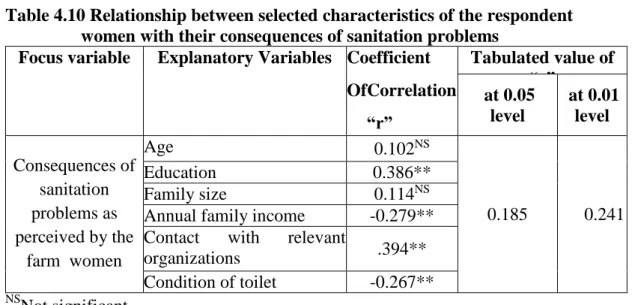
4.3 Relationship between Selected Characteristics of the Women and Their Consequences of Sanitation Problems
30
4.3.1 Age and consequences of sanitation problems 31
4.3.2 Education and consequences of sanitation problems 31 4.3.3 Family size and consequences of sanitation problems 32 4.3.4 Annual family income and consequences of sanitation
problems
33 4.3.5 Contact with relevant organizations and consequences of
sanitation problems
33 4.3.6 Condition of toilet and consequences of sanitation
problems
34
4.4 Causes of Sanitation Problems 35
CHAPTER V SUMMARY OF FINDINGS, CONCLUSIONS AND RECOMMENDATIONS
37-41
5.1 Summary of Findings 37
5.1.1 Characteristics of the Women 37
5.1.2 Consequences of Sanitation Problems 38
5.1.3 Item Wise Consequences of Sanitation Problems 38
5.1.4 Relationship between selected characteristics of the women and their consequences of sanitation problems
38 5.1.5 Causes of Sanitation Problems
5.2 Conclusions 39
5.3 Recommendations 40
5.3.1 Recommendations for policy implications 40
5.3.2 Recommendations for further study 41
REFERENCES 42-46
APPENDICES 47-50
v
LIST OF TABLES
Table Title Page No.
3.1 Distribution of the Women Constituting the Population, Sample and Reserve List in Selected Unions
21 4.1 Distribution of the women according to their consequences 25 4.2 Rank order of the Consequences of Sanitation Problem Faced Index
(CSPFI)
26 4.3 The salient features of the selected characteristics of the women 27 4.4 Distribution of the women according to their age 27 4.5 Distribution of the women according to their education 28 4.6 Distribution of the women according to their family size 28 4.7 Distribution of the women according to their annual income 29 4.8 Distribution of the women according to their media contact 29 4.9 Distribution of women according to their toilet condition 30 4.10 Co-efficient of correlation showing relationship between selected
characteristics of the women with their consequences of sanitation problems
31
4.11 Summarized results of Causes of Sanitation Problems 35 4.12 Suggestions to minimize the sanitation problems with citation
number
35
vi
LIST OF FIGURES
Figure Title Page No.
2.1 Conceptual framework of the study 17
3.1 Map of Gaibandha district showing Sundorganj upazila 19 3.2 Map of Sundorganj upazila showing selected study area 20
LIST OF APPENDICES
Appendix No. Title Page No.
APPENDIX -A
English version interview schedule on
Consequences of sanitation problems as perceived by the rural women
47-49
APPENDIX -B Correlation matrix showing the interrelationships among
the concerned variables 50
vii
ABBREVIATIONS
BBS Bangladesh Bureau of Statistics
DPHE Department of Public Health Engineering GDP Gross Domestic Product
CRI Centre for Research and Information JMP Joint Monitoring Programme
ODF Open Defecation Free
MDG Millennium Development Goals DAE Department of Agricultural Extension WHO World Health Organization
FAO Food and Agriculture Organization MoYS Ministry of Youth and Sports IPM Integrated Pest Management SAAO Sub Assistant Agriculture Officer SAU Sher-e-Bangla Agricultural University SPSS Statistical Package for Social Sciences GoB Government of Bangladesh
UNICEF United Nations International Children's Emergency Fund SDG Sustainable DevelopmentGoals
FSM Free School Meals
DLHS District Level Household Survey WSH Water, Sanitation and Hygiene
CSPFI Consequences of Sanitation Problem Faced Index
viii
CONSEQUENCES OF SANITATION PROBLEMS AS PERCEIVED BY THE RURAL FARM WOMEN
ABSTRACT
The main purpose of the study were to determine the extent of consequences of sanitation problems of the rural women; to determine and describe some selected socio-economic characteristics of the rural women; to explore the relationship between each of the selected characteristics of the rural women and their consequence of sanitation problem; and to identify the causes of sanitation problems of the rural women. The study was undertaken purposively in SundArganj upazila under Gaibandha district. Validated and well-structured interview schedule was used to collect data from 105 women during March 1st to April 30th 2021. Descriptive statistics Pearson's Product-Moment Correlation Co-efficient were used for analysis.
Majority (60.95%) faced high consequences of sanitation problems while 12.38 percent faced low consequences of sanitation problems and (26.67%) faced medium consequences of sanitation problems. Among six selected characteristics of the women, education and contact with relevant organizations had positive significant relationship with their consequences of sanitation problems but annual family income and condition of toilet had negative significant relationship with their consequences of sanitation problems. As per Consequences of Sanitation Problem Faced Index (CSPFI), ‘transmission of harmful viruses and bacteria’ ranked 1st and ‘feeling unwell in doing family work’ ranked last position.
MST. TASMINA AKTER
1 CHAPTER I INTRODUCTION
1.1 General Background
Proper sanitation promotes health, improves the quality of the environment and thus, the quality of life in a community. Sanitation refers to the safe collection, transportation, treatment and disposal of human wastes. In developing countries, improvements in practices of disposing of human excreta are crucial to raising levels of public health.
An increasing amount of literature suggests that health problems result from the lack of sanitation facilities, especially among the urban poor living in overcrowded informal settlements. Invariably, it is the poor who suffer the most from the absence of safe water and sanitation because they lack not only the means to provide such facilities but also the information on how to minimize the ill-effects of the unsanitary conditions in which they live (John and Kalbermatten, 1980). As a result, the negative effects of unsanitary living conditions lower the productive potential of the people who can least afford it.
Bangladesh has been working towards eliminating open defecation since before its independence in 1971. The Department of Public Health Engineering (DPHE) began some of its first sanitation and latrine projects in the mid1960s, a time when latrine coverage was estimated to be less than 1% (Al-Muyeed, 2015). Since then, Bangladesh has made substantial progress in improving sanitation coverage across the country.
According to the WHO/UNICEF Joint Monitoring Programme (JMP), in 2000, approximately 18% of the population was practicing open defecation (JMP, 2017). As of 2018, the country had nearly ended open defecation. The significant accomplishments of improving sanitation are largely attributed to the leadership of the GoB and initiatives such as Community-Led Total Sanitation2 , which was developed and launched in Bangladesh in the early 2000s (CRI, 2017).
The Perspective Plan of Bangladesh (2010-2021): Making Vision 2021 a Reality (GoB, 2012a) is a cross-cutting national development plan for achieving Vision 2021. Vision 2021 sets development targets aimed at eradicating poverty and inequalities, improving standards of living, and achieving middle-income status by the 50th anniversary of Bangladesh in 2021. In regard to sanitation, the Perspective Plan lays out the following sanitationrelated target under the umbrella of ‘Promoting Human Development’:
2
“Contagious diseases will be eliminated and primary health care and sanitation will be ensured for all,” (GoB, 2012a). The Perspective Plan does not define sanitation, nor does it specify what ‘ensured’ sanitation for all entails. These details are addressed specifically in the Sector Development Plan (See 4.5. Plans and strategies) The Perspective Plan also addresses sanitation in institutions. To promote and sustain health in Bangladesh, the plan states that adopting policies that support sanitation in HCF could improve public health in the long-term (GoB, 2012a). However, the developments of such policies are presented as a supportive activity and are not an explicit goal or target in the Perspective Plan. For schools, the plan states the following outcome: “All students enrolled in primary, secondary, and tertiary levels will have access to gender responsive health, nutrition, water and sanitation, socio-cultural development, greater participation in sports and ensuring a fruitful learning and living environment,” (GoB, 2012a).
The disposal of untreated human waste into water or tidal mudflats, practiced in most coastal and waterfront communities, is satisfactory from the public health point of view, if the water is saline enough to prevent its use for drinking, if the feces are always deposited into the waters and not on land, and if there is sufficient current for dilution (Michael and McGarry, 1977).
Studies on the health aspects of sanitation show that water and human wastes are major factors in the transmission of more serious types of diseases in the developing world (John and Kalbermatten, 1980). There are 20 to 30 different communicable water- related diseases. These diseases are classified according to the mode of spread: first, water-borne diseases which are infections spread through water-supplies; 2) water- washed diseases which are due to the lack of water for personal hygiene; 3) water-based diseases which are infections through aquatic invertebrate animals; 4) water-related insect vectors (David and Bradley, 1977). Excreta, both feces and urine, contain an array of pathogenic viruses, bacteria, protozoa and helminths and are principal vehicle for the transmission and spread of a wide range of communicable diseases (Richard and Feacham, 1980). Sanitary disposal of human waste is necessary for the following reasons: to eliminate the causative agents of those water and excreta-related diseases;
to convert waste into readily re-usable resources and so conserve both water and nutrients; and to prevent the pollution of any body of water (ground water or surface
3
water) to which the effluent escapes after re-use or into which it is discharged without re-use (Duncan and Mara, 1977). The organic pollution of water is especially undesirable as it interferes with the use of water for drinking and other domestic, industrial or agricultural purposes; it interferes with aquatic life and it may drastically disrupt the ecology of the surrounding area.
There is growing studies on the benefits perceived by members of a household with access to improved sanitation. There is strong evidence from observational, quasi- experimental, and small-scale intervention studies that the individual benefit to having improved sanitation is potentially very large. Evidence from experimental evidence (Patil et al., 2014) and reduced form estimations (Headey, 2013; Duflo et al., 2015;
Geruso & Spears, 2015) indicates positive difference. But how much of this benefit is actually driven through a community benefit, or externality to private sanitation, is less well understood. Hence, there is a need to empirically quantify the benefits and the sources of the benefits in particular, of sanitation infrastructure, as well as the sources of these benefits to develop more efficient and greater policies and with higher impact.
We estimate a model for the individual production function of health for children in farm Bangladesh assuming a linear-inparameters approximation.
This paper contributes to the studies on the health impact of sanitation access in two ways. First, it adds to the existing evidence on the positive relationship between better sanitation infrastructure and early childhood health outcomes (Bose, 2009; Gunther &
Fink, 2010; Kumar & Vollmer, 2012; Patil et al., 2014; Duflo et al., 2015; Geruso &
Spears, 2015). The second, and most important, adds evidence to the idea on the existence of that positive externalities derive from access to sanitation infrastructure.
1.2 Statement of the Problem
In regards of importance of consequences of sanitation problems of farm women the investigator of this survey was highly interested to explore the consequences of sanitation problems of farm women.
This study attempted to find out the answer of the following research questions:
What were the consequences of sanitation problems of farm women?
What were the salient features of the selected characteristics of farm
4 women?
Is there any relationship between each of the selected characteristics of the farm women and their consequences of sanitation problems?
What were the causes of sanitation problems of the farm women and what were the suggestions to minimize the problems?
For getting a view of above questions, the researcher undertook a study entitled
“consequences of sanitation problems of the farm women”.
1.3 Objectives of the Study
The focal point of the research work was to explore the consequences of sanitation problems of farm women. This is why the following objectives were structured out in order to provide an appropriate track.
i) To determine the extent of consequences of sanitation problems of the farm women
ii) To determine and describe some selected socio-economic characteristics of the farm women
iii) To explore the relationship between each of the selected characteristics of the farm women and their consequence of sanitation problem
iv) To identify the causes of sanitation problems of the farm women and to make some suggestions to minimize the problems.
1.4 Justification of the Work
Bangladesh has one of the highest population densities in the world, with around 160 million people and 63.37% percent of the population, living in farm areas (BBS, 2020).
Almost half of this population is women. Bangladesh has made remarkable progress in eliminating the practice of open defecation. But climbing the ‘sanitation ladder’ still represents a challenge. In Bangladesh, there is a high proportion of shared toilets particularly in farm area (UNICEF, 2013). Still, the quality of sanitation coverage is an emerging area of concern, with more than 40 percent of all latrines classified as
“unimproved”. However, the current rate of improved sanitation is growing at only 1.1 percent annually (World Bank, 2015). This growing rate is not enough to coverage all the farm women in Bangladesh. More over most of the farm women are not concerned about post defecation hygiene. Socio-economic factors are also associated with
5
methods practiced. In general, the effectiveness of hand washing practices is poor.
Faecal coliform bacteriological counts were reported to be high for both left and right hands. About 85% of women studied who lived in slums and 41% of farm women washed their hands using only water. However, most women rubbed their hands on the ground, or used soil, and rinsed them with water during post-defecation hand washing (Hoque, 2004). Which is responsible for deadly disease like diarrhea, cholera, typhoid etc? That’s why the researcher deemed it a timely necessity to undertake the present study “causes and consequences of sanitation problem of farm women”.
1.5 Assumptions of the Study
An assumption is the supposition that an apparent fact or principle is true in the light of the available evidence (Goode and Hatt, 1952). The following assumptions were in mind of the researcher while undertaking this study:
i. The respondents included in the sample had capacity of furnishing proper responses to the questions contained in the interview schedule.
ii. The responses furnished by the respondents were valid and reliable.
iii. Information furnished by the respondents included in the sample was representative of the whole population of the study area.
iv. The researcher who acted as interviewer was well adjusted to the environment of the study area.
v. The data collected from the respondents were free from bias.
vi. Both the variables of this study were normally and independently distributed with their respective means and standard deviation.
vii. The findings of the study are expected to be useful for planning and execution of various programmes in connection with development of the country.
6 1.6 Limitations of the Study
It is necessary to impose definite limitations to make the research manageable and meaningful.
1. The research was confined to the one union of Sundarganj upazilla under Gaibandha district.
2. Data were collected from a small group of respondents taken as the sample of the study because of time and resource constrains.
3. The researcher had to face many obstacles during data collection. All the data were recall data. So, the researcher had to depend on the data as given by the respondents.
4. Only six socio-economic characteristics of the women were selected as independent variables.
5. Time allocation and budget was also limited in this study.
6. The researcher had to face many difficulties in conducting the research as ascertainment of effect is very complex especially in case of measuring consequences of sanitation problems of farm women as it has slow changing nature.
1.7 Scope of the Study
The present study was designed to have understanding consequences of sanitation problems of farm women and to explore its contribution with their selected characteristics.
i. The findings of the study will, in particular, be applicable to the study area at Sundarganj upazilla under Gaibandha district. The findings may also be applicable to other locale of Bangladesh where socio-cultural, economic circumstance do not differ much than those of the study areas.
ii. The findings of the study may also be subsidiary to the field worker of extension service to enhance their action strategies on consequences of sanitation problems of farm women.
iii. The findings of the study will be conducive to accelerate the improvement in agriculture, information needs and the way of dissemination especially tuned to key role players in the society as well as consequences of sanitation problems of farm women. The outcomes might also be helpful to the planners
7
and policy makers, extension workers and beneficiaries of the agriculture.
iv. To the academicians, it may help in the further conceptualization of the systems model for analysing the consequences of sanitation problems of farm women. The findings of this study may have other empirical evidence to all aspects of consequences of sanitation problems of farm women strategies which may be used to build theory of consequences of sanitation problems of farm women.
1.8 Definitions of some frequently used terms
The researcher used some uncommon terms and references in this study. They should be clarified and explained them properly by the researcher for easy understanding for all concerned. Therefore, the terms used in this piece of research work are defined and interpreted as follows:
Age: Age of the respondents referred to the period of time from birth to the time of interview.
Education: It is the act or process of imparting or acquiring general knowledge, developing the powers of reasoning and judgment, and generally of preparing oneself or others intellectually for mature life.
Family size: Family size of a respondent referred to the total number of members in her family including him/her, children and other dependents.
Annual family income: The term annual family income referred to the annual gross income of respondents and members of her family from different sources.
Contact: It defines as one’s extent of exposure to different communication media.
Problem: According to sociologist’s problem is a perceived gap between the existing state and a desired state, or a deviation from a norm, standard, or status quo. Although many problems turn out to have several solutions (the means to close the gap or correct the deviation), difficulties arise where such means are either not obvious or are not
8
immediately available. In this study problem was defined as the phenomenon of constraints or hinders into sanitation practices by the respondents.
Condition of toilet: Result in an unhealthy environment contaminated by human waste. Without proper sanitation facilities, waste from infected individuals can contaminate a community's land and water, increasing the risk of infection for other individuals.
Sanitation: Sanitation refers to public health conditions related to clean drinking water and treatment and disposal of human excreta and sewage. Preventing human contact with feces is part of sanitation, as is hand washing with soap.
Consequence: The effect, result, or outcome of something occurring earlier: a result or effect of an action or condition.
9 CHAPTER II
REVIEW OF LITERATURE
The present study is concerned with the involvement of farm women in consequences of sanitation problems as perceived by the farm women. This review of literature chapter deals with the review of past studies and findings related to study. The researcher came across with some expert opinions and has tried his best to collect needful information through searching relevant studies, journals, periodicals, bulletins, leaflets, internet etc. These enhanced the researcher's knowledge for better and clear understanding of the present study. This chapter has been presented in three sections as follows:
Section 1: Review of Literatures Related to Sanitation issues Section 2: Research Gap of the Study
Section 3: Conceptual Framework of the Study
2.1 Review of Literatures Related to Sanitation issues
Howard (2021) water and sanitation services are critical for public health. The importance of these services is reflected in SDG 6 and the associated targets 6.1, 6.2 and 6.3. Much progress remains to be made to achieve these targets, but it is already becoming clear that greater ambition is needed. This paper looks at three global challenges: the need to increase the level of service to protect public health including infectious respiratory diseases; the role of sanitation in combatting anti-microbial resistance (AMR); and the urgent need to build more climate-resilient services. We need to upgrade the SDG targets to focus on universal access to piped water on premises, to incorporate action on AMR in definitions of safe sanitation and to embed actions to improve resilience, which take into account the greater ambition called for in the SDG 6 targets. This requires a shift in thinking in the sector, away from relying on households and communities to manage their services to properly funded, professional services staffed by trained technical, managerial and finance staff. This will require more public finance and better use of financial instruments that have proved effective in other sectors. Increasing our ambition will mean the world can achieve the aim of universal access to safe, sustainable, and resilient services and protect public health.
10
Mansour et al. (2017) according to the Joint Monitoring Programme (JMP), 58% of urban residents benefited from improved sanitation facilities in 2015. Open defecation has reportedly been eradicated in urban areas. However, 12% use unimproved facilities and 30% rely on facilities which are shared by different households, or on public (fee- paying) facilities. Most urban residents rely on onsite sanitation facilities: Dhaka is the only city in Bangladesh with a sewer system, to which only 20% of its population is connected. The legal framework for sanitation is fragmented, but recent progress has been made in developing a draft regulatory framework for FSM. The legal framework for sanitation services is distributed across several acts of law. The main acts pertaining to sanitation are the City Corporation and Pourashava Acts (2009) that assign to local governments the responsibility for sanitation services. At the same time, the Water Supply and Sewerage Authority (WASA) Act established the creation of WASAs (public utilities) in City Corporations, the prime responsibility of which is to provide water and sanitation services. Other environmental and health-related acts provide norms for environmental quality standards. In recent months, the Local Government Division of the Ministry of Local Government, Farm Development and Cooperatives (MoLGRD&C) drafted an institutional and regulatory framework for FSM, with support from key donors involved in the sanitation sector. The draft framework clarifies the roles and responsibilities for FSM, re-affirming City Corporations and municipalities’ roles for ensuring services, and the need for potential partnerships with WASAs where relevant. The framework also proposes guidelines for the design of household facilities and faecal sludge treatment facilities; specifies the potential of private sector participation; and identifies the need for the MoLGRD&C to set up a dedicated unit in the City Corporations or municipalities for FSM. As of February 2017, the draft framework was ready for approval by Parliament.
Christine et al (2006) the year 2005 marks the beginning of the “International Decade for Action: Water for Life” and renewed effort to achieve the Millennium Development Goals (MDGs) to reduce by half the proportion of the world’s population without sustainable access to safe drinking water and sanitation by 2015. Currently, UNICEF and WHO estimate that 1.1 billion people lack access to improved water supplies and 2.6 billion people lack adequate sanitation. Providing safe water and basic sanitation to meet the MDGs will require substantial economic resources, sustainable technological solutions and courageous political will. We review five major challenges to providing
11
safe water and sanitation on a global basis: (1) contamination of water in distribution systems, (2) growing water scarcity and the potential for water reuse and conservation, (3) implementing innovative low-cost sanitation systems, (4) providing sustainable water supplies and sanitation for megacities, and (5) reducing global and regional disparities in access to water and sanitation and developing financially sustainable water and sanitation services.
It is estimated that the risk of fecal-oral diseases resulting from poor water, sanitation and hygiene (WSH) contributes to 5.7% of the global disease burden (Prüss et al., 2002). Diarrhea is the most common fecal-oral disease associated with poor WSH, accounting for nearly 0.8 million child (under five years) deaths each year worldwide (Liu et al., 2012), and 11% of all deaths of children under five in 2010 (UNICEF, 2012).
Open defecation, practiced by an estimated 626 million people in India (JMP, 2012) and around 560 million by 2015, is indicated as a major contributing factor to diarrheal disease.
Many studies have attempted to quantify the effect of this transition from widespread open defecation to improved sanitation on health outcomes. However, to date, few rigorous studies have been conducted and most have taken place alongside complementary water and hygiene interventions, making it difficult to isolate the effect of safe feces containment (Andres et al., 2013). Indeed, some have suggested there is too little evidence on the complementary effects of WSH interventions and that too much attention has been focused on understanding the epidemiology of single transmission pathways (Eisenberg et al., 2007, 2012). A widely cited meta-analysis estimates the impact of sanitation on diarrheal disease to be 32% (Fewtrell et al., 2005), but this estimate is based on just two studies.
More recently, communities which were randomly assigned to receive a community- led total sanitation and sanitation marketing intervention reported reductions in 2-day prevalence of diarrhea in children under five of 45% (Cameron & Shah, 2013). It is critically recognized that the consequences of poor sanitation extend beyond the burden of diarrhea. Exposure to fecal contamination in the environment and chronic diarrhea decreases the ability to absorb essential nutrients, leading to malnutrition (Checkley et al., 2008). This effect also goes the other way, with poor nutritional status associated
12
with increased risk of diarrhea (see for example, Chen et al., 1981). Poor sanitation is increasingly recognized as a distal cause of underweight and stunting in children (Humphrey, 2009). Malnourishment during childhood is associated with severe long- term consequences. These long-term consequences include poor cognitive development, lower school attendance, reduced human capital attainment, and potentially, a higher risk of chronic disease in adulthood (Victora et al., 2008).
There is strong evidence that the individual benefit to having improved sanitation is potentially very large, but to what extreme is this benefit actually driven through a community benefit, or externality to private sanitation, is less well understood. It has been suggested that even a few remaining open defecators in a community risk bringing fecal matter back into the environment resulting in continued contamination of soil and water, and potentially infecting others in the community who practice safe sanitation.
In other words, even if my household has chosen to practice safe sanitation, if others in my community continue to defecate in the open, what are the consequences for the welfare of my household?
Experimental and quasi-experimental studies have looked at the impact of improved sanitation on child health outcomes including diarrhea, infant mortality, and stunting.
However, most of these studies have focused on the effects at the household level, and while they acknowledge the possibility that an important part of the effect has been driven by externalities, previous work has not estimated these effects ( Spears, 2013; Spears et al., 2013). Recent research such as that of Patil et al. (2014) and Clasen et al. (2014) may have even underestimated the beneficial effects of improved sanitation by restricting the analysis to effects over the average at village level, which mixes the effects from externalities and private returns to sanitation. Headey, (2013) investigates the drivers of rapid declines in child under nutrition in Bangladesh, and finds evidence of a positive and non-linear relationship between levels of open defecation in a community and nutrition outcomes.
One of the most relevant analyses for the current study is a recent paper that used propensity score matching to estimate the effect of access to improved sanitation in India on diarrhea in children under five using the DLHS-3 (Kumar & Vollmer, 2012).
The authors found that access to improved sanitation reduces diarrhea by 2.2 pp
13
corresponding to a 17% drop in prevalence. Another study (Bose, 2009), using similar methods from Nepal, looks at access to sanitation using a 2006 Demographic and Health Survey (DHS), finding reductions of 5% from mean prevalence of 8%, a substantially larger relative reduction. Similar results were found in Duflo et al. (2015), when using experimental data to evaluate a water and sanitation program in India, reductions between 30% and 50% in diarrhea prevalence were found.
In other studies, Spears, (2013) estimates the effect of open defecation in anthropometric measures between and within countries, and finds positive benefits from externalities and direct effects of eliminating open defecation; also, Spears ,(2013) looked at the relation between infant mortality and sanitation and found that an important driver of the effects was coming through externalities. Finally, Gunther &
Fink, (2010) analyzed data from 172 DHS surveys and found that households having flush toilets have 13% lower odds of diarrhea than households without – in line with the estimates from Kumar & Vollmer, (2012), but much less than estimates from meta- analyses. Moreover, this study finds the benefits at the cluster level (a cluster in the DHS is typically a village for farm areas and district for urban areas) are twice as large as those at the household level, suggesting there may be positive externalities to improved sanitation. In contrast to the positive results found in these studies, a study in India that employed multiple matching techniques failed to find a consistent effect of access to improved toilets on diarrhea. The authors hypothesize that behavior, rather than infrastructure, could be driving these null results.
Flood deteriorates the normal functions of life, affecting homesteads, agricultural land, daily activities, water supply and sanitation condition and economic structure. Along with the numerous vulnerabilities, problems related to water supply, sanitation and health become acute during a flood. During a flood especially water supply and sanitation system are severely affected that boost the spreading of waterborne diseases causing stern health problems. Besides this, like other poor communities due to reduced incomes owing to losses of assets, rural poor experience increased difficulty in food that create relentless health and nutrition problems (Gaillard et al., 2008).
Half of the global population will menstruate for a significant portion of their lives, yet around the world this normal and natural process is surrounded by stigma, shame and
14
silence. Despite being a critical part of women’s and girls’ reproductive health, menstruation remains significantly under-researched and addressed (Bobel, 2020).
The last decade, has, however, seen menstruation gain increasing recognition within research, programming, and policy. The United Nation’s (UN) Special Rapporteur on the Human Rights to Water and Sanitation first began to consider menstruation under the remit of water, sanitation and hygiene (WASH) following a visit to Bangladesh in 2009. She explains: “my visit to Bangladesh informed the rest of my mandate in terms of the needs of menstruating girls and women, not just in schools but across all aspects of their lives, at home, in the workplace and beyond. Menstrual hygiene and health became an additional consideration to be included within the requirements of the human right to sanitation” (Roaf and de Albuquerque, 2020).
There has been an emphasis on the use of sanitary pads from all actors (NGO, government and private), with some programmes supporting the manufacture and distribution of these, and/or promoting their use. Advertisements for disposable sanitary pads have typically promoted these by contrasting them with the use of re-useable cloths (sometimes referred to as ‘rags’) as inherently unhygienic. Some academic articles on MH in Bangladesh take a similar position in asserting that the use of cloths is unhygienic (Mondal et al., 2017; Zakaria et al., 2020; Sultana et al., 2020; Asha et al., 2019).
In developing countries transmission of cholera/diarrhoea is believed to be associated with poor quality of water for drinking, bathing, washing utensils, etc. with faecal pollution of water sources and the quality of home environment are identified as the key source of pathogens causing diarrhoea (Spira, Sayeed, Khan and Sattar 1980).
It was also found that more than half of the women do not wash their hand before feeding their child (Hossain et al., 2019).
A contrast result published in Lancet reports that overall, 54% of world’s population maintains good personal hygiene, which is higher among women (59.5%) than men (44.5%) (Lubys, 2005).
Diarrheal disease has been considered as a serious global problem (WHO, 2018) and leading cause of child mortality around the world (Boschi-Pinto et al., 2018).
According to World Health Organization, 1.8 million people die every year from diarrhoeal diseases including cholera; 90% are children under 5 years of ages, mostly
15
in developing countries. Of diarrhoeal diseases, 88% is attributed to unsafe water supply, inadequate sanitation and hygiene (Brace et al., 2005).
Akter & Ali in 2014 identified that factors such as poverty, lack of consciousness, lack of willingness, water sources and availability are barrier to proper hygiene behavior.
They stressed that adoption of hygiene practice influences by income and access to available safe of water.
2.2 Research Gap of the Study
According to the review of literature of the present study the researcher has found the following research gaps:
Very few researches on consequences of sanitation problems as perceived by the farm women have so far been conducted and no research has so far been conducted to measure the consequences of sanitation problems as perceived by the farm women. Hence the researcher carried out the present study to determine consequences of sanitation problems as perceived by the farm women.
No research work has so far been conducted to measure consequences of sanitation problems as perceived by the farm women and extent of selected problem i.e. indifference about hygiene, using rags in menstruation, drinking water from open sources, single toilet for many persons, lack of knowledge on excrement management, inability of buying soap/hand wash, unavailability of money for making toilet, habit of not using soap/hand wash after using toilet, defecation in open place, unavailability of land for making toilet and using unhealthy kutcha toilet. The researcher carried out the study to explore the extent of practices of those strategies and level of problem faced by the women in practicing those strategies to minimize sanitation problem.
No research work has so far been carried out to explore the relationship between each of the selected characteristics of the women with their consequences of sanitation problems as perceived by the farm women. The researcher carried out the study to explore the relationship between each of the selected characteristics of the farmers with their consequences of sanitation problems as perceived by the farm women.
16 2.3 Conceptual Framework of the Study
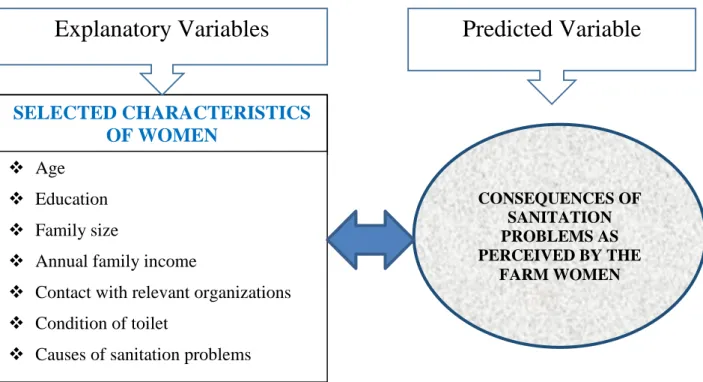
In scientific research, selection and measurement of variables constitute an important task. Consequences of sanitation problems as perceived by the farm women may be influenced and affected through interacting forces of many independent factors. It is not possible to deal with all the factors in a single study. Therefore, it was necessary to limit the factors, which included age, education, family size, annual family income, contact with relevant organizations and condition of toilet. Thus, consequences of sanitation problems as perceived by the farm women were the predicted variable of the study and 6 selected characteristics of the women were considered as the explanatory variables those might have relationship with their consequences of sanitation problems.
Considering the above-mentioned situation and discussion, a conceptual framework has been developed for this study, which is diagrammatically presented in the following Figure 2.1.
17
Figure 2.1 Conceptual framework of the study SELECTED CHARACTERISTICS
OF WOMEN
Age
Education
Family size
Annual family income
Contact with relevant organizations
Condition of toilet
Causes of sanitation problems
CONSEQUENCES OF SANITATION PROBLEMS AS PERCEIVED BY THE
FARM WOMEN
Explanatory Variables Predicted Variable
18 CHAPTER 3 METHODOLOGY
The methods and procedures used in conducting research need very careful consideration.
Methodology should be such that it enables the research to collect the valid information and to analyze the same property to arrive at correct decisions. The methods and procedures followed in conducting this study have been described in this Chapter.
3.1 Locale of the Study
The study was conducted at Sundarganj upazilla under Gaibandha district of Bangladesh.
Sundarganj upazila area 426.52 sq km, located in between 25°24' and 25°39' north latitudes and in between 89°24' and 89°43' east longitudes. It is bounded by Pirgacha ulipur and Chilmari upazilas on the north, Gaibandha and Sadullapur upazilas on the south, Chilmari and Char Rajibpur upazilas on the east, Pirgachha, Mithapukur and Sadullapur upazilas on the west. Fifteen unions of Sundarganj upazilla among of them two unions namely Dahabanda and Sarbananda were selected randomly for study. Four villages were selected from the selected two unions by taking two of each union. Four villages were finally select through random sampling technique from the selected unions. . A map of Gaibandha district showing Sundarganj upazila and a map of Sundarganj upazila showing the study area have been shown in Fig 3.1 and 3.2, respectively.
3.2 Population and Sampling
Two unions were randomly selected for this study. One thousand and fifty two family heads of the 4 villages was constituted as the population of this study. Ten percent of the population from each of the four villages were selected proportionately and randomly by using a Table of Random Numbers (Kerlinger, 1973). Thus, 105 women were selected to constitute the sample for this study.
19
Figure 3.1: Map of Gaibandha district showing Sundarganj upazila.
20
Figure 3.2: Map of Sundarganj upazila showing the study area.
21
Reserve lists of 10 women were also prepared so that the women of this list could be used if any respondent of the sample was not available during the interview. Distribution of the women constituting the population, sample and those included in the reserve list has been shown in Table 3.1 for clarity of understanding.
Table 3.1 Distribution of the women constituting the population, sample and reserve list in selected unions
Unions Villages Number of women
Reserve list Population Sample
Dahabanda Dokkhin Gopalcharon 242 24 2
Pochim Gopalcharon 277 28 3
Sarbananda Purba Bachahati 293 29 3
Pochim Bachahati 240 24 2
Total 1052 105 10
3.3 Variables of the Study and Their Measurement Variables of the study and their measurement are below:
3.3.1 Measurement of consequences of sanitation problems
Consequences of sanitation problems were the main focus variable of the study. It was measured on the basis of the consequences of sanitation problems scores. A scale was used for measuring consequences of sanitation problems. The scale contained 10 observed consequences, which the women might face in respect of sanitation. Each woman was asked to indicate the extent of difficulty faced by each of the consequences by checking any one of the four alternative responses as "high problem", "medium problem", "low problem" and "no problem". Weights were assigned to these responses as 3, 2, 1 and 0, respectively. Weights for responses against all the 10 consequences-items of women were added together to obtain her consequences of sanitation problems score.
Therefore, the consequences of sanitation problem score of the women could range from 0 to 30, where ‘0’ indicated no problem and ‘30’ indicated highest consequences of sanitation problems.
To compare the severity among the problems, Consequences of Sanitation Problem Faced Index (CSPFI) was computed for each item using the following formulae:
CSPFI = Phx3 +Pm x2 + Pl x1 + Pn x0
22 Where,
CSPFI = Consequences of Sanitation Problem Faced Index Ph = Number of women faced "high problem"
Pm = Number of women faced "medium problem"
Pl= Number of women faced "low problem"
Pn = Number of women faced "no problem"
Thus, the CSPFI of the problems could range from 0-315, where 0 indicated no problem and 315 indicated highest consequences of sanitation problems. Rank order also made with the descending order of the CSPI of the items.
3.3.2 Measurement of selected characteristics of the farm women
As mentioned earlier, nine selected characteristics of the women constituted the independent variables of this study. Procedures followed for measuring these variables are described below.
3.3.2.1 Age
Age of a woman was measured in complete years as reported by the respondent in response to question item no. 1 of the interview schedule (Appendix A). Example, a woman of 35 years old got score of 35.
3.3.2.2 Education
The education of a woman was measured on the basis of her years of schooling (completed in educational institute), which was determined by her response to item no.
2 of the interview schedule (Appendix A). A score of one was given for each year of schooling. For example, if a woman passed class V or equivalent, her education score was taken as 5. If a woman passed the final examination of class IX, her score was taken as 9. A score of 0.5 was given to that woman who could sign her name only. A score of zero (0) was assigned to the illiterate women.
3.3.2.3 Family size
The family size was measured by the total number of members in the family of a respondent including herself, husband, children and other dependents. The information
23
was obtained by a respondent's response to item no. 3 of the interview schedule (Appendix A). The total number of family members was considered as the family size of a respondent.
3.3.2.4 Annual family income
It referred to the total earnings in thousand taka by all the family members of a respondent from agriculture, others crop, poultry, livestock, fisheries, business, service, daily labour, others during a year as contained in question no. 4 of the interview schedule (Appendix A).
3.3.2.5 Contact with relevant organizations
Contact with relevant organizations was measured as one's extent of contact to different information sources. Each respondent was asked to indicate her nature of contact for each of 8 selected media with 05 alternative responses as regularly, often, occasionally, rarely and not at all contacts and scores were assigned for those alternative responses as 4, 3, 2, 1 and 0 respectively.
Logical frequencies were assigned for each of the alternative responses as mentioned in question no. 5 of interview schedule. Thus, extension media contact score of the farmers could range from 0 to 32, where 0 indicated no contact and 32 indicated highest contact.
3.3.2.6 Condition of toilet
Condition Shared by own family members
Shared by other family members
a. concreted 6 5
b. Semi-concreted 4 3
c. Normal shade 2 1
d. don’t have any 0 0
3.4 Identifying causes consequences of sanitation problems
To identify the causes of Sanitation Problems, 13 items were selected after thorough consultation of relevant experts. After pretesting with these 13 items, 11 were selected in the interview schedule for final data collection. Respondents were asked to mention the causes of Sanitation Problems and again they were asked to rank the causes they mentioned based on importance. A lowest score of 1 was assigned for lowest
24
importance cause. Similarly, scores of 2, 3, 4, …….. were assigned to 2nd, 3rd, 4th, ……..
lowest important causes, respectively. Accordingly, highest score was assigned to highest important cause. Then scores of all the 105 respondents were added together against each of the causes to get the index of the causes.
3.5 Data Gathering instrument
In order to collect relevant data from the respondents an interview schedule was prepared. The interview schedule was pre-tested before final data collection for necessary correction, modification and adjustment. The interview schedule contained both open and closed form of questions. Simple and direct questions, and some scales were included in the schedule to obtain information for both explanatory and focus variables. The questions were arranged systematically and presented clearly. The interview schedule in English rendering are attached in Appendix-A.
3.6 Collection of Data
The researcher herself collected data for this study personally through interviewing the women by using the interview schedule prepared earlier. Appropriate rapport was established with the respondents before collecting relevant information. However, if any respondent failed to understand any question, the researcher took necessary care to explain the matter. Data collection was started on 1 March, 2021 and completed on 30 April, 2021.
3.7 Data Processing and Analysis
The collected data were compiled, tabulated, and analyzed in accordance with the objectives of the study. The SPSS computer software was used to perform the date analysis. Descriptive statistics such as number, percent, mean, standard deviation, range and rank order were used to describe data. Pearson's Product Moment Correlation Co- efficient was used in order to explore the relationships between the concerned variables. Five percent (0.05) level of probability was used as the basis for rejection of any null hypothesis.
3.8 Hypothesis
'The following null hypothesis was formulated to explore the relationships of each of the selected characteristics of the women with their consequences of sanitation problems. "There is no significant relationship between each of the six selected characteristics of the women with their consequences of sanitation problem.
25 CHAPTER IV
RESULTS AND DISCUSSION
In this chapter the findings of this study have been discussed in relation to the present findings and also to those found in other studies. The study investigated the consequences of sanitation problems as perceived by the farm women. In accordance with the objectives of the study, presentation of the findings has been made in four sections. The first section deals with the extent of consequences of sanitation problems as perceived by the farm women, the second sections deals with selected characteristics of the farm women and the third section deals with relationship between selected characteristics of the women and their consequences of sanitation problems. Forth section deals with causes of sanitation problems.
4.1 Consequences of Sanitation Problems
Consequences of sanitation problems of the women were measured by four point scale against as described in methodology chapter through 10 items. The problems score ranged from 7 to 27 against the possible range of 0-30. The average was 20.02 and standard deviation was 5.79 respectively. On the basis of their problem, the women were classified into the following three categories: "low" (up to 10), "medium" (11-20) and "high" (above 20). Table 4.1 contains the distribution of the women according to their problem.
Table 4.1 Distribution of the respondent women according to their perceived consequences
Categories (Scores) Women
Mean SD Number Percent
Low (upto 10) 13 12.38
20.02 5.79
Medium (11-20) 28 26.67
High (>20) 64 60.95
Total 105 100
Information presented in Table 4.1 show that the majority (60.95%) of the women had high problem while 12.38 percent of the respondent women had low problem.
Comparatively few women (26.67%) had medium problem. The findings again revealed that an overwhelming proportion (87.62 %) of the women had medium to high consequences of sanitation problems.
26
4.1.1 Item wise Consequences of Sanitation Problems
Cconsequences of sanitation problems faced by the farm women were ranked according to the descending order of (CSPFI) as shown in Table 4.2. As per Consequences of Sanitation Problem Faced Index (CSPFI), transmission of harmful viruses and bacteria ranked 1st followed by environmental pollution, financial losses, acute diarrhea, long term dysentery, pollution of drinking water, pollution of open water sources, neo natal deaths and other disease infestation and feeling unwell in doing family work in last position.
Table 4.2 Rank order of the Consequences of Sanitation Problem Faced Index (CSPFI)
Nature of problems
Extent of Consequences due
to sanitation problem CSPFI
score Rank High Medium Low No
Transmission of harmful viruses
and bacteria 81 10 6 8 269 1st
Environmental pollution 75 12 10 8 259 2nd
Financial losses 62 26 13 4 251 3rd
Acute diarrhoea 58 21 16 10 232 4th
Chronic dysentery 51 24 20 10 221 5th
Pollution of drinking water 47 27 12 19 207 6th
Pollution of open water sources 41 24 18 22 189 7th
Neo natal deaths 39 21 15 30 174 8th
Other disease infestation 33 25 17 30 166 9th
Feeling unwell in doing family
work 29 10 27 39 134 10th
The results show that the highest consequence of sanitation problem was transmission of harmful viruses and bacteria. As per consequences of sanitation problem faced index (CSPFI), ‘Transmission of harmful viruses and bacteria’ ranked 1st followed by
‘environmental pollution,’ ‘financial losses,’ ‘acute diarrhoea,’ ‘chronic dysentery,’
‘pollution of drinking water,’ ‘pollution of open water sources,’ ‘neo natal deaths,’ and other disease infestation and feeling unwell in doing family work in last position. This was caused because the women were more involved in agricultural activity found in the study area. The lowest consequences of sanitation problem at the study area were feeling uncomfortable in doing family work. This happened because the women usually in rural area are busy with their duty, so they did not manage their time properly for sanitation in the study area.
27
4.2 Selected Characteristics of the respondent women
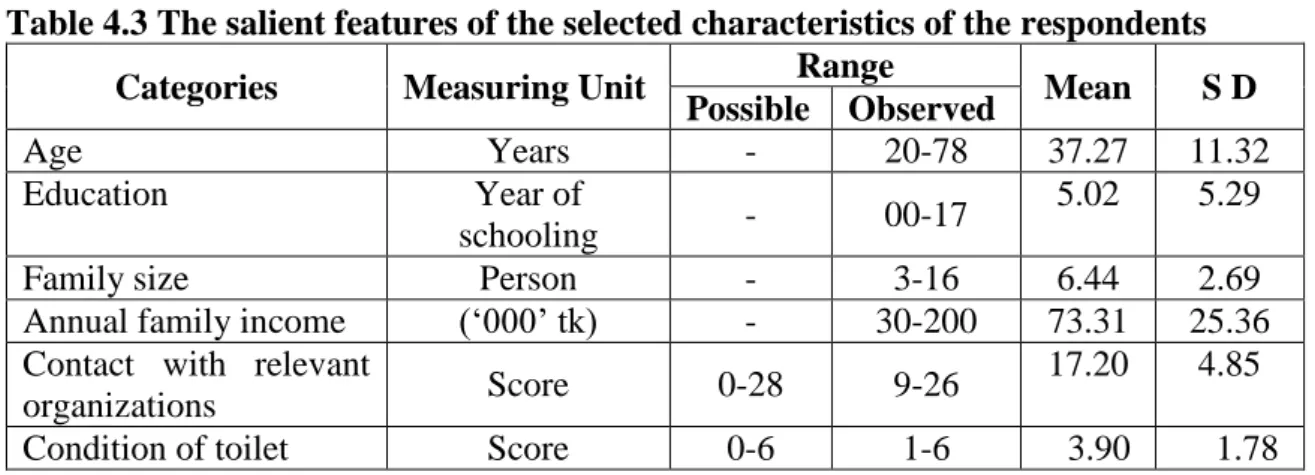
Six characteristics of the women were selected for this research. The characteristics include: age, education, family size, annual family income, contact with relevant organizations and condition of toilet. Some descriptive statistics of these features are given in Table 4.3 information contained in the Table 4.3 reveal the salient features of the characteristics of the women in order to have an overall picture of these characteristics at a glance. However, for ready reference, separate Tables are provided while presenting categorizations, discussing and /or interpreting results concerning each of the characteristics in this Chapter.
Table 4.3 The salient features of the selected characteristics of the respondents Categories Measuring Unit Range
Mean S D Possible Observed
Age Years - 20-78 37.27 11.32
Education Year of
schooling - 00-17 5.02 5.29
Family size Person - 3-16 6.44 2.69
Annual family income (‘000’ tk) - 30-200 73.31 25.36 Contact with relevant
organizations Score 0-28 9-26 17.20 4.85
Condition of toilet Score 0-6 1-6 3.90 1.78
4.2.1 Age
Age of the respondent women ranged from 20 to 78 years, the average being 37.27 years and the standard deviation, 11.32. All the variables were categorized on the basis of their possible scores except age was categorized based on the classification provided by the Ministry of Youth and Sports, Government of the People’s Republic of Bangladesh. The distribution of the women according to their age is shown in Table 4.4.
28
Table 4.4 Distribution of the respondent according to their age
Categories Women
Mean SD
Number Percent
Young aged ( up to 35 ) 59 56.19
37.27 11.32
Middle-aged( 36-50 ) 33 31.43
Old( >50) 13 12.38
Total 105 100.0
Table 4.4 showed that the highest proportion 56.19 percent of the respondent women were "young aged" category, while 31.43 percent of them were "middle aged" category and 12.38 percent of the women were "old aged" category. The findings indicate that a large proportion (87.62 %) of the farmers were young to middle aged.
4.2.2 Education
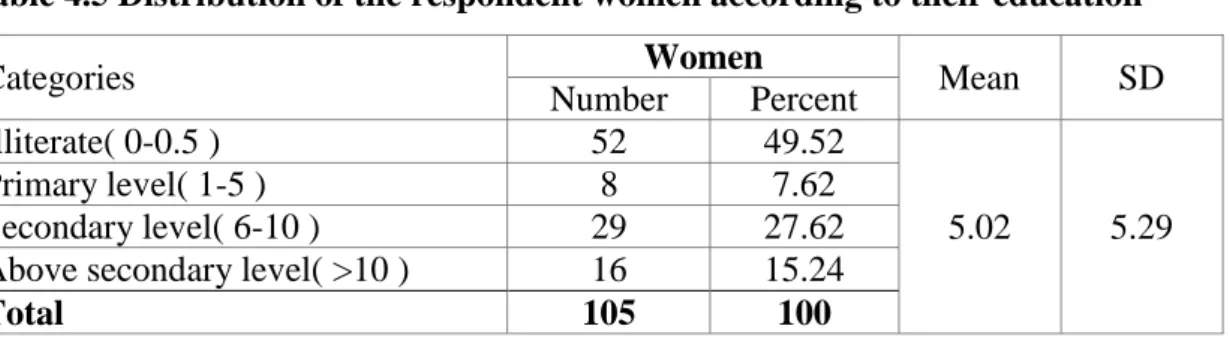
The education scores of the respondent women ranged from 0 to 17. The average was 5.02 and the standard deviation was 5.29. On the basis of their educational scores, the women were classified into four categories, namely "illiterate (0-0.5), primary (1-5), secondary (6-10) and above secondary (above 10). The distribution of the women according to their education is shown in Table 4.5.
Table 4.5 Distribution of the respondent women according to their education
Categories Women
Mean SD
Number Percent
Illiterate( 0-0.5 ) 52 49.52
5.02 5.29
Primary level( 1-5 ) 8 7.62
Secondary level( 6-10 ) 29 27.62
Above secondary level( >10 ) 16 15.24
Total 105 100
Result presented in table 4.5 indicated that the majority (49.52 %) of the respondent women were illiterate compared to 27.62 percent of them were secondary level of education. About 7.62 percent of the respondent women were primary level of education, while 15.24 percent were above secondary level of education. The findings thus, indicate that the current literacy rate in the study area is lower than that of the national average of 73.9 percent (BBS, 2021).
4.2.3 Family size