Creating a new Cryptographic algorithm using Collatz
Conjecture
by
Shoumya Shuprabho Rasheed 18201055
Rakibul Hasan Remon 18201139
Monwar Labib 21101095
A thesis submitted to the Department of Computer Science and Engineering in partial fulfilment of the requirements for the degree of
B.Sc. in Computer Science and Engineering
Department of Computer Science and Engineering Brac University
September 2022
©2022. Brac University All rights reserved.
Declaration
It is hereby declared that
1. The thesis submitted is our original work while completing a degree at Brac University.
2. The thesis does not contain material previously published or written by a third party, except where this is appropriately cited through full and accurate referencing.
3. The thesis does not contain material that has been accepted or submitted for any other degree or diploma at a university or other institution.
4. We have acknowledged all main sources of help.
Student’s Full Name & Signature:
Shoumya Shuprabho Rasheed 18201055
Rakibul Hasan Remon 18201139
Monwar Labib 21101095
Approval
The thesis titled “Creating a new Cryptographic Algorithm using Collatz Conjec- ture” submitted by
1. Shoumya Shuprabho Rasheed (18201055) 2. Rakibul Hasan Remon (18201139)
3. Monwar Labib (21101095)
Of Summer 2022 has been accepted as satisfactory in partial fulfilment of the require- ment for the degree of B.Sc. in Computer Science and Engineering on September 28, 2022.
Examining Committee:
Supervisor:
(Member)
Mobashir Monim Lecturer
Department of Computer Science and Engineering Brac University
Thesis Coordinator:
(Member)
Dr. Md. Golam Rabiul Alam Associate Professor
Department Brac University
Head of Department:
(Chair)
Dr. Sadia Hamid Kazi
Associate Professor and Chairperson Department of Computer Science and Engineering
Brac University
Abstract
Owing to the increasing need for the security of information and data access, due to the steep increase in the rate at which there are more methods of breaking the existing algorithms, which primarily rely on a prime number, this thesis looks at the possible use of the Collatz Conjecture to create a new cryptographic algorithm as an alternative to existing methods. This research document discusses network security and different encryption and decryption schemes. We have highlighted and analysed AES, RSA, and a few others and how each model implements different mathematical behaviour. In this age of fast communication, users are often more concerned about their information being transmitted as swiftly as possible without overthinking its security. Cryptography is a method that has been used for data security for many years now, and new improvised methods have been introduced to enhance the already existing norms. Our proposed model attempts to create safe and secure communication over a networked system. The main objective of this research is to find a novel data security method that would strengthen the already existing ones.
Keywords: Keywords: Cryptography; Encryption; Decryption; Collatz Conjec- ture; Symmetric; Asymmetric; Diffie-Hellman
Dedication
We dedicate our thesis to our friends, family, and, most importantly, our teachers.
Acknowledgement
First and foremost, all praise to the Almighty Allah for whom we have managed to complete our thesis smoothly. Secondly, to our Supervisor, Mobashir Monim, for his kind support and advice in our work. He helped us whenever we needed help.
Moreover, we sincerely express our gratitude to all our respective teachers, compan- ions, and staff for all the support throughout. Finally, we are forever indebted to our parents for their continuous support and prayers. It is only because of them we got this amazing opportunity to learn and complete our undergraduate degree.
With their kind support and prayer, we are now on the verge of our graduation.
Table of Contents
Declaration i
Approval ii
Abstract iii
Dedication iv
Acknowledgment v
Table of Contents vi
List of Figures viii
List of Tables ix
Nomenclature x
1 Introduction 1
1.1 Research Problem . . . 2
1.2 Research Objectives . . . 2
2 Historical Cryptography 3 2.1 World War I . . . 3
2.2 World War II . . . 4
3 Literature Review 5 3.1 Definition . . . 6
3.1.1 Cryptography . . . 6
3.1.2 Symmetric Cryptography . . . 6
3.1.3 Asymmetric Cryptography . . . 6
3.1.4 Hashing . . . 6
3.1.5 Encryption . . . 7
3.1.6 Decryption . . . 7
3.1.7 Collatz Conjecture . . . 7
3.1.8 DIFFIE HELLMAN . . . 7
3.1.9 Shift Cipher . . . 8
3.1.10 Byte Injection . . . 8
3.1.11 Byte X-OR . . . 8
3.1.12 Byte Substitution . . . 8
3.2 Related Work . . . 8
3.2.1 Diffie-Hellman . . . 8
3.2.2 Byte Substitution . . . 9
3.2.3 Byte X-OR . . . 10
3.2.4 Null Byte Injection . . . 11
3.2.5 Shift Cipher . . . 12
4 Work Plan 14 4.1 Concern with Existing Model . . . 14
4.2 Architecture of the Proposed Model . . . 14
4.3 Motivation for Design Choices . . . 17
4.4 Key Negotiation and Generation Technique . . . 19
4.4.1 Diffie-Hellman . . . 19
4.4.2 Step Count from Collatz Conjecture . . . 20
4.5 Methods used in the Algorithm . . . 21
4.5.1 Shift Cipher . . . 21
4.5.2 Byte X-OR . . . 21
4.5.3 Byte Injection . . . 22
4.5.4 Byte Substitution . . . 22
4.6 Complete Breakdown of Algorithm . . . 23
5 Results and Analysis 37 5.1 Implementation and Computational cost . . . 37
5.2 Randomness and confusion of Ciphertext . . . 40
5.3 Parametric Comparison and Secret Key . . . 41
6 Conclusion 42
Bibliography 44
List of Figures
2.1 Zimmerman Telegram . . . 3
2.2 The Enigma machine . . . 4
3.1 Types of Cryptography . . . 6
3.2 Basic Workflow of Encryption and Decryption . . . 7
3.3 Twofish Mechanisms . . . 11
4.1 Encryption and Decryption process . . . 16
4.2 Communication between Sender and Receiver . . . 17
4.3 The average percentage of each mathematical property for n number of random arrays . . . 18
4.4 Demonstration of Diffie-Hellman . . . 19
4.5 3n + 1 Conjecture . . . 20
4.6 Basics of Shift Cipher . . . 21
4.7 Basics of X-OR . . . 22
4.8 S-box used for byte substitution in AES[S-BOX] . . . 23
4.9 Tree demonstration of 3n+1 Conjecture . . . 25
5.1 Autotime for Encryption . . . 39
5.2 Autotime for Decryption . . . 39
List of Tables
4.1 Parameters set for the Proposed Model . . . 15
4.2 Design Choice Indicator . . . 18
4.3 Values used in Sample Problem . . . 26
5.1 Execution and Autotime for different Message and key Size . . . 38
5.2 Comparison between RSA, AES and Proposed Model . . . 41
Nomenclature
The next list describes several symbols & abbreviation that will be later used within the body of the document
3DES Triple Data Encryption Algorithm AES Advanced Encryption Standard
ASCII American Standard Code for Information Interchange D−H Diffie-Hellman
DES Data Encryption Standard ECC Elliptical curve Cryptography
GCHQ Government Communication Headquarters IDEA International Data Encryption Algorithm M DS Maximum Distance Separable
P DF Portable Document Format P HP Hypertext Preprocessor P HT Pseudo Hadamard Transform
P W LCM Piece Wise Linear Chaotic Map RAM Random-Access Memory
ROM Read-only Memory RSA Rivest-Shamir-Adleman S−BOX Substitution Box T M Trade Mark
U RL Uniform Resource Locator
U T F −8 Unicode Transformation Format 8 W W II World War II
X−OR eXclusive OR
Chapter 1 Introduction
Technology has advanced over the years at the speed of light. We have achieved so much in the past few decades that nothing seems impossible now. With the ever-growing world of information and data, it has become one of the most crucial and, at the same time, gruelling tasks to make sure that data is secured and not going into the hands of a transgressor. Modern technology involves a great deal of data that requires confidentiality. Cryptography is a method by which that is achieved. [18] In the beginning, the Roman cryptography method was known as the Caesar Shift Cipher. A particular number was fixed (three being a common choice), and that number shifted the letters of a message. Then, the letters of the recipient of this message were moved back by the same number, and the original message was obtained. Since that time, it has been upgraded quite a few times. It involves techniques that ensure data security for reliable and safe communication.
When describing cryptography, two kinds of texts are in use; plaintext and cipher- text. Plaintexts are transparent data understandable to everyone who has access to it. Ciphertexts are plaintexts that have been encrypted using cryptography.
Cryptography is mainly divided into two major classes; transposition and substitu- tion. Furthermore, two basic [1] and almost quite outdated methods are commonly used for cryptography; monographically, involving one character at a time, and poly-graphically involving more than one character.
The rearrangement of characters to encrypt information is the primary role of cryp- tography through transposition. The characters in the plaintext each have a different frequency of occurrence distributed over a wide range, but a cryptanalyst can easily deal with this. A cryptanalyst performs analysis on a ciphertext to transform it back to plaintext.
The primary motivation behind this research is to create a new system for informa- tion and data security that would increase the strength of the reliability of commu- nication over the network. And to bridge the gap between security issues and safe communication, cryptography will play a major role.
1.1 Research Problem
As the internet expands, it is more susceptible to the breach of sensitive data, and now more than ever, cyber security requires a robust system to ensure information security. As the world advances with technology every day, all kinds of information are transmitted over the internet. Networked computers, smartphones, and all other personal computers have made information and data less physical [6] and thus more open to the possibility of getting into the hands of transgressors.
Over the past few decades, the increased number of networked computers and sys- tems resulted in a surge in cybercrime. Therefore, more opportunities are created for unauthorised activities due to billions of internet users and countless information held by governments and businesses. The lack of knowledge of internet users and their vulnerability contributes to this global issue.[6]
Even after meteoric advancements in information, communication, and the implica- tion of data science in various fields of technology, numerous threats to information encryption are still a matter of concern. As of 2021, according to [20], the Covid-19 pandemic has influenced the practice of remote work, which has significantly raised the rate of cyber threats and has opened up new trends in cyber security. This indicates that we are still lagging in information security and have not yet achieved a solid solution.
Therefore, cryptography and its advancements are essential to combat different forms of cyber threats, especially those involving data theft, data breach, and other unavoidable vulnerabilities affecting data transfer.
1.2 Research Objectives
As mentioned earlier, the main goal of this research is to create an algorithm for cryptography that enhances the efforts to stop all forms of threats to the information system. To achieve that, we will try to incorporate a relatively new technique using an unconventional mathematical sequence to build the model. The use of this quite mysterious yet extremely intriguing mathematical sequence, the Collatz Conjecture, will be the most challenging part.
Chapter 2
Historical Cryptography
2.1 World War I
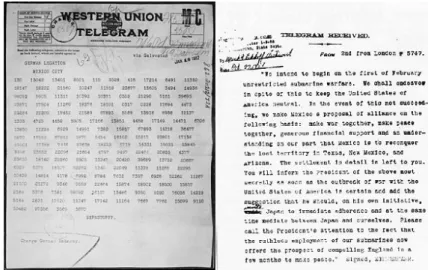
In early 1917, British cryptographers discovered a German-encoded telegraph during the early stages of World War I. This communication was known as the Zimmerman Telegram. These cryptographers deciphered the message successfully, altering the direction of cryptanalysis. Using this decoded correspondence, they urged the US to join the war [14].
The Zimmerman Telegram was a top-secret message sent between German Foreign Secretary Arthur Zimmerman and German Ambassador Heinrich von Eckardt in Mexico. According to the letter, if Mexico joined the German side, it might reclaim its territories of New Mexico, Texas, and Arizona. Despite this offer, Mexico decided that reclaiming its former territories was neither practicable nor desirable.
The telegraph was delivered at the height of World War I [14]. Until then, the United States has attempted to preserve its neutrality. The British and other allies had appealed to the US for help, and public opinion in the US was progressively shifting toward war. The British conveyed the decoded telegram to the United States on February 24, 1917, and On April 6, 1917, the US declared war against Germany and its allies. [5]
Figure 2.1: Zimmerman Telegram
2.2 World War II
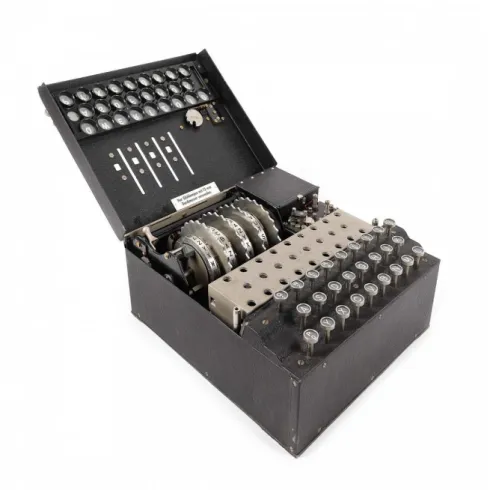
German field agents used the Enigma machine to encode and decode letters and communications throughout World War II. The Enigma machine, like the Feistel function of the 1970s, was one of the first automated ways of encrypting data using an iterative cipher. It utilised a series of rotors to allow the user to encode or decode a message with the use of power, a fluorescent bulb, and a reflection. The starting position of the rotors was determined with each encrypted data and was based on a predetermined sequence that was based on the calendar, enabling the system to be used even if this was compromised.
When the Enigma was in use, each keypress caused the rotors to move in alignment from their predefined positions, resulting in the formation of a new letter. With a text in hand, the user would input each letter into the machine using a typewriter- like key. The rotors would align, and a character would illuminate, exposing to the operator the letter’s real identity. When the operator hits the key, the illuminated letter transforms into encrypted text. Although the rotors’ continually [22] changing the internal amount of energy was not random, it did produce a simple substitution cipher that may be unique. [19]
Figure 2.2: The Enigma machine
Chapter 3
Literature Review
To understand cryptography and its applications, we must understand how it has been used over the years. It is not a modern concept; rather, it has been in prac- tice for a long time to secure communication. Before the introduction of modern encryption and decryption devices, cryptography was used to cover sensitive infor- mation using basic written texts by soldiers in wars, military leaders, [15] spies, etc.
With the introduction of modern technology, it is now used not just for information confidentiality but also for message integrity checking, identification authentication, interactive proofs, etc.
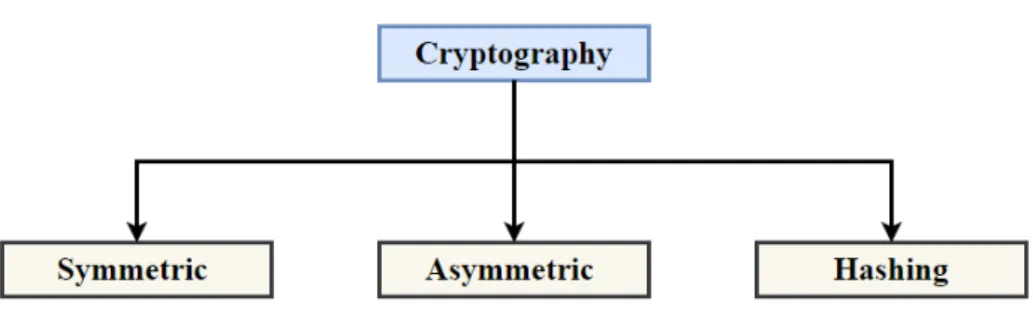
In today’s world, every commercial application needs a higher level of security and confidentiality of information. As a result, to increase the quality of confidential- ity of information, numerous steps have been taken to improve the cryptographic algorithm. Cryptographic algorithms must be designed with an even distribution of computational power and security. As mentioned earlier, algorithms nowadays use either symmetric or asymmetric caters according to their needs. Symmetric and asymmetric algorithms are used for the conversion of plaintext to ciphertext.
A ciphertext is a parametrized family which consists of encryption functions. The reason for this construct to ciphertext is that hackers cannot invert the encryption function except for people who know the key, as a result, they can see that there is a message but cannot read it as they do not have the key and therefore do not know which function from the family to invert from.[15]
As we have seen before, cryptography’s importance and application are very well- acknowledged. However, extensive research on different cryptographic algorithms and its model has not been done for a very long time [15]. With the ongoing devel- opment of modern technology, the demand for different encryption techniques has been on the rise. As we learn and research more about the history of different cryp- tography, we must be proactive and keep in mind the possible future developments.
As mentioned, we will focus on our cryptographic model incorporating Collatz con- jecture or the 3n+1 mathematical sequence. To do so, it is important to have deep knowledge of the existing mathematical model for symmetric and asymmetric cryptographic algorithms.
3.1 Definition
3.1.1 Cryptography
Cryptography studies secure communication between a sender and receiver. Its main goal is to convert messages and data over a communication channel so that only the sender and its dedicated recipient can interpret the message. Cryptography includes encryption, hashing, etc. Various cryptographic methods have been developed over the years using complex mathematical logic to create encryption and decryption algorithms. These algorithms are used to increase the integrity of communication.
3.1.2 Symmetric Cryptography
For encryption and decryption, the same key is used in this method of cryptogra- phy. The sender and receiver must have a shared key when converting plaintext to ciphertext and vice versa.
3.1.3 Asymmetric Cryptography
To tackle the major challenges of key creation and distribution, asymmetric cryp- tography was developed. Each sender and recipient have their own key in this sort of encryption. An asymmetric cryptosystem contains a public and private key for each user. At all times, the secret key must be kept private. However, the public key can be distributed. Encrypted data may only be decrypted using its complementary private key.
3.1.4 Hashing
The job of hashing is to calculate a fixed-size bit string value from a file that contains a block of data. Hashing converts this data into a shorter fixed length that contains the original string. The hash value contains the summary of the entire file. Hashing helps to gain faster access to elements in the string.
Figure 3.1: Types of Cryptography
3.1.5 Encryption
To simply define encryption, it is the conversion of information and data into un- intelligible codes that would prevent unauthorised access to it. It is a process to ensure the digital protection of data using mathematical or other logical methods.
Encryption enhances the integrity and maintains privacy in a communication net- work.
3.1.6 Decryption
The process of returning data to its original state after it has been encrypted is known as decryption. During decryption, the system brings out and transforms the jumbled data into letters and visuals that not only the reader but also the system can comprehend. Decryption can be done manually or automatically. However, a combination of keys or passwords can also be used.
Figure 3.2: Basic Workflow of Encryption and Decryption
3.1.7 Collatz Conjecture
Collatz conjuncture is a unique and simple approach initially devised by German mathematician Lothar Collatz in 1937 [2]. Although it is impossible to explain this theorem mathematically, it is theoretically proven. If any number is even, n/2 would be used. In the case of odd numbers, it will be 3n+1. Using this approach, the result will always be a positive integer of 1. Until the sequence reaches an infinite loop of 4, 2, and 1.
3.1.8 DIFFIE HELLMAN
The Malcolm Williamson of GCHQ originally created the Diffie-Hellman key ex- change method. It was later improved, and only a shared secret could be created using this technique. Its security is given by the discrete log problem’s computa- tional complexity. The common symmetric key would be (gb)a = gba = gab mod p.
3.1.9 Shift Cipher
Caesar Cipher is known as one of the most basic and earliest encryption systems.
Another name is substitution Cipher. In this method, one letter is substituted by another letter, moving the alphabet down in certain places, and every letter shifts one bit right or left.
3.1.10 Byte Injection
The concept of byte injection is similar to that of a null byte injection, where null characters are injected into a URL that alters the information.
3.1.11 Byte X-OR
Byte X-OR or an eXclusive OR operation is all about a key size ranging from 1-256 values of a byte. For each corresponding bit, the byte X-OR takes patterns of 2-bit of equal lengths and performs eXclusive OR operations.
3.1.12 Byte Substitution
Byte substitution is a type of substitution cipher. Generally, a single letter or pair of letters from the regular text are substituted with other symbols or groups of symbols in a substitution cipher, a data encryption system.
3.2 Related Work
Here, we have reviewed some popular existing models of cryptography which are already in use or have been used in the past. We have tried to figure out the mechanism for each cryptographic system to determine how we can proceed with our model. We have highlighted some key operations used for cryptography and a few of the algorithms that have already incorporated them.
3.2.1 Diffie-Hellman
The Diffie-Hellman algorithm is named after White Diffie and Martin Hellman. The main function of this algorithm is to use a secure channel for the transfer of a public or a private key. The Diffie-Hellman algorithm works in the following way:(1)The receiver has the ownership of both the private and public keys generated by the Diffie-Hellman algorithm. (2)Sender acquires the public key that the receiver gen- erates, which is then used in the Diffie-Hellman algorithm to establish a new set of public keys that will be used temporarily. The sender then takes the recently gen- erated public keys which were created by the receiver to create an unplanned secret
number known as the “session key”, which will be used to encrypt the forwarding data, including the temporary public key. Subsequently, the receiver can derive the session key mathematically; as a result, the rest of the ciphertext message can be decrypted easily. [7]
3.2.2 Byte Substitution
Polyalphabetic Substitution Cipher
This article [9] shows us how polyalphabetic cipher maintains data integrity using multiple subkeys for every plaintext letter. Cipher substitution has its fair share of use in many algorithms. Polyalphabetic cipher uses alphabetic substitution. In a polyalphabetic substitution cipher, the plaintext is enciphered upon its arrival in the text. Here each letter carries a one-to-many connection with its alternatives. The term “Polyalphabetic” refers to using multiple keys instead of a single one. Here each key is a stream of subkeys that solely depends on the position of the plaintext character.
For example: ‘b’ can be enciphered as ‘e’ at the start of the text and as ‘n’ in the middle. As a result, polyalphabetic cipher hides the initial letter frequency, making it difficult for attackers since they cannot use individual letter frequency static to divide the ciphertext.
Polygraphic Substitution Cipher
In [2] it demonstrates how a polygraphic substitution cipher is built up and works to perform tasks that are superior to Polyalphabetic Substitution Cipher. Technically we can say, Polygraphic substitution Cipher is an upgrade to Polyalphabetic Sub- stitution Cipher, with the substitution that involves replacing a group of Plaintext messages with another different group of characters from the ciphertext. In Poly- graphic Substitution Cipher, the plaintext letter is divided into groups of adjacent letters while maintaining the same length, then transformed with different letters while retaining the same size in cipher text.
AES
With the extensive use of computers and the growing need for computer technology, particularly in military and government [11] functions, computer security is becom- ing more important. The issue to be solved is how to ensure the confidentiality, integrity, and usefulness of a messaging system’s hardware and software and the message being processed, stored, and delivered. The AES algorithm works with 128-bit input and produces 128-bit output. The key used to encrypt the input data might be 128, 192, or 256 bits long. Encryption and decryption often employ the 128-bit key. It makes use of the same key for encryption and decryption. AES uses multiple rounds of different key sizes e.g.; 10 rounds for 128-bit keys. For any key size, the first round is common in which the plain text is X-ORed with the key to produce 128, 192, or 256 states. The operations shiftRows, subBytes, mixColumns, and addRoundKey are performed on the states by each middle round. There is no [12] mixColumns step in the last round, comparable to the middle of the step. The opposite of encryption is decryption. The Inverse mixColumn Steps are not included
in the final decryption rounds.
3.2.3 Byte X-OR
Blowfish
This article [21] describes the history and working mechanism of Blowfish. Blow- fish is a symmetric algorithm, 64-bit block cipher with a changeable length. It was created in 1993 by Bruce Schneier as a ”general-purpose algorithm.” It was devel- oped to be fast, untied, and a possible replacement for DES and IDEA algorithms.
Blowfish consists of a block size of 64 and a key size length that ranges from 32 to 448 bits. Blowfish also has 16 Feistel iterations, where each iteration acts on 64-bit blocks divided into two 32-bit words. One encryption key is used for the encryption and decryption process.
Blowfish is divided into two parts:
1. Data encryption: It is a 16-round Feistel network that consists of a key-dependent permutation and a key-dependent data substitution. S-boxes are used during the substitution method, which plays a vital part in the encryption process. The en- cryption process mainly works in X-OR logic gates.
2. Key expansion and subkeys: In this process, the bit keys are divided into several subkeys in this process. These subkeys play an essential factor in the algorithm.
Eighteen 32 bits are in the P array with four 32 bits S-boxes that consist of 256 entries. The subkey calculation is as follows:
• The S and P boxes are adjusted to hexadecimal digits of pi.
• The first elements in the P array, P1, are X-ORed with the initial 32 bits. The same goes for P2, which is X-ORed with the next 32 bits. The process goes on till every P-array is X-ORed.
• The zero strings in the algorithm are encrypted.
• The subsequent arrays are replaced with the output.
• The output gets encrypted using blowfish by using modified subkeys.
• After the previous process is completed, the P3 and P4 are modified.
• It goes until all P arrays and S-boxes are reformed.
Twofish
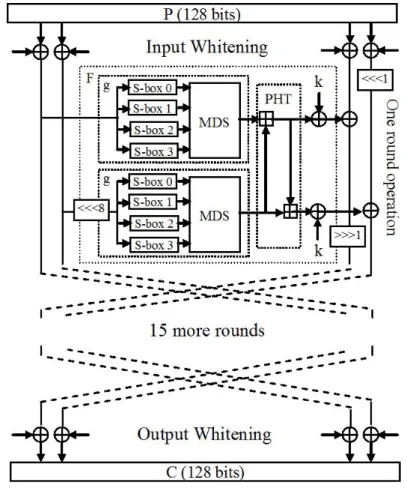
This article [3] explains how Twofish was designed to overcome blowfish. Since blowfish had some limitations. Twofish is the successor of blowfish and uses a single key for both encryption and decryption purposes; it can have a block size of 128, 192, and 256 bits. Twofish can be used in network applications where keys change frequently and in systems where minimum or even no RAM or ROM is needed.
Figure 3.3: Twofish Mechanisms
Through this figure, we can see that Twofish is a Feistel network. This means that half of the function is passed through an F function, and the later half is X-ORed with the result that comes out from the F function.
During each round, two 32-bit words are passed into the F function. Four bytes are formed from each word, which is forwarded to four different key-dependent S-boxes.
The result of the 4 output bytes is then combined with the help of the MDS matrix and formed into a 32-bit word. After that, the two 32-bit words were combined with the help of PHT, and then they were passed on to be added to two round subkeys and, later on, X-ORed with the right half of the text. 1-bit rotations occur before and after the X-OR operation happens. To prevent an attack, an additional round is added by pre-whitening and post-whitening to ensure security; they act as additional subkeys, which are then X-ORed before and after the last round in the text block.
3.2.4 Null Byte Injection
[4] shows how null byte injection is used to benefit the third party to get valuable information from a user. Null byte Injection is used to take advantage of avoiding sanity checks on the web framework by adding null byte characters, which are URL encoded and opened by the user. Later on, after the injection process becomes successful enough, it can then go on to help attackers to gain unauthorised access to system files. For example:
• An attacker wants to upload a PHP file like “ABC.php” with “ABC” being the malicious file, but the extension allowed by the system is only a .pdf file.
• So the attacker can reconstruct the file name as “ABC.php%00.pdf ” and then uploads the file.
• The application reads the file, sees that it is a .pdf file extension, authenticates it, and throws the end of the string since it contains the null byte. This way, the “ABC.php” gains access to the system file and lets the attackers access a user’s system files.
3.2.5 Shift Cipher
This article [17] displays that back in the ancient days how the shift cipher played an important role during critical times. Military establishments have had a huge effect on encryption. The constant need for private and secure connections began in the information age, around the 80s. Since the internet was introduced in the 1960s, it wasn’t popular till 1989. The need for increased security of Information has become a must. Encryption helps to hide data by altering it into unreadable code.
Leon Battista Alberti came up with an encryption method that involves a cipher disk, which involves sliding mechanical disks that change with several substitution ciphers by encryption. Around the 1500s, Blaise De Vigenere implemented Alberti’s polyalphabetic cipher style, which then came to be known as Vigenere Cipher. The process is almost the same as the Caesar cipher, with a slight tweak that involves the key changing during the encryption process. The Vigenere Cipher employs a letter grid and the replacement technique. Vigenere Square or Vigenere Table is the grid utilised, which consists of 26 alphabets offset. The process starts off with a specific hidden word that will be used as an encryption key. The plaintext’s first alphabet will be aligned on the x-axis, while the concealed word’s first letter will be aligned on the y-axis. The plaintext character is then exchanged for the consonant letter. This process goes on until all the keywords are used. Example:
The plaintext to be encrypted is “Attack”. Here the hidden word chosen by the person encrypting is “Lemon”.
Since the character size doesn’t match the encrypted plaintext, the keyword will get repeated until it matches the plaintext length. The substitution starts with the letter L, the row, and the letter A in the column; the joint letter is then found, L.
This process goes on until the whole plaintext is substituted. The end product is Plaintext: ATTACK.
Keyword: LEMONL.
Ciphertext: LXFOPV.
The decryption process uses a similar method, with the person having to discover the column that correlates with the ciphertext character in the keyword’s row.
From the above discussion, it can be observed that the established models fulfilled their purposes. Although the established models had some limitations, there exists room for improvement. So in our proposed model, we have taken in the factors of limitations and tried to implement the methods uniquely. For ex: In a polyalpha- betic substitution cipher, multiple keys are generated for a single plaintext character.
In the polygraphic substitution cipher, the same situation occurs instead of a single plaintext character group of plaintext characters being taken, and each group must contain the same length. In our proposed model, we plan to execute byte substitu- tion to create more chaos in the algorithm. We have tried implementing the same general concept for byte X-OR by incorporating different mathematical properties.
Moving on to Null byte injection, we can see that it is used to breach safety protocols to cause harm to a person’s system software. In our model, we made an effort to use Byte injection, keeping the same concept of Null byte injection with a possibility of an additional mathematical equation to create uniqueness. Shift cipher had a brief history from the early days, so in our proposed model, we intend to use a few tweaks to set it apart from the existing models and make it more complex than it already is.
Chapter 4 Work Plan
4.1 Concern with Existing Model
AES came into the limelight when DES and 3DES could not fulfil their purposes.
The issue regarding DES was that it ran very slow, specifically [13] related to appli- cations, and the 56-bit key size was the biggest downside. One of the main concerns with 3DES is that it cannot withstand massive cyber attacks [4]. Though AES re- placed DES and AES, it also had its fair share of issues with AES being too simple, and the same encryption happens with every box. ECC has a few issues; first of all, it is the size of the encrypted message compared to RSA.[10] Another issue with the RSA algorithm is that the algorithm is quite complex to implement, leading to errors. Diffie hellman is vulnerable to attacks where a user’s identity is not estab- lished; as a result, a hacker can alter the message’s meaning. During key scheduling, Blowfish consumes a huge amount of time. So to sum it all up, keeping all those issues in mind, we will try to enhance the security system in our algorithm so that it can withstand the issues the previous algorithms had to deal with.
4.2 Architecture of the Proposed Model
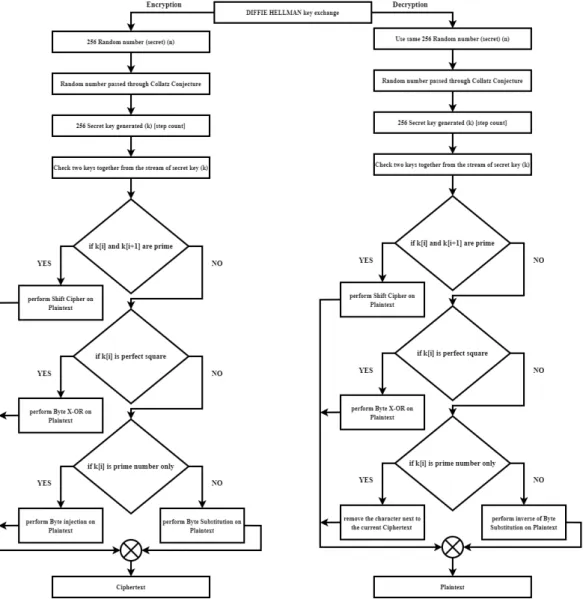
In this section of the paper, we will be demonstrating the tentative structure of our proposed model. We will be looking into implementing the Collatz conjecture in our algorithm. As we know, cryptography can be of two types; symmetric and asymmet- ric. Our focus is tilted towards creating a symmetric cryptographic model; however, an alternative asymmetric model can also be implemented. Like any other cryp- tographic model, our proposed one will also feature an encryption and decryption mechanism.
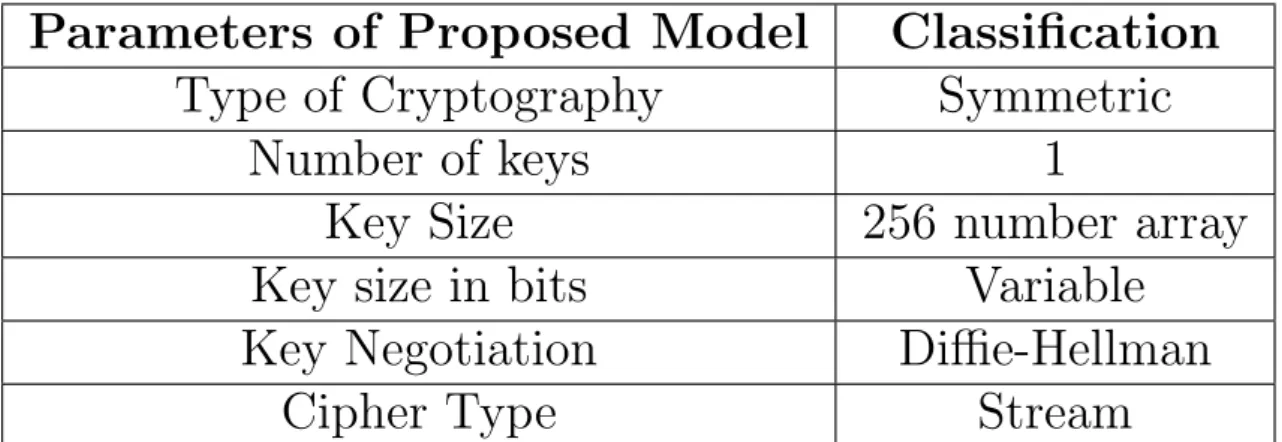
Before going into the main demonstration, we will look into the framework we have set for our model. As we can see in table 4.1, we have designed our cryptographic algorithm following the basic concept of symmetric encryption. We have imple- mented a stream cipher scheme using an array of 256 numbers which will be acting as the encryption or decryption key. For our proposed system, we have decided to implement the Diffie-Hellman key exchange protocol followed by the application of
the Collatz Conjecture. A detailed description of the architect is in the following sections of this paper.
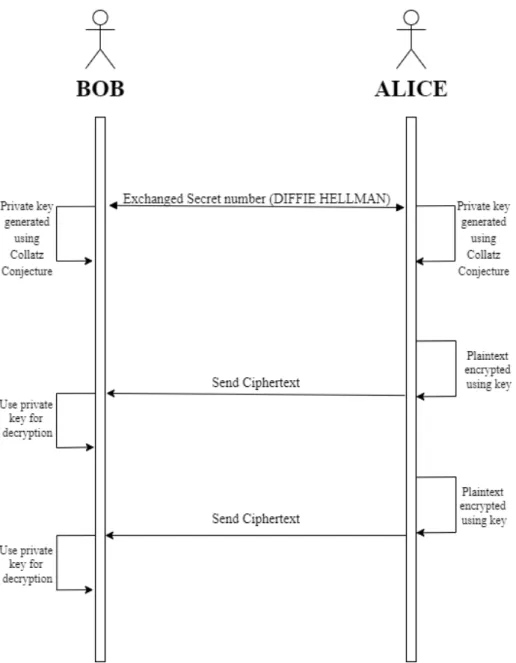
Note: We have used the example of Alice and Bob to demonstrate communication between them wherever applicable.
Parameters of Proposed Model Classification Type of Cryptography Symmetric
Number of keys 1
Key Size 256 number array Key size in bits Variable
Key Negotiation Diffie-Hellman
Cipher Type Stream
Table 4.1: Parameters set for the Proposed Model
Pseudocode of Algorithm:
Message = Plaintext
Secret Random Number (n) →Diffie Hellman key Exchange Secret key (k) →step count from Collatz Conjecture
Define perfectSquareCheck (k):
Check for Perfect Square Number Define isPrimeCheck (k):
Check for Prime Number Define conPrimeCheck (k):
Check for Consecutive Prime Number Define encryption (Message, k)
Ciphertext = “ ” for i in k
if conPrimeCheck(i) == true:
do Shift Cipher on Message elif perfectSquareCheck(i) == true:
do Byte X-OR on Message elif isPrimeCheck(i) == true:
do ByteInjectiononM essage else:
do Byte-Substitution on Message return Ciphertext
Define decryption (Message, k) Plaintext = “ ”
for i in k
if conPrimeCheck(i) == true:
do Shift Cipher on Ciphertext elif perfectSquareCheck(i)== true:
do Byte X-OR on Ciphertext elif isPrimeCheck(i) == true:
remove character next to current Ciphertext else:
do inverse Byte Substitution on Ciphertext return Plaintext
Figure 4.1: Encryption and Decryption process
Figure 4.2: Communication between Sender and Receiver
4.3 Motivation for Design Choices
As we have shown in the previous section, how we have mapped out our model, in this following section, we will be discussing how we reached our design implication.
Cryptography and concepts of mathematics go hand in hand. Our model uses different operations on plaintext to generate a ciphertext. While creating a blueprint of the model, the main objective was to create randomness in the encryption system, which would eventually lead to a chaotic system generating a ciphertext that would indicate no pattern and would be difficult to decrypt.
To achieve this, we have designed a simple python program that would take an array of random numbers and give us the count for different mathematical properties,
which include; prime numbers, perfect squares, consecutive prime numbers, i.e. a prime number followed by another prime number, and numbers which are neither of these, we are referring to as numeral digits.
Figure 4.3: The average percentage of each mathematical property for n number of random arrays
As we can see in the figure, the percentage of each mathematical property indicates how often they appear in a random set of numbers. For our model, the key that we will generate will be negotiated through the D-H protocol but will follow a random pattern consisting of numbers with different mathematical entities. To make it into a system that creates complexity, we have mapped our model in such a way that the number which possesses the property with the highest percentage will be used to encrypt/decrypt the plaintext implementing the most robust function and the simplest form of encryption is assigned to the least occurring mathematical attribute.
Encryption and Decryption techniques in increasing
order of complexity
Assigned Mathematical properties (rate of occurrence )
Shift Cipher Consecutive Prime (2.6%)
Byte X-OR Perfect square (3.0%)
Byte Injection Prime Number (15.7%) Byte Substitution Numeral Digits (78.7%)
Table 4.2: Design Choice Indicator
4.4 Key Negotiation and Generation Technique
4.4.1 Diffie-Hellman
Malcolm Williamson of GCHQ created the Diffie-Hellman key exchange method, which was then independently improved upon by Whitfield Diffie and Martin Hell- man. Only a shared secret can be created using the Diffie-Hellman key exchange technique. In most cases, the generated shared secret consists of a common sym- metric key. Users can create a shared symmetric key using it. The discrete log problem’s computational complexity is what gives Diffie-Hellman its security.
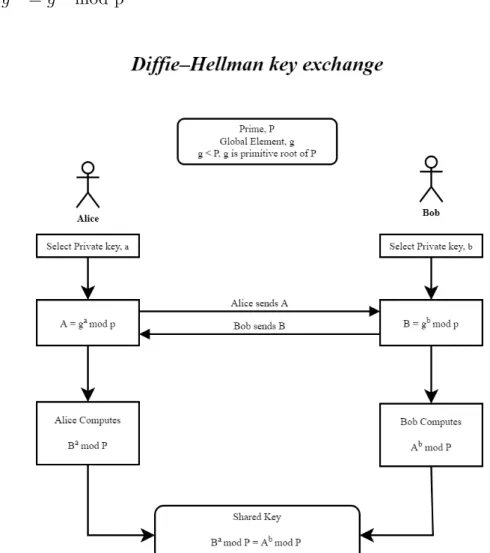
Let p be a prime number and g be a generator, where this p and g are public.
Alice selects a secret value, a Bob selects a secret value, b Alice sendsga mod p to Bob Bob sendsgb mod p to Alice
Both compute shared secretgab mod p (gb)a =gba =gab mod p
Figure 4.4: Demonstration of Diffie-Hellman
4.4.2 Step Count from Collatz Conjecture
A mystery in the world of mathematics, such that it is called a conjecture and not even a theorem. This is because the simple yet impossible to explain mathematical problem, also referred to as the 3n+1 sequence, is yet to be formally proven. In his abstract [8], Craig Alan Feinstein states that Collatz 3n+1 conjecture must have an infinite number of lines and, therefore, cannot be formally proven. To define the conjecture, we need to understand where the complication arises. If any positive integer is chosen and it is an even number, we divide it by 2; and if it’s an odd number, we multiply it by 3 and add 1. This sequence was initially devised in 1937 by German mathematician Lothar Collatz [2]. Following this pattern, the result of any positive integer would be 1. This theorem is repeated until the sequence reaches an infinite loop of 4,2, and 1.
The conjecture is so mesmerising that mathematicians have toyed with it for several years. Some mathematicians have sought to deconstruct or rebuild the Collatz conjecture into even more manageable parts. Due to its unique and simple approach, there have been many applications concerning the conjecture.
Despite the straightforward and feeble outlook of sequence, it has intrigued numerous mathematicians to dig deep into the problem, and in most cases, it has left them with very few positive outcomes. Famous mathematician Paul Erdos rightly stated,
”Mathematics is not ready for such problems”.
Figure 4.5: 3n + 1 Conjecture
4.5 Methods used in the Algorithm
4.5.1 Shift Cipher
The Caesar Cipher method is rated as the most basic and earliest among the encryp- tion systems. This technique is a substitution Cipher, where one letter is substituted by another letter that moves the alphabet down in specific places of the given text.
This shifting can be shown such that A can be replaced by B, and B can be replaced by C. Every letter is shifting one bit right. The same procedure is for the left shift for Caesar Cipher.
Shift n in encryption phase:
E (x) = (x+n)
Shift n in decryption phase:
D (x) = (x-n)
Figure 4.6: Basics of Shift Cipher
4.5.2 Byte X-OR
Byte X-OR, also known as an exclusive OR operation, deals with a key size that ranges from 1-256 values of a byte. Byte X-OR takes 2-bit patterns that have to be of equal length and performs exclusive OR operations for each corresponding bit.
The output will only be 1 if only 1 of the bits is 1, and the output will be 0 if both of the corresponding values are 0 or 1.
Figure 4.7: Basics of X-OR
4.5.3 Byte Injection
Byte injection is a process that is usually used to alter the nature of a message.
It involves the insertion (injection) of a random character (byte) into the string of information which alters the meaning or value of the original message.
For example, the string ”Hello World!” may become ”Hell5o Wocrld!G” after three- byte injections.
4.5.4 Byte Substitution
In the AES algorithm, a 16*16 matrix is used, which consists of byte values that are known to be an S-box that contains a permutation of all 256 8-bits. The non-linearity of an S-box is highly dependent on the dispersal of input data using an S-box. For the
generation of the S-box, it needs to go through 2 processes. In the first step, a piece- wise linear chaotic map (PWLCM) is used to generate initial S box positions during the post-processing technique; the dispersing property measures the maximum non- linearity that follows a sequence. The second step follows reverse engineering, and the dispersion property is used within the design loop or systematic dispersal of the input substituting sequence. As a result, the controlled randomisation changes the probability distribution of S-box differentials. This leads to substituting S-box positions for output differences reverting to a known input difference.[16]
Figure 4.8: S-box used for byte substitution in AES[S-BOX]
4.6 Complete Breakdown of Algorithm
Now that we have established the basics of the model, we will be looking into a further detailed demonstration of the encryption and decryption mechanism with simple plain text. For any cryptographic procedure, key creation and negotiation are very crucial steps. We are channelling our focus mostly on the encryption and decryption process and using the Diffie-Hellman key exchange scheme for our secret key encryption.
Theoretical Example
Secret Number Negotiation using Diffie-Hellman
Choosing a random large prime number, p = 79 Generator, g = 3
Alice:
Private key is 8
Public key = g(Alice′s private key) mod p
= 38 mod 79
= 4 Bob:
Private key is 14
Public key = g(Bob′s private key) mod p
= 314 mod 79
= 72
Shared Secret number:
Alice Compute:
Bob’s Secret Number = (Bob′s public key)(Alice′s private key) mod p
= 728 mod 79
= 13 Bob Compute:
Alice’s Secret Number = (Alice′s public key)(Bob′sprivatekey) mod p
= 414 mod 79
= 13
Secret Number array(n) =[13, 12, 19, 26, 31, 99, 81, 76, 31, 94, 66, 54, 43, 20, 86, 51, 10, 162, 60, 67, 49, 40..]
• For the entire process, the above mechanism will be implemented for creating the Secret number array consisting of 256 numbers.
• After receiving the Secret number array, Alice and Bob will generate the Secret key array using the Collatz Conjecture, for encryption and decryption.
• In our example, the step to reach the 4-2-1 loop is 7 for its corresponding value of 13, which is the initial shared secret number in the array. 7 here is the private key for the cryptographic method. Figure 4.9 below demonstrates the process of key generation.
Figure 4.9: Tree demonstration of 3n+1 Conjecture
Plain Text Ascii/UTF-8
Shared Secret number from array
Using
Collatz Conjecture to get the step count
[key set]
T 84 13 7
h 104 12 7
i 105 19 18
s 115 26 8
[space] 32 31 104
i 105 99 23
s 115 81 20
[space] 32 76 20
o 111 31 104
u 117 94 103
r 114 66 25
[space] 32 54 110
A 65 43 27
l 108 20 5
g 103 86 28
o 111 51 22
r 114 10 4
i 105 162 105
t 116 60 17
h 104 67 25
m 109 49 22
Table 4.3: Values used in Sample Problem
Table 4.3 demonstrates the first few stages of the working mechanism of the algo- rithm. Here we have assigned a key to each character in the plain text according to the index number of the key array. For e.g., the first value in the array is 13, and the first character in the plain text is T; thus, we get 13 as its private key for T. Similarly, we assign values from the array to each of the characters in the plain text. Lastly, we can see that we have also assigned a value to each character which indicates the step/hops it took for the key to reach the 4, 2, 1 loop in the conjecture. This step count is the unique factor used for encryption and decryption in this model.
Encryption
Now that we have achieved the step count, n for each character in the plain text, Alice will be applying the previously mentioned methods on the plaintext index after comparing the values of the step count.
Plaintext Message: This is our Algorithm
Secret Number array(n)= [13, 12, 19, 26, 31, 99, 81, 76, 31, 94, 66, 54, 43, 20, 86, 51, 10, 62, 61, 49, 66, 40. . . .]
Secret Step count array(key) = [7, 7, 18, 8, 104, 23, 20, 20, 104, 103, 25, 110, 27, 5, 28, 22, 4, 105, 17, 25, 22. . . ..]
Now to encrypt each character in the plaintext, Alice will compare the values of key in pairs to determine their mathematical characteristics
Shift Cipher [key= 7]
Plaintext Decimal Value
(Plaintext) Decimal Value + key Decimal Value
(Ciphertext) Ciphertext
T 84 84 + 7 91 [
• The first two numbers in the key set are 7 and 7.
• 7 and 7 are double prime numbers; thus, Alice would encrypt the next plaintext value using shift cipher.
Byte Injection [key= 7]
Plaintext
Decimal Value (Plaintext)
Plaintext, (2 * key) +
128
Decimal Values (Ciphertext)
Ciphertext
h 104 104, (2*7)+128 104, 142 hˇZ
• Similarly, Alice will compare the next two values which are 7 and 18. Since the first value is a prime number, Alice will insert a character next to the current index in the plaintext. To get the character, Alice will simply find the Ascii/UTF-8 character using the formula:
– (2 * key) + 128, where the key is the step count for that particular number.
– Here, the key is 7; therefore, the character that generates is ˇZ.
Byte Substitution [key= 18]
Plaintext
Decimal Value (Plaintext)
Decimal Value + key
Decimal Value
Hex Value
S-Box Value
S-Box to Decimal Value
Decimal Value +
128
Decimal
Value Ciphertext
i 105 105 + 18 (123)10 (7B)16 (21)s (33)10 33 + 128 161 ¡
• Since, in the secret key sequence the next key is 18 therefore, for values that are simply neither prime nor a perfect square, Alice will carry out byte- substitution.
– The plaintext value is added to the key, and its equivalent hex value is generated.
– Using an S-box and the hex value, Alice will obtain the value which will be used to replace the plaintext.
– As the value from the S-box is in hexadecimal, its value will be converted to decimal.
– Lastly, 128 will be added to the value to get the equivalent Ascii/UTF-8 char which will give Alice the ciphertext.
– The above-mentioned steps are followed each time byte-substitution is carried out.
Byte Substitution [key= 8]
Plaintext
Decimal Value (Plaintext)
Decimal Value + key
Decimal Value
Hex Value
S-Box Value
S-Box to Decimal Value
Decimal Value +
128
Decimal
Value Ciphertext
s 115 115 + 8 (123)10 (7B)16 (21)s (33)10 33 + 128 161 ¡
Byte Substitution [key= 104]
Plaintext
Decimal Value (Plaintext)
Decimal Value + key
Decimal Value
Hex Value
S-Box Value
S-Box to Decimal Value
Decimal Value +
128
Decimal
Value Ciphertext [space] 32 32 + 104 (136)10 (88)16 (C4)s (196)10 196 + 128 324 n´
Byte Injection [key= 23]
Plaintext
Decimal Value (Plaintext)
Plaintext, (2 * key) +
128
Decimal Values (Ciphertext)
Ciphertext
i 105 105, (2 * 23) + 128 105, 174 i®
Byte Substitution [key = 20]
Plaintext
Decimal Value (Plaintext)
Decimal Value + key
Decimal Value
Hex Value
S-Box Value
S-Box to Decimal Value
Decimal Value +
128
Decimal
Value Ciphertext
s 115 115 + 20 (135)10 (87)16 (17)s (23)10 23 + 128 151 —
Byte Substitution [key= 20]
Plaintext
Decimal Value (Plaintext)
Decimal Value + key
Decimal Value
Hex Value
S-Box Value
S-Box to Decimal Value
Decimal Value +
128
Decimal
Value Ciphertext [space] 32 32 + 20 (52)10 (34)16 (18)s (24)10 24 + 128 152 ˜
Byte Substitution [key= 104]
Plaintext
Decimal Value (Plaintext)
Decimal Value + key
Decimal Value
Hex Value
S-Box Value
S-Box to Decimal Value
Decimal Value +
128
Decimal
Value Ciphertext o 111 111 + 104 (215)10 (D7)16 (0E)s (14)10 14 + 128 161 Zˇ
Byte Injection [key= 103]
Plaintext
Decimal Value (Plaintext)
Plaintext, (2 * key) +
128
Decimal Values (Ciphertext)
Ciphertext
u 117 117, (2 * 103) + 128 117, 334 u ˘O
Byte X-OR [key= 25]
Plaintext
Decimal Value (Plaintext)
Decimal Value ⊕
key
Decimal Value (Ciphertext)
Ciphertext
r 114 114 ⊕ 25 107 k
• Since for the above encryption, the corresponding key value is a perfect square(25), thus Alice will carry out byte X-OR between 25 and the corresponding plain- text char Ascii/UTF-8 value, as mentioned in the algorithm.
Byte Substitution [key= 110]
Plaintext
Decimal Value (Plaintext)
Decimal Value + key
Decimal Value
Hex Value
S-Box Value
S-Box to Decimal Value
Decimal Value +
128
Decimal
Value Ciphertext [space] 32 32 + 110 (142)10 (8E)16 (19)s (25)10 25 + 128 153 ™
Byte Substitution [key= 27]
Plaintext
Decimal Value (Plaintext)
Decimal Value + key
Decimal Value
Hex Value
S-Box Value
S-Box to Decimal Value
Decimal Value +
128
Decimal
Value Ciphertext
A 65 65+ 27 (92)10 (5C)16 (4A)s (74)10 74 + 128 202 Eˆ
Byte Injection [key= 5]
Plaintext
Decimal Value (Plaintext)
Plaintext, (2 * key) +
128
Decimal Values (Ciphertext)
Ciphertext
l 108 108, (2 * 5) + 128 108, 138 lˇS
Byte Substitution [key= 28]
Plaintext
Decimal Value (Plaintext)
Decimal Value + key
Decimal Value
Hex Value
S-Box Value
S-Box to Decimal Value
Decimal Value +
128
Decimal
Value Ciphertext g 103 103 + 28 (131)10 (83)16 (EC)s (236)10 236 + 128 364 U˘
Byte Substitution [key= 22]
Plaintext
Decimal Value (Plaintext)
Decimal Value + key
Decimal Value
Hex Value
S-Box Value
S-Box to Decimal Value
Decimal Value +
128
Decimal
Value Ciphertext o 111 111 + 22 (133)10 (85)16 (97)s (151)10 151 + 128 279 ˙e
Byte Substitution [key= 4]
Plaintext
Decimal Value (Plaintext)
Decimal Value + key
Decimal Value
Hex Value
S-Box Value
S-Box to Decimal Value
Decimal Value +
128
Decimal
Value Ciphertext
r 114 114 + 4 (118)10 (76)16 (38)s (56)10 56 + 128 184 ¸
Byte Substitution [key= 105]
Plaintext
Decimal Value (Plaintext)
Decimal Value + key
Decimal Value
Hex Value
S-Box Value
S-Box to Decimal Value
Decimal Value +
128
Decimal
Value Ciphertext i 105 105 + 105 (210)10 (D2)16 (B5)s (181)10 181 + 128 309 ˆȷ
Byte Injection [key= 17]
Plaintext
Decimal Value (Plaintext)
Plaintext, (2 * key) +
128
Decimal Values (Ciphertext)
Ciphertext
t 116 116, (2 * 17) + 128 116, 162 t
Shift Cipher [key= 7]
Plaintext
Decimal Value (Plaintext)
Decimal Value ⊕
key
Decimal Value (Ciphertext)
Ciphertext
h 104 104 ⊕ 25 113 q
Byte Substitution [key= 22]
Plaintext
Decimal Value (Plaintext)
Decimal Value + key
Decimal Value
Hex Value
S-Box Value
S-Box to Decimal Value
Decimal Value +
128
Decimal
Value Ciphertext m 109 109 + 22 (131)10 (83)16 (EC)s (236)10 236 + 128 364 U˘
Ciphertext: [hˇZ¡¡´ni®—˜ˇZu ˘Ok™Elˇˆ S ˘U ˙e¸ˆȷtq ˘U
Decryption
Secret Random Number array(n) = [5, 12, 19, 26, 31, 99, 81, 76, 31, 94, 66, 54, 43, 20, 86, 51, 10, 62, 61, 49, 66, 40. . . .]
Secret Step count array(key) = [7, 7, 18, 8, 104, 23, 20, 20, 104, 103, 25, 110, 27, 5, 28, 22, 4, 105, 17, 25, 22. . . ..]
Ciphertext: [hˇZ¡¡´ni®—˜ˇZu ˘Ok™Elˇˆ S ˘U ˙e¸ˆȷtq ˘U Now to decrypt each character in the ciphertext.
Shift Cipher [key= 7]
Ciphertext
Decimal Value (Ciphertext)
Decimal Value -
key
Decimal Value (Plaintext)
Plaintext
[ 91 (91-7)
1084 T
• Bob will compare the values of n in pairs to determine their mathematical characteristics.
– The first two numbers in the key set are 7 and 7.
– 7 and 7 are double prime numbers. Thus Bob would decrypt the next cipher text value using shift cipher.
Byte Injection [key = 7]
Ciphertext Decimal Values (Ciphertext)
Decimal Value
(Plaintext) Plaintext
hˇ Z 104 ,142 104 h
• Similarly, Bob will compare the next two values which are 7 and 18, and since the first value is a prime number, Bob will remove the character next to the current index in the ciphertext. In this case, “ˇZ” will be removed from the ciphertext.
Byte Substitution [key = 18]
Ciphertext
Decimal Value (Ciphertext)
Decimal Value - 128-bit
Decimal Value
S-Box Value
Hex Value
Hex Value to Decimal
Value
Decimal Value -
key
Decimal Value (Plaintext)
Plaintext
¡ 161 161 - 128 (33)10 (21)s (7B)16 (123)10 123 - 18 105 i
• Since in the secret key sequence the next key is 18, therefore values that are simply neither prime nor a perfect square, Bob will carry out byte-substitution.
– The ciphertext value is taken, and 128 is subtracted from it, which is then converted to its hex value.
– Using an S-box and the hex value, Bob will obtain the value which will be used to replace the ciphertext.
– As the value from the S-box is in hexadecimal, its value will be converted to decimal.
– Lastly, the key will be deducted from the value obtained from the S-box to get the equivalent Ascii/UTF char which will give Bob the ciphertext.
– The steps as mentioned earlier are followed each time byte-substitution is carried out.
Byte Substitution [key = 8]
Ciphertext
Decimal Value (Ciphertext)
Decimal Value - 128-bit
Decimal Value
S-Box Value
Hex Value
Hex Value to Decimal
Value
Decimal Value -
key
Decimal Value (Plaintext)
Plaintext
¡ 161 161 - 128 (33)10 (21)s (7B)16 (123)10 123 - 8 115 s
Byte Substitution [key = 104]
Ciphertext
Decimal Value (Ciphertext)
Decimal Value - 128-bit
Decimal Value
S-Box Value
Hex Value
Hex Value to Decimal
Value
Decimal Value -
key
Decimal Value (Plaintext)
Plaintext
´
n 324 324 - 128 (196)10 (C4)s (88)16 (136)10 136 - 104 32 [space]
Byte Injection [key = 23]
Ciphertext Decimal Values (Ciphertext)
Decimal Value
(Plaintext) Plaintext
i ® 105, 174 105 i
Byte Substitution [key = 20]
Ciphertext
Decimal Value (Ciphertext)
Decimal Value - 128-bit
Decimal Value
S-Box Value
Hex Value
Hex Value to Decimal
Value
Decimal Value -
key
Decimal Value (Plaintext)
Plaintext
— 161 161 - 128 (33)10 (21)s (7B)16 (123)10 123 - 18 115 s
Byte Substitution [key = 20]
Ciphertext
Decimal Value (Ciphertext)
Decimal Value - 128-bit
Decimal Value
S-Box Value
Hex Value
Hex Value to Decimal
Value
Decimal Value -
key
Decimal Value (Plaintext)
Plaintext
˜ 324 324 - 128 (196)10 (C4)s (88)16 (136)10 136 - 104 32 [space]
Byte Substitution [key = 104]
Ciphertext
Decimal Value (Ciphertext)
Decimal Value - 128-bit
Decimal Value
S-Box Value
Hex Value
Hex Value to Decimal
Value
Decimal Value -
key
Decimal Value (Plaintext)
Plaintext
Zˇ 142 142 - 128 (14)10 (OE)s (D7)16 (215)10 215 - 104 111 o
Byte Injection [key = 103]
Ciphertext Decimal Values (Ciphertext)
Decimal Value
(Plaintext) Plaintext
u ˘ O 117, 334 117 u
Byte XOR [key = 25]
Ciphertext
Decimal Value (Ciphertext)
Decimal Value ⊕
key
Decimal Value (Plaintext)
Plaintext
k 107 107 ⊕ 25 114 r
• Since for the above decryption, the corresponding key value is a perfect square(25), thus Bob will carry out byte X-OR between 25 and the corresponding cipher- text char Ascii/UTF-8 value, as mentioned in the algorithm.
Byte Substitution [key = 110]
Ciphertext
Decimal Value (Ciphertext)
Decimal Value - 128-bit
Decimal Value
S-Box Value
Hex Value
Hex Value to Decimal