EFFECT OF DIFFERENT LEVELS OF ORGANIC AND CHEMICAL FERTILIZERS ON THE PERFORMANCE
OF TRANSPLANT AMAN RICE VARIETIES
I.
MD. ABDUR RAZZAK REGiSTRATION NO. 09-037 17
A Thesis
Submitted to the Faculty ofAgriculture.
Sher-e-Bangla Agricultural University, Dhaka, in partial fulfilment of the requirements
for the degree of
MASTER OF SCIENCE JN
AGRONOMY
SEMESTER: January-June, 2011 Approved by:
(Prof. Dr. A. K. M. Ruhul Amin) (Prof. Dr,.'Md. Jafar UlIah)
Supervisor Co-supervisor
(Prof. Dr. A. K. M. Ruhul Amin) Chairman
Examination Committee
OEcRXFFICJI2!E
This is to certify that the thesis entitled, "EFFECT OF DIFFERENT LEVELS OF ORGANIC AND CHEMICAL FERTILIZERS ON
THE PERFORMANCE OF TRANSPLANT AMAN RICE
VARIETIES" submitted to the Faculty of Agriculture, Sher-e-Bangla Agricultural University. Ohaka, in the partial fulfilment of the requirements for the degree of MASTER OF SCIENCE IN AGRONOMY, embodies the result of a piece of honafide research work carried out by MD. ABDUR RAZZAK, Registration No. 09-03717 under my supervision and guidance.
No part of the thesis has been submitted for any other degree or diploma.
I further eerti' that such help or source of information, as has been availed of during the course of this investigation, has duly been acknowledged.
Dated: tr..c-n.
Place: Dhaka, Bangladesh
4>
(Prof. Dr. A. K. M. Ruhul Amin) Supervisor
ACKNOWLEDGEMENT
Aihamdulillah, all praises are due to the almighty Allah Rabbul Al-Arnin for his gracious kindness and infinite mercy in all the endeavors to the author to let him successfully complete the research work and the thesis leading to Master of Science.
The author would like to express his heartfelt gratitude and most sincere appreciations to his supervisor Professor Dr. A.K.M. Ruhul Amin, Chairman, Department of Agronomy, Sher-e-Bangla Agricultural University. Dhaka, for his valuable guidance, advice, immense help, encouragement and support throughout the study period.
Grateful appreciation is conveyed to Co-supervisor Professor Dr. Md. Jafhr Ullah, Department of Agronomy. Sher-e-Bangla Agricultural University. Dhaka, for his constant encouragement. cordial suggestions, constructive criticisms and valuable advice to conduct the research as well as prepare the thesis.
The author expresses his deepest respect and botmdless gratitude to all the respected teachers of the Department of Agronomy, Sher-e-Bangla Agricultural University, Dhaka, for their valuable teaching, sympathetic co-operation and inspirations throughout the course of this study and research work.
The author wishes to extend his special thanks to Raihan IJIlali, S. M. Mehedi Flassan, Md. Ziaul Islam, for their help during experimentation. Thanks to all other friends for their support and encouragement to complete this study.
The author appreciates the assistance rendered by the staff members of the Department of Agronomy and Farm Division, Sher-e-Bangla Agricultural University.
Dhaka, who have helped him during the period of experimentation.
Finally, the author is deeply indebted to his parents, sisters and other relatives for their moral support, encouragement and love, and prays to reach the author in this position.
The Author
;
I,
-
EFFECT OF DIFFERENT LEVELS OF ORGANIC ANI CHEMICAL FERTILIZERS ON THE PERFORMANCE OF TRANSPLANT AMAN
RICE VARIETIES
ABSTRACT
An experiment was conducted at the Sher-e-Bangla Agricultural University Farm, Dhaka during the period from June-December 2010 to study the effect of variety and integration of organic and chemical fertilizers on the yield and yield-contributing characters of Transplant aman rice varieties. The experimental treatments included (a) two T. aman rice varieties viz., BRRI dhan46 and Nizershail (b) nine levels of organic and chemical fertilizers viz., without fertilizer (control), recommended dose of chemical fertilizers, cowdung, compost, recommended dose of chemical fertilizers + cowdung, recommended dose of chemical fertilizers + compost, V2 of the recommended dose of chemical fertilizers + cowdung, ½ of the recommended dose of chemical fertilizers + compost, V2 of the recommended dose of chemical fertilizers + cowdung + compost. The experiment was laid out in a split plot design with three replications by placing the variety in the main plots and fertilizers in the subplots. Significant effects on total tillers, effective tillers hilY', panicle length, filled grains panicle, I 000-grain weight, grain yield and straw yield were found by the application of fertilizers on the tested varieties. Significantly the highest grain yield was found with BRRI dhan46 using either recommended dose of chemical fertilizers ( 4.76 t ha4) or 1/2 of the recommended dose of chemical fertilizers + cowdung + compost (4.65 t haj.
LIST OF CONTENTS
CHAPTER TITLE PAGE
ACKNOWLEDGEMENT
ABSTRACT ii
LIST OF CONTENTS iii
LIST OF TABLES vi
LIST OF FIGURES vii
LIST OF APPENDICES viii
LIST OF ACRONYMS ix
1. INTRODUCTION 01
2. REVIEW OF LITERATURE 04
2.1 Effect of variety on the performance oft aman rice 04 2.2 Effect of inorganic fertilizers on the performance of T. 07
aman rice
2.2.1 Effect of nitrogen on T. aman rice 07
2.2.2 Effect of phosphorus on 1. aman rice 09
2.2.3 Effect of potassium on T. aman rice II
2.2.4 Effect of sulphur on T. aman rice 12
2.2.5 Effect of zinc on T. aman rice 13
2.2.6 Effect of inorganic fertilizer combination on the 14 performance oil'. aman rice
2.3 Effect of cowdung on the performance of T. aman rice 16 2.4 Effect of compost on the performances of T. aman rice 17 2.5 Effect of fertilizer and manure combinations on 19
performance of T. aman rice
3. MATERIALS AND METHODS 23
3.1 Description of the experimental site 23
3.1.1 Location 23
3.1.2 Climate 23
UI
LIST OF CONTENTS (Cont'd)
CHAPTER TITLE PAGE
3.1.3 Soil 24
3.2 Variety used 24
3.3 Experimental Details 25
3.3.1 Treatments 25
3.4 Design and layout 25
3.5 Crop cultivation 26
3.5.1 Seedlingraising 26
3.5.2 Land preparation 26
3.5.3 Application of fertilizers and manures 27
3.5.4 The uprooting and transplantation of seedtings 27
3.5.5 Intercultural operation 27
3.6 Harvesting, processing and data collection 28
3.6.1 Growth data 28
3.6.2 Yield contributing characters and yield data 28
3.7 Procedures of data collection 29
3.7.1 Plant height 29
3.7.2 Tillers hilU 29
3.7.3 Dry weight hill' 29
3.7.4 Effective and non-effective tillers hilF' 29
3.7.5 Panicle length 30
3.7.6 Grains and sterile spikelets paniclC' 30
3.7.7 weight of 1000-grain 30
3.7.8 Grain yield 30
3.7.9 Straw yield 30
3.7.10 Biological yield 31
3.7.11 Harvest Index './
-e
313.8 Collection of initial soil sample
3.9 Soil sample analysis
r . -,
313.10 Statistical analysis 32
\.
:1#
4. RESULTS AND DISCUSSION
-
334.1 Plant height 33
4.2 Number of total tillers hill' 37
4.3 Dry weight hill' 40
iv
LIST OF CONTENTS (Cont'd)
CHAPTER TITLE PAGE
4.4 Number of effective tillers hill1 43
4.5 Number of non-effective tillers hill' 44
4.6 Panicle length 47
4.7 Number of filled grains panicle 47
4.8 Number of unfilled grains paniele' 48
4.9 Weigbt of 1000-grain 49
4.10 Grain yield 49
4.11 Straw yield 53
4.12 Biological yield 53
4.13 Harvest index 54
5. SUMMARY AND CONCLUSION 55
REFERENCES 61
APPENDICES 72
V
LIST OF TABLES
TABLE TITLE PAGE
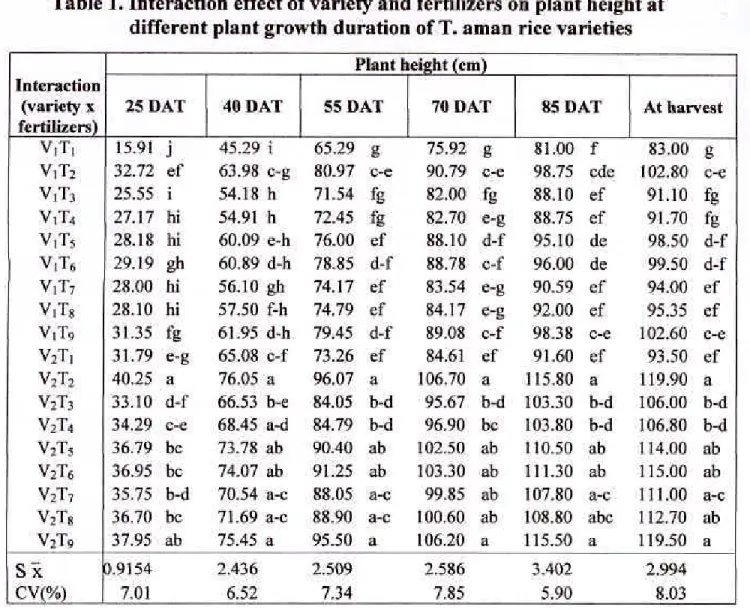
Interaction effect of variety and fertilizers on plant height at 36 different plant growth duration of T. aman rice varieties
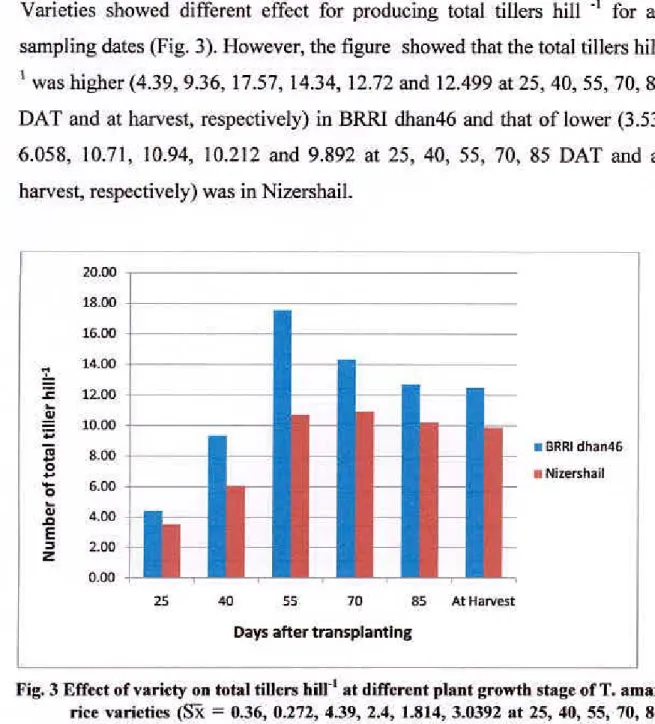
2 Interaction effect of variety and fertilizers on total tiller hilt' at 39 different plant growth stage of T. aman rice varieties
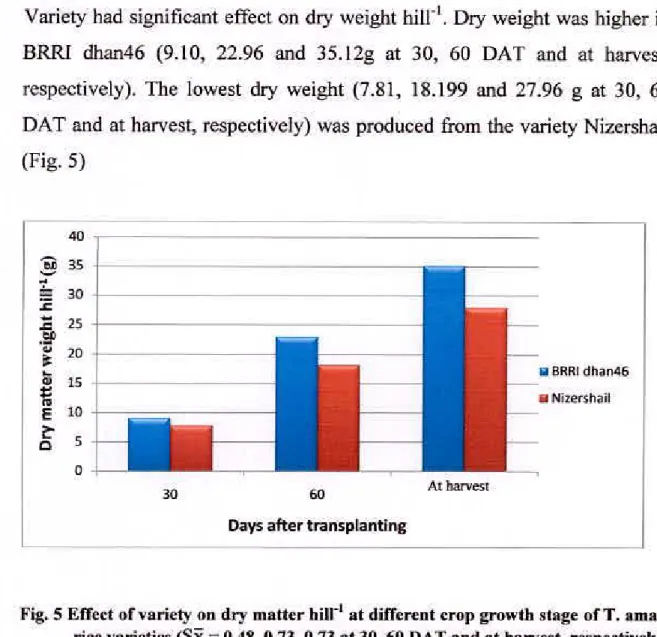
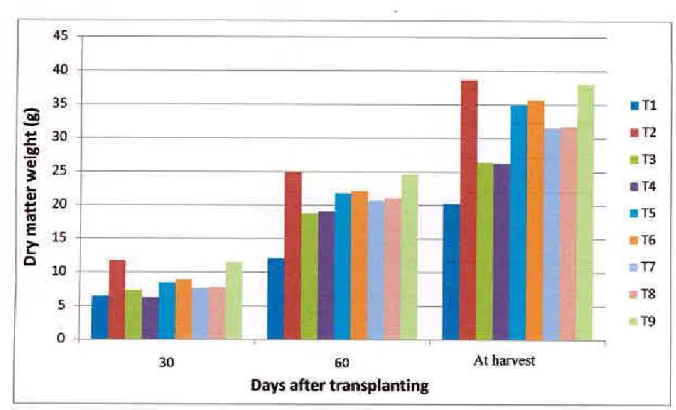
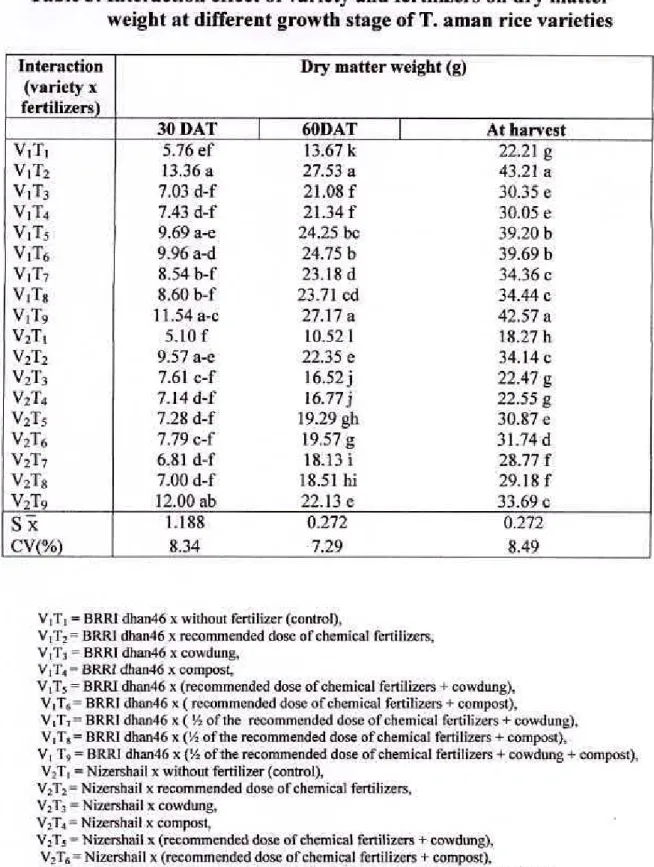
3 Interaction effect of variety and fertilizers on dry matter weight 42 at different growth stage of 1'. aman rice varieties
4 Effect of variety on different yield contributing characters of T. 44 aman rice varieties
5 Effect of fertilizers on different yield contributing characters of 45 1'. aman rice varieties
6 Interaction effect of variety and fertilizers on different yield 46 contributing characters of T. aman rice varieties
7 Effect of variety on yield and harvest index of'l'. aman rice 50 varieties
8 Effect of fertilizers on yield and harvest index ofT. aman rice 51 varieties
52 9 Interaction effect of variety and fertilizers on yield and harvest
index of T. aman rice varieties
vi
LIST OF FIGURES
FIGURE TITLE PACE
I Effect of variety on plant height at different growth 33 duration of T. aman rice varieties
2 Effect of different manures, fertilizers and their on plant 34 height at different plant growth duration of T. aman rice
varieties
3 Effect of variety on total tillers bill1 at different plant 37 growth stage of T. aman rice varieties
4 Effect of organic and inorganic fertilizers on total tillers 38 hill 4 at different plant growth duration of T. aman rice
varieties
5 Effect of variety on dry matter hi11 1 at ditlèrent growth 40 stage of T. aman rice varieties
6 Effect of fertilizers on dry matter weight at different 41 growth stage of T. aman rice varieties
vi'
LIST OF APPENDICES
APPENDIX TITLE PAGE
I Map showing the experimental site under study 72
II Monthly average relative humidity, air temperature. 73 total rainfall and sunshine hours of Dhaka during June
to December. 2010.
Ill Chemical properties of the initial soil of the 74 experimental site (0-15 cm depth)
IV Chemical analysis result of cowdung and compost 75
V Chemical properties of the soil after harvestmen of the 76 experimental site (0-15 cm depth)
VI Mean square values for plant height of'l'. aman rice 77 varieties at different days after transplanting (DAT)
VII Mean square values for total tiller number hill1 of T. 78 aman rice varieties of of interaction at different days
after transplanting (DAT)
VJH Mean square values for yield contributing characters of 79 T. aman rice varieties
LX Mean square values for grain yield, straw yield. 80 biological yield and harvest index of T. aman rice
varieties
vi')
LIST OF ACRONYMS
AF.Z = Agro- Ecological Zone
BARC = Bangladesh Agricultural Research Council BBS = Bangladesh Bureau of Statistics
WARDA = West Africa Rice Development Association BINA = Bangladesh Institute of Nuclear Agriculture BRRI = Bangladesh Rice Research Institute
cm = Centimeter
cv. = Cultivar
DAT = Days after transplanting
DAS = Days after sowing
° C = Degree Centigrade
DF = Degree of freedom
DMRT = Duncan's Multiple Range test
EC = Emulsifiable Concentrate
ci at = and others
etc. = Etcetera
FAO = Food and Agriculture Organization
g = Gram
Ill = Harvest Index
IIYV = High yielding variety
hr = hour
WAD International Fund for Agricultural Development IRRI = International Rice Research Institute
kg = kilogram
LV = Local variety
LSD = Least significant difference
in = Meter
= meter squares
MV = Modern variety
mm = Millimeter
MP = Murates of Potash
viz. = namely
N = Nitrogen
ns = Non significant
% = Percent
CV % = Percentage of Coefficient of Variance
P = Phosphorus
K = Potassium
ppm = Parts per million
SAU = Shcr-e- Bangla Agricultural University
S = Sulphur
t hi' = Tons per hectare
TSP = Triple super phosphate
UNDP United Nations Development Program
USC = Urea supergranules
Zn = Zinc
fm
Er.
cCCTr , CHAPTER 1V
INTRODUCTIONBangladesh is an agro-based country, and rice (Oryza saliva L.) is our staple food. It is generally considered as a food deficit country, though the rice production has been doubled compared to that of 1970s (Nasiruddin, 1993).
This deficit is due to the fact that growth rate of rice production failed to keep pace with increasing population growth rate. The alarming population growth, rapid industrialization and urbanization during the past few decades resulted in remarkable reduction of cultivated land of the county. By the year 2030, population will reach up to 191 million and the demand of cereal has been projected reach 43.8 million tons (Anon. 1993) against the present production of only 19 million tons. Moreover, the yields of MV rice declined during 1970 to 1981 by 3.0% annually for aus, 1.0% for aman and 3.0% for boro and this trend of negative growth also found to continue over the next decade (Roy, 1996). This is particularly alarming for the sustenance of the people of Bangladesh. Among different rice groups of Bangladesh, Transplant aman is the most important that contributed a lot to the total rice yield. As a result, emphasis should be given to increase the aman yield through the adoption of proper management especially judicious application of fertilizers.
In order to break the above yield barriers, sustaining the productivity and obtaining sufficiency in food, the overall management system of crop culture needs to be improved especially through the nutrient management of crops.
Proper utilization of different sources of nutrients in the context of crop-soil productivity must be explored for the existence of the people. The sources of nutrients for crops are nutrient reserve of soil, organic and inorganic fertilizers. None of the sources is complete and therefore, no one is sufficient
to sustain soil fertility and productivity. Combination of organic and inorganic fertilizers is being stressed now-a-days.
Soil organic matter plays an important role in preserving the fertility and productivity of soil. Organic matter content in Bangladesh soils is gradually declining due to high cropping intensity and which also causes quick decomposition of organic matter. On the other hand, the farmers rarely add sufficient amount of organic manures to the soil against the removal. As a result, natural nutrient reserve in soil is steadily declining which compels the farmer to pay for increased level of chemical fertilizers only to sustain crop yields.
Integration of organic and inorganic fertilizers may facilitate the utilization of nutrients for crop growth and productivity and help replenish the organic matter status in soil. As the organic matter is the key pivot of nutrient availability and maintenance of better physical condition of soil, it is an essential factor for crop productivity and higher yield. It has already been indicated that the intensive cropping and use of chemical fertilizers have trusted tremendous pressure on the soil organic matter and soil nutrients resulting in the decrease of crop production.
But cowdung is scarce and limited in South East Asia including Bangladesh.
In such situation, easily prepared compost can be used instead of cowdung.
But cowdung or compost is not utilized properly for crop production.
Application of cowdung or compost may play an important role in rice cultivation when used alone or in combination with chemical fertilizers.
Enormous efforts are therefore, needed to formulate organic fertilizers, chemical fertilizers and their combination, that will technically effective and
feasible, economically viable, socially acceptable and environmentally sound. In view of limited information on the problems mentioned above, a study was therefore, undertaken with the following objectives:
To observe the effect of chemical fertilizers on the performance of transplant aman rice,
To examine the effect of organic manures on the performance of transplant aman rice, and
Finally, to evaluate the combine effect of organic manures and chemical fertilizers on the performance of transplant aman rice.
3
CHAPTER 2
REVIEW OF LITERATURE
Rice yield and yield contributing characters are considerably influenced by different dose of chemical fertilizers and manures like cowdung and compost and their combined application. Literature reviewed in this regards on transplanted aman (T. aman) rice with different rates of inorganic and organic fertilizers have been presented below:
2.1 Effect of variety on the performance of T. aman rice
Vergara et al. (1974) reported about the variable effect of variety on the number of grains panicl&'. Kumbhar and Sonar (1978) reported the variable effect of rice varieties on grain yield.
Choudhury and Ohosh (1978) carried out a number of field trials with 62 line of scented rice cultivars and observed that 1000-grain weight was highly variable that ranged from 9.0 to 23.0 g. But in some varieties, 1000-grain weight was identical in BR3 and BR8 varieties.
Sawant et at (1986) conducted an experiment with the new rice cv. R-73- I - 1, R-7 11 and the traditional cv. Ratna and reported that the traditional cv.
Ratna was the shortest for the new rice cv. R-73- 1-1, R-7 II.
Babiker (1986) carried out an experiment with rice cv. Ciiza-171 and (3iza- 180 and observed that, total tillers hilr' was significantly affected by the cultivars. The variable effect of cultivar on total number of tillers hilE' was also observed by Idris and Matin (1990).
Shamsuddin ci al. (1988) conducted an experiment with 9 different rice varieties and observed that plant height different significantly among the varieties.
El
Kamal et at (1988) carried out an experiment with BR3, 1R20 and Pajam2 and found that number of grains panicle were 107.6, 123.0 and 170.9, respectively for the three varieties.
Rafey ci' at (1989) conducted an experiment with different rice cultivars and reported that I 000-grain weight differed among the cultivars studied.
Singh and Gangwer (1989) reported from an experiment with four rice cultivar C-14-8, CR-1009, IET-5656 and IET-6314 that grain number panicle, 1000-grain weight and biological yield were the highest for C-14-8 among the varieties.
BRRI (1991) reported that the number of effective tillers produced by some transplant aman rice ranged from 7 to 14 and it was significantly differed with variety to variety.
K.han (1991) conducted a greenhouse pot experiment with rice cv. BR6 and CSR4 and reported that yield was higher in cv. CSR4 than in BR6. BRRJ ( 199 1 ) also reported that the plant height differed among the varieties.
Hossain ci' at (1991) reported that the growth characters like plan height total tillers hilr' and number of grains panicl&' differed significantly among BR), BR1 1, Pajam and Jaguli varieties in boro season.
Suprihatno and Sutaryo (1992) evaluated the performances of seven IRRI hybrids and 13 Indonesian hybrids using IR 64 and Way-Seputih as cheek varieties. They concluded that IR 64 was the highest yielding, significantly out yielding then IR 64616Ff, IR 64610M and JR 62829A/IR 54 which in turn out yielding Way -Seputih.
Chowdhury et al. (1993) stated that the cultivar BR23 showed superior performances over Pajam in respect of yield and yield contributing characters viz, number of bearing tiller hill', length of panicle, 1000-grain weight, grain and straw yields. On the other hand Pajam produced significantly taller plant, higher number of total spikelets panicle", grains panicle" and sterile spikelets panicle".
All and Murshid (1993) conducted an experiment during July to December 1999 to determine suitable variety for late transplanted aman rice, cv. BR23, BRI I and Kumragoir. They reported that local Kumragoir statistically out yielded the modem two cultivars of BR23 and BRI 1.
BINA (1993) evaluated the performance of four varieties IRATOM 24, BRI4, BINA 13 and BINA 9. It was found that varieties differed significantly on plant height, panicle length, number of nonbearing tillers, and sterile spikelets panicle".
BRRI (1994) reported that Tulsimala produced the highest number of
spikelets panicle" and BR 14 produced the lowest number of spikelets panicle".
BRRI (1995) conducted an experiment to find out the performance of BR4, BRIO, BRI 1, BR22, BR23 and BR25 cultivars including two local Check Challish and Nizersail planted at 20 cm x 20 cm spacing with 2-3 seedlings hill". The results indicated that BR4, BRIO, BRI 1, Challish and Nigersail produced grain yields of 4.38, 3.12 and 2.70 t ha", respectively. Challish cultivar followed earlier than all other varieties. BR 22 and BR23 showed poor performance.
6
2.2 Effect of inorganic fertilizers on the performance of T. aman rice 2.2.1 Effect of nitrogen on T. aman rice
BRRI (1980) reported that grain and straw yield of BRI I and BRI4 increased significantly at its different stations when applied 100 kg N hi'.
Ayyasamy and Venkatararnan (1983) studied the effect of different levels of nitrogenous fertilizers and reported that the highest paddy yield was obtained with 120 kg N hi' in the Kharif season.
Kim et at (1983) conducted a field trial on rice cultivar Kiyonishike with 84 kg N hi' against zero N. They observed that, at most sampling dates, plant height, tiller number, leaf area, dry weight of below ground and ear weight were higher compared to zero N fertilizer treatments.
Thind et at (1983) studied the influence of nitrogen application on rice grain yield and observed that increasing rate of N application increased the yield significantly up to 180 kg N ha*
Awan el al. (1984) reported that application of nitrogen with different levels on rice increased plant height, panicle length, 1000-grain weight, grain and straw yields significantly. Kumer el al. (1986) and Koihe and Mitra (1985) studied the effect of different levels of nitrogen forT. aman rice and reported that the yield was increased significantly with N application.
Patel et at (1987) observed three years in a trial with the application of 80, 100 120 and 140 kg N hi' to rice cultivar 1R22 that gave the rice yield of 3.74, 4.23, 4.51 and 4.74 t had, respectively, and 100 kg N hi' was the optimum economic rate.
BRRJ (1988) carried out experiments at its different stations, using 0, 40, 80 and 120 kg N hi' with BR9, BR1 I and RR16 varieties with blanket doses of
'I
P, K and S at the rate of 25, 35 and 16 kg ha". respectively. The varieties BR9 and BRI6 produced the highest grain yield ranging from 5.5-6.0 t ha*
Wagh and Throat (1988) reported that 50+30 + 10 + tO kgN hi' applied at 8 days after transplanting (DAT), maximum tillering, primordia initiation and flowering gave the highest yield.
Rahman (1992) carried out a field trail with 0, 25, 50, 75 or 100 kg N ha" on BR 11. He obtained the grain yield of 4.8 t hi' with control treatment and the highest yield (6.7 t hi') with 75-100 kg N hi'.
Mukherjee and Mandal (1995) conducted a field experiment in 1987 to 1988 in West Bengal on rice cv. Ratna was given with 100 kg N hi' as urea in 2- 3 splits in 3 different ratio i.e. 90:10: 0, 70: 20: 10 and 50: 30: 20 at transplanting, tiller initiation and panicle initiation, respectively. They found that grain yields over 20 % higher control plots.
Bandyopadhyay et at (1988) carried out an experiment on flooded rice cv.
Pusa Basmati applying 60, 120 or 180 kg N hi' and found that seed yields increased with N application upto 120 kg hi'.
Choudhari ci cit (1998) conducted a field experiments on three rice cultivars in 1993-96 in Maharashtra by applying 25-100 kg N hi' or no fertilizers or 12 t hi' FYM and observed that the grain yield (2.9 t hi') was highest with 100 kg N ha 1. Haryana Basmati, Kasturi and Pusa Basmati produced mean grain yields of 2.46, 2.38 and 2.261 ha", respectively.
Behera (1998) conducted a field experiment on scented rice during rainy season of 1993, 1994 and 1995 applying 0, 30, 60, 90 and 120 kg N hi' and
8
found that the yield increased 12.9, 22.3, 28.5 and 31% over control, respectively. He has observed that HKR 228 gave the higher grain yield and l-IKR 228 was superior to other cultivars for panicles m and gave a higher grain yield and also found that all the growth and yield forming characters increased linearly upto 90 kg N hi' and there after grain yield increased marginally.
2.2.2 Effect of phosphorus on T. aman rice
Machado et at (1984) grew Bluebelle by sowing in the first 2 weeks of November and treated with 0, 100, 200 or 300 kg P205 as TSP. They observed that the availabitity of P increased linearly with application but even at values as low as 1.8 ppm. There was no immediate or residual effect of P on yields.
Saravanan and Kothandaraman (1984) reported the effect of different types of P fertilizers on rice grain yield. Phosphorus was applied at the rate of 26.19, 39.29 or 52.39 kg ha 1 . Grain yield increased with increasing P application.
Saggar et at (1986) reported from field trails with rice and wheat alone or in a rotation that the application of 39 kg P increased mean rice yield of 5.2 to 6.2 t hi' and mean wheat yield from 1.8 to 3.7 t hi'. They also reported that application of 39 kg P hi' to both wheat and rice in rotation increased soil available P from 6.8 to 18.4 ppm.
Melgar and Ligier (1986) with 26 fertilizer trails of phosphatic fertilizer in the North of Carrientes Province showed that the rate of 44 kg hi' P increased rice yields by an average of 400 kg hi'. Almost 3 times of the
ro' VA
average yield increase was obtained on soils containing 3.3 ppm P, but little or no response was obtained on soils containing more than 6-2 ppm.
BRRI (1991) conducted five term field trails to determine the appropriate frequency of P fertilizer application. Soils where P availability was marginal (Olsen P just around 10 ppm), P fertilizer application to every alternate crop of Boro-Fellow- T. aman sequence reported as good as that to each crop. In this case P application increased grain yield significantly by about 0.2 to 1.4 t ha over the control. It was suggested that soils with moderate to high available P contents (Olsen P 15 ppm or more) might require even a less frequent P application for optimum rice yield.
Momuat et at (1992) conducted a field experiment using several rate of triple super phosphate (TSP) to evaluate the response of rice crop to TSP application. Using several TSP rates, application of TSP up to 200 kg ha4 did not increase rice yield significantly.
Hassan et al. (1993) carried out an experiment to observe the yield response of Basmati 385 rice to 0, 33, 66 and 99 kg P h&'. All treatments received 125-62-4.2 N, K, Zn ha 4. They observed that yield increased significantly upto 33 kg ha4 for all soil P test values, but significant responses to the next higher dose was observed only when test values were less than or equal to 11 mgPkg'.
Mahajan et at (1994) conducted that a pot experiment on a clay soil, 3 rice cultivars received 0, 80 and 120 kg P205 hi'. Grain yield was the highest with 80 kg P205.
10
Subba el al. (1995) reported that phosphorus applied at the rate of 50 mg P kg4 soil as SSP increased the grain and straw yields significantly.
2.2.3 Effect of potassium on T. aman rice
Morok and Dhaliwal (1987) reported form a replicated field trails enveloping graded doses of K showed that paddy response to the application of K in soils of low to medium K availability. A dose of 30 kg of 1(20 ha4 was optimum that gave unit response of 4.90 kg grain with one K of K20 dose and also gave a net profit of Rupees 1.88 per Rupee invested on potassium fertilizer.
Uexkull (1984) reported that in traditional rice culifire, the negative K balance over a 5 year period was only 169 kg haS', under intensive HYV culture it increased to about 1200 kg hi'.
Purohit et aL (1986) conducted two year trials with three varieties of rice and four levels of K20 (0, 40, 60 and 80 kg hi') and observed that grain yield and net profit were the highest with 80 kg K20 ha*
BRRI (1990) studied the potassium response on rice in 18 field trials. The soil had variable levels of available K (exchangeable K 0.11-0.44 mgIlOO g).
Five K treatment, 0, 30, 60, 90 and 100 kg ha' were tested at each location with BR1, BR3, BR14 and BRI5 rice varieties. The application of 30 kg K hi' increased grain yield slightly over control at most of the locations where increased K doses did not bring any additional yield.
BRRI (1994) reported that by applying K rate up to 120 kg hi' that, it failed to increase the straw and grain yield significantly over 30 kg K ha4.
Saleque et aL (1995) reported that a positive yield response in rice was found up to 120 kg K ha
2.2.4 Effect of sulphur on T. aman rice
Islam et at. (1990) reported that sulphur application significantly increased the grain and straw yield of BR2 rice. They have also reported that application of sulphur increased the concentration of S both in grain and straw.
Shamim et at (1991) reported that the grain yield of rice cv BRI I increased 390 kg ha due to application of 30 kg h&'.
Tandon (1991) reported the response of about 40 crops to S under field conditions in India. Among the crops, the application of S to rice increased the grain yield by 752 kg hi' and on an average paddy yield was found to be increasing by 17% in 27 studies.
Bhuiyan (1992) carried out field trials on crop response to fertilizers and showed that S deficiency in both soils and crops was increased due to the use of S free fertilizers. He further stated that, there was frequently a synergistic effect between N and S fertilizer in rice. Superphosphate elemental S and S bentonite also increased the yield of rice.
Rashid et at (1992) carried out a trial in Pakistan in 1988-91 on rice cv.
Basmati-385 by applying different S sources and found that element S produced yield increases of 18, 9.2 and 5.8% when applied at transplanting, or 15 or 30 days after transplanting.
12
Islam and Hossain (1993) reported that application of 20 kg S ha with NPK significantly increased the grain yield of BR1 I rice. Tupaticar and Sonar (1995) showed that application of 2.5 t ha1 of pyrite increased grain and straw yields over control.
2.2.5 Effect of zinc on T. aman rice
Babiker (1986) reported that rice cultivars Giza 171 and Giza 180 were grown with 0, 25, 50 and 75 kg ZnSO4 ha4 in nursery and field experiment and found that leaf area, heading date, plant height, tillering capacity, productive tillers, panicle length, number of grains and spikelets panicle4,
1000- grain weight and panicle weight were increased significantly due to application of ZnSO4. It was concluded that 50 kg ZnSO4 Iii' was most effective and economic rate for improving grain yield and its components.
Salam and Subramanian (1988) reported that application of 5.7 kg Zn ha4 increased the grain yield but did not affect the straw yield. It was further reported that application increased Zn uptake by plant.
Hossain ci at (1989) reported that the application of zinc in the form ZnSO4 haS' significantly increased both grain and straw yields as well as different yield components except the number of tillers hiW'.
Chhibba et at (1989) conducted field trials on a Zn deficient soil in the Punjab province of india with 0, 5, or 10 kg Zn ha as ZnSO4, ZnO and Zn frits on Jaya rice. Rice grain yield increased significantly with Zn application irrespective of rate or source, among sources and the highest rice grain yield was produced by ZnSO4 and flits, ZnO was least effective.
13
Sarker et at (1989) reported that the effects of Zn application at the rate of 20 kg ZnSO4 hi' to the soil during seed bed preparation or three foliar sprays of 0.5% ZnSO4 + 0.25 % lime at 10 days intervals after transplanting gave grain yields of 7.2 to 7.4 t hi' compared with 5.6 t hi' without Zn.
Mostafa (1990) reported from Egypt that the application of ZnSO4. either soil or foliar spray significantly increased the grain yield of rice.
Dixit and Khanda (1994) conducted a field experiment and found that application of ZnSO4 increased the grain yield of rice. Sarkunan et al.
(1996) conducted a pot experiment under flooded condition and found that Zn application increased the grain yield of rice. Conducted a pot experiment under flooded condition and found that Zn application increased the grain yield of rice.
2.2.6 Effect of inorganic fertilizer combination on the performance of T.
aman rice
Miah and Eunus (1978) reported that the application of increased doses of NPK tended to produce increased grain yield. Among the 16 NPK treatment combinations, Ill kg of N and 45 kg each of P205 and K20 hi' came out to be the best for grain yield.
Bhuiya et al. (1979) carried out a fertilizer trial in the Bangladesh Agricultural University Farm with I R8, a high yielding rice variety using three rates of N (0, 113 and 135 kg N hi1 ), two rates of P (0 and 45 kg P205 hi') and two rates of K (0 and 45 kg K20 hi'). Application of N and P increased both the grain and straw yield. But the effect of N application was more pronounced than the effect noted due to P application. The application of K slightly decreased the grain and straw yield of rice.
14
1-lossain
nat
(1989) reported that sulphur application significantly increased the grain and straw yield of rice and Zn + NPK applications increased higher grain and straw yield but were not statistically significant over NPK treatment. Sulphur and Zn content in grain and straw increased considerably due to addition to S and Zn respectively. Greatly boosted up to5%
and 82%over control when sulphur was added with N and NPK treatment, respectively.
Chaudhury and Badiuzzaman (1992) found that grain yield increased significantly due to application of K up to 100 kg hi' and grain and straw yield also increased due to application of 30 kg hi' S and highest grain yield (5.9 t hi') from combined application of 150 kg K20 and 30 kg S hi' as well as applying K favourably influenced yield components while S level had no significant variations on plant hight and straw yield.
Sagwal and Kumar (1994) carried out an experiment on Basmati-370 rice in 1990 during rainy season by applying zero fertilizer, 60 kg N, 30 kg P205, 30 kg K20 or 25 kg ZnSO4 hi' as N, NP, NPK or N P K Zn to Basmati-370 and PK and Zn were applied at pudding and N in 2 equal splits 3 and 6 weeks after transplanting. Grain yield ranged from 1.6 t hi' with no fertilizer to 2.59 t hi' with NPKZn an financial returns were highest N P K Zn.
Choudhury ci at (1994) conducted a field experiment during dry and wet season with cv. BR3 and BRI 1 and observed that combined application of N, P, K and S from urea, TSP, MP and gypsum gave similar grain yields of
5.6-5.7
t hi' in the wet season.Sajjad (1995) conducted field experiment in Papua New Guinea on rice cv.
wantok and Tamba applying on fertilizers or S fertilizers rates between 60-
15
30-30 and 140-70-70 kg NPK ha4, yield on wantok was 4.7 t hi' in the control treatment and highest (8.8 t hi') at the highest NPK rate but yield increase was significant only up to 100-50-50 kg NPK hi' (8.1 t hi'). Yield of Tambu was 5.2 t hi' without fertilizers and 8.8 t ha4 at the highest application rate, which was not significantly different from 7.5 t hi' with 120-60-60 kg hi'.
Gogoi and Lalita (1996) conducted an experiment by applying 3 rates of NPK fertilizer (0-0-0, 20-10-10, or 40-20-20 kg ha' as N-P205-K20) on transplanted rice cv. Mahsuri and Badshabhog under flood condition.
Cultivar Mahsuri (4.08 t hi') significantly out yielded the traditional Baotshabhog (2.75 t hi').
Lal and Roy (1996) carried out an experiment on rice and applying zero NPK. 2 rates between 2kg N +1kg P205 + 0.5 kg 1(20 and 10 kg N +15 kg P205 +2.5 kg K20/1000 m2. Grain yield of 3.96 t hi' was obtained when 2 kg N + 1 kg P205 + 0.5 kg K70. A further increase in the NPK rate did not increase the grain yield significantly.
Fageria and Zimmerman (1996) found that grain yield, dry matter production and yield components increased with increasing fertilizer rates.
2.3 Effect of cowdung on the performance of T. aman rice
Rashid and Siddique (1988) reported that cattle manure at high rates increased grain yields. Kuppuswamy et al. (1992) conducted a field trials in 1989 at Anna-malainagan, Tamil Nadu with rice cv. lR-20 were application of lot Farmyard manure (FYM) gave grain yields of 7.33 t hi'.
ILl
Rajput and Waris (1992) reported that maximum rice yield was obtained when 100 kg N + farmyard manure was applied at the rate of 10 t ha4. The grain and straw yields were 34.7 and 52.5 t ha4, respectively.
Kant and Kumar (1994) reported that the increasing rates of amendments with FYM increased the number of effective tillers hilf' significantly and number of grains panicle, 1000-grain weight was also increased over the control. At the maximum level of FYM (30 t ha4, increase of 48% tillers hilF', 14% of grains panicl&' and 4.5% weight of 1000-grains over the control were recorded. They have also reported that higher rate of FYM (30 t hi') resulted 22.0% increase in grain yield over the untreated piots.
Gupta (1995) found that the application of pig manure (10 t ha4 ) produced The highest grain yield (4.5 t haj followed by poultry manure and FYM which produced yield of 4.10 and 3.90 t ha1 of rice grain, respectively. The increase of rice yield with organic manure was 34 to 55% higher over the control of 5 to 22% higher over NPK fertilizer, it was concluded that application of organic manures like pig manure and FYM are beneficial to rice cultivation in Altisoils.
Bhattacharya c/ al. (1996) carried out an experiment in plastic pots of 5 kg capacity with no hole and filled with 4 kg soil. They have reported that the application of 2.59 kg ha1 of FYM could produce about 2 g pof' grain as well as straw yield than no FYM treated soil.
2.4 Effect of compost on the performances of T. aman rice
Patel et al. (1983) reported that rice yield significantly increased by the granulated composts. Application of 60 kg N as granulated compost hi' to rice was the most effective in increasing the number of panicles per unit
17
i-I
area, fertile spikelets panicled, 1000-grain weight and rice yields followed by urea enriched FYM.
Nelidov et al. (1986) reported that compost stimulated soil microorganism, increased non-symbiotic N-fixation, neutralized the alkaline reaction of the soil S improved plant nutrient. These results have a significant increase in the productivity of rice.
Sharma ci' at (1990) reported that wheat straw, rice straw and water hyacinth were applied at 4 rates and on 4 dates before transplanting to rice cv. Ratna. Grain yield increased significantly within organic FYM or with rates upto the equivalent of 15 t hi 1 . With wheat straw and rice straw application yield was highest 10 t hi'. Yield increased significantly when wheat straw and rice straw were applied upto 30 days before transplanting (DBT), but such increases were less pronounced with FYM water hyacinth.
The effects of higher rate (10 and 15 t ha1) were higher with early application of organic materials per 20 and 30 DBT.
Chattopadhyay ci at (1992) reported that application of compost with urea gave the highest yields of rice. Plant uptake of N, F, K, Zn, Fe, Mn and Cu and the nutrient status of soil with the different treatments are presented.
Jhilayvathi ci al. (1995) reported that partially decomposed and fully decomposed coir pit (12.50 t hi') incorporated two days before transplanting rice cv. DAT 36 seedlings influenced the rice yield components like panicle length and grain panicl&', grain yields were 3.82, 3.79 and 375 t hi' in rice when applied at 30-d, 25-d and 20-d CCP (Composted coir pith), respectively, compared with 3.31 t h' in unamended controls.
18
2.5 Effect of fertilizer and manure combinations on performance of T. aman rice
Mian and Eaqub (1976) reported that the application of N, residual P and FYM influenced the yield and yield contributing characters of rice.
Kobayashi et al. (1989) conducted an experiment on rice growth with annual application of either 10 or 20 t FYM h&' or 10 t FYM with 80 kg each of N, P205 and K20. Average unpolished rice yields over the 5 years were 3.66 t ha with 10 t FYM ha', 3.35 t with 20 t FYM h and 5.92 t with FYM+NPK fertilizer. Plant height, number of stems m 2 and panicle number all showed similar difference to those shown on yield but the number of grains per ear was highest with 10 t FYM hi'.
Sharnia et a!(l990) reported that significant increase in grain yield of rice as obtained by the application of recommended rate of nutrient through chemical fertilizer + 8 t FYM hi'. Ahmed and Rahman (1991) reported that the application of organic matter and chemical fertilizer increased tiller and
panicle production and straw and grain yields of rice.
Mandal et al. (1990) observed that the application of 0 or 10 t FYM ha gave average paddy yields of 1.90 and 2.64 t hi', respectively. Applying 40 kg N hi' or N + P205 + 1(20 at 40 + 2 20, 60 + 40 + 40, 80 + 60 + 60 kg ha gave yield of 3.17, 3.90, 3.54 & 4.0 t ha' without FYM but 3.81, 4.10, 4.54 and 4.58 t hi' with FYM, respectively. The numbers of panicle m 2, spikelets, panicle, percentage of filled grains and 1000-grain weight
increased with increasing NPK rates and FYM application.
Raju et at (1993) observed, in rice field in the rainy season by applying 0, 50, 75 or 100% of the recommended NPK fertilizer rate, 50% of the
19
recommended NPK rate + 7.5 t FYM, 6 t rice straw or 4.48 + sesbanai cannabania hi', 75% of the recommended NPK rate + 3.757 FYM, 3 t rice straw or 2.24 + S. cannabania or 60 kg N had as urea, 17.5 kg P as single super phosphate and 33.3 kg K as Muriate of potash. The recommended fertilizer rate gave the highest grain yield of 5.23 t had which was not significantly different from 5. 15 t and 4.47 t with 75% of the recommended rate + 3 t rice straw or 2.24 t hi' . cannabania, respectively. Application of 60 kg N gave 4.35 t and the control yield was 2.71 t hi'.
Ohosh et. al. (1994) reported that grain yield of rice cv. CR1018 was
increased in both of the combinations of organic (10 t hi' FYM) and inorganic N fertilizer (25 kg N hi) as it were compared with an organic fertilizer alone (20 t FYM hi').
Mathew ci al. (1994) conducted a field experiment on rice cv. Jyothi that was given no fertilizers, a recommended rate of NPK fertilizers, manure with lOt hi' FYM + 35 kg each of P and K + 35 or 17.5 kg N. They have observed that grain yield was the highest (3.44 t hi') with FYM + 35 kg N compared with 3.2 + obtained with the recommended NPK rate.
Roy ci al. (1996) observed that application of 60 kg N in urea and 60 kg FYM gave the highest rice yield. There was no significant difference in yield when 120 kg N had was app either through urea or ammonium chloride alone, or a combination of the both. The yield and yield component were lower when 120 kg N was applied through FYM and Nitrogen use efficiency was highest when 60 kg N was applied through urea and 60 kg through FYM.
20
Singh (1995) reported that cattle manure significantly improve rice yield but was less efficient than urea. The combination of cattle manure and urea showed no positive interaction effects. Total N uptake by rice was also significantly higher from urea than manure P and K uptake by rice increased
in response to N application from urea and cattle manures.
Delower et at (1996) observed that the effect of organic recycling on wheat- mungbeen-rice (grown during the T. aman season) cropping system. Five treatment were evaluated viz, control, compost, compost + half of NPK, frill of NPK and compost. Decomposed straw was applied at 20, 10 & 24 t hi' for wheat-mungbean-rice respectively. The application of compost alone had a lesser effect on growth and yield of wheat-mungbean and rice, but the application of compost +NPK increased yield. The full NPK +compost treatment increased rice yields by 83-85% compared with the compost.
Jeony et al. (1996) observed that rice was given 110 kg N + 120 kg P + 130 kg K ha1 (100% NPK) alone or with 5 t rice straw ha or half these NPK rate (50% NPK) alone or 5 t rice straw. 20 t compost + 20 t fermented pig manure, Pig manure + compost, 3 t oil cake or 5 t fermented chicken manure hi'. Application of organic manure + 50% NPK gave grain yield of 9 to 17% lower than these were obtained with 100% NPK rate. Grain content alkali digestion value and gel consistency were unaffected by treatments.
Amylase content of grain was lower in plant given straw, compost or compost + pig manured compared with 100 % NPK treatment. In general, organic fertilizer did not improve rice cooking quality and tests.
Sanzo a' at (1997) observed that applications of stander rate of 200 kg N, 80 kg P and 90 kg K ha1 or 15, 30 or 45 t cattle manure hi' with or without PK, with or without 50% or 100% of the standard rate of application N.
21
Yield generally increased with increasing rates of manure, with better result in combination with NPK, with 45 t manure there was no significant difference in yield between N rates.
S ingh et at (1997) conducted a field trail at Birasa Agricultural University by applying 0, 50, 75 or 100% of 120 kg N + 50kg P205 + 40kg 1(20 ha1 and 10 t FYM ha1 and or 13 kg Cyanobacteria ha4, they obtained highest rice yield of 4.58 t ha with 100% NPK + FYM + Cyanobacteria.
From the reviews cited above it is clear that manuers and fertilizers have positive influence on yield of rice, and combination of them produces better yield in most of the cases.
22
CHAPTER 3
MATERIALS AND METHODS
The experiment was conducted at the experimental field of Sher-e-Bangla Agricultural University, Dhaka during the period from June to December 2010 to study the effect of different organic, inorganic and their combinations on the performance of transplant aman rice. The details of the materials and methods have been presented below:
3.1 Description of the experimental site 3.1.1 Location
The experiment was carried out in the Sher-e-Bangla Agricultural University farm, Dhaka- 1207. The experiment field was located at 90°2jE longitude and 23041N latitude at an altitude of 8.6 meters above the sea level. The experimental site was located under the agro-ecological zone of Modhupur Tract, AEZ-28. For better understanding the experimental site is shown in the Map of AEZ of Bangladesh in Appendix I (UNDP and FAO, 1988).
3.1.2 Climate
The experimental area belongs to the sub-tropical climate that is characterized by high temperature, high humidity and heavy rainfall with occasional gusty winds in kharif season (April - September) and less rainfall associated with moderately low temperature during the rabi season (October - March). The average relative humidity, maximum temperature, minimum temperature, total rainfall and sunshine hour of the experiment site varied as 69 - 84%, 26.4°C - 32.10C, 14.10C - 26.30C, 12.8 - 373.1 mm and 3-5.7 hrs respectively (Appendix H).
23
3.1.3 Soil
The soil of the experimental field belongs to the general soil type of Shallow Red Brown Terrace type under Tejgaon Series. The land was above flood level and sufficient sunshine was available during the experimental period.
The physiochemical properties of the soil have been given in Appendix Ill.
3.2 Variety used
Two transplant aman rice cultivars viz., BRRI dhari46 and Nizershail were used as test crops. Their salient features are as stated below.
BRRI dhan46
BRRI dhan46 is generally grown in arnan season in flood prone areas after flooding. It is photosensitive like BR22, BR23 and Naizersail. This variety was developed through hybridization between BR1 1, Shornolota and RSC 14766a. This variety matures at 145-150 days of planting. It attains at a plant height of 90 cm. The variety gives an average yield of 5 t ha*
Nizershail
Nizershail is a local variety. Its leaves are frequent, erect and deep green in colour. Seedling attained 30 cm within 30 days. This variety gives better yield up to 30 August planting. In early planting, the average grain yield is 3.5 - 4.5 t hi'. If situation favors, this variety can be transplanted in later than August 30 but yield reduces drastically in late planting (BRRI, 1991 and Miah etal., 1990).
24
3.3 Experimental Details 3.3.1 Treatments
There are two factors in this experiment. These are as follows:
Factor A. Variety-2
BRRI dhan46, and Nizershail
Factor B. Organic and inorganic fertilizer and their combination - 9 T1 = Without fertilizer (control)
T2 = Recommended dose of chemical fertilizers iii)T3 = Cowdung
T4 = Compost
T5 = Recommended dose of chemical fertilizers + cowdung T6 = Recommended dose of chemical fertilizers + compost,
T7 = '/2 of the recommended dose of chemical fertilizers + cowdung
T8= V2 of the recommended dose of chemical fertilizers + compost
T9 = V2 of the recommended dose of chemical fertilizers + cowdung +
compost
Recommended dose of manures and fertilizer has been presented in section 3.5.3.
'U
3.4 Design and layout
The experiment was laid out in a split plot design with three replications.
Experimental plot was first divided into three blocks. Each block was then divided into two main plots to accumulate the cultivar at random. Each main plot was then divided into nine subplots where fertilizers and manures and their combination treatments were allocated randomly. Thus the total number of units plots were
54.
Layout of the experiment was done keeping25
inter block and inter plot spacing of I in and
0.75
in, respectively. The unit plot size was 4.0 in x 2.5 in.3.5 Crop cultivation 3.5.1 Seedling raising
Rice seeds BRRI dhan46 was collected from the Bangladesh Rice Research Institute, Joydebpur, Gazipur and Nizersahil was collected from the Bangladesh Agriculture Development Corporation, Dhaka. Seeds were soaked in water for 24 hours and then incubated for 48 hours. Nursery beds for each variety were prepared and sprouted seeds of two rice varieties were sown in the wet nursery bed on 8 July 2010. Proper care was taken to raise the seedlings in the nursery beds. No manuring and fertilization was done, but irrigation was done and weeds were removed from the nursery bed as and when necessary.
3.5.2 Land preparation
The experimental field was first opened on 2 July 2010, by a tractor drawn disc plough. First ploughing was done on 25 July and another one was done on 28 July, 2010. The land was irrigated on 30 July 2010. Later on, the land was puddled thoroughly by ploughing and cross ploughing for four times with a country plough followed by laddering to level the land. Weeds and stubble were removed from the land and thus the land was made ready for transplanting. The field layout was done on 30 July 2010, immediately after land preparation.
26
3.5.3 Application of fertilizers and manures
—4 Recommended dose of N, P. K and S were 74, 48, 48 and 7.5 kg hi1 respectively, and that of cowdung or compost St hi' (BRRI 2011). Fertilizer and manure, and their combination was applied in the individual plots as per treatment. Except urea all the chemical fertilizers and cowdung or compost were applied at the time of final land preparation and mixed them thoroughly with soil one day before transplanting. Urea was top dressed in three equal splits, one third of urea was applied at 10 days after transplanting and the remaining two third were applied in two equal splits at 35 and 55 days after transplanting.
3.5.4 The uprooting and transplantation of seedlings
Seedlings were raised separately on nursery bed and 24 days old seedlings were transplanted on 1 August in 2010, by maintaining a space of 15 cm between hills and 25 cm between rows. Necessary gap filling was done at 7 days after transplanting.
3.5.5 Intercultural operations
The crops were kept under constant observations from transplanting to harvesting. Intercultural operations such as weeding, irrigation, pest management and other necessary cultural operations were done for proper growth and development of the crops.
Two weedings were done on 15 and 45 days after transplanting to keep the crops free from weeds. Natural precipitation was not found adequate and therefore, supplementary irrigations were done at 60, 75 and 90 days after transplanting.
The crop was infested with stem borers (T,yporyza encertulus) at 80 DAT.
This was controlled by spraying Diazinon 60 EC at the rate of I L hi'.
Successive two sprays at seven day intervals were required to control them.
27
3.6 Harvesting, processing and data collection 3.6.1 Growth data
Ten sample plants were selected at random from each plot and tagged them for taking growth data.
3.6.2 Yield contributing characters and yield data
Ten hills from each plot were collected at random prior to harvesting and taken out for studying yield attributes. The crop was harvested plot wise on the basis of their maturity. The crop was harvested when 80% spikelets were matured. First harvesting was done on 15 November, 2010. These plants were taken out with respective tag levels. An area of central 3m2 were harvested for measurements of grain and straw yields. The harvested crops were threshed, cleaned, dried, weighed and necessary data were collected on various crop characters. The following data were recorded:
Growth data:
Plant height (cm) Tillers hill' (no.)
Dry weight hiW' (g)
Yield contributing characters data:
Effective tillers hill4 (no.) Non-effective tillers hiW' (no.) Panicle length (cm)
Sterile spikelets panicle" (no.) Grains panicle4 (no.)
Total spikelets panicle4 (no.) 1000-grain weight (g)
Yield and harvest index data:
Grain yield (t hi') Straw yield (t ha1)
Biological yield (t hi') Harvest Index (%).
3.7 Procedures of data collection 3.7.1 Plant height
The height of the plant was taken from the ten preselected hills at the time of 25, 40, 55, 70, 85 DAT and at harvest. Plant height was measured from the ground level to the tip of the leaf of plant. The average height of ten hill, was considered as the height of the plant for each plot. The height was expressed in centimeter (cm).
3.7.2 Tillers hill'
Total number of tillers were counted from the ten preselected hills at the time of 25, 40, 55, 70, 85 DAT and at harvest. The tillers obtained from ten hills were averaged to have tillers hilt'
3.7.3 Dry weight hill' (g)
Three sample hills uprooted from each plot unbiasly, wash them in water and then dried them in an electric oven maintaining 600C for 48 hours. Then the hills were weighed in an electric balance and averaged them to have dry weight hill1.
3.7.4 Effective and non-effective tillers hill'
The number of tillers from the sample ten hills were counted. The tillers having panicles with at least one grain were considered as effective tillers.
PQ
On the other hand, tillers having no panicle were regarded as non-effective tillers.
3.7.5 Panicle length (cm)
Panicle length was recorded from the basal nodes of the rachis to apex of each panicle.
3.7.6 Grains and sterile spikelets panicl&'
Number of grains and sterile spikelets were counted from ten randomly selected particle. Presence of any material in the spikelets was considered as grain. On the other hand, the sterile spikelets lacked any food materials inside.
3.7.7 Weight of 1000-grain (g)
One thousand grains were randomly collected from the seed stock obtained from plants of each plot and were dried in an oven and weight them by using an electric balance. The weight was adjusted at 14% moisture content and expressed in grams (g).
3.7.8 Grain yield (t ha 1)
Plants of central 3m2 area were harvested and grains were separated from the plant. The grains were cleaned and dried properly in the sun. After drying, the weight of the grain was measured and the weight was converted as t ha*
The grain weight was adjusted at 14% moisture content and expressed in t hi'.
3.7.9 Straw yield (t ha4
Straw from 3 m2 areas of each plot was weighed after repeated drying and expressed in t hi'.
30
3.7.10 Biological yield (t ha')
Grain yield and straw yield were altogether regarded as biological yield and expressed in t hi'.
The biological yield was calculated with the following formula:
Biological yield = Grain yield + Straw yield
3.7.11 Harvest Index (%)
Harvest index was calculated from the grain yield and straw yield and expressed in percentage (%) using the following formula:
Grain yield
Harvest Index (%) = A 100
Biological yield
l-Iere, Biological yield = Grain yield + Straw yield
3.8 Collection of initial soil sample
For chemical analysis, soil samples were collected from the experimental filed at a depth of 0 - 15 cm before final land preparation and also after harvest and then they were composited to form a bulk sample. The soil sample was air dried, ground and sieved to remove unwanted materials and kept in ploy bag for laboratory analysis.
3.9 Soil sample analysis
Soil sample were analyzed for both physical and chemical properties form the soil characteristics under the experimental plot were analyzed in the Soil Testing Laboratory, Soil Resources and Development Institute. Khamarbari, Dhaka.
31
3.10 Statistical analysis
The data were compiled and tabulated in proper form for statistical analysis.
Analysis of variance was done following the experimental design with the help of the computer package program MSTATC. The mean differences among the treatments were adjudged by Duncan's New Multiple Range Test (Oomez and (omez, 1984).
32
120 100 80 60 40 20
CHAPTER 4
RESULTS AND DISCUSSION
Effect of chemical fertilizers, cowdung, compost and their combination on the growth, yield and yield contributing characters of BRRI dhan46 and local variety Nizershail studied and the results have been presented in Table 1 to 9 and figure 1 to 6 discussed below.
4.1 Plant height (cm)
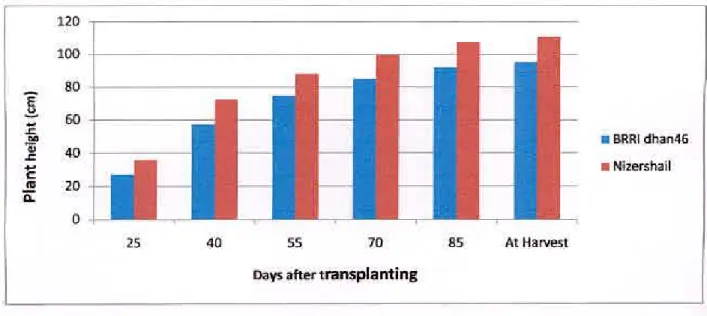
The effect of variety on plant height was affected at different days after transplanting (Fig. I). Taller plant (35.95, 72.40, 88.03, 99.59, 107.591 and 110.93 cm at 25, 40, 55, 70, 85 DAT and at harvest, respectively) was produced by Nizershail and the shorter (27.35, 57.21, 74.834, 85.01, 92.07 and 95.38 cm at 25, 40, 55, 70, 85 DAT and at harvest, respectively) was produced by BRRI dhan46. This differences were mostly due to the genetic variation among the varieties. These results were agreed with those of Shamsuddin et at (1988) who have stated that plant height varies among the varieties.
25 40 55 70 85 At Harvest
Days after transplanting
a BRRI dhan46 Nizershail
Fig. I Effect of variety on plant height at different growth duration of T. aman rice varieties (S X= 0.36, 0.64, 0.73, 4.94, 6.35 and 6.71 at 25, 40, 55, 70,85 DAT and at harvest, respectively)
33
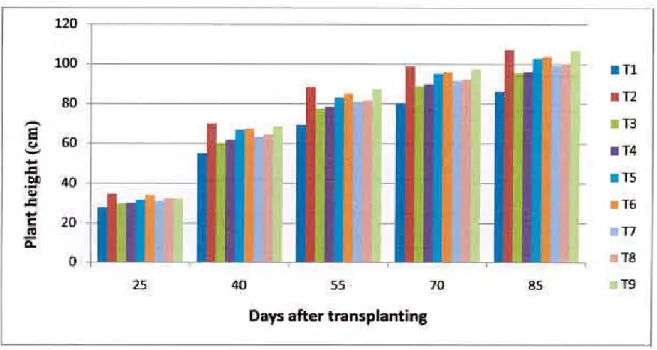
Effect of different fertilizers, manures and their combination treatment on plant height was significantly affected at 5% level of probability (Fig. 2).
Plant attained maximum height (34.71, 70.01. 88.52, 98.74, 107.3 and 111.3 cm at 25, 40, 55, 70, 85 DAT and at harvest, respectively) with T2 treatment (recommended dose of chemical fertilizers) and the shortest plant (28.08, 55.19, 69.28, 80.26, 86.3 and 88.25 cm at 25, 40, 55, 70, 85 DAT and at harvest, respectively) with the control treatment. Therefore, it was clear that the plant height at harvest increased at each level of fertilizers over the control. The results corroborates with the findings of Koboyashi et al.
(1989) who observed increasing plant height with FYM + fertilizer N applied plots.
120 -
100 80 60
* .p 40
-C (0 20
CL
0
25 40 55 70 85
- •T1 .T2
T3 T4 .15
16 17 18 T9 Days after transplanting
Fig. 2 Effect of fertilizers on plant height at different plant growth duration of T.
aman rice varieties (Sx = 0.6473, 1.7247, 1.7743, 1.83, 2.41 and 2.12 at 25, 40, 55, 70, 85 DAT and at harvest, respectively).
= Without fertilizer (control).
= Recommended dose of chemical fertilizers,
= Cowdung,
= ComposL
T, = Recommended dose of chemical fertilizers + eowdung, I= Recommended dose of chemical fertilizers + compost,
T7 = 4 of the recommended dose of chemical fertilizers + cowdung, 18 = V: of the recommended dose of chemical fertilizers + compost,
19 = 1/2 of the recommended dose of chemical fertilizers + cowdung + compost 34