DECEMBER, 2007
SHER-E-BANGLA AGRICULTURAL UNIVERSITY DHAKA-1207
DEPARTMENT OF AGRICULTURAL EXTENSION AND INFORMATION SYSTEM
Registration no. 27582/00738 MD. ALINUR MASUD
FARMERS' ADOPTION OF MODERN MAIZE CULTIVATION
- - -=-:::---
-~ --
(Prof. Md. Sbadat Ulla) Co-supervisor
Approved by:
SEMESTER: JULY- DECEMBER, 2007
AGRICULTURAL EXTENSION AND INFORMATION SYSTEM
MASTER OF SCIENCE (M.S.) IN
Su6mittea to tfie Pacu{ty of }tgricufture, Sfier-e4Janofa )fgricuftura{ Vniversi.ty, (])fia(a,
in partial fuifil[ment
of
tfie requirements for tfie tfegreeof
A Thesis
REGISTRATION No. 27582/00738 MD. ALINUR MASUD
BY
FARMERS' ADOPTION OF MODERN MAIZE
CULTIVATION
Dated:
Dhaka, Bangladesh
during the course of this investigation has been duly acknowledged by him.
I further certify that such help or source of information, as has been availed of This is to certify that the thesis entitled, "T-)fJ.l{'M'E.(}?S · jl(DCXPilO!N O•F 9do:DECRJ{ :M.;1IZ'E C7J£<[['f/)f7109\ submitted to the Faculty of Agriculture,
Sher-e-Bangla Agricultural University, Dhaka, in partial fulfillment of the requirements for the degree of ~'fER Of SCIENCE in AC,lUCU .TlJRAL FXTE~510. A D JNFORMATION SYSTEM embodies the result of a piece of bona fide research work carried out by
rl .\Ii nr surl Registration No.27582/00738 under my supervision and
guidance. No part of the thesis has been submitted for any other degree or diploma.
<Dat,e: ••••••••••••••••••
Sher-e-Bangla Agricultural University
PABX: +88029144210-9 Fax: +88029112649Sher-e-Bangla Nagar, Dbaka-1207
www.sau.cdu.bdIDISD CJ\116D JO
MY
mao~EID PAmE_NlS
Bangladesh Agricultural Development Corporation Bangladesh Agricultural Research Council
Bangladesh Bureau of Statistics
Bangladesh Institute of Nuclear Agriculture Bangladesh Rice Research Institute
Crop Diversification Program
Department of Agricultural Extension Food and Agriculture Organization Gross Domestic Product
Government Organization High Yielding Variety
Integrated Pest Management
International Maize and Wheat Improvement Centre International Maize Promotion Project
Master of Science Ministry of Agriculture
Non Government Organization Number
Co-efficient of Correlation Rangpur Dinajpur Rural Service Standard Deviation
United Nations Development Program
United States Agency for International Development Thousand Taka
RDRS SD
UNDP
US AID
"OOO"TK.
'r'
BADC
BARC BBS
BINA BRRI CDP DAE FAO GDP GO HYV IPM
CIMMYT
IMPP
MS MOA
NGO
No.
LIST OF ABBREVIATIONS AND ACRONYMS
The Author December, 2007
Dhaka, Bangladesh
Thanks are due to Librarians and other officers of the library of SAU, Dhaka, for their help while reviewing or searching related literature.
Appreciation Is extended to all of the respondents of the study area who cooperated with the author in providing necessary information during collection of data. Special thanks to Mr. Abdul Hanan and Mohammad Mazharul Islam for their help.
The researcher expresses his cordial thanks and sincere appreciation to Professor Mohammad Hossen Buyan, Department of Agricultural Extension and Information System, SAU, Dhaka and other respected teachers for their valuable Instructions and encouragement throughout the whole course of the research work.
The author also expresses his appreciation, gratitude and heartfelt thanks to his Co-Supervisor Prof. Md. Shadat Ulla, Department of Agricultural Extension and Information System, SAU, Dhaka, for his valuable suggestions, kind co- operation and encouragements for completion of the research work. His contribution and inspiration into every phase of the research work are never forgettable by the researcher.
author llkes to express his deepest sense of gratitude, sincere
INdldlon
and Immense Indebtedness to his thesis Supervisor Professor M.Haque, Depart of Agricultural Extension and Information System, SAU, Dhaka, for his scholastic/nobel guidance, valuable suggestions, sincere Interest and continuous encouragement and all kind of support and help throughout the period of research work and also the preparation of
manuscript.
AD praises and appreciations are due to the almighty Allah for His endless with whose blessings the author has been able to complete this work.
ACKNOWLEDGEMENT
111
24 2.3 The ConceptuaJ Framework of the study
2.2 Review of the studies concerning the relationship 15 between Farmers' characteristics and their adoption
CHAPTER2
REVIEW OF LITERATURE
2.1 Review of relevant literature 11
CHAPTER I INTRODUCTION
1.1 General background 1
1.2 Statement of the problem 5
1.3 Specific objectives 6
1.4 Justification of the study 6
1.5 Assumption of the study 7
1.6 Scope of the study 7
l. 7 Limitation of the study 8
1.8 Definition of the terms 8
PAGE I
n m
VII~~~
Vlll IX
x
OF ABBREVIATIONS AND ACRONYMS WLEDGEMENT
OF CONTENTS TOFTABLES
LIST OF FIGURES LIST OF APPENDIX ABSTRACT
CONTENTS
.
45 45 47 47 47
48
48 48 49 49
49
50 4.1 Selected characteristics of the maize growers
4.1.1 Age 4.1.2 Education
4.1.3 Innovativeness
4.1.4 Knowledge in maize cultivation
4.1.5 Farm size 4.1.6 Annual income 4.1. 7 Cosmopoliteness
4.1.8 Agricultural training exposure 4.1.9 Extension contact
4.2 Adoption of modem maize cultivation technologies 4.2.1 Adoption of modem variety
CHAPTER4
RESULT AND DISCUSSION
42 43 43 3.6 Statement of hypothesis
3.7 Collection of data
3.8 Data processing and analysis
26 mllati" on and sampling design 29
3.3 Instrument for data collection 29
3.4 Measurement of the variables 30
3.4.1 Measurement of the independent variables 30 3.4.2 Measurement of the dependent variable 38
3.5 Problems faced by the farmer in adopting modem maize 41 cultivation
3
DO LOGY
v
51 Adoption of recommended urea fertilizer 52
Adoption of maize Sheller 52
Adoption of modern maize cultivation 52
"onship between the selected characteristics of the 53 growers and their adoption of modern maize
cultivation
4.3. l Age and adoption of modem maize cultivation 56 4.3.2 Education and adoption of modem maize cultivation 56 4.3.3 Innovativeness and adoption of modem maize 57
cultivation
4.3.4 Knowledge in maize cultivation and adoption of 57 modem maize cultivation
4.3.5 Fann size and adoption of modem maize cultivation 58 4.3.6 Annual income and adoption of modem maize 58
cultivation
4.3.7 Cosmopoliteness and adoption of modem maize 59 cultivation
4.3.8 Agricultural training exposure and adoption of modern 59 maize cultivation
4.3.9 Extension contact and adoption of modern maize 60 cultivation
4.4 Problems faced by the farmers in modem maize 61 cultivation
83
91
APPENDIX A APPENDIXB BIBLIOGRAPHY 73
5.1 Summary of the findings
. .1 Individual characteristics of the farmers
5.1.2 Adoption of modem maize cultivation technologies 5.1.3 Result of the hypothesis
5.1.4 Problem faced by the farmers 5.2 Conclusion
S.3 Recommendations
5.3.l Recommendation for policy implications 5 .3 .2 Recommendation for the further study
65 6S 67
68 69 69
71 71 72
... &Jl"'ll..,.y OF THE FINDINGS, CONCLUSION AND
VII
SL. NO. TITLE PAGE
1.1 Maize production trends ofBangladesh1999-2004 4 4.1 Salient feature of the respondents with their 46
characteristics
4.2 Distribution of the respondents according to their 51 adoption
4.3 The meaning for 'r' value 53
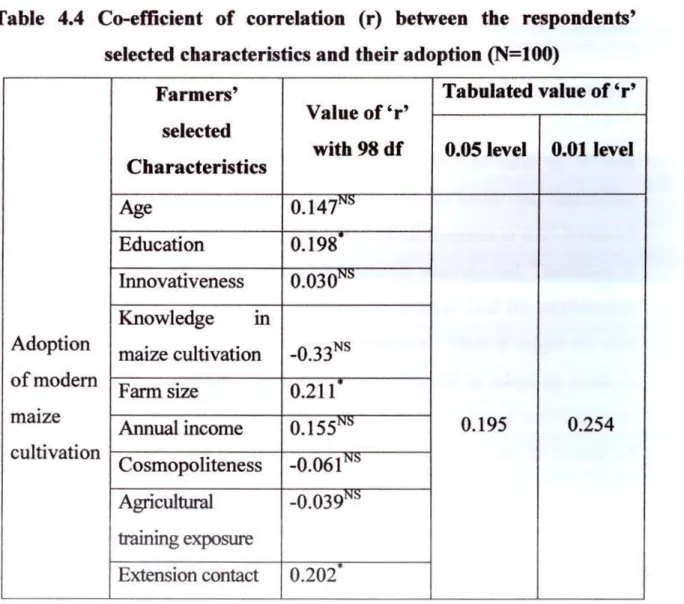
4.4 Co-efficient of correlation (r) between the respondents 55
selected characteristics and their adoption (N= 100)
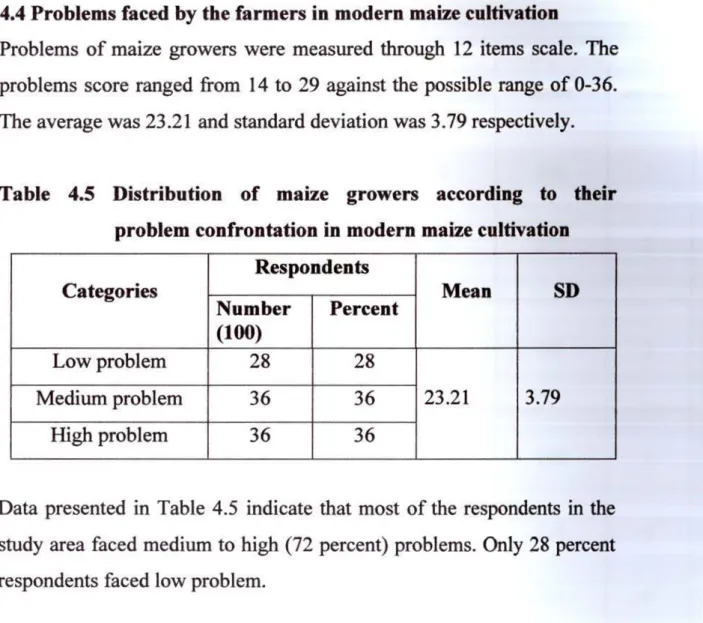
4.5 Distribution of maize growers according to their 61 problem confrontation in modern maize cultivation
4.6 Extent of problem in modern maize cultivation 62 LIST OF TABLES
A map ofDaudkandi Upazilla showing Sundalpur Union 28
FIGURE Page
The conceptual model of the study 25
A map of Comilla district showing Daudkandi Upazilla 27
LIST OF FIGURES
3.1
nc
Interview schedule 83
Correlation matrix showing interrelation among all 91 the variables (N=lOO)
LIST OF APPENDIX
The main objective of the study was to find out the extent of adoption of
modem maize cultivation by the farmers, to describe the selected characteristics of the maize growers and also to explore the relationships between the selected characteristics of the growers and their adoption of modem maize cultivation. The study was conducted in a union named Sundalpur under Daudkandi upazila of Comilla district. A total of 100 farmers
were selected as sample for the study from a population of 496. Data were collected from the maize growers by using personal interview schedule during the period from first January to 15 January, 2008. Apart from descriptive statistical methods, Pearson's Product Moment Correlation Co-efficient analysis was used in order to analyze the data. Findings indicated that the majority (65 percent) of the growers had medium to high adoption of modern maize cultivation while 35 percent had low adoption. Out of nine selected characteristics of the growers, three, namely education, farm size and extension contact, had positive significant relationship. The rest of the variables namely:
age, innovativeness, knowledge in maize cultivation, annual income, cosmopoliteness and agricultural training exposure did not show any significant relationships with their adoption of modern maize cultivation. Out of 12 problems faced by the farmers, two problems in order of importance were: (i) non-availability of hybrid seed and (ii) non-availability of storage facilities at framer's level.
ABSTRACT
:u.,. .... :...'..u' ADOPTION OF MODERN MAIZE CULTIVATION
By
Md. Alinur Masud
In order to face frequent food shortage and to save the heavy drainage of foreign currency required for importing of food grains, it is essential to increase agricultural production. It is not feasible to increase the agricultural production through expansion of cultivated area, because practically all the available arable land is now being used m crop production. So the most logical way is to raise the yields by adopting cropping intensity. These can be possible by practicing crop diversification, modern technology, high yielding variety (HYV), short duration crops and taking benefit of huge extension network.
The population of Bangladesh is 137 million with a growing rate of 1.48 percent per annum and 76.61 percent of the population live in the rural areas and its population density is 928 per sq. kilometres (BBS, 2005). It is Asia's 5lh and world's 7lh most populous country. The per capita
r
income is about$ 520 and its people have a life expectancy of 64.9 years (BBS, 2005).
enl Background:
is a developing country with an area of 1,47,570 sq.
kilometres. The major portion of the population lives in the rural areas and two-third of her labour forces (68.6 percent) is engaged in agriculture (BBS, 2001 ). The economy of the country is predominantly agrarian accounting for 21.91 percent of GDP (BBS-2005). So, Agriculture plays a vital role in employment, poverty alleviation, food security, standard of
living and increase of earnings.
INTRODUCTION CHAPrERl
During last few years farmers have widely adopted cultivation of HYV
maize in their farming system, it is now extensively used as poultry and animal feed. The people also consume roasted and fried maize. An enormously large number of small enterprises can be developed in maize growing regions to produce and sell this product and to create new opportunities of rural employment. Farmers of Bangladesh were not experienced in commercial maize cultivation. Now-a-days they have been influencing by the Govt. Organization and private organization to adopt modem maize cultivation technology. Maize can play an important role
along with other cereals in meeting future need of growing population. It has also some other benefits such as low production cost, high farm return, increase employment opportunity, supply poultry feed and industrial raw materials etc.
About 84% maize harvest is made in the Rabi season. Maize can be grown as intercrop or mixed crop with potato, sweat potato, chili, groundnut, tomato, etc.
is one of the important cereal crops in many developed and countries in the world. It is widely used in the developed es as a major source of carbohydrate for animal feed and as an
Strial raw material for wet and dry milling (Swami Nathan et al,
1982). It is the third major cereal crop after rice and wheat in Bangladesh.
Maize is grown all over Bangladesh specially in Lalmonirhat, Kurigram, Dinajpur, Rajshahi, Rangpur, Rangamati, Gaibandha, etc. Maize can grow throughout the year in the subtropical climate of Bangladesh. It is grows in three cropping seasons :(a) Rabi (Nov. - Feb), (b) Kharif-1 (March-June )and ( c )Kharif-2 (July-Oct).
3
Maize cultivation in Bangladesh has been increased through vanous interventions of the MOA, BARI, and Crop Diversification Program.
DAE-IMPP, BRAC, BADC and so many private organizations. At present various type of hybrid varieties are available in Bangladesh such as Pacific-11, Pacific -60, Kiron, Uttaron etc.
IMPP has promoting expansion of maize cultivation aJI over the country in successive phase. Now-a-days it has been operating in 200 Upazila's of 47 districts and the project period has been extended upto June 2005.
Northern area of Bangladesh is the main maize-producing zones.
Ghorarghat and Birol Upazila in Dinajpur, Hatibandha and Patgram Upazila in Lairnonirhat, Dhunat and Sherpur Upazlia in Bogra and the district of Chuadanga and Meherpur witnessed proliferation of maize cultivation (Ahmed, 2003).
Priority and importance were also given to undertake IMPP project 2nd
phase was started from July 1995 for implementation in 150 Upazila of 33 districts for maize for production.
bas always been considered as a minor crop in Bangladesh. But importance and potential of maize, the planning commission in recommended maize to be included in Crop Diversification (CDP). As a result, MOA developed a project entitle "integrated Promotion Project (IMPP)" and was under taken in august, 1991 1he assistance of United Nation Development Program (UNDP) and
States Agency for International Development (USAID).
Implementation of the project started in 124 Upazila of 21 districts in September 1992, and it was completed in June, 1995, it was 1st phase of
IMPP.
In the year 1999-2000, rice production were 4,74,000 tons from 3,78,000 hectare area, wheat l,25,000 tons from l,23,000 ha area and maize 40,75,000 tons from 3161 ha area and also in the year 2000-01 rice production were 5,16,000 tons from 3,84,000 ha of land, wheat 1,14,000 tons from 1, 14,000 ha and maize production where 103 5000 tons 4910 ha area respectively (BBS 2001). We found the popularity of maize among the farmers of Bangladesh is sharply increasing day by day. Maize varietals improvement in Bangladesh is mainly carried out by BARI, so far if released 11 improved maize verities including three hybrids. At present DAE, some NGOS and International organization like CIMMYT, F AO etc. have taken strong interest to support the maize production
Source: BBS. 2004.
Year Area (ha) Production (m, Ton) Yield (ton/ha)
1999-00 3161 4075 1289
2000-01 4910 10350 2107
2001-02 19979 64335 3220
2002-03 29070 117255 4033
2003-04 50050 241460 4824
Table 1.1 Maize production trends in Bangladesh
ion of hybrid maize has gained extensive popularity resulting of area and production. Area of maize cultivation has increased 50,050 hectare with annual production of 2, 41,460 m. tons grain
~-04 from merely 4,075 m. tons from 3,161 hectare in 1999-00.
1.1 indicates the increased area, production and yield of maize.
er, it has been meeting only about 45 percent of the national and. Much more need to be done to meet the total demand.
5
The study also aimed at finding out those factors, which facilitated as well as those, which caused barriers to the adoption of maize cultivation by the farmers.
1.2 Statement of the problem:
In view of the foregoing discussion, the investigator under took a piece of study entitled "Farmers' adoption of modem maize cultivation technologies" This research information are required which could be helpful to the policy maker, concerned bodies with the supply of inputs, technologies, knowledge and confronted with several problems having solution.
The area and production is increasing with an exponential rate (Agarawal, 2002). Higher yield up to 8-10 tons/ha can easily be obtained using hybrid seeds, balanced fertilizers and better management (Quayyum and Hoque, 1995 and Iqbal, 2001).
• productivity in the country seems to be highest in the Asian region with an average yield of 5. 73 tons/ha. This is due to favorable growing conditions during the maize season (October to March) and the increased use of hybrid seeds coupled with a number of improves production practices by the growers (Gonzalez, 2001).
in the country, public sector procurement of maize has been
!llW=t like rice and wheat in order to encourage farmers in maize ion. The efforts for increasing area and modem maize cultivation farmers.
1.4 Justification of the Study:
Maize cultivation is getting popularity among the farmers of Bangladesh by the introduction of new hybrid varieties coupled with growing market demand as well as poultry feed have opened a tremendous potentiality of maize. The government is also supporting this growth. Needless to say
1.3 Specific objectives:
The following specific objectives were set forth in order to proper direction to the study:
1. To identify and describe some selected characteristics of maize growers. The selected characteristics were:
(i) Age (ii) Education (iii) Innovativeness (iv) Knowledge in maize cultivation (v) Firm size (vi) Annual income (vii) Cosmopoliteness (viii) Agricultural Training exposure (ix) Extension contacts.
2. To explore the relationships between the selected characteristics of the farmers and their adoption of modem maize cultivation.
3. To describe the extent of problems faced by the farmers m adopting modem maize cultivation.
4. To determine the influencing factors of the adoption of modem maize cultivation by the farmers.
1. What is the adoption behavior of modem maize cultivation by the farmer?
2. What are the characteristics of maize growers?
3. Is there any relationship between the farmers' selected
characteristics and their adoption of modem maize cultivation?
4. What are the problems of adoption of modem maize cultivation?
purpose
of this study was to have answers to the following research7
1.6 Scope of the Study
The main focus of the study was to determine adoption of modem maize cultivation. The findings of the study will be specifically applicable to Comilla district. However, the findings will also have implications for other areas of the country having relevance to the socio-cultural context of the study area.
Views and options furnished by maize growers included in the sample selected those of the population of the study.
The respondents included in the sample for this study were competent enough to furnish proper responses to the queries included in the interview schedule.
The researcher who acted as interviewer was adjusted to social and environmental conditions of the study area. Hence, the data collected by him from the respondents where free from bias.
1.S Assumptions of the Study
An assumption is the supposition that an apparent fact or principle in true in the light of the available evidence (Good, 1945). The researcher has the following assumption in mind while undertaking this study:
The responses furnished by the respondents were reliable. They expressed the truth about their opinion and interest.
research is necessary to determine pattern of diffusion of modem cultivation in order to formulate long-term strategy on maize ction. As no research in the field of diffusion-adoption of this ology has been identified so far, the researcher deemed it a timely
~Aity to undertake the present study entitled "Farmer's Adoption of
1.8 Definition of Terms
Adoption: Adoption is the implementation of a decision to continue the use of an innovation. According to Rogers (1995) "Adoption is a decision to make full use of an innovation as the best course of action available".
When an individual takes up a new idea as the best course of action and 1. Population for the present study were kept confined within the heads of the maize growing farm families as because they were the major decision makers in the adoption of modem maize cultivation.
2. Characteristics of maize growers are many and varied but only ten were selected for investigation in this study as stated in the objectives. This was done to complete the study within limited resources.
3. The study was confined mainly to farmers' adoption modem maize cultivation technologies.
4. Facts and figures were collected by the investigator applied to the present situation in the selected area.
1. 7 Limitations of the Study
Considering the time, money and other necessary resources available to the researcher and to make the study manageable and meaningful, it became necessary to impose certain limitations as noted below:
investigator believes that the findings of the study will reveal the menon related to diffusion of innovation. These will be of special
.-;&'llii>JI. to the policy makers and planners in formulating and redesigning
extension programmes especially for maize cultivation. The findings expected to be helpful to the field workers of different nation building i-a...,,ents and organizations to develop appropriate extension strategies for effective working with the rural people.
9
Annual income: It referred to the total annual earning of the entire family member from agriculture and other non-agriculture sources (like services, business and day labour etc.) during a year. It expressed in taka.
Extension media contact: It referred to an individual's exposure to or contact with different communication media and sources and personalities being used for dissemination of new technologies among the farmers.
Education: Education referred to the development of desirable Knowledge, skill and attitude in the individual through reading, writing and other related activities. It was measured in terms of actual grades or class passed by a respondent.
Cosmopoliteness: The term cosmopoliteness referred to the maize growers mobility from their own village to another village, upazila and district.
Knowledge in maize cultivation: It referred to awareness of the rural farmers of land preparation, sowing time, sowing method, fertilizer and irrigation management, pest control, harvesting method, storage method, etc.
: Age of the respondent was defined as the period of time in actual from his birth up to the time of interviewing.
it, the phenomenon is known as adoption (Ray, 1991 ). In this , adoption was defined as the phenomenon of taking up a new idea
• ) and put it into practices by the farmers of Daudkandi upazila.
Modern Maize Cultivation: Modern maize cultivation referred as the cultivation of maize with the use of method or technique viz. sowmg method, application of fertilizer, use of variety, etc.
Problem faced: The term "Problem faced" refers to different problems faced by the farmers during maize cultivation.
Training exposure: It referred to the total number of days that a respondent received training in his entire life from different organization under different training programmes.
Maize production technologies: Maize production technologies referred to the different kind of technologies which were used for maize cultivation. In this study, technology was defined as the combination of four practices (i.e. variety, intercropping, recommended dose of urea and use of Sheller) used for maize cultivation.
Technology: The combination of all the management practices used for producing and otherwise managing of a given crop, crop mixture, livestock and other farm activities.
Farm size: It referred to the total area on which a farmers' family carries
on farming operation. The area is estimated in terms of full benefit to the farmer's family.
Innovativeness: It is degree to which an individual is relatively earlier in adopting innovations than other members of his social system (Rogers, 1983). This was comprehended by the quickness of accepting innovations by an individual in relation to others.
11
Rahman (2001) conducted an investigation on knowledge attitude and adoption of Aalok-620 I hybrid rice by the farmers of sadar upazila in Mymenshingh district. The study revealed that the majority (75 percent)
2.1 Review of relevant literature:
Hussen (200 I) conducted investigation on adoption of modem sugarcane cultivation practices by the farmers of Daweangonj Upazila in Jamalpur district. The study revealed that about ninety one percent (91 percent) of the farmers had medium adoption compared to 7 percent having low adoption and only 2 percent having high adoption of modem sugarcane cultivation practices.
researcher made and elaborated search of available literature for this
111e&rc.h. But no study could be found to be specially undertaken in this
direction. Therefore, attempt has been made in the present chapter to review some interlinked literature on this aspect from home and aboard.
The interlinked reviews conveniently presented on the major objectives of the study as far as possible. This chapter is divided into three major sections. The first section deals with review of relevant literature regarding adoption of modem maize cultivation by the farmers. The second section deals with past research findings relating to the relationship of farmers' adoption behavior with their selected characteristics. The conceptual framework of the study is presented in the third section.
REVIEW OF LITERATURE CHAPTER2
Sarker (1997) studied the extent of adoption of improved potato cultivation practices by the farmers in Comilla district. The study revealed that more than half (55 percent) of the respondents had medium Chowdhury ( 1997) conducted an investigation on adoption of selected BINA technologies by the farmers of Boura union in Mymensingh district. The study revealed that the majority (53 percent) of the respondents had no adoption of BINA technologies and 42 percent were adopted BINA technologies.
Rahman ( 1999) conducted an investigation on adoption of balanced fertilizer by the farmers of Ishargonj upazila in Mymensingh district. The study revealed that the majority (71 percent) of the respondents had medium adoption compared to 29 percent having below optimum level.
Podder (1999) concluded a research study on the adoption of Mehersagar Banana by the farmers. He found 47 percent of the respondents had medfum adoption compared to 14 percent having low and 39 percent high adoption.
(2002) conducted a study on adoption of modem agricultural logies by the farmers of Sandwip. The study revealed that 69 mcent of the farmers had medium adoption while 13 percent had low adoption and 18 percent had high adoption of modem agricultural technologies.
farmers had medium adoption while 18 percent and 7 percent had and low adoption in Aalok-6201 hybrid rice cultivation respectively.
Hossain (1991) studied the extent of adoption behavior of contact wheat growers in sadar upazila of Jamalpur district. He found that more than
13
Nikhade et al. (1993) observed on adoption of improved practices of soybean cultivation that cent percent adopted improved varieties. More than 82 percent had adoption of package practices like line sowing, spacing and intercultural operations. Partial adoption was observed in majority of the soybean growers (74.6 percent) with regard to recommended seed rate.
Hoque (1993) conducted an investigation on the adoption of improved practices of sugarcane cultivation in Sreepur upazila of Gazipur district.
The study revealed that 31 percent of the sugarcane growers had high adoption while 37 percent had medium and 32 percent had low adoption of improved practices in sugarcane cultivation.
Muttaleb (1995) studied the extent of the adoption of improved technologies of potato cultivation by the farmers in Haibatpur union under sadar thana of Jessore district. The study revealed that 8 percent of the potato growers had high adoption of improved technologies, 43 percent has medium and 49 percent had low adoption.
Dll08 (1995) studied the adoption of recommended dose of fertilizer found that 36.64 percent respondents used recommended dose of urea g percent used recommended dose of MP, 11.88 percent used T.S.P and only 2 respondents used gypsum in their potato cultivation.
·on compared to 23 percent having low adoption and 22 percent adoption of improved potato cultivation practices.
Rai Grover and Gangwar (I 989) conducted a study on identifying factors responsible for acreage substitution and low yield of maize. This study showed a general downward trend in area and productivity of maize in Haryana, India. It argued that maize acreage in given year was influenced by size of irrigated area, lag year maize acreage and lag year relative mcome.
Kariuka ( 1990) studied the economic impact of the adoption of hybrid
maize in Swaziland. The study revealed the sensitivity of hybrid maize
adoption to different farming systems and the limited usefulness of a partial analysis in evaluating the impact of innovations. A macro level cost-benefit analysis was used in an ex-post appraisal if impact of maize research, complemented by an ex-ante projection of the potential benefits and costs of its component maize breeding programme. Moderate increase in production cost would not effect the area of land devoted to maize, farm families are unlikely to produce beyond subsistence requirements without a considerable increase in output prices.
Bembridge and Williams (1990) studied the personal, sociological, socio-
psychological and communication characteristics that influence the adoption of maize practice in Farmer Support Programme in South Africa. The study revealed less than 50 percent of the farmers who adopted practices were implementing them according to recommendations and many did not have a clear concept that the practices were interrelated.
half (52 percent) of the growers had medium adoption of improved farm practices compared to 34 percent having low adoption and only 14 percent high adoption.
15
Hussen (2001) conducted a study, which concluded that age of the sugarcane growers had a significant negative relationship with their adoption of modern sugarcane cultivation practices. Rahman (1999) also found similar result in this study.
Rahman (2001) observed that there was no significant relationship between age and adoption of Aalok-6201 hybrid rice cultivation practices. Podder (1999) and Hossain (1999) are found similar results in their respective studies.
Sardar (2002) conducted a study on adoption of IPM practices by the farmers under PETRRA project of RDRS. He found that age of the farmers had a negatively significant relationship with their adoption of IPM practices.
Aurangozeb (2002) conducted a study on adoption of integrated homestead farming technologies by the rural women in RDRS. He found that there was a significant negative relationship between age and adoption of integrated homestead farming Technologies.
Age and adoption
Islam (2002) conducted a study on adoption of modem agricultural technologies by the farmers of Sandwip. He found that age of the farmers was not related to their adoption of modem agricultural technologies.
2.2 Review of the Studies Concerning the Relationship between Farmers' Characteristics and their Adoption.
Aurangozeb (2002) conducted a study on adoption of integrated farming technologies by the rural women in RDRS. He found that there was a positive relationship between education and their adoption on integrated farming technologies.
Sardar (2002) conducted a study on adoption of IPM practices by the farmers under PETRRA project of RDRS. He found that education of the farmers had a positive significant relationship with their adoption of IPM practices.
Education and adoption
Islam (2002) conducted a study on adoption of modem agricultural technologies by the farmers of Sandwip. He found that education of the farmers had a positive significant relationship with their adoption of modem agricultural technologies.
Hamid ( 1995) conducted a study on adoption of recommended sugarcane cultivation practices by the farmers. He found that age had a significant negative relationship with the adoption of recommended sugarcane cultivation practices.
Sarkar 1997) observed that there was no significant relationship between age of the farmers and their adoption of improved potato cultivation practices. Similar findings were observed by Singh (1989) and Kher(l 992) in their respective studies.
Chowdhury ( 1997) observed that the age of the farmers had no significant relationship with their adoption of selected BINA technologies.
17
Innovativeness and adoption behavior:
Rahman (2001) revealed that the highest proportion (63 percent) at the farmers had low innovations as compared to 22 percent medium innovativeness and 15 percent very low innovativeness.
Krishna (1969) conducted a research study on the adoption of hybrid maize in Karimnagar, India. He found significant negative relationship between the education of the respondents and their adoption of hybrid maize.
Chowdhury ( 1997) found a positive significant relationship between the education of the farmers and their adoption of selected BINA technologies. Similar results were found by Barkatullah (1985), Ali et al.
(1986), Hoque (1993), Bashar (1993) Khan (1993), Pal (1995) and Sarkar (1997) in their respective studies.
Rahman (2001) conducted a study on knowledge, attitude and adoption of the farmers regarding Aalok-6201 hybrid rice in sadar upazila in Mymensingh district. He found that academic qualification of the farmers had a significant positive relationship with their adoption regarding Aalok-6201 hybrid rice.
1msen (2001) conducted a study on farmers' knowledge and adoption of modem sugarcane cultivation practices. He found that education of the growers had a positive significant relationship with their adoption of modem sugarcane cultivation practices.
ices by the farmers under PETRRA project ofRDRS. He found that farm size of the farmers had a positive significant relationship with their adoption of IPM practices.
Farm size and adoption
Islam (2002) conducted a study on adoption of modem agricultural technologies by the farmers of Sandwip. He observed that farm size of the farmers had a positive significant relationship with their adoption of modem agricultural technologies.
Agricultural knowledge and adoption
Sarkar ( 1997) found that potato production knowledge of potato growers had a positive and significant relationship with their adoption of improved potato cultivation practices. Ali et at. (1986), Muttaleb (1995) and Rahman (1995) observed similar results in their respective studies.
Hossain ( 1999) found a positive significant relationship between innovativeness of the farmers and their adoption of fertilizer and also observed no relationship with adoption of pesticides.
Islam (2002) conducted a research study on adoption of modem agricultural technologies by the farmers of Sandwip. He found that innovativeness of the farmers had significant and positive relationship with their adoption of modem agricultural technologies.
Aurangozeb (2002) observed that there was significant relationship between innovativeness and adoption of integrated homestead fanning technologies.
19
Annual income and adoption
Sardar (2002) conducted a study on adoption of IPM practices by the farmers under PETRRA project of RDRS. He found that the annual income of the farmers had no relationship with their adoption of IPM practices.
Chowdhury ( 1997) conducted a research on adoption of selected BINA technologies by the farmers. He indicated that farm size of the farmers had a strongly positive significant relationship with their adoption of selected BINA technologies. Rahman (1986), Okoro et al. (1992), Khan (1993). Hoque (1993) and Sarkar(l 997) observed similar results in their respective studies.
Hussen (2001) conducted an investigation on adoption of modern sugarcane cultivation practices by the farmers' of Dewangonj upazila in Jamalpur district. He observed that there was a significant positive relationship between farm size of the farmers and their adoption of modern sugarcane cultivation practices.
Ranman (2001) conducted an investigation on knowledge, attitude and adoption of Aalok-6201 hybrid rice by the farmers of sadar upazila in Mymenshigh district. He observed that there was a significant positive relationship between farm size of the farmers and their adoption of Aalok-6201 hybrid rice.
Aurangozeb (2002) conducted a study on adoption of integrated homestead farming technologies by the rural women in RDRS. He found that there had no relationship between homestead area and their adoption of integrated homestead farming technologies.
Chowdhury ( 1997) found a significant and positive relationship between annual income and adoption of selected BINA technologies. Rahman (1986), Okoro et al. (1992), Islam (1993), Khan (1993), Sarker (1997) observed similar result in their respective studies.
Islam (2002) conducted a study on adoption of modem agricultural technologies by the farmers of Sandwip. He observed that the annual income of the farmers had no relationship with their adoption of modem agricultural technologies.
Hussen (2001) conducted an investigation on adoption of modem sugarcane cultivation practices by The farmers of Dewangonj upazila in Jamalpur district.He observed that there was a significant positive relationship between annual income of the farmers and their adoption of modem sugarcane cultivation practices.
Rahman (2001) conducted an investigation on knowledge, attitude and
adoption of Alok-6201 hybrid rice fry the farmers of sadar upaziia in Mymensingh district. He observed that there was a significant positive relationship between annual income of the farmers and their adoption of Alok-6201 hybrid rice.
mangozeb (2002) conducted a study on adoption of integrated estead fanning technologies by the rural women in RDRS. He found that there was a positive significant relationship between annual income of the respondents and their adoption of integrated homestead farming Technologies.
21
Aurangozeb (2002) conducted a study on adoption of integrated homestead farming technologies by the rural women in RDRS. He found that cosmopoliteness of the respondents had a significant positive relationship with their adoption of integrated homestead farming technologies.
Hussen (200 I) conducted an investigation on adoption of modem sugarcane cultivation practices by the farmers of Dewangonj upazila in Jamalpur district. He observed that there was a significant positive relationship between cosmopoliteness of the farmers and their adoption of modem sugarcane cultivation practices.
Cosmopoliteness and adoption
Rahman (2001) conducted an investigation on knowledge, attitude and adoption of Aalok-620 l hybrid rice by the farmers of sadar upazila in Mymenshigh district. He observed that there was a significant positive relationship between cosmopoliteness of the farmers and their adoption of Aalok-620 I hybrid rice.
Tolawar and Hirevenkaragouder (1989) studied on factors of adoption of poultry management practices. They revealed that the farmers having high income tend to own bigger size of poultry unit and possess more knowledge of improved practices leading to higher level of adoption.
Kunzra et al. (1989) studies on Adoption of green fodder production as related to some characteristics of livestock owners. They revealed that adoption of green fodder production was positively and significantly correlated with the annual income of livestock owners.
Aurangozeb (2002) conducted a study on adoption of integrated homestead farming technologies by the rural women in RDRS. He found that there was a positive significant relationship between contact with extension media of the respondents and their adoption of integrated homestead farming technologies.
Extension contact and adoption
Islam (2002) conducted a study on adoption of modem agricultural technologies by the farmers of Sandwip. He found that extension media, contact of the farmers had no significant relationship with their adoption of modem agricultural technologies.
Islam (2002) conducted a study on farmers' knowledge and adoption of ecological agricultural practices under the supervision of Proshika. He found that agricultural training exposure of the farmers had no significant relationship with their adoption of ecological agricultural practices.
Training and adoption
Rahman (2001) observed in study that training received of the farmers had a significant and positive relationship with their adoption regarding Aalok-6201 hybrid rice.
Chowdhury ( 1997) found that there was no significant relationship between the farmers' cosmopoliteness and their adoption of selected BINA technologies. Similar results were observed by Hossain (1991) and Islam ( 1986) in their respective studies.
(1999) found a positive significant relationship between cosmopoliteness of the farmers and their adoption of fertilizer. Pal (1995), Haque (1993), Khan (1993), Islam (1986) and Halim (1985) observed similar results.
23
Heong (1990) observed that the lack of adoption of IPM technologies in rice was frequently attributed to lack of sufficient extension.
Nahar (1996) found that there was a significant positive relationship in agricultural knowledge on farm women in homestead farming and their level of contact with information sources.
Sarker (1997) observed a positive and significant relationship between extension contact and adoption of improved potato cultivation practices.
Kashem et al. (1990). Kher (1992), Pal (1995), Islam (1993), Haque ( 1984) also found the similar results in their respective studies.
Hussen (2001) conducted an investigation on adoption of modem sugarcane cultivation practices by the farmers of Dewangonj upazila in Jamalpur district. He observed that there was a positive significant relationship between extension contact of the farmers and their adoption of modem sugarcane cultivation practices.
Sardar (2002) conducted a study on adoption of IPM practices by the farmers under PETRRA project of RDRS. He observed that contact with
RDRS personnel of the farmers had a positive significant relationship with their adoption of IPM practices.
Rahman (2001) conducted an investigation on knowledge, attitude and adoption of Aalok-6201 hybrid rice by the farmers of sadar upazila in Mymensingh district. He observed that there was a significant positive relationship between extension contact of the farmers and their adoption of Aalok-6201 hybrid rice.
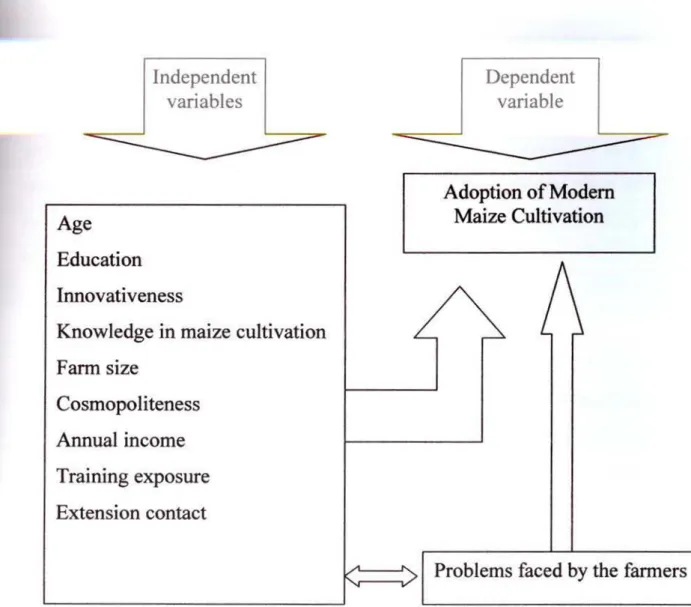
This study expected that farmers' adoption of modern maize cultivation as dependent variable, which was influenced by selected characteristics of the farmers as independent variables viz. age, education. innovativeness, knowledge m maize cultivation, farm size, Annual mcome, cosmopoliteness, training exposure and extension contact. The conceptual model of the study has been presented in figure 2. 1
The conceptual framework of Rosenberg and Hovland (1960) was kept in mind while framing the structural arrangement for the dependent and independent variables.
2.3 The Conceptual Framework of the Study
Adoption is a decision to make full use of innovation as the best course of action available (Ray, 1991 ). When an individual takes up a new idea as the best course of action and practices, this phenomenon is known as adoption. The present study tried to focus two concepts: first adoption of
maize production technologies by the farmers and the second their selected characteristics. A dependent variable may be influenced and affected through interacting forces of many characteristics in his surrounding. It is impossible to deal with all characteristics in a single study.
Fig. 2.1 The conceptual model of the study
Problems faced by the farmers
25
Adoption of Modem Maize Cultivation
Dependent variable
Cosmo politeness Annual income Training exposure Extension contact
Knowledge in maize cultivation Farm size
Innovativeness Age
Education
Independent variables
3.1 The Locale of the Study:
A Union named Sundalpur in Daudkandi Upazilla under comilla district was purposefully selected due to easy communication as well as easy contact with the maize growers' of the study area. This Upazilla is situated at about 35 Km west of Comilla town and according to the guidance of the research supervisory committee one Union with maize as the more cultivated crop were to be the study area of the present research.
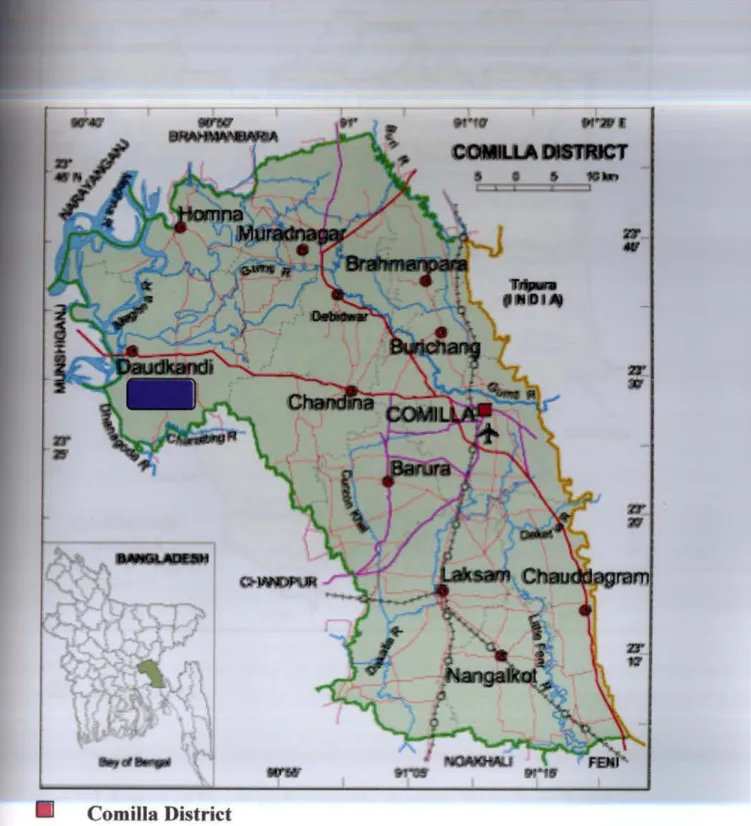
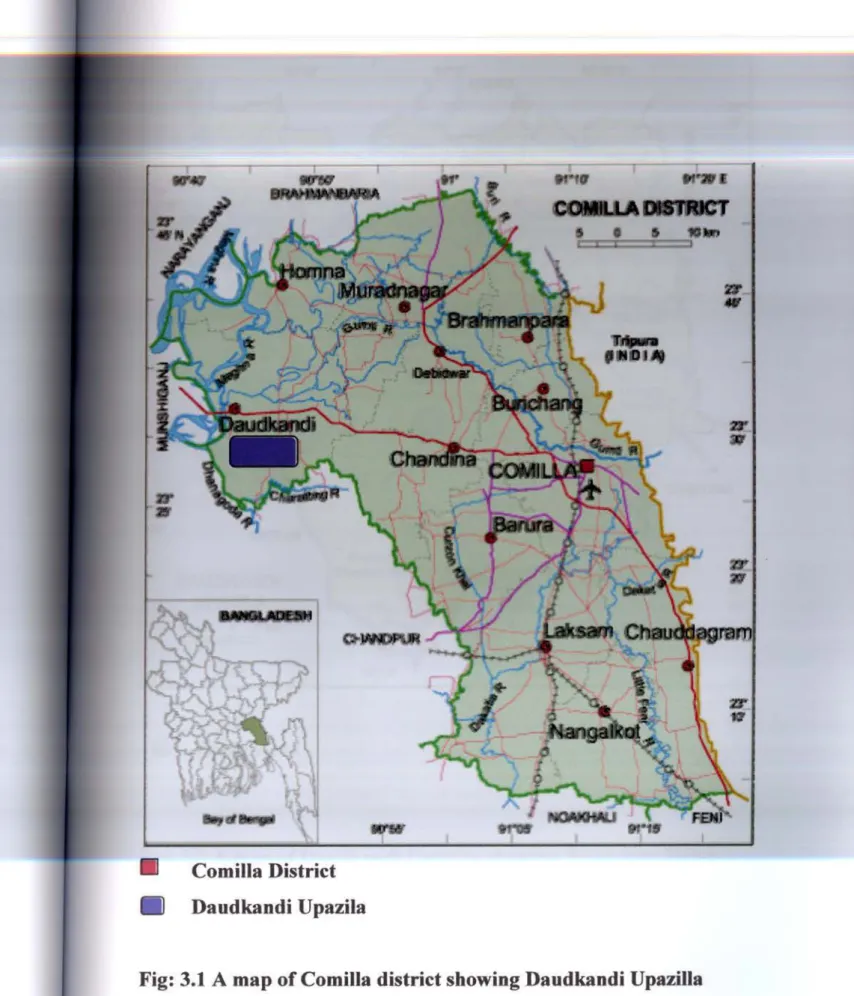
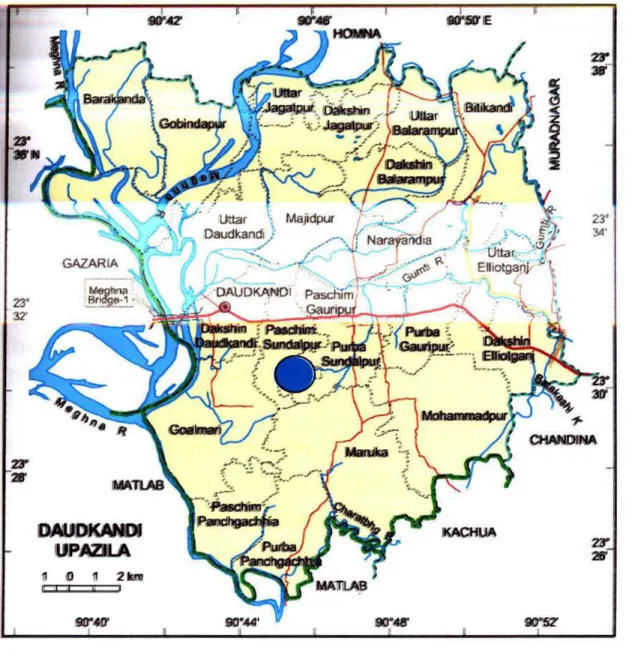
The selected Union is about 4km from the Daudkandi Upazilla head quarter. A map of Comilla district and the study area has been presented in fig 3 .1 and 3 .2 respectively.
Methodology deserves a very careful consideration in conducting scientific research. Importance of methodology in conducting any
research cannot be undermined. Methodology enables the researcher to collect valid and reliable information and to analyze them properly to arrive at correct decisions. Keeping this point in view, the researcher took utmost care for using proper methods in all the aspects of this piece of research work. Methods and procedures followed in conducting this study bas been described in this chapter.
MEmODOLOGY
CHAPTER-3
• ..
• ..
27
Fig: 3.1 A map of Comilla district showing Daudkandi Upazilla
Ill
Comilla District• Daudkandi Upazila
.. •
caas• ••H&C T
I I I • ..,
...
.,., ..
Fig: 3.1 A map of Comilla district showing Daudkandi Upazilla
• Comilla District
• Daudkandi Upazila
...
21"
•
.. •
. . . ... ....,
.,., ..
28
Fig: 3.2 A map of Daudkandi Upazilla showing Sundalpur Union
• Study Area
23•
32'
,,,..,E
23·
34'
Appropriate schedule was also developed to operationalize the selected characteristics of the maize growers. The draft interview schedule was prepared in English version and was pre-tested with maize growers. This pre-test facilitated the researcher to examine the suitability of different questions and statements in general. The interview schedule may be seen at Appendix-A.
3.3 Instrument for Data Collection:
In order to collect reliable and valid Information from the maize growers, an interview schedule was prepared carefully keeping the objectives of the study in mind. The interview schedule contained both open and closed form questions.
3.2 Populations and Sampling Design:
All the maize growers of the selected Union were the population of the study. A list of the farmers of this Union was prepared with the help of Md. Monoar Hossen, Sub Assistant Agriculture Officer, Upazilla Agricultural office; Daudkandi, Comilla. The total numbers of maize growe