MANAGEMENT IN SELECTED AREAS OF DAUDKANDI UPAZILLA UNDER
CUMILLA DISTRICT
MD. HABIBUR RAHMAN
Department of Agricultural Extension and Information System Sher-e-Bangla Agricultural University
Dhaka-1207
DECEMBER, 2020
MANAGEMENT IN SELECTED AREAS OF DAUDKANDI UPAZILLA UNDER
CUMILLA DISTRICT
BY
MD. HABIBUR RAHMAAN REG. NO: 18-09205
Submitted to the faculty of Agriculture, Sher-e-Bangla Agricultural University, Dhaka
In partial fulfillment of the requirements for the degree of
MASTER OF SCIENCE IN
AGRICULTURAL EXTENSION AND INFORMATION SYSTEM Semester: July-December, 2020
Approved By:
Mohammad Zamshed Alam
Professor & Chairman
Department of Agricultural Extension & Information System Sher-e-Bangla Agricultural University Dhaka-1207 Prof. Md. Mahbubul Alam, PhD
Supervisor
Department of Agricultural Extension and Information System
Sher-e-Bangla Agricultural University Dhaka- 1207
Prof. Md. Abul Bashar Co-Supervisor
Department of Agricultural Extension and Information System
Sher-e-Bangla Agricultural University Dhaka- 1207
Sher-e-Bangla Agricultural University
Sher-e-Bangla Nagar, Dhaka-1207
CERTIFICATE
This is to certify that the thesis entitled “Use of ICT by the Fishermen for Fish Farm Management in Selected Areas of Daudkandi Upazilla under Cumilla District” submitted to the Faculty of Agriculture, Sher-e-Bangla Agricultural University, Dhaka, in partial fulfillment of the requirements for the degree of Master of Science in Agricultural Extension and information system, embodies the result of a piece of bona fide research work carried out by Md. Habibur Rahman, Registration No. 18-09205 under my supervision and guidance. To the best of my knowledge, no part of the thesis has been submitted for any other degree or diploma.
I further certify that any help or source of information, received during the course of this investigation has been duly acknowledged.
Dated: December, 2020 Dhaka, Bangladesh
--- Prof. Md. Mahbubul Alam, PhD Supervisor
Department of Agricultural Extension and Information System
Sher-e-Bangla Agricultural University Dhaka-1207
“Dedicated to My Beloved Wife, Respected Parents
And
Affectionate
Daughter “Mashkura ”
I
All praises are to the ‘Almighty Allah, Omnipresent and Omniscient, who enabled to me accomplish of this research work.
The author reckons at first a great pleasure and honor to express his heartfelt gratitude, deepest sense of appreciation, best regards and profound indebtedness to his research supervisor, Prof. Md. Mahbubul Alam, PhD, Department of Agricultural Extension and Information System, Sher-e-Bangla Agricultural University, Dhaka for his scholastic guidance, continuous supervision, valuable suggestions and instructions, in completion of the research work as well as in preparing this manuscript.
The author is highly indebted and grateful to his respective teacher and co-supervisor, Prof. Md. Abul Bashar, Department of Agricultural Extension & Information System, Sher-e-Bangla Agricultural University, Dhaka for his helpful comments and suggestions, sincere encouragement, heartfelt and generous cooperation in improving the manuscript.
The researcher reckons special thanks to Mst. Nazma Akter Upazilla Fisheries Officer of Daudkandi upazilla for her cordial support and also deems his heartfelt gratitude to Md. Abdullah al Mamun, Assistant Upazilla Fisheries Officer of Daudkandi upzaila.
The researcher is grateful to Mawlana Ebrahim, Hafez Mawlana Farid, Md. Aziz Ullah, and Md. Zamil Hossain for their cordial help during the data collection of the study.
The author likes to extend cordial thanks to his elder brother Razeul Islam Razu and thanks to his friends especially Shohel, for their kind co-operation, valuable advice during his study.
Finally, the researcher expresses his thanks gratefulness to all of his well-wishers and parents.
The Author
II
ACKNOWLEDGEMENTS...I TABLE OF CONTENTS... II-III LIST OF TABLES………...IV LIST OF FIGURES...V LIST OF APPENDICES...V LIST OF ABBRERVIATIONS...VI ABSTRACT ... VII
1 INTRODUCTION ... 1
1.1 Background of the Study ... 1
1.2 Statement of the Research Problem ... 3
1.3 The Research Questions ... 4
1.4 Objectives of the Study ... 5
1.5 Scope and Significance of the Study ... 5
1.6 Assumptions of the Study ... 5
1.7 Limitations of the Study ... 6
1.8 Definition of Important Terms ... 6
2 REVIEW OF LITERATURE ... 10
2.1 Concept of Information and Communication Technology (ICT) ... 10
2.2 Use of ICT in Fisheries Sector ... 11
2.3 ICT use Constraints ... 14
2.4 Factors Influencing the Use of ICT ... 15
2.4.1 Age and the use of ICT tools ... 15
2.4.2 Education and the use of ICT tools ... 16
2.4.3 ICT use experience and the use of ICT tools ... 17
2.4.4 ICT ownership and the use of ICT tools ... 17
2.4.5 Usefulness of using ICT tools ... 18
2.4.6 Use of ICT by the Farmers ... 19
3 METHODOLOGY ... 23
3.1 Research Design ... 23
3.1.1 Locale of the study ... 23
3.1.2 Population and sampling frame... 24
3.1.3 Instrument for data collection ... 25
3.1.4 Collection of data ... 25
3.1.5 Variables of the study ... 25
3.2 Measurement of Variables ... 26
III
3.3 Data Analysis ... 29
3.3.1 Editing ... 29
3.3.2 Coding and tabulation ... 29
3.3.3 Categorization of data ... 29
3.3.4 Method of data analysis ... 29
4 RESULT AND DISCUSSION ... 30
4.1 Respondents Characteristics and Descriptive Statistics ... 30
4.1.1 Age ... 31
4.1.2 Level of education ... 31
4.1.3 Annual family income ... 32
4.1.4 Farming experience ... 33
4.1.5 Communication exposure ... 33
4.1.6 Fisheries training received ... 35
4.1.7 ICT possession ... 36
4.1.8 Usefulness of using ICT tools in fish farm management ... 36
4.2 Use of ICT tools by the Fisherman in Fish Farm Management ... 38
4.2.1 Significant relationship of level of education in use of ICT by the fishermen for fish farm management in Daudkandi upazilla under Cumilla district ... 41
4.2.2 Significant relationship of communication exposure by the fishermen for fish farm management in Daudkandi upazilla under Cumilla district ... 41
4.2.3 Significant relationship of ICT possession by the fishermen for fish farm management in Daudkandi upazilla under Cumilla district ... 42
4.3 Barriers faced by the fish farmers in using ICT tools ... 42
5 SUMMARY OF FINDINGS, CONCLUSIONS AND RECOMMENDATIONS 44 5.1 Summary of the Study ... 44
5.1.1 Selected factors that influence farmers use of ICT tools in fish farm management ... 44
5.1.2 Use of ICT tools by the fish farmers ... 47
5.2 Conclusions of the Study... 47
5.3 Recommendation of the Study ... 48
5.3.1 Recommendation for policy formulation ... 48
5.3.2 Recommendation for further study ... 49
APPENDIX- A... 60
IV
LIST OF TABLES
Table 4.1 The salient features of the selected characteristics of the fish
farmers………..30
Table 4.2 Distribution of the farmers according to their age………...31
Table 4.3 Distribution of the farmers according to their education ... 32
Table 4.4 Distribution of the fish farmers according to their annual income ... 32
Table 4.5 Distribution of the farmers according to their farming experience ... 33
Table 4.6 Distribution of the farmers according to their Communication exposure ... 34
Table 4.7: Distribution of the farmers according to Communication exposure……...35
Table 4.8 Distribution of the farmers according to their training exposure ... 35
Table 4.9 Distribution of the farmers according to their ICT Possession ... 36
Table 4.10 Distribution of the fish farmers according to their Usefulness of using ICT ... 37
Table 4. 11 Distribution of the fish farmers according to their Usefulness of using ICT tools………...………38
Table 4.12 Distribution of the farmers according to their use of ICT tools…………38
Table 4.13: Distribution of the fish farmers according to their use of ICT tools…….39
Table 4.14: Multiple regression co-efficient of the selected characteristics of the Fish Farmers with their use of ICT for Fish Farm Management………...40
Table 4. 15 Distribution of the fish farmers according to the barrier faced by them...42
V
LIST OF FIGURES
Figure 2.1 Conceptual framework of the study…………...22
Figure 3.1 Map of Cumilla district showing Daudkandi upazilla………23
Figure 3.2 Map of Daudkandi upazilla showing study area ………24
Figure 4.1 Barrier faced in using ICT tools for fish farm management………43
LIST OF APPENDICES APPENDIX- A An English Vesion of Interview Schedule ………..……..60
VI UFO Upazilla Fisheries Officer
AUFO Assistant Upazilla Fisheries Officer UFEO Upazilla Fisheries Extension Officer BBS Bangladesh Bureau of Statistics FAO Food and Agriculture Organization GO Governmental Organisation
GDP Gross Domestic Product GPS Global Positioning Systems IT Information Technology
ICT Information and Communication Technology MEAS Modernizing Extension and Advisory Services NGO Non-Governmental Organisation
SPSS Statistical Package for Social Science
TAM Technology Acceptance Model
VII DISTRICT
MD. HABIBUR RAHMAN ABSTRACT
The study was conducted to determine the extent of use of ICT by the fishermen for fish farm management, to determine the extent to which the selected factors influence fish farmer’s use of ICT for fish farm management and to identify the barriers are faced by the fish farmers in using ICT tools for fish farm management in selected areas of Daudkandi upazilla under Cumilla district. Two unions namely Baro para and Gouripur of Daudkandi upazilla were randomly selected as research area under Cumilla district. Data were collected from 103 randomly selected fish farmers from the study areas, through personal interview by the researcher himself during October 25 to November 25, 2020. Data were analyzed by Multiple Regression analysis using SPSS 25.0. Age, education, fish farm size, fish farming experience, communication exposure, fisheries training received, ICT possession, usefulness of use ICT tools were the selected variables for the study. Data indicates that that majority of the respondents’ (38.8%) use of various ICT were found less while one-third of them 33% use moderately. A little more than one-fourth of the respondents (28.2%) use ICT tools for fish farm management. Majority (86.4%) of the fish farmers in the study area were of middle to young aged This study found that middle to young aged fish farmers is more interested and engaged in fish farming and their high use of ICT in fish farming. (63.1%) of the fish farmers’ education level varied from primary to secondary levels. Thus, it can be said that the high education level, more interested and used of ICT for fish farming. Concerning the barrier, ‘high cost of ICT tools’ was most frequently reported by fish farmers followed by ‘lack of ICT training and ICT infrastructure. Findings revealed that, level of education, communication exposure and ICT possession had positive and significant contribution to the use of ICT for fish farm management which constitutes 67.4% (R2 = 0.674) of the variances. Thus, the study concludes with the recommendation to enable favorable environment to promote use of ICT tools in receiving fish farming information.
1 CHAPTER-I 1 INTRODUCTION
1.1 Background of the Study
Information and communications technology (ICT) is an extensional term for information technology (IT) that stresses the use of communications and the integration of telecommunications (telephone lines and wireless signals) and computers, as well as necessary enterprise software, storage and audiovisual, that enable users to access, store, transmit, and manipulate information. (Benard and Dulle 2017). This can also be referred to as the digital infrastructures like mobile, computers, laptops, internet, you tube, face book, twitter etc. which generate information to others (Kuhlmann, 2005). Digital and other electronic technologies are transforming our economies, societies and people’s lives. Technology has had an especially profound impact on the information and communications activities that have always been central to sustainable development. Information communication technology (ICT) facilitate communication and information processing by electronic means that includes radio, television telephone, mobile phone, computers and the Internet. (Ajani, 2014)
New ICT are being used across the sector in fisheries, from resource assessment, capture or culture to processing and commercialization. (Jensen, 2007). Some are specialist applications such as sonar for locating fish. Others are general purpose applications such as Global Positioning Systems (GPS) used for navigation and location finding, mobile phones for trading, information exchange and emergencies, radio programming with fishing communities and Web-based information and networking resources. (Donner, 2009). A wide range of technologies can be adapted and introduced in all but the most remote communities and once appropriated by users, can have positive impacts on their lives. Food and livelihoods security issues and the lack of extension support for fishers and fish farmers can be addressed through information networks. New opportunities can emerge from combining mobile and newer networking technologies (Mlozi, et al., 2012).
Programmers and policies supporting further development of ICT in fishing communities and across the sector more broadly must link effectively between relevant stakeholders
2
from local to international, levels, be designed to cater truly for the needs of the poor and lead towards more responsible fisheries. Information and communications technologies are a fundamental development tool to support information sharing, collaboration and dialogue leading to increased participation and ownership (Donner, 2009).
ICT in the fisheries sector are emerging fields focusing on enhancing fisheries and rural development. It involves applications of innovative ways to use ICT in the rural domain.
The advancement in ICT can provide accurate, timely, relevant information and services to the fish farmers, thereby facilitating an environment for a more remunerative fisheries sector. However, all the ICT initiatives are not uniform with disparities between regions in the level and quality of telecommunications, information and the effort of individuals, public and private organizations, and differentiated nature of demand of the fish farmers in different areas. As a result, there have been many successes, failures, lessons learned and experiences gained, so far. While these initiatives are intended to address the needs of the farmers through ICT, their actual usage and their ability to bring significant impact on the fish farm productivity and socio-economic development of the intended beneficiaries use the facilities provided for them meaningfully to meet their needs (MEAS Project January 2013).
The common problems in the use of ICT in rural segments are ICT illiteracy, availability of relevant and localize contents in their languages, easy and affordable access and other issues as awareness and willingness for use of new technologies among the rural peoples etc. (Sofìa Reino, et al., 2011). Most of the fish farmers of Bangladesh are still lack of information and modern fisheries knowledge. Most fish farmers need easy access to information like elements, availability and access, of information like element, availability, access and utilization. ICT that creates opportunities for rural fish farmers to obtain information and knowledge about market, fisheries issues, problems and suggest how to develop the fisheries market. Mobile services in the fisheries sector provide more information on the market, weather, transport service and fisheries techniques that help to contact the agencies and department (Aker, 2011).
Being located in South Asia, Bangladesh has a young and rapidly growing population of 164 million (BBS January 2014). With more than 30 percent of the citizens living below
3
the poverty line, the country’s GDP per capita ranks among the lowest in the world. The economy mainly depends on agriculture and the production of apparel and garments with little development of other industries. However
,
favorable demographic and macro- economic trends, high economic growth rates (6.3 percent in 2012) and a relatively liberal investment climate have convinced (Goldman Sachs and JP Morgan) to identify Bangladesh as one of the most attractive emerging economies. Despite having 50 years of history the government has only from 1997 officially recognized the potential of the Bangladeshi ICT industry and its impact on the economy That is why; it is considered as one of the most serious threats to fisheries production with its potential negative aspects on human health, food security, agriculture, fisheries, biodiversity, water, economic activities and other natural resources (NCSA, 2007). The impacts of climate variability, change and extreme events will lead to severe stress on overall development, environment and human well-being.1.2 Statement of the Research Problem
The major constraints to fish farming were identified as those of environmental impacts of aquaculture operations: water pollution (Olagunju, et al., 2007), inadequate supply of fingerlings, inadequate information, and feeds supply (Olagunju et al., 2007).
Information and communication technology (ICT) is enhancing the capacity building of different communities. As one of the big community farmers in Bangladesh, the fishermen are facing different problems and hindrances to enhance their income.
Fisheries productivity can be increased in Bangladesh through the usage of ICT among fishermen. It could bring changes in economic development and enhance the quality of life especially in fishermen communities. Fish farmers face many financial and economic problems in the use of ICT. Similarly, many fishermen do not take an interest in using ICT (Hosseini et al., 2012). There are many other factors observed such as lack of interest of ICT service providers in rural areas and low quality of service as major causes of not using ICT tools among fishermen community. The fishermen community does not have proper access to connect directly with the market due to a lack of proper usage of computers and mobile phones (Odada et al., 2004) and (Omar, et al., 2011) indicated that fishermen are facing many problems 4 and hindrances in ICT usage including the
4
expensive cost particularly computer and sonar. Fishermen still depend on the traditional way having no exposure towards ICT usage and ICT benefits. They cannot judge the status of the trade and could decide whether to sale cannot judge the status of the trade and decide whether to sale cannot judge the status of the trade and decide whether to sell their product or to remain at sea to continue fishing. The fishermen hesitate to learn about ICT from experts. (Fowler & Etchegary, 2001) revealed that mobile phones were still relatively expensive for poor farmers and fishermen. In addition to the cost of the phone itself, maintenance factors such as recharging the phones are also important considerations in developing country's regions (Fowler & Etchegary, 2001). (Munyua, 2007) indicated in the Bangladesh context that uncoordinated ICT initiatives have created several problems including the high cost of the technology, poor ICT connectivity, skills and lack of local contents. Furthermore, there is a lack of information sharing culture and low awareness of ICT use in development at all levels. These issues raise the questions of finding out the appropriate ICT tools. While mobile phones may be suitable for certain aspects of improving the lives of the community, similarly other technologies such as radio or internet could play an equally important complementary use in significant changes of the recent world. We could say that media strongly presented important use in human development. Unfortunately, in most fishing communities, empowerment projects are not habit of think about ICT tools as a pivotal component toward this change.
1.3 The Research Questions
Based on the above approach, this study was conducted on the basis of the following research questions:
i. What are the selected factors that influence fish farmers to use ICT in fish farm management?
ii. What extent do fish farmers use ICT tools for fish farm management?
iii. What is the significant influence of the selected factors on fish farmer’s use of ICT for fish farm management?
iv. Which barriers are faced by the fish farmers in using ICT tools for fish farm management?
5 1.4 Objectives of the Study
In view of the aforesaid research questions, the following objectives were formulated:
i. To determine and describe the socio-economic characteristics of the respondent fish farmers
ii. To determine the extent of use of ICT by the fish farmers for fish farm management
iii. To determine the extent to which the selected factors influence fish farmer’s use of ICT for fish farm management.
iv. To identify the barriers faced by the fish farmers in using ICT tools for fish farm management.
1.5 Scope and Significance of the Study
This research will especially help the fish farmers to know how to use the different ICT tools for fish farm management. It will planners, policymakers, and concerned people learn about the use practices of ICT taken by various level fish farmers against conventional cultivation method. This will help the policy-planners planners prepare a plan to increase the farmers’ income, food security, and well-being in response to modern technology in the field level. It will also make the concerned people aware of thinking about various alternatives to adapt ICT tools with the problems faced by traditional tools.
1.6 Assumptions of the Study
Assumption is the supposition that an apparent fact or principle is true in the light of available evidences (Goodman, 2005). An assumption is taken as a fact or belief to be true without proof. The following assumptions have been taken into consideration for the present following study. The respondents are involved in furnishing proper responses to the questions contained in the interview schedule.
i. The interviewers have to be well adjusted to the social and cultural environment of the study area.
ii. Opinions furnished by the respondents are representative of the whole population of the study.
iii. The respondents should have given accurate and current information.
iv. The interviewers should be able to rate the responses of the fish farmers with adequate precision.
v. The data are normally and independently being distributed.
6 1.7 Limitations of the Study
This study fulfills the requirement of the Masters of Science (MS) in Agricultural Extension & Information System. It is exploratory and the study covered only one upazilla (i.e., Daudkandi) due to limited resources, time and financial constraints. The findings will show the impact of ICT tools use in Daudkandi upazilla. It is held that the result generated from this study is relevant to many areas of the county and other countries that have similar information and communication technology and adaptation pattern. Other limitations are as follows:
i. The study is confined to flood plain land area of Daudkandi upazilla under Cumilla district.
ii. Several data collecting methods, scales and statistical tests have been utilized to measure the use of ICT over a relatively short period of time.
iii. For information about the study, the researcher has to depend on the data furnished by the selected respondents during the interview with them.
iv. Level of knowledge of the respondents is also a barrier to the study.
v. The conceptual framework of the study emphasizes the use of ICT in the locality. It may not be applicable in all other areas of Bangladesh.
1.8 Definition of Important Terms
For clarity of comprehension certain the accompanying terms frequently used all through the study are characterized and defined in alphabetical order:
Information and Communication Technologies (ICT)
ICT refer to communication technologies that include computers, the Internet, geographical information systems, mobile phones, and the traditional electronic media like radio, television and e-newspaper. In this study, any computer-mediated communication media and applications such as mobile phones, Internet, social media, digital information repositories, ICT-assisted call centers, digital photography, web or mobile apps, and blogs are considered. (Ajani, 2014; Balaji, et al., 2007)
Internet
The Internet is interconnected between of thousands of networks and millions of computers using standardized communication protocol (TCP/IP). It is a network of a computer networks that connects billion of webpages. The Internet carries many
7
information resources and services, such as e-mail, apps, shopping, instant messaging, music, videos, and news. (Mohanty & Mishra, 2020)
Computer
Computer is a programmable electronic device that processes data and convert data into useful information. It performs high-speed processing of numbers. (Norton, 2008)
ICT ownership
ICT ownership refers to a respondent’s possession of ICT devices like mobile phones, computers, laptops, the Internet.
Age
Age of the respondent was characterized as the timeframe from his birth to the time of interview.
Level of education: Level of education of an individual farmer was defined as the formal education received up to a certain level from an educational institute (e.g. school, college and university) at the time of interview.
Communication
Communication is a process in which participants create and share information with one another in order to reach a mutual understanding. This definition implies that Communication is a process of convergence (or divergence) as two or more individuals exchange information in order to move toward each other (or apart) in the meanings that they ascribe to certain events (Valente & Rogers, 1995)
Group Media
Group media defines as the recurrence of exposure of the respondents to various group of information, for example, group discussion meetings, farm demonstration meeting, method demonstration meetings and result demonstration meetings.
Individual Media
Individual media defines the recurrence of respondents' presentation to various individual information sources, for example, neighbors, companions, relatives, extension workers, local leader, and so on.
8 Information Sources
The term information sources define the media or channels through which different data are diffused among the farmers on various aspects including crops, livestock, fisheries, education and other similar matters.
Mass Media
The mass media are the mean of communication or instrument or device through which messages are transmitted towards a generally extensive, heterogeneous, and mysterious crowd inside a moderately shorter coordinated structure the source of people's gathering.
Mass media incorporated into the study were radio, TV, internet, face book/tweeter, you tube etc.
Organizational Participation
Is characterizes as a relationship of two or more persons which have no less than one face to face meeting per year. Cooperation in an association defines to his participating in the association as general member, executive member or executive officer.
Social Media
Social media is defined by (Kaplan & Heinlein, 2009) as a group of Internet-based applications that build on the ideological and technological foundations of Web 2.0, and allow the “creation and exchange of user-generated content.
Mobile phone
A portable telephone that sends and receives radio signals through a network of short- range transmitters located in overlapping cells throughout a region, with a central station making connections to regular telephone lines. Also called cellular telephone, mobile phone. A small telephone that people can take with them and use outside their homes called also mobile phone, (chiefly US) cellular phone, (US, informal) cell, (British) mobile.
Technology
The branch of knowledge that deals with the creation and use of technical means and their interrelation with life, society, and the environment, drawing upon such subjects as industrial arts, engineering, applied science, and pure science. The application of this knowledge for practical ends. Scientific or industrial process, invention, method, or the like. The sum of the ways in which social groups provide themselves with the material
9
objects of their civilization. The purposeful application of information in the design, production, and utilization of goods and services, and in the organization of human activities
ICT Perceived usefulness
ICT perceived usefulness is one of the independent constructs in the Technology Acceptance Model (TAM). This was defined by Fred Davis defined this "the degree to which a person believes that using a particular system would enhance his or her job performance". It means whether or not someone perceives that technology to be useful for what they want to do.
10 CHAPTER-II
2 REVIEW OF LITERATURE
An attempt was made in this Chapter to represent a brief review of related research information to evaluate the extent of use of ICT in Baro para and Gouripur union under Daudkandi upazilla of Cumilla district in Bangladesh. Since, the literature review forms a linkage between past and present research works related to problem that helps an investigator to draw a satisfactory conclusion. A few research works on the use of ICT in farming practices by the farmers of studied area have been reviewed according to the following sequences:
2.1 Concept of Information and Communication Technology (ICT)
Murray, et al., (2011) conducted investigation on Information and communications technology (ICT) is an another/extensional term for information technology (IT) which stresses the use of unified communications and the integration of telecommunications.
Alam & Uddin (2018) investigated on ‘Use of information and communication technologies by the farmers in receiving agricultural information’. The purposes of the study were to determine the extent of use of Information and Communication Technologies (ICT) by the farmers in receiving agricultural information in Homna upazilla under Cumilla district and to explore the contribution of selected characteristics of respondents with their ICT use in receiving agricultural information
Achora, Mwije & Masabo (2019) conducted an investigation on Use of information communication technologies in conservation agriculture knowledge pathways among smallholder farmers in Machakos and Laikipia countries, Kenya. The main objective of this study was to analyse the use of ICT for Conservation Agriculture knowledge among smallholder farmers in Machakos and Laikipia counties, Kenya.
Alkhaldi & A. N. (2016) conducted a study on the broadness of ICT covers any product that will store, retrieve, manipulate, transmit or receive information electronically in a digital form, e.g., personal computers, digital television, email, robots. For clarity, Zippo provided an ICT hierarchy where all levels of the hierarchy "contain some degree of
11
commonality in that they are related to technologies that facilitate the transfer of information and various types of electronically mediated communications.
Alam (2015) showed that 89.7 percent of the respondents had no use to low use of Cell Phone for receiving agricultural information and 10.3 percent of the respondents had medium use to high use of Cell Phone for receiving agricultural information at Singair upazilla of Manikganj district in Bangladesh.
Uddin (2015) revealed that about two third (64.5%) of the respondents had medium use of ICT in receiving agricultural information compared to 13.6 % and 21.8 % having low and high use of ICT in receiving agricultural information respectively at Homna upazilla of comilla district in Bangladesh.
Ahmed (2012) conducted a study on Utilization and effectiveness of ICT for disseminating agricultural technologies among the farmers
Gakuru, et al., (2009) noted that in Tanzania, building on the utility of mobile phones as recording tools, listening devices, money-makers, and catalysts for dialogue, community radio stations are incorporating mobile technology into programming and it is being used for advisory services in agriculture.
Ajani (2014) conducted a study on Promoting the use of information and communication technologies (ICT) for agricultural transformation in Sub-Saharan Africa: Implications for policy. Information and communication technologies (ICT) have the potential to reach many farmers with timely and accessible content.
2.2 Use of ICT in Fisheries Sector
Fisheries are a branch of agricultural science. E-agriculture (sometimes written e- agriculture or referred to as ICT in agriculture) is a relatively recent term in the field of agriculture and rural development practices. Consistency in the use of this term began to materialize with the dissemination of results from a global survey carried out by the United Nations (UN). Food and Agriculture Organization (FAO, (2006) conducted in late by the of the United Nations found that half of those who replied identified "e agriculture" with information dissemination, access and exchange, communication and
12
participation processes improvements around rural development. In contrast, less than a third highlighted the importance of technical hardware and technological tools.
Benard, Dulle & Lamtane (2018) conducted a study on the influence of ICT usage in sharing information on fish farming productivity in the southern highlands of Tanzania.in the southern highlands of Tanzania Benard. The use of ICT in sharing information is very important in enhancing fish farming productivity among fish farmers. However, little is known on the between the use of ICT and fish farming productivity in the southern highlands of Tanzania.
Benard and Dulle (2017) conducted a study on application of ICT tools in communicating information and Knowledge to artisanal fishermen communities in Zanzibar. Results showed that artisanal fishermen need information on weather conditions, modern fish capturing methods, market and marketing and fish preservation and processing. The study also found that mobile phones and radio are the most ICT tools used by the artisanal fishermen. The findings also revealed that communicating information and knowledge through ICT tools was limited by lack of funds, poor network connectivity, lack of training and seminars on the use of ICT in accessing information and poor coverage on radio and television transmission.
Mangstl (2008) conducted a study on emerging issues, priorities and commitments in e- agriculture. Here E-agriculture, therefore, describes an emerging field focused on the enhancement of agricultural and rural development through improved information and communication processes. More specifically, e-agriculture involves the conceptualization, design, development, evaluation and application of innovative ways to use information and communication technologies (ICT) in the rural domain, with a primary focus on agriculture (e-Agriculture Community of Practice) In 2008, the United Nations referred to e-agriculture as "an emerging field" with the expectation that its scope would change and evolve as our understanding of the area grows.
Akinbile & Alabi (2010) conducted a study on use of ICT among fish farmers in Oyo state. This is through improving capacity of fish farmers with the use of Information Communication Technologies (ICT). In determining the use of ICT among
13
fish farmers in Oyo State, one hundred and twenty respondents were interviewed for the study.
Gakuru, et al., (2009) conducted a study on innovative farmer advisory services using ICT. Many ICT in agriculture or e-agriculture interventions have been developed and tested around the world, with varied degrees of success, to help agriculturists improve their livelihoods through increased agricultural productivity and incomes, and reduction in risks. Agriculture Network Information Centre has to be formed for providing internet access to quality, authoritative agriculture information, and specialized reference services. Seamless integration of GIS, SRS and GPS etc. holds the key for effective utilization of spatial technologies to solve agriculture problem. Unlike most science and technology disciplines, agriculture has a mechanism for distilling and distributing research to those who need it.
Aphunu & Atoma (2011) conducted a study on extent of use of ICT by fish farmers in Isoko Agricultural Zone of Delta State, Nigeria. The study examined the extent of use of ICT by fish farmers in Isoko agricultural zone of Delta State. The respondents were well aware of and used the telephone (GSM), television and radio for their contacts and enquiries, report preparation and information search. However, use of ICT facilities was constrained by the problem of maintenance, low level of production and rural poverty.
Training to increase technical efficiency of farmers on ICT use and maintenance, and establishing appropriate policies to reduce rural poverty remain instrumental towards ICT use by fish farmers.
Akinbile & Alabi (2010) conducted a study on use of ICT among fish farmers in Oyo state. The need to reduce the import bill on fish through improved fish farming in order to meet its increasing demand led to enhancement of local production. This is through improving capacity of fish farmers with the use of Information Communication Technologies (ICT).
Jensen (2007) conducted a study on the digital provide: information (technology), market performance and welfare in the South Indian fisheries sector’. When information is limited or costly, agents are unable to engage in optimal arbitrage. Excess price dispersion across markets can arise, and goods may not be allocated efficiently. In this setting, information technologies may improve market performance and increase welfare.
14
Between 1997 and 2001, mobile phone service was introduced throughout Kerala, a state in India with a large fishing industry. Using micro level survey data, we show that the adoption of mobile phones by fishermen and wholesalers was associated with a dramatic reduction in price dispersion, the complete elimination of waste, and near-perfect adherence to the Law of One Price. Both consumer and producer welfare increased. The importance of ICT is also recognized in the 8th Millennium Development Goal, with the target to "make available the benefits of new technologies, especially information and communications technologies (ICT) to the fight against poverty (World Bank, 2019).
2.3 ICT use Constraints
Van Wart, et al., (2017) conducted a study on integrating ICT adoption issues into (e-) leadership theory. Telematics and Informatics. Constraints are the element which hinders in doing some activities or operations in a certain field. It is the negative factor which not only reduces production but also hinders the way of adaptation.
Benard, Dulle & Lamtane (2019) conducted a study on challenges associated with the use of information and communication technologies in information sharing by fish farmers in the Southern highlands of Tanzania. It was found that the most frequently used ICT by fish farmers in sharing agricultural information were mobile phones, radio and television. Also, the study revealed that major challenges facing fish farmers in sharing information include unfavorable radio or television broadcasting time, high cost of acquiring and maintenance of ICT facilities, lack of training on ICT, poor network connectivity and low level of literacy. Moreover, it was further found that there was negative significant relationship (P < 0.05) between challenges associated with the use and degree of ICT usage by fish farmers.
Asif, Farouque, Rahman, & Rana (2018) conducted a study on constraints of using information and communication technologies by young entrepreneurs for farm management. The main purpose of the study was to investigate the constraints of using information and communication technologies (ICT) by the young entrepreneurs in farm management. The study was conducted in four randomly selected villages of Trishal and Fulbaria upazilla under Mymensingh district.
15
Gelb, et al., (2008) conducted a study on adoption of ICT enabled information systems for agricultural development and rural viability. In ICT adoption workshop at the IAALD-AFITA-WCCA conference. There were continued references to the multitude of barriers to ICT use throughout the workshop discussions. The following lists several – not necessarily specific to fisheries sector or rural communities they include-
a. The lack of physical and human resource infrastructure which was repeatedly cited as a major impediment. Comments identifying wireless connectivity as an alleviating factor for example did not contribute to the understanding of this issue since wireless facilities need infrastructure as well. Infrastructure was related to technology in general.
b. Too much innovation can be an obstacle by blocking the use of older technologies which can often be more effective and/or by imposing an unacceptable cost.
c. ICT use based on working within communities takes longer in many cases because of the lack of understanding and awareness of the needs and challenges of small-scale fish farmers, lack of understanding what ICT can do including unexpected deviations from initials fish farmer and community expectations.
d. Ensuring leadership within the political and governmental environment.
e. Developing leadership and agents of change at all levels including communities.
f. Sharing ICT use funding including public/private partnership.
g. Sharing details of successful projects including business opportunities and their benefits.
2.4 Factors Influencing the Use of ICT 2.4.1 Age and the use of ICT tools
Abraham (2006) revealed that age had significant contribution to the impact of using ICT tools by the fish farmers for fish farm management.
Ajani (2014) reported that there was negative significant relationship between the age of the fish farmers and the level of use of different ICT tools for fish farming purposes by them.
16
Ogutu, et al., (2014) who reported that there was significant positive correlation between the age of the farmers and their participation in ICT based market information service projects for accessing to agricultural market information.
Ahmed (2012) it was observed that there was no significant relationship between age of the farmers and ICT utilization in agriculture by them.
Aker (2011)) noticed that the age of the farmers was a significant factor inversely influencing the use of ICT tools by them. It was observed in the study that the use of ICT tools for agricultural transactions was greater among the younger farmers.
Ali (2011) noticed that age of the farmers had no significant relationship with adoption of mass media-based information for decision-making in vegetable cultivation.
Duncombe (2011) it was revealed that age of the farmers had no contribution to the adoption of ICT by the farmers.
Goodman (2005) observed that at least two types of ICT media were used by most of the respondents aged between 21 to 60 than respondents of other ages.
Mlozi, et al., (2012) reported that the younger farmers had more exposure to ICT usage and courses than the older farmers.
Pandian (2002) found that farmers‟ age had direct positive effect between age of the farmers and effect of use of video education on knowledge retention
2.4.2 Education and the use of ICT tools
Alam (2015) found that education showed significant and positive relationship with their use of cell phone.
Uddin (2015) found that education had significant contribution on their use of ICT media.
Abraham (2006) revealed that level of education had significant contribution to the impact of using ICT by the farmers.
Mollah (2006) observed in his study that education of the farmers had significant positive relationship with the rice production technologies.
17
Anisuzzaman (2003) concluded that the education of the farmers had significant positive relationship with their use of information and communication media.
Nuruzzaman (2003) in his study observed that education of the farmers had significant positive relationship with their use of mass media.
Pandian (2002) found that education of the farmers had direct positive effect on the effect of video education on knowledge retention.
2.4.3 ICT use experience and the use of ICT tools
While the author did not find any direct study of the relationship between mobile phone use experience and extent of ICT use in agriculture extension discipline, anecdotal evidence suggests, users skill increases over time with using of a particularly technology.
He becomes more familiar with the technology. Therefore, their extent of use is expected to be higher with times. Considering this analogy, this study formulates the hypothesis that past experiences positively influence users to use ICT more for their work.
2.4.4 ICT ownership and the use of ICT tools
A microwave-radio telephone system installed in the remote region of Tumaca, Columbia, along with community access points resulted in better trade and market opportunities (Lio and Liu, 2006). Rural telephone and community radio services initiated in India and Sri Lanka had received a positive response from farmer communities (James, 2004).
The International Institute of Communication Development (IICD) at Manobi, an African telecom company have initiated a collaborative program to help the farmers of Burkina Faso, Ghana, Mali, Uganda and Zambia gain access to market price information via text messages. Wireless Application Protocol (WAP), or the mobile internet as well as personal computers and personal digital assistants (PDA). Also, Village Phone Program (VPP) of Grameen Bank of Bangladesh successfully converted telephones into production goods by lowering transaction costs (Bayes, 2001).
Use of mobile phones help farmers to make decisions much more easily than without mobile phone and farmers got, exchanged, and manipulated information quickly by using mobile phone. The ownership of mobile phones by agricultural stakeholders had widely
18
spread and increasingly assist to overcome isolation and made communication among rural people easier. Mobile phones are, therefore, becoming increasingly important to agro-based entrepreneurs as an infrastructural device for improving efficiency of agriculture markets and contributing to empowerment (Mlozi, et al., 2012).
Mobile phones are becoming increasingly important to agro-based entrepreneurs as an infrastructure service for improving efficiency of agriculture markets, hence contributing to female farmers empowerment. Mobile phones helped them to easily obtain agricultural information when they needed. Moreover, other evidence found that farmers having mobile phone can decide the best time to sell crops and livestock as they could get instant information on prices at different market places (Ashraf, et al., 2005).
It can be assumed that smart phone users are most interested in communicating with extension agent than the farmers who have featured phone. Most of the farmers use internet in their phones. It also can be assumed that the people who have their own device are more fluent to communicate with the extension workers and for other activities.
2.4.5 Usefulness of using ICT tools
Many studies showed that the access of communication technologies have impact on the economic, poverty reduction as well as agriculture development. The use of mobile phones could increase the efficiency of farmers by affordable access of communication technologies in rural areas of developing countries. The study was conducted in Bangladesh indicated that use of mobile phones increased access of information among men and women and improved their living standard (Abraham, 2006; Aker, 2008;
Galperin & Mariscal, 2007; Jensen, 2007, Bhavnani, et al., 2008).
Role of ICT in agricultural production on Africa reported that ICT played a significant role in a country’s development. (Horestone, 2012). The main objective of that paper was to assess if at all on the proliferation of ICT of the African continent had any significant impact on agricultural production. The results found that ICT played significant role in enhancing agricultural production while mobile phones remain a significant contributor to agricultural growth. The result also found that certain socio-economic characteristics such as higher education level and skills were prerequisites for effective improvement in agricultural production due to the adoption and utilization of new technologies. Other
19
evidence suggested that there was a strong relationship between usefulness of ICT and influence of using ICT in agriculture (Dixon, 2009).
Farmers had the real need to access about market information, land records and services, accounting and farm management information, management of pests and diseases, rural development programs and hence ICT could help accessing those services. ICT projects dealing such services are extremely limited. ICT help farmers to get timely information yet availability of ICT is remained limited (Meera, et al., 2004).
Research conducted in Ghana reported that mobile phones stimulate the development of agricultural information and advisory services which positively impact farmers’ income and agricultural production (Kora, 2010).
Result from India shows that ICT helped farmers in receiving clear and focused services, simple and user friendly, accurate and timely information, well organized and easy to find agricultural information (Kataria, 2015). Furthermore, ICT would enable extension workers to gather, store, retrieve and disseminate a broad range of information needed by small producers such as information on best practices, new technology, better prices of inputs and outputs, better storage facilities, improved transportation links, collective negotiations with buyers, information on weather. Emergence of new agricultural development paradigms challenge the conventional methods of delivering important services to citizens. ICT had been developed as a tool for achieving meaningful societal transformation, which was believed to provide a reliable network in agricultural sector.
ICT had been utilized as an extension tool, which has enhanced the information flow between agricultural extension services and their clients (D’ Silva, et al., 2010).
Therefore, it may be concluded that with the increase of perceived usefulness of using ICT, respondents’ use of ICT will increase.
2.4.6 Use of ICT by the Farmers’
Aminuzzaman, et al., (2003) observed a study on induction of ICT as a strategic tool for agricultural development and reported that ICT helped farmers in crops production by using clear and focused services but the main limitations to the adoption of ICT in agriculture appeared to lie in the education levels and cultural backgrounds of rural communities, as well as a lack of motivation stemming from the farmers’ perception of
20
the scant usefulness of ICT and their limited digital skills. Connectivity was another important obstacle, despite regional advances.
The overall goal or expected outcome of this research is to see the potential of modern ICT to improve yields and income, and to disseminate knowledge to farmers to help them manage risk in an informed manner. Modern ICT can play a role in bridging the information gap, and in reducing the information asymmetry that exists between farmers and between regions. The delivery of information through mobile phones has the potential to deliver localized content rapidly, and can thus enhance the dissemination of knowledge and information on technologies, inputs, markets and prices, and help in better risk management. This can act as a catalyst to enable better adoption of improved technologies, seed varieties, and farming practices (Mittal, 2009).
Action Aid (2011) defines the list of basic conditions for successful farming: land, water, farming inputs (seeds, breeds, farm tools and equipment, sustainable fertilizers and pesticides), extension services and training, credit and financial services, etc. If these three observations are taken as facts, modern ICT can be used as an efficient tool to enable non-progressive farmers to connect to extension information and to make them adopt technology faster. ICT can play an important role in the adoption of technologies that are in an early stage of development like no tillage and the genetically modification technology revolution (Fischer, et al., 2009).
Meera, et al., (2004) reported that farmers had the real need to access about market information, land records and services, accounting and farm management information, management of pests and diseases, rural development programmers and ICT could help accessing these services. They found that ICT helped farmers to get timely information however sufficient availability of ICT facilities was limited. ICT can help to exchange market information, weather report and business information. By the blessings of technology, the farmers can directly contact with the brokers or agent to sell their products. One of the perceived benefits of modern ICT is greater access to information about marketing prices. It is expected that price information will have a beneficial impact by improving the bargaining power of farmers with traders. Thus, enabling them to realize better prices and by reducing arbitrage, wastage or spoilage (Mittal, et al., 2010).
21
Jensen (2007) found that the introduction of mobile phones decreased price dispersion and wastage by facilitating the spread of information for fishermen in Kerala. Both consumer and producer can be benefitted by using ICT. A produce may find the most profitable channel of selling products and consumers can compare the products’ price across markets and decide about their shopping. The farmers who had no mobile phone were facing many problems in selling their products and getting market related information in comparison to mobile phone users. In rural areas most of the farmers cannot contact with the agricultural experts due to lack of communication. These people mostly depend on conventional methods of communication like personal contact, bulletin boards, price charts. Often, they failed to obtain necessary information when needed.
Thus, accurate and timely information remains as one of the main problems especially for the smallholder farmers (Duncombe, 2011).
2.5 Conceptual Framework of the Study
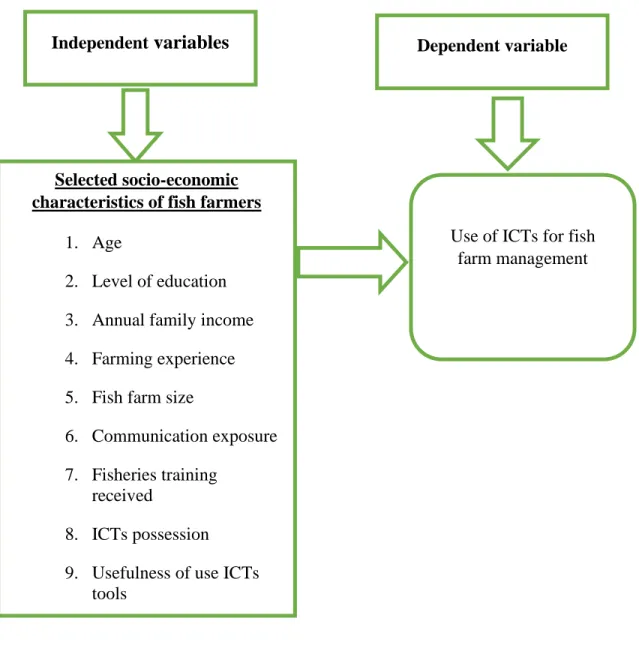
Conceptual framework is the foundation for understanding the research issues and linkage among different variables. It helps as guiding principles for analyzing the research issues. It also helps easy visualization of the relationship between the dependent and independent variables. The study tried to focus towards use of ICT by the fish farmers for fish farm management. A dependent variable may be influenced and affected through interacting forces of many characteristics in his surroundings.
The conceptual framework of Rogers and Schoemaker (1971) were kept in mind while fish framing the structural arrangement for the dependent and independent variables. This study expected use of ICT by the fish farmers for fish farm management as dependent variable, which was influenced by selected socio-economic characteristics of the fish farmers as independent variables viz. age, level of education, annual family income, farm size, farming experience, fisheries training received, communication exposure, ICT possession, usefulness of uses ICT and barrier in adopting ICT tools for fish farm management. Now the conceptual model of the study has been presented in the Figure 2.1
.
22 Independent variables
Selected socio-economic characteristics of fish farmers
1. Age
2. Level of education 3. Annual family income 4. Farming experience 5. Fish farm size
6. Communication exposure 7. Fisheries training
received
8. ICTs possession 9. Usefulness of use ICTs
tools
Figure 2.1 Conceptual framework of the study
Figure 1Figure 2.1 Conceptual framework of the study
Dependent variable
Use of ICTs for fish farm management
23
3 METHODOLOGY
This chapter describes the procedures and methods used in this study. This chapter is divided into three sections. The first section describes the overview of research design. The second section describes the measurement of variables. Finally, the third section describes the methods applied in data analysis.
3.1 Research Design 3.1.1 Locale of the study
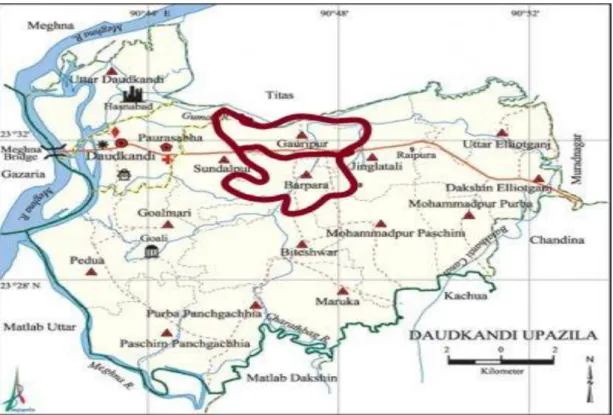
Cumilla district is selected purposively as it is potential district of Bangladesh for fisheries practices. There are twelve upazillas in Cumilla district, among Daudkandi upazilla were selected purposively. The study was conducted in two unions namely Baro para and Gouripur. These unions were selected purposively because farmers of these areas are comparatively conventional method followers. Prior to selecting these unions, a thorough discussion with the concerned GOs and NGOs personnel and local elites was conducted by the researcher to contact targeted farmers. (Figure 3.1 and 3.2 show the map of the locale of the study).
Figure: 3.1 Map of Cumilla district showing Daudkandi upazilla
24
Figure: 3.2 Map of Daudkandi upazilla showing study area 3.1.2 Population and sampling frame
Fishermen using ICT for fish farm management in Daudkandi upazilla under Cumilla district constituted the population of the study. The list of all the fish farmers in Daudkandi upazilla was collected. Thus, a total of 235 fish farmers were constituted the population of this study. Data were collected from the sample rather than whole population due to time and fund constraints. Fish farmers were selected randomly and proportionately from the villages as the sample by using a random number table.
Thus, 103 fish farmers were selected as the sample for this study using an online sample determination application. Data collection was conducted only once they willingly agreed to participate in the survey voluntary. Distribution of population, sample size and pre-test sample are shown in the Table 3.1.
Table 3.1 Population and sample of this study
Union Population Sample size Pre-test sample
Baropara 135 65 4
Gouripur 100 38 3
Total 235 103 7
25
Since the reasons for study were to test the hypotheses and measure the variances, a cross-sectional survey strategy was operationalized for this study. Henceforth, data was gathered utilizing an organized meeting plan. Remembering the targets, the study adjusted approved estimation things from earlier investigations, at whatever point conceivable. The beforehand prepared interview schedule was prettied and vital adjustments were completed. In most instances, closed form questions were used.
Approved estimation of each construct with their literature sources was exhibited in an English version of the interview schedule as joined in Appendix-A.
3.1.4 Collection of data
Data for this study were collected through personal interview by the researcher himself period from 25th October to 25th November, 2020. The interview schedule prepared earlier by the researcher was used to gather information. All possible efforts were made to explain the purpose of the study to the respondents to get valid and pertinent information from them. Interviews were conducted with the respondents at their fish farm. While starting the interview with any respondent, the researcher took all possible care to establish rapport with them so that they did not feel uneasy or hesitant to furnish proper responses to the questions and statements in the schedule.
The questions were explained and clarified whenever any respondent felt difficulty in understanding properly. None of the fish farmers was interviewed from the reserve list during final collection of data.
3.1.5 Variables of the study
Two variables were used for this study:
1. Dependent variable: It is a variable that is the result or outcome or effect of other variables. This variable is often known as criterion or outcome variable. The dependent variable's value depends on the other variables' value, that is, independent variable. In this study, use of ICT tools for fish farm management by the fish farmers was considered as the dependent variable.
2. Independent variable: It is a variable that the researcher can control over or manipulate to predict another variable (i.e., dependent variable). Therefore, this variable is often called as predictor variable or causal variable. In an experimental setting, a researcher wants to manipulate the variable or introduce new variable to see
26
training received, ICT device ownership, usefulness of using ICT tools barrier in adopting ICT tools were considered as independent variables.
3.2 Measurement of Variables
Variables are two types. These are discussing in the below:
3.2.1 Measurement of independent variables 3.2.1.1 Age
Age of the fish farmers refers to the period of time from his birth to the time of interview. It was measured in terms of actual years on the basis of his response to item No. 1 of the interview schedule (Appendix A).
3.2.1.2 Education
The education of a respondent was measured by the number of years of successful schooling. A score of one (1) was assigned for each year of schooling completed. For example, if a respondent completed study up to class five, his education score was assigned as 5.
The knowledge status of a respondent who could sign only was assigned a score of 0.5 while illiterate fish farmers were assigned a score of 0. Besides, if a respondent did not go to school but studied at home and if his knowledge status was equivalent to a formal school education.
3.2.1.3 Fish farm size
Farm size of a respondent referred to the total area of land on which he carried out the fish farming operation, the area being in terms of full benefit to him. The term refers to the fish farm area either owned by the respondent or culture fish on share-farming lease or taking from other including homestead pond. It was measured in hectares for each respondent using the following formula:
FS = A + B + 1
2 (C + D) + E Where, FS = Fish farm size,
A = Homestead Pond,
27 C = Pond taken from others as borga D = Pond given to other as borga, E =Pond taken from others on lease,
The data was first recorded in terms of local measurement unit i.e., decimal and then converted into a hectare. The total area, thus, obtained is considered as his fish farm size score (assigning a score of one for each hectare of land). This variable appears in item number three (3) in the interview schedule as presented in Appendix -A.
3.2.1.4 Fisheries training received
Training of a respondent was measured by the total number of days for which a respondent attended in different training programs on fish farming. If a respondent takes training for 7 days, he will get 7 scores. This variable appears in item number ten (10) in the interview schedule as presented in Appendix -A.
3.2.1.5 Communication exposure in fish firming
Communication exposure was measured as one’s extent of contact to different information sources. Each respondent was asked to indicate his nature of contact for each of 14 selected media with five alternative responses was prepared for the respondents. Following scores were assigned for each of 14 media.
Extent of exposure Score Assigned
Never 0
Rarely 1
Occasionally 2
Often 3
Regularly 4
Thus, the communication exposure scores of fish farmers could range from 0 to 56.
Where ‘0’ indicated no exposure and 56 indicated very high media contact. This variable appears in item eight (8) in the interview schedule as presented in Appendix- A.
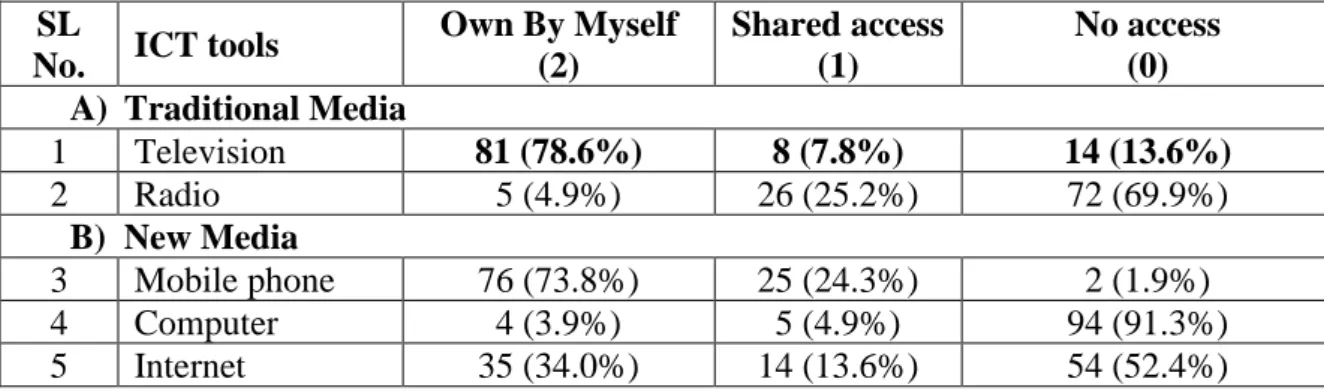
3.2.1.6 ICT possession
The ICT possession score of a respondent was computed on the basis of his possession of the number and type of ICT devices. This considered both self and shared access. Scores for ICT possession were assigned as follow: