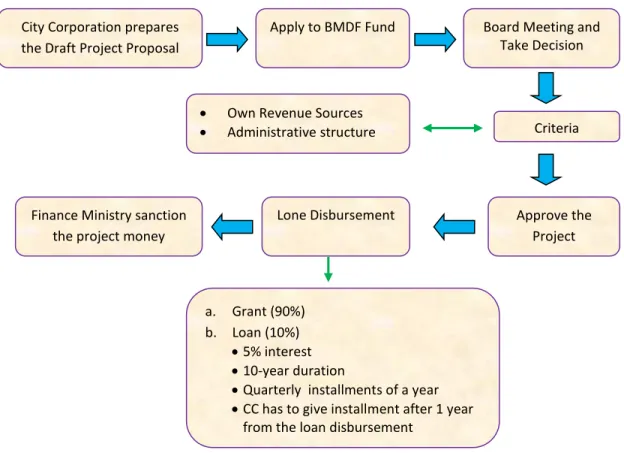
However, the city corporation has little influence over the projects intended to improve the delivery of public goods and services. Therefore, the process of improving the delivery of public goods and services can be lengthy.
Introduction
Objective
It also discusses the enabling framework for upgrading the status of municipalities and related administrative functions and functional powers. It specifically addresses the role of the NCC in providing public spaces and reclaiming open space from encroachment, which includes water resources for community use.
Structure of the report
Concretely, their ability to respond to population density and settlement growth through administrative restructuring and expansion of municipal boundaries and reorganization of ward boundaries is looked at. Allocation of public space is critical to ensuring quality of life for city dwellers and has significant implications for business prospects in the informal sector.
Data sources and methods
Of the slum dwellers, 50 percent and 39 percent go to a district and private hospitals respectively. Waste management: Only 23 percent of city dwellers have access to formal waste management systems.
Political and Governance Framework
- Legal framework for political authority and governance structure of city corporations
- Legal framework for political authority of local governments in Bangladesh
- Governance structure of city corporations
- Evolution of political and governance frameworks of urban local government in Bangladesh
- Political and governance frameworks: positioning Narayanganj
- Political authority
- Governance structure: Internal and external organizational set up
- Key findings
The executive power of city corporations is set out in Chapter Seven of the Local Government (City Corporation) Act 2009. The vertical accountability of the city corporations lies with the Local Government Department (LGD) under MoLGRDC for policy guidance and fiscal transfers.

Functional Mandates and Responsibilities
- Legal framework for public goods provision
- Role of City Corporation and its relationship with other government agencies
- Pricing power for services
- Geographical fragmentation and land use
- Norms for fresh capital investment and maintenance of assets
- Key findings
As mentioned above, NCC has a unique mechanism to deliver public goods and services which includes various agencies such as RAJUK and other parastatal bodies, in addition to the city corporation itself. The municipal corporation is divided into two sides by the river Shitalakshya, with wards 1 to 18 on one side and wards 19 to 27 on the other. Interestingly, in the NCC, it turns out that there are areas like the Export Processing Zone where the city corporation provides basic services for which they cannot levy charges.
The city corporation itself has little influence over the projects designed to improve public goods and services. May create provision for maintenance, protection and development of assets owned or given to City Corporation. To serve the purpose of laws if City Corporation has to own assets outside its territory, it can own assets with the government's approval.
However, if donor countries want to invest in a city corporation area, they must follow the Government-to-Government (G2G) policies. On the other hand, for allotment of shops in city corporation markets, the city corporations follow the Shop Allotment Policy of the Directorate of Government Accommodation. However, the city corporation has very little influence over projects aimed at improving public goods and services.
Municipalisation Criteria
Legal framework for municipalisation
- Policies, acts, rules and regulations for city corporation boundaries
- Authority of city corporations to extend boundaries
The government may include any areas adjacent to a city corporation to the boundary of the corporation or exclude any area from the boundary of the corporation according to the process determined by law and gazette notification. This law; rules; regulations; all the orders, instructions and powers in terms of this Act; shall apply to any area included in the city corporation. This law; rules; regulations; all the orders, instructions and powers in terms of this Act; shall cease to apply to any area excluded from the city corporation.
The Government may amend the first schedule of this Act by notification in the Gazette. As previously noted, urban local governments in Bangladesh, including city corporations such as NCC, are subject to strong control from the central government. Similarly, increasing the size and boundaries of city corporations and their authority to make rules and conduct their business are all subject to the consent of the central government.
This can be seen in NCC, where in order to enlarge the boundary or make adjoining areas part of it, NCC has to notify MoLGRDC in writing of its needs; MoLGRDC then seeks the support of the respective Deputy Commissioner in gathering public opinion on the proposal to expand the boundary of the city corporation. After collecting public views, the Deputy Commissioner shall submit a report to a committee constituted at MoLGRDC to evaluate the proposal and public opinion. The committee then makes its recommendations to the Cabinet department, which in turn reviews them and forwards them to the Prime Minister for the final decision.
Criteria for classifying urban authorities as city corporations and pourashavas
- Criteria to assess the classification of city corporations and municipalities/pourashavas
- Change in ward boundaries
2011.11 About 60 percent of the urban population lives in urban corporations, while 40 percent live in pourashavas. About a third of the total road length is constructed in Class A municipalities (Yunus and Rahman, 2015). The main reason why municipalities have evolved over the years is to provide local public goods and services more efficiently to the local residents and to collect taxes, tolls and charges from the respective residents to fund these activities.
Although municipalities are classified according to size, revenue mobilization and population density (classes A, B and C), there is no change in the administrative structure and mandate across these classes. The necessary guidelines have been gazetted and as per the guideline in order to fix the boundaries, a number of officers – who are the existing LGD employees – are recruited to assist. When determining ward boundaries, it is required that the area's size and population density be maintained.
For the purpose of determining boundaries, a ward boundary demarcation officer may examine relevant circumstances and examine related documents; the officer can consider all the objections and suggestions regarding ward delimitation. For the purpose of eliminating any errors or deviations, based on the accepted objections or suggestions, the boundary demarcation officer may amend or change the initial ward list under sub-section (ii) of the City Corporation Act (2009). After the amendments or changes have been made, the Boundary Demarcation Officer will draw up the final list of wards, with reference to the included areas.
Key Findings
Fiscal System
- Framework and composition of existing revenues and capital grants of city corporations
- Trend and composition of annual income generation
- Own source revenue
- Process of Fiscal Transfers to city corporations
- Borrowing framework and procedure for city corporations
- Key Findings
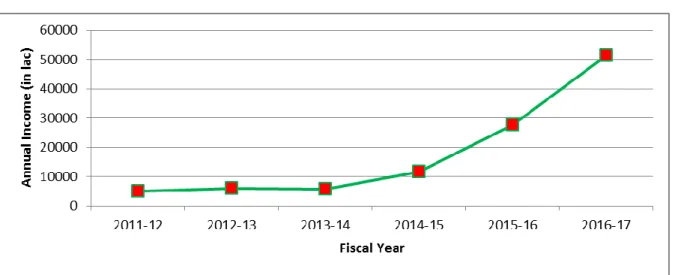
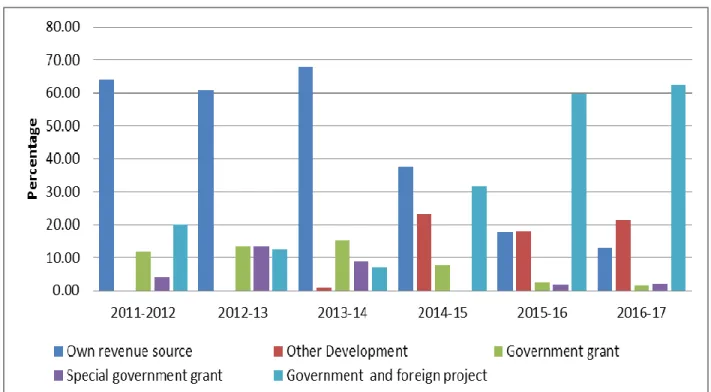
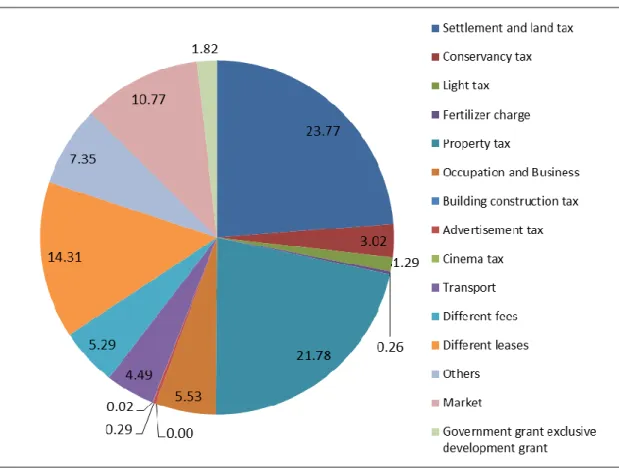
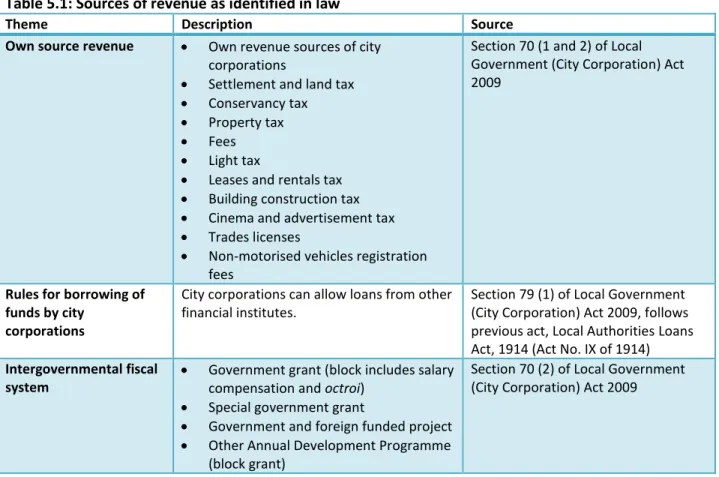
Octroi tax was introduced after the 1980s, and the government distributed grants to city corporations from the annual octroi revenue. Along with this, LGED allocates a fixed, nominal amount of money to city corporations for development activities. The schedule sets the highest tax rates any city corporation is allowed to levy.
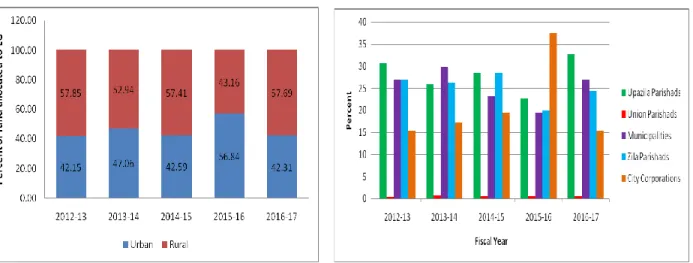
According to the same study, most municipalities and city corporations received ADP group grants more or less on time, but there was a delay in receiving specific group grants. In Bangladesh, there is no express framework for the allocation of grants by the central government to urban corporations; however, there are some implicit criteria that are not publicly disclosed. An NCC official stated that the political influence and population size of city corporations also influence the national government's funding decisions.
City corporations can borrow money from banks with prior approval from the central government. City corporations generate funds from two main sources: THV and transfers from the national government. The schedule fixes the highest tax rates that any city corporation is allowed to levy.
Public Space
- Agencies to manage public land and social space in cities
- Legal framework for the management of land and public space
- Legal framework for land classification, conversions and valuations
- Legal framework for public space access and usage
- Management of public land and open spaces in NCC
- Key Findings
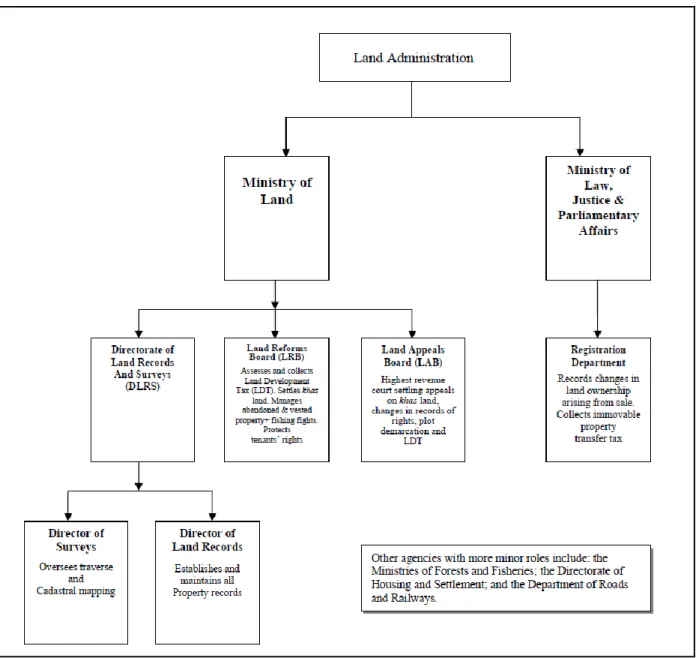
When city companies decide to build on public space, they follow the master plans of the development authorities. City corporations such as Sylhet, Comilla and Rangpur, which do not have development authorities, have to deal with the office of the Deputy Commissioner of Land Development. The compensation for surplus land payable under subsection (3) of the Land Reform Ordinance 1984 shall be assessed and paid in the prescribed manner.
City corporations' legal mandates regarding the management of public areas and public spaces are listed in table 6.1. The purpose of the DAP is to (a) provide basic infrastructure and services in the study area through systematic planning; (b) create a conducive environment to promote economic activities; (c) improve the area's drainage system and protect against flood intrusion; and (d) create service centers to enable urban growth. For example, to develop open spaces for city dwellers, NCC sought a piece of khas land under Shitalakshya mouza, which belonged to the deputy commissioner's office.
There are a few slums in the NCC public lands; However, with the help of many projects funded by development donors, an effort has been made to improve living conditions in these areas. There is a lack of cooperation between public land authorities and city corporations in providing social space. The encroachment of public land for profit-oriented activities is managed through informal intermediaries, and is possible because of the vast amount of khas land and vacant land in the city.
Findings and Conclusions
- Political and governance framework
- Functional mandates and responsibilities
- Municipalisation criteria
- Fiscal system
- Public space
- Conclusions
Analysis of the legal framework shows that, despite a national movement towards increased decentralization, the central government retains control over city corporations through its overall administrative system. Some of the key issues regarding the functional mandates and responsibilities of city corporations still need to be addressed. On the advice of the government, development agencies design and implement projects to improve public goods and services.
There is a lack of coordination in the provision of social space between public land authorities of the national government and city corporations. The genesis of the problem lies in the fragmented legal provisions: the NCC has conflicting and overlapping mandates with RAJUK and the Deputy Commissioner for Public Land Use Planning. The encroachment on public lands for profit-oriented activities is managed through informal intermediaries and is possible due to the large amount of khas and vacant land in the city.
The local government reform process is underway and shows promising trends, particularly the promulgation of the City Corporation Act 2009, which in theory provides greater mandates and functional responsibilities for city corporations to efficiently deliver public goods and services. There are loopholes in existing legislation that allow the national government control over the autonomous functioning of local government. A corporate area is an administrative unit of the Republic for the purposes of Article 59 of the Constitution of the People's Republic of Bangladesh.