Knowledge-based Development in Muslim Countries – Status and Prospects
A.K.M.A. Islam
Department of Physics, Rajshahi University
Thursday, September 15, 2011
Thursday, September 15, 2011 5th IIUC Conf on Education 1
WHAT IS KNOWLEWDGE
Knowledge is a familiarity with someone or something, which can include information, facts, description, and or skills acquired through experience or education.
Scientific knowledge is a method of inquiry based on gathering observable, empirical and measurable evidence subject to specific principles of reasoning.
Scientific method consists of the collection of data
through observation & experimentation, and the
formulation & testing of hypothesis.
Tuesday, June 21, 2022 5th IIUC Conf on Education 3
In Islam, knowledge (Arabic: ملع, ʿilm) is given great significance. "The Knowing" (al-ʿAlīm) is one of the 99 names reflecting distinct attributes of God.
The Qur’an asserts that knowledge comes from God (2:239) and various hadith encourage the acquisition of knowledge.
Muhammad (SA) is reported to have said " Seek knowledge from the cradle to the grave " and " Verily the men of knowledge are the inheritors of the prophets ".
Islamic scholars, theologians and jurists are often given the title ‘alim , meaning "knowledgable".
Knowledge
”
Knowledge-based Development & Challenge
Sir Francis Bacon, “Knowledge is Power
Knowledge-based societies refer to societies that are well educated, and who therefore rely on the knowledge of their citizens to drive the innovation, entrepreneurship & dynamism of that society’s economy.
• Only Knowledge-based societies develop – they dominate
• Future belongs to knowledge-based societies only.
But it is nevertheless an intellectually formidable task requiring sustained efforts over a longer period of time.
CHALLENGE The new millennium brought us an opportunity to
acquire new knowledge, new tools & new resources.
Development of systems that make use of knowledge, wisdom & intelligence is a step towards meeting this challenge.
The ability of the intelligent systems to capture and redistribute expertise has significant implications on
Knowledge-based Development Paradigms
Tuesday, June 21, 2022 5th IIUC Conf on Education 5
We now have new development paradigms:
The World Bank has introduced a knowledge-based framework at the national level called the Knowledge-Based Economy or KBE. It consists of 4 pillars
— Education;
— Science and technology, and innovation;
— ICT infrastructure;
— Economic incentive regime.
The Asian Development Bank later expanded this framework to include the socio-cultural and natural-environmental domains. The resulting framework is called Knowledge-Based Development KBD.
KBD is the combination of two powerful development paradigms:
sustainable development and knowledge-based management.
Current Situation in OIC Countries
Here we will limit our talk on S&T related situations of OIC countries
The Muslim world (OIC), as the present status would indicate, lacks the capacity to produce knowledge to catch up within the competitive world. This is despite Islam has always encouraged al-ilm, that is knowledge & science.
The Muslims, by and large, are not behaving as
true representatives of Islam, individually or
collectively.
Higher Education
57 member-countries of OIC have ~500 universities;
i.e. one univ/3 m Muslims
USA has 5,758 universities & India has 8,407
In 2004, Shanghai Jiao Tong University compiled an 'Academic Ranking of World Universities‘:
Not one university from Muslim-majority states was in the top-500.
Tuesday, June 21, 2022 5th IIUC Conf on Education 7
Production of Scientific Publication
Total articles published in 2008 in journal covered by SCI-expanded, Social Science CI & Arts-Humanities CI
= 54,400
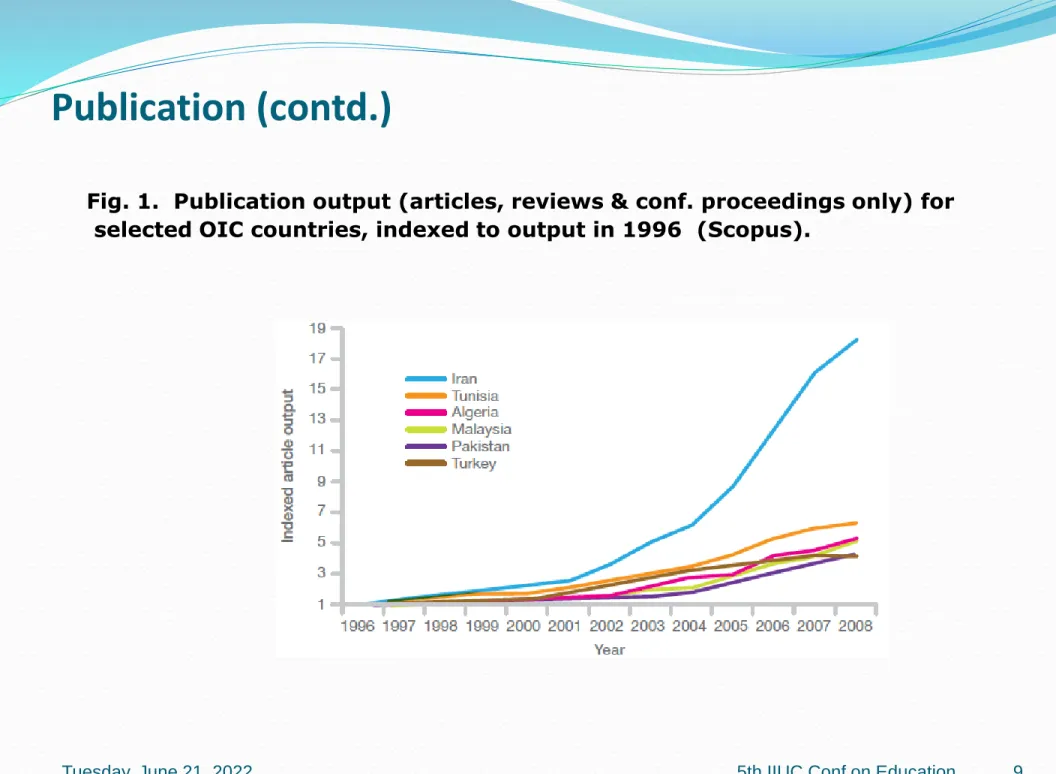
Scientific publications in the OIC is heavily due to a few of the member countries:
- 51.8% = Turkey (17,730 or 32.6%), Iran (10,451 or 19.2%)
- Egypt, Malaysia & Pakistan accounts for ~ 15%
- 17 countries : Each publishes less than 50 articles.
- Nigeria (stands out in the Sub-Sahara) with over
1,000 articles.
Publication (contd.)
Fig. 1. Publication output (articles, reviews & conf. proceedings only) for selected OIC countries, indexed to output in 1996 (Scopus).
Tuesday, June 21, 2022 5th IIUC Conf on Education 9
Publication (contd.)
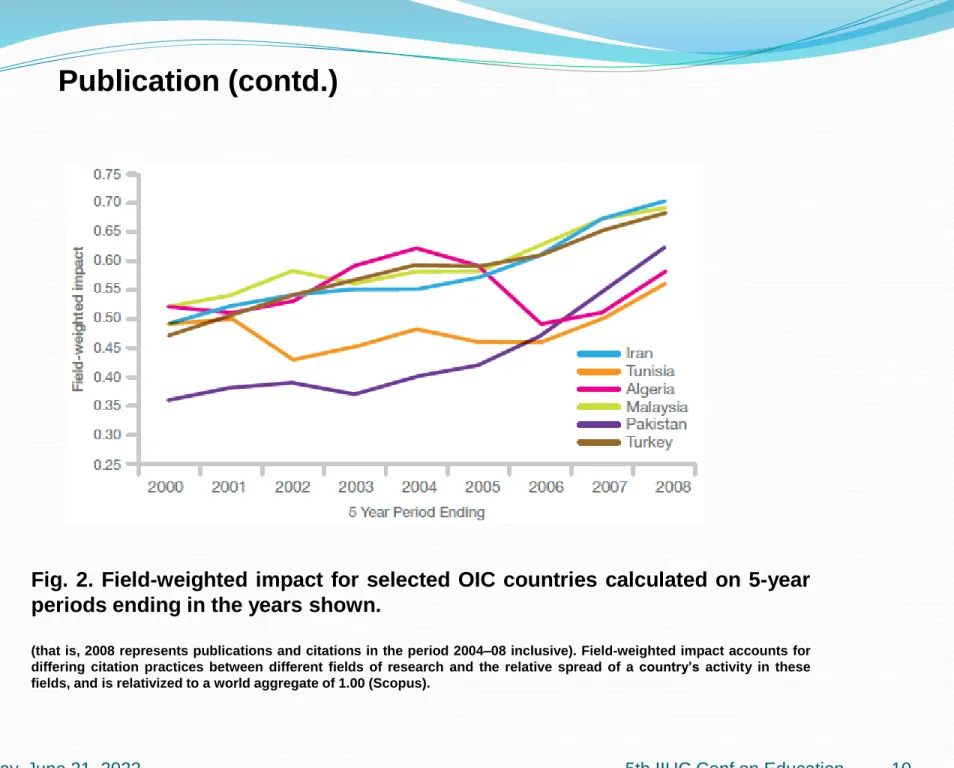
Fig. 2. Field-weighted impact for selected OIC countries calculated on 5-year periods ending in the years shown.
(that is, 2008 represents publications and citations in the period 2004–08 inclusive). Field-weighted impact accounts for differing citation practices between different fields of research and the relative spread of a country’s activity in these
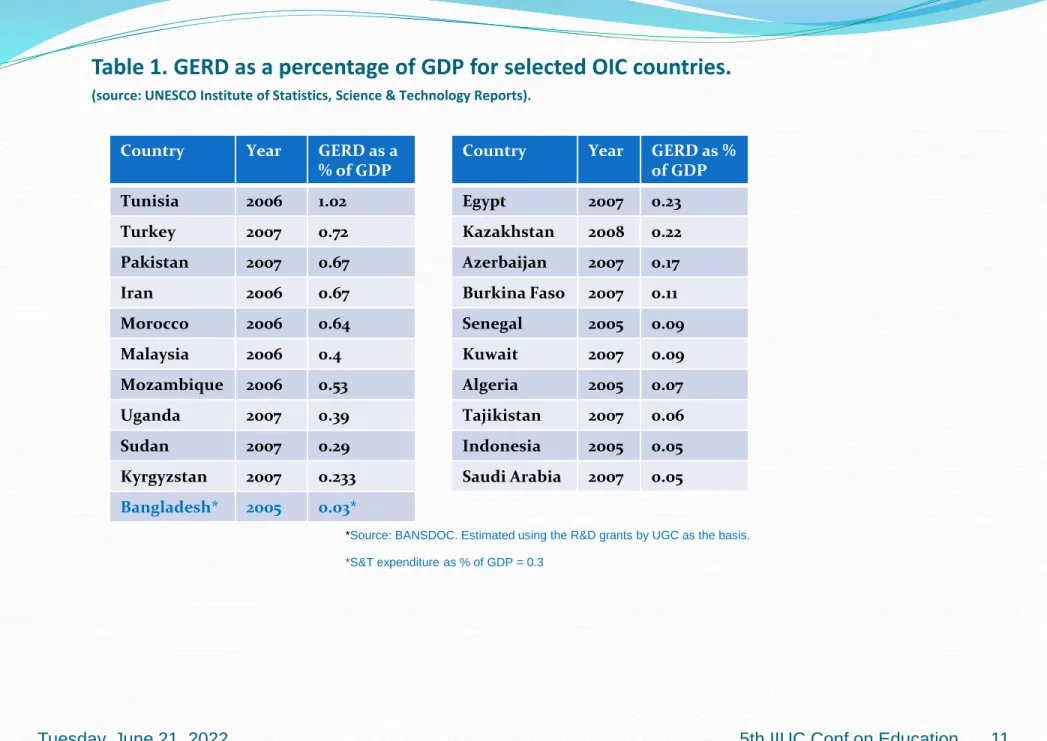
Table 1. GERD as a percentage of GDP for selected OIC countries.
(source: UNESCO Institute of Statistics, Science & Technology Reports).
Country Year GERD as a
% of GDP Tunisia 2006 1.02
Turkey 2007 0.72
Pakistan 2007 0.67
Iran 2006 0.67
Morocco 2006 0.64 Malaysia 2006 0.4 Mozambique 2006 0.53
Uganda 2007 0.39
Sudan 2007 0.29
Kyrgyzstan 2007 0.233 Bangladesh* 2005 0.03*
Tuesday, June 21, 2022 5th IIUC Conf on Education 11
Country Year GERD as % of GDP
Egypt 2007 0.23
Kazakhstan 2008 0.22 Azerbaijan 2007 0.17 Burkina Faso 2007 0.11 Senegal 2005 0.09
Kuwait 2007 0.09
Algeria 2005 0.07 Tajikistan 2007 0.06 Indonesia 2005 0.05 Saudi Arabia 2007 0.05
*Source: BANSDOC. Estimated using the R&D grants by UGC as the basis.
*S&T expenditure as % of GDP = 0.3
GDP
Combined annual GDP of 57 OIC countries = $2 trillion
America produces goods & services worth $12 t;
China $8 t, Japan $3.8 t & Germany $2.4 t (purchasing power parity basis).
Oil rich Saudi Arabia, UAE, Kuwait & Qatar collectively produce goods & services (mostly oil) worth $ 500 billion
Spain ~ $ 1 t, Poland $489 b, Thailand $545 b
(Muslim GDP as a percentage of world GDP is fast declining).
Human Resources
Muslim-majority countries: 230 scientists/m muslims
Jordan = 2,910; 4 members (Jordan, Tunisia above world average)1,000;
9 (mostly sub-Saharan) < 100 Niger = 10 ;
USA: 4,000 scientists/m, Japan: 5,000/m
In the entire Arab world:
Total full-time researchers: 35,000, only 50 technicians/m Arabs
In the CW: ~ 1,000 technicians/m
The Muslim world spends 0.2% of its GDP on R&D, while the CW spends ~ 5% of its GDP
Conclusion:
The Muslim world lacks the capacity to produce knowledge
Tuesday, June 21, 2022 5th IIUC Conf on Education 13
Exports of High-tech Products
Exports of high technology products as a percentage of total exports are an important indicator of knowledge application.
EHTP = Export of high technology products as a percentage of total exports
Malaysia & Indonesia: Two top ranking OIC member countries in the EHTP (95% of the total exports of the OIC)
Malaysia: 63.4 b (87%), & 3.5% of those of the world .
Bahrain, Bangladesh, Benin, Egypt, Guinea, Kuwait, Maldives, Nigeria, Pakistan, Qatar, Saudi Arabia, Suriname, Syria, Togo, UAE (=15 countries) account for <2%.
Pakistan: 1 %, Saudi Arabia: 0.3 %;
Kuwait, Morocco, & Algeria are all: 0.3 %, while Singapore is at 58 %.
Conclusion:
The Muslim world is failing to apply knowledge
Tuesday, June 21, 2022 5th IIUC Conf on Education 15
Example of Bangladesh: National S&T Policy
Bangladesh would serve as an example of OIC countries’ inadequate efforts to be self-reliant despite a very good national policy on S&T. The features of the policy are:
The aims and strategies of national S&T policy as outlined in 1986 still serve as a guiding post 2005. In recognition of the fact that the formulation of a comprehensive & coherent national S&T policy, designed to contribute to the achievement of the country's development objectives, is necessary for the effective application of S&T for development, the Government of Bangladesh considers it appropriate to formulate a new National S&T Policy. The Policy is designed to fulfill the following primary aims:
• To attain scientific & technological competence & self-reliance, to help increase production &
employment in various sectors & sub-sectors of the economy.
• To be in consonance with the socio-economic, cultural, educational, agricultural & industrial policies of the nation.
• To contribute to the worldwide pool of scientific & technological knowledge.
• To seek out & recognize high talents in various areas of S&T.
• To strengthen cooperation in S&T between developed & developing countries, & particularly among developing countries themselves.
• To provide guideline for institutional arrangements or rearrangements in the R&D structure (including education & training) for attainment of the above objectives.
The low level of achievement in OIC countries results from the cumulative effect of multiple factors, and not from a single dominant cause.
FACTORS:
• Dictatorial regimes (authoritarian ruling systems) &
unstable funding are more important obstacles to S&T.
• Significant progress depends on changes in values &
institutions - no small order.
• Policymakers & Scientists will need to face up to some important challenges.
• Low investment.
• Weak education systems.
• Poor infrastructure, and
• Negligence & absence of proper Political Will.
Some Specific Reasons of Low Level of
Achievements
Tuesday, June 21, 2022 5th IIUC Conf on Education 17
Some other factors:
• Demographics
The number of research scientists and engineers remains well below that of rich countries as well as Latin America and South and East Asia.
* Education
- There is too much rote learning, and far too little support for science education at all levels.
- Most Universities and technical schools emphasize teaching rather than research.
- Few strong doctoral programs or research centers of academic excellence exist.
- Overcrowded, underfunded, and turbulent universities have been unable to function properly.
Research
- The Muslim world suffers not much from the shortage of scientists and engineers, but it does have an acute scarcity of career researchers.
- While several countries boast outstanding individual researchers & projects, there is little mentorship or in- house ability to train young researchers.
- Most science and engineering graduates are employed in bureaucratic posts.
- Inadequate equipment and access to data also reduces scientific output per researcher
- Far few incentives to publish and the absence of quality doctoral programs within the region.
Tuesday, June 21, 2022 5th IIUC Conf on Education 19
Uncordinated Research
• There is a lack of coordination among research groups resulting in insufficient harmonization of research projects. This leads to duplicated and neglected areas of research.
• There is an overall lack of demand for research by policy makers resulting in uncoordinated research without benefits for the population.
If research coordination is improved in developing countries, the efficiency and efficacy of research will increase and better policies can be developed.
Effective strengthening of ICT, Agricultural, National health, Veterinary, Petroleum research systems to name a few will improve the lot of the population.
The Muslim world has failed to provide a satisfactory home for science even after nearly 50 years of would-be institution-building.
The failure to build viable research institutions at the national level has thwarted most attempts at regional cooperation. Talented researchers must still leave the region to obtain advanced postgraduate training.
Facing the future – S&T in the Muslim world
Tuesday, June 21, 2022 5th IIUC Conf on Education 21
In order to strengthen research the following weaknesses must be addressed:
1. Research Culture
Educational research is often given low priority in national agendas and policy-making is seldom based on rational educational research. Further the absence of a "research culture" prevents research findings from being appreciated and utilized.
2. Coordination of research
There is no definite overall research strategy in education and researchers are often vulnerable to the conflicting demands made by different agencies over time.
Furthermore, researchers are seldom consulted in the process of identifying research projects and allocating resources.
3. Development & maintenance of research capacity
Coordinated efforts to improve the training of researchers are required. Educational research is often carried out with less rigor and less quality control than other research.
Further there is need for developing basic data bases and securing more stable mechanisms for funding research.
4. Research Priorities
The development of an adequate or appropriate research agenda should ideally depend on the perceptions of the beneficiary.
Tuesday, June 21, 2022 5th IIUC Conf on Education 23
5. Regional cooperation
• The similarity of applied-research needs and priorities, such as solar energy, desertification, and desalination, should produce shared interests.
• Meetings held over two decades in OIC to coordinate regional research have produced much rhetoric and little action – it must be put in action.
6. Government competence to be in place
• Applied-research units in government ministries, such as agriculture or construction, have often become sinecures for political appointees with little or no interest or capabilities for research.
Lastly, S&T research should be adequately institutionalized: continuity of funding & personnel, long-term goals, & management autonomy are to be ensured.
Technological capability is of utmost importance for a country to keep pace in the race of development in the 21st century. This capability should come from S&T - an intellectually formidable task requiring sustained efforts over a longer period of time.
The attainment of leadership in key areas of S&T, e.g.Engineering & Applied Sciences, Micro-electronics, ICT, Agricultural & Genetic Engineering, Biotechnology, Medicine, Defense technology are what the Muslim countries need today.
Conclusion: Goal of Development
Tuesday, June 21, 2022 5th IIUC Conf on Education 25
All these should thrive once SCIENCE-BASED EDUCATION takes root and adequate basic infrastructure such as energy, communication and transportation is developed.
Further the goal of development cannot be achieved unless one has scientific & technological knowledge and skills.
All out efforts have to be deployed in a mission- oriented and time-targeted mode with proper Political Will.
Goal of Development (contd.)
Thank you