Marketing strategy of an E-Commerce - A Customer Feedback Approach
BY
AHONA GOOLA NUR ID: 193-25-827
This Report Presented in Partial Fulfillment of the Requirements for the Degree of Master of Science in Computer Science and Engineering
Supervised By
Shah Md. Tanvir Siddique
Assistant Professor
Department of CSE Daffodil International University
Co-Supervised By
Mr. Narayan Ranjan Chakraborty
Assistant Professor Department of CSE
Daffodil International University
DAFFODIL INTERNATIONAL UNIVERSITY DHAKA, BANGLADESH
SEPTEMBER 202
©Daffodil International University 1
APPROVAL
This Project Titled “Marketing strategy of an E-Commerce - A Customer Feedback Approach”, Submitted by AHONA GOOLA NUR to the Department of Computer Science and Engineering, Daffodil International University, has been accepted as satisfactory for the partial fulfillment of the requirements for the M.Sc. in Computer Science and Engineering and approved as to its style and contents.
The presentation has been held on 12 September 2021.
BOARD OF EXAMINERS
______________________
Dr. Touhid Bhuiyan Professor and Head
Department of Computer Science and Engineering Faculty of Science & Information Technology Daffodil International University
Chairman
©Daffodil International University 2 ________________________
Dr. Md. Ismail Jabiullah Professor
Department of Computer Science and Engineering Faculty of Science & Information Technology Daffodil International University
Internal Examiner
________________________
Dr. Sheak Rashed Haider Noori
Associate Professor and Associate Head
Department of Computer Science and Engineering Faculty of Science & Information Technology Daffodil International University
Internal Examiner
©Daffodil International University 3 ________________________
Dr. Mohammad Shorif Uddin Professor
Department of Computer Science and Engineering Jahangirnagar University
External Examiner
©Daffodil International University 4
DECLARATION
I hereby declare that this project has been done by us under the supervision of Shah Md.
Tanvir Siddique, Assistant Professor, Department of CSE Daffodil International University. I also declare that neither this project nor any part of this project has been submitted elsewhere for the award of any degree or diploma.
Supervised by:
Shah Md. Tanvir Siddique Assistant Professor
Department of CSE
Daffodil International University Co-Supervised by:
Mr. Narayan Ranjan Chakraborty Assistant Professor
Department of CSE
Daffodil International University
Submitted by:
Ahona Goola Nur ID: 193-25-827 Department of CSE
©Daffodil International University 5 Daffodil International University
ACKNOWLEDGEMENT
First, I express my heartiest thanks and gratefulness to Almighty God for His divine blessing makes us possible to complete the final year thesis successfully.
I am grateful and wish our profound indebtedness to Shah Md. Tanvir Siddique, Assistant Professor, Department of CSE Daffodil International University, Dhaka. My supervisor has deep Knowledge & a keen interest in the field of
“Marketing strategy and E-Commerce" to carry out this project. His endless patience, scholarly guidance, continual encouragement, constant and energetic supervision, constructive criticism, valuable advice, reading many inferior drafts, and correcting them at all stages have made it possible to complete this thesis.
I would like to express my heartiest gratitude to the Head, Department of CSE, for his kind help to finish our project and to other faculty members and the staff of the CSE department of Daffodil International University.
I would like to thank my entire coursemate in Daffodil International University, who took part in this discussion while completing the course work.
Finally, I must acknowledge with due respect the constant support and patients of my parents.
©Daffodil International University 6
ABSTRACT
The subject of this thesis is a marketing strategy of E-Commerce and its application in the form of an advertising campaign. The work is split into two parts, theoretical and practical. The first theoretical part starts with a describes Facebook marketing is followed by the creation of a marketing strategy and ends with a description of performance measurement methods. The second practical part starts with a situation analyses of a given company, followed by a marketing campaign plan and best practices for e- commerce Facebook advertising. The rest of the thesis contains a description of the campaign launch, its evaluation, and suggestions for future research.
©Daffodil International University 7 TABLE OF CONTENTS
CONTENTS
PAGE
Board of examiners 1
External examiners 2
Declaration 3
Acknowledgements 4
Abstract 5
CHAPTER
CHAPTER 1: INTRODUCTION
9-111.1 Introduction 9
1.2 Motivation 10
1.3 Rational of the Study 10
1.4 Research Question 11
1.5 Expected Output 11
1.6 report Layout 11
CHAPTER 2: BACKGROUND STUDY
12-162.1 Introduction 12
2.2 Online Marketing Definition 12
2.3 Online Marketing Framework 14
2.4 Traditional Marketing Funnel 15
2.5 Consumer Decision-Making Process 16
©Daffodil International University 8
CHAPTER 3: RESEARCH METHODOLOGY
17-283.1 Introduction 17
3.2 Facebook Marketing Strategy 17
3.3 Situation Analysis 17
3.4 Facebook Advertising 23
3.5 Facebook Page 23
3.6 Business Manager 24
3.7 Facebook Pixel 26
CHAPTER 4: EXPERIMENTAL RESULT & DISCUSSION
29-324.1 Introduction 29
4.2 Experimental results 29
4.3 descriptive analysis 30
4.4 Summary 32
CHAPTER 5: SUMMARY, CONCLUSION,
RECOMMENDATION, AND IMPLICATION FOR FUTURE 33-36 RESEARCH
5.1 Summary of the study 33
©Daffodil International University
9
5.2 Conclusion 33 5.3 Recommendation 33
5.4 Implication for further study 33
REFERENCES
10-32 LIST OF FIGURES PAGE
-NO FIGURES Figure 1.1: The number of monthly Facebook product users 2021 10Figure 2.1: Difference between digital and internet marketing 13
Figure 2.2: STDC Framework 14
Figure 2.3: Traditional marketing funnel 15
Figure 2.4: Consumer decision-making process 16
Figure 3.1: Facebook marketing objectives 20
Figure 3.2: Facebook Page Creation 24
Figure 3.3: Business Manager Setup 25
Figure 3.4: Ad Account Creation 26
Figure 3.5: Facebook Pixel in Business Manager 27
Figure 3.6: Facebook Pixel Code for PROTECT CZ 28
Figure 4.1: Sessions and Purchases before and during campaign 32
©Daffodil International University 10
CHAPTER 1 INTRODUCTION
1.1 Introduction
Online shopping is one of the innovations been presented through the progression of innovation and the improvement of modern electronic administrations advertised to showcase clients such as vendors and buyers. Despite the recently shaped innovation and benefit, this advertising has been developing exceptionally quickly and e-commerce and online shopping have presented numerous openings for its client.
These days Facebook plays a gigantic part in a major number of companies that attempt to advance their item or administrations. It gets to be one of the most effortless ways to reach the potential client and discover out what does he/she like. Extraordinary highlights like
"Facebook Business Manager" open an enormous assortment of distinctive sorts of advancements. To create it clear and mostly efficient each advancement action needs to have an arrangement that reflects the methodology and characterizes how to attain its objectives.
To remain in slant and reach more youthful eras, companies utilize this Web source to supply the finest benefit and most recent data approximately them. Facebook could be a great way to keep in touch with most of the clients around the world. It gives a plausibility to reach diverse bunches of clients agreeing to the particular statistic settings, as well as settings speaking to the interface of a chosen target.
©Daffodil International University 11 1.2 Motivation
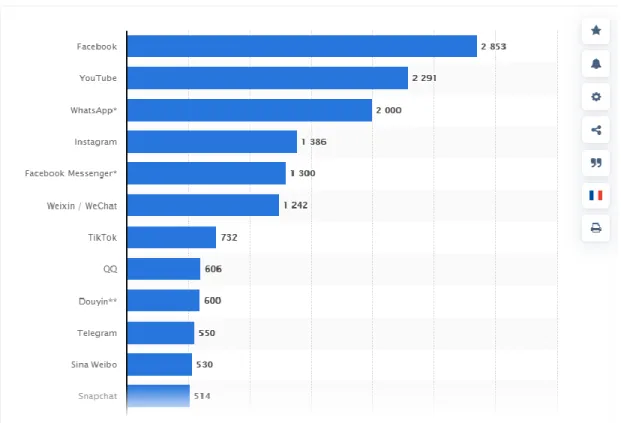
The use of social media is on the rise worldwide. It is undoubtedly a popular online activity that is regularly increasing. Social media statistics for 2021 show that there are 3.5 million social media users worldwide and this number is only growing. Figure 1.1 shows the percentage of users of social media. People connected with social media for different purposes like business, marketing, health, and other social issues. If we can use this social media and could generate collective intelligence, then it will be helpful for us.
Figure 1.1: The number of monthly Facebook product users of 2021
1.3 Rationale of the Study
Social media users Increment every year. It may be evidence-based on data which is the most excellent advertising procedure for a brand based on the particular target gathering of people. get it who is planning to buy and how to reach a potential client with a
restricted budget. Most issues that are associated with advancements on social media are
©Daffodil International University 12 reaching to be discussed and analyzed to discover the leading arrangement to create this brand well known and well-selling. The viable portion of this proposition is reaching to appear how to analyze and come up with objectives that are expressed within the starting.
The proposition speaks to the promoting technique of the brand specified over. This promoting portion is planning to be appeared and clarified through the Facebook Commerce Director – a device that gives a parcel of valuable highlights for advancing and popularizing brands and companies.
1.4 Research Questions
To create this work more organized and coherent, the author will reply to some questions amid investigation and clarification of diverse topics. The creator considers the questions recorded underneath will offer assistance to understand the most headings of the subject and characterize what comes about got to be gotten after this Proposal work. As well, they are valuable in understanding what are the most issues or shortcomings of the said brand.
1. What is the target audience and how to define it?
2. How to make an ad using Facebook Business Manager?
3. What types of ads are the most appropriate for this brand?
1.5 Expected Output
From this paper, we expected a valuable and significant result. We expect to assemble as numerous as conceivable calculations in all fields. We expect to put through them and we'll investigate more than one calculation in any specific field. We attempted to compare them and discover out the best calculation for that specific field. We wish anybody can effortlessly discover arrangements or calculations for their issue in that particular field.
1.6 Report Layout
We divided this paper into some chapters. anyone can easily find out which parts he needs.
In the next section, we have discussed the background which contains the introduction, related work, research summary, scope of the problem, and challenges. In the next chapter, we discussed research methodology. After that experiment results and discussion will be shown and in the last chapter summary, conclusion, recommendation, and implementation for future research will discuss.
©Daffodil International University 13
CHAPTER 2 BACKGROUND
2.1 Introduction
In this chapter, we will talk about our paper's background. Our paper is a literature base paper. For this chapter, we have to search for some related works. We have to make a research summary. We found out some scope of problem and challenges too.
2.2 Online Marketing Definition
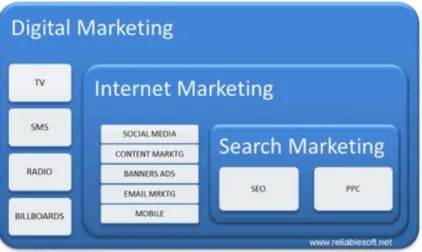
At the beginning of this subchapter, it is necessary to differentiate between online and digital marketing. Digital marketing is a broader term as it describes channels beyond internet marketing. Among exclusively online channels like social media, display, search engines it includes other digital media like mobile phones, television, and radio. (Financial Times Lexicon, 2017) Alex Chris in his comparison of digital marketing and social media uses a diagram that demonstrates the main differences between digital and internet marketing.
©Daffodil International University 14
Figure 2.1: Difference between digital and internet marketing
The most widely used online marketing channels, according to Fishkin (2009), are as follows:
- Website itself
- Social Media Marketing - E-mail marketing
- Search Engine Marketing - including pay-per
- click advertising (PPC) and search engine optimization (SEO) - Display Advertising
- Online Public Relations - Affiliate Marketing
- Conversion Rate Optimization
©Daffodil International University 15 -Social Media Marketing
2.3 Online Marketing Framework
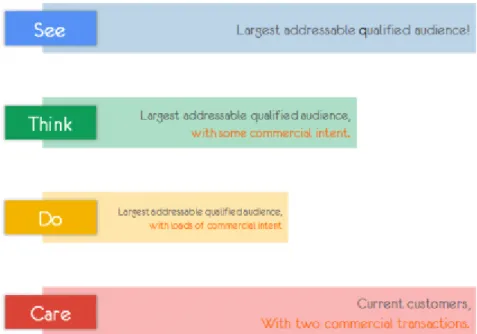
Well, known online marketing framework called See, Think, Do, Care (STDC) was presented by Kaushik in 2013. Kaushik built this framework because he considered the traditional AIDA (Attention, Interest, Desire, Action) marketing model insufficient for capturing the complexities and measurements of online marketing. His goal was to create
a customer-centric framework with a holistic evaluation of online marketing activities.
Figure 2.2: STDC Framework
©Daffodil International University 16 2.4 Traditional marketing funnel
Figure 2.3: Traditional marketing funnel
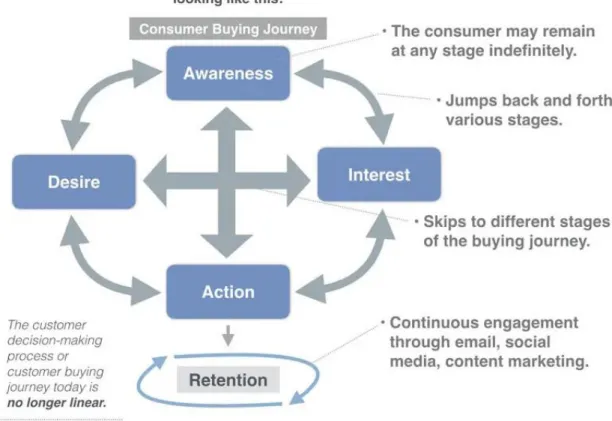
©Daffodil International University 17 In the traditional marketing funnel, a consumer is made aware of a brand's existence, compares and considers a brand's competitor products, and decides to purchase a chosen product.
2.5 consumer decision-making process
Figure 2.4: Consumer decision-making process
Consumers nowadays have the implies to do their item investigate at domestic online and on the go on their versatile phones. The control is moving from marketers to buyers, as buyers presently got to control to square advertisements, conduct their investigation, and opt-out of devotion promoting programs.
©Daffodil International University 18
CHAPTER 3
RESEARCH METHODOLOGY
3.1 Introduction
Research methodology is the process that is used to collect or gather information and data to make any decision. It is a systematic and theoretical analysis process to apply to a field of study. It includes the theoretical analysis of the body part of the methods and principles associated with a lot of knowledge.
3.2 Facebook Marketing Strategy
To effectively launch a marketing campaign, it is necessary to have a strategy. This is what will be discussed in this chapter including situation analysis, goal setting, and eventually the ins and outs of Facebook marketing and advertising.
3.3 Situation analysis
The perfect recipe for crafting a marketing strategy does not exist. It is because each business is unique and it means that each marketing strategy has to be uniquely crafted as well. Each business has to sell a different product(s), operate in different markets, and fulfill different customer needs with different competitors influencing their moves. The most qualified people to create the strategy are the ones who see the company holistically and can synthesize knowledge from multiple sources. Five foundational pillars of knowledge have to be established to create a solid marketing strategy. According to Ryan and Jones (2009), those are following:
1. Knowledge of business 2. Knowledge of competitors 3. Knowledge of customers 4. Knowledge of goals
5. Knowledge of Key Performance Indicators
©Daffodil International University 19 1. Knowledge of business
The first factor is to know whether a business is ready and able to utilize online marketing.
The two main questions to ask in this matter are whether is the target audience online and whether are offered products or services suitable for online promotion (Ryan and Jones, 2009). The second factor is financial and human resources. The allocated resources will differ according to the size of the company and the needed amount of human resources to launch and run the campaign. The main resources are budget, staff, and technological infrastructure (Carter, 2012).
2. Knowledge of competitors
When entering the realms of online marketing the scope of competition increases significantly. The same online technologies that allow one business to reach people in the whole country or even around the world are available to its competitors as well. Knowledge of competitors allows them to understand their strategies, reveal weak spots and turn them to their advantage.
To start it is important to ask the following questions:
- Who are the competitors in the online marketplace?
- How do they differ from current offline competitors?
- What are their current activities in the online advertising space? (Ryan and Jones, 2009)
3. Knowledge of customers
For a company that has been in business for some time, it should not be difficult to determine its typical customer. It is now easier than ever with the help of Facebook's feature audience insight that allows analyzing demographics of current customers or website
©Daffodil International University 20 visitors. In case the company is new, no matter whether it is a local business or an aspiring global start-up, it is necessary to acquire knowledge about potential customers.
There are several questions to ask while trying to understand customers:
- Is the target group the same both online and offline?
- How are the customers using digital technology?
- What are the interests of the target group?
- What is their level of education?
- Are they married, dating, or single?
- In what age group is they and what is their gender? (Ryan and Jones, 2009; Carter, 2012) It is often not possible to answer all the questions, but in the beginning, it is enough to create a prototype of persona and subsequently refine the idea according to the data about the acquired customers. To define an “ideal customer” or persona,
Brian Tracy recommends clarifying the following:
- Benefits customer is looking for in a product - Location of the customer
- Time when the customer buys
- Customer’s buying strategy (Tracy, 2005)
4. Knowledge of goals
©Daffodil International University 21 After understanding business and getting to know customers and competitors, it is crucial to define the expected gains of the advertising activities. That means setting clear, measurable, and achievable goals. Businesses can choose from several goals, ranging from lead generation, increasing awareness or engagement, and generating online sales. All goals have eventually the same end goal: to increase the company's profit.
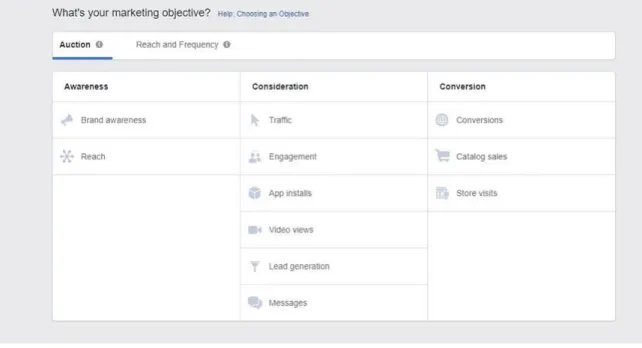
Facebook differentiates its advertising objectives (goals) into three categories according to the purchasing stage of customer: Awareness, Consideration, and Conversion
Figure 3.1: Facebook marketing objectives
Awareness
This group of objective aim to generate interest in offered product or service. It contains goals “Brand awareness” and “Reach”
Consideration
©Daffodil International University 22 Objectives in this category are meant to make people thinking about business and start researching. The objectives range from driving traffic, lead generation to acquiring page likes.
Conversions
The last class of objectives contains actions at the bottom of the funnel that means conversions e.g., leads, registrations, and purchases. (Facebook, 2017)
As your business grows, your campaign goals will change. First, your campaigns may focus on building awareness and acquiring new customers. Later, you may encourage people to make a purchase or sign up for an event.
Awareness
©Daffodil International University 23 Consideration
Conversions
5. Knowledge of Key Performance Indicators
©Daffodil International University 24 According to Reh (2017), Key Performance Indicators (KPIs) are metrics that evaluate the rate of success of a specific activity that a company engages in. One of the main factors that differentiate online marketing from offline is measurability (Visser, 2017). In online campaigns, virtually everything that happens can be tracked. That includes how people react to the ad, how it performs, and eventually whether it fulfills its end goal.
3.4 Facebook Advertising
When a comprehensive and clear strategy is formed it is necessary to develop more profound details and specifics considering the Facebook environment. This subchapter is going to describe the essentials for advertising on Facebook namely Facebook page and Business manager. Without these prerequisites, it is not possible to start any advertising or communication campaign
3.5 Facebook Page
The primary prerequisite for publicizing on Facebook is Facebook Page, which is “a public profile particularly made for businesses, brands, celebrities, causes, and other organizations.” (TechTarget, 2012).
There are two options for creating the page: either from the Facebook homepage before logging in (right below the "Create Account button”) or from the footer of News Feed in both right and left columns (Landsverk, 2015)
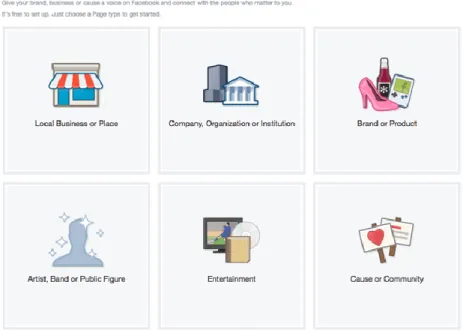
Six types of pages can be chosen according to the type of business or organization:
- Local Business or Place
- Company, Organization, or institution - Brand or Product
- Artist, Band, or Public Figure - Entertainment
©Daffodil International University 25 - Cause or Community
Figure 3.2: Facebook Page Creation 3.6 Business Manager
The creation of a Page is only the first step to effective Facebook advertising. The next step is the creation of Business Manager (BM) which is a tool from Facebook launched in 2014.
It was designed for companies and smaller advertisers and allows better administration of managed pages and advertising accounts (Constantine, 2014).
The main advantages of BM are the following:
- Easier management of Pages and Advertising accounts - Better management of access for multiple people - No need to create fake profiles to manage ads
©Daffodil International University 26 - Possibility to create dynamic product ads
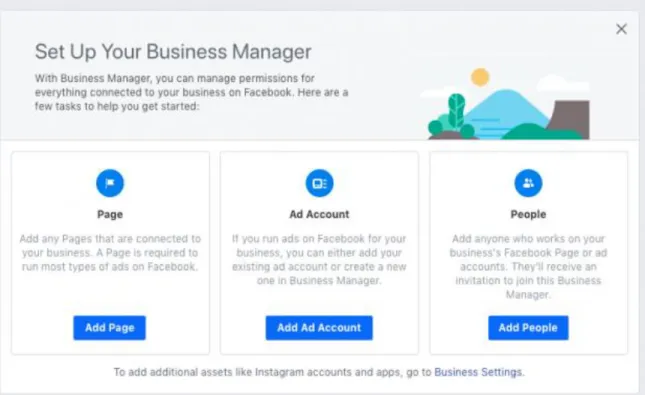
Figure 3.3: Business Manager Setup
The three-step guide shows three options that guide BM components setup:
1) Add Page
2) Add Advertising Account 3) Add People
The first two options allow you to either request access to an already existing Page or Add an Account or create a new one. The third option stands for adding new people to the newly created BM. Roles can be assigned either as Employee with limited rights or as Admin with full access. The invite to collaborate in the BM is sent via email.
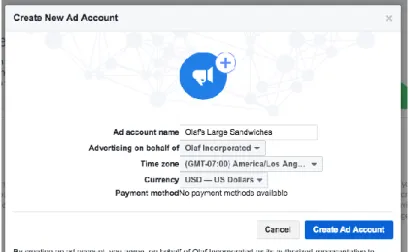
An advertising account is part of the BM and is necessary as it is used for payments and billing. To set it up it is needed to select name, time zone, currency, and payment method.
©Daffodil International University 27 In case the payment method is not set up it is necessary to select it after the creation of the Add Account. Two options are available: Credit/Debit Card or PayPal.
Figure 3.4: Ad Account Creation
There are two more components needed for e-commerce advertising on Facebook:
- Facebook pixel
- XML Feed/Product catalog 3.7 Facebook Pixel
JavaScript code called Facebook Pixel is needed for conversion tracking and remarketing.
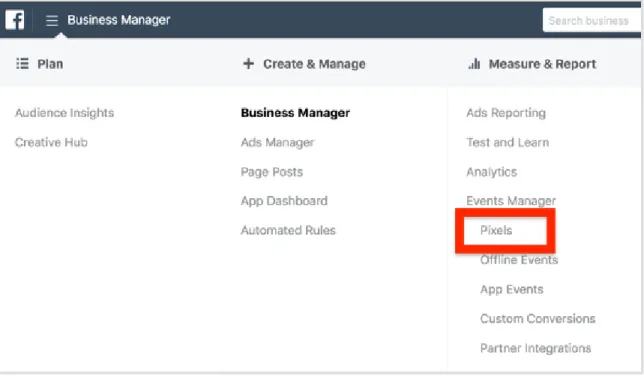
The Pixel can be found in the Business Manager in the Measure & Report section.
©Daffodil International University 28
Figure 3.5: Facebook Pixel in Business Manager
After selecting “Create Pixel”, Facebook offers two options: - Automatic integration of pixel into e-commerce platforms.
- Raw JavaScript code that should be copied and pasted between HTML tags on every page of the website (this is the option used for PROTECT CZ)
Base code for PROTECT CZ website looks as follows:
©Daffodil International University 29 Figure 3.6: Facebook Pixel Code for PROTECT CZ
The number in blue is Facebook Pixel ID that allows it to be paired with Business Manager, Ad Account, and Product Feed. In addition to the basic Page View event that tracks all pages that user visited there are two more events necessary for e-commerce: Add to Cart and Purchase
Add to Cart event should get triggered when the user clicks the button that adds the product to the basket and Purchases event after users click the last confirmation button in a checkout process and place an order. For these two events there are additional JavaScript parameters that need to be tracked for Dynamic Ads to work (the text in italics is an example of variables from protecting. CZ):
- content _type: product - content _ids: XY123456 - value: 2378.6
- content _name: ATLAS ESF sandal - currency: CZK (Facebook, 2017)
©Daffodil International University 30
CHAPTER 4
EXPERIMENTAL RESULTS AND DISCUSSION 4.1 Introduction
In our previous chapter, we as of now discussed the introduction, background, and methodology. In this chapter, we will discuss our experimental results and discussion.
4.2 Experimental results
Platform Campaign Reach Impression Link
Clicks Views Budget Sales Food Delivery Facebook food 550,907 1,037,033 7,520 $311.39 1,369
Google N/A 910,603 21,651 $260.54 2,378
Platform Campaign Reach Impression Link
Clicks Engagement Budget Sales RB - Dettol
Facebook Dettol 129,280 153,157 249 6,412 $100 56
Platform Campaign Reach Impression Link
Clicks Views Budget Sales Facebook Samsung TV 166,242 197,155 9,746 $695 21 TV
Google Samsung TV 608,465 14,705 $170.03 5
Platform Campaign Reach Impression Link
Clicks Views Budget Sales
dress
Facebook dress 165,121 187,145 10,746 $100 150
Google dress 208,465 4,705 $50.03 5
Platform Campaign Reach Impression Link
Clicks Views Budget Sales
Mobile Facebook
Samsung
S21 Plus 1,532,425 2,601,317 82,099 $1,216.93 346 YouTube
Samsung
S21 Plus N/A 153,439 1,254 60,871 $394.65 79
©Daffodil International University 31 4.3 Descriptive analysis
The campaign ran for approximately 5 days and depleted the whole allocated budget. Five product categories were promoted to audiences with the following interests and demographics.
Two types of campaigns with the following goals were created: Traffic and Product Catalog Sales. For Traffic campaigns two types of targeting were tested:
-Interests and Demographics o Home Improvement (Hobbies) o Gardening (Hobbies)
o Hiking (Sports and Outdoors) o Fishing (Sports and Outdoors) o Do It Yourself (Hobbies) o Construction (Industry) o Agriculture (Industry)
o Farming, Fishing, and Forestry (Industry) - Lookalike Audiences
o 1% Audience from the visitor in the last 180 days o 1% Audience from all registered users' e-mails
Product Catalog Sales remarketing campaign was segmented as follows:
- DPA visited product/added to cart in the last 7 days – Desktop Newsfeed Placement - DPA visited product/added to cart in the last 7 days – Mobile Newsfeed Placement
©Daffodil International University 32 - DPA visited product/added to cart in the last 5 days – Right Column Placement
Traffic Campaign
Traffic campaign targeted people in either SEE or THINK phases. The ad copy was mostly two or three sentences long and contained emojis to grab attention. It often started by pointing out coming cold weather, presented benefits of the products (e.g., comfort and warmth), and concluded by stating one or two features.
Conversion Campaign
Product Catalog Sales campaign was the only campaign with conversions for goals. The campaign was remarketing to the users who visited the target website in the last seven or five days. The ad was targeting people in the DO phase, users who clicked through the acquisition ad and shown interest in the promoted product but did not purchase.
Overall Evaluation
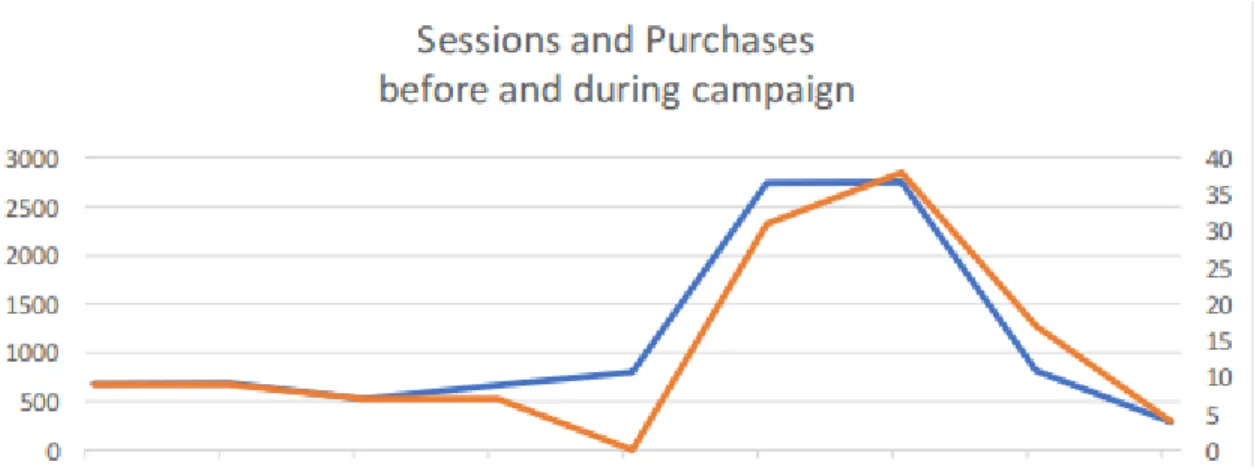
Following data has been acquired from Google Analytics. Before campaign launch target transactions per week. Average sessions before the campaign were per week.
©Daffodil International University 33
Figure 4.1: Sessions and Purchases before and during the campaign
4.4 Summary
In this chapter, we made a table based on our information. We compare all algorithms together and try to find out the best algorithm for that particular field.
©Daffodil International University 34
CHAPTER 5
SUMMARY, CONCLUSION, RECOMMENDATION, AND IMPLICATION FOR FUTURE RESEARCH
5.1 Summary of the study
The research objective was to define a theoretical and practical approach to arranging, creating, and assessing of Facebook promoting campaign. This objective was satisfied as well as the thesis covers both a wide high-level procedure approach to campaign arranging and point-by-point campaign strategies counting execution estimation, campaign setup and optimization. The proposed showcasing campaign technique and strategies might be utilized by other e-commerce for arranging a Facebook advertising campaign.
5.2 Conclusion
We wish if any new learner to start a new work it will be a great help for them because in our time duration we try to gather as many as possible data and its related field. We compare them try to find out the best data so we think it will be easier to use and they don't feel the confused middle of their work.
5.3 Recommendation
We recommend this paper for new learners and new researchers who will be confused by writing their papers. They can decide first which algorithm is perfect for their paper. They can also compare them and for their particular field, they can use more than one algorithm.
5.4 Implication for further study
This proposal lies generally within the fast-developing field of online showcasing.
Facebook publicizing particularly is quickly changing from month to month and unused highlights are being included or altered. Indeed although the creator attempted to utilize the most current sources in his investigation, readers within the future have to be cautious and ought to check whether is displayed data is up to date.
©Daffodil International University 35 Assist investigate within the future might incorporate strategies on how to coordinated Facebook marketing with other publicizing channels such as Look, Show, and Mail.
Furthermore, progressed strategies of cross-channel measurements and attribution may well be explored. Creation of and progressed substance promoting methodology may be one of the closely inspected subjects as well. In case greater budget is available more wide testing of copy and promotion bunches got to be carried out
Even though limited by the recommended range of thesis this work tried to grasp the topic of Facebook marketing comprehensively. The research contributed to furthering knowledge of online and Facebook marketing by utilizing the newest findings and turning them into actionable blueprints on how to plan, launch and evaluate Facebook advertising campaigns.
References
1. Authorizet.net, “E-commerce. Getting started guide”
https://www.authorize.net/content/dam/anet-redesign/documents/ecommerceguide.pdf 2. Casandra Campbell (2018) “Facebook Ads: The Beginner’s Guide to the Facebook Pixel” Retrieved 02.04.2018 from https://www.shopify.com/blog/72787269- relaxadvertising-on-facebook-just-got-a-lot-easier
3. Chris tread away, Mari Smith (2012), “Facebook Marketing: An Hour a Day" Retrieved 03.05.2018from ProQuest Ebook Central, http://ebookcentral.proquest.com/lib/arcada- ebooks/detail.action?docID=821834.
4. FlashStock Technology Inc., Michael Scissons, Jeremy Vo, Hooly Sim (2018)
“Flashstock’s Instagram Marketing Strategy E-book”. Retrieved 25.03.2018 from
©Daffodil International University 36 http://www.johnschnell.net/pdf/social/Instagram-Marketing.pdf
5. Facebook Business (2018), “Learn More About the People that Matter to Your Business with Facebook Audience Insights” Retrieved 04.05.2018 from
https://www.facebook.com/business/news/audience-insights
6. Help Center (2018), “About Facebook Pixel” Retrieved 03.04.2018 from
https://www.facebook.com/business/help/742478679120153?helpref=page _content) 7. Help Center (2018), “The Facebook Pixel” Retrieved 02.04.2018 from
https://www.facebook.com/business/help/651294705016616)
8. Help Center (2018), “Advertising Objectives” Retrieved 06.05.2018 from https://www.facebook.com/business/help/197976123664242
9. Johnathan Dane (2018), “How to Use Facebook Audience Insights for Better Targeting” Retrieved 03.05.2018 from https://sproutsocial.com/insights/facebook audience-insights
10. Juan Ramos (2014), “Facebook page vs. Facebook profile: Do you know the difference?” Retrieved 17.11.2017 from https://blog.hootsuite.com/facebook-page-vs Facebook-profile
11. Kevin Johnston (2018), “How to identify your strategic goals in a small business”
Retrieved 28.03.2018 from http://smallbusiness.chron.com/identify-strategic-goalssmall- business-56508.html
12. Kevan Lee (2018), “The complete guide to Facebook Advertising” Retrieved 01.04.2018 from https://blog.bufferapp.com/wp-
content/uploads/2016/08/BufferComplete-Facebook-Ads-Guide.compressed-1.pdf 13. Kevin Curran, Sarah Graham, Christopher Temple (2011), “Advertising on
Facebook” Retrieved 27.03.2018 from http://uir.ulster.ac.uk/20605/1/IJED-Facebook.pdf 14. Kristi Hines, (2018) “How to Use Facebook Analytics for Your Website” Retrieved 06.05.2018 from https://www.socialmediaexaminer.com/how-to-use-facebookanalytics- for-website/
©Daffodil International University 37 15. Leia Gatch (2015) “Learn to Make Soutache: Braid-and-Bead Embroidery Jewelry”
Retrieved 01.05.2018 from https://makezine.com/2015/07/23/learn-make-soutachebraid- bead-embroidery-jewelry/
16. Naomi Parry, (2017), “How to use Facebook Audience Insights: A beginner’s guide”
Retrieved 03.05.2018 from https://blog.hubspot.com/marketing/facebook- audienceinsights-guide
17. Shannon Greenwood, Andrew Perrin, Maeve Duggan (2016), “Social Media Update 2016” Retrieved 22.03.2018 from http://www.pewinternet.org/2016/11/11/socialmedia- update-2016/
18. Shaun Elley (2016) “Guide to Using Facebook Business Manager” Retrieved
03.05.2018 from https://www.goinflow.com/guide-to-using-facebook-businessmanager/
19. Veronika Baranovska, (2017), “7 tips for Using Instagram for Business” Retrieved 03.05.2018 from http://sendible.com/insights/7-tips-for-using-instagram-forbusiness 20. William M. Luther (2001), “Marketing Plan: How to Prepare and Implement It”
21. BUTLER, Jonny. A Guide To Facebook Ad Campaign Objectives. In: Adgo Blog [online]. Ago, 2017 [cit. 2017-11-16]. Available at:
http://www.adgo.io/blog/2017/6/21/a-guide-tofacebook-ad-campaign-objectives
22. CONSTINE, Josh. Facebook’s Secret New “Business Manager” Could Compete With Developer Partners For Marketing Dollars. In: TechCrunch [online]. TechCrunch, 2014 [cit. 2017-11-13]. Available at: https://techcrunch.com/2014/03/14/facebook-business- manager/
23. https://www.facebook.com/business/help/1438417719786914
©Daffodil International University 38