Raihan Uddin Amplifier; Aziha Kamal from the Department of Software Engineering, Daffodil International University has been accepted as satisfactory for partial fulfillment of the requirements for the degree of Bachelor of Science in Software Engineering and approval regarding its style and content. This paper presents our Bachelor of Science Thesis “Towards actuator and sensor service modules for a middleware supporting end-user-driven collaborative service composition”. Imtiaz-Ud-din, Assistant Professor, Department of Software Engineering, Daffodil International University, for giving us the opportunity to do this.
Touhid Bhuiyan, Professor and Head, Department of Software Engineering, Daffodil International University, and all the teachers in our department. While existing end-user-driven service composition tools provide support for building composite IOT-based services to meet user needs at runtime, an environment that will enable end-users to co-create both web services and IOT-based services to meet user requirements on, while none yet exist to the best of our knowledge. More specifically, our contribution lies in designing and implementing a pluggable IOT-based sensor and actuator environment that can be used to support the composition of end-user-driven collaboration of both IOT-based services and other web services.
In recent years, the number of IOT-based services has increased and the integration of IOT services over the web has gradually begun, according to Calinescu, R., Grunske, L., Kwiatkowska, M., Mirandola, R., & Tamburrelli, G. After the collaboration of both based on IOT and web service, creating a complex ecosystem and for this ecosystem creating uncertainty in the running context and needs of the users at the time of execution.
Motivating Scenario
Objective
Outline of the Thesis
LLITERATURE REVIEW
Related Work
Related Technology and Framework
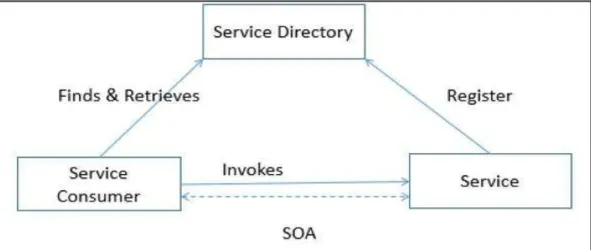
- Service Oriented Architecture
- Distributed Agent Architecture
- Cloud MQTT Protocol Server
- Internet protocol
- Wireless Fidelity (Wi-Fi)
From the top down, what's missing: an architecture that allows the end user to define the goal and associated actions by creating composite services using both IoT-based services and web services based on their needs, without any programming knowledge. Internet protocol is the main communication protocol through which data is sent from one device to another device over the Internet according to Valsamakis, Y., & Savidis, A. Each packet traveling over the Internet is treated as an independent unit of records, apart from any relationship with any other registration unit.
Wi-Fi is a local area network (LAN) technology designed to provide broadband coverage within the building. Now a days office, home, hotels, cafes, airports and also a city is covered by Wi-Fi.
DESCRIPTION OF PROPOSED SYSTEM
Proposed System Architecture
- End-User Development Interface and Code Generation Engine
- Code Execution Engine
- IoT Sensor Service
- IoT Actuator service
- Web Service
Sensors are advanced devices that are used every now and then to distinguish and respond to electrical or optical signals. In our proposed system architecture, IoT sensor service and code engine execution modules communicate with each other through request and perception. In our proposed system architecture, IoT actuator service and code engine execution modules communicate with each other through status and action.
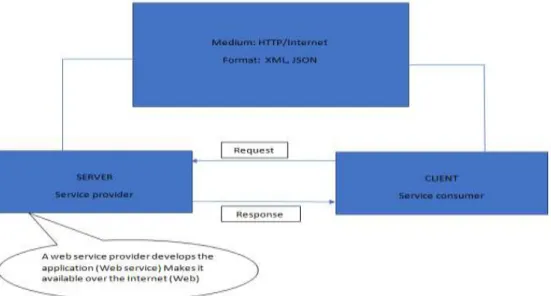
Web service implies a product framework or architecture that supports applications to viably talk to each other through the web. It can be used very well in any equipment or programming stages and can also be used independently in any programming dialects. It is used in service-based model architecture and tends to be considered as a first favorable position or purpose behind the use of web services.
Service-based model means that web services take place at the web server and any applications can request information from it and spend it for the different users. Various applications are composed of various programming languages and that is the reason why they cannot talk to each other, but by using web services we can talk to various applications using open conventions.
IMPLEMENTATION
IoT Sensor Service, IoT Actuator Service and Web Service Working Module
- Pluggable Module
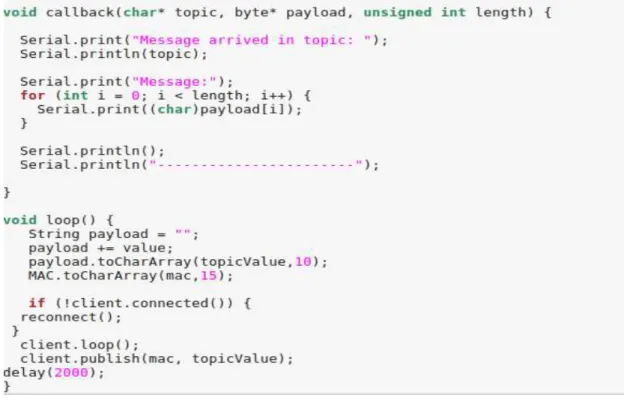
- IoT Sensor Service
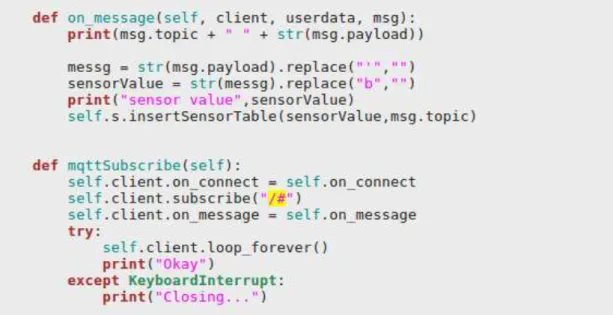
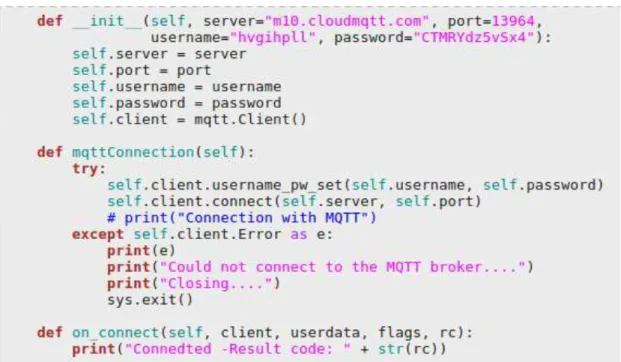
- IoT Sensor Service to CloudMQTT Server
- CloudMQTT Server
- CloudMQTT Server to Database
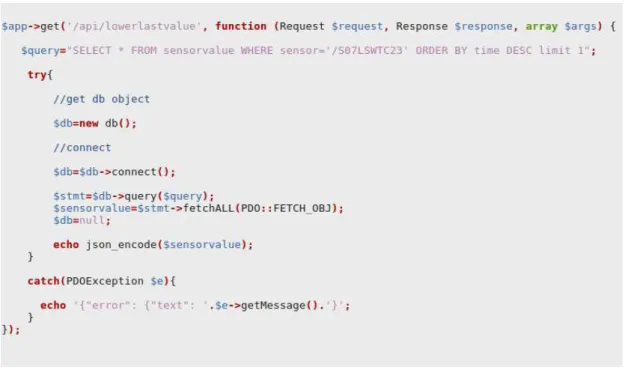
- Database to Web Service
- Web Service to Database
- Database to CloudMQTT Server
- CloudMQTT to IoT Actuator Service
- IoT Actuator Service
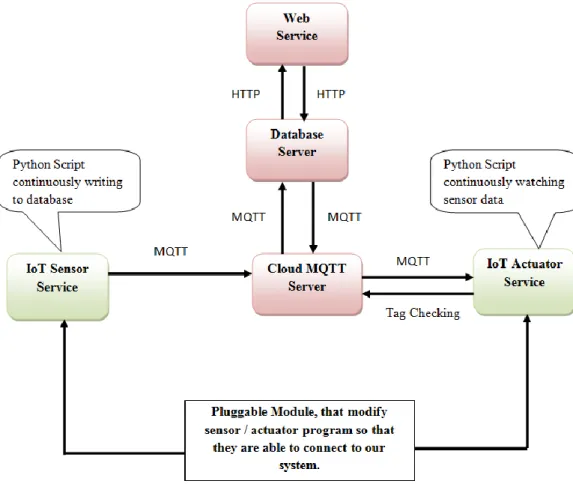
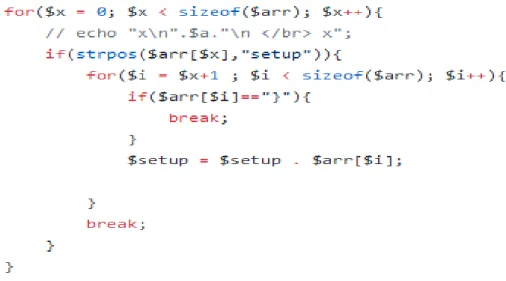
In our pluggable platform we have identified this basic structure and based on this we inject the connection programming code into the file and create a new file containing every necessary connection related code to connect our existing system. By identifying the basic structure, the pluggable codes inject the necessary connection-related code into the existing file and create a new file. We use a CloudMQTT server to receive data from sensor and send data to drive, also to communicate with the database.
The database sensor table contains four columns and they are sensor, data, sensor value and time. Using the sensor value, the user takes an action, this action is again performed by HTTP protocol from web service to database. In IoT actuator service, the whole time actuator module checks the action value of specific actuator through tag.
If the IoT actuator service receives a value for a specific actuator, it retrieves data from the database and provides an action.
PROOF OF CONCEPT
Experimental Setup
- Arduino IDE
- Apache HTTP Server
- MySQL
- Brackets (Text Editor)
- Postman
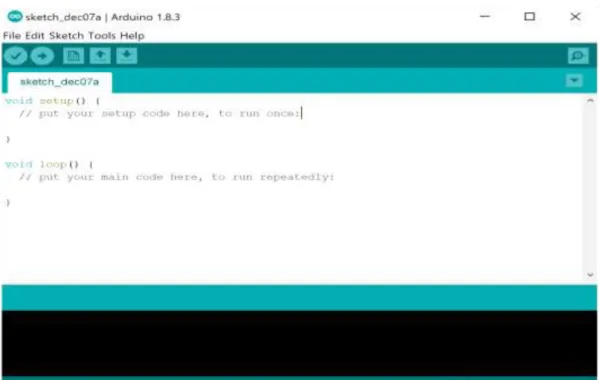
The Arduino IDE uses the avrdude program to change the executable code in the content record to the hexadecimal encoding that is assembled on the Arduino board by a loader program in the board's firmware. The Apache HTTP Server, colloquially called Apache, is a free and open source web server that is downloaded under the terms of the Apache 2.0 License. Apache is created and maintained by an open network of engineers under the auspices of the Apache Software Foundation.
It is a cost-effective delivery of reliable, superior and versatile web-based and installed database applications. It is an integrated exchange protection, ACID-acceptable database with full confer, rollback, crash recovery, and column-level locking capabilities. Created by Adobe Systems, it is free and open-source programming, authorized under the MIT License, and is currently maintained on GitHub by Adobe and other publicly released designers.
Postman is available as a packaged Google Chrome app and an in-app Google Chrome app. Expectations to absorb information to use the program are low, most customers should have the capacity to quickly create and test API calls. It mechanizes the way to build API requests for and test API responses, allowing engineers to establish a highly skilled workflow.
Practical Experiment
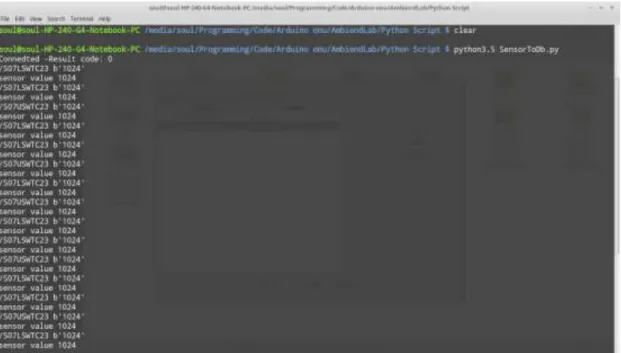
Figure 5.5 shows that the sensor module can read data and is useful for further experiment. For this we use the MQTT protocol to publish our sensor data in the database. The ID is the auto-generated field that is automatically created when sensor data is sent to the database.
From this tag value it can be determined from the sensor data which sensor data it concerns. The data field shows the value of the sensor collected by the sensor module and the time field changes automatically as each sensor data is updated. In Figure 5.7 we send our sensor data from the database to the middleware via the HTTP protocol.
The user must drag and drop the sensor value and the action performed by the actuator. Based on the user need, the code is automatically generated and a PHP script is automatically executed in the background. The sensor module, middleware and actuator module are independent because each part of our system is separated from each other.
When the database value for the actuator module is updated, the action is performed by the relay which can control the motor to switch it 'ON' or 'OFF'. When the database value of the action field is False or Zero, the actuator module looks like this. When the motor is in the 'ON' state, the motor is used to show our experimental output from the actuator module.
When the database action field value is True or One (1), the actuator module looks like this. In the 'ON' state, the relay will be 'ON' for the motor used in our experiment to display the output of the actuator module. The actuator module action values output by the relay for 'ON' or.
Result summery
CONCLUSIONS
Contribution
Future work