i
“© Daffodil International University”
Developing Network Security-Enhanced Model for an Enterprise Network
BY
MD MEHEDI HASAN ID: 151-19-1649
AND
E-OHAB AHMED ID: 151-19-1669
AND
MD.FARUK HOSSAIN ID: 151-19-1714
This Report Presented in Partial Fulfillment of the Requirements for the Degree of Bachelor of Science in Electronics and Telecommunication
Engineering.
Supervised By
MD. TASLIM AREFIN Associate Professor and Head
Department of ICE
Daffodil International University
DAFFODIL INTERNATIONAL UNIVERSITY DHAKA, BANGLADESH
JANUARY 2019
ii
“© Daffodil International University”
iii
“© Daffodil International University”
iv
“© Daffodil International University”
ACKNOWLEDGEMENT
First of all we would like to express our cordial gratefulness to Almighty ALLAH for His kindness, for which we successfully completed our project within time and we also apologize to Him for our any kind of mistakes.
We would like to express our boundless honor and respect to our supervisor, Md.
Taslim Arefin, Associate professor and Head, Department of Information and communication Engineering (ICE), Daffodil International University. His dedicated efforts, wise advices and keen knowledge showed the path of achievement.
We would like to thank the graduate committee Dr. A.K.M Fazlul Haque Associate Dean & Professor Department of ICE, Daffodil International University and Dr.
Mohammad Quamruzzaman, Professor Department of ICE, Daffodil International University and Dr. Subrata Kumar Aditya, Professor Department of Electrical and Electronic Engineering, University of Dhaka. We also like to thank to other faculty members and the staffs of the Department of Information and communication Engineering and Faculty of Engineering, Daffodil International University.
And last but not the least we must acknowledgement with due respect the constant support and patience of our family member for completing this project report.
v
“© Daffodil International University”
ABSTRACT
Networks security plays a significant role and that seriously considered as major task when design a network. A Network administrator set different rules policy and procedure to protect the network from different type of threat like passive and active attacks from various vulnerable source. The Network must be protected from accessing unknown sources. The number of threat, attacks (Denial-of-service (DoS) and distributed denial-of-service (DDoS) attacks, Aurora attacks, Malware Attack ,Port Scanning , password sniffer, IP Spoofing ,Session Hijacking and Man-in-the- Middle Attacks, Cyber-attack, etc. ) increasing day by day and these attack need to identify, explore and take necessary steps for prevent it. So a firewall setup required to secure the network from malicious attacks. The Networks Securities Expert day by day Discovering strong policy and make tremendous rules for prevent those attacks.
The main aim of this project is to protect the network from vulnerabilities, threats, attacks, by performing various task and different policy (like IPsec VPN, Strong Masquerades, Port forwarding, Create trusted Zone on WAN and LAN side, etc.) In this project, An Enhanced Network security Model for an Enterprise network has been designed and presented,, Using Firewall with various networking devices. Also, this project has been conducted the network security weakness based on its firewall along with its types of threats and responses of those malicious attacks, the method of preventing those attack form hackers to access the network. Also this project provides a Checklist to use in evaluating whether a network is adhering to best practices in network security and data confidentiality. Different software (GNS3, Metasploit, Freemeter, VMware) has been installed for analyzing security threats and attacks also Bandwidth Monitoring and deployed Strong Firewalls (Fortinet-FortiGate) for prevent these.
Keywords: Network Security, Threats, Firewalls, Enterprise, Network design, IPsec VPN
vi
“© Daffodil International University”
TABLE OF CONTENTS
Contents Page Number
Board of Examiners ii
Declaration iii
Acknowledgements iv
Abstract v
Chapter 1 Introduction 1-7
1.1 Introduction 2
1.2 Enterprise Network 3
1.3 Motivation 6
1.4 Aims and Objective 6
1.5 Thesis Formation 7
Chapter 2 Background of Work 8-28
2.1 Introduction 9
2.2 History of Network Security 10
2.3 Types of Attacks 11
2.3.1 Passive Attack 11
2.3.2 Active Attack 12
2.3.3 Distributed Attack 13
2.3.4 Insider Attack 13
2.3.5 Close in Attack 13
2.3.6 Spy Ware Attack 13
2.3.7 Phishing Attack 13
2.3.8 Hijack Attack 14
2.3.9 Spoof Attack 14
2.3.10 Password Attack 14
2.3.11 Buffer Over Flow 15
2.3.12 Exploit Attack 15
2.4 Threat to Network Security 15
2.4.1 Adware 15
2.4.2 Backdoor Trojans 15
2.4.3 Bluejacking 15
vii
“© Daffodil International University”
2.4.4 Bluesnarfing 15
2.4.5 Boot Sector viruses 16
2.4.6 Browser Hijackers 16
2.4.7 Chain Letters 16
2.4.8 Cookies 16
2.4.9 Denial of Service Attack 16
2.4.10 Document Viruses 17
2.4.11 Email Virus 17
2.4.12 Internet Virus 17
2.4.13 Mousetrapping 17
2.4.14 Obfuscated Spam 17
2.4.15 Page jacking 17
2.4.16 Parasitic Viruses 18
2.4.17 Pharming 18
2.4.18 Phishing 18
2.4.19 Aurora Attack 18
2.5 Firewall 19
2.5.1 Circuit Level Firewall 20
2.5.2 Application Level Firewall 20
2.5.3 Packet Filtering Firewall 21
2.6 Fortinate Firewall 22
2.7 Features of Firewall 24
2.7.1 Based on Features 24
2.7.1.a Stateful Inspection Firewall 24
2.7.1.b Application Level Gateways 25
2.7.1.c Multilayer Inspection Firewall 26
2.7.1.d Dynamic Firewall 26
2.7.2 Based on Uses 26
2.7.2.a Software Firewall 26
2.7.2.b Hardware Firewall 26
2.7.3 Based on Budgets 26
2.7.3.a Commercial or Paid Firewall 26
viii
“© Daffodil International University”
2.7.3.b Free or Open source Firewall 26
2.8 Literature Review 26
Chapter 3 Security In an Enterprise Network 29-38
3.1 Threats in Network Security 31
3.1.1 Unstructured Threat 31
3.1.2 Structured Threats 31
3.1.3 External Threats 31
3.1.4 Internal Threats 31
3.2 Network Security Layers 32
3.2.1 Physical Layer 32
3.2.2 Data Link layer 33
3.2.3 Network Layer 33
3.2.4 Transport Layer 33
3.2.5 Session Layer 34
3.2.6 Presentation Layer 34
3.2.7 Application Layer 34
3.3 Physical Installation Attack 35
3.4 Device Communication Attack 36
3.5 Typical Enterprise Network Security Design 36
3.5.1 Virtual Private Network (VPNs) 37
3.5.2 Firewall 37
3.5.3 Intrusion Detection & Prevention System 38
3.5.4 WAN Optimization 38
3.5.4.a Data Protection 38
3.5.4.b Problem Resolution 38
Chapter 4 Problem Statement of an Enterprise Network 39-47
4.1 Problem in Existing System 40
4.1.1 IP spoofing 41
4.1.2 Insider Intrusion 41
4.1.3 Denial of Service 41
4.1.4 No Protection Against Masquerades 42 4.1.5 Firewall Trust on Trusted Network (LAN & 42
ix
“© Daffodil International University”
WAN)
4.2 Proposed Model for an Enterprise Network 43
4.2.1 Strong Authentication 44
4.2.2 High Data Security 44
4.2.3 Multilevel Protection 44
4.2.4 Network Traffic Encryption 45
4.2.5 IPsec 45
4.2.6 Port Forwarding 46
4.2.7 Internet Traffic Filtering 47
4.2.8 Different Web Access policy for users 47
Chapter 5 Implementation and Evaluation 48-62
5.1 Devices and Appliances 49
5.2 Implementation of Firewall with the integration of Different Policy
52 5.3 Implementing port forwarding and policy against
Direct Internet Traffic
54 5.4 Implementation of Internet protocol security in
Proposed Model.
56
5.5 Results 59
5.6 Performance Analysis and Evaluation 60
Chapter 6 Conclusion 63-65
6.1 Future Scope 65
References 66
Appendix 67
Abbreviation 68
x
“© Daffodil International University”
List of Figures
Chapter Contents Page No
Chapter 1
Fig 1.1 Enterprise Network 5
Chapter 2
Fig 2.1 Passive Attack 11
Fig 2.2 Active Attack 12
Fig 2.3 Distributed Attack 12
Fig 2.4 Spyware Attack 13
Fig 2.5 Phishing Attack 14
Fig 2.6 Hijack Attack 14
Fig 2.7 Aurora Operations 19
Fig 2.8 Packet Filtering Firewall 21
Fig 2.9 The Working Process of Fortinate Firewall 23 Fig 2.10 Authentication and Security Process of
Fortinate Firewall
23 Fig 2.11 Physical View of fortunate Firewall 24 Fig 2.12 Unit Operation of Fortinate-FortiGate
Firewall
24
Chapter 3
Fig 3.1 Network Security Layers 32
Fig 3.2 Security Present in the Different Kinds of Enterprise Network
36
Fig 3.3 Firewall 37
Chapter 4
Fig 4.1 Existing Network Model of an Enterprise Network
41
Fig 4.2 Proposed Model 43
Chapter 5
Fig 5.1 Proposed Model for an Enterprise Network 51
xi
“© Daffodil International University”
Fig 5.2 Aurora Attack take place IPS 52 Fig 5.3 Configuration FotiGate VM with CLI Mode 53 Fig 5.4 Ping Statistics of FortiGate Vm with Host PC 53 Fig 5.5 Port Forwarding in FortiGate Firewall 54 Fig 5.6 Object Creat in Fortigate Firewall 55 Fig 5.7 Policy for Direct Internet Traffic in LAN Side 55 Fig 5.8 Traffic History of Direct Internet Traffic
Ingoing and Outgoing
56 Fig 5.9 VPN Configuration in Local Interface for Port
Forwarding in FortiGate Firewall
57 Fig 5.10 IPsec VPN Configuration in Both 58 Fig 5.11 Firewall Policy for IPsec VPN 58 Fig 5.12 Lunching Aurora in Metasploit Tools with
Port Forwarding
59 Fig 5.13 Vulnerability Scan log in FortiGate Firewall 60 Fig 5.14 Log Monitoring in the Firebase of FortiGate 60 Fig 5.15 Utilization of Bandwidth Before Applying the
Proposed Model
61 Fig 5.16 Utilization of Bandwidth After Using Firewall 61
Fig 5.17 Existing System 62
Fig 5.18 Compression Between Existing and Proposed System
62
xii
“© Daffodil International University”
List of Tables
Chapter Contents Page No
Chapter 3
Table 3.1 OSI layers Attacks 35
Chapter 5
Table 5.1 List of Tools and Device for Implementation and Application
51
1
“© Daffodil International University”
CHAPTER 1
INTRODUCTION
2
“© Daffodil International University”
1.1 Introduction
Now, in this modern world computer network system increases rapidly day by day.
Therefore a strong security system is very much important to protect the network. In a computer network, users confront dangers from a wide range of assault from hackers.
So, the development of network systems and the Internet, the dangers of data and systems have risen significantly. A large number of these dangers have turned out to be cunningly practiced assaults causing harm or submitting robbery. As personal, government and business basic applications turn out to be more pervasive on the Internet, there are numerous prompt advantages. Though these network based applications can make security dangers to the users and also companies and government.
In a network system, there are many kinds of method of attacks and these are the active attack, passive attack, distributed attack, spyware attack, phishing attack, hijack attack, spoof attack, buffer overflow, exploit attack and many more. By reducing these attack a home or little office may just require fundamental security while vast organizations may require high upkeep and propelled software and hardware to keep malicious assaults from hacking and spamming. New Threats Demand New Strategies as the system is the way to your association for both real clients and would-be assailants.
Without palatable network security, various individuals, associations, and governments are in risk of losing that advantage. Network security is the method by which computerized data assets are guaranteed, the goals of security are to ensure secrecy, look after trustworthiness, and guarantee accessibility. Considering this, it is basic that all systems be shielded from dangers furthermore, vulnerabilities all together for a business to accomplish its fullest potential. Regularly, these dangers are relentless because of vulnerabilities, which can emerge from misarranged hardware or software, poor network plan, intrinsic technology weakness, or end-client indiscretion. A router is like numerous PC's in that it has numerous default service.
Many of this service is useless and also used by an assailant for gathering information. For this purpose, all pointless service should be restricted in the router configuration to keep the assailant from stealing data or harm the network. In this paper, an audit of assaults on routers and in what manner can anticipate, and
3
“© Daffodil International University”
alleviating it will be depicted routers and firewall are extremely basic parts of network tasks and network security. Diligent administration and careful review of switch and firewall tasks, can minimize arrange downtime, enhance security, obstruct the attacks and hackers, organize dangers decline, and help in the investigation of suspected security violation.
1.2 Enterprise Network
An enterprise network is a network which helps to connect partners PCs and related contraptions across over workplaces and work bunch systems. An enterprise network diminishes correspondence traditions, empowering structure, and gadget interoperability, and furthermore improved interior and outside enterprise data management. This venture also called a corporate network.
The main motivation of an enterprise network is to extract different client and workgroups. All method should be able to contact with each other and provide and recover data. Also, physical process and gadgets ought to have the capacity to keep up and give good execution, unwavering quality, and security. Enterprise computing models are produced for this reason, encouraging the investigation and enhancement of built up big enterprise communication protocols and methodologies. 1]
In degree, an enterprise network may incorporate Local and wide Area Network (LAN/WAN), contingent upon operational and departmental necessities. An enterprise network can fuse all procedure, including Windows and Apple workstation and working frameworks (OS), UNIX frameworks, centralized computers and related gadgets like smart phones and tablets. A firmly consolidated enterprise network successfully joins and uses distinctive gadget and framework correspondence protocols. [1]
Enterprise network Includes different kind of service and server. In this service there are both public and private access. For example, web-based services could be accessed by different clients from various networks, they can also get into other services like database services. Users from Internet, internal network, and branches networks can access their e-mail and FTP accounts. For security purpose, access to database servers is restricted from internal network, it should not be obtain from public network. EN contains various networks, each network has its function, users, devices, and technology.[1]
4
“© Daffodil International University”
Securing servers of the enterprise network are essential, they must be available and secure. Enterprise network has various needs, it needs availability, scalability, security, and mobility. Users at any time and from anywhere should be able to connect to services hosted at enterprise network. There are different techniques that should be implemented within the enterprise network to maintain availability.
Unavailability of services damage enterprise prestige, it accommodates its business.
Fast recover will avoid service unavailability, a business cannot tolerate failure, and it costs many. Various technology and mechanisms are used to defeat this shortcut, failover technology is such one. It becomes harder to maintain availability as more services are distributed in an enterprise network. Accelerated growth in an enterprise network is critical, enterprise network should be able to connect more branches networks. WAN devices such as routers should be range enough to connect new branches, we need not change the whole infrastructure of the enterprise network. In addition, enterprise network requires a scalable wireless network, so it can connect new wireless sites. Scalability permits continuation without the need to change enterprise network infrastructure.
Today most users have smartphones like android, iPhone, these phones require a wireless connection. Enterprise network should support mobility for wireless devices in order to enable mobile users to access enterprise network service from anywhere and at any time. There are different wireless technologies that can be used in an enterprise network. Wi-Fi is a wireless technology that intends to connect user inside enterprise network, they usually used for the indoor connection. It may be possible to use Wi-Fi to connect branches networks but it still limited in the distance that it covers. On the other hand, WiMAX is used to connected branches networks of large distance, it needs more equipment and devices than Wi-Fi. WiMAX connects both sites and remote users to the enterprise network. Giving a protected enterprise network is not an easy job, it needs more efforts, money, and devices. We cannot figure the enterprise network without security, it will be a big problem.
5
“© Daffodil International University”
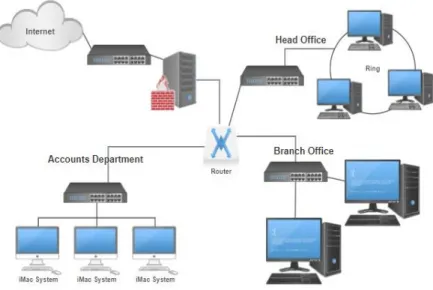
Figure 1.1: Enterprise Network
So, Enterprise network management is an important task that administrators should care about it. Analysis and collecting information from different networking devices and users necessary for monitoring and controlling EN. Most monitoring devices use SNMP protocol to collect information about network devices, they may also need to enable syslog service as well. Authors in proposed an Enhancing Enterprise Network Management using SMART, they try to make management of heterogeneous devices flexible and reliable. The paper utilized mobile agent technology for enterprise network in order to plan a hierarchical network management structure. It aims to manage 4 dynamic evolving network components using disseminated network the executives, adaptable coordination and runtime topology disclosure.
Due to the importance of Enterprise network security, we chose this topic as final year thesis to think about arrangements improving computer security. There is no total wellbeing arrangement in this way, so as to secure the data on a network, we have to develop numerous layers of insurance. A firewall is the outmost layer of the network.
In this paper, we will briefly elaborate on the concept of Network security of an enterprise network, how it can be done in the past. And with the emergence and rising use of internet how security threats are pointed to our devices is also studied. The objective of this thesis is to think about the essential ideas of a firewall, dangers to computer network security, firewall topologies, how they work and organization of open source firewall items. And finally a secure network model of an enterprise network.
6
“© Daffodil International University”
1.3 Motivation
Usually, an enterprise network composed of a distributed infrastructure that connects different users, devices and branches networks. It includes high execution computing servers and heavy storage solutions that depend on big information, capable infrastructure, and speed network for both local area network and wide area network.
Enterprise network includes data center that hosts various services such as web, E- mail, DNS, FTP, and other services. Some of these services are attained by the public user via the Internet, while others are attained via the internal network. So deploy secure enterprise network is very much important. In this Paper, we will discover the idea of an enterprise network. Also, we will see the components of EN in more detail such as devices, operating systems, network equipment’s, and others.[1]
Then we will introduce the importance of network security of an enterprise network.
Improper configuration of security in an enterprise network. Also, we will explain newly deployed security model of an enterprise network. This newly deployed security model minimize threats to give better secure network. Also, this security- enhanced model can be resolved the future attack.
1.4 Aims and objective
Since the improper security model of an enterprise network exists, this thesis gives an overview of the different kinds of security attack of an enterprise network and how to prevent these attack. And finally gives a properly deployed security model. The aim of this work are to publish and identify the idea of attack and threat to a computer network, to highlight various allaying techniques used to complicate threats and assaults, to outline the methodology to actualize the best security model for an enterprise network. [2]
The various type of attack and different kinds of mitigation technique are discussed in this thesis. Finally implemented a secure network which prevents those attack.
So a secure model implemented-
1. To defend vital info while as yet enabling access to the individuals who require it.
2. To ensure proper authentication need access control for resources.
3. To deploy multilevel security in order to prevent vulnerability.
4. To minimize security threat from different kinds of attack.
5. To ensure guarantee in privacy and correct access.
7
“© Daffodil International University”
1.5 Thesis Formation
The rest of the thesis paper is created as follows:
Chapter 2 talks about the background of work. It discusses the history of network security. Also, it discussed the different types of attack and threats of an enterprise network. In this chapter, we have talked about the overall view of a firewall.
Chapter 3 explains the different kinds of internal and external threats. It also described different threats in the OSI network model. In this chapter, we have shown a typical enterprise network model. To protect the enterprise network we have talked about VPN.
In chapter 4 we have explained the existing network model of our enterprise network.
We have also talked about difficulties of our network. Later we have explained our proposed security model of an enterprise network with different kinds of security- enhanced characteristics.
In chapter 5 we have implemented our proposed security model. We have use GNS3 tools to evaluate our proposed model, while we have used a FortiGate firewall to evaluate our network. We have also used a different policy to integrate our network model. Later we have discussed our result. Finally, in chapter 6, we discussed the conclusion and future work.
8
“© Daffodil International University”
CHAPTER 2
BACKGROUND OF WORK
9
“© Daffodil International University”
2.1. Introduction
Network security begins with approval, ordinarily with a user name and a password.
Network security comprises of the arrangements and approaches received by a network overseer to forestall and screen unapproved get to, alteration in framework, abuse, or Denial of a computer network and network available assets. Fundamentally network security includes the approval of access to data in a network, which is controlled by the network administrator. It has turned out to be increasingly critical to personal computer clients, and associations. In the event that this approved, a firewall powers to get to arrangements, for example, what administrations are permitted to be gotten to for network clients. So that to forestall unapproved access to system, this part may neglect to check possibly unsafe substance, for example, computer worms or Trojans being transmitted over the network. Anti-virus software or an Intrusion Detection System (IDS) help distinguish the malware. [1][2]
Today anomaly may likewise screen the system like wire shark traffic and might be logged for review purposes and for later on high level investigation in system.
Correspondence between two hosts utilizing a network might be utilizes encryption to keep up security arrangement. The world is ending up increasingly interconnected of the Internet and new networking innovation. There is a so vast measure of individual, military, business, and government data on network administration frameworks worldwide accessible. Network security is happening to extraordinary significance in light of protected innovation that can be effortlessly obtained through the Internet.
The network security is explored by researching the following:[2]
History of network security
Types of network attacks and security methods
Threat to network security
Internet architecture and security aspects of the Internet
Security for internet access in networks
Current development in the network security hardware and software
Literature Review
10
“© Daffodil International University”
2.2 History of Network Security
System and Network Technology is a key innovation for a wide assortment of utilizations. It is a basic necessity in current circumstance networks, there is a noteworthy absence of security strategies that can be effectively actualized. There exists a "correspondence gap" between the engineers of security innovation and designers of networks. Network configuration is a created procedure that is relies upon the Open Systems Interface (OSI) show. The OSI display has a few focal points when planning network security. It offers measured quality, adaptability, and institutionalization of conventions. The conventions of various layers can be effortlessly consolidated to make stacks which permit measured advancement. As opposed to secure network design is definitely not a very much created process. There isn't a system to deal with the multifaceted nature of security necessities. While considering about network security, it ought to be stressed that the entire network is secure. It doesn't just worry with the security in the computers at each finish of the correspondence chain. While exchanging starting with one node then onto the next node information the correspondence channel ought not be vulnerable to attack. A hacker will focus on the correspondence channel, get the information, and unscramble it and reinsert a copy message. In spite of the fact that anchoring the network is similarly as vital as securing the computers and scrambling the message. [3] While developing a protected system, the accompanying should be considered.
Accessibility – Approved clients are given the way to impart to and from a specific network.
Confidentiality – Information in the network stays private, Discloser ought not to be effortlessly conceivable.
Authentication – Ensure the clients of the network are, the client must be the individual who they state they are.
Integrity – Ensure the message has not been altered in travel, the substance must be same as they are sent.
Non‐repudiation – Ensure the client does not negate that he utilized the network.
11
“© Daffodil International University”
2.3 Types of Attacks
Networks are liable to assaults from malicious sources. Furthermore, with the approach and expanding utilization of web join is most ordinarily developing on expanding. The principal classifications of Attacks can be from two classes: "Active"
when a system interloper blocks information going through the system, and "Passive"
in which a gatecrasher starts directions to disturb the system's ordinary activity structure must have the ability to bind hurt and recover immediately when assaults occur. There are some more kinds of attack that are additionally basic to be considered. [4]
2.3.1 Passive Attack
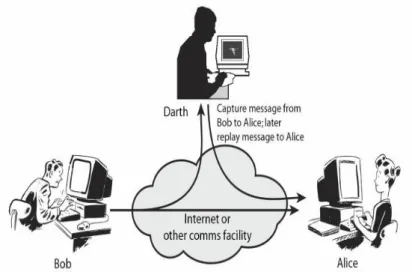
A passive attack screens decoded traffic and scans for clear-content passwords and touchy data that can be utilized in different sorts of assaults. The checking and tuning in of the correspondence channel by unapproved aggressors are known as a passive attack. It includes traffic analysis, observing of unprotected correspondences, decoding pitifully scrambled traffic, and catching verification data, for example, passwords.
Figure 2.1: Passive Attack 2.3.2 Active Attack
In an active attack, the attacker always tries to sidestep or break into secured system frameworks while the correspondence is an ongoing process. It could be done through stealth, viruses, worms, or Trojan horses. Active attack includes endeavors to break protection highlights and to take or adjust data. Unapproved attacker screens, listens to and adjusts the information stream in the correspondence channel known as a active attack.
12
“© Daffodil International University”
Figure 2.2: Active Attack 2.3.3 Distributed Attack
A distributed attack want that the enemy present code, for example, a Trojan steed or indirect access program, to a ―trusted‖ part or programming that will later be circulated to numerous different organizations and clients. Distribution attacks center around the vindictive modification of equipment or programming at the processing plant or amid dispersion.
Figure 2.3: Distributed Attack
13
“© Daffodil International University”
2.3.4 Insider Attack
As indicated by a Cyber Security Watch review insiders were observed to be the reason in 21 percent of security breaks, and a further 21 percent may have been because of the activities of insiders.
2.3.5 Close-in Attack
A close in attack includes somebody endeavoring to get physically near system parts, information, and frameworks so as to take in more about a system. Shut in assaults construct of standard people achieving close physical neighborhood to systems, frameworks, or offices to modify, assembling, or denying access to data. One mainstream type of close in attack assault is social engineering.
2.3.6 Spyware attack
Spyware is a serious computer threat that screens our online exercise or introduces a program without our assent for the benefits or to catch individual data.
Figure 2.4: Spyware attack 2.3.7 Phishing Attack
Hacker creates a fake web site that looks accurately original popular site like Tweeter in phishing attack, after that Hacker send an email message and attempting to trap the client into clicking a link that lead to the fake website. When a hacker succeeds to trick a user then user tries to log into his/her account by providing account information and then hacker get the username and password after that hacker uses them on the original website.
14
“© Daffodil International University”
Figure 2.5: Phishing Attack 2.3.8 Hijack attack
In a hijack attack, a hacker assumes control over a session between two people and disconnect the other individual from the correspondence. The victims still trust that he is conversing with the first party and may send Private data to the hacker coincidentally.
Figure 2.6: Hijack attack 2.3.9 Spoof attack
In the spoof attack, the attacker tone down the source address of the packets he or she is sending so that they put in an appearance to originate from another person. This might be an endeavor to sidestep the firewall rules. [4]
2.3.10 Password attack
An attacker endeavors to break the passwords put away in a network account database or a secret word secured document. There are three kinds of password assaults: a dictionary attack, a brute-force attack, and a hybrid attack. A word list file used on a
15
“© Daffodil International University”
dictionary attack, which is a list of potential passwords. A brute-force attack is the time when the attacker attempts each conceivable mix of characters.
2.3.11 Buffer Overflow
A buffer overflow attack is the point at which the attacker sends more data to an application that is normal. A buffer overflow attack usually results in the attacker increasing managerial access to the network in an order incite or shell.
2.3.12 Exploit attack
In this sort of attack, the assailants aware of a security issue inside a operating system or a bit of software and use that information by abusing the vulnerability.
2.4 Threat to Network Security
There is different type of network threats discussed below…
2.4.1 Adware
It is software that shows commercial on our computer. Adware, or advertising- supported program, displays advertising banners or pop-ups on our computer when we use the application. Adware can back off our computers. It can also back off our internet connection by downloading advertisements.
2.4.2 Backdoor Trojan
A back door Trojan enables somebody to take control of another client's computer by means of the Internet without his or her authorization. It might act like genuine programming, similarly as other Trojan steed programs do, with the goal that clients run it. On the other hand as is currently progressively regular clients may permit Trojans onto their PC by following a connection in spam mail.[4]
2.4.3 Bluejacking
Sending mysterious, undesirable messages to various clients with Bluetooth- empowered cell phones or workstations is called blue jacking. Bluejacking relies upon the capacity of Bluetooth phones to recognize and contact other Bluetooth gadgets adjacent.
2.4.4 Bluesnarfing
Bluesnarfing is the robbery of data from a Bluetooth phone. Like Bluejacking, Bluesnarfing relies upon the limit of Bluetooth-empowered gadgets to recognize and contact others close-by. In theory, a Bluetooth client running the correct software on their computer can find an adjacent phone, interface with it without victim
16
“© Daffodil International University”
affirmation, and download victim phone book, pictures of contacts and schedule. Our cell phone's serial number can also be downloaded and used to clone the phone. [4]
2.4.5 Boot sector virus
Boot sector viruses spread by changing the program that empowers your computer to fire up. When we switch on a computer, the hardware searches for the boot sector program which is for the most part on the hard disk yet can be on a floppy disk or CD and runs it. This program by then stacks whatever is left of the working system into memory. A boot sector virus replaces the first boot section with its own, adjusted variant.
2.4.6 Browser Hijacker
Browser hijackers change the default home and inquiry pages in our Internet browser.
A few websites run a content that changes the settings in our browser without our authorization. This hijacker can add easy routes to our "Top choices" organizer or, all the more genuinely, can change the page that is first shown when we open the browser.
2.4.7 Chain Letters
An electronic chain letter is an email that urges us to forward duplicates to other individuals. Chain letters, similar to virus hoaxes, rely upon us, as opposed to on computer code, to engender themselves. [4]
2.4.8 Cookies
Cookies are records on our computer that empower websites to recall your subtleties.
When we visit a website, it can put a record called a cookie on our computer. This empowers the website to recollect your subtleties and track our visits. Cookies are little content documents and can't hurt our data. Be that as it may, they can trade off our privacy. Cookies can be put away on our computer without our insight or assent, and they contain data about you in a frame you can't get to effectively.
2.4.9 Denial of Service (DoS)
Denial-of-service (DoS) attack keeps clients from getting to a computer or website. In a DoS attack, a hacker endeavors to over-burden or close down a computer, with the goal that real clients can never again get to it. Typical DoS attacks target web servers and expect to make websites inaccessible. The most widely recognized sort of DoS attack includes sending more traffic to a computer than it can deal with.
17
“© Daffodil International University”
2.4.10 Document Viruses
A large number of the virus is a large program that can duplicate itself and expanse starting with one document then onto the next. Numerous applications, for example, word handling and spreadsheet programs, use macros.[4]
2.4.11 Email Virus
A large number of the most productive viruses disperse themselves consequently by email. Ordinarily, email-mindful infections rely upon the client double tapping on a connection. This runs the malicious code, which will at that point mail itself to other individuals from that computer.
2.4.12 Internet Worms
Worms vary from PC infections since they can engender themselves, instead of utilizing a transporter program or document. They essentially make precise of themselves and use correspondence between PCs to spread. A worm can have pernicious impacts. For instance, it might utilize influenced computers to storm websites with solicitations or information, making them crash (a "denial of service"
assault). On the other hand, it can scramble a client's documents and make them unusable. In either case, organizations can be extorted.
2.4.13 Mouse Trapping
Mousetrapping keeps us from leaving a website. In the event that we can't stop with the back or close button. At times, entering another web address does not empower us to escape either. The site that mousetraps we will either not enable you to visit another address, or will open another browser window showing a similar site. A few
mousetraps let us quit after various endeavors, however others don't.
2.4.14 Obfuscated Spam
Muddled spam is an email that has been camouflaged trying to trick hostile to spam software. Spammers are always endeavoring to discover approaches to adjust or disguise their messages so that our anti-spam software can't peruse them, yet we can.
2.4.15 Page Jacking
Page-jacking is the utilization of imitations of respectable web pages to get clients and divert them to different websites. Con artists duplicate pages from a setup website and put them on another site that has all the earmarks of being authentic. They enroll this new site with real search engines, so clients completing a pursuit find and pursue
18
“© Daffodil International University”
Connects to it. At the point when the client touches base at the site, they are naturally diverted to an alternate site that shows publicizing or offers of various services. They may likewise search that they can't exception from the site without restarting their computers.
2.4.16 Parasitic Virus
Parasitic infections, otherwise called record infections, spread by appending themselves to programs. When we begin a program contaminated with a parasitic virus, the virus code is run. To disguise itself, the infection by then passes control back to the main program. The operating system on our computer sees the virus as a major aspect of the program we were endeavoring to run and gives it similar rights.
These rights enable the virus to duplicate itself, introduce itself in memory or make changes on our computer. [4]
2.4.17 Pharming
Pharming diverts you from a genuine site to a false duplicate, enabling hoodlums to take the data you enter. Pharming misuses the manner in which that site addresses are made.
2.4.18 Phishing
Phishing is the utilization of bogus messages and websites to deceive us into providing private or individual information. Commonly, we get an email that seems to originate from a trustworthy association, for example, a bank. The email incorporates what seems, by all accounts, to be a connection to the association's website. In any case, on the off chance that we pursue the connection, we are associated with a copy of the website. Any subtleties we enter, for example, account numbers, PINs or passwords, can be stolen and utilized by the hackers who made the false site. These are few among the Network Threats. [4]
2.4.19 Aurora Attack:
There are different types of attack in Internet world whose are dangerous and
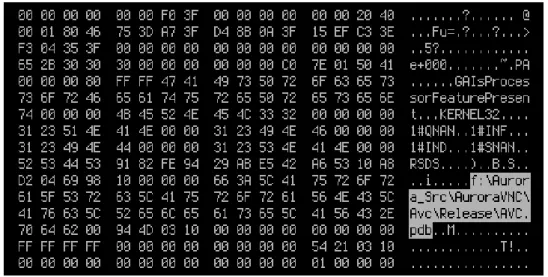
Alarming for secure data form hackers and attackers. Among those attack Aurora attack is one of them. It’s a cyber-attack from hacker in the real world .With cyber- attack hackers steal our valuable and essential data form us. Hackers uses different malicious tools with a false encryption that seems real and trusted. But behind that they use different algorithms and code to make false attack to hack and find out the vulnerability of a system, in aurora operations Aurora vulnerability can be allayed by
19
“© Daffodil International University”
reducing the out-of-phase opening and closing of the breakers from a hackers. Some inclined suggested policy incorporate adding usefulness in defensive transfers to guarantee synchronism and including a time delay for shutting breakers. Figure 3 shows encryption of aurora attack by generating binary.
Figure 2.7: Aurora operations 2.5 Firewall
A firewall is a network security framework intended to keep access to or from a private network. Firewalls can be utilized as both hardware and software, or a blend of both. Be that as it may, the issue emerges when we don't know which firewall we need to utilize. So to take care of this issue we are influencing a characterization with the goal that we to can choose which firewall we have utilized by our use. Firewalls are fundamental parts of all networks. Anyway, they are hard and if not effectively configured and oversaw may outcome in security breaks.
These Firewalls are the main onward edge guard component against network assaults.
In any network condition network, Security is a fundamental part of network aspect and the executives. In any case, a network will commonly comprise of a wide range of client applications all of which speak to main security breaks. Besides, there are various protocols, for example, Packet assembler/disassembler (PAD), Internet Control Message Protocol (ICMP) and Simple Network Management Protocol (SNMP) that are empowered as a matter of course and should be unequivocally debilitated. While other protocol, for example, HTTP and HTTPs must be permitted yet confined utilizing access control records. It is fundamental in this way to debilitate
20
“© Daffodil International University”
a conceivably extensive variety of administrations and services interfaces that are not being utilized but rather specifically limit different conventions with a proper firewall setup. Subsequent to recognizing main security branches a switch must be arranged by methods for a firewall. Firewall is a standout amongst the most generally utilized answers for the Internet world. All traffic inside to outside and the other way around must go through the firewall. Distinctive sorts of firewalls have diverse kinds of standards and operating system. The approved traffic will be sent dependent on local arrangements.[4] The firewall itself is secured, i.e.; it utilizes a confided in equipment and operating system. For the most part, firewalls are of three sorts.
Circuit-level firewalls
Application level firewalls
Packet filtering firewalls 2.5.1 Circuit Level Firewalls
The circuit level passage firewalls work at the session layer of the OSI model. They screen TCP handshaking between the packets to decide whether an asked for the session is authentic. And the data went through a circuit level door, to the web, seems to have originated from the circuit level gateway. Along these lines, there is no chance to get for a remote PC or a host to decide the inner private IP locations of an association, for example. This method is additionally called Network Address Translation where the private IP addresses beginning from the diverse customers inside the system are altogether mapped to people in general IP address accessible through the web access supplier and after that sent to the outside world (Internet).
Along these lines, the packet is labeled with just the Public IP address (Firewall level) and the inner private IP delivers are not presented to potential interlopers. [2]
2.5.2 Application Level Firewalls
An Application level passage which is additionally called a proxy server goes about as a transfer of application-level traffic. A client can contact the gateway by utilizing a TCP/IP application and afterward the gateway gets some information about the remote host which is to be gotten to. At that point accordingly the client must give a valid client ID and confirmation subtleties, at that point the passage contacts the application on the remote host and trade the TCP segments application information
21
“© Daffodil International University”
between the two end focuses. Be that as it may, to play out these things the door must execute the proxy code.
2.5.3 Packet Filtering Firewalls
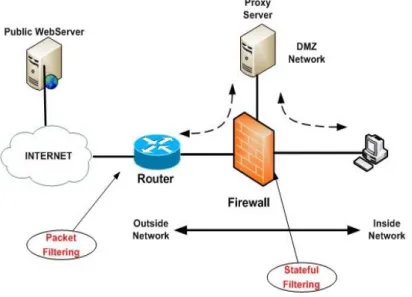
The packet sifting is done depends on the arrangement of principles configured on a packet channel router. The packet is onwards or abandoned based on the configurations done.
There are two default strategies engaged with sending or disposing of the packet, they are:
Default: Discard (Which doesn't coordinate the arrangement of tenets)
Default: Forward (Which becomes with at any rate any of the tenets)
Figure 2.8: Packet filtering firewalls
In the event that a packet matches with at any rate any of the guidelines, one of the default moves makes put i.e., it is sent, and on the off chance that it doesn't coordinate with any of the arrangement of standards, at that point the other default move makes put i.e., disposes of the packet. The block diagram of a Packet filtering router is appeared in Figure 1. The packet separating is done dependent on data in the system packet. [2]
Source IP address: The IP address from where the packet is produced.
Destination IP address: The IP address to which it wishes to send.
Transport-level address of source and destination: The applications like SNMP or telnet which are characterized by the vehicle level port (TCP or UDP).
22
“© Daffodil International University”
IP protocol field: Transport protocol is defined
Interface: From which interface of a router the packet is begun and to which interface of a switch the packet is.
2.6 Fortinet Firewall
Now a days a burning question in networking security is that how to secure of in- house or enterprise network or any other platform. Then the word of firewall is comes to our mind. Fortinet is the next generation firewall as it’s deployment in a big networking sector or any local large will add a tremendous security which is really a better options for enhancing security.[5]
A security architects think that how to provide major threat protection for their enterprises or any other platform including intrusion prevention, DoS attack, web filtering, anti-malware and various types of application control, will face a major complexity to hurdle managing these point products as well as no integration and lack of visibility. A prediction and Gartner estimates that by 2019 80% of enterprise traffic will be encrypted and 50% of attacks targeting enterprise will be backdoor in encrypted traffic.
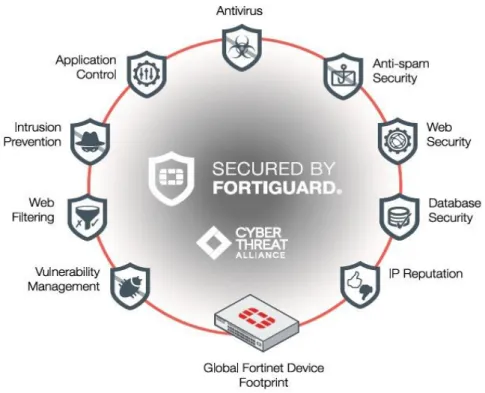
FortiGate Next Generation Firewall uses reason fabricated security processors and threat knowledge security administrations from FortiGuard labs to convey top of the line assurance and elite including scrambled traffic. FortiGate decreases unpredictability with robotized deceivability into applications, clients and organize and gives security evaluations to receive security best practices.
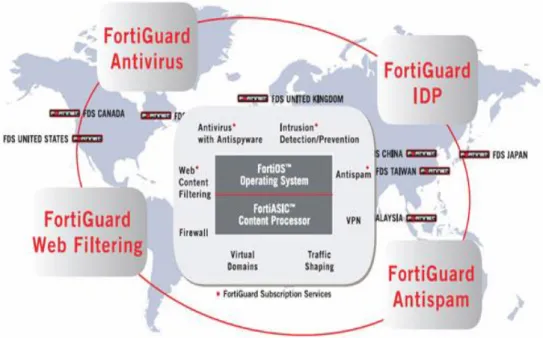
Working procedure: A Fortinet hyper version of FortiGate which protects TCP/IP layer or other important layer. Its gives the multilayer security of network topology.
Figure 2.9 shows the working procedure of Fortinet-fortiGate Firewall. Figure 2.10 shows the different steps of authentication and filtering in Fortinet firewall.[5]
23
“© Daffodil International University”
Figure 2.9: The working process of Fortinet firewall
Figure 2.10: Authentication and Security process of Fortinet firewall
Physical device of Fortinet firewall that shows below in the figure 2 (a) with different types of model and physical port. Forti analyzer will gives clear understanding about that device .figure 2(b) shows that unit operation in forti Analyzer with its port view and different potentiality. [5]
24
“© Daffodil International University”
Figure 2.11: Physical view of Fortinet firewall
Figure 2.12: Unit operation of Fortinet- FortiGate firewall
2.7 Features of Firewall
Based on Features
Based on Usage 2.7.1 Based on Feature
2.7.1.a Stateful inspection firewall
An innovation that controls the stream of traffic between at least two systems. SI Firewalls track the condition of sessions and dropping packets that are not part of a session permitted by a pre-characterized security approach. This is once in a while called session-level security since they keep state data for each system session and make permitted/denied choices dependent on a session state table.[6]
25
“© Daffodil International University”
SI firewalls go past separate transmission control protocol (TCP) associations with include numerous such associations. Session-level firewalls bolster dynamic protocols by distinguishing port alternative guidelines in customer server correspondence and looking at future sessions against these arranged ports. For example, to follow File Transfer Protocol (FTP) sessions, the firewall reviews the control association, utilized for issuing command and arranging dynamic ports, and afterward permits in different data associations for exchanging files.
Since session level protection gives every one of the advantages of packet level insurance without the restrictions, it renders packet level security superfluous for generally organizes. [6]
2.7.1.b Application-level gateways (pro6-7iies)
An application-level proxy server gives all the proxy highlights and furthermore gives broad packet examination. At the point when packets from the outside touch base at the passage, they are tested and assessed to decide if the security approach enables the bundle to go into the inside network. Not exclusively does the server assess IP addresses, it additionally takes a gander at the information in the parcels for debasement and modification.
A typical application-level passage can give proxy services to applications and conventions like Telnet, FTP (File Transfer Protocol), HTTP (Hypertext Transfer Protocol), and SMTP (Simple Mail Transfer Protocol). Note that a different proxy must be introduced for every application-level administration. (A few vendors accomplish security just by not giving intermediaries to a few administrations, so be watchful in your assessment.) With proxies, security strategies can be significantly more amazing and adaptable in light of the fact that all the data in packets can be utilized by heads to compose the guidelines that decide how parcels are dealt with by the passage. It is anything but difficult to review pretty much everything that occurs on the door. You can also strip PC names to cover up inward frameworks and assess the substance of packets for propriety and security. [6]
26
“© Daffodil International University”
2.7.1.c Multilayer inspection firewall
The stateful multi-layer inspection (SMLI) firewall uses a sophisticated form of packet-filtering that examines all seven layers of the Open System Interconnection (OSI) model. Every packet is inspected and thought about against known conditions of a benevolent packet. While screening router firewalls only examine the packet header, SMLI firewalls examine the whole packet including the data.
2.7.1.d Dynamic firewall
A dynamic packet filter is a firewall office that can screen the condition of dynamic associations and utilize this data to figure out which network data to permit through the firewall. By recording session data, for example, IP locations and port numbers, a dynamic parcel channel can actualize a lot more tightly security pose than a static bundle channel.[6]
2.7.2 Based on Usage
A dynamic packet filter can actualize a lot more tightly security pose than a static bundle filter.
2.7.2.a Software firewall
It is a bit of software that is introduced on our computer so as to shield it from unapproved access.
2.7.2.b Hardware firewall
It is a gadget to which we interface with our computers or network so as to shield them from unapproved access.
2.7.3 a Based on budgets
2.7.3 b Commercial or paid firewall
A firewall which possesses a fully fledge properties and any clients can utilize it however they need to pay to utilize those administrations. [6]
Examples: Cyberoam, SonicWALL-Dell 2.7.3.c Free or open source firewall
The firewall which is accessible uninhibitedly and can be utilized by anybody and anybody can change the source code and even discover bugs and report them.
Example: IPFire, IPCop, PFSense, etc.
2.8 Literature Review
The comparison between the commercial and the open source firewall in an enterprise network. Also discussed and focused on the different matters by which he could make
27
“© Daffodil International University”
out the difference between these two types of firewall. The proprietary firewall is better but the open source firewall can be made same as paid firewall by modifying the source code. In this paper, then we have compressively studied the features of the open source firewall which could prevent the cyber-attacks which occurs on the open source firewall in which they have made some of the rules that would prevent the entry of the outsiders in the network. So that the malicious activities inside the network could be prevented.
In this paper, the authors have concluded that for the specific instance the fortigate firewall has superior transaction rate performance and application-level filtering capabilities. The fortigste firewall is functionally superior for network-level filtering, VPN capabilities due to IPSEC, integration with a heterogeneous multi-protocol environment. We have also studied several Firewall projects in experimental stages.
At last, the best firewall arrangement might be a mix of both application level and network level packet separating. This experiment provides a basis for future experiments building toward general conclusions between open source implementations versus general commercial implementations. Effective advancement of a standard must adjust the requests of selection. Achieving the widest adoption of a standard attracts suppliers of complementary assets such as software and services, this can be achieved by widespread technology licensing on favorable terms, but by doing so, the sponsor runs the risk of losing the ability to appropriate economic rents from the standard. We described that, all main security elements of the project that were effective for its success. As we see, almost all of them were well known open source software that can be applied instead of too many proprietary and commercial tools.
No product cost, free accessible updates, source code accessibility.[6]
Comprehensive method and so many other shapes can be very persuasive for entrance open source world and improve its practical and favorable software. In this paper, authors have implemented the Fortinate firewall open source firewall and then they have worked on it as a trial in organizations. In this paper, the author had defined Network’s security tool was the beginning with the something that can protect the internal network from the external accessing. So, the firewall is a better perimeter defense which it enhances to provide the guard on the network’s traffic. Firewall system had involved in network’s environment over the years from the simple method with only packets filtering to the sophisticated packet inspectors which can decide to
28
“© Daffodil International University”
allow or barrier the traffic trust on its aim, sources, and destinations. A progressive inspection packet rule is the best technology within the others firewall’s technologies.
It is a better or complete firewall method for a network’s traffic defense.
The list of open source firewall are as follows:
Untangle
PFSense
Smoothwall
Endian
Clear OS
Zentyal
IPTables
UFW
Vuurmuur
ConfigServer Security Firewall
If we consider a scenario where the employee has just login its credentials and he/she is enjoying the internet services but due to some reasons like power loss, accidental removal of LAN cable/Ethernet cable from the system, or he/she has just log out from the services of using internet accidentally.[6] In such cases, the complication arises.
The complications or the problem that we found in any of the open source firewall is that if any such situation arises, as the user login using its credentials the ip address of the user is stored in the firewall and the logs are generated with reference to their ip address. If the above situation arises the ip allocated to the user will return back to the pool of ip. Then the user will try to login again by providing their credentials. In such cases, the same or different ip will be allocated to the existing user. If the same ip is allocated to the user then the situation is fine. But if the different ip is allocated then the previous ip will be allocated to different user in the LAN network. As we all know that all the open source firewall provides the ip based logs. So the firewall won’t be able to differentiate the actual user by taking ip into consideration. So to solve this complication/problem the logs obtained by the firewall should also have the ip address.
29
“© Daffodil International University”
CHAPTER 3
SECURITY IN AN ENTERPRISE NETWORK
30
“© Daffodil International University”
Security in an Enterprise Network
Securing network services and devices is the main task of the enterprise network, all data traffic is passed by network devices. We need to protect routers, switches, personal computers, servers, operating systems, and any devices in the enterprise network .Without enough protection many people’s properties as well as businesses and governments are in danger of losing their riches, network security will protect loyalty, maintain fidelity, and confirm availability for an enterprise network.
Enterprise network should open network security to give integrity to information data, they must be right and protected in opposition to corruption and disallowed change.
Encryption provides loyalty, authenticated users can only entrance and view information data. Enterprise network includes large information that stores the heavy amount of sensitive data. Stealing of these data exposes enterprise network to compromise and even to harm business.
Enterprise network should be protected from intrusions and attacks which are originated from the internal and external network. Compromising enterprise network would be expensive, it will stop enterprise reputation which will effect on business.
Enterprise network security devices should have the latest updated subscription, they should fix vulnerability of the systems, instruct traffic, and log network traffic activity. We need an updated security pattern that gleam changes in technology and services, we have to build and maintain a strong network security for end users and servers. As an enterprise network expands to include new technology, services, and systems, the likelihood of emerging new vulnerability with various degree of disability increases.
In general, security threats are arisen due to vulnerabilities, which illustrate the degree of weakness in software and hardware. Vulnerabilities are appeared due to different reasons, misconfiguration of hardware or software is a common one. Directors should avoid default configurations, they should expend more time to secure configuration.
Well, network model will avoid dynamic vulnerabilities, properly allocate of network security devices is necessary through design. As new attacks arise, the challenge becomes bigger. Enterprise network should have an efficient detection and restraint system against zero-day attacks. Intrusions try to steal data of EN, they intend to compromise EN. Today attack becomes complicated, they depend on the attacker
31
“© Daffodil International University”
with high skills. APT-based attacks become a serious attack against EN, they are funded by governments and organizations. They illustrate cyber-attack that want special awareness and early alerts. There are various types of APT-based attacks, Aurora operation and RSA attack are general examples. Security threats are produce from various sources, the internet is the most common one. Attacks use malicious code to compromise victim host and hence distributed across enterprise network to compromise the whole enterprise network.
3.1 Threats in Network Security
The threats in network security can be divided into four sections and those classifications are the explanation of different threat occurs in a network and harmful for the whole system.
3.1.1 Unstructured Threat
The unstructured security danger is the sort of risk worked by an untalented individual peoples attempting to access a system. They usually utilize general hacking instruments, as shell contents, and secret key saltines. A legitimate security arrangement ought to effectively cross this sort of assault. At the end of the day, these type of Hackers or attackers couldn't be thought little of on the grounds that they can cause genuine damage to the system.
3.1.2 Structured Threat
In contrast to unstructured dangers, organized risk by hackers are all around gauged and profoundly adulterated. They utilize modern hacking instruments to enter systems and they can interim into government or business PCs to quintessence data. On certain reason, organized dangers are completed by epitomized criminal possess or industry contenders.
3.1.3 External Threats
Some refused individuals outsider of the organization who don't have access to the organization’s PC framework or system could cause intriguing danger. They more often than not interim into the organization's system by means of the Internet or server. Both master and unpracticed programmers could present outlandish dangers.
3.1.4 Internal Threats
This kind of risk could be by a freaky worker who has approved enter to the organization's system. Like developed dangers, the harm that could be containing by such a hacker expand on the skilled of the Hacking. [7]
32
“© Daffodil International University”
3.2 Network security Layers
Implementing advocacy in altitude is essential for enterprise network, it gives security at many layers.
Figure 3.1: Network security layers 3.2.1. Physical Layer
The physical layer is responsible to transmitting information over system correspondence media. It could also referred as most changeable and venerable layer.
At the point when conduct with this sort of layer, unserious matter like unplugging the PC control rope or squandering system link could sporadically cause an incredible and untraceable destruction on an individual system, and it could reason extraordinary damage to the PC.
There are a great deal of vulnerabilities that the physical layer is standing up to, few of which include: loss of characteristic control, the mischief of equipment and data, separation of physical information joins, control harm, input logging like keystroke and other physical taking of information and equipment, and imperceptible block attempt of information. These vulnerabilities could make extraordinary damage organize security through physical layers if denial isn't done at the ideal time. By and by, there are dependably results accessible for any shakedown of harm caused to a system.