Chapter One
Introduction
1.1 Rationale of study:
Internship program of University is a partial requirement for the graduation of BBA students. Every B.B.A student is appointed to learn some practical knowledge within the pre-stipulated period by observing the organization day to day activities. In this regard our internship program started at 27th October at Islami Bank Bangladesh Limited. In the modern society commercial Banks occupy a position of economic importance. They play a Significant role to meet the needs of the society such as capital formation, large-scale production, industrialization, growth of trade and economy etc.
Islamic banks are unconditional and specialized financial institutions that perform most of the standard banking services and investment activities on the basis of profit and loss sharing system conforming to the principles of Islamic Shari’ah. Out of 50 banking institutions, 7 banks are backed by Islamic mechanism and worldwide accepted Islamic morality and established code of conduct. This paper, however attempts to appraise performance and dictate the overall scenario of Islami Bank Bangladesh Limited performing beneath the umbrella of Islamic shari’ah and approved welfare oriented principles.
1.2 Objectives of report
The first objective of writing the report is fulfilling the partial requirements of the BBA program. In this report, we have attempted to give an overview of Islami Bank Bangladesh Limited in general. The primary objective of this report is to observe the general banking, investment related activities & foreign exchange operations of Islami Bank Bangladesh Ltd.
The other objectives include:
Following are the main objectives
● To familiar the history of Islami Banking in Bangladesh.
● To learn about the overall general banking operations of IBBL.
● To show the investment mechanism and product offerings in different modes of IBBL.
● To learn about the shari’ah aspects followed for foreign exchange operations.
● To learn about the welfare activities of IBBL.
● To show the differences with conventional banking regarding different aspects.
● To identify strength and weakness of IBBL.
● To find problems or lacking that IBBL is facing.
● To recommend actions that may be necessary to redesign the investments of IBBL
2
1.3 Methodology
In order to carry out the report, we have collected the required data from both primary and secondary sources. We focused on taking the interviews of the personnel involved in the different departments, Manager and Senior Level Employees, Business Clients and Account Holders. After collecting information the data were used to analyze information, Graphical tools were used to get clear picture of the situation.
a) Nature of the study: Exploratory
b) Sources of information: Both primary and secondary information sources were used to complete this report.
Primary sources of data: Direct interview process in bank employees.
Secondary sources of data : Manuals provided by Islami Bank Training & Research Academy, Published financial statement & Website of Islami bank Bangladesh Limited.
Analytical Review:
● PEST Analysis
● SWOT Analysis
● Graphical Analysis 1.4 Scope of the Study
Islami Bank is the pioneer of welfare driven economy and promoter of balanced growth in a country like Bangladesh which has a poverty stricken contemporary economic background.
To address the ongoing condition of IB and their bright prospects is a vital issue to be explored.
1.5 Limitations
During preparing this report I have faced these following limitations:
● Inadequate published information about bank
● Financial constraints to collect information
● Insufficient information in websites of bank
● Confused definition about products and services of Islamic Bank
● Unsound database about Islamic banks in Bangladesh Bank
● Busy working environment
● Lack of sufficient well informed officials
● Data could not been collected for confidentiality or secrecy of management
1.6 Objectives of Islamic Banking
The primary objective of establishing Islamic banks all over the world is to promote, foster and develop the application of Islamic principles in the business sector. More specifically, the objectives of Islamic banking when viewed in the context of its role in the economy are listed as following:
● To offer contemporary financial services in conformity with Islamic Sharia’s;
● To contribute towards economic development and prosperity within the principles of Islamic justice;
● Optimum allocation of scarce financial resources; and to help ensure equitable distribution of income.
These objectives are discussed below:
Offer Financial Services:
Interest-based banking, which is considered a practice of Riba in financial transactions, is unanimously identified as anti-Islamic. That means all transactions made under conventional banking are unlawful according to Islamic Sharia’s. Thus, the emergence of Islamic banking is clearly intended to provide for Sharia’s approved financial transactions.
4
Islamic Banking for Development:
Islamic banking is claimed to be more development- oriented than its conventional counterpart. The concept of profit sharing is a built-in development promoter since it establishes a direct relationship between the bank’s return on investment and the successful operation of the business by the entrepreneurs.
Optimum Allocation of Resources:
Another important objective of Islamic banking is the optimum allocation of scarce resources. The foundation of the Islamic banking system is that it promotes the investment of financial resources into those projects that are considered to be the most profitable and beneficial to the economy.
Definitions of Terms used in Islamic Banking Operations
The following terms as used in this guideline, if not repugnant to the subject or affairs, shall have the following meaning:
● "Sharia’s" means such rules and regulations as have their origin in the holy Qur'an and Sunnah to govern all aspects of human life.
● "Islamic bank" means such a banking company or an Islamic banking branch (es) of a banking company licensed by Bangladesh Bank, which follows the Islamic Shariah in all its principles and modes of operations and avoids receiving and paying of interest at all levels.
● "Islamic Banking Business" means such banking business, the goals, objectives and activities of which is to conduct banking business/activities according to the principles of Islamic Shari’ah and no part of the business either in form and substance has any elements not approved by Islamic Shari’ah.
● "Branch or Branch Office" means any branch or Branch Office of Islamic Bank Company or office or Branch of such interest based conventional Banks which run Islamic banking business.
● "Depositor" means someone who holds with any Islamic Banking Company any account namely Current account based on Al-Wadiah principles, Savings or long and short term deposit accounts under Mudaraba principles.
● "Investment" means any such modes of financing which Islamic Bank Company does bin accordance with principles of Shari’ah or as per the Shari’ah approved modes like Mudaraba, Musharaka, Bai-Murabaha, Bai-Muajjal, Istisna, Lease, Hire-purchase under Shirkatul Melk, etc.
● "Client" means such a person or institution who/which has any business relationship
Bangladesh is one of the largest Muslim countries in the world. The people of this country are deeply committed to Islamic way of life as enshrined in the Holy Qur’an and the Sunnah.
Naturally it remains a deep cry in their hearts to direct and design their economic lives in accordance with the precepts of Islam. The establishment and commencement of Islamic banks in Bangladesh, is the true reflection of this inner urge of its people.
In our banking sector there operates 7 banks which are backed by Islamic Shari’ah and approved principles according to Quran and Sunnah. First Islamic bank is IBBL which is established in 1983. This was in fact the one of a kind bank in the Southeast Asia. Other players in the market are:
● EXIM Bank
● SJBL
● First Security Islami Bank Ltd
● Al-ArafahIslami Bank Ltd
● Social Islami bank Ltd
● ICB Islamic Bank
6
Chapter Two
Organizational Profile
2.1 Islami Bank Bangladesh Limited
The establishment of Islamic Bank Bangladesh Limited on March 13, 1983, is the true reflection of this inner urge of its people, which started functioning with effect from March 30, 1983. This Bank is the first of its kind in Southeast Asia. It is committed to conduct all banking and investment activities on the basis of interest-free profit-loss sharing system.
With the active co-operation and participation of Islamic Development Bank (IDB) and some other Islamic banks, financial institutions, government bodies and eminent personalities of the Middle East and the Gulf countries, Islamic Bank Bangladesh Limited has by now earned the unique position of a leading private commercial bank in Bangladesh.
Corporate information: (As on Diary 2021 of IBBL)
Date of Incorporation 13th March 1983
Inauguration of 1st Branch 30th March 1983
(Local office, Dhaka)
Formal Inauguration 12th August 1983
Share of Capital
Local Shareholders 36.91%
Foreign Shareholders 63.09%
Authorized Capital Tk. 20,000.00 million
Paid-up Capital Tk. 16,099 million
Deposits Tk. 9,46,291 million
Investments (including Investment in Shares) Tk. 9,53,150 million Foreign Exchange Business Tk. 277,739.00 million
Number of Branches 384
Number of SME Service Centers 20
Number of Shareholders 13500
Manpower 11381
8
2.2 VISION OF IBBL
The vision of Islamic Bank Bangladesh limited is to strive to achieve superior financial performance be considered a leading Islamic bank by reputation and performance.
● To establish and maintain the modern banking techniques
● To ensure the soundness and development of the financial system based on Islamic principles and to become the strong and efficient organization with highly motivated professionals, working for the benefit of people, based upon
● Accountability, transparency and integrity in order to ensure stability of financial systems.
● Encourage savings in the form of direct investment.
● To encourage investment particularly in projects which are more likely to lead higher employment
2.3 MISSION OF IBBL
To establish Islamic banking through the introduction of a welfare oriented banking system and also ensure equity and justice in the field of all economic activities, achieve balanced growth and equitable development through diversified investment operations particularly in the priority sectors and less developed areas of the country, to encourage socio-economic uplift and financial services to the low income community particularly in the rural areas.
2.4 Special features of
The bank is committed to run all its activities as per Islamic Shariah. IBBL through its steady progress and continuous success has earned the reputation of being one of the leading Private Sector Banks’ of the country. The distinguishing features of IBBL are as follows:
● All activities are conducted on interest-free banking system in accordance with Islamic Shari’ah.
● Investment is made through different modes permitted under IslamiShari’ah.
● Establishment of participatory banking instead of banking on debtor-creditor relationship.
● Investment income of the Bank is shared with the Mudaraba depositors according to a ratio to ensure a reasonable fair rate of return on their depositors.
● Its aims are to introduce a welfare-oriented banking system and also to establish equity and justice in the field of all economic activities.
● It extends Socio-economic and financial services to the poor, helpless and low-income group of the people for their economic enlistment particularly in the rural areas.
● It plays a vital role in human resource development and employment generation particularly for the unemployment youths.
● Its aim is to achieve balanced growth and equitable development of the county through diversified investment operations particularly in the priority sectors and in the less developed areas.
● It extends co-operation to the poor, the helpless and the low-income group for their economic development
10
2.5 MANAGEMENT OF IBBL
Islami Bank Bangladesh limited is being managed by a board of directors comprising foreigners and local. An executive committee is formed by the board of directors for efficient and smooth operation of the Bank. Besides a management committee looks after the affairs of the bank.
Organizational Structure
Chapter Three
Analytical Part of IBBL
12
3.1 PEST Analysis of Islami Banking System
Political > Economical > Social > Technological
PEST analysis: Bangladesh Perspective
PEST analysis is a comprehensive analytical process to trace the competitive position in the general business environment of any country. The countrywide various factors under the four terms specified above categorize the status of any business concern.
● Political factors:
Regional legislation, legal procedure, law and order of a country influence the banking mechanism to a greater extent. Our provision is more or less friendly towards the banking sector. Principles directed by the regulatory authority and international bodies’ impact the banking performance of our country.
● Economical:
GDP, corporate income tax provision and distribution channels, market routes and customer base are components of economical factor. Our country background and increasing customer demand raise the importance and evolution of Islamic banking system.
● Societal factors:
The biggest proposition of Islamic banking system is the religious perception in minds of people since most of the residents of our country are Muslims. Media support, life style, major events like RAMADAN, Eid festivals and Hajj saving propensity also stimulate the advancement of Islamic banking.
● Technological aspect:
Technological factors involve competitive development, research methodology, revolutionary online transaction system, innovative potentials, one stop service delivery system manipulate the Islamic shari’ah powered banks operating in our country.
3.2 SWOT ANALYSIS
STRENGTH WEAKNESS OPPORTUNITY THREATS
SWOT analysis is a tool for screening an organization and its environment. It is the first stage of planning and helps marketers to focus on key issues. It helps to detect the possible threats and opportunities in the market and viability. It helps recognize internal strength and overcome weaknesses.
It is the scanning of the internal and external environment is an important part of the strategic planning process. Environmental factors internal to the firm usually can be classified as strengths, or weaknesses, and those external to the firm can be classified as opportunities or threats.
14
STRENGTHS
● Islamic Banking will explicitly reorganize the deplorable condition of the poor and marginalized segments of society. Banking products which comply with Islamic law are becoming increasingly popular, not only in the Gulf countries and far eastern states like Malaysia, but also in other developed markets such as the United Kingdom. Reputed banks like Standard Chartered, Citibank, and HSBC are operating interest free windows in several West Asian countries, Europe and USA.
There is a huge potential market in Bangladesh for Islamic banking products.
● Moreover, Islamic banking helps the weaker and hapless section of the society through various financial products. Islamic banking finances (through its Joint ventures, partnerships and leasing)are provided by investors or banks to the borrowers with a condition that financial risk is to be borne by the investors, and other risks to be borne by the borrower. This helps even the indigent and vulnerable to get finance at a no risk and cost basis, but definitely requires other credits like strong business proposal, rational planning, skilled hands and specialized art to attract the financier. Better business proposals succeed in fetching funds as opposed to the projects with comparatively poor propositions. Such inclusive growth will aggrandize the Bangladeshi economy.
● There is no room for diversion of funds. Therefore, investment in consonance with Islamic banking principles will surely boost the engine of economic growth in our country.
● Commercial banks cannot raise deposits without promising a specified rate of return to depositors, but under Shari’ah, returns can only be determined post-facto depending on profit. Also banks have to maintain a Statutory Liquidity Ratio (SLR), which involves locking up a substantial portion of funds either as cash, gold or in government securities. Such cash will not get any return, keeping it in gold is risky as it could depreciate and government securities come with interest.
● We have seen the fall of giants in the world of financial sector like Lehman Brothers in the aftermath of the US sub-prime mortgage crisis. Therefore, it is of paramount importance to be strict about credit rating system, to circumvent any chance of further bankruptcy. Since Islamic banking adheres to strict credit rating
WEAKNESS
● Islamic banking needs to introduce corporate governance with transparent accounting standards. It needs to perform detailed evaluation before embarking Profit Loss Sharing Scheme, which demand a pool of highly trained professionals. The imparting of professional training is costly. Detailed principles are still to be laid down and techniques and procedures evolved to carry them out.
● The financial institutions in Bangladesh comprises of Banks and Non Banking Financial Institutions. Banks in Bangladesh are governed through some Regulatory Acts. But Islamic banking operations sometimes contradict with the set laws. Like:
● Banking Regulations Act prohibits bank to use any sort of immovable property apart from private use –this is against Ijarah for home finance.
● Banking Regulations Act requires payment of Interest which is against Shari’ah.
● It is observed that inability to evaluate a projects' profitability has tended to act against investment financing. Some borrowers are frustrated to the banks appraisal efforts as they are reluctant to provide full disclosures of their business.
● Limited appeal outside core customer base.
● Widely acceptable and reliable techniques are yet to be devised.
● Adverse selection has been one of the major impediments in the world of Islamic banking.
● Among the other disincentives from the borrower's point of view are the needs to disclose his accounts to the bank if he were to borrow on the Profit Loss Sharing basis. However, many small-time businessmen do not keep any accounts, leave alone proper accounts. And large conglomerates do not like to disclose their real accounts to anybody
16
OPPORTUNITY
● Fastest growing religion in the world.
● The size of the market will be very large if it can be targeted properly.
● In the name of religious faith, people are looking for interest free banking and finance.
It is significant to mention here that Islamic banking is not meant for Muslims only but non Muslims may also avail the benefit of it. And it is feasible to have a parallel banking system based on Shari’ah along with a conventional one.
● After 4/5, most of the countries started pulling out their investments from the US and Europe because of the fear of freezing of assets. Another reason could be the slowdown in the economies of western countries. A growing Bangladeshi economy has created a huge enthusiasm among Islamic nations as it sees the unlimited opportunities it can avail.
● Islamic banking is an effective mechanism to defeat the liquidity and inflation problems along with allowing comprehensive growth. For real inclusive growth, we have to ensure increase in income and employment status of workers in all segments.
● If Islamic banking is introduced, the inadequate labor capital ratio, for informal sector workers associated with agriculture and manufacturing industries could be resolved through equity finance, which might be a revolution in our agriculture and unorganized sector. With improved labor capital ratio, our vulnerable workers associated with agriculture and unorganized sector might be able to compete effectively with the formal sector workers. Thus Islamic Banking may financially empower majority of our work force.
THREATS
● Moving towards more Shari’ah compliant services offered by mainstream banks.
● It may bring financial segregation in the economy. The compartmentalization of Shari’ah compliant and Non Shari’ah Compliant banking might be dangerous for the stability of our financial environment.
Chapter Four
Functions of IBBL
18
4.1 General Banking Operations
General banking provides the foundation of banker – customer relationship through opening account. This is the busiest department and the daily transactions of concerned to the customers for drawing or depository money , selling of the instrument to them for remittance purpose, collection of their instruments providing other services to them and keep customer section busy.
Usually the following sections/departments are involved to perform the general banking operations:
Cash Section
● Bills & Remittance Section
● Clearing and Collection Section
● Accounts Section
The major general banking operations of IBBL are;
● Mobilizing deposits through opening different types of account.
● Receipts and payments of cash.
● Passing, cancellation, issuance and payment of cheque.
● Maintenance of Vault and Strong Room under Joint custody for safe keeping cash and vouchers.
Handling transfer transactions
● Operations of Clearing House. Proper housekeeping, maintenance of Books and Records and Computer (eIBS Software)
● Maintenance of ATM, Electronic Funds Transfer, Internet Banking, Phone Banking etc.
● Maintenance of security in transaction hour by armed security guard.
Correspondence, receipt & dispatch.
Personal administration
● Proper housekeeping, maintenance of Books and Records and Computer (eIBS Software)
● Maintenance of ATM, Electronic Funds Transfer, Internet Banking, Phone Banking
● Maintenance of security in transaction hour by armed security guard.
Correspondence, receipt & dispatch.
20
4.2 Mobilizing Deposits
Islami Bank accepts deposits under two principles viz. Al-Wadeah principle and Mudaraba principle. Current account is operated on Al-Wadeah principle and all other deposit accounts on Mudaraba principle of Islamic Shari’ah.
Al-Wadeah
The word 'Al-Wadeah' has been derived from the Arabic word 'Wada'yun' which means to keep/to deposit/to give up/Amanat.
In case of Amanat, Bank/any other person/institution cannot use, invest, and amalgamate the funds of Amanat with the banks/his/its other funds without prior permission of the owner of the Amanat.
Thus, in Al-Wadeah account there is a provision to obtain prior permission from the owner of the fund to use, invest, amalgamate the said fund with their/other funds and return the same within banking hour on demand. Bank is here ‘MuaddahElaihe’ and depositor is ‘Muadd’
Mudaraba
The word 'Mudaraba' has been derived from Arabic word 'Darb'/'Darbun' which means
“Travel”. Thus the word ‘Mudaraba’ means travel for undertaking business.
Mudaraba is a form of partnership in profit whereby one party provides capital and the other party provides skill and labour.
The provider of capital is called ‘Shahib-al-Mal’ or the ‘Rabb-ul-Mal’ (the financier or owner of the fund) and acts like a sleeping or dormant partner while the provider of skill and labour is called ‘Mudarib’ (entrepreneur/organizer) who provides the entrepreneurship and management for carrying on any venture, trade, industry or service with the objectives of earning profits.
Both the parties share the profit as per pre-agreed ratio and the losses, if any, being borne by the provider of capital i.e. ‘Shahib-al-Mal’ except if it is due to breach of trust, misconduct, negligence or violation of the conditions agreed upon by the Mudarib becomes liable for that.
The Mudarib is in the nature of a trustee as well as an agent of the business. He is to work with honesty and sincerity and to exercise the maximum possible care and precaution in the exercise of his functions.
4.3 Deposit Products of IBBL
● Al-Wadeah Current Account
● Mudaraba Savings Account
● Mudaraba Special Notice Account
● Mudaraba Term Deposit Account
● Mudaraba Hajj Savings Scheme
● Mudaraba Savings Bond SchemeX
● Mudaraba Special Savings Account
● Mudaraba Monthly profit Deposit Account
● MudarabaMuhor Savings Account
● MudarabaWaqf Cash Deposit Account Al-Wadeah Current Account
The major features of this account are as follows:
● The depositor can deposit any amount in this account and the bank receives money from the clients for safe-custody with the condition to return the money on demand.
● The depositor can withdraw any amount at any time through cheque or any other acceptable means retaining the minimum balance in the account.
● As the depositors do not take the risk of losses with Al-Wadeah account they are not entitled to any profit from use of their deposits by the investors.
● Cheques, bills etc. may be collected in this account.
● Govt. excise and incidental charges for safe keeping of the depositors’ money or for services rendered to them can be realized from the account as per rule.
Mudaraba Savings Account
The major features of this account are as follows:
● This account may be opened in single or joint name of the person (s) or any organization acceptable to the Bank.
● The accountholders are generally allowed to deposit several times as they require but in case of withdrawal of money there are some restrictions as per rules and practices of the commercial banks.
● The Bank is authorized to invest the Mudaraba funds at the risk of the depositors.
● The Bank will arrange proper deployment of funds without any intervention of the depositors.
● Total profit resulting from such investment will be distributed between the Bank and the depositors as per agreed ratio.
22
● If any loss is incurred, it is to be borne by the depositors. However, in IBBL a reserve fund named as ‘Investment Loss Offsetting Reserve (ILOR)’ has been created to meet up such losses and other purposes.
Chart 1
IBBL is the bank which is able to collect highest amount of deposits among the whole banks.
No one can compete with this bank. From 2016 to 2020 the amount of deposits is just doubled. For this reason the bank has the great opportunity to invest its huge amount of money. And at the same time this never faces any type of liquidity crisis in spite of maintaining this huge amount of deposits. Now IBBL maintains more than TK. 2 lac million as deposit.
4.4 Local Remittance
Remittance represents transmission/transfer of money from one place to another. Local remittance represents remittance that takes place within the territory of a country.
Banks have a wide network of branches all over the country and offer various types of remittance facilities to the public/customer/client etc.
Modes of Local Remittance:
There are four modes of remittances which are as under:
(a) DD - Demand Draft (b) TT - Telegraphic Transfer (c) PO - Payment Order (d) Online banking
24
Demand Draft
According to Section 85 (A) of the Negotiable Instruments Act, a demand draft is “an order to pay money drawn by one office of the bank upon other office/branch of the same bank for a sum of money payable to order on demand”.
Issuance of DD
A prescribed Application Form bearing No. F-20 is required for effecting remittance through D-D and the following columns should be filled in properly:
● Name and address of the applicant.
● Telephone No. (if any).
● Date
● Signature of the applicant
● Name of the payee
● Drawee branch
● Amount in figure and words.
● Commission is to be realized /charged as per Head Office circular.
● At present min. Tk. 23/-
● For Tk. 1-20,000 (Com. 20+Vat 3), but for Tk20,001 and above Tk. 1/thousand and vat @ 0.15%
SS (Telegraphic Transfer)
Telegraphic transfer is so far the quickest method of transferring funds from one place to another. Sometimes, the remitter of the funds requires the money to be available to the payee immediately. In that case the banker is requested by the remitter to remit the funds over telephone. It is an instruction conveyed by telegraph/telex/telephone to the drawee branch for paying certain amount of money to a specified person.
Issuance of TT
TT Application form (F-22) is to be filled in by the remitter with full particulars signature of
B-44 branch wise serially under supervision of authorized official. Message to be passed immediately to the drawee branch under secret test by Telex, Telephone, Telegram followed by IBCA for confirmation. Cost memo F-23 to be issued and handed over to the client.
26
Online banking:
IBBL is the only bank in Bangladesh that has developed and implemented core banking software eIBS having online features by its own software engineers based on open source technology and oracle. The online banking section of IBBL does the following activities:
● Post all kinds of online related vouchers
● Post all kinds of deposits accounts
● Issue balance confirmation letter to the A/C holder
● Check daily computer transaction list
● Prepare IBCA/IBDA vouchers etc.
4.5 Modes of Investment of IBBL
Investment is the action of deploying funds with the intention and expectation that they will earn a positive return for the owner. Funds may be invested in either real assets or financial assets. When resources are used for purchasing fixed and current assets in a production process or for a trading purpose, then it can be termed as real investment. Specific examples of financial investments are:
deposits of money in a bank account, the purchase of Mudaraba Savings Bonds or stock in a company. Since Islam condemns hoarding savingsand a 2.5 percent annual tax (Zakat) is imposed on savings, the owner of excess savings, if he is unable to invest in real assets, has no option but to invest his savings in financial assets.
Investment is one of the important functions of IBBL. IBBL collect Deposits on Al-wadeah
and Mudaraba principles and deploy the collected fund using shari’ah-based Mechanism & Modes of Investment.
Objectives and principles of investment
The objectives and principles of investment operations of the Bank are:
● To invest fund strictly in accordance with the principles of Islamic Shari’ah.
● To diversify its investment portfolio by size of investment, by sectors (public & private), by economic purpose, by securities and by geographical area including industrial, commercial &
agricultural.
● To ensure mutual benefit both for the Bank and the investment-client by professional appraisal of investment proposals, judicious sanction of investment, close and constant supervision and monitoring thereof.
● To make investment keeping the socio-economic requirement of the country in view.
● To increase the number of potential investors by making participatory and productive investment.
● To finance various development schemes for poverty alleviation, income and employment generation with a view to accelerating sustainable socio-economic growth and uplift of the society.
● To invest in the form of goods and commodities rather than give out cash money to the investment clients.
28
4.6 Foreign Exchange Operations
IBBL is playing a very important role in foreign exchange business of the country. Islami Bank offers different trade products and services complying Shari’ah and law of the land. The foreign exchange operations can be categorized in following four areas:
1. Import Services and Import Finance 2. Export Services and Export Finance 3. Foreign Remittance Services
4. Foreign Exchange Treasury operations
Principles of Foreign Exchange Operations:
Service Principles Scope of applications Basis
∙ Letter of Credit
Wakalah ∙ Safe keeping Commission basis
∙ Remittance
∙ Letter of Credit
∙ Performance Bond
Kifalah ∙ Bid Bond Commission basis
∙ Advance payment
∙ Guarantee
Financing Scope of applications Basis
Principles
∙ Murabaha Import
Bai ∙ Murabaha Import Bills Mark up basis
∙Murabaha post Import Bills
Shirkat ∙ Mudaraba
∙ Musharaka Sharing basis
∙ Hire purchase under Shirkatul Rental basis
Ijarah Melk
30
Shari’ah aspects Foreign Exchange Operations
Islami Bank follows the following shari’ah aspects at the time of Foreign Exchange Operations:
Wakalah: Agency service
● Wakalah means entrusting someone to act as agent on behalf of principal.
● Agency is one of the most important elements of Islamic partnership.
● Agent gets fees/commission for extending desired services from the principle.
Kifalah: Surety ship
● Kifalah means an obligation that someone wants to assume in addition to its existing obligation in respect of a demand for something.
● Kifalah may relate to a person, finance or an act.
● Finance kifalah means an obligation to be met in the event of the principal debtor‘s inability to honor his obligation.
Bai: Buy and sell
● Bai is defined to mean simultaneously ‘purchase and sale’. i.e. the exchange of a thing of value by another thing of value.
● The subject of sale must be existing at the time of sale.
● The subject of sale must be in the ownership of the seller at the time of sale.
Shirkat: Partnership
● Shirkat means partnership for undertaking any lawful business.
● There are two broad categories of partnership include:
a. Mudaraba b. Musharaka
Ijarah: Leasing
It is an arrangement to lease equipments, buildings or other facilities to a client against an agreed rental .There are two broad categories of ofIjarah:
a. IjarahMuntahia bit Tamlik (Hirepurchase) b. Ijarahwaliqtina (Leasing)
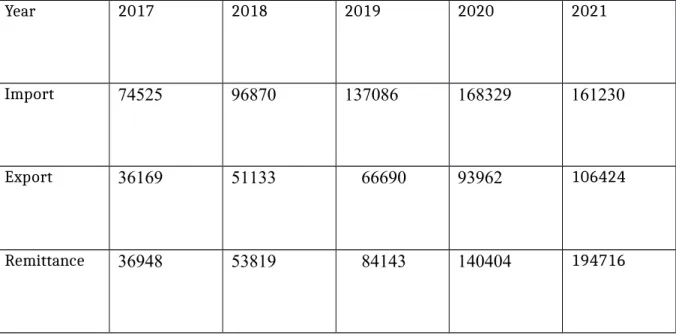
Trend of Export and Import and Remittance over the years:
Export and Import and Remittance
Table 1.1 In Million
Year 2017 2018 2019 2020 2021
Import 74525 96870 137086 168329 161230
Export 36169 51133 66690 93962 106424
Remittance 36948 53819 84143 140404 194716
32
4.7 Welfare Activities of IBBL
Welfare is a condition of having good health, comfortable living and pleasant working conditions (Hornby). Hence, it can be said that welfare services are those which ensure conditions of having good health, comfortable living and working conditions, which are generally one’s basic needs. Islam views work as the primary means of earning and acquiring income and wealth. But if real income is not sufficient to purchase necessities of life, then welfare services become essential in a society to maintain the minimum standard of living of the people. In fact, in every society, there are many people who lack the necessary income and, consequently, face inadequate lifestyles due to unemployment and under-employment.
Their condition cannot improve if welfare services remain absent and concentration wealth remains in certain segments of society. The Quran states the principle that “wealth should not circulate only among the rich” [59:7].
The Quran also encourages people to contribute generously to social welfare and helping the needy in society. Thus the Quran establishes the general principle of generous welfare spending while encouraging sacrificial levels of spending perhaps for social crises and for conditions demanding high financial support. Thus Islam calls for the meeting of the basic needs of the poverty groups through welfare services, which might include –
Care for others:
Siddiqi (1995, pp.2-3) mentioned that care for others, or helping behavior, is another cardinal principle of Islamic economic behavior. It tempers the self-interest that is ingrained in human nature to ensure survival. It is a natural concomitant of trusteeship, since one serves the Master by caring for His people. The Prophet, peace
Zakat:
Zakat is one of the five pillars of Islam. In a broad sense, it is only for social welfare purposes as specified by the Quran: “The Zakat is (meant) only for the poor and the needy, those who collect the tax, those whose hearts are to be won over, for the freeing of human beings from bondage, for the relief of those overwhelmed by debts, for the cause of God (all priority social needs), and for the wayfarer: (this is) an ordinance from God and God is all-knowing, Wise”[9:60].
34
Qard Hasan (benevolent loan)
Since interest on all kinds of loan is prohibited in Islam, a loan, which is to be given in accordance with the Islamic principle, has to be, by definition, a benevolent loan (Qard Hasan), i.e. a loan without interest. It has to be granted on the grounds of compassion; to remove the financial distresses caused by the absence of sufficient money in the face of dire need. Since banks are profit-oriented organizations, it would seem that there is not much scope for the application of this technique. However Islamic banks also play a socially useful role. Hence, they make provisions to provide Qard Hasan besides engaging in income generating activities. However practices differ in this respect. Some banks provide the privilege of interest free loans to the holders of investment accounts at the bank. Some other banks have the provision to provide interest free loans to needy students and other economically weaker sections of the society. Yet, some other banks provide interest free loans to small producers, farmers, entrepreneurs who are not qualified to get financing from other sources. The purpose of these interest-free loans is to assist them in becoming financially independent or to assist in raising their incomes and standard of living.
Chapter Five
Findings, Recommendations, Conclusion
36
5.1 Findings
From the above analysis we found that the overall functions and performance of IBBL over the years are quite satisfactory. Though the no of branches in not enough for this overpopulated country, the IBBL is performing well. Though it’s a profitable bank, it has some lacking which are constrains for its operations.
● Devising an interest-free mechanism:
They have not yet been successful in devising an interest-free mechanism to place their funds on a short-term basis. They face the same problem in financing consumer loans and government deficits.
● Risk of profit-sharing:
The risk involved in profit-sharing seems to be so high that almost all of the Islamic banks in Bangladesh have resorted to those techniques of financing which bring them a fixed assured return. As a result, there is a lot of genuine criticism that these banks have not abolished interest but, they have, in fact, only changed the nomenclature of their transactions.
● Inadequacy of legal support of the Central bank:
The Islamic banks do not have the legal support of the Central bank in Bangladesh, do not have the necessary expertise and trained manpower to appraise, monitor, evaluate an audit the projects that are required to finance. As a result, they cannot expand despite huge excess financial liquidity.
● Lack of risk-hedging instruments:
The prohibition against “riba” and some “fiqh” issues in the interpretation of
“gharar” mean that many risk-hedging instruments based on traditional tools, such as option, futures and forwards are not available to Islamic banks in the current state of Islamic banking.
● Underdeveloped money market and government securities based on profit-loss sharing:
This may difficult to manage the liquidity in terms of mismatching the asst-liquidity and increases the liquidity shocks. Fortunately, significant progress has been made in Iran for government securities and short-term instruments such as National Participation Certificates and Central Bank Mushrakah for such issues.
● Requirement of holding a large proportion of the assets in reserve accounts:
Islamic banks have historically been forced to hold a large proportion of their assets in reserve accounts in central banks or in correspondent accounts than conventional banks. This has significantly affected their profitability because Central Bank gives minimum or no return to these reserves. This in turn, has affected their competitiveness ad increases their potentiality to the external shocks with its consequences.
● Operational risks:
Operational risks may arise from various sources;
a. The unique activities that Islamic banks must perform.
b. The non-standardized nature of some Islamic products.
c. The lack of an efficient and reliable Shari’ah legislation system to enforce financial contracts.
● Risks involved with ‘Salam’:
Salam (purchase with deferred delivery) contracts expose Islamic banks to both credit and commodity price risk. This is because banks agree to buy the commodity on a future date against current payment and also hold the commodity until it can be converted to a cash.
· Risks involved with ‘Ijarah’:
Ijarah also contain the credit and commodity price risk because this contract do not provide Islamic banks with the ability to transfer substantial risks and rewards to the lessee as leased assets must be carried on the balance sheet of banks for the term of the issue.
38
5.2 Recommendations
After observing the operation procedure of IBBL, we recommend the following:
IBBL should launch new financial products to attract customers as Consumer Credit Scheme, Child Education Scheme, and Plastic Money etc. IBBL can also lunch ATM as diversification.
Marketing Division:
To increase the faith of people, IBBL should convince them in the best manner, so that market share can be captured. Marketing division should concentrate more on investment strategy.
Diversify Assets Portfolio:
Leading portfolio of IBBL should be diversified. It should not concentrate or give weight only in working capital financing.
IT Facilities:
IT facilities of IBBL are not satisfactory enough. Computer system which owned by branch are not up to date, not sufficient and moreover some of computer system not work properly when they are needed. There is no sufficient and high bandwidth Internet connection available in the bank. So, IBBL should develop Information Technology to ensure better service for the customer and support communication with outside
Upgrading website:
Islami Bank Bangladesh Ltd. should upgrade its website regularly and provide details information of Consumer Credit Scheme.
Real judgment before sanctioning the loans:
When a loan is issued for the customer, he should justify by the KYC policy. It is a sensitive issue for the investment division. So the relevant officer must take the responsibilities to recover the loan.
Ensure Sufficient Manpower:
The number of human resources in documentation section is really insufficient to give services to huge number of customers. So, number of staff should be increased in the sections.
40
Need Personnel having Business Knowledge:
Most of the personnel have no business education. So selection of employee from business school can give proper solution.
Development of Human Resources:
Human resource is another sector for the branch to be developed urgently. Human resources, in the branch, need to be equipped with adequate banking knowledge. Majority of the human resources must have basic knowledge regarding money, banking, finance and accounting.
Without proper knowledge in these subjects, efficiency cannot be optimized. Bank can arrange training program on these subjects.
Ensure Proper Maintenance of Files:
IBBL gives personalized services. All the officers have to give concentration to the customers, while maintaining the customer files. Every staff should try to reduce these irregularities.
5.3 Conclusion:
Banks play a very vital role in the economic development of the country. The popularity of banks is increasing day by day which leads to increase competition as well. Currently 57 Banks are operated in Bangladesh. All the Commercial banks are offering almost the same products and services. But the way they provide the services are different from each other. So people choose their bank according to their satisfaction and need. On the other hand, Banks innovate new products and services to attract their desired customer. Islami Bank Bangladesh Ltd. is one of the fast growing banks in Bangladesh because of its rapid customers’
satisfaction. The bank is committed to run all its activities as per Islamic Shari’ah. IBBL through its steady process and continued success has, by now, earned the reputation of being one of the leading private sector banks of the country. Islami Bank Bangladesh Ltd. is also playing an important role in establishing Islamic Economics by combing the economic values with social and moral values. By following the novelty of Islamic Economics the bank is trying to make a balance development between spiritual and material life. Still now hear about 301 Islamic banking and financial institutions in about 49 countries of Asia, Africa, Europe, America and countries like Pakistan, U.K., U.S.A., Germany, Argentina, Denmark, Luxembourg, Switzerland and India have been established. The banking system of Pakistan and Iran was totally remodeled on the basis of Islamic Shari’ah services. IBBL will be more effective in our economy by launching new financial products to attract deposit as Consumer Credit Scheme, Pension Scheme, and Child Education Scheme and contribute more to develop the living standard of middle class people.
42
Bibliography
1. Islamic Banking Books - Habibur Rahman
- Beyond debt : Islamic experiments in global finance - Islamic capital markets : a comparative approach
- The International Handbook of Islamic Banking and Finance
2. Annual Reports of Islami Bank- 2020-2021 3. Websites
- https://www.bb.org.bd/
- Islamic capital markets : a comparative approach
4. Handout provided by IBTRA
5. The financial Express (Online News Portal)
.