Rehabilitation & Training Center for Destitute Children, Gazipur, Konabari
BY
SABRINA SARKER BITHI
12108028
ARC 512, SEMINER ll
Submitted in partial fulfillment of the requirements for the degree of Bachelor of Architecture
Department of Architecture
BRAC University, Dhaka, Bangladesh
ABSTRACT:
Homeless children who live on the streets and children affected by extreme poverty has become a very sensitive issue of all over the world. It is now reached such an extreme level that sheltering and training them become very necessary. Now in many places of our country also started to work on it privately and some cases with the contribution of our government. 'Training & Rehabilitation Centre for the Destitute Children' in
Konabari, Gazipur is an example of that. Here most of the children are taken in, at a very early age and cared for until they are ready to do their own work for living. The whole organization cannot always offer much choice to the children due to the lack of proper infrastructure to facilitate that kind of learning and environment. It also cannot accommodate the number of children it could hold considering the amount of area the site of the institution has.
It is very important to understand that the needs and wants of these children, because they are very different from the children who comes from a well off family. Sometimes some of them even go through severe mental trauma that affects their psychological development. And this is a very important part of growing up to be a responsible person in the society.
The main target of this project is to create such a place for the children where they can academically, and mentally and respectfully cope up with the rest of the society in future by getting proper care and training. And as a student of architecture my target is to make such spaces to provide all of these conveniences. So that, in future every child will become an asset rather than a threat to our society.
ACKNOWLEDGEMENTS
After 6 years of long journey this is the last project of the Bachelor of Architecture
course. Along the way it is very obvious to face a lot of obstacles and without the help of Almighty Allah and immense support of some nice people.
My gratitude will never be enough for my family and my uncle Md Mokhlesul Haque who had been so patient and helpful throughout the journey.
My mentors, Abul Fazal Mahmudun Nobi, Iftekhar Ahmed, Akhter Mahmud And Fuad Hasan Mallick are very supportive throughout the time. I am very thankful to them for guiding me during the progress of this project.
I am extremely grateful to my senior Mehnaz sulatana for supporting me mentally and economically in my most important period of my life when my parents were not here. I am also grateful to my friend M Naushin Puspa and Mahbuba Sultana Mishu and their families for supporting and assisting me whole time to complete this project.
I am very thank full to my juniors Ishtiaque Hossain Anok, Anuprova Mandal, Ananna Ahmed, Subah Shamim and Quazi Tabassum Tahrim Sifat . Without them the project wouldn’t complete on time.
I also appreciate the support I received from my friends, Malobika Dipanwita Roy, Tasnif Adiba Sanam, Joynal Abadin and Faisal Sah shafi.
Finally special thanks to Shahid Ahmed, AKM Ashrafuzzaman, Rahana Akhter, Akbar Hossain, Rubina Zaman, Reshma Akhter, Sharmin Ahmed, Mithila Haque , Ashique Mahbub and Akramuzzaman and all other people whom I met along this journey who motivated me to think positively and confidently.
CONTENTS
1 INTRODUCTION
………01-041.1 ABSTRACT………...01
1.2 PROBLEM STATEMENTS……….02
1.3 Project Rationale……….02
1.4 Aims and objective……….03
1.4 Program……….04
2 LITERATURE REVIEW
...05-18 2.1 What is rehabilitation center? ...052.1.1 History of forming rehabilitation center………..05
2.1.2 The Scope and Importance of Rehabilitation…………...13
2.1.3 The Effects of Rehabilitation………...14
2.1.4 Rehabilitation Centre for the Destitute Children………..15
2.2 Childhood……….06
2.2.1 The Needs and Necessities of a child………...07
2.2.2 Experience/Learning and Environment……….09
2.2.3 Family / Nurture……….11
2.3 Destitute Children………..12
2.3.1 Social Issues of the destitute children………...12
2.4 The Importance of Training center………16
3 CONTEXT AND SITE ANALYSIS
………....19-31 3.1 Destitute children in the Bangladeshi context………..193.1.1 Risk factors………...20
3.2 SITE………...23
3.2.1 General Overview of the Area………....24
3.2.2 Physical Features……….24
3.2.3: Access………...24
3.2.1 Road Networks……….26
3.2.2 Surrounding Building Types and Height………..28
3.3 SWOT Analysis………...30
4 Program analysis
………...32-35 4.1 Programs……….334.1.1 The academic building………32
4.1.3 Administrative building………32
4.1.4 Dormitory………...33
4.1.5 Social center……….33
4.1.6 Training building………...34
4.1.7 Multipurpose and Audio visuals………....34
4.1.8 Staff Quarter……….35
5 CASE STUDIES
………36-50 5.1 Orphanage at Ramu……….365.2 SOS CHILDREN VILLAGE, BOGRA……….38
5.3 SOS CHILDREN VILLEGE ANURADHAPURA, SRILANKA...45
6 DESIGN DEVELOPMENT
………..51-676.1 Development of Site Plan………...51
6.1.1 Plan Development and Zoning 6.2 Design Drawings………..55
6.3 RENDERED PERESPECTIVES……….61
6.4 MODEL IMAGES………...64
7 CONCLUSION
………688 REFERENCES………...69
LIST OF ABBREVIATIONS
BBS = Bangladesh Bureau of Statistics UN = United Nations
UNCRC = The United Nations Convention on the Rights of the Child UNICEF = The United Nations Children's Emergency Fund
ECD = Early Childhood Development
CGECCD = Consultative Group on Early Childhood Care and Development BMI = Body Mass Index
PM&R = Physical Medicine and Rehabilitation PT = Physical Exercise
CEDEFOP = European Centre for the Development of Vocational Training VRA = Vocational Rehabilitation Association
VET = Vocational Education and Training ILO = International Labor Organization
FIGURES
Fig 01; Aerial View of Site with Nearby Landmarks
Fig 2.2.1 Effects of Early Nutrition
Fig 02, 03; inside the site
Fig 04; Greens around the site
Fig 05, 06; Access to the site Fig 07, road networks
Fig 08, 09; Road condition at the surroundings of the site Fig 10 ; Surrounding Building Types
Fig 11; solid void relationship
Fig 12; Surrounding Building Heights
Fig 13, 14; Industrial buildings at the surroundings of the site
Fig 15; Road condition and industrial buildings at the surroundings of the site Fig 16, 17; Surroundings of the site
Figure 18; one school around 3 km distance Fig 19, Pedestrian spaces
Fig 21, Indoor-Outdoor Relationship Fig 20, Indoor-Outdoor Relationship
Fig 22, Light and ventilation in the classroom Fig 23, 24; SOS CHILDREN VILLAGE, BOGRA Fig 25, 26; specially designed for disabled children Fig 27, 28; low cost structure
Fig 29, 30; Structure and material Fig 31, 32; Elevations
FIG 33, 34 RATIO OF HARD AND SOFT SURFACE THROUGH PLAN Fig 35,36; Landscaping
Fig 37,38; Indoor Outdoor relationship Fig 39; Primary functional zonning Fig 40; Detailed functional zonning
Fig 40, 41, 42; Academic building and dormetory of the center (www.sos-usa.org) Fig 43; Dormetory (www.sos-usa.org)
Fig 44; Communal space in masterplan Fig 45; Detailed communal space Fig 46; Master plan
Fig 47; Detailed zonning of mother house Fig 48,49; Sections of mother house Figure 50; Zoning in the Site
Figure 51; Programs placement in the Site Fig.52; Development in Plan
Fig 53; First Floor Plan, not to scale Fig. 54; Second Floor Plan, not to scale
Fig.55; South Elevation, not to scale
Fig 56; North Elevation, not to scale
Fig 57, 58; Sections , not to scale
Fig.59; Axonometric View towards Female Dorm and Hydroponic shades
Fig.60; Axonometric View form the flyover to the site
Fig.61; View towards main entry from Auditorium
Fig.63; View towards Staff Quarter and Staff Kitchen from Garden beside the pond Fig.62; View towards the playground from vocational training center
1
CHAPTER: 01 INTRODUCTION
Name of the project: Rehabilitation and training center for the destitute children Client: Ministry of health and social welfare
Location: Gazipur, Konabari.
Site area: 8 acres (383368 sqft) 1.1 ABSTRACT
Homeless children who live on the streets and children affected by extreme poverty has become a very sensitive issue of all over the world. It is now reached such an extreme level that sheltering and training them become very necessary. Now in many places of our country also started to work on it privately and some cases with the contribution of our government. 'Training & Rehabilitation Centre for the Destitute Children' in
Konabari, Gazipur is an example of that. Here most of the children are taken in, at a very early age and cared for until they are ready to do their own work for living. The whole organization cannot always offer much choice to the children due to the lack of proper infrastructure to facilitate that kind of learning and environment. It also cannot accommodate the number of children it could hold considering the amount of area the site of the institution has.
It is very important to understand that the needs and wants of these children, because they are very different from the children who comes from a well off family. Sometimes some of them even go through severe mental trauma that affects their psychological development. And this is a very important part of growing up to be a responsible person in the society.
2 1.2 PROBLEM STATEMENTS
The childhood memory is the most beautiful part of our life. Whatever, we went through from our childhood that affects us in our future. If we can provide our children a healthy environment, they will grow up as responsible adults for the society. If we neglect them, they will become liabilities and sometimes dangerous to the society.
In the case of our country, it is a small developing country with lots of issues like, overpopulation, lack of food, poverty, unemployment, unhealthy environment etc. By facing these from so many years many of the children of our country are facing Ignorance and negligence in the section of basic five human rights. Almost 50% of Bangladesh's primary school students drop out before finishing it (Haq, 2013), because in this cases food and shelter is more important than education. Sometimes they don’t get that too! And the condition is even worse for the children who are living in streets without a roof, home or sometimes family. And according to the research of BBS (Bangladesh Bureau of Statistics) the homeless children who live on street and self- dependent from a very early age live in even worse condition. Sometimes they work for 10 hours and above with a very little salary where they don’t have the proper education or training and overload of work according to their age and physical strength. In our country Bangladesh this is around 11% of the total labor force (BBS)
1.3 Project Rationale
There is already a Rehabilitation Centre situated in the same site. But the capacity of this center is not enough according to the affected children. The school building, training space, dormitory don’t have enough space to hold such number of children. And the facilities are not enough due to the lack of proper investments, guidance and lack of
3
proper infrastructure and training equipment. Even they don’t have a staff quarter for the 24 hours of proper care and security. For this reconstruction of this center is very
necessary so that it will provide better capacity with proper infrastructure.
This project inspires me to give these children the opportunity of proper training environment to make a good base for future, to have a healthy (both physically and mentally) life in the institution and an independent (both financially and socially secure) life after their institutional experience. So that in future they can also count as like any other responsible citizen in the country with self-respect and confidence. As an
architecture student I want to ensure through my design, the proper function, program, policy, environment which will help these children to have a happy childhood in this institution.
1.4 Aims and objective
Now this organization is under the Ministry of Social Welfare. And they have the initial idea of sheltering & training the destitute children as long as they are ready to fit in the society with proper work and ability to take care of them in a healthy way in the society.
The main target of this project is to create such a place for the children where they can academically, and mentally and respectfully cope up with the rest of the society in future by getting proper care and training. So that, in future every child will become an asset rather than a threat to our society.
For this they have some basic aims to fulfill their target.
1. Fulfilling the five basic needs of every human- food, cloth, shelter, healthcare and education.
4
2. Create a proper positive environment to support the community in future.
3. Arrange the proper training system according to their ability so that they can be the manpower of this overpopulated country
4. Create space for their recreation and development of their mental health 5. Arrange proper guidance, care and security and training for self-defense.
1.4 Program
A general list of program is given bellow according to the common functions of a rehabilitation and training center and the proposal of the government.
Dormitory
School
Training center
Social center
Administration
Staff quarter
Dinning
Auditorium/ Audio visual hall
Officer’s quarter
Trainer’s quarter
Sanitation and Healthcare center
Communal space (mosque, field, garden etc.)
5
CHAPTER: 02
LITERATURE REVIEW
2.1 What is rehabilitation center?
A place where -
Restore to good health or useful life, as through therapy and education.
Restore to good condition, operation, or capacity.
Reinstate the good name
Restore the former rank, privileges, or rights (Jalal, 2013)
2.1.1 History of forming rehabilitation center
From the very early period people who were not fit in the society or socially unaccepted were kept away from the society directly or indirectly. The people who were not able to contribute to the society or seemed harmful to the society, were neglected or avoidable to others. The “NORMAL” people didn’t even think or care to fix their flaws or restore their lost abilities.
But at mid-18th century (Clark, 2007), a movement was held to help addicted people.
After that movement, the first rehabilitation center was built up.
Its name was 'sober houses'. This idea of rehabilitation was also used to correct
criminal offenders. Rehabilitation in a group of people rather than punish or segregation seemed to be better for correcting the criminals. This idea of taking in people and giving them facilities to help themselves, all in a community setting was taken in by the
medical sector.
6
Around the 1950's, the idea of Physical Medicine and Rehabilitation came into being which is believed to improve the conditions of people suffering physical trauma and injuries (Verville, 2009). This type of rehabilitation emphasized to restore and enhance the well-being of the patient through the use of medicines. Around late 1950s that
‘physical therapy’ started to gain much appreciation and was taken as process to
improve the conditions of people in rehabilitation centers (Kiinteberg, 1992. By this time rehabilitation centers also claiming to cure trauma and injuries solely by using PT and gained much popularity. This was the history of how rehabilitation centers dealing with disabilities.
After some years, the idea of psychosocial rehabilitation started for those with mental health problems were helped with community integration (Gill, Pratt, Barrett, and Roberts, 2006). Along with psychotherapy, special attention was necessary to support daily functioning and social interaction and others.
2.2 Childhood
Childhood years are the key to productive life. (Shafi ’16). According to the UNCRC (1989), a child is a human being below the age of 18 years. So just like adults, they have some basic needs in their life. It is the most important stage of life where generally they should get the utmost care and affection in a family and society. In this stage of life, they should get the proper development which will help them to grow up as a
responsible and contributing person of the society in future. A minimum required physical growth and proper nurture can make them fit enough to carry their social and daily life activities properly. Again just physical perfection will not work for the children in
7
the society, if they are not well developed psychologically. So, proper development would be a well-balanced situation of physical, psychological and social development for the children.
Our country Bangladesh is a highly populated country and according to Barkat et. al (2009) about 44% of the total population of Bangladesh is children or under the age of 18. So it is confirm that the proper development of these children is the key to the future success of the country.
2.2.1 The Needs and Necessities of a child
"Basic needs" is a list of food and water, shelter and clothing as Denton (1990) describes. These are the things that needed for the life to sustain. But it is now accepted that sanitation, education and healthcare are also basic needs of a person.
Proper sanitation keeps people away from different types of diseases. This is necessary for physical health too. When a child grows, he or she will suffer from several diseases or natural illness for growing up. Without healthcare, the child may become disabled or in worst cases die. Education is also important to interact with their environment and support themselves in future. So, in the development years of a child it is very
necessary to fulfilled all the basic needs. By ensure these need, it can be possible to develop positive and optimal growth in a child. Tanner (1989) briefs up this whole issue by saying that, the main elements that ensures that a child grows into a healthy person is by ensuring his nutrition and a positive environment. (Jalal 2013)
8
Fig 2.2.1 Effects of Early Nutrition (UNICEF, 2001)
Apart from the conventional basic needs, children may have other wants too. Children may want a colorful dress, choice of foods or toys etc. These are not mere wants of luxury from the children. But is the will to try out new things or to feel the experience of doing different things. These wants can many times be equally as important as the basic needs, because through these wants they also learn and perceive the world around them. Fulfilling these wishes of the children doesn't always spoil them. But it teaches them that they are valued, helps them develop trust, decreases stress and assists them in proceeding down a more optimal developmental trajectory, and decreases the developmental and behavioral problems. (Dunn and Kontos, 1997)
9
According to Colin (1996) a child requires meaningful attachment for positive cognitive development. The feeling of connectedness, warmth, love and security makes the child feel respected and valued.
Praise, recognition, opportunities of self-expression and developmentally appropriate exercises are important in the psychological development of children as Greenspan and Brazelton (2001) points out.
2.2.2 Experience/Learning and Environment
The intelligence of a child is not inherited from his or her parents, but mostly develops through stimulation from the child's environment & experience, as pointe out by
Mahmud (2011). His senses would began to grow & respond better to its surroundings when he or she will have opportunities to challenge them, exercise them, & finally learn from them. There seems to be series of learning about a child's environment from birth to adulthood that he or she has to go through. Mahmud (2011) further acknowledges this by saying that it is important to realize how a child is received, accepted, stimulated
& appreciated in his environment & how he learns to feel about himself. And these have a great influence on how he lives & grows into adulthood.
All these positive experiences in a child's environment can be given by a warm community. For a child to grow up into a person who can contribute to the society means that he or she has to grow up and be integrated in such a society. Being segregated from the society as a child might mean that he will always remain segregated as an outcast or burden. This gave rise to the idea of 'child integration' which is the inclusion of children in a variety of daily activities of families and
10
community. Paradise & Rogoff (2009) discusses that this kind of children's integration in family and community activities provides a learning environment as children are able to observe and pitch in as they feel they can. Therefore, such integration would allow the children to learn more, accept the community around him, and would to give back to the society in future. After a child is provided with the basic needs, and then with the nurture
of a family, the feeling of being integrated in a community or society makes it complete for the child to grow up as a fully functioning member of the society.
Learning begins as soon as the child is born and he or she learns to sense. In this time through interaction and experience, a child begins to gather knowledge (CGECCD, 2013). However, it is also important that a child is given some form of education from others. Education in childhood is essential to the child's physical, emotional & social development. While the perception of education may vary, it is accepted that education is a broad aspect & is very important for the children, especially till the age of 8
(CGECCD, 2013). Even though the learning continues throughout a person's life, the learning capacity is most well demonstrated in these early childhood years. Just like parents' encouragement stimulates the children, education stimulates the children's mind in similar ways. With proper stimulation, the child goes through significant psychological developments that can enhance his or her emotional, social and intellectual capabilities (Bradley, 1998). The learning experience of children during development years guides how they see the world around them in future. However, it is not just the development in these years that education provides, it also provides the children with knowledge to live and support their lives in future. It is often forgotten that a major part of a child's education is indeed playing. In our context the concept of
11
playing is even more fitting because playing combines both the aspect of community integration through social interaction and also the aspect of traditional education like learning how to read and write. Playing is the most effective way in which a child can learn.
2.2.3 Family / Nurture
Care or nurture is the most essential want of every child. And without parents it is not possible to give the best care and warmth to the children. Having parents in a family is a blessing for every child because they don’t have to fight for their livelihood.
Kelly (1996) argues that time and attention from parents can be considered as a need rather being option that the child should receive. Contribution of the parents and the family are vital for the development in children.
A child can develop a sensitive attunement with the positive support and love from a family. This means that a child will have his or her inner confidence boosted which will help them to carry out difficult tasks independently and promotes effective personal functioning (Siegel and Solomon, 2003)
Along with basic needs, the parents ensure the physical protection, safety and
regulation of the children. This provides the children with the feeling of security, stability and trust which in turn guide the development of the children’s behavior in future
(Tahseen, 2012)
Parents are also responsible for encouragement and thus stimulation of a child’s abilities and act as a companion and help them in troubled times (Greenspan and Brazelton, 2011)
12
So, overall a reassuring and supportive community is very much responsible for social and cultural development in a child. By nurturing this positive actions may make children to carry their necessary values and participates in social useful tasks.
2.3 Destitute Children
“Any child who is not getting proper care even if his or her parents are alive, e.g father is a criminal and is in a jail and mother is not well so there is no one to take care of the child, so the child will be called as destitute child” (Chingtham, 2014). These children are basically street children, orphans or disabled children who are unable to fulfill their basic necessities of their life. According to UNICEF there are around 100 million children living on the street all over the world today who are devoid from their basic needs.
2.3.1 Social Issues of the destitute children
Most of the destitute children are forced to engage in different kinds of work because they have to support themselves. As per Barkat et. al (2009), about 7.4 million children are working across the country, which is one in every six children in Bangladesh.
Majority of them acquire the resources needed to support life from begging and various types of dirty labor work that are rejected by the casual wage labor force
(Chingtham, 2014).
In Bangladesh, around 18.7% beg, 13.3% sell flower or newspapers, 60% are 'tokai' meaning they collect things from street or garbage and sell it elsewhere and the rest
13
8% are involved in other professions. These children work for long works, on an
average of 10.6 hours a day in dirty environments, but the income very low, an average of 362 BDT daily as child work is less valued. Moreover, people are mostly behaving poorly with these destitute children with about 76.7% of these children facing some sort of harassment. {Subarna et. al, 2014).
Of the 8% children who are involved in miscellaneous professions, many maybe related to crime and prostitution, or other similar professions where they are subject to extreme abuse. About 41% of the destitute children have not heard about HIV/AIDS at all (Barkat et. al, 2009). And an astoundingly about 88% of these street children take some form of drug which is detrimental to their physical or mental wellbeing according to Subarna et.
al (2014). Jalal (2013) adds to this issue by saying that these children are vulnerable to victimization, exploitation, & abuse of their civil & economic rights. These abuse &
exploitation in turn lead to a corrupt society.
2.1.2 The Scope and Importance of Rehabilitation
The American Heritage Dictionary (2011) gives the meaning of the word 'rehabilitate' as
"to restore to a good health and useful life, as through therapy and education".
Therefore, rehabilitation can be explained as the process of helping an individual achieve the highest level of function, independence, and quality of life possible.
However, rehabilitation does not reverse or undo damage caused by mental or physical trauma.
14 2.1.3 The Effects of Rehabilitation
The destitute children, due to deprivation of basic needs and abuse, many a times develop mental trauma or poor physical health and injuries. Jalal (2013) discusses about these destitute children being victims of physical and mental abuses, and
exploitation to disgraceful and dangerous work. These deprivations put them in severe mental trauma. Rehabilitating them would mean that their psychological condition can be improved with the care in a community and proper nutrition with physical exercise would restore the children to optimal health, functioning and well-being. Once the basic needs of the children are fulfilled, the children can climb up the ladder of Maslow's Hierarchy of Needs (1954) where they can have satisfactory feeling about themselves.
The children will suffer less from inferiority complex, and get their hopes of being a part of the society which will motivate them to work on their well-being and future. These children when grown up will want to give back to the society. As per Senelick (2012), rehabilitation is the key to getting back to a functioning level where one can live happily and hopefully work to support them.
Jalal (2013) further points this out that rehabilitating the children doesn't only give the children a better future, but will increase the employment in industries and other sectors.
This will boost the overall economy of Bangladesh. Moreover, effective rehabilitation of these destitute children would mean that corrupt parties will not have any power to corrupt the society any more through children. Therefore, the unsocial activities will decrease like drug dealing, robbery, theft, prostitution, etc.
15
2.1.4 Rehabilitation Centre for the Destitute Children
As for the case of children, a mixture of the different types of rehabilitation procedure would be required, where their physical well-being can be restored through regular PT and psychosocial development can occur by growing up as a member of a supportive community. However, rehabilitation of children is very different from adult rehabilitation. Camden, Tetreault and Swaine (201 0) stresses this point by saying that rehabilitation for children refers to all the services required to foster social participation of the children, and not solely to specialized interventions. This means that while an adult may be rehabilitated just fine through individual physical therapy, proper nutrition and care, a child will require much more interaction and social touch from the
community around him or her. Also, growing children have more needs than adults and thus would require more attention and care. This calls for the need for more caretakers and staff that would be required for an adult rehabilitation of the same size.
While a rehabilitation center for the children is quite different from an adult rehabilitation center, a rehabilitation center for the destitute children requires some special
consideration. It is important to realize that the children come from deprivation, and the foremost thing that they require is shelter and food. The next requirement is for destitute children are proper sanitation and clothing. While other rehabilitation centers would be focused on addressing special problems like addiction, crime or disability, rehabilitation centers for the destitute children would address more general issues like making sure of the basic needs and proper development of the children from thereon. Many a times these are the only requirements of a child to grow up as healthy and functioning individuals. (Chingtham,2014)
16
After the basic needs are met, then they can be given the conventional rehabilitation procedures, if needed, like physical therapy through exercises in playfields and
psychosocial development by giving proper attention in an interactive community. It can also be seen as 'children home' where a child grows up having their needs and wants meet in a social environment, just like they would in a family. The idea of community- based care can be used here. In a community-based care, children are put in a family in the community and the guardians will provide individual care and nurture in the context of a family and community. Such guardians are sometimes designated in such
rehabilitation centers, which will have a few children they will be responsible for.
But then, there can be special cases of illnesses or addiction in the children taken from the streets (Chingtham, 2014). These special cases have to be dealt separately but given all other facilities that the rest of the children are getting, which goes beyond the scope of 'children homes'. Therefore, rehabilitation centre for the destitute children has to restore a wide range of issues, considering at the same time the growth and
development of the children.
2.4 The Importance of Training center
In the year 2001, an organization in UK named Vocational Rehabilitation Association, UK (VRA) came up with the idea of 'Vocational Rehabilitation'. It is a process which helps people with various issues and obstacles to overcome barriers to accessing, maintaining and returning to useful occupations in the society ("Vocational
Rehabilitation Association, UK", 2001). This means that along the same time a person is
17
being treated for trauma, this kind of rehabilitation also prepares the person so that he or she can perform as contributing members of the society.
The rehabilitation of destitute children is further strengthening and embracing this modern concept of vocational rehabilitation. Because, this is nothing but proper vocational training given in a rehabilitation center and this concept has been there for long time.
This is mostly important in the case of a child rehabilitation center because the child will grow up to be an adult someday and cannot remain in the center. Therefore, it is only logical that the child is given some kind of training in the years while he is in the
rehabilitation center so that he or she can perform in the society outside when the child matures. Subarna et. al (2014) recommends such ventures where the destitute children would be given education and vocational training along with the shelter during nights.
Vocational Education and Training (VET) can be defined as a link between primary vocational training and further education within a structure of lifelong learning
(Rauner, 2008). Vocational Education can called be as technical education because it teaches people practical work that can be readily used in the field. Vocational
Education and Training (VET) aims to equip people with knowledge, know-how, skills and/or competences required in particular occupations or more broadly on the labor market ("Terminology of European Education and Training Policy", 2014). It is, therefore, an essentially non-formal education but has a particular application in the practical field. Jalal (2013) discusses about the vocational training of the WEMA Center by saying that the program equips the youth with basic literacy and livelihood skills ranging from tailoring and dress making, cookery to computer skill. The program helps
18
the young people to explore opportunities for employment or setting up their own small business. The benefits of vocational training are quite a handful. According to Lettmayr
& Riihimaki (2011) vocational training can help both the individual and the country, and both economically and socially. The economic benefits at individual level can be
earnings and career development. The social benefits for the individual would be satisfaction and motivation. On a larger scale, it can boost economic growth, reduce crime and increase social cohesion. According to Ahmed and Khan (2014), the unemployment of rate of Bangladesh is
4.5% & under-employment rate 20.3%. Considering the rates and population of destitute children, the situation can go either ways. With negligence of these children, the situation will not improve but become even worse. But with proper rehabilitation and training, these children can change the situation of current unemployment and start the blowing the winds of change.
19
CHAPTER: 03
CONTEXT AND SITE ANALYSIS
3.1 Destitute children in the Bangladeshi context
About 26.5 million children in Bangladesh fall below the national poverty line which is about 42% of the children population of the country (Barket et. Al, 2009). And the number of homeless children in Bangladesh is around 400 thousand, and out of these about 150 thousand children do not know about their parents or lost them.
(Bangladesh Sangbad Sangstha, 2002) these children who lack shelter find the streets as their home. In Dhaka vehicle terminals like Kamalapur railway station, Tejgaon
railway station, Sadarghat Launch terminal are crowded with such children lacking basic amenities of life (Jalal, 2013)
According to Chinghtham (2014), there are multiple forces that drive a child into
destitution. The major reason for destitute children is death to parents. Then there is the reason of broken families which forces the children into destitution. Most times the problem arises because of poverty which results in families falling apart.
3.1.1 Risk factors
Deprivation in destitute children is broken down into categories according to the basic needs of life (Majengwa, 2016, Chingtham, 2014)
Shelter: this is the most common deprivation. For the case of destitute children.
Most of them are deprived of a proper roof to live under
20
Food: Starvation can be the most adverse form of this deprivation while
unhygienic and insufficient foods are more common form . Among the destitute children 56.7% only get to eat once in a day only (Subarna et.al 2014)
Sanitation: lack of proper provision of toilets and improper sewage system.
Education: With the destitute children lacking more fundamental needs like food, Education remains a dream for them
All of these may well be very severe forms of deprivation that would affect the children, but other deprivation of wants like family, love, attachment and social bonding can be devastating for the children.
One risk is the physical ill-being of the child later in life or during the growing years.
These health problems arise from lack of basic need like proper food and water, clothing, sanitation, healthcare etc. If the needs and wants of the children are not fulfilled properly; it can also give rise to psychological problems. Without the parents, family & feeling of being part of a community, a child will lose all the benefits of having those as discussed but also further develop problems like the inferiority complex.
Childhood of every person is said to be the most important period of life, as the future life has great influence on it. Children from birth to age 12 are said to be highly sensitive to their surroundings & personality development occurs in this period. Being exposed to unwanted environment and deprivation in this time of life many have negative effects in behavior in their later life (Jalal, 2013).
This also has the same implication as with the children with physical issues, because if the children are not mentally sound then they cannot perform their job properly to
21
contribute to the society when they grow up. If the children are deprived of such needs it will also mean that they will not have the required knowledge, education or skillset to work in the society.
Maslow (1954) in his theory of 'Hierarchy of Needs' further clarifies this aspect that the basic needs like physiological needs and feeling of safety are bases for children to have a healthy development. Fulfilling these base needs means that the children will feel a sense of belongingness to their environment and understand their roles.
This will help them keep their self-esteem boosted and therefore have a proper understanding of own self as an adult to perform and contribute to the society.
Disruption of needs and wants at base level of the pyramid would mean the higher attributes in the pyramid level will be difficult to be developed. Because of deprivation the children may have all these sorts of physical and psychological issues, along with the lack required knowledge.
This means that they will not be able to work as functioning individuals in the society, and eventually become a burden. In worst cases, it may increase the rate of crimes and abuse in the society, and force the next generation into destitution as well creating a toxic cycle in the society.
22 3.2 SITE
Location: Konabari, Gazipur Site Area: 8 Acres
Fig 01; Aerial View of Site with Nearby Landmarks (Google Earth, 2019) 3.2.1 General Overview of the Area
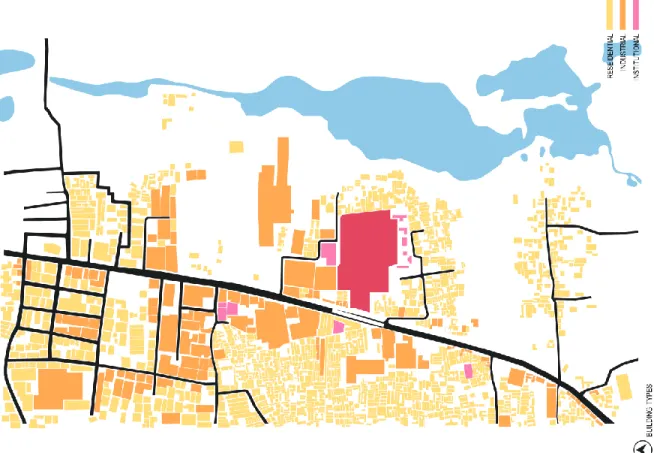
Gazipur is a district which is about two hours’ drive from Dhaka City. Being in the city side, it has seen much development and migration lately. Konabari is a region which falls in the middle along the Dhaka-Tangail Highway. Much of the development in Gazipur is related to industries and it is the same case with Konabari. It has become an area of high industrial activity. A lot of factories like garments, food, metal and
pharmaceuticals have grown in this region. The trend is built more and more factories are being set up in the region. Around these factories are some residential areas where the factory workers and working class lives. In such an industrial and busy area sits the current site for the Rehabilitation & Training Centre for the Destitute Children.
23 3.2.2 Physical Features
Topography: The topography inside the site is flat but a little bit down from the road Vegetation: There is enough green inside the site providing a soothing environment.
But it is only onside the site. The surroundings are lack of greens and full of industrial buildings.
Fig 02, 03; Inside the site (Author)
Fig 04; Greens around the site (Author)
24
Shape and orientation: An overall rectangular shape with some major fragmentations around the perimeter. It is situated along the north south.
3.2.3: Access: The site is approached directly from the main Dhaka-Tangail-Jamalpur Highway. The entry is through a 12’ road connected to the main Highway. There are other secondary connections to the site but most of them are not used much.
Fig 05, 06; Access to the site (Author) 3.2.1 Road Networks
Fig 07, road networks (Author)
25
The primary path around the site would be the Dhaka-Tangaii-Jamalpur highway which is around 80 feet wide. But due to building the Kashempur flyover, only 40% of the highway is being used now. For this traffic condition in this road is terrible, always congested with high traffic day and night and traffic movement is very slow and most times completely stuck. There are a few secondary paths, one which goes into the side and others in close vicinity to the site. These paths lead to some small residential zones in which there are narrow alleyways serving as tertiary paths. Some paths when
analyzed are seen to halt abruptly and suggest that it would be more convenient if those paths could be connected to the road network. One such path is the one which goes into the site and could be connected to the network of paths that are on the east side of the site, the residential zone.
Fig 08, 09; Road condition at the surroundings of the site (Author)
This would mean a better connection to the site and easier flow through the path networks as a whole. Another possibility could be a secondary access to the site from the main highway. This would create a loop of path inside the site meaning vehicles can
26
entry and exit easily. There could be another connection to the site on the west side where a mosque stands. This connection would allow the children to access the mosque easily. This is however only true if the new connections to the paths can be made. The area is very busy and boring, and might be made lively through the
gatherings that would happen in a node. Even though it is not possible to create a path or a node, the possibility that it might happen can be given the opportunity by making way through some boundary walls.
3.2.2 Surrounding Building Types and Height
Fig 10 ; Surrounding Building Types (Author)
27 Fig 11; solid void relationship (Author)
The site is surrounded by many different types of buildings but mostly factories. These factories are mostly on the west and south of the site. These factories create huge industrial wastes which are highly toxic.
28 Fig 12; Surrounding Building Heights (Author)
It is these factories that go over 5 stories high in many cases. There is a new factory that sprouted up on the south western side just brushing on the site's boundary wall which is 10 stories high. There is also a mosque along the western side of the side. On the north western side are a few residential houses and mostly open fields. The eastern side is mostly a residential zone which houses the industry workers of the area. Their existences are temporary as most of these structures are light mostly of tin and not so big, and the residents are not the original owners of the place, just living there by paying rent. However just on the north eastern side there is a 'Kishori Unnayan Kendra’ which is also a similar sort of organization.
29
Fig 13, 14; Industrial buildings at the surroundings of the site (Author)
The big factory building on the south west end of the site requires a buffer space so that the it seems that it is a bit away and not just rose up against the edge of the site.
This buffer can be created by some big thick landscape of trees keeping away the unwanted noise and sight of the factory to some extent. Another building of importance would be the mosque on the south side. The mosque can be invited and given respect by making it more visible creating a platform in front of it inside the site.
This would work with the earlier idea of introduction of a new connection to the site from this mosque's side
30 3.3 SWOT Analysis
Strengths:
Lots of green inside the site which is very peaceful and creates a serene environment
Entry is clear and direct
Site is very much visible from the main highway
It is a flat land Weakness:
Excessive chaos and noise at the entrance of the site due to the construction of the new flyover
The highway is always stuck with high traffic
High buildings on the south western side block the view and wind
Absence of nodes around the surroundings
Road condition is very poor
Fig 15; Road condition and industrial buildings at the surroundings of the site (Author)
31
Fig 16,17; Surroundings of the site (Author) Opportunity:
Enough spaces for design a suitable landscapes
The inner environment is soothing and peaceful which is necessary for design a rehabilitation center for children
Similar training institute is situated so close which can be connected together
A prominent mosque on the west side of the site which can be directly connected to the site and enhance its beauty
Threats:
The industrial wastes are toxic which can be harmful for the children if they are in contact
There are more industries are growing up which will cause more problems in future
Unplanned residential growth along north and east of the side. It can block connections to the site.
32
CHAPTER: 04 Program analysis
4.1 Programs
The institution has described some basic program outline or some ideas of the functions about their distribution in multiple infrastructures and some ideas which should have proposed are given here with description.
4.1.1 The academic building: A substantial distinguished structure. This is one of the most prominent facilities a visitor sees on entering the campus. It will be the functional heart of the organization. It is for the formal education to prepare for exams like P.S.C, J.S.C, S.S.C, etc. The school would have a primary and secondary division with
designated classrooms, along with the facilities like the library and canteen. A small administrative unit is also required for daily work procedure.
Figure 18; one school around 3 km distance (Author)
33
4.1.3 Administrative building: This building provides all the necessary information about the organization. Basically it deals with all sorts of information, admission, elements of business administration (accountant, registrar and records) and also
provides us a visitor center. Along with the office rooms, a meeting room and admission center would be required in this block.
Reception (1*200)= 200 sqft
Lounge (1*300)= 300 sqft
Admission (1*500)= 500 sqft
Office (1*700)= 700 sqft
Private cabin (2*200)= 400 sqft
Meeting room (1*500)= 500 sqft
Records (1*300)= 300 sqft
Toilets (4*40)= 160 sqft
4.1.4 Dormitory: It is the shelter for the children or their own accommodation. In this block, bedrooms, common rooms, dorm tutors’ rooms and other common services is required to serve the functions.
Bedroom (40*500)= 20,000 sqft
Common room (5*300)= 1,500 sqft
Dorm tutors’ room (16*250)= 4,000 sqft
Toilets (28*40)= 1,120 sqft
Storage (1*300)= 300 sqft
34
4.1.5 Social center: For social gathering and recreation. Other than residential and educational purpose there are other requirements, characterized as medical facility, day care and other vocational learning classes. This block should have a medical center, counseling center and indoor games zone and prayer space.
Dining (1*4500)= 4,500 sqft
Kitchen (1*1200)= 1,200 sqft
Counseling unit (1*1500)= 1,500 sqft
Medical (1*1000)= 1,000 sqft
Prayer (1*500)= 500 sqft
Toilets (10*40)= 400 sqft
Laundry (1*1000)= 1,000 sqft
4.1.6 Training building: It is for vocational training. Beside basic formal education these children needs to have the practical knowledge and training on some works so that they can gain some extra skills that can be used as a support system for their future. The types of training would be decided by the organizations which is popular at the current work types in our country.
4.1.7 Multipurpose and Audio visuals: The multipurpose is important to gather children designed to serve the school performance and for music and drama
performances and also public lectures. It can be open like an amphitheater or shaded can be used for other purposes. In addition, an audio visual facility is required for various educational and recreational purposes for the children and outsiders. A guests’
waiting room, exhibition space is also required.
35
Audio Visual Room (1*5000)= 5,000 sqft
Meeting room (1*2000)= 2,000 sqft
Store (1*500)= 500 sqft
Toilets (10*35)= 350 sqft
4.1.8 Staff Quarter: It should be a fully functioned building with accommodation, dining and common living rooms. This should be separate from others and have the category according to their services.
Bedroom (30*500)= 15,000 sqft
Living (5*300)= 1,500 sqft
Dining (1*1000)= 1000 sqft
Toilets (10*40)= 400 sqft
Besides all of this 30% circulation of the total program is also required. All these programs would be functioned for 400 children of three categories and minimum 150 staffs and teachers. And this organization has to have the opportunity of incrimentality.
It is a small institution, which cannot serve the whole country’s children. But with the help of the idea, many other organizations can be interested to create another for many more children who need this help.
36
CHAPTER: 05 CASE STUDIES
5.1 Orphanage at Ramu
Location: Ramu, Chittagong Architect: Charles Boccara Area: 3 Acres
The project is on a small site area considering the children and their activities that requires wide open spaces to run and play around. However, the execution of the project created tranquil yet playful spaces amidst the nature. The site topography is flat,
& the lush green landscapes around the building as if it is a part of the nature itself. The roofs are flat and allows ample amount of sunlight inside the interiors that creates a bright and uplifting atmosphere.
The pedestrians are well connected with functions from all the structures. This provides proper access to all the functions from any point of the site. The circulation also does the job of zoning and defines particular spaces. The connection and relationship
between the interior and exterior is the very profound and gives life to the project. There is access behind the buildings too, so children and go around and play freely.
37
Fig 19, Pedestrian spaces ( Tahseen, 2012)
There is courtyard in front of the building and space behind the building which provides wide natural vistas in both directions. There are also pocket spaces in the outdoors for social gathering. There is also a small playground for sports.
Fig 20, Indoor-Outdoor Relationship (Tahseen, 2012)
38
Fig 21, Indoor-Outdoor Relationship (Tahseen, 2012)
Along with good indoor-outdoor relationship & transitions, the project also boasts good hierarchy of spaces, separating the public & semi-public spaces from private spaces.
The spaces are also arranged with keeping in the mind the institutional spaces and informal spaces where the children can play. The arrangement is such that the both are separated but easily accessed from one another.
Fig 22, Light and ventilation in the classroom (Tahseen, 2012)
39
The project also considers the climate and ensures proper cross ventilation and wind flow. This is especially highlighted in the classrooms where there is also great provision of natural lighting that is achieved by orienting the building correctly. The buildings are made of bricks and structural walls which blend with the green nature around it. The use of such material is also economically feasible for such type of projects.
5.2 SOS CHILDREN VILLAGE, BOGRA Architect: Late Architect Raziul Ahsan
Fig 23, 24; SOS CHILDREN VILLAGE, BOGRA (www.archdaily.com)
The SOS Children's Village Bogra is situated about 225 km to the west of Dhaka and 8 km to the north of Bogra. Construction of the family houses and various ancillary
buildings was completed by the beginning of 1995. SOS Children's Village Bogra consists of ten family houses, the village director's house, a communal building and an administration and service area. Amphitheater near school building, Apart from the SOS Hermann Gmeiner School, there is an SOS Social Centre, an SOS Kindergarten and a field. The SOS Hermann Gmeiner School consists of 7 classrooms for the primary school and 12 classrooms for the secondary school. lt was opened in 1996 and has a capacity of up to 580 pupils. The SOS Social Centre includes a day-care centre, which
40
is also open to the children of working mothers from the local community. ln addition to that, it offers health counseling, training workshops and community support.
Fig 25, 26; specially designed for disabled children (www.archdaily.com)
The residential buildings (family houses, director's residence, principal's residence) and the community centers are situated along the north-west side of the site with the
schools (elementary and high school) and the south-west boundary of the site. Near the entrance of the site is the guard house, the C.W's residence the elementary school and the community center. These are arranged in a cluster so as to separate the family houses from the entrance and to bring in privacy. The clusters clearly show the separation between the administrative section and the residential section. The family houses, ten in number are arranged in cluster form in the south-western side of the site.
Each of the houses accommodates ten children and a female attendant, who is given the post of the children's mother and rears them up in that way. The entrance to each of the family houses is towards a central courtyard around which they rise at different level
41
differences. The pathway to these houses is flanked by steps. The pavement throughout the complex, as well all the buildings is done in red bricks with green corrugated sheets as the roofs. The red tint of the bricks brings out the warmth of the children living at the village and Bangladesh's climate. On the other hand the corrugated sheet on the roof makes the structures well-blended with the green of the landscape of the complex. All in all, at a glance the whole complex seems like a small village set amidst the landscape of Bogra just as its founder Hermann Gmeiner wanted.
Fig 27, 28; low cost structure (www.archdaily.com)
Each of the family houses has a back terrace with its entrance towards the courtyard where children play during their free time. They are each arranged at different levels which bring out both visual fluidity in some places and privacy in some places.
The houses are surrounded by lush grass and trees and plants on all sides. Elevation design of all the residences is the same. The elementary school and high school can be differentiated from each other because of their long shaded corridors. The SOS
complex is landmarked with water tank which is visible from far away while on the Bogra highway.
42
Fig 29, 30; Structure and material (www.archdaily.com)
The family houses and all the other buildings are very simple in plan and outlook just like the orphaned children living there. It is made of red brick with corrugated sheets as the roof the buildings. They bring out a very homely atmosphere for the children, where they would enjoy growing up. The concept of the design of complex with the houses and the other respective buildings was that they would seem to rise out of the earth, giving the impression of a simple bhita bari to the person visiting. The houses have green tin roof which go very well with the red brick, although it has a false concrete slab beneath when seen from the inside.
Fig 31, 32; Elevations (www.archdaily.com)
43
The elevation of the buildings and plan of the complex does not make it something extraordinary looking or high-tech in today's architecture of Bangladesh but as a whole, the complex stands out as a sensitive thought towards architecture, a maturity in design and most important of all - love towards the children of SOS, for whom the complex was being built-making a statement in the face of architecture in Bangladesh.
5.2.1 RATIO OF HARD AND SOFT SURFACE
FIG 33,34 RATIO OF HARD AND SOFT SURFACE THROUGH PLAN (JALAL,13)
From the circulation plan and the plan showing the ratio of built and inbuilt ratio, it is observed enough green spaces are even.
Fig 35,36; Landscaping (www.archdaily.com)
44
Fig 37,38; Indoor Outdoor relationship (www.archdaily.com)
5.2.2 ZONAL ANALYSIS
From the zoning analysis, is has been observed the school section and administration is located near the entrance of the area, which can be said the public zone. The sport zone is located in such a way it cannot be accessed directly from the main entrance. It access is from the school zone and the residential zone. This sport zone can be said the semi-public zone. The residential area is completely isolated from the public zone, and is treated as private zone with internal courtyard.
Fig 39; Primary functional zonning (Jalal; 13)
45 Fig 40; Detailed functional zonning (Jala; 13)
5.3 SOS CHILDREN VILLEGE ANURADHAPURA, SRILANKA Architect: Chelvadurai Anjalendran
SOS Children's Village Anuradhapura, which is a loving home to 140 children was dedicated to Srilankan children on January 27, L997 by SOS Children's Villages President Helmut Kutin. An SOS Kindergarten, an SOS Hermann Gmeiner Social Centre, Youth Facility for boys and girls and Computer Training Centre are catering to the needs of children of the Village as well as the community in the vicinity. This SOS Children's Village, which is located at Dahaiyagama, approximately 2 km from
Anuradhapura, consists of 14 family houses and the usual additional buildings. The
46
kindergarten has four group rooms, where up to 110 children both from the SOS Children's Village and from its neighborhood can be looked after.
There is also an SOS Youth Facility and an SOS Vocational Training Centre, which offers computer courses and technical training (motor mechanics and welding). Older boys from the SOS Children's Village normally move to the SOS Youth Facility when they start a vocational training course or go on I higher education in order to learn to shoulder responsibility and to start making their own decisions.
Fig 40, 41, 42; Academic building and dormetory of the center (www.sos-usa.org)
47 Fig 43; Dormetory (www.sos-usa.org)
Fig 44; Communal space in masterplan ( Jalal’13)
48 Fig 45; Detailed communal space (Jalal ‘13)
Fig 46; Master plan (Jalal ‘13)
49
Fig 47; Detailed zonning of mother house (Jalal ‘13)
50 Fig 48,49; Sections of mother house (Jalal ‘13)
51
CHAPTER: 06
Design Development
6.1 Development of Site Plan
The design initially started dividing the whole are in 4 zones.
Public
Semi public
Private &
Agricultural zone
Initial thinking of this rehabilitation center courtyard was always a concern and was intentionally tried to bring that in the design pattern.
The basic idea was to create open spaces throughout the area & the buildings were placed depending on the
Natural ventilation
Easy accessibility
I tried a subtle design which would create space which would encourage 'Activities' and the 'Memories'
52
Figure 50; Zoning in the Site (Author)
53 .
Figure 51; Programs placement in the Site (Author)
54 6.1.1 Plan Development and Zoning
While the rough zoning and form typology were decided upon, definitive decision onthe final master plan came through multiple trial and errors
Fig.52; Development in Plan (Author)
55
6.2 Design Drawings
56 Fig 53; First Floor Plan, not to scale (Author)
57 Fig. 54; Second Floor Plan, not to scale (Author)
58
59 Fig.55; South Elevation, not to scale (Author)
Fig 56; North Elevation, not to scale (Author)
60 Fig 57, 58 ; Sections , not to scale (Author)
61
6.3 RENDERED PERESPECTIVES
Fig.59; Axonometric View towards Female Dorm and Hydroponic shades (Author)
Fig.60; Axonometric View form the flyover to the site (Author)
62
Fig.61; View towards main entry from Auditorium (Author)
Fig.62; View towards the playground from vocational training center (Author)
63
Fig.63; View towards Staff Quarter and Staff Kitchen from Garden beside the pond (Author)
64
6.4 MODEL IMAGES
65
66
67
68
CONCLUSION
The children who roam around the streets of the cities are much more mature than they look. Though the target is not enough to fit all the children in our country, but the
realization of giving education and training to the surroundings’ children whose parents are busy with their works for 8 hours. At least by doing this any new child won’t become destitute. This self-realization that these children are highly potential is the core learning from this project. By doing this project it was amazing to get to know their perspectives, nature and intelligence. The approach and implementation was simple, but well-thought, based upon the learning gained from the children themselves. And it can be hoped that this design will consider as a prototype to form another centers like this.