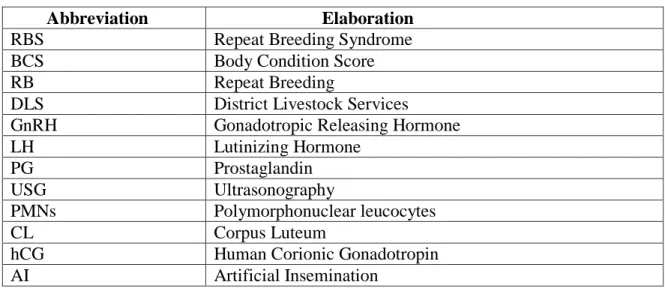
Repeat Breeding Syndrome is considered to be one of the most emerging and frustrated reproductive disorders among dairy herds, hampering beneficial productivity and causing heavy economic losses to farmers' livelihoods. Repeated breeding (RB) means that a cow does not become pregnant after three regular artificial inseminations. (AI) services by an inseminator or natural services by a breeding bull. The aim of this study was to assess the status of Repeat Breeding Syndrome (RBS), including the factors that increase the risk of RBS, the various etiological factors, the diagnostic and treatment approaches of RBS commonly applied in Bangladesh. It can be diagnosed using various techniques such as rectovaginal palpation, vaginoscopy, uterine cytology and the in vivo imaging technique of ultrasound.
The incidence of reproduction in dairy cattle can be reduced by improving their conception rate through careful handling of the genitals during insemination to avoid acquired abnormalities, appropriate treatment of reproductive tract infections, administration of hormone therapy to improve success fertilization and reduction of embryonic mortality, and ensuring breeding. of dairy cattle after appropriate clinical examination by a skilled inseminator. Therefore, it is essential to determine the prevalence and correlate risk factors for the occurrence of reproductive cows and also to evaluate the efficacy of drugs or interventions used to treat reproductive cows in Bangladesh.
Introduction
2 | Obstructions and abnormalities of the reproductive tract, early or latent embryonic abnormalities, poor reproduction, hormonal dysfunction causing approximately 40.1% of repeat reproduction (Maurer & Echternakamp,1985), management techniques including genetic, nutritional and infectious factors etc. Failure of fertilization has been considered as a prominent factor mainly caused by poor heat detection by farmers, incorrect estimation of artificial insemination at fixed times, poor sperm quality. Fertilization failure or premature embryonic death is considered the main pathogenesis of repeatedly breeding animals (Wodaje & Mekuria, 2016).
Usually, repeat breeder cows are diagnosed and treated by the veterinarians based on history of the previous services and clinical examination of the cows. The alternative ways of different hormonal therapy can be applied in dairy herds to increase the reproductive efficiency and reduce the reproductive problem related to anestrous and failure of fertilization and conception (Savalia et al., 2014).
Methodology
Risk factors of RBS
Parity: A higher conception rate is observed in multiparous cows than in parous cows (Coleman et al., 1985). Furthermore, Boyd and Reed (1961) reported that an increased conception rate is shown from parity 2 up to 6, and then decreased at parity 7 and 8.
Etiology of RBS
Bull factors: Repeat breeding can also be due to bull and semen factors (Perez et al.,2012). Season is also a very important consideration for semen collection, as semen collected during hot summer months has been shown to have lower fertility (Khawaskar et al.,2012) which may contribute to repeated breeding. A survey suggested that 14.75% dairy cattle are repeat breeders due to management reasons (Singh et al., 2008).
Infectious agents have only been reported for 2%-8% of embryonic losses in cattle (Campanile et al.,2005). The majority of offspring loss in cattle is observed during the first 42 days after breeding (Inskeep, Fields et al.,2002) and especially 6-20 days after breeding (Ayalon,1978), when this is very is easily possible by rectal palpation. evaluate pregnancy. Other recent developments to evaluate endometritis include the new intravaginal device 'Metricheck', which is known to be more sensitive in detecting endometritis than vaginoscopy (McDougall et al.,2007).
Endometrial EGF concentration is altered in RB cows and may serve as a potential marker for the identification of cows that may prove to be repeat breeders (Katagiri et al., 2004). Improvements in in vivo imaging technology include computer-aided image analysis of USG, three-dimensional USG, color Doppler USG, and magnetic resonance imaging (MRI) can also be used to detect repetitive animal breeding (Sarty et al., 1996). Tubal patency testing: Tubal occlusion can result in reduced fertility when unilateral and sterility when bilateral (Bruyas et al., 1993).
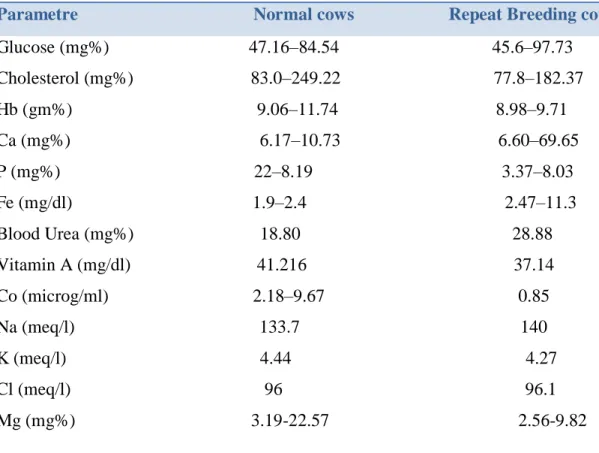
Progesterone levels both in estrus and during the luteal phase appear to be critical in dairy cattle (Sreenan et al., 2001). It has been shown that as the level of progesterone in AI increases, the conception rate in cows decreases (Ghanem et al., 2006). Therefore, systemic administration of antibiotics should be used in the treatment of severe cases of metritis (Chenault et al., 2004).
The new (third and fourth) generation cephalosporins have shown efficacy against most uterine pathogens at low MIC values and the first generation cephalosporin (cefapirin) is recommended for intrauterine use as the drug of choice for subclinical endometritis (Kaimanickam et al., 2005) . In most cases, it is suggested to combine an antibiotic with an imidazole derivative (metronidazole or tinidazole) to treat anaerobic microbes and protozoa that may be unusually present (Purohit & Sharma,2007). In addition, the most potent and safest approach appears to be the use of prostglandins (PG) for 5-10 days of estrus alone or followed by uterine lavage (Feldmann et al., 2005).
Antioxidants such as vitamins C and E are known to modulate oxidative stress and reduce endometrial damage both biochemically and histologically (Guney et al., 2007). Correction of luteal insufficiency: Causes of luteal insufficiency may be due to decreased response to circulating luteotrophic hormones leading to insufficient production of progesterone during the luteal phase after reproduction, which may be the cause of embryonic death (Kimura et al. , 1987). The use of pedometers and radio-telemetry devices (Lehrer et al., 1992) has been suggested to improve the detection of estrus and, therefore, the timing of insemination.
Some of the approaches include the administration of vitamins C and E and dexamethasone (Wang et al., 1999) and intrauterine insemination of vitamin C with little success.
Diagnostic approaches of RBS
Therapeutic approaches of RBS
Correction of endometritis: When clinical or subclinical endometritis is suspected, the clinician's first choice should be the administration of antimicrobial agents the day after insemination to rid the uterus of organisms that may be detrimental to conceptus survival. Alternatively, antibiotics can be infused into the uterus for 3-5 days during estrus and insemination, when more pus is observed clinically or when treatment with antibiotics alone fails or in severe cases leading to high concentrations of the drug in the uterine cavity and endometrium, and a relatively small amount is absorbed into the systemic circulation (Masera et al., 1980). It has been reported that intramuscular (IM) administration of 0.2 IU/kg bovine insulin to dairy cows on days 8, 9 and 10 of oestrus resulted in increased concentrations of progesterone and administration of 500 ml 25% dextrose at oestrus with insulin (5 ml bovine insulin) (Selvaraju et al., 2002).
16 | P a g e microminerals during the periparturient period (Wild, 2006), the influence of controlled feeding during the dry period (Beever, 2006), the effect of degradable proteins in the rumen (Tamminga, 2006) and embryo survival in dairy cows managed in pastoral conditions. It is also suggested that depositing sperm in the body of the uterus offers a distinct advantage in improving conception rates, compared to when it is deposited in the middle of the cervix (Purohit, 2010). Also, if any errors occur in the preparation of the AI weapon or those in the maintenance of the frozen/liquid sperm should be seriously reviewed because they may contribute to conception failures.
It is therefore important to inform farmers about the possible consequences of poor hygiene at calving and after birth. Some of the less common treatments described for cows suffering from the RB syndrome include acupuncture therapy (Lin et al., 2002), intraperitoneal insemination (Lopez-Gatius, 1995), use of herbal remedies (Hegde et al., 2002) and embryos. transmission at 7-8 days oestrus with or without AI at oestrus (Dochi et al, 2008). The effect of a single administration of cephapirin or cloprostenol on the reproductive performance of dairy cows with subclinical endometritis.
Effect of nutritional management of dairy cows on reproductive efficiency. Animal Reproduction Science;96:282–96. Synchronization rate of ovulatory follicle size and pregnancy rate after synchronization of ovulation starting on different days of the estrous cycle in lactating dairy cows. The influence of macro and micro minerals in the peri-estrous period on the fertility of dairy cattle.
First of all, I would like to express my deep gratitude to “Almighty Allah” who enabled me to complete my research work and dissertation.