40th Leeds-Lyon Symposium on Tribology & Tribochemistry Forum 2013 September 4-6, 2013, Lyon, France
Optimized Nanolubricant for Friction Reduction
M.I.H.C. Abdullah1, M.F.B. Abdollah1*, H. Amiruddin1, N.R. Mat Nuri1
1Center of Advanced Research on Energy, Universiti Teknikal Malaysia Melaka, Hang Tuah Jaya, 76100 Melaka, Malaysia
*
Corresponding author for [email protected]
1. Introduction
In Malaysia, capability of nanoparticles as lubricating oil additive to improve the performance of diesel engine oil has not yet been studied extensively. Therefore, this paper presents the experimental results for conventional diesel engine oil enriched with optimized nanoparticles
2. Experimental procedure
Based on design of experiment (DOE) through Taguchi method of L9 orthogonal array (Table 1),
nanolubricant samples were prepared using various fractions of hexagonal boron nitride (HBN) and alumina (Al2O3) nanoparticles. The samples were stabilized only
with addition of an appropriate amount of surfactant. The tribological testing of nanolubricants was performed using four-ball tester according to ASTM D4172.
The results were analyzed using analysis of signal-to-noise (SN) ratio and analysis of variance (ANOVA) for determining optimal values for low coefficient of friction (COF) and quantitatively measured the significance of all main factors.
Table 1 L9 orthogonal arrays design by Taguchi method
Sample
3. Results and discussion
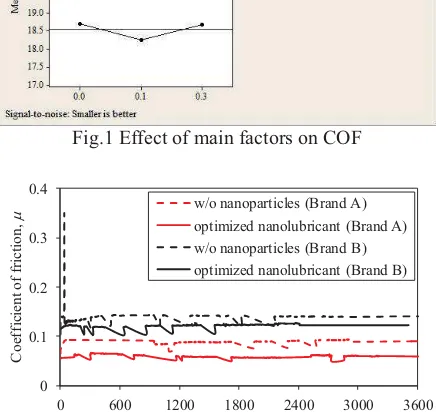
A greater SN ratio value corresponds to a better performance (low COF). From Fig. 1, the COF is decreases with decreasing Al2O3 content and increasing
HBN content. On the other hand, surfactant does not have a significant effect on COF. The increases in COF can be caused by Al2O3 nanoparticles making tiny
grooves on the surface. Meanwhile, increasing HBN can make a protective film to some extent by coating the rough friction surfaces to achieve low COF [1].
However, from ANOVA, Al2O3 and surfactanthave
bigger contribution or greater influence on the mean of means compared to mean of SN ratio. It means that the optimum value of HBN was taken from the response of mean of SN ratio, while the optimum value of Al2O3 and
surfactant was taken from response of mean of means. By using the optimized values of 0.5 vol% HBN and 0.3 vol% surfactant, COF decreased by 12%~33% compared to conventional diesel engine oil as shown in Fig. 2.
Fig.1 Effect of main factors on COF
Fig.2 COF with and without nanoparticles additives
4. Conclusion
From the statistical analysis using SN ratio and ANOVA, the COF is decreases with increasing HBN content in conventional diesel engine oil. The optimized values of 0.5 vol% HBN and 0.3 vol% surfactant decreased COF by 12%~33% compared to conventional diesel engine oil.
5. References
[1] Lee, K., Hwang, Y., Cheong, S., Choi, Y., Kwon, L., Lee, J. ans Kim, S.H., “Understanding the role of nanoparticles in nano-oil lubrication,” Tribol Lett. 35, 2009, 127-131.
0 0.1 0.2 0.3 0.4
0 600 1200 1800 2400 3000 3600
C
w/o nanoparticles (Brand A) optimized nanolubricant (Brand A) w/o nanoparticles (Brand B) optimized nanolubricant (Brand B)