UNIVERSITI TEKNIKAL MALAYSIA MELAKA
MACHINABILITY STUDY ON VARIOUS FIVE AXIS
MACHINING CENTRE CONFIGURATION
This report is submitted in accordance with the requirement of the Universiti Teknikal Malaysia Melaka (UTeM) for the Bachelor of Engineering Technology
(BETP) with Honours
By
STUDENT NAME (NURAIMAN BIN SAMLI) MATRIX NUMBER (B071210368)
IC NUMBER (920803-14-5257)
DECLARATION
I hereby, declared this report entitled “Machinability Study On Various Five Axis Machining Centre Configuration” is the results of my own research except as
cited in references.
Signature : ………. Author’s Name : NURAIMAN BIN SAMLI
APPROVAL
This report is submitted to the Faculty of Engineering Technology of UTeM as a partial fulfillment of the requirements for the degree of Bachelor of Engineering Technology (BETP) (Hons.). The member of the supervisory is as follow:
ABSTRACT
ABSTRAK
DEDICATION
ACKNOWLEDGEMENT
Primarily I would like thank God for being able to complete this research with success. Then this appreciation to Mr Syahrul Azwan Bin Sundi @ Suandi and Mr Syafik Bin Jumali , whose valuable guidance that helped me patch this research. Because of his guidance on suggestion and improvement in this research bring major contributor toward completing of the research.
Then I would like to thank my parents and friends who have helped me with their valuable suggestion to make this research more relevant in various phase of this research.
TABLE OF CONTENT
LIST OF ABBREVIATIONS, SYMBOLS AND NOMENCLATURE x
CHAPTER 1 : INTRODUCTION 1
1.0 Introduction 1
1.1 Problem Statement 4
1.2 Objective 4
1.3 Scopes 5
CHAPTER 2 : LITERATURE REVIEW 6
2.1 Numerical Control 6
2.1.1 Functions of a Machine Tool 7 2.1.2 Advantages of NC machine tools 8 2.2 Computer Numerical Control (CNC) 10
2.2.1 Advantages of CNC 11
2.2.2 Limitations of CNC 11
2.3 CNC Machining Centers 12
2.3.1 Classification 12
2.3.2 Features of CNC Machining Centers 13 2.4 Analyzed Machine Configurations 14 2.4.1 Specific Machine Example Used Throughout The Work 14 2.4.2 General Transformation for 5-Axis Machines 16 2.5 Surface Finish / Roughness 17 2.5.1 Surface Finish Parameter 21
2.6 Dimensional Accuracy 22
2.6.3 Geometric Errors 24
CHAPTER 3 : METHODOLOGY 26
3.1 Process Flow 27
3.1.1 Explanation of Flow Chart 28
3.2 Process Parameter 30
3.3 Machining Equipment 32
3.3.1 DMU60 Monoblock Deckel Maho 32 3.3.2 Mazak VRX630-5X II T 33
3.4 Equipment For Analysis 34
3.4.1 Mitutoyo Surface Roughness Tester SJ-410 34 3.4.2 Zeiss Contura G2 RDS 10/21 CNC CMM 35
3.5 Data Collection 36
CHAPTER 4 : RESULT & DISCUSSION 37
4.1 Result Of Surface Roughness 38
4.2 Dimensional Accuracy 49
CHAPTER 5 : CONCLUSION & RECOMMENDATION 54
5.1 Summary of Research 54
5.2 Recommendation For Future Studies 57
APPENDIX 58
LIST OF TABLES
3.1 Process Parameter. 28 3.2 DMU60 Monoblock Deckel Maho Specification. 30 3.3 Mazak VRX630-5X II T Specification. 31 3.4 Mitutoyo Surface Roughness Tester SJ-410 Specification. 32 3.5 Zeiss Contura G2 10/21 CNC CMM. 33
LIST OF FIGURES
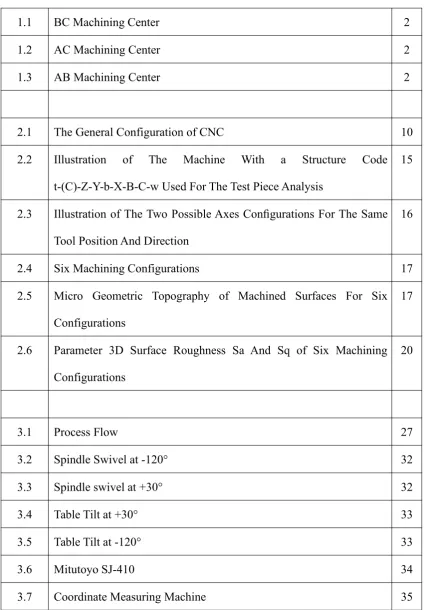
1.1 BC Machining Center 2 1.2 AC Machining Center 2 1.3 AB Machining Center 2
2.1 The General Configuration of CNC 10 2.2 Illustration of The Machine With a Structure Code
t-(C)-Z-Y-b-X-B-C-w Used For The Test Piece Analysis
15
2.3 Illustration of The Two Possible Axes Configurations For The Same Tool Position And Direction
16
2.4 Six Machining Configurations 17 2.5 Micro Geometric Topography of Machined Surfaces For Six
Configurations
17
2.6 Parameter 3D Surface Roughness Sa And Sq of Six Machining Configurations
20
3.1 Process Flow 27
3.2 Spindle Swivel at -120° 32 3.3 Spindle swivel at +30° 32 3.4 Table Tilt at +30° 33 3.5 Table Tilt at -120° 33
4.1 Location of inspection 38
4.2 Location A 41
4.3 Location B 42
4.4 Location C 43
4.5 Location D 44
4.6 Tool Axis 45
4.7 Location E 46
4.8 Average Ra both set of configurations. 48
4.9 Location Of CMM 49
LIST OF ABBREVIATIONS, SYMBOLS AND
Coordinate frame(xyz)0built in translating cam
Translating cam surface
Surface equation of meshing element of roller Unit outward normal of translating cam Length of float link
Length of crank link
Distance between z2 and z3 axes Distance between x3 and x4 axes
Displacement of roller-followers displacement of translating cam ith point on nominal surface
ith actual measured point
ith nearest point to nominal surface Required NC data values for CMM
Distance between the design point and the set point along the normal vector Width of roller
CHAPTER 1
INTRODUCTION
1.0 Introduction
Nowadays , there are many five-axis machining centers configurations available in the market. Manufacturer build this machine to meet the market demands. The 5-axis machining center was developed to make complex parts on one machine, as opposed to several. A 5-axis machining center can cut part on multiple sides of a part simultaneously in one setup. In addition, the process reduces idle times, increases accuracy, and increases the overall speed of production.
Otherwise, center can be mean as the point from which an activity or process is directed, or on which it is focused. Configuration is computing the way in which all the equipment that makes up a computer system is set to operate.
Five-Axis Machining Centers do not just move in the linear axes X, Y and Z. Instead, these machines also move in two rotary axes. In this research, focusing on tools of configuration which is B-C and A-C . Figure below shows the type of orientation of axis tool configurations :
Figure 1.3 : A-B Machining Centre. (Mazakas, A.,2011) Figure 1.1 : B-C Machining
True 5-axis machining refers to the ability to feed the tool through the cut using all axes to smoothly follow a contoured surface. After all, 5-axis machines were first developed for the aerospace industry. In this example of a blade, the rotary axes move continuously during the cut.
One of the most practical applications is called 3+2 machining. The part is rotated into position before the start of each cut and then a standard 3-axis tool path is run. This makes programming easy since rotary motion only occurs between operations. 3+2 machining also allows you to rotate the part into a position that allows shorter tools to reach deep areas. This technique is often used in mold making to prevent the problem of tool deflection. Another practical application is to lock only one of the axes, which is called 4+1 machining. The B-axis on a mill-turn is tilted and locked into position while still allowing the part to rotate during the cut. The B-axis spindle is more rigid when used in this configuration.
1.1 Problem Statement
The workpiece setup can be arranged in many ways in five axis machining center to work more efficiently. Nowadays, there are several kinds of machining center configuration that available in market. Machinability include the complexity of the part can be produce by the machine and also capability of the the difference of set of configuration to do the job well and also to control the precision of the part during machining. In process efficiency, it will count as the time taken of the operation take place without any parameter error occur during the part to be produce in a certain time. In previous study, many of researches explain the mechanism of this two type configuration. So that, in this research figured out about machining performance or machinability between one to another set of configuration when involving all the five axes , which is A-C and B-C machining centre configuration.
1.2 Objective
The aim that needs to be achieved in this research is stated below :
1. To investigate the effect on dimensional accuracy between one to another set of configurations when involving five axes.
1.3 Scopes
The scopes fixed as a border in this research. Hence, the scopes provides guideline for the area that have or have not cover. Scope in this research is stated below :
1. CATIA V5 software will be use to completing this research. 2. The part that will be machined are made up of Aluminum.
CHAPTER 2
LITERATURE REVIEW
In this section, some of previous studies was implemented to guide this research and relate to the finding current studies.
2.1 Numerical Control
i. Starting and stopping of machine tool spindle. ii. Controlling the spindle speed.
iii. Positioning the tool tip at desired locations and guiding it along desired paths by automatic control of motion of slides.
iv. Controlling the rate of movement of tool tip ( feed rate) v. Changing of tools in the spindle.
2.1.1 Functions of a Machine Tool
The purpose of a machine tool is to move away excessive material, usually metal from the material supplied to let a work piece of the required shape and size, produced to an acceptable accuracy and surface finish. The machine tool should possess certain capabilities in order to fulfill these requirements. It must be :
i. Able to hold the work piece and cutting tool properly.
ii. Endowed the sufficient power to enable the tool to cut the work piece material at economical rates.
2.1.2 Advantages of NC machine tools
i. Reduced lead time.
Lead time includes the time needed for planning, design and manufacture of jigs, etc. This time may amount to several months. Since the need for special jigs and fixtures is often entirely eliminated, the whole time needed for their design and manufacture is saved.
ii. Elimination of operator errors.
The machine is controlled by instructions registered on the tape provided the tape is correct and machine and tool operate correctly, no errors will occur in the job. Fatigue, boredom, or inattention by operator will not affect the quality or duration of the machining. Responsibility is transferred from the operator to the tape, machine settings are achieved without the operator reading the dial.
iii. Operator activity.
The operator is relieved of tasks performed by the machine and is free to attend to matters for which his skills and ability are essential. Presetting of tools, setting of components and preparation and planning of future jobs fall into this category. It is possible for two work stations to be prepared on a single machine table, even with small batches. Two setting positions are used, and the operator can be setting one station while machining takes place at the other.
iv. Lower labor cost.
More time is actually spent on cutting the metal. Machine manipulation time ex Gear changing and often setting time are less with NC machines and help reduce the labor cost per job considerably.
batches is kept at a minimum. Large storage facilities for work in progress are not required. Machining centers eliminate some of the setups needed for a succession of operation on one job time spent in waiting until each of a succession of machine is free is also cut. The components circulate round the machine shop in a shorter period, inter department costs are saved and ‘program chasing’ is reduced.
vi. Longer tool life.
Tools can be used at optimum speeds and feeds because these functions are controlled by the program.
vii. Elimination of special jigs and fixtures.
Because standard locating fixtures are often sufficient of work on machines. the cost of special jigs and fixture is frequently eliminated. The capital cost of storage facilities is greatly reduced. The storage of a tape in a simple matter, it may be kept for many years and manufacturing of spare parts, repeat orders or replacements is made much more convenient.
viii. Flexibility in changes of component design.
The modification of component design can be readily accommodated by reprogramming and altering the tape. Savings are affected in time and cost.
ix. Reduced inspection.
The time spent on inspection and in waiting for inspection to begin is greatly reduced. Normally it is necessary to inspect the first component only once the tape is proved; the repetitive accuracy of the machine maintains a consistent product.
x. Reduced scrap.
The time taken in machining is predictable, consistent and results in a greater accuracy in estimating and more consistency in costing.
2.2 Computer Numerical Control (CNC)
CNC refers to a computer that is joined to the NC machine to make the machine versatile. Information can be stored in a memory bank. The programme is read from a storage medium such as the punched tape and retrieved to the memory of the CNC computer. Some CNC machines have a magnetic medium (tape or disk) for storing programs. This gives more flexibility for editing or saving CNC programs. Figure 2.1 illustrates the general configuration of CNC.
Figure 2.1 : The General Configuration of CNC.