Informasi Dokumen
- Penulis:
- Rahayu Lestari
- Pengajar:
- Dr. Abdul Firman Ashaf, S.I.P, M.Si
- Drs. Sarwoko, M.Si
- Sekolah: University of Lampung
- Mata Pelajaran: Communication Science
- Topik: Nationalism in Film (Studies Hermeneutic Content Analysis of Nationalism In the Eagle Blood And Motherland Film)
- Tipe: thesis
- Tahun: 2012
- Kota: Bandar Lampung
Ringkasan Dokumen
I. INTRODUCTION
The introduction provides a comprehensive overview of the significance of film as a contemporary mass communication tool. It establishes the film's role in conveying themes of nationalism, which evolves over time within the context of Indonesia's history. The introduction also outlines the research objectives, focusing on the construction and content of nationalism in the films 'Darah Garuda' and 'Tanah Air Beta', as well as a comparison of their messages.
II. LITERATURE REVIEW
This section reviews prior research on nationalism, emphasizing its historical development and significance in Indonesian cinema. It discusses how nationalism is represented in films and its relevance to societal values. The literature review highlights the need for a hermeneutic approach to analyze film content, which allows for a deeper understanding of the underlying messages of nationalism in cinematic narratives.
III. METHODOLOGY
The methodology outlines the qualitative hermeneutic analysis used to interpret the films. It explains the process of data collection, including watching and classifying scenes from both films to identify elements of nationalism. The hermeneutic approach, as articulated by Paul Ricoeur, is emphasized as a means to achieve optimal understanding of the films' messages and their cultural significance.
IV. ANALYSIS OF 'DARAH GARUDA'
This section analyzes 'Darah Garuda', focusing on its construction of nationalism through elements of religiosity and ethnicity. It details how 50% of the film's scenes contribute to the portrayal of Indonesian nationalism, emphasizing the film's ideological approach and dynamic narrative structure. The analysis highlights the film's role in fostering national integration and instilling values of nationalism among viewers.
V. ANALYSIS OF 'TANAH AIR BETA'
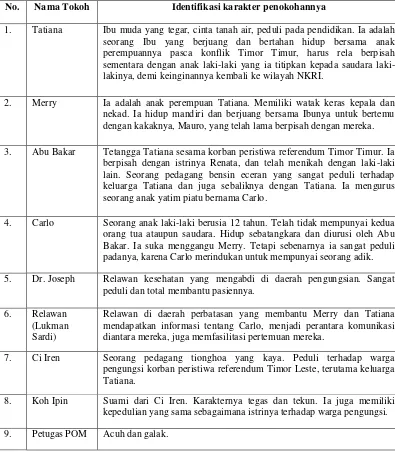
The analysis of 'Tanah Air Beta' reveals its emphasis on cultural elements and ethnicity in constructing nationalism. This film features a different narrative approach, with 44% of its scenes dedicated to nationalism. The section discusses how the film's linear narrative and cultural focus contribute to a sense of unity and identity among viewers, reinforcing the significance of nationalism in contemporary Indonesia.
VI. COMPARATIVE ANALYSIS
This section compares the two films in terms of their packaging of nationalist messages. It identifies key differences in narrative structure, with 'Darah Garuda' employing a long-dynamic flow and ideological approach, while 'Tanah Air Beta' utilizes a short-linear groove with a strong cultural emphasis. The comparison underscores the varied ways nationalism can be internalized through cinematic representation.
VII. SIGNIFICANCE OF NATIONALISM
The significance of nationalism in both films is discussed in this section. 'Darah Garuda' is portrayed as a catalyst for individual and collective unity in maintaining independence, while 'Tanah Air Beta' emphasizes national wholeness and the interrelationship between citizens and the nation. This highlights the films' roles in promoting national identity and values among audiences.
VIII. CONCLUSION
The conclusion synthesizes the findings of the research, reiterating the importance of film as a medium for conveying nationalist messages. It emphasizes the potential of cinema to foster national integration and inspire a sense of belonging among viewers. The study advocates for further research on the impact of film in shaping cultural and national identities in Indonesia.