CHAPTER II
THEORETICAL BACKGROUND AND HYPOTHESIS DEVELOPMENT
2.1 Efficiency Market Theory
An efficiency capital market is one in which stock prices fully reflect available information (Ross et al., 2011). If capital market can react rapidly and it’s accurate to reach new equilibrium price which fully reflect with information available, then this market condition is efficiency market (Jogiyanto, 2010). This efficiency market can affect earnings and equity of company because that information’s can give changes in investor behaves. According to Ross et al. (2011) in corporate finance, there are three conditions that can lead to efficiency, that are:
1. Rationality
In this rationality, all of the investor will think rationally. If there are new information infiltrate, the investors give a fast reaction to its new information. If it’s happen in public company, automatically the equity value will be influenced and it will affect the earnings of companies also. The market prices of companies can also changes because of the new information that the investors get.
2. Independent
beyond what market efficiency predict. But, if the investor has emotional resistance which means investor easily react to new information in a pessimistic manner, the stock price would likely rise less than market efficiency.
3. Arbitrage
The Arbitrage generates profit from the simultaneous purchase and sales of different, but substitute, securities. In this stage, the investor will think professionally. If the arbitrage of professional dominates the speculation of amateurs, market value would still be efficient.
In general there are two forms of market efficiency, the informational efficiency market which is seen from the information point of view and the decisional efficiency market which more emphasis in making decisions (Jogiyanto, 2010). Jogiyanto (2010) said in informational efficiency market, there are three forms of efficiency market which are (1) weak form is market which the prices of securities fully reflect past information, (2) Semi strong form is market which the prices of securities fully reflect all publicly available information, (3) Strong form is market which the prices of securities fully reflect all information including private information. The stock price consequences of new earnings information suggest that capital market participants have enormous incentives to efficiently use all sources of available information to predict earnings, including information useful for anticipating changes in earnings before they are announced.
2.2 Equity
2.2.1 Definition of equity value
Equity value is a value that describes how well or poorly the management of comapany try to manage their wealth, it can be seen from the measurement of financial performance obtained. A firm will seek to maximize the value of his company. The increase in value of the company is usually characterized by rising stock prices in the market.
In general, equity value is the important information needed by investors because the values contained in the equity value were used for the main information in making investment. Equity value is convex in earnings and book value (Burgstahler and Dichev, 1997) where the book value provides a measure of the value of the firm’s resources. Another definition of book value conducted by Keown et al. (1996) is the value of asset as shown on a firm’s balance sheet. It represents the historical cost of the asset rather that its current market value or replacement cost.
There are several ways in assessing the equity value. Equity value can be obtained in terms of asset stock and operating efficiency. Equity value is shown to equal the expected value from maintaining the present course of operations plus the value of the option to expand or contract the scale of operations (Zhang, 2000).
(Zhang, 2000). Equity value is the value of a company that can be seen from the amount of assets and liabilities (Burgstahler and Dichev, 1997). Equity value is one factor in attracting investment. If a company has a good equity value, then the situation indicated that the company's assets and activities are also good so that it can attract the attention of investors. This equity value also related with the book value since book value can be part of the equity value. The book value of equity represents the equity of shareholders (from a balance sheet perspective) less than preferred stock.
Valuation based on accounting data starts with the two basic accounting constructs, earnings and book value (Burgstahler and Dichev, 1997). Accounting data are adjusted to correct the biases introduced by conservatism, this is done by referring to past investment activities and the degree of conservatism in the accounting policy adopted. Based on information extracted from the adjusted accounting data, equity value is determined.
versa relation when the firm’s has high profitability. The firm’s are likely to continue and will grow their operation.
2.2.2 The important of book value
According to Burgstahler and Dichev (1997), market value of equity can be observed directly in trade firms. However, including the book value of equity in the valuation is very important because it can help to eliminate the negative bias in the coefficient on earnings in loss firms (Collins et al., 1999). Book value is a cost-based measure of the value of firm’s resources, where the cost is independent of how the firm will use the resources (Burgstahler and Dichev, 1997). Hence, this research will not only use market value to reflect the equity value, but also including the book value of equity.
Earnings are a relatively more important determinant of value and it is high relative to book value (Burgstahler and Dichev, 1997, Collins et al., 1999). Book value of equity has substantial incremental explanatory power beyond earnings in equity valuation for loss firms (Collins et al., 1999). Ohlson (1995) argues that the book value of equity projecting expected earnings in the future.
to determine the value of the company. In such cases, profits expected in the future that provide information sufficient to calculate the present value in determining the value of company (Ohlson, 1995). Thus, the book value of equity and profit is the basis for determining the variable value of the company. 2.2.3 Market to Book Value
Market to book ratio of equity reflects that market assess the company’s investment return in the future can be seen from expected return of equity (Smith and Watts, 1992). The difference in the market value and the book value of equity investment shows the opportunities of company’s investment (Collins and Kothari, 1989). The proxy market to book ratio of equity states that most of the company's growth prospects expressed by market prices. Another research who used this proxy is Kallapur and Trombley (1999).
the ratio can be found on the market reaction to the positive signal of the company that affects the relationships of earnings of the company.
Book value is calculated using the value of equity on the balance sheet date of 31 December. While Market value is measured using the closing share price on the announcement date to reflect the market response to the financial statements.
2.3 Earnings
Accounting information such as stock price and return is very important and useful for investors. The importance of accounting information can be seen in the study Ball and Brown (1968) in which earnings have an influence on corporate income. Earning can be defined as the profit which produce from company in a certain period. Market value and earnings have a positive relationship that is where the earnings increases, the function of market value also increased (Burgstahler and Dichev, 1997).
Earnings occupy a central position in accounting. Earnings information is a component of the company’s financial statements, according to SFAC no. 8 earnings information has the following benefits: (1) to assess the performance of the management, (2) to help estimate the ability of earnings representative in the long term, predict earnings and assess the risk of earnings in investment or credit loans.
an earnings level variable. Lev and Zarowin (1999) use the returns-earnings association as measure of usefulness of financial statement information. They identify the decline in association as a decrease in usefulness of financial information because such association reflects consequences of investor’s actions. Earnings also used by investor to see the firm’s prospects.
Easton and Harris (1991) shows that both earnings changes and levels have explanatory power when they are included simultaneously in a regression model of abnormal returns on earnings. Earnings level variables can enter the earnings-return model because of the transitory component in the previous period’s earnings. According to Beaver (1968), when the annual earnings announcement contains information, the variability of stock price changes will appear larger when announced earnings than any other time during the year. It is because there is a change in the equilibrium value of the stock price during the announcement period. The result of these studies provides evidence of change behavior of stock prices and volume around the announcement date, as well as indicates that the annual earnings contain information relevant to assess the company.
(Achim et al., 2009). This research will use Earnings per Share (EPS) to measure the earnings.
EPS is generally considered to be the single most important variable in determining a share's price. It is also a major component of the price-to-earnings valuation ratio. Achim (2009) said basic EPS is calculated by dividing profit or loss attributable to ordinary equity holders of the parent entity (the numerator) by the weighted average number of ordinary securities outstanding (the denominator) during the period.
EPS can be achieved when running the company operations. Earnings per share or EPS obtained from earnings available to common stockholders divided by the weighted - average shares outstanding. EPS can be calculated as follows (Achim 2009):
Basic EPS =
In EPS, it is better to use weighted average because the number of common securities can change over time. The average of common securities circulating in the respective financial year reflects the possibility that the value of the share capital should be variable during that financial year.
2.4 Investment growth
2.4.1 Definition of Investment
not be consumed today but are used in the future to increase wealth. The definition of investment can be elaborated as monetary asset purchased with the idea that the asset will provide income in the future or appreciated and be sold at a higher price.
Firms make investment for multitude of reasons. One of the reasons is to place the funds in higher-income-yielding application which can also provide ready access to funds as and when necessary (Deegan, 2000). If the firms need the money in short term, firm probably can invest it to marketable securities which they can readily be converted to cash. Aside from short term investment, there is also long-term investment. For the long-long-term investment the company intends to hold for more than a year.
2.4.2 Type of Investment
According to Halim (2003), Investment can be distinguish into two types.
1. Investment in financial asset
Investment in financial asset had done in capital market. Examples of investments in financial assets carried in the financial markets are in the form of certificates of deposit, commercial paper, money market securities, and other.
2. Investment in real asset
establishment of factories, mines opening, clearing land for plantations, and others.
Based on Jogiyanto (2010), there are two types of investment, direct investment and indirect investment.
1. Direct investment
Direct investment can be done by purchasing financial assets in the stock market. The purpose of direct investment is to gain enough control over future decisions.
2. Indirect investment
Indirect investment can be defined as the purchase of shares of investment companies that have a portfolio of financial assets from other companies.
2.4.3 Growth
growth as something should be maximized in the firms, this also lead and show about how important of growth is.
Investment growth affect the results related to the profitability of investment where also affect firm value. Economic reasoning suggest that whether investment growth enhances value generation depends on profitability; define as earnings in a period divided by the equity book value at the beginning of the period. Profitability also represents a firm’s ability to generate value from invested capital, thus indicating the desirability of increasing or reducing the scale of operations (Hao et al., 2011).
The relationship between growth and profitability seems can not be avoided because profit can assist firm to growth in their investment (Mukhopadhyay and AmirKhalKhaly, 2010). In existing research, growth increases the value-earnings relation and also it strengthens the value-earnings relation in terms of a steeper slope for high-profitability firms, the effect is expected to be smaller and can even disappear for low-profitability firms (Collin and Kothari, 1989).
2.4.4 Investment Opportunity Set
company's prospects can be estimated from Investment opportunity set (Hasnawati, 2005). This research will include the Investment Opportunity Set (IOS) because individual growth variable will not be able to capture the growth opportunities of a firm in entirely (Jaggi and Gul, 1999).
There are some of the definitions about Investment Opportunity Set (IOS). First, according to Hasnawati (2005), IOS is combination of assets in place and investment options in the future with a positive net present value. Another definition come from Gaver and Gaver (1995) that define the IOS as value of the company which the amount depend on expenditure that determined by management in the future, which is now the investment options are expected to result in a larger return. In conclusion, IOS can be identified that has relationship with the current spending or in the future with the value/return/prospect as a result form investing decision to generate values. For companies that cannot use the opportunity of investments, they will have a higher expenditure than the value of lost opportunity. Value of the investment opportunity is the present value of the options the company to make an investment in the future.
others. Companies that grow are not always a small company or actively conducting research & development. In general it can be said that the IOS illustrate the breadth of opportunities or investment opportunities for a company, but is highly dependent on the choice of the company for the expenditure in the future. Thus IOS are not observable, so the need to be selected a proxy that can be associated with other variables in the enterprise, such as growth variables, policy variables, and others.
According to Hasnawati (2005) there are three proxies of IOS that used in previous research, they are:
(1) Price based proxies based on the difference between the assets and the value of the stock market. This proxy is highly dependent on the price of the stock. This proxy is also base on the idea that a company's growth prospects are partially represented by the stock price, then companies that have high growth will have a higher market value relative of assets owned.
(3) Variance measure is a proxy which revealed that an option will become more valuable if the use of variability to estimate the size of the growing options such as return variability of the underlying assets increase.
This study will use a proxy of investment where the investment proxy may indicate a high level of investment activity is positive. Companies with high IOS assume will have high investment anyway (Hasnawati, 2005). Kallapur and Trombley (1999) said that ratio capital expenditure to asset as the IOS proxy has positively correlated with growth.
2.5 Relation between investment, earnings and equity value
Equity value is convex in earnings, especially for low-efficiency firms and growth firms (Zhang, 2000). If the company’s earnings increase, the possibility of the company to continue running the business and operations will also increase. This rise is also expected to increase future earnings, which could also affect the equity value and earnings relations.
Picture 2.1
2.6 Previous Research
There are some research about the relation of equity value, earnings and investment growth. Those researches are really closely related to this study. One research to another research might be had different arguments and opinion.
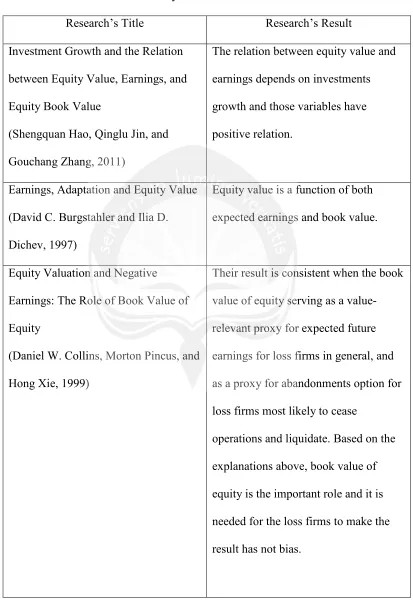
Hao et al. (2011) theorize that the growth might increase the equity value-earnings relation for high profitability firms but it has negative effect on the slope for lower-profitability firms. Their study gives the better understanding of the fundamental determinants of earnings, equity value and the investment growth. They said that earnings and equity book value serve as explanatory variables for equity value. In this situation, prospective investment growth and investment activities alter the way accounting data are mapped into value. So the conclusion of their research was the relation between equity value and earnings depends on investment growth and those variables have positive relation.
Another research is about earnings, adaptation and equity value conducted by Burgstahler and Dichev (1997). In this research, they were focused on the relation of equity value, earnings and book value. They predict
Earnings Equity value
that the value of equity is a convex function of both expected earnings and book value. The empirical prediction strongly supports the prediction of the convexity – the coefficient on earnings increases with the ratio of earnings to book value and the coefficient on book value decrease with the ratio of earnings to book value. Thus the result shows that the equity value is a function of both expected earnings and book value.
In Collins et al. (1999), the research is about the equity valuation and negative earnings which focused on the role of book value of equity. They said that book value of equity has important role also in valuing loss firms. Their result is consistent when the book value of equity serving as a value-relevant proxy for expected future earnings for loss firms in general, and as a proxy for abandonment option for loss firms most likely to cease operations and liquidate. They suggest that book value of equity is an important value attribute for loss firms.
Table 2.1
Summary of Previous Research
Research’s Title Research’s Result
Investment Growth and the Relation between Equity Value, Earnings, and Equity Book Value
(Shengquan Hao, Qinglu Jin, and Gouchang Zhang, 2011)
The relation between equity value and earnings depends on investments growth and those variables have positive relation.
Earnings, Adaptation and Equity Value (David C. Burgstahler and Ilia D. Dichev, 1997)
Equity value is a function of both expected earnings and book value.
Equity Valuation and Negative Earnings: The Role of Book Value of Equity
(Daniel W. Collins, Morton Pincus, and Hong Xie, 1999)
Their result is consistent when the book value of equity serving as a value-relevant proxy for expected future earnings for loss firms in general, and as a proxy for abandonments option for loss firms most likely to cease
How do Accounting Variables Explain Stock Price movement? Theory and Evidence
(Peter Chen and Gouchang Zang, 2007)
They said that the stock return which related to the earnings yields, capital investment, and changes in profitability and growth opportunities, and discount rate are highly significant.
2.7 Hypotheses development
An earning is one factor to measure the company's equity value. To find out the earnings we also still need corporate profitability where it is a component associated with the investment company. The existence of the company's investment activities are needed because it gives information about earnings and the market reaction.
Earnings have been reflected real value of equity value. When investors have interest in investing their money to the companies, they will see the companies condition through the equity value. After seeing the equity value, investor will make the decision whether the company has a good prospect in the future or not. If the equity value of the company is good, they will be interested to invest for the company. This situation can increase the investment growth and the company also has opportunity to increase their earnings.
have tended to move together with the stock prices from a company.It means that earnings can affect the stock price which also related with the investment activity of the company. Increase in stock price also give impact to the equity value of companies which also connected with the investment activity. Investment growth gives impact on earnings which can affect the equity value of firms.
Equity value is a function of both expected earnings and book value (Solomons, 1995). The prospective investment and past investment activities alter the way accounting data are mapped into value (Hao et al., 2011). Investment growth which related with profitability will also focus on the price of shares outstanding is important (Chen and Zhang, 2007).
Research of Collins and Kothari (1989) concluded that there is a positive correlation between growth opportunities and earnings response coefficients. Growing company is expected to increase market responsiveness of the profits that are informed in the financial statements. Kallapur and Trombley (2001) states that sets of the company's investment opportunities is an important component of market value. This is due to the investment opportunities of a firm affects the perception of managers, owners, investors and creditors against the company.
new product, replacement of new machine and etc. (Myers, 1976 in Hasnawati, 2005). Therefore, the equity value is strongly related to earnings on an enterprise cannot provide conclusive results. This is because there are many other possible factors that can affect the final outcome for the company's equity value. One of the possible factors is investment growth of the company.
Growth is expected by internal and external parties, as a good growth gives signal for the development of the company. From the point of view of investors, the investment growth of a company is a sign that the company has a favorable aspect. If the company has a favorable aspect, investors will be intersted in buying shares, so the demand for the company’s stock will rise abd will affect the stock price. The effect on stock prices will affect the equity value of company. Based on these idea and previous research, hypotheses can be formulated as follows: