I
78
Yunus et aL Med J IndonesAsthma prevalence
among
high
school students
in
East
Jakarta,
2001,
based on
ISAAC
questionnaire
Faisal Yunus', Ralnawati Antu.iu', Menaldi Rasmin*, Hadiarto Mangunnegoro*, Anwa. Jusut', Adang Bachtiar"
Abstrak
penelitian ini bertujuan menilai prevalensi asma pada anak sekoLah berumur l3-14 tahun di Jakarta Timur Penelitian ini bersifat suryei cross secilàna! pada 22i4 pelajar sekolah menengah berumur antara 13-14 tahun di Jakarta Timur pada tahun 2001 menggunakan kuesioner ISAAC. Uji piovokasi bronkus menggunakan metakolin pada 186 pelajar. Berdasarkan kuestoner ISAAC didipltkan 7,20À pelajar mempunyai riwdyat mengi, 4,1% mengalami mengi dalam 12 buLan terakhir, I,8oÀ pernah mengalami ,rrorgon asma beiat àalam l2'bulan terakhir, 3,3?6 mengalami mengi sesudah latihan, dan 6,3'% mengalami batuk pada malam hari, sedaigkan mereka tidak sedang menderitafu. Prevalensi penyakit alopi seperti rinitis dan eksim terdapat pada 14,2'% dan 3'9'% subjei, sedangkan prevalensi rinitis dan elcim dalam l2 bulan terakhir adalah 10,6'% dan 2,9?6. Secara statislik terdapat hubungan beimakna antara ge.lala mengi dan atopi (p < 0,05). Dari kuesioner nilai kappa bermakna 0,84 berhubungan dengan mengi dalam 12 bulan terakhir. LIjl provokai bronkus minunjukkan sensitivitas 90% dan spesiJisitas 83,5%, nîlai predÎl<si positif 68,12% dan nilai prediksi negattf Ô5,'794. preratensi asma di Jakarta Timur tahun 2001 berdasarkan kuesioner ISAAC adalah 8,9%o dan prevalensi 'kumulatif
11,5oÀ. Kuesioner ISAAC bisa digunakan untuk penelitian prevaLensi asma pada anak sekolah di Indonesia. (Med f Indones 2003; l2:178-86)
Abstract
The aim of this study wos to assess asthma prevalence in children between I3-14 years of age in East Jakarta. This study is a cross sectional-study which surveyed 2234 high school students betvveen the ages of I3 and l4 years in East Jakarta in 2001 using the ISAAC questionnaire. Bron'chial chatleige test was appLied holine substance to 186 sludents. Reports.based on the IsAACquestionnaire
indicatethatT,2(%ofteenagehavehad
ence,4,lo/ohavewheezingwithinthelasti2months, 1.8 oÀhaveeversufferedsevereasthmaattackwithinthelastl2months,3.3'%havesufferedwheezingafterexercise,and6-3'%have got night cough *i'ite they were not sufferingfrom cold. Prevalence of atopy diseases such as rhinitis and eczemawere 14.2'% and 3.9'%' mianwhite rhinitis and eczema pievaleice within the last 12 months according to this sludy were 10.60À and 2.9%o respectively. Statistically, there is a signifcant correlation between wheezing symptom and atopy (p < 0.05). From Indepth quesionnaire, a signifcani value of kappa-0.84 related with wheezing within the last I2 months was found. Bronchial challenge test results indicatetiat
sensitivity *ot g0%, specifcity 83.58%, positive predictive value 68.12'% and negative predictive value was 95'73%. Asthma prevalence in East Jakartà oi ZOO\ based on ISAAC questionnaire was 8.9026, and cumulative prevalence 11.5%. The ISAAC questionnaire can be used to study asthma prevalence in children at multicenter in Indonesia. (Med J Indones 2003; I2: 178-86)Keywords: bronchia! challenge, high school student, ISAAC questionnaire, East Jakarta, asthma prevalence
Asthma
is a
chronic respiratory tract disease thatcould
happen at all ages and could be severe and fatal. More than I00 million people all over the world have sulfered from asthma and the prevalence amongDepartment of Respiratory Medicine, Faculty of Medicine, University of Indonesia, Persahabatan Hospital, Jakarta,
Indones ia.
"
Public Health Division, Faculty of Public Health, University of Indonesia, Jakarta, Indonesiachildren is on the increase.l Although asthma is not a
new disease (it has been known for a long time) , its causes are still not clear.2
Asthma prevalence was increased both in adult and children all over the world.3-s Globally the range of asthma prevalence was between 0
-
30% at different population.lIn
Oslo, the
prevalenceof
asthma amongst childrenwas
increasedwithin
l3
years period of time (from 3.4% inl98l
to 9.3o in tee+;.1In
Australia, asthma prevalence had increased morelol 12, No 3, July - September 2003
than two times in one decade, there is 10.4% in 1982 become 21.6%
in
1992.4While
in
Taiwan the prevalence of asthma had amplified from 1.30% in 1974 and turn out tobe 5.070Âin
1985 and 5.80% in 199 1.5 In England, asthma prevalence amongst children 12 years of age had also increased from l7o/o-
22% duringl5
years.o Usually, the researcher define asthma diagnosis based on its symptom within the last l2 months.'In Indonesia, asthma is one cause of high morbidity after infection.s Asthma prevalence in children yary from one place to another.
In
several big cities, the range is befween 2.7o/oe to 22.2oÂ.10 According to the Indonesian Household Health Survey (HHS) 1986, asthma, bronchitis, and other respiratory diseases ranks fifth as the cause of morbidity and tenth among the causeof
death. Meanwhile, accordingto
HHS1992, asthma, bronchitis,
and
emphysema ranks seventh as the cause ofdeath in Indonesia.sAsthma prevalence among countries is difficult to compare since
the
studiesoften
use
different questionnaires. This difficulty highlights the need for one standard method, which could be applicable for monitoring asthma trends and comparing prevalence internationally and regionally. Such standard method " could help physicians and public health experts to take action to reduce asthma prevalence, which has dramatically increased in recent times. Quite recentlythe
Steering Committeeof
International Study ofAsthma and Allergies
in
Childhood (ISAAC) has developed a standard procedure for study on asthma prevalence,which could
be
used universally in different languages and geographical areas, mating cross-country and regional comparisons possible. 7'llA
previous literaturedid
mentionthat
asthma prevalencein
children in Indonesia is lower than in other countries.eIn
orderto
avoid
having high numberof
asthma casesin
children
asin
other countries, Indonesia mustdevelop
strategies that could ensure effective monitoring andcontrol
of asthma casesin
future. Thisof
course requires a sustainablesludy
to
ascertain the rate tendency ofasthma and prevalence in children in Indoriesia.
Srudy method
comprisedthe
use
of
ISAAC questionnaire, which has been translated into Bahasa Indonesia. Resultsof
this
sfudy may
assist in identifying asthma disease patternin
Indonesia. It may also helpto
unravel someof
the underlyingfactors
responsiblefor
the grorving incidence ofAsthma prevalence in Eas!
Jakarta
179asthma in many countries. The success of cunent and future preventive efforts particularly
in
developing countries depends very much on our knorvledgeof
such underlying factors.METHODS
Design
Cross sectional study and continued with diagnostic test. The study was conducted at selected high schools
in
Eastern partof
Jakarta. Methacholine challenge was carriedout
at
asthmaclinic
in
Persahabatan Hospital, Jakarta surveying 186 students. The time frame was from April to September 2001.Target population of this research consists of teenage students in Indonesia. High school students of 13 to 14 years of age were targeted because such students from
both
public and private schools in East Jakarta are easily accessible.A
sample of students was taken randomly from a total numberof
119,105 students which enrolled in 256 high schools in Eastern partof
Jakarta. In all 2400 students from 60 different schools were selected. The age range of these students during the study was supposed to be from thirteen years or more to f,rfteen years or less (> l3 - S 15).Procedure
Muhistage random sampling technique was adopted in this study. Firstly, 60 out of the 256 high schools in Eastern Jakarta were selected using simple random sampling method. Then
a
computer based program was used to randomly select subject study.In
each school were distributed 40 sets of questionnaire. The questionnaires were given to selected sludents to behlled
in by
them. Priorto
the distributionof
the questionnaires, respondents were given a brief lectureon
asthma andits
symptoms such as wheezing, cough, dyspnea, as well as rhinitis and eczerna, and were also given clear instructions asto
how tofill
inthe
questionnaire. Respondentswere given
the opportunilyto
take the questionnaires home and relurn them the next day through their teachers in casethey
are
not
sure aboutthe
answersthey
areproviding. Complete questionnaire were categorized
into
3
groups namely asthmawithin the
last
12180
Yunus et althe original questionnaire by the research I in order to measure the value agreement (kappa).
Some students were selected
at
random from both asthma and non-asthma groups for the next stageof
the shrdy, which was the examinationof
how their pulmonary function and the bronchial challenge test. Bronchial challenge test was performedon
someselected and non-selected but willing students. All the students
for
the
test were supposedto
meet the following conditions:1.
Subjects shouldbe
asymptomatic,do
not have medical treatment whichwould
interfere with bronchial challenge test such as 82-agonist or anticholynergic MDI(
4 hours, teophyline or oral antimuscharinic<8
hours.'' Antihistamine<
24 hours and theophylline slow release<
48 hours.Asthma patients
using
co-rticosteroid could continue using ordinary dose.''\rEP1 before test should be
>
80% from predictivevalue based on Indonesia Pneumobile Project, 1992. Subjects should
not be
under exacerbation or asthmatic status, cooperative and should not be suffering from pulmonary diseases, which cause severe pulmonary dysfunction.After obtaining the results of the bronchial challenge test, sensitivity, specificify, positive predictive value (PPV), and negative predictive value (NPV) were calculated by using two times two tables. Data were analyzed using SPSS 10.0 statistical package pro$am.
The study was licensed
by
East Jakarta RegionalOffice
of
Departmentof
Education,which
also assisted through writing of lettersto
heads of schoolsto
requestfor
their
co-operation.The
informed consent from parents of sfudents who were willing to participate in the bronchial challenge test were sought through their teachers Ethical clearance was given by authority board.RESULTS
Questioner responses
Of
2400 questionnaires that were distributedto
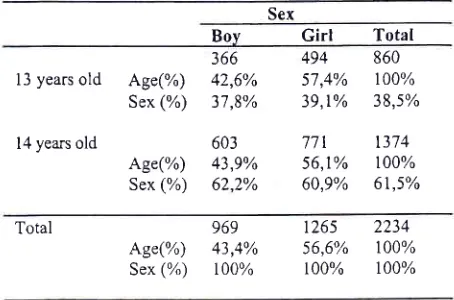
the str-rdents, 2234 (93.08%) were fified out and returned. These comprised of 969 (43.4%) questiornaires from male (boys) respondents and 1265 (56.6%) from female (girls) respondents. Eight hundred and sixty questionnaires (38.5%of
total
questionnaire) werereceived from respondents' aged of l3 years. Fourteen
Med J Indones
(14) year old respondents reh:rned
a
totalof
1374 (61.5%) questionnaires. This is illustrated in the table below (table 1).Table l. Response of ISAAC questionnaire l3-14 years old
Sex
Boy
Girl
Total13 years
old
Age(%) Sex (%)14 years old
Age(%) Sex (%)
494
860 57,4% r00%39,r%
38J%771
1374 56,1% 100% 60,9% 61,5% 36642,6% 37,8%
603 43p% 62,2%
2
5
Total
969
1265
2234Age(%)
43,4%
56,6% 100% Sex(%) t00% r00%
t00%Based on symptoms quesionnaire (table 2), asthma
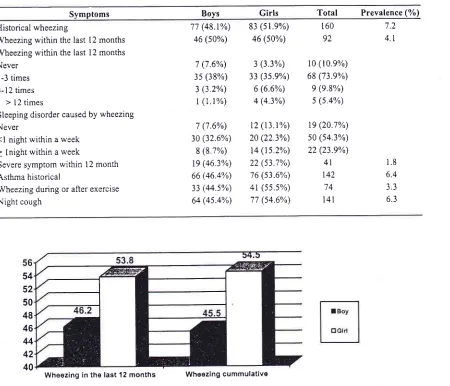
sufferers within the last 12 months were 199 students (8.9%) consisting
of
92 boys (46.2%) and 107 girls (53.8%).These
numberswere
derivedfrom
a combinationof
answers suppliedby
respondents to questions number2
(wheezingwithin
thelast
12 months), 7 (wheezing during or after exercise within the last 12 months)and
8
(wheeze/cough at night within thelast
12 months). Cumulative wheezing, which was the combinationof
answers to questions number 1,2,6,7,and 8 was found tobe257 students (11.5%) which comprisesof
117 boys (45.5%) and140 girls (54.5%) (Figure l).
Answers provided to question relating to rhinitis indicate that 317 students (14.2%) have rhinitis history. They comprised of
l4l
boys (44.5%) and 176 girls (55.5%),Respondents who have had rhinitis within the last 12 months were 236 shrdents (10.6%); they consisted of
104 boys (44.1%) and 132 girls (55.9%).
From eczema question
it
was found that 89 (3.9%) students comprising of 31 boys (34.8%) and 58 girls (65.2%) have eczema history,while
66
students (2.9%) madeup
of
21
boys (31.8%) and45
girls (68.2%) have had eczema rvithin the last 12 months. [image:3.612.328.555.144.294.2]Vol 12, No 3, July - September 2003
Table 2. Symptoms prevalence (%)
Asthma prevalence in East Jakarta
t8l
Symptoms
Boys
Girls
Total
Prevalence (7o)Historical wheezing
Wheezing within the last 12 months
Wheezing within the last l2 months
Never l-3 times
4-12 times
> 12 times
Sleeping disorder caused by wheezing
Never
<l night within a week
> lnight within a week
Severe symptom within l2 month
Asthma historical
Wheezing during or after exercise
Night cough
71(48.t%)
83 (51.9%) 46(s0%)
46 (s0%)7 (7.6%) 3s (38%)
3 (3.2%) l (1.1%)
7 (7.6%)
30 (32.6%)
8 (8.7%)
19 (16.3%) 66 (46.4%)
33 (44.s%)
64 (4s.4%)
3 (3.3%)
33 (35.9%)
6 (6.6%) 4 (4.3%)
t2 (t3.r%) 20 (22.3%) t4 (ls.2%)
22 (53.7%)
76 (s3.6%)
4t (5s.s%)
77 (54.6%)
160 92
10 (10.e%)
68 (73.e%) 9 (e.8%)
5 (s.4%)
19 (20.1%)
50 (s4.3%) 22 (23.9%)
4l
t42
141
7.2
4.r
1.8
6.4 3.3 6.3
54 52 50 48 46 44 42 40
Wheezing in the last 12 months Wheezlng cummulative
FigureI. Asthma prevalence within the last l2 months compare to prevalence of asthma cumulalive
On the whole, answers provided by respondents were
found to be
in
conformity with the researchers own knowledge about asthma prevalencein
children inJakarta. The agreement of question, which answer by them, and interview of asihma experience were found
about 0.76
for
wheezing experience and 0.84 forwheezing within the last 12 months.
Bronchial challenge test
Bronchial challenge
test
was
carriedout
using rnethacholine which i'.ave VEPl a80% at spyrometritest. The 185 students who were seiecled and were
wilting
to
participatein
the
bronchial test werecomprised of 82 boys (44.1%) and 104 girls (55.9%).
Table 3 shows the results of bronchial challenge test
using methacholine
to
the three groupsof
st'.rdents.The
resultsof
this
sludy also
demonstrate thatnegative bronchial challenge test was found
in
l2students
(57J%)
with
positive
experienceof
wheezing, I 12 students (95.7%) who do not havewheezing experience and
10
(20.8%) who have had wheezing experience within the last l2 months.Out
of
the
l9
students (10.2%)who
reportedwheezing after exercise,
it
was found that 3 of them(15.8%) have negative BHR, while, 16 (84.2%)bave positive BHR. Of the 167 students who reported never had wheezing after exercise, the study found that 36
[image:4.612.42.492.92.478.2]I
82
Yunus et all3l
(18.4%)
were found
to
have
negative.Statistically, there is a significant correlation between wheezing after exercise and BHR (p<0,001).
In
order
to
measurevalidity
of
questionnaire,bronchial challenge test was carried out as a golden standard of asthma diagnose. The bronchial challenge
test in this sludy was carried out
to
186 students ofwhich
69
wereasthmatic and
I 17 werenon-asthmatic. Of the 69 asthmatic students, 47 of them
(68.1%) had positive BHR.
Nine
of
the
47
had rvheezing experience and38
(80.9%) have ever had wheezing within the last 12 months. Only 5 out of the I 17 non-asthmatic sfudents were foundto
have positive BHR. The conelation between questionnaireand bronchial challenge found that sensitiviry value was about 90%, specificiry 83.58%, PPV 68.I2o and
NPV 95.73%.
DISCUSSION
Questionnaire
This cross sectional sludy was conducted in Jakarta. To ensure that the sample is a true representative
of
the target population,
a simple
random sampling technique was used to select respondents. The purposeof using ISAAC questiomaire for this survey was to
make
it
simple for respondents to answer questionsby
themselves.The
ISAAC
questionnaire usesordinary
languageand
uncomplicated medicalterminology. It also has a high level of sensitiviry and
specificity that has been tested in 156 countries and at
156 asthma centers
with
different environment and languages. Besides,ISAAC
questionnaire wasdeveloped with the intention to avoid misanswer or denials in answering questions by respondent.
Most
of
epidemiological researcheson
asthma prevalence are basedon
subjective judgment ofTable L The result ofbronchial challenge test
Med J Indones
respondents. The weaknesses of researches which use questionnaire,
as
a
tool
is
the
possible bias ofmemory. Answering
the
same questiontwice
at different period of time could provide knowledge of"how
far
arethe
differencesof
understanding ofasthma with regard to wheezing terminology". Bias of
memory usually happens
to
sludents who have lightand rare asthma symptom within the last l2 months of
period (current asthma). The results of both test on continuous wheezing experience showed the degree of appropriateness was significant, about 0.76, and with a question of wheezing experience within 12 months was 0.84. These findings suggest that, there is a high degree of agreement between answers provided
in
thefirst and
second interviews.
It
proves
thatquestionnaire can be used as a device for measuring asthma prevalence in children.
Asthma Prevalence
As
severaI asthma researchesin
Jakarta have demonstrated, asthma prevalencein
high
schoolstudents
is
lower thanin
primary school pupil.Similar findings were made
by
various researches inother countries
but
theunderlying
causesof
this phenomenon is still unknown.A comparison of asthma prevalence among countries
has long been difficult. This
is
due to the fact thatdifferent sh-rdies use different questionnaire and research technique. Compare with previous researches
on asthma prevalence in Indonesia, such as the study
of asthma in high school students in Central Jakarta, Semarang, Palembang, and other researches conducted
outside
Jakarta,this
study indicates that asthmaprevalence
in
Eastern Jakartais
higher (Figure 2). Comparing it to the siudy on teenagers of 13 to14 yearso[
agein
Bandung which also usedthe
ISAACquestionnaire,
it
can
be
observedthat
asthma prevalence in Jakarta is higher than in Bandung.Group
BHR(+)
BHR[-)
TotalWheezing experience (+) Wheezing experience (-)
e (12.e%)
5 (4 3%)
12 (s7.1%)
t 12 (9s.1%) 2t (n.3%)
t1
(63%) Wheezine ivithin the last 12months
J8(19.20Â)
l0(20,8%)
48 ]21;7%ùVoL 12, No 3, July - September 2003 Asthma prevalence in East Jakarta 183
Prevalence of Asthma at High School Student in lndonesia
s
ql (,
I
(la) L
o-z+ 22 20
18 16
14 12 10
I
6 4 2 0 [image:6.612.49.475.98.285.2]Semarang 1995 Palombang 1995 Bandung 1995 Malang 1995 Csntral Jakarla Yogyâkarta'1999 Ea6t Jakarta
Figure 2 Prevalence asthma ofschool children at several cities in [ndonesia
Viral
infection dunng childhood could become a predisposition factor, which may cause decreasingimmune response Th2, causing IgE production to
reduce.
15
The high incidenceof
viral
infection among childrenin
Indonesia seemsto
be oneof
underlyingfactors
contributingto
thelow
asthmaprevalence compare
to
prevalencein
the developedrvorld. Some studies have concluded that children who seldom suffer from infection during their under-five years
of
age would have higher riskof
asthmainfection during their school age.rb
A multicenter study by ISAAC in 56 countries found
prevalence
of
rhinitis allergyto
be belween 1.4oÂ-39.1%, and prevalence of eczema tobe
about0.3%-20.5%.
The
study statedthat
centerswith
low prevalenceof
eczema usually also have low asthma prevalence and symptom of rhinitis.e In this study, theprevalence
of
rhinitis
in
high
school sludents inJakarta was found to be slightly high (14.20Â), while in conhast, prevalence of eczema was low (3.9%).
As declared rhinitis allergy and asthma are chronic diseases that
could
emerge together especially inchildren. There are sel'eral factors, which are already
known related to asthma and rhinitis. It is for instance knorvn that asthma and allergy rhinitis have the same
genetic predisposition,
and
similar respiratory tract mucous. lnflammation is the important factor in eitherasthma
or
rhinitis pathogenesis.A
bearerol
allergyrhinitis
often suftèrs from asthma exacerbation inautumn when plants begin to pollinate. Furthermore,
allergy reaction
in
the nose mucous would activate asthma symptoms. Effective treatment of rhinitis may reduce the asthmatic symptoms. l7Correnls concludes that upper and lower respiratory
tract infection could occur together. Symptom
of
rhinitis was reported higherin
asthma patients (28-78%) compare to the generalpopulation (20%). About 19-38%of
allergy rhinitis patients were suffering from asthma.Of
all
respondentsof
this sludy who have wheezing experience, it was observed that about 84 (52.5%) have rhinitis andl9
(11.9%) have eczema. Therefore, statistically,there
is a
significant relationship beflveen wheezing and atopy (rhinitis and eczema).Bronchial challen ge test
Bronchial
challenge
test
is
often
used
in epidemiological studyas
the
golden standard ofasthma diagnose.
This
test
employs non-specifitcprovocation substance. With regards to children with
asthma, most of them show positive BHR, but in
non-asthmatic children, majority of them show negative
BHR,
In this sh-rdy, the bronchial challenge test revealed that
52 students have positive HBR;
they
consistof
3lI
84
Yunus et alcommunity
level
done
by
Leynaert,le which concluded thatthe
numberof
BHR
is
greater inwomen than in men since a diameter of womens' lung and respiratory tract is smaller than men.
The results
of
this study also show that people whohave experience wheezing within the last
l2 months
have a greater chanceof
suffering HBR than thosewho have asthma
or
no-asthma. With respondentsclassified as asthmatic according to the answers they
supplied, the bronchial challenge test revealed that
57.1% has negative bronchial hyperactivily
to the
sludents who has ever had asthma and 20.8% in thegroup
of
current asthma. The diffeiences could bedue
to
several factorsincluding
memory bias. Respondents who have suffered from asthma longtime
ago, mighthave
wrong perceptionsof
the disease, or they really might not have BHR or perhapsit
is caused by sensitivity and specificify, which aremuch clearer
in
bronchial challengetest
than inusrng questtonnalre.
The results of this sludy also show that 4.3% of those students, who do not have wheezing experience, have
positive
BHR.
This means that 4.3oÂof
sludentshave asymtomatic BHR. Other studies have already
shown
that
people
with
asymtomatic airwayhyperresponsiveness have greater chance of getting asthma
than
peoplewho
do
not
have
airwayhyperesponsiveness.20 Epidemiologicat study done by
Palmer et.al2r pointed
out that
increasinghyperesponsiveness of respiratory tract at early stages
of life is a strong prediction of critical asthma disease
in the fulure and other respiratory symptoms.
It
couldalso become a signal that a baby haS a risk factor
of
asthma
and
permanent wheezingduring
their childhood penod.Physical activily is one
of
the trigger factors, which may cause acute obstruction of respiratory lract knownas exercise-induced bronchospasm. This problem is
more likely to occur in children rather than teenagers,
and
it is
dueto
the fact that children have morephysical activily. Researches
in
other countries havereported that exercise prevalence as trigger cause
of
asthma symptom is very high in'the rangeof
40%-90%o.22
In
this
research, wheezingafter
exercise occurred in 74 respondents (3.3%) and using statisticalanthmetic,
it
was found that thereis
a
significant relationship belween wheezing and--exercise which isshown as BHR reaction. Cabral et.a[22 have proved that exercise-indLtced bronchospasm is more likely to occur
in children with more severe asthma symptom, and the
Med J Indones
degree of asthma symptom as a result of exercise does
not have reliable relationship with the level of clinical
asthma symptom.
In this shrdy, after the subjects have had the bronchial
challenge test, some of them suffered from minor side
effects such as chest discomfort (6 persons or 3.8%),
cough (5 persons or 3.lYo), headache (2 students or 1.2%) and wheezing (5 apprentices or 3.1%). These
side
effectscan
be
treatedwith
bronchodilatorsubstances. None
of
the respondents suffered from loosing his/her sound after being tested, as reportedby
previous researcherwho
used histamineas
a provocation material.23 Eventhough,a
measurementof
pulmonary functionis
difficult
to
perform in children, in this sludy only one student whose lungfunction could
not
be
measured becausehe
was uncooperatl ve.Smoking should be restrained since
it
is the maincause of respiratory diseases, however, its role as an
origin of asthma is still not clear. In several surveys, smoking among population
has
beenlinked
to hyperesponsiveness of respiratory tract. Smoking can cause temporary hyperesponsiveness respiratory kactin
normal people. Passive smoking could increasehyperesponsiveness
of
respiratorytract
in
adult asthma patients, however, asthma patients withsmoking cessation show decreasing hyperesponsiveness respiratory ffact. On the whole , there is
little
evidence thai smokingin
adults increases
asthma .to' Thitresearch found that three shrdents with positive BHR
have had smoking experience. In addition, two students
with
asthma mentioned, "they do not believe smokingof
cigarettecan
trigger
asthma attack." (Data not displayed). Their perceptions might be due to the fact that they only suffer fromlight
asthma and have hadonly
short-term exp.osureto
cigarette smokingconsidering their age.2a
In
epidemiological research, asthmacould
be diagnosed by lookingfor
symptoms and signs such aswheezing experience, wheezing which is provoked by certain stimulus, statement
that
he/she is suffering from asthma, and history of asthma that is confirmedby
a
doctor.In
this research, wheezingor
asthmawithin
the last 12
months rvas usedas
asthmadefinition. By conducting the bronchial challenge test,
values diagnostic questionnaire
in
this shrdy wereclose to those
of
a sludy conducted in Australia byJenkins et.a[25 using the ISAAC questionnaire This is
Itol 12, No 3, July - September 2003
communify
level.
It
has high
specificity, very practicable, easyto
do,
simple,and
relativelylnexpensrve.
CONCLUSION
1. The result of the study demonstrates that asthma
prevalence among high school children
of l3
tol4years in Eastern Jakarta in 200 I lvas about 8.90%,
while cumulative prevalence was ll.5%.
2.
By using Bronchial Challenge test this study foundthat sensitiviry of ISAAC questionnaire was 90%.
However its specificity was found to be 83.58%,
while positive predictive value 68.12 and negative predictive
value were
68.12%and
95.13% respectively.3.
Prevalence of rhinitis and eczema were 14.20Â and 3.9oÂ, meanwhile rhinitis and eczema prevalencewithin the last 12 months were 10.6% and 2.9oÂ
respectively. There
is
a significant
correlationbetween wheezing symptom and atopy.
4.
This study has shown that questionnaire is a goodinstrument
for
measuring asthma prevalence in epidemiological survey in Indonesia.5.
The results of this study could be used as basis for monitoring asthma prevalence in the fulure.Acknowledgments
This work was supported by the
and Development, Ministry of Indonesia.
Agency for Research
Health, Republic
of
REFFERENCES
1.
Global Initiative for Asthma. Global strategy for asthmamanagement and prevention. NHLBI
/
WHO Workshop Report. NationaL Institute ol Health. Publication number95-1659, 1995; 1-t16.
2.
European Communily Respiratory Health Survey.Variations in the prevalence of respiratory symptoms, sell-reported asthma attacks, and use of asthma medication in
the European Communiry Respiratory Health Survey
(ECRHS). Eur Respir
I 1996;9:
687-95.3. Nystad
W, Magnus P, Gulsvik A, Skarpaas JK, Carlsen KH. Changing prevalence of asthma in school children: evidence for diagnostic changes in asthma in two surveyslJ yrs apart. Eur Respir J t997; l0: 1046-5 t.
4.
Pearce N, Weitand S, Keil U, Langridge P, Anderson HR, S[rachan D, et al. Sell-reported prevalenceol
asthmasymptoms in children in Australia, England, Germany and
Asthma prevalence in East
Jakarta
I 85Nerv Zealand: an intemational comparison using the
ISAAC protocol. Eur Respir J 1993; 6: 1455-6 I
Zhong NS. New insights into risk lactors
of
asthma.Respirology 1996; 3: 59-66.
6.
Bun ML, Butland BK, King S, Williams EV. Changes in asthma prevalence: two surveys l5 years apart Arch Di\s7.
ChiLd I989; 64 1452-6
Kemp T, Pearce N, Crane J, Beasley R. Problems of
measuring asthma prevalence. Respirology 1996;3: t83-8 Department
of
Health Republicol
Indonesia Healthsituation in Indonesia. In: Indonesian Health Profile 1997.
Department of Health RI, Jakarta, 1997; 49-101.
The Internationat Study
of
Asthma and Allergies inChildhood (ISAAC) Steering Committee. Worldwide
variations in the prevalence of asthma symptoms: the
Intemational Study of Asthma and Allergies in Childhood (ISAAC). Eur Respir J 1998; l2: 315-35.
10. Chandra HMS, Muid
M,
Mardhani YS, Sumakto N, Santoso NB. (Abstr) Asthma prevalence and its risk factorsin high school students in Malang. Delivered on the tenth Congress ofPediatrics, Bukit Tinggi, June l6-20 1996.
Kaur B, Anderson HR, Austin J, Burr M, Harkin LS,
Strachan DP, et a[. Prevalence of asthma symptoms,
diagnosis, and treatment in 12-14 years old children across
Great Britain (lnternational Srudy of Asthma and Allergies in Childhood, ISAAC UK). BMJ 1998; 3 t6:118-24. t2. Chinn S, Burney P, Jarvis D, Luczynska C. Variation in
bronchial responsiveness
in
the European Communiry Respiratory Health Survey (ECRHS). Eur RespirI
1.997;10:2495-501.
13. Yunus F, Wirjokusumo R, Mangunnegoro H. Bronchial hyperresponsiveness paltern
of
obstructive airwaysdeseases patients. Paru 1989;9: l3-9.
14. Republika. Jakarta is the most polluted ciry in the world, 3
April 1996
15. Von Mutius E,
Llti
S, Hirsch T, Leupold W, Keil U, Weiland S. K. Frequency of infections and risk of asthma,atopy and airway hypenesponsiveness in children. Eur
Respir J 1999; 14:
4-ll.
16. Mochizuki H, Shigeta M, Arakawa H, Kato lvl, Tokuyama
K, Morikawa A. Bronchial hypenesponsiveness before and after the diagnosis
of
bronchial asthmain
children. Pediatrics 2000; 106:l 442-6.[7. Fireman P. Therapeutic approaches to allergy rhinitis: treating the child. J Atlergy Clin Immunol 2000; 105
(Suppt): 616-2t,
18. Corren J. Atlergic rhinitis and asthma: How importanl is
the link?. J Altergy Clin Immunol 1997; 99(Suppl): 781-6. 19. Leynaert B, Bousquet J, Henry C, Liard R, Neukirch F. [s
BHR more lrequent in women than in men?. Am J Respir
Crit Care Med 1997; t56: l4l3-20.
20. Laprise
C,
Boulet LP. Asymptomatic airwayhyper-responsiveness: A three-year lollow-up. Am J Crit Care
Med 1997; t56: 401-9.
21. Palmer LJ, Rye PJ, Cibson NA, Burton P& Landau LI, LesouelPN. Airway responsiveness in early inlancy predicts asthma, Iung function and respiratory symptoms by school
age Am J Respir Crit Care lvled 2001; 163: 37-45.
22. Cabral ALB, Conceicao CM, Fonceca-Guedes CHF, martins MA. Excrcise-induced bronchospasm in children, ellects ol asthma severiry. Am J Respir Crit Care lvled
t999; 159: l8l9-21.
I
86
Yunus et al Med J Indones lI
I
23. Clifford RD, Radfort
M,
Howell JB, HolgateST.
25. Jenkins MA, Clarke JR, Carlin JB, Robertson CF, Hopper Prevalence of atopy and range of bronchial responseto,
JL, Dalton IvlF, et al. Validation of questionnaires and metacholine in 7 and ll
year old schoolchildren. ArchDis
BHR against respiratory physician assessmentin
the Child 1989; 64: 1126-32. diagnosis ofasthma. Int J Epidemiol 1996;25:609-16.24. Bumey PGJ. Epidemiology. In: Clark TJH, Godfrey S, Lee
TH editors. Asthma. 3'h ed. Chapman
&
hall Medical, London, 1992:254-89.