ContentslistsavailableatScienceDirect
Developmental
Cognitive
Neuroscience
jou rn a l h om epa g e:h t t p : / / w w w . e l s e v i e r . c o m / l o c a te / d c n
From
ERPs
to
academics
Charles
H.
Hillman
a,∗,
Matthew
B.
Pontifex
a,
Robert
W.
Motl
a,
Kevin
C.
O’Leary
a,
Christopher
R.
Johnson
a,
Mark
R.
Scudder
a,
Lauren
B.
Raine
a,
Darla
M.
Castelli
baUniversityofIllinoisatUrbana-Champaign,UnitedStates bUniversityofTexasatAustin,UnitedStates
a
r
t
i
c
l
e
i
n
f
o
Articlehistory:Received26April2011
Receivedinrevisedform6July2011 Accepted12July2011
Keywords:
Academicachievement Scholasticperformance P3
Inhibition Workingmemory Executivecontrol
a
b
s
t
r
a
c
t
Standardizedtestshavebeenusedtoforecastscholasticsuccessofschool-agechildren,and havebeenrelatedtointelligence,workingmemory,andinhibitionusing neuropsycholog-icaltests.However,ERPcorrelatesofstandardizedachievementhavenotbeenreported. Thus,therelationshipbetweenacademicachievementandtheP3componentwasassessed inasampleof105childrenduringperformanceonaGo/NoGotask.TheWideRange AchievementTest–3rdeditionwasadministeredtoassessaptitudeinreading,spelling, andarithmetic.RegressionanalysesindicatedanindependentcontributionofP3amplitude toreadingandarithmeticachievementbeyondthevarianceaccountedforbyIQandschool grade.Nosuchrelationshipwasobservedforspelling.ThesedatasuggestthattheP3,which reflectsattentionalprocessesinvolvedinstimulusevaluationandinhibitorycontrolmay beabiomarkerforacademicachievementduringchildhood.
© 2011 Elsevier Ltd. All rights reserved.
1. Introduction
Standardizedtestsareoftenusedtoforecastscholastic
successfromearlychildhoodthroughvocational,
gradu-ate,andprofessionalstudies (Kuncel andHezlett, 2007;
Kuncelet al.,2004).Insecondaryeducation,federal
ini-tiatives have placed external pressures on schools to
provide studentswithbasiccompetencies in traditional
academicsubjectmatter(e.g.,mathematics,reading,
sci-ence).Suchcompetenciesaremonitoredviastandardized
tests to determine educational program effectiveness,
fundingappropriations,andstudentacademicplacement.
Accordingly,thequantificationandpredictionofacademic
successisappealingforanumberofreasons.
Researchers focused on education have long been
interestedintheunderlyingcognitiveprocessesthat
com-∗ Correspondingauthorat:DepartmentofKinesiology&Community Health,317LouiseFreerHall,906SouthGoodwinAvenue,Universityof Illinois,Urbana,IL61801,UnitedStates.Tel.:+12172442663; fax:+12172447322.
E-mailaddress:[email protected](C.H.Hillman).
prisescholasticperformance(Bulletal.,2008;Diamond
etal.,2007).Severalcomponentcognitiveprocesseshave
demonstrated considerable relatedness with academic
achievement including general cognitive ability (Rohde
and Thompson, 2007), intelligence (Jensen, 1998), and
processingspeed(Jensen,1992),aswellasaspectsof
goal-directedexecutivecontrolfunction(Bull etal.,2008;St.
Clair-ThompsonandGathercole,2006).Specifically,
inhi-bitionand workingmemoryhaveboth beenimplicated
inmathematicalandreadingability,whilealackof
con-sensusexistsregardingtheroleofcognitiveflexibilityon
scholasticperformance(BullandScerif,2001;DeStefano
and LeFevre, 2004; St. Clair-Thompson and Gathercole, 2006). St. Clair-Thompson and Gathercole (2006) used
exploratory factor analysis to study the relationship
betweenexecutivecontrolandacademicachievement(i.e.,
English,mathematics,andscience)in11–12yearold
chil-dren,andidentifiedtwoseparateexecutivecontrolfactors,
oneassociatedwiththeupdatingofthecontentsof
work-ingmemoryandtheotherassociatedwiththeinhibition
ofunrelatedinformation.Thethirdexecutivecontrol
fac-tor(i.e.,cognitiveflexibility)wasnotidentifiedashaving
1878-9293/$–seefrontmatter© 2011 Elsevier Ltd. All rights reserved.
adistinctrelationshipwithacademicachievement.Such
findings suggestthat the executivecontrol functionsof
workingmemoryand inhibition are related tolearning
in the academic environment, and are consonant with
otherreportsoftheroleofexecutivecontrolinacademic
achievement,includingthosewhodemonstratedifficulties
inacademicsubjectmatter(deJong,1998;Passolunghiand
Siegel,2001).
Todate,theseinterestinglinkagesbetweenacademic
achievementandexecutive controlfunctionshave been
explored solely via task performance or in-class
sys-tematic observation (Mahar et al., 2006; Grieco et al.,
2009),andhaveneverbeeninvestigatedusing
neuroelec-tricmeasurement.Thestudyoftheneuroelectricsystem
provides a more direct means by which to examine
underlyingcognitiveoperationsthatoccurbetween
stim-ulusengagementandresponseexecution.Inparticular,a
classoftheelectroencephalogram,knownasevent-related
brain potentials (ERPs), provides online measurement
ofcognitive processing;thus,potentially shedding light
onspecificaspectsof cognitionthat constitute
variabil-ity in scholastic performance. The P3 (i.e., P3b, P300)
is a largepositive-going peak of an ERP, which occurs
approximately300–800msfollowingstimulusonsetwith
maximum amplitude over the parietal cortex (Donchin
etal., 1986).Thisendogenous component is thoughtto
reflect neuronal activityassociated withthe revisionof
thementalrepresentationofthepreviousevent(Donchin,
1981),suchthatP3amplitudeisdeterminedbythe
allo-cation of attentional resources toward the updating of
workingmemory(Donchinand Coles,1988).P3 latency
isgenerally consideredasameasure ofstimulus
detec-tionandevaluationtime(IlanandPolich,1999;Magliero
etal.,1984),whichisoftenindependentofresponse
selec-tionand behavioral action (Verleger, 1997).BecauseP3
is sensitiveto a host of cognitive and biological
deter-minants(see Polich and Kok, 1995for review),it is an
intriguing component of the neuroelectric system that
may lend itself well to the study of individual
differ-ences.
In the current study, a Go/NoGo task was used to
elicit an ERP, because prior research suggests that the
NoGo-P3providesadirectmeasureofinhibitorycontrol;
thus serving as a biological marker for aspects of
cog-nitiveand/orneuralinhibitorycontrol(Kamarajanetal.,
2005).Thistaskrequiresindividualstodiscernbetween
twostimuliunderseparateinstructionconditions.Inthe
Gocondition, individuals are presented witha train of
stimuliandareinstructedtorespondonlyontherare
occa-sionwhena targetstimulusispresented.Such stimulus
presentationprobabilitiesrequireattentionalvigilanceto
thetasktoaccuratelydetecttheinfrequentGostimulus
inordertoupdatethecontentsoftheworkingmemory
representation ofthe stimulusenvironment, whereby a
prominentP3 potential overlying theparietal regionof
thescalp is observed. In the NoGo condition,a similar
trainofstimuliareprovidedandindividualsareinstructed
torespondtothemajority ofstimuli, suppressingtheir
response ononly the rare occasion. As such, theNoGo
conditionrequiresinhibition of theprepotentresponse,
and elicits a P3 characterizedby a fronto-centralscalp
distribution that is thought to index inhibitory control
(Johnstoneetal.,2007;Kamarajanetal.,2005;Smithetal., 2004).
In theexperiment reportedherein,we examinedthe
associationbetweenpreadolescentchildren’sGo/NoGoP3
amplitudewiththeirperformanceonarithmeticand
read-ing comprehension achievement from the Wide Range
AchievementTest– 3rdedition(WRAT3).Wehypothesized
that theP3would serve asa biologicalmarkerfor
per-formanceontheWRAT3,withlargeramplitudereflecting
betterachievementtestperformance.Wefurtherexpected
thatthisrelationshipwouldemergedespitetheinclusion
ofothermeasures(i.e.,IQ)withestablishedrelationships
toacademicachievement,suggestingtheuniquenessofP3
intheexplanationofscholasticperformance.
2. Method
2.1. Participants
Onehundredfivepreadolescent children (42female;
mean age: 8.8±0.6 years) fromtheeast-central Illinois
regionwererecruitedtoserveasparticipants.Theracial
composition wassimilartothatofthecountywith45%
Caucasian,31%AfricanAmerican,13%Asian,and11%
Bi-racialorotherethnicities.Allparticipantsprovidedwritten
assentandtheirlegalguardiansprovidedwritteninformed
consentinaccordancewiththeInstitutionalReviewBoard
of theUniversity of Illinoisat Urbana-Champaign.Prior
to testing, legal guardians’ completed a health history
anddemographicsquestionnaire,reportedthattheirchild
was free of neurological diseases, attentional disorders
(asindexed byscoresbelowthe80thpercentileonthe
ADHDRatingScaleIV;DuPauletal.,1998),individualized
educational plans,orphysical disabilities,and indicated
normalorcorrectedtonormalvision.Socioeconomic
sta-tus(SES)wasdeterminedusingatrichotomousindexbased
on:participationinfreeorreduced-pricelunchprogram
atschool,thehighestlevelofeducationobtainedbythe
mother andfather, andnumberof parentswhoworked
full-time(Birnbaumetal.,2002)1.Legalguardian’s,in
col-laborationwiththeirchild,completedtheTannerStaging
System (Tanner, 1962), indicating that theparticipant’s
pubertal status wasat or below a score of 2 (i.e.,
pre-pubescent)ona5-pointscale.Additionally,childrenwere
administeredtheKaufmanBriefIntelligenceTest(K-BIT;
KaufmanandKaufman,1990)byatrainedexperimenter
toassessintelligencequotient,aswellastheEdinburgh
HandednessInventory(Oldfield,1971)todeterminehand
dominance.Demographicdataforallparticipantsis
pro-videdinTable1.
1Participants’socioeconomicstatus(SES)wasclassifiedintothree
Table1
Mean(SD)valuesforparticipantdemographics.
Variable Allparticipants
N 105
Age(years) 8.8(.6)
Tannerstage 1.6(.5)
K-BITcomposite(IQ) 108.3(11.3)
Socioeconomicstatus(SES) 1.9(.9)
Bodymassindex(kg/m2) 19.6(4.7)
WRAT3readingachievement 110.0(13.1)
WRAT3spellingachievement 106.1(14.5)
WRAT3arithmeticachievement 101.3(15.8)
2.2. Measures
2.2.1. Academicachievementassessment
Academicachievementwasassessedindividuallyinthe contentareasofreading (i.e.,thenumber ofwords cor-rectly pronounced aloud), spelling (i.e., the number of words correctly spelled), and arithmetic (i.e., the num-berof mathematical computationscorrectly completed) using the Wide Range Achievement Test – 3rd edition (WRAT3;WideRange,Inc.,Wilmington,DE).TheWRAT3 isapaperandpencilbasedacademicachievement assess-mentthathasbeenage-normedreferencedandhasbeen stronglycorrelatedwiththeCaliforniaAchievementTest– Form E and theStanford Achievement Test (Wilkinson, 1993).
2.2.2. Neurocognitiveassessment
Neuroelectric and behavioral indices of performance
(i.e.,reactiontime,responseaccuracy)werecollectedin
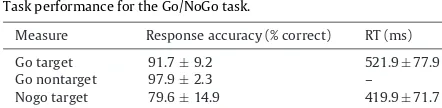
responsetoaGo/NoGotask(seeTable2).IntheGotask,
participantswereinstructedtorespondwitharighthand
thumbpressonlywhentheysawaninfrequenttarget
stim-ulus(i.e.,acartoondrawingofalion)andtoignorethe
frequentnon-targetstimulus(i.e.,acartoondrawingofa
tiger).In theNoGotask, whichwaspresented following
theGotask,instructionsreversedtheresponsemappings
ofthetargetandnon-targetstimuli,suchthatparticipants
wererequired torespondtothefrequentstimulus(i.e.,
a cartoondrawingofa tiger)andinhibitthepre-potent
responsetotheinfrequentstimulus(i.e.,acartoondrawing
ofalion).ThismanipulationallowsfortheelicitationofaP3
inresponsetotheinfrequentstimulusforbothtasks,with
theamplitudeoftheP3beingrelatedtoworking
mem-orydemandsinresponsetotheGotasktargetcondition
(Polich,2007)andinhibitorycontroldemandsinresponse
totheNoGotasknon-targetcondition(Johnstone etal.,
2007;Kamarajanetal.,2005;Smithetal.,2004).Ineach
task,participantscompletedtwoblocksof125trials,with
Table2
TaskperformancefortheGo/NoGotask.
Measure Responseaccuracy(%correct) RT(ms)
Gotarget 91.7±9.2 521.9±77.9
Gonontarget 97.9±2.3 –
Nogotarget 79.6±14.9 419.9±71.7
Nogonontarget 71.2±14.3 –
Note:Mean±SD.
thelionandtigerstimulipresentedwithaprobabilityof .2and.8,respectively.Stimuliappearedfor200msona blackbackground,witha1700msinter-trialinterval.Prior tobeginningeachtask,participantscompletedablockof 40practicetrials.
2.2.3. ERPrecording
Electroencephalographic(EEG) activity wasrecorded from 64 electrode sites (FPz, Fz, FCz, Cz, CPz, Pz, POz, Oz, FP1/2, F7/5/3/1/2/4/6/8, FT7/8, FC3/1/2/4, T7/8, C5/3/1/2/4/6, M1/2, TP7/8, CB1/2, P7/5/3/1/2/4/6/8, PO7/5/3/4/6/8, O1/2) arranged in an extended montage based on the International 10-10 system (Chatrian et
al., 1985) using a Neuroscan Quik-cap (Compumedics,
Inc,Charlotte,NC). Recordingswerereferenced to
aver-agedmastoids(M1,M2),withAFzservingastheground
electrode, and impedance less than 10k. Additional
electrodes were placed above and below the left orbit
andontheoutercanthusofeacheyetomonitor
electro-oculographic (EOG) activity with a bipolar recording.
Continuous data were digitized at a sampling rate of
500Hz,amplified500timeswithaDCto70Hzfilter,anda
60HznotchfilterusingaNeuroscanSynamps2amplifier.
ContinuousdatawerecorrectedofflineforEOGartifacts
usingaspatialfilter(CompumedicsInc.,Neuroscan,2003).
Stimulus-locked epochs were created for correct trials
from −100 to 1000ms around the stimulus, baseline
correctedusingthe−100to0mspre-stimulusperiod,and
filteredusingazerophase shiftlow-passfilterat 30Hz
(24dB/octave).Trialswithartifactexceeding±75Vwere
rejected.TheP3componentwasevaluatedasthelargest
positivegoingpeakwithina350–600mslatencywindow,
respectively.Amplitudewasmeasuredasthedifference
betweenthe pre-stimulusbaseline and maximum peak
amplitude; peak latencywas defined asthe time point
corresponding to the maximum amplitude. Given that
thetopographic maximaoftheP3totheGotasktarget
conditionandtheNoGotasknon-targetconditionvaried
betweenthecentraland parietal regionsacross
partici-pants,P3 amplitude and latency wascalculated within
each participant and task as the mean value across 9
electrode sitesin a centro-parietalhot-spot(C1, Cz,C2,
CP1,CPz,CP2,P1,Pz,P2).Onaverage,31.6±6.8trialswere
includedintheGotaskanalysesand27.9±6.3trialswere
includedintheNoGotaskanalyses.
2.3. Procedure
2.3.1. Day1
Academicachievementassessment. On the firstvisit
to the laboratory, participants completed an informed
assent,EdinburghHandednessInventory(Oldfield,1971),
as well as the Kaufman Brief Intelligence Test (K-BIT;
KaufmanandKaufman,1990).Concurrently,participants’
legalguardianscompletedaninformedconsent,health
his-toryand demographicsquestionnaire, theADHD Rating
ScaleIV(DuPauletal.,1998),andamodifiedTannerStaging
System questionnaire. Participants were then
adminis-tered the Wide Range Achievement Test – 3rd edition
[image:3.561.42.263.73.168.2] [image:3.561.40.261.625.679.2]2.3.2. Day2
Neurocognitiveassessment.Onthesecondvisit(Mdays
fromday1=11.8±8.8),participantswerefittedwitha
64-channelQuik-cap(CompumedicsNeuroscanInc.,ElPaso,
TX)andseatedinasoundattenuatedroomwherethe
neu-roelectrictestingtookplace.Followingtheprovisionoftask
instructions,participantswereaffordedtheopportunityto
askquestionsandfortypracticetrialswereadministered
priortothestartoftesting.Uponcompletionofthelasttask
condition,all electrodeswereremovedand participants
werebriefedonthepurposeoftheexperiment.
3. Results
3.1. Dataanalysis
Bivariate correlation analyses were conducted using
Pearsonproduct-momentcorrelationcoefficientsbetween
the three domains of academic achievement and the
descriptivevariables(e.g.,age,sex,BMI,etc.),the
behav-ioralvariables (i.e., RTand accuracy)and ERPvariables
(i.e.,amplitudeandlatency).Hierarchicallinearregression
analyseswerethenperformedtoexplainvarianceinthe
domainsofacademicachievement.Thiswasundertaken
byregressingdomainsofacademicachievementon
sta-tisticallysignificantdescriptivecorrelates(e.g.,IQ)inStep
1andstatisticallysignificantbehavioralandERPvariables
inStep2.ThesignificanceofthechangeintheR-square
valuebetweenthetwoStepswasusedtojudgethe
inde-pendentcontributionofbehavioralandERPvariablesfor
explainingvarianceinacademicachievementbeyondthat
ofthedescriptivevariables.Thisanalysiswasperformed
separately for each of the three domains of academic
achievement.Aconservativep-valueof.01wasadopted
alongwithaone-tailedtestforjudgingstatistical
signif-icance in allanalyses given the number of tests in the
bivariateandregression analyses.Thedataanalysiswas
performedinPASWStatistics,18.0.
3.2. Bivariatecorrelations
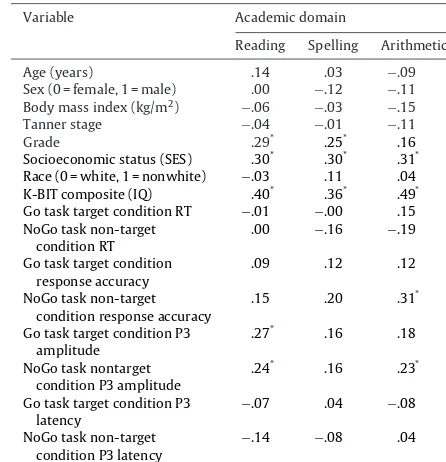
The correlations between descriptive variables and
domainsofacademicachievementareprovidedinTable3.
K-BIT scoresand SESweresignificantly associated with
reading (r=.40 and r=.30, respectively),spelling (r=.36
andr=.30,respectively),andarithmetic(r=.49andr=.31,
respectively)performance. Gradewassignificantly
asso-ciatedwithreading(r=.29)andspelling(r=.25),butnot
arithmetic(r=.16),performance.Theothercorrelationsfor
age,sex,BMI,Tannerstage,andracewerenotstatistically
significant.
ThecorrelationsbetweenbehavioralandERPvariables
and domains of academic achievement are provided in
Table 3. P3 amplitude to the Go task target condition
wassignificantlyassociatedwithreading(r=.27),butnot
arithmetic(r=.18)andspelling(r=.16),achievement.P3
amplitudetotheNoGonon-targettaskwassignificantly
associatedwithreading(r=.24)andarithmetic(r=.23),but
notspelling(r=.16),achievement.Lastly,theaccuracyof
performancefortheNoGotasknontargetconditionwas
significantlyassociated witharithmetic(r=.31),but not
Table3
Bivariate correlationsbetween academicdomains anddemographic, behavioral,andneuroelectricvariables.
Variable Academicdomain
Reading Spelling Arithmetic
Age(years) .14 .03 −.09
Sex(0=female,1=male) .00 −.12 −.11
Bodymassindex(kg/m2)
−.06 −.03 −.15
Tannerstage −.04 −.01 −.11
Grade .29* .25* .16
Socioeconomicstatus(SES) .30* .30* .31* Race(0=white,1=nonwhite) −.03 .11 .04 K-BITcomposite(IQ) .40* .36* .49* GotasktargetconditionRT −.01 −.00 .15 NoGotasknon-target
conditionRT
.00 −.16 −.19
Gotasktargetcondition responseaccuracy
.09 .12 .12
NoGotasknon-target conditionresponseaccuracy
.15 .20 .31*
GotasktargetconditionP3 amplitude
.27* .16 .18
NoGotasknontarget conditionP3amplitude
.24* .16 .23*
GotasktargetconditionP3 latency
−.07 .04 −.08
NoGotasknon-target conditionP3latency
−.14 −.08 .04
*p<.01withone-tailedtest.
reading(r=.15)andspelling(r=.20),achievement.There
werenosignificantcorrelationsbetweeneitherreaction
timeorP3latencywithacademicachievement.
Finally,Pearsonproduct-momentcorrelationanalyses
wereconductedonP3amplitudeandlatencywithtask
per-formancemeasuresofRTandresponseaccuracybecauseof
theimportanceofthisrelationshipforstimulusevaluation
andinhibitorycontrol.Responseaccuracywasassociated
withP3amplitude(r=.20)andP3latency(r=−.22)during
infrequenttrialsintheNoGotask.GotargetRTwas
nega-tivelycorrelatedwithGoP3amplitude(r=−.20).Noother
significantcorrelationswereobserved.
3.3. Regressionanalysis
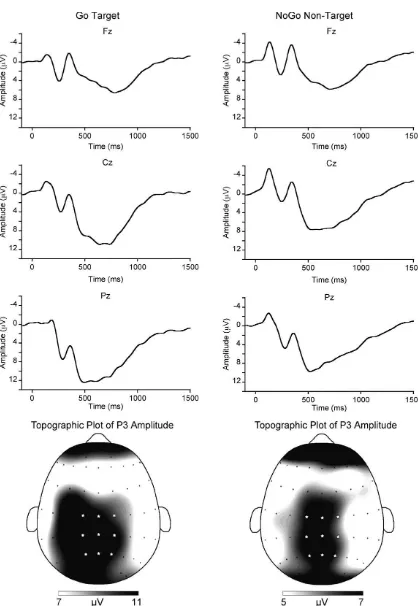
Fig.1illustratesgrand averagewaveformsand
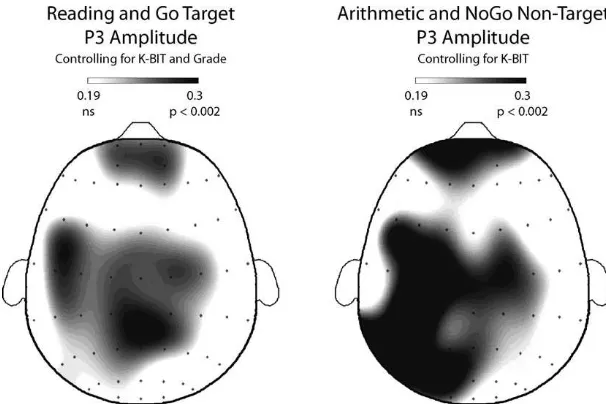
topo-graphicplotsfortheGoandNoGotasks.Fig.2illustratesthe
topographic distributionof partialcorrelations between
P3 amplitudeandacademicachievementcontrollingfor
relateddescriptivevariables.
3.3.1. Readingachievement
The results for the first regression analysis are in
Table4.Thehierarchicalregressionanalysisindicatedthat
Grade (B=4.67, SE B=1.85, ˇ=.23) and K-BIT (B=0.36,
SE B=0.12, ˇ=.31) explained a statistically significant
(F=9.56,p=.001)amountofvarianceinreading
achieve-ment (R2=.22) in Step 1. Only P3 amplitudeto theGo
tasktargetconditionexplained a statisticallysignificant
(F=5.52, p=.005) and incremental amount of variance
in reading achievementbeyond thevariables in Step 1
(R2=.08)inStep2.Thescatterplotforthebivariate
corre-lationbetweenP3amplitudetotheGotasktargetcondition
[image:4.561.281.504.81.312.2]Fig.2. TopographicplotsillustratingthepartialcorrelationsbetweenP3amplitudeinresponsetotheGotasktargetconditionandReadingachievement controllingforK-BITandGrade(left)andP3amplitudeinresponsetotheNoGotasknon-targetconditionandArithmeticachievementcontrollingfor K-BIT(right)asafunctionofscalptopography.
Table4
Summaryofhierarchicalregressionanalysisforreadingachievement.
Variable B SEB ˇ
Step1
Grade 4.67 1.85 .23*
Socioeconomicstatus(SES) 1.49 1.45 .11 K-BITcomposite(IQ) 0.36 0.12 .31* Step2
Grade 4.63 1.78 .23*
Socioeconomicstatus(SES) 1.59 1.42 .11 K-BITcomposite(IQ) 0.35 0.12 .30* GotasktargetconditionP3amplitude 0.31 0.15 .21* NoGotasknontargetconditionP3amplitude 0.18 0.18 .10
Note:R2=.22forStep1;R2=.08forStep2(p<.05). * p<.05withtwo-tailedtest.
40 30 20 10 0 -10
Go Target P3 Amplitude
(μV) 80
100 120 140 160
Reading Achievement
(standard score)
Fig.3.Scatterplotwithlineofbestfitand95%confidenceintervalsfor thebivariateassociationsbetweenP3amplitudefortheGotasktarget conditionwithReadingachievement.
3.3.2. Spellingachievement
Wedidnotundertakeregressionanalysisforspelling
achievementastherewerenobehavioralorERPvariables
thatcorrelatedwiththisdomainofacademicachievement
inthebivariateanalysis.
3.3.3. Arithmeticachievement
The resultsfor thesecond regression analysisare in
Table5.Thehierarchicalregressionanalysisindicatedthat
K-BIT (B=0.62, SE B=0.14, ˇ=.44) explained a
statisti-callysignificant(F=16.58,p=.001)amountofvariancein
arithmeticachievement(R2=.25)inStep1.Bothresponse
accuracy (B=0.29, SE B=0.09, ˇ=.27) and P3
ampli-tude to the NoGo task non-target condition (B=0.52,
SE B=0.16, ˇ=.26) explained a statistically significant
(F=10.36,p=.001)and incremental amount of variance
inarithmeticachievementbeyondthevariablesinStep1
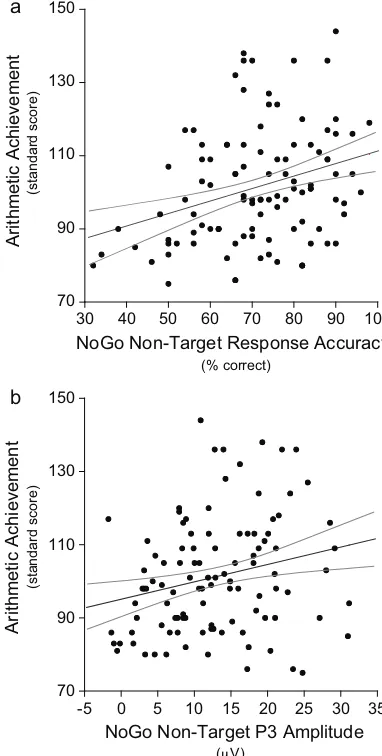
(R2=.13)inStep2.Thescatterplotsforthebivariate
cor-relationsbetweenaccuracyandP3amplitudetotheNoGo
tasknon-targetconditionwitharithmeticachievementare
inFig.4.
Table5
Summaryofhierarchicalregressionanalysisforarithmeticachievement.
Variable B SEB ˇ
Step1
Socioeconomicstatus(SES) 1.68 1.70 .10
K-BITcomposite(IQ) 0.62 0.14 .44*
Step2
Socioeconomicstatus(SES) 0.70 1.58 .04 K-BITcomposite(IQ) 0.63 0.13 .45* NoGotasknon-targetcondition
responseaccuracy
0.29 0.09 .27*
NoGotasknon-targetcondition P3amplitude
0.52 0.16 .26*
[image:6.561.121.424.52.254.2] [image:6.561.39.258.327.431.2] [image:6.561.50.245.471.656.2]100 90 80 70 60 50 40 30 70 90 110 130 150
a
b
A
rit
hm
et
ic A
c
hie
v
eme
nt
(s ta ndar d scor e )NoGo No
n-Tar
get
Response
Accuracy
(% correct) 35 30 25 20 15 10 5 0 -5 70 90 110 130 150A
rit
hm
et
ic A
c
hie
v
em
ent
(s tand ar d scor e )NoGo No
n-Tar
get
P3 Ampl
itud
e
(μV)Fig.4. Scatterplotwithlineofbestfitand95%confidenceintervalsfor thebivariateassociationsbetweenaccuracy(a)andP3amplitude(b)for theNoGotasknon-targetconditionwithArithmeticachievement.
4. Discussion
Thepurposeofthepresentstudywastoprovideearly
evidence tosuggest that neuroelectric indices of
atten-tionandinhibitionmayserveasabiomarkerofacademic
achievementinpreadolescentchildren.Indeed,theresults
indicated that P3 amplitude accountedfor unique
vari-anceinreadingandarithmeticperformanceontheWRAT3,
beyond the variance explained by IQ and task
perfor-mance.Interestingly,theP3componentcollectedduring
twocognitivetasks(i.e.,Go/NoGo),eachtappingdifferent
aspectsofcognition,displayedadifferentialrelationship
withreadingandmathematicsachievement,indicatingthe
uniquenessof thispotentialinreflecting theunderlying
executivecontrolrequirementsofeachacademicsubject.
Specifically,P3amplitudeduringtheGotarget
condi-tionexhibitedasignificantrelationshiponlywithreading
achievement.TheoriessurroundingP3toa Gotask(i.e.,
also knownas theoddballtask) suggest that it reflects
neuronal activityassociated withrevisionof themental
representationofthepreviouseventwithinthestimulus
environment(Donchin,1981).P3amplitudeisdetermined
by the allocation of attentional resources when
work-ingmemoryisupdated(DonchinandColes,1988),such
thatP3issensitivetotheamountofattentionalresources
allocatedtoastimulus,withlargeramplitudereflecting
greater amounts of attention (Polich, 1987; Polich and
Heine,1996).Accordingly,thedatareportedhereinsuggest
thattheP3representsaneuroelectricindexofattention
allocationintheserviceofupdatingduringreading
com-prehension,withlargeramplitude(i.e.,greaterallocationof
attentionalresources)reflectingbetterupdatingcapability,
whichin turnmightrelatetosuperiorreading
achieve-ment.
Relative to arithmetic achievement, a relationship
wasobservedforinhibition,withincreasedachievement
related to better performance on the NoGo non-target
condition.BeyondtherelationshipwithNoGo task
per-formance, NoGo-P3 amplitude exhibited a significant
relationshipwitharithmeticachievement.Empirical
evi-denceforNoGo-P3indexingthecontrolofinhibitionexists
(Kamarajan et al., 2005), providing support for a
neu-roelectric markerreflecting theinhibitory requirements
underlyingsuperiormathematicsachievement.This
asser-tion is consonant with other research suggesting that
neural inhibition underlies the P3, with its amplitude
reflectingthesuppressionofextraneousneuronalactivity
(Polich,2007).Assuch,thecurrentfindingssuggestthat
neuroelectric measures of inhibitory control contribute
to the variance explained in mathematics achievement
beyondthatoftaskperformanceindicesofinhibition.
Todate,onlyoneotherreporthasdescribeda
relation-shipbetweenacademicachievementand aspectsof the
neuroelectricsystem.HirshandInzlicht(2009)observed
individual differences in error-related negativity (ERN)
componentamplitudetoaStroopcolor-namingtaskand
scholasticperformance of college-agestudents, as
mea-suredviagradepointaverage. Theyreportedthatlarger
ERNamplitudefollowingerrorswasrelatedtobetter
aca-demicperformance,andsuggestedthatgreateramplitude
ofthiscomponentreflectedanincreasedabilitytomonitor
performanceandactivateexecutivecontrolmechanisms
insupportofscholasticperformance(HirshandInzlicht,
2009).
Althoughtherewereaninsufficientnumberoferrors
ofcommission toreliablyassess theERNcomponentin
responsetothetasksusedwithinthecurrent
investiga-tion, the present findings further extend the literature
demonstrating unique relationships between working
memory and inhibitory aspects of executive control
withreadingandmathematicsachievement.Specifically,
the current findings are consonant with those of St.
Clair-Thompson and Gathercole (2006), who identified
relationships between working memory and inhibition
withacademicachievement.Suchapatternofresultswas
replicatedhereinwithtaskperformancemeasuresof
exec-utivecontrol,andextendedtoincludeneuroelectricindices
supportingtheseaspectsofcognition.Thesedataalso
sup-porttherelationshipbetweenintelligenceandacademic
achievement(Jensen,1998),butindicatethatintelligence
[image:7.561.54.245.57.435.2]performance and neuroelectric variables continued to
increasetheamountofvarianceaccountingforacademic
achievement.
Incontrast,taskperformancemeasuresoftheGo/NoGo
tasklargelydidnotrelatetoacademicachievement.That
is,onlyNoGonontargetaccuracywasrelatedtoarithmetic
achievement,whileRTacrossbothconditionswas
unre-latedtoacademicachievement.Thus,althoughresponse
accuracyduringtaskconditionsrequiringinhibitionmay
indexachievementinmathematics,suchafindingmight
alsosuggestthat theP3component is amore sensitive
marker of the various aspects of cognition underlying
academicachievement.Alternatively,thedemandsofthe
Go/NoGo task are such that behavioral measures
sim-plymay not reflect therelationship betweeninhibition
andworkingmemorywithacademicachievement.That
is, due to the relative ease of this task, little variance
existed in Go task performance. However, task
perfor-mancewasrelativelylowintheNoGotask,withnon-target
response accuracy being the only measures associated
witharithmeticachievement.Thus, it is possiblethat a
lackofvarianceincertaintaskconditionsmayhave
pro-hibitedsucharelationshipfrombeingobserved.Clearly,
furtherresearchisnecessarytodeterminetherelationship
betweenbehavioral measuresofinhibitionand working
memorywithacademicachievement.
Itisimportanttonotethatthesefindingsmaynot
sim-plyreflectamodelinwhichworkingmemorysolelyrelates
toreading achievementand inhibition solely relates to
mathematicsachievement.Infact,thereisawealthof
lit-eraturedemonstrating thatinhibition relatestoreading
and workingmemory relatesto mathematics(Bull and
Scerif,2001;Gernsbacher,1993;St.Clair-Thompsonand Gathercole,2006).Forinstance,inhibitionisnecessaryto
suppresstheautomaticactivationofinappropriateor
irrel-evant information for successful comprehension during
reading (Gernsbacher, 1993) and problem solving
dur-ingmathematics(PassolunghiandSiegel,2001).Further,
relevantinformationmustbeheldinthecontentsof
work-ingmemoryforefficientandeffectivecomprehensionand
problemsolvingduringtheseaspectsofachievement(Bull
andScerif,2001;St.Clair-ThompsonandGathercole,2006).
Assuch, itis highlyprobablythatthefindings reported
herein do not reflect a selective relationship between
specificcognitiveprocesses andspecificacademicskills.
Rather,thedatalikelyindicatethattheP3derived from
specific cognitive tasks reflect components of
achieve-mentthataredifferentiallyreflectedintheserelationships.
Someevidence exists todemonstrate that visuo-spatial
working memory, relative to inhibition, accounts for a
largerportionofthevariancewhenexplainingthe
relation-shipbetweencognitivecontrolandEnglishachievement
(St.Clair-ThompsonandGathercole,2006).Insupportof
this relationship,thecurrent data observedthat theP3
derivedfromataskrequiringvisuo-spatialattentionand
workingmemorywasrelatedtoreadingachievement.As
such,futureeffortsshouldbedirectedtowarddetermining
whethertheP3derivedduringothercognitivetasksmay
reflectthesesameareasofachievement(i.e.,aglobal
rela-tionship)andthusmayalsoserveasageneralbiomarkerfor
scholasticsuccess,orwhethertherelationshipsobserved
hereinareselectivetothecognitiveandacademic
achieve-ment tests.Through suchresearch,wemaynotonlybe
abletounpackaspectsofscholasticachievementbutwe
mayalsobeabletodeterminewhichunderlyingprocesses
accountfortheobservedvarianceinscholasticsuccess(i.e.,
workingmemory,inhibition,attention,longtermmemory,
relationalmemory,etc.).
Finally,itisinterestingtonotethatnorelationshipwas
observedfortheP3componentandspellingachievement.
Such a pattern of resultsindicates that theP3 maybe
an indicatorof performance forselect academicsubject
matter,ratherthanageneralindexofoverallscholastic
per-formance.However,thefactthattheP3fromtwodifferent
tasks(i.e.,GoandNoGo)reflecting differentialcognitive
functions wasobserved suggeststhat this neuroelectric
component might provide a novel approach to
assess-ingspecificaspectsofacademicachievementinchildren.
Overall,thefindingssupporttherelationshipofworking
memoryandinhibitoryaspectsofexecutivecontrolwith
academicperformance,andsuggestthatP3might
repre-senta uniquebiomarkerofachievement.Giventhatthe
child participantsinthis studywerecognitivelyhealthy
and withoutindividualeducationplans,suchameasure
mayhaveimportantimplicationsforeducationalpractice,
asitmayassistintheidentificationofsubclinical
cogni-tivedeficits,andalloweducatorstotailortheirindividual
lessonplanstoenhancelearning.
Authordisclosurestatement
Theauthorsdeclarenocompetingorconflicting
inter-ests.
Acknowledgements
Supportfor ourresearchand thepreparation of this
manuscript was provided by a grant from theNational
InstituteofChildHealthandHumanDevelopment(NICHD)
to Charles Hillman (RO1 HD055352) and a fellowship
awardedtoMatthewPontifexthroughtheNICHD
Devel-opmentalPsychobiologyandNeurobiologyTrainingGrant
attheUniversityofIllinois(2T32HD007333).
References
Birnbaum,A.S.,Lytle,L.A.,Murray,D.M.,Story,M.,Perry,C.L.,Boutelle,K.N., 2002.Surveydevelopmentforassessingcorrelatesofyoung adoles-cents’eating.Am.J.HealthBehav.26,284–295.
Bull, R., Espy,K.A., Wiebe,S.A.,2008. Short-term memory, working memory, andexecutivefunctioning inpreschoolers:longitudinal predictorsofmathematicalachievementatage7years.Dev. Neu-ropsychol.33,205–228.
Bull,R.,Scerif,G.,2001.Executivefunctioningasapredictorofchildren’s mathematicsability:inhibition,switching,andworkingmemory.Dev. Neuropsychol.19,273–293.
Chatrian,G.E.,Lettich,E.,Nelson,P.L.,1985.Tenpercentelectrodesystem fortopographicstudiesofspontaneousandevokedEEGactivity.Am. J.EEGTechnol.25,83–92.
CompumedicsNeuroscan,2003.Offlineanalysisofacquireddata(SCAN 4.3–Vol.II,EDIT4.3).[SoftwareManual].ElPaso,TX.
deJong,P.F.,1998.Workingmemorydeficitsofreadingdisabledchildren. J.Exp.ChildPsychol.70,75–96.
DeStefano,D.,LeFevre,J.-A.,2004.Theroleofworkingmemoryinmental arithmetic.Eur.J.Cogn.Psychol.16,353–386.
Donchin,E.,1981.Surprise!...Surprise?Psychophysiology18,493–513. Donchin,E.,Coles,M.G.H.,1988.IstheP300componentamanifestation
ofcontextupdating?Behav.BrainSci.11,355–372.
Donchin,E.,Karis,D.,Bashore,T.R.,Coles,M.G.H.,Gratton,G.,1986. Cogni-tivepsychophysiology:systems,processesandapplications.In:Coles, M.G.H.,Donchin,E.,Porges,S.(Eds.),Psychophysiology:Systems, Pro-cesses,andApplications.TheGuilfordPress,NewYork,pp.309–330. DuPaul,G.J.,Power,T.J.,Anastopoulos,A.D.,Reid,R.,1998.ADHDRating Scale– IV:Checklists,norms,andclinicalinterpretation.TheGuilford Press,NewYork.
Gernsbacher,M.A.,1993.Lessskilledreadershavelessefficient suppres-sionmechanisms.Psychol.Sci.4,294–297.
Grieco,L.A.,Jowers,E.M.,Bartholomew,J.B.,2009.Physicallyactive aca-demiclessonsandtimeontask:themoderatingeffectofbodymass index.Med.Sci.SportsExerc.41,1921–1926.
Hirsh,J.B.,Inzlicht,M.,2009.Error-relatednegativitypredictsacademic performance.Psychophysiology46,1–5.
Ilan,A.B.,Polich,J.,1999.P300andresponsetimefromamanualStroop task.Clin.Neurophys.110,367–373.
Jensen,A.R.,1992.Theimportanceofintraindividualvariationinreaction time.Pers.Individ.Differ.13,869–881.
Jensen,A.R.,1998.Thegfactor:thescienceofmentalability.Praeger, Westport,CT.
Johnstone,S.J.,Dimoska,A.,Smith,J.L.,Barry,R.J.,Pleffer,C.B.,Chiswick, D.,etal.,2007.Thedevelopmentofstop-signalandGo/Nogoresponse inhibition inchildren aged7–12years: performanceand event-relatedpotentialindices.Int.J.Psychophysiol.63,25–38.
Kamarajan,C.,Porjesz,B.,Jones,K.A.,Chorlian,D.B.,Padmanabhapillai,A., Rangaswamy,M.,etal.,2005.Spatial-anatomicalmappingofNoGo-P3 intheoffspringofalcoholics:evidenceofcognitiveandneural disin-hibitionasariskofalcoholism.Clin.Neurophysiol.116,1049–1061. Kaufman,A.S.,Kaufman,N.L.,1990.KaufmanBriefIntelligenceTest.
Amer-icanGuidanceService,CirclePines,MN.
Kuncel,N.R.,Hezlett,S.A.,2007.Standardizedtestspredictgraduate stu-dents’success.Science315,1080–1081.
Kuncel,N.R.,Hezlett,S.A.,Ones,D.S.,2004.Academicperformance,career potential,creativity,andjobperformance:canoneconstructpredict themall?J.Pers.Soc.Psychol.86,148–161.
Magliero,A., Bashore, T.R.,Coles,M.G.H., Donchin,E., 1984. On the dependenceofP300latencyonstimulusevaluationprocesses. Psy-chophysiology21,171–186.
Mahar,M.T.,Murphy,S.K.,Rowe,D.A.,Golden,J.,Shields,A.T.,Raedeke, T.D., 2006. Effects of a classroom-based program on physical activity and on-task behavior. Med. Sci. Sports Exerc. 38 (12), 2086–2094.
Oldfield,R.C.,1971.Theassessmentandanalysisofhandedness:The Edin-burghinventory.Neuropsychologia9,97–113.
Passolunghi,M.C.,Siegel,L.S.,2001.Short-termmemory,working mem-ory,andinhibitorycontrolinchildrenwithdifficultiesinarithmetic problemsolving.J.Exp.ChildPsychol.80,44–57.
Polich,J.,1987.Taskdifficulty,probabilityandinter-stimulusintervalas determinantsofP300fromauditorystimuli.Electroencephalogr.Clin. Neurophysiol.63,251–259.
Polich,J.,2007.UpdatingP300:anintegrativetheoryofP3aandP3b.Clin. Neurophysiol.118,2128–2148.
Polich,J.,Heine,M.R.D.,1996.P3topographyandmodalityeffectsfroma single-stimulusparadigm.Psychophysiology33,747–752. Polich,J.,Kok,A.,1995.CognitiveandbiologicaldeterminantsofP300:an
integrativereview.Biol.Psychol.41,103–146.
Rohde,T.E.,Thompson,L.A.,2007.Predictingacademicachievementwith cognitiveability.Intelligence35,83–92.
Smith, J.L., Johnstone, S.J., Barry, R.J., 2004. Inhibitory processing during the Go/NoGo task: an ERP analysis of children with attention-deficit/hyperactivity disorder. Clin. Neurophysiol. 115, 1320–1331.
St.Clair-Thompson,Gathercole,H.L.S.E.,2006.Executivefunctionsand achievementsinschool:shifting,updating,inhibition,andworking memory.Q.J.Exp.Physiol.59,745–759.
Tanner,J.M.,1962.Growthatadolescence:Withageneralconsiderationof theeffectsofhereditaryandenvironmentalfactorsupongrowthand maturationfrombirthtomaturity.BlackwellScientificPublications, Oxford.
Verleger,R.,1997.OntheutilityofP3latencyasanindexofmental chronometry.Psychophysiology34,131–156.
Wilkinson,G.S.,1993.WideRangeAchievementTest3Administration manual.JastakAssociates,Wilmington,DE.