APATITE GROWTH OPTIMATION ON CHICKEN
MUCOUSE BY FOURIER TRANSFORM INFRARED (FTIR)
CHARACTERIZATION
ADIPURWA MUSLICH
DEPARTMENT OF PHYSICS
FACULTY OF MATHEMATICS AND NATURAL SCIENCES
BOGOR AGRICULTURAL UNIVERSITY
Transform Infrared (FTIR) Characterization. Supervised by AKHIRUDDIN MADDU and YESSIE WIDYA SARI.
Some experiment had been conducted to grow apatite from supersaturated solution of calcium phosphate ions on chicken mucouse. The calcium and phosphate ions were originated from Ca(NO3)2 and (NH4)2HPO4. Carbonate ions from (NH4)2CO3 was also used as starting
solution. Experiment was carried out within about 5 hours at temperature 370 C and pH 7. Value of Ca+ : PO4
was 1.67, while molar ratio of CO3
: PO4
was 0.5 : 1. Molarity of molar ratio CO32- : PO43- variated approximately 0.15 : 0.30, 0.51 : 1.02, and 0.90 : 1.80. Mass of mucouse
powder was constant 0.75 gram. The analysis result of Fourier Transform Infrared (FTIR) showed that the precipitation was apatite carbonate type A and B. In these experiment it was found out that the mucouse reduce the crystallinity of apatite precipitant, and the growth of apatite crystal was optimum at solution with molar ratio CO3
: PO4
3
APATITE GROWTH OPTIMATION ON CHICKEN
MUCOUSE BY FOURIER TRANSFORM INFRARED (FTIR)
CHARACTERIZATION
Paper
As one of the rule to obtain the Science Bachelor Degree
Faculty of Mathematics and Natural Sciences
Bogor Agricultural University
ADIPURWA MUSLICH
G74103021
DEPARTMENT OF PHYSICS
FACULTY OF MATHEMATICS AND NATURAL SCIENCES
BOGOR AGRICULTURAL UNIVERSITY
Title
: Apatite Growth Optimation on Chicken Mucouse by Fourier
Transform Infrared (FTIR) Characterization
Name
: Adipurwa Muslich
NRP
:
G74103021
Accepted by :
1
stSupervisor
2
ndSupervisor
Dr. Akhiruddin Maddu
Yessie Widya Sari, M.Si
NIP. 132 206 239
Approved by :
Dean of Faculty of Mathematics and Natural Sciences
Bogor Agricultural University
Prof. Dr. Ir. Yonny Koesmaryono, MS
NIP. 131 473 999
5
PREFACE
Alhamdulillah, the author thanked God to have finished this paper. This paper, “Apatite Growth Optimation on Chicken Mucouse by Fourier Transform Infrared (FTIR) Characterization” is the requirements for finishing the scholarship at Department of Physics, Bogor Agricultural University.
This paper is also expected to give more information, especially in hydroxyapatite synthesis for substitute bone. As we know that bone is the most implanted tissues after blood. And the major solid components of human bone are collagen and apatite minerals, like hydroxyapatite. So, furthermore this paper expected to give contribution in medical implantation. However, physical analysis is needed in many science area to analyze the properties of materials, including in medical. This paper has many flaws. The author hopes much suggestion from all contributors to make this paper better and useful for everyone.
The author is thankful to :
1. Almighty Allah SWT, the ruler of heaven and earth,
2. Supervisors, bapak Dr. Akhiruddin Maddu for all suggestion and advices, and ibu Yessie Widya Sari, M. Si for spirits, guidance, and counseling, also for all things that make me more positive,
3. Examiners, bapak Dr. Kiagus Dahlan and Ibu Siti Nikmatin, M. Si , for suggestion and criticism,
4. Research grant of A2 programme, 5. Dr. Greta Zahar for the mucouse,
6. Parents, who are my motivation, my backbone. My sisters (Dwita and Astri) and brother (Rayi),
7. The girl who always stand up for me. Many thanks for everything, tik. Success for us, 8. My partners, Irma and Uliz. It will be so hard without you, girls,
9. Bara Gank (Opik, Awit, Koes, Malie, Subhi, Yulia). Guys, thanks for the happiness, cheerful, care, spirit, and sport! Friendship never end, it is priceless!
10.Seven Soul (Dnot, Marwkun, Syeikh, Priyo, Az, Jallun, Alwi, Uncle Ruud). It’s pleasure to be here with you all. Wisma Ananda (Tya, Asih, Lira) and nenden, thanks so much. Physicscholic 40, Harist, Icha, Gita. Thanks for support! Iez, Rika, Melly, thanks, labbers! Hudar, Dikun, Mada, Ziah, Ita, Ratna,
11.Lecturer and laborant at department of physics, physics 39, 41, 42 12.FOKKUS 36, 37, 38, 39, 40, 41, 42, 43,
13.Ruri, Ade, Akfen, Rio and all. Friends forever!
14.And for all who still stand behind me. Thank you very much.
April 2007
CURICULUM VITAE
The writer was born at Subang 23 February 1986 as first child from the couple Mochamad Muslich and Tity Mulyati.
The writer was educated at Kindergarten Handayani Indra Bhakti, Bandung at 1990-1991, Elementary School of Palmerah 17, West Jakarta at 1991-1997, Junior High School 75 of West Jakarta 1997-2000, Senior High School 1, Subang at 2000-2003.
7
CONTENTS
Page
TABLE LIST ... vii
FIGURE LIST ... vii
APPENDIX LIST ... vii
INTRODUCTION ... 1
Background ... 1
Problem ... 1
Aim of Research ... 1
Time and Place of Research ... 1
THEORY ... 1
Formation of Hydroxyapatite Crystal from Solution ... 1
Matrix ... 3
Calcium phosphate compound identification with Infrared Spectroscopy ... 3
MATERIAL AND METHOD ... 4
Equipment and materials ... 4
Method ... 4
Sample preparation ... 4
Precipitation ... 4
Characterization ... 5
RESULTS AND ANALYSIS ... 5
Formation of apatite mucouse composite ... 5
Analysis apatite mucouse composite use FTIR ... 5
CONCLUSION AND SUGGESTION ... 7
Conclusion ... 7
Suggestion ... 7
REFERENCES ... 7
TABLE LIST
Page 1. Contents of water, inorganic materials, and organic materials
in bone and tooth (in wt%) ... 2
2. Mass precipitate in sample with and without mucouse by variation of CO32-: PO43- molar ratio ... 6
3. Phosphate and carbonate absorption band ... 10
FIGURE LIST
Page 1. Hydroxyapatite structure ... 2
2. Change in Ca/P ratio to pH value of reaction solution ... 2
3. Research flowchart ... 5
4. FTIR spectra of sample 1a, 1b, 2a, 2b, 3a, and 3b ... 9
5. FTIR spectra of mucouse ... 10
APPENDIX LIST
Page 1. Experiment set-up ... 11
2. FTIR spectrometer ... 12
3. FTIR spectra sample 0.15 M : 0.30 M without mucouse ... 13
4. FTIR spectra sample 0.15 M : 0.30 M with mucouse ... 14
5. FTIR spectra sample 0.51 M : 1.02 M without mucouse ... 15
6. FTIR spectra sample 0.51 M : 1.02 M with mucouse ... 16
7. FTIR spectra sample 0.90 M: 1.80 M without mucouse ... 17
INTRODUCTION
Background
Bone is a passive motion tool that has a lot of usages, one of those is to prop the body. The bone is unique among the tissues of the body, in the level of its resistance to compressive forces. This resistance results from its composition. Collagen and other organic molecules give bone strength, while hydroxyapatite is responsible for the resistance to compression1.
Bone is classified as hard tissues which can experience regenerative growth2. In medical field, bone reconstruction has done to repair the bone fracture or defect. There are techniques deals with bone reconstruction such as allograft (bone reconstruction using bone from other person), and xenograft (bone reconstruction using animal bone). That techniques have weakness, in comparison, disturbed by immunological response. In addition, the cost of bone allograft, which require careful handling, are expectional high1.
Autograft (bone reconstruction using health bone from that person) is the most satisfy bone reconstruction because the implant bone contains important cells which are needed. Moreover the disadvantages of autograft were prolongation of operation time, increased loss of blood, the risk of infection, nerve and vascular injury, thrombosis, fracture risk, additional scar, postoperative pain and cost of additional operation1. Synthetic biomaterials are expected can overcome those problems. Synthetic biomaterials is an inert substance which used to implantation in biological system, to replace hard tissues disfunction2. A biomaterial is defined as any systemically, pharmachologically inert substance or combination of substance utilized for implantation within or incorporation with a living system to supplement or replace functions of living tissues or organ1. Synthetic biomaterials must be biocompatible, no corrosion, has long time stability, and strength. The term “biocompatible” suggest that the material described displays good or harmonious behavior in contact with tissue and body fluids. Now, synthetic biomaterials has developed from metal, polymer, ceramics, and other materials.
Calcium phosphate compound in stable crystal phase Ca10(PO4)6(OH)2 or
hydroxyapatite has correlated with hard tissue. Poorly crystalline Hydroxyapatite (HAp) is the major mineral component of bone and
other physiologically calcified tissues. This hydroxyapatite (HAp) is responsible for the load resistance. Synthetic HAp is developed to result biomaterial which has good behavior and biocompatible with hard tissue3.
Problems
Calcium phosphate compound is needed to make synthetic biomaterial that used to replace the disfunction bone. To make it grows in human body, it must contain amorphous phase which is regenerative bone phase. The growth is persisted just only in matrix.
In this research, calcium phosphate compound was made by synthetic method from some chemical compound which contain calcium phosphate then it is decanted in chicken mucouse. So apatite crystal was formed at the surface of mucouse. This mucouse was used as matrix of apatite growth. The calcium phosphate compound was identified by using Fourier Transform Infrared Spectroscopy (FTIR).
Aim of research
1. Resulting apatite mucouse as filler materials which can handle limitation problem of bone implantation. 2. Giving information about material’s
characteristic. So, it can be more biocompatible than allograft or xenograft biomaterial.
Time and place of research
This research hold in 2 different laboratories. The preparation and precipitation hold in Biophysics Laboratory, Physics Department of IPB, Darmaga. Characterization by using FTIR hold in Biofarmaca Study Center IPB. This research started from March 2006 until January 2007.
THEORY
Formation of Hydroxyapatite Crystal from Solution
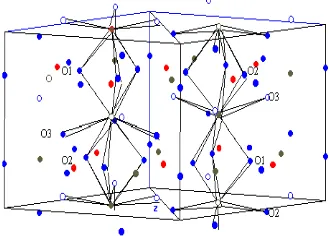
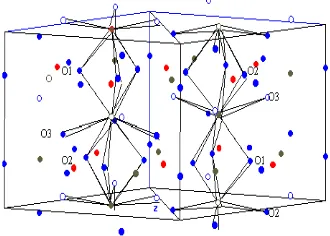
most stable calcium phosphate phase at a normal temperature and pH between 4 and 124.Hydroxyapatite crystal unit has hexagonal structure with lattice parameter a = b = 9.432 Å and c = 6.881Å (Figure 1).
Apatite is a general term crystalline mineral. There are many apatite compound, including flouroapatite, chloroapatite, carbonate apatite, and hydroxyapatite. Biological apatite is found in human or animal teeth and bones. Mineral is the main inorganic compound in calcified hard tissues (e.g. bone and teeth). Physically, interaction between mineral and organic compound yield mechanical properties. Organic give tensile strength, while mineral is responsible for the resistance to compression. Interfacial bonding between the mineral and organic constituents is based, in part, on electrostatic interaction between negatively charged organic domain and the positively charged mineral surface1. Generally, there are three essential methods for preparing hydroxyapatite crystal, including the process from solid reaction to solid crystal, from solution to solid crystal, and from vapor to solid crystal. Wet method (using solution reaction) is useful for preparing very small crystal of hydroxyapatite6.
Synthesis of hydroxyapatite is affected by calcium and phosphate concentration in solution. Solution with Ca2+ and PO4
3-concentration less than 2mM is called as low supersaturation condition, and solution with Ca2+ and PO4
concentration more than 10 mM is called as high supersaturation condition.
Figure 1 Hydroxyapatite structure5.
Table 1 Contents of water, inorganic materials, and organic materials in bone and tooth (in wt%)5.
Bone Tooth
Dentine Enamel
Inorganic 60 70 96
Organic 30 17 2
Water 10 13 2
Hydroxyapatite crystals form directly without presence of metastable calcium phosphate phase in low supersaturation solution. Precipitation of calcium phosphate in high supersaturation condition results a metastable phase between amorphous and crystalline calcium phosphate3. The presence of carbonate ions in conversion amorphous phase become crystal apatite phase will influence the form of hydroxyapatite crystal. This carbonate ions will cause demorfology and reduce the size of crystal, also non stoichiometry7.
In hydroxyapatite structure, carbonate can substitute OH- ion, and form type A carbonate apatite, and if substitute PO43- ion will form
type B carbonate apatite. Generally, precipitation at low temperature will form carbonate apatite type B, while apatite from dry reaction at high temperature will produce carbonate apatite type A. Apatite precipitation from calcium and phosphate saturation solution can produce hydroxyapatite crystal8. Hydroxyapatite crystal in calcium phosphate compound is affected by pH solution. Value of Ca/P in hydroxyapatite is change gradually with pH increase.
Figure 2 Change in Ca/P ratio to pH value of reaction solution1.
3 5 7 9 11
11
Getting value as Ca/P 1.67, pH solution must be controlled between 7 – 8, near 7.4. Carbonate can be an inhibitor grow of apatite crystal, especially in low pH. Apatite grow is also affected by Mg2+ and F2+ ions. Increase of Mg2+ ion will tends to increase amorphous phase and reduce the size of apatite crystal, while F2+ ion make apatite crystal stronger.
Matrix
Matrix is an anionic macromolecule that is important in calcification process and hydroxyapatite crystal fixation on collagen fiber. Without matrix, bone mineralization will not occur8. This matrix is used as a medium to grow crystal hydroxyapatite.
Matrix consists of collagen, and collagen is polymer which formed in nature during the growth circle of all organisms. Hence is also referred as biological polymer or biopolymer. Collagen is a family of structurally related proteins, which occur in all animals and are most abundant protein in vertebrates. They are extra cellular proteins that are results great tensile strength. Collagen provide the insoluble scaffold for the provision of shape. Collagens occur as a supramolecular assemblies, with the attachment of macromolecules, lycoproteins hydrated polymers, inorganic ions and cells9. Collagen has the general amino acid, and this amino acid is consist of amino (NH) and carboxyl (COO) bench.
Collagen, as a natural polymer, is increasingly being used as a device material in tissue engineering and repair. It has an excellent biocompatible properties. So it can be used as bone, cartilage, and blood vessel walls. Collagen is easily degraded and resorbed by the body and allows good attachment to cells. However, its mechanical properties are relatively low in comparison to bone. Both collagen and hydroxyapatite devices significantly inhibited the growth of bacterial pathogens, the most frequent cause of prosthesis-related infection11. The stability
of collagen is affected by dehydration, contacts with agents which reduce hydrophobic interaction (e.g, urea) or simply by application of heat1. Collagen as natural polymer that represents the matrix material of bone, teeth, and connective tissue can be extracted from animal or human sources.
Chicken mucouse was selected as matrix because it has biologic material properties which is biocompatible, biodegradable, elastic in damp condition condition but brittle in dry
condition, and furthermore it has low price in economical value9.
Calcium phosphate compound identification with Infrared Spectroscopy
Infrared spectroscopy deals with the interaction of infrared light with matter. Molecules are flexible, moving collections of atoms. The atoms in a molecule are constantly oscillating around average positions. Bond lengths and bond angles are continuously changing due to this vibration. A molecule absorbs infrared radiation when the vibration of the atoms in the molecule produces an oscillating electric field with the same frequency as the frequency of incident infrared light. All of the motions can be described in terms of two types of molecular vibrations. One type of vibration, a stretch, produces a change of bond length. A stretch is a rhythmic movement along the line between the atoms so that the interatomic distance is either increasing or decreasing. The second type of vibration, a bend, results in a change bond angle. These are also sometimes called scissoring, rocking, or “ wig wag “ motions. Each of this two main types of vibration can has variations. A stretch can be symmetric or asymmetric. Bending can occur in the plane of the molecule or out of plane; it can be scissoring, like blades of a pair of scissors, or rocking, where two atoms move in the same direction.
frequencies. Because groups of atoms have unique fundamental modes of vibration, the peaks in a FTIR spectrum represent specific chemical bonds and chemical functional groups, each infrared spectrum is a “fingerprint” for that material12. The horizontal axis has units of wavenumbers. Each wavenumbers value matches a particular of frequency light. The vertical axis show % transmitted light. At each frequency the % transmitted light is 100 % for light that passes through the molecule with no interactions, it has a low value when the infrared radiation interact and excites the vibrations in the molecule.
Calcium phosphate compound phase can identified by FTIR. Identification is based by vibration absorption band PO4
bench. It has known that PO4
free bench has 4 vibration modes, stretching vibration (υ1) with
wavenumber 965cm-1. Bending vibration (υ2)
with wavenumber 460 - 430 cm-1. Stretching asymmetry vibration (υ3) with wavenumber
1090 – 1040 cm-1. Bending asymmetry
vibration (υ4) with wavenumber 610 – 575
cm-1. If PO43- symmetry disturb vibration will
degenerate and cause infrared band spectra break13.
In hydroxyapatite υ1 spectra show in 960
cm-1 wavenumber as weak band. Phosphate υ3
absorption band has two maxima in wavenumber 1090 cm-1 and 1030 cm-1. Phosphate υ4 absorption band has break
spectra with two maxima in wavenumber range 602 cm-1 and 564cm-1 14.
Hydroxyapatite infrared spectra has OH -absorption band in wavenumber range 632 and 3570 cm-1. Water absorption band in hydroxyapatite is shown by broad band in range wavenumber 2600 cm-1 to 3750 cm-1 15. Presence of apatite carbonate type A in sample is signed by carbonate band in range wavenumber 1545, 1450, 890 cm-1, while presence of apatite carbonate type B is signed by carbonate band in range wavenumber 1465, 1412, 873 cm-1.
One of the most popular techniques for handling solid sample in FTIR has been KBr pelleting (other alkali metal halides have also been used). Hailde salt have the property of cold flow in which they have glass-like transparent or translucent properties when sufficient pressure is applied to the finely powder materials. In using this technique, a milligram or less the finely ground sample is intimately mixed with about 100 mg of dried potassium bromide powder. KBr pelleting produce excellent spectra that appear in many
spectral libraries 16 . This KBr also can vanish the background spectra sample.
MATERIAL AND METHOD
Equipment and materials
Materials which used in this research are (NH4)2HPO4 pro analysis, (NH4)2CO3 pro
analysis, Ca(NO3)2 pro analysis, N2, chicken
mucouse, NH3 pro analysis, aquadest, pH
Buffer. Equipment which used in this research are analytic scale, hot plate, magnetic stirrer, pH meter, thermometer, furnace, pyrex beaker glass, aluminum foil, buret, polyethylene bottle, FTIR Spectrophotometer.
Method
Sample preparation
Apatite crystal was grown by mixing calcium phosphate compound. This compound was come from precursor materials (NH4)2HPO4 , (NH4)2CO3, and Ca(NO3)2.
Molar ratio between CO3
and PO4
was about 0.15 : 0.30, 0.5 : 1.02, and 0.90 : 1.80, while mass of mucouse was constant 0.75 gram. And molar ratio between Ca2+ and PO4
was 1.67.
Ammoniac (NH4OH) was used to clean up
the chicken mucouse.it was followed by heat treatment ef chicken mucouse at 110oC for 2 hours. If there was still a yellowish chicken mucouse, the clean treatment was repeated. Clean mucouse is used as matrix.
Precipitation
Precursor materials (NH4)2HPO4 and
(NH4)2CO3 were dissolved in 50 ml aquadest,
after mass of this material has determined. Then this solution was mixing in a beaker glass. Clean mucouse drop into that solution , while Ca(NO3)2 through into beaker glass by
using buret.
Precipitation was controlled under physiologic condition, at temperature 37oC, pH 7.4 and also nitrogen atmosphere. NH3 is
used to control pH, if pH increase, NH3 is
13
Characterization
FTIR characterization was used to determine contain of complex bench in calcium phosphate compound. Sample powder is pressed until become pellet. This sample powder is always mixed with 100 mg KBr powder to form pellet. KBr is used to vanish background. KBr pellet will show a good spectra, because this pellet can transmit infrared region with low cut off.
RESULTS AND ANALYSIS
Formation of apatite mucouse composite Formation of apatite mucouse composite was resulted by precipitation of precursor materials (NH3)2HPO4 and (NH3)2CO3 which
was dropped by Ca(NO3). CO32- and PO4
3-concentration ratio is 0.5, but its molarity was variated, that was molar ratio of CO3
and PO43- 0.15 : 0.30 , 0.51 : 1.02, and 0.90 :
1.80 with and without chicken mucouse. While precipitation, 0.75 gram mucouse powder was added into solution. This mucouse mass was persistent for all CO32- : PO43- variations, and was used as a
control for that variations. Condition during precipitation was held as physiologic condition, at temperature 37o C and pH 7.4.
The result of this precipitation was white mucouse apatite precipitate.
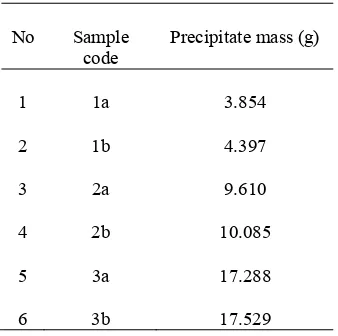
Solution of apatite mucouse compound with molar ratio CO32-: PO43- were described
by table3. Samples with mucouse show bigger mass precipitate because there are mucouse addition. Relation of molar ratio CO3
2-: PO4 3
are shown in table 2. From each sample, it show that ratio molar of CO32-: PO43 0.90 :
1.80 yield greater mass precipitate, with or without mucouse. It shows that higher molarity of CO3
2-: PO4
tends to more mass precipitate. In sample with molar ratio of CO32-: PO43 0.15 : 0.30 show different mass
precipitate with and without mucouse about 0.5 gram, and sample with molar ratio 0.51 : 1.02 show different mass precipitate about 0.4 gram, while sample with molar ratio 0.90 : 1.80 show less different mass about 0.2 gram. It means that mucouse in higher concentration sample will disappear, especially in sample with molar ratio 0.90 : 1.80
Analysis apatite mucouse composite use FTIR
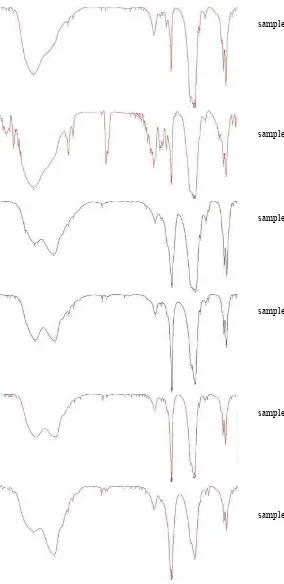
FTIR was used to analyze precipitate from phosphate and carbonate bench. Infrared spectra from calcium phosphate compound without mucouse, described by figure 4, and infrared spectra from calcium phosphate compound with mucouse is described by figure 4. Absorption band of phosphate and carbonate with variation ratio of molar is showed by table 2.
Generally, infrared spectra of calcium phosphate compound without mucouse show presence of phosphate absorption bands υ1, υ3,
and υ4, and also carbonate absorption bands υ2
and υ3. Phosphate absorption band υ1 in
sample 1a, 2a, and 3a appear as weak and small band near 960 cm-1, which is characteristic of calcium phosphate. While sample 1b, 2b, and 3b show weak phosphate absorption band υ1 with low intensity, it
means that sample 1b, 2b, and 3b have less characteristic of calcium phosphate compound. Phosphate absorption band υ3
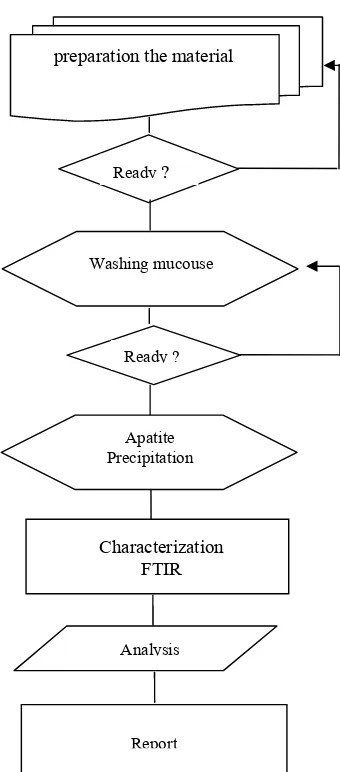
preparation the material
Ready ? Washing mucouse Ready ? Characterization FTIR Analysis Report Apatite Precipitation
Table 2 Mass precipitate in sample with and without mucouse by variation of CO32-: PO43- molar ratio.
appear near 1090 cm-1 and 1030 cm -1 for each
sample without mucouse, this is suitable with literature, which has two maxima near 1090 cm-1 and 1030 cm-1 17. Phosphate absorption band υ3 is asymmetry, this asymmetry band
show that there are a lot of crystalline phase calcium phosphate compound17. Sample 1a, 2a, and 3a have asymmetry υ3 band, so this
sample contain crystalline. Compare with sample 2a and 3a, sample 1a has more asymmetry phosphate υ3 band.
So this sample contain more crystalline phase than sample 2a and 3a. It is occur because carbonate concentration in sample 1a is less than others. Carbonate is an inhibitor in crystallization process on calcium phosphate compound, which can reduce the crystal size7. More carbonate ion in solution tend to reduce the crystallinity. In sample, carbonate concentration is increase, also phosphate concentration. This increasing tends to more amorphous precipitate. So, although phosphate is also increase, carbonate ion is still role as an inhibitor. Absorption band υ4
also show spectra with two maxima which related with literature in wavenumber 602 and 564 cm-1 17 . Crack structure of phosphate
absorption band υ4 also show crystalline phase
of calcium phosphate. Compare with sample 2a and 3a, sample 1a cracker at υ4 spectra, it
means that there are more crystalline phase. Carbonate absorption band υ2 in each sample
1a, 2a, and 3a are occur near 876 cm-1, 877 cm-1, and 874 cm-1, while carbonate absorption band υ3 show two maxima near
1456 cm-1 and 1451 cm-1 also in 1544 cm-1,
1543 cm-1 , and 1542cm-1. Presence of carbonate apatite crystal type A is signed by
carbonate band at wave number near 1545, 1450 and 890 cm-1, while presence of carbonate apatite crystal type B is signed by carbonate band at wavenumber near 1465 , 1412, and 873 cm-1 3. Sample 1a, 2a, and 3a shows the presence of two type apatite carbonate, that is near 1545 and 1450 cm-1 as
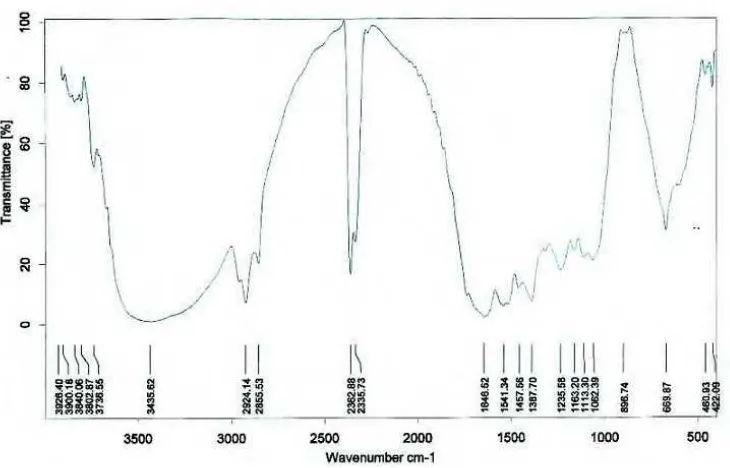
type A and near 873 cm-1 as type B. Very broad band near 2600 cm-1 – 3700 cm-1 is present in each sample without mucouse. This broad band is identified as hydroxyl bench (OH-). The presence of absorption OH -molecules are occur at broad band near 2600 cm-1 – 3750 cm-1 and near 1650 cm-1 3. Mucouse had been identified separately, also with FTIR. Infrared spectra of mucouse is shown in figure 5. Mucouse spectra has shoulder near 1644 cm-1 and peak at 1541cm-1 as NH asymmetry and symmetry bench, and also COO- peak at wavenumber 1646 cm-1 and 1387 cm-1. Beside that, there are very broad band at wavenumber near 2600 – 3600 cm-1 as hydroxyl bench and NH3
18
.The presence of NH3, NH and COO- at mucouse spectra show
the characteristic of amino acid in collagen fiber. It means that mucouse has characteristic like collagen fiber, that can be used as matrix. Table 3 show phosphate and carbonate absorption band with addition of mucouse at each variation of molar ratio phosphate and carbonate. Generally, sample with mucouse, which is sample 1b, 2b, and 3b has phosphate absorption band υ1, υ3, and υ4, and carbonate
absorption band υ2 and υ3, with hydroxyl
broad band. Sample 1b show new peaks near their original peak. The additional peaks is characteristic of mucouse. It means that apatite compound in sample 1b form composite with mucouse. Phosphate absorption band in sample 1b is change when mucouse is added. Phosphate absorption band υ1 is become weak, but still show the
character of calcium phosphate. While structure of phosphate absorption band υ3 is
more symmetry and crack structure of υ 4 band
is decrease. It means that addition of mucous can make the calcium apatite compound more amorphous also reduce the crystallinity.
Compare to sample 2b and 3b, either 2b nor 3b shown a significant differences. Phosphate absorption band υ1 in sample 2b
show the characteristic of calcium phosphate compound. Phosphate absorption band υ3
became more asymmetry, and crack structure of υ4 band is decrease. This results show that
sample became more crystalline. Phosphate absorption band υ1 in sample 3b is also show
the characteristic of calcium phosphate No Sample
code
Precipitate mass (g)
1 1a 3.854
2 1b 4.397
3 2a 9.610
4 2b 10.085
5 3a 17.288
15
compound. Phosphate absorption band υ3
became more symmetry and crack structure or υ4 band is also reduce. It means that sample 3b
show more amorphous than sample 2b but still show crystalline phase.. Carbonate absorption band υ2 and υ3 in sample 1b, 2b and 3b show
the presence of type A and B carbonate apatite, same with sample without mucouse.
Compare with sample 2b and 3b, mucouse is can be identified only in sample 1b, which is sample with CO32- : PO43- molar
concentration 0.15 : 030 . This results show that mucouse is “vanish” if molar ratio of CO3
: PO4
more than 0.15 : 030. Mucouse has possibility to evaporate with hydroxyl bench while heated. Beside that, the stability of collagen in mucouse is also disturb by contact of agents that will reduce the hydrophobic interaction1, and also is caused by increased of carbonate concentration that will inhibit the grow of apatite mucouse.
CONCLUSION AND
SUGGESTION
Conclucion
Increase of molar ratio of phosphate and carbonate will increase amount of precipitate too. Based on infrared spectra of phosphate and carbonate, samples without mucouse for all molar ratio variation, show characteristic of calcium phosphate compound, and also form crystalline phase. Samples with mucouse show that calcium phosphate is more amorphous and reduce the crystallinity. Compare to all samples with mucouse, spectra of apatite with mucouse are only show in sample with molar ratio 0.15 : 0.30 . It means that the growth of apatite is optimum at molar ratio of CO3
: PO4 3
about 0.15 : 0.30. In all variation of molar ratio CO32- : PO43, mass of mucouse
constant 0.75 gram. Increase of carbonate concentration will reduce the stability of collagen in mucouse.
Suggestion
For researcher who wants to continue this research, is suggested to concern the experimental techniques like pH, temperature, and stirring. To get more significant and accurate results, variation of ratio molar and concentration CO32- : PO43 is also suggested.
REFERENCES
1. Bhat SV. 2002. Biometerials. India : Alpha Science International
2. Villee CA, Walker WF, Barnes RD. 1984. Zoologi Umum.terj. Jakarta ; Erlangga.
3. Notonegoro HA. 2003. Analisis Spektroskopi Infra Merah dan Difraksi Sinar-X Pertumbuhan Kristal ApatitPada Mucoza Ampela Ayam [Skripsi]. Depok : Fakultas Matematika dan Ilmu Pengetahuan Alam.
4. Koutsopoulos S. Synthesis and characterization of hydroxyapatite crystals: Areview study on the analytical
methods.Departement of Chemistry,
University of Patras, Greece. 20 February 2002.s
5. Hanson, Bob. 2005. 150000000:1 Model
of Hydroxyapatite.
www.stolaf.edu/people/hanson
6. Aoki, Hidaki. 1991. Science and Medical Applications of Hydroxyapatite. Institute for Medical and Dental Engineering. Tokyo Medical and Dental University. 7. Hidayat Y, A Maddu, DS Soedjoko.
Spektroskopi Fourier Transform Infrared (FTIR) Senyawa Klsium Fosfat Pengaruh Ion F- dan Mg2+ Hasil Presipitasi. Jurnal Biofisika 2006, in press.
8. Rafal AM. 201. Polymer-Calcium Phosphate Composite for Use Ann Injectable Bone Substitute [thesis].
Massachusetts Institute of Technology. 9. Broto, Rawan. 2004. Manifestasi Klinis
dan Penatalaksanaan Osteoporosis [21 September 2006].
10. Wahl,D A, J T Czernuska. Collagen-hydroxyapatite composite for hard tissue repair. European cells and materials vol II. Dept of materials university of Oxford, 2000.
11. Volland W, Belleve vommunity college. 1999. Organic Compound Identification Using Infrared Spectra. Washington; Belleve.
12. Dee KC, Puleo DA, Bizios R. 2002. Tissue-Biomaterial Intreractions. New Jersey : Willey-Liss.
13. Herzberg G. 1964. Molecular Spectra and Molecular Structure. II. Infrared and Roman Spectra of Polyatomic Molecule.
New Jersey;D. Van Nostrand Co. Inc. 14. Soedjoko DS, S Wahyuni. 2002.
15. Riyani E, A Maddu, DS Soedjoko.
Karakterisasi Senyawa Kalsium Fosfat Karbonat Hasil Pengaruh Penambahan Ion F- dan Mg2+ Hasil Presipitasi. Jurnal Biofisika. 2005.
16. Skoog DA, Holler FJ, Nieman TA.
Principles of Instrumental Analysis. 17. Djarwani S. Sorjoko. 1999. Kajian
komposisi dan struktur senyawa mineral dalam kutikula macrobachium rosenbergh dan panaeus monodon serta evolusinya selama periode molting. Desrtasi, 61, Institut Teknologi Bandung.
17
Figure 4 FTIR spectra of sample 1a, 1b, 2a, 2b, 3a, and 3b.
sample 1a
sample 1b
sample 2a
sample 2b
sample 3a
Figure 5 FTIR spectra of mucouse.
Table 3 Phosphate and carbonate absorption band.
No Sample Molar ratio (M)
Phosphate absorption band (cm -1) Carbonate absorption band (cm -1)
ν
1ν
3ν
4ν
2ν
31 1a 0.15 : 0.30 962 1097-1036 603 - 567 876 1544-1456
2 1b 0.15 : 0.30 1090-1035 603-567 877 1541-1459
3 2a 0.51 : 1.02 961 1090-135 604-567 877 1543
4 2b 0.51 : 1.02 962 1094-1036 604 - 567 877 1543
5 3a 0.90 : 1.80 961 1094-1030 604-567 874 1542-1451
19
Appendix 1 Experiment set-up.
pH meter and thermometer digital. Buret which is filled by Ca(NO3)2
(NH
4)
2HPO
4and
(NH
4)
2CO
3Aluminum foil
HOT PLATE 7.4
21
23
25
27
CHARACTERIZATION
ADIPURWA MUSLICH
DEPARTMENT OF PHYSICS
FACULTY OF MATHEMATICS AND NATURAL SCIENCES
BOGOR AGRICULTURAL UNIVERSITY
ABSTRACT
ADIPURWA MUSLICH. Apatite Growth Optimation on Chicken Mucouse by Fourier Transform Infrared (FTIR) Characterization. Supervised by AKHIRUDDIN MADDU and YESSIE WIDYA SARI.
Some experiment had been conducted to grow apatite from supersaturated solution of calcium phosphate ions on chicken mucouse. The calcium and phosphate ions were originated from Ca(NO3)2 and (NH4)2HPO4. Carbonate ions from (NH4)2CO3 was also used as starting
solution. Experiment was carried out within about 5 hours at temperature 370 C and pH 7. Value of Ca+ : PO4
was 1.67, while molar ratio of CO3
: PO4
was 0.5 : 1. Molarity of molar ratio CO32- : PO43- variated approximately 0.15 : 0.30, 0.51 : 1.02, and 0.90 : 1.80. Mass of mucouse
powder was constant 0.75 gram. The analysis result of Fourier Transform Infrared (FTIR) showed that the precipitation was apatite carbonate type A and B. In these experiment it was found out that the mucouse reduce the crystallinity of apatite precipitant, and the growth of apatite crystal was optimum at solution with molar ratio CO3
: PO4
APATITE GROWTH OPTIMATION ON CHICKEN
MUCOUSE BY FOURIER TRANSFORM INFRARED (FTIR)
CHARACTERIZATION
Paper
As one of the rule to obtain the Science Bachelor Degree
Faculty of Mathematics and Natural Sciences
Bogor Agricultural University
ADIPURWA MUSLICH
G74103021
DEPARTMENT OF PHYSICS
FACULTY OF MATHEMATICS AND NATURAL SCIENCES
BOGOR AGRICULTURAL UNIVERSITY
4
Title
: Apatite Growth Optimation on Chicken Mucouse by Fourier
Transform Infrared (FTIR) Characterization
Name
: Adipurwa Muslich
NRP
:
G74103021
Accepted by :
1
stSupervisor
2
ndSupervisor
Dr. Akhiruddin Maddu
Yessie Widya Sari, M.Si
NIP. 132 206 239
Approved by :
Dean of Faculty of Mathematics and Natural Sciences
Bogor Agricultural University
Prof. Dr. Ir. Yonny Koesmaryono, MS
NIP. 131 473 999
PREFACE
Alhamdulillah, the author thanked God to have finished this paper. This paper, “Apatite Growth Optimation on Chicken Mucouse by Fourier Transform Infrared (FTIR) Characterization” is the requirements for finishing the scholarship at Department of Physics, Bogor Agricultural University.
This paper is also expected to give more information, especially in hydroxyapatite synthesis for substitute bone. As we know that bone is the most implanted tissues after blood. And the major solid components of human bone are collagen and apatite minerals, like hydroxyapatite. So, furthermore this paper expected to give contribution in medical implantation. However, physical analysis is needed in many science area to analyze the properties of materials, including in medical. This paper has many flaws. The author hopes much suggestion from all contributors to make this paper better and useful for everyone.
The author is thankful to :
1. Almighty Allah SWT, the ruler of heaven and earth,
2. Supervisors, bapak Dr. Akhiruddin Maddu for all suggestion and advices, and ibu Yessie Widya Sari, M. Si for spirits, guidance, and counseling, also for all things that make me more positive,
3. Examiners, bapak Dr. Kiagus Dahlan and Ibu Siti Nikmatin, M. Si , for suggestion and criticism,
4. Research grant of A2 programme, 5. Dr. Greta Zahar for the mucouse,
6. Parents, who are my motivation, my backbone. My sisters (Dwita and Astri) and brother (Rayi),
7. The girl who always stand up for me. Many thanks for everything, tik. Success for us, 8. My partners, Irma and Uliz. It will be so hard without you, girls,
9. Bara Gank (Opik, Awit, Koes, Malie, Subhi, Yulia). Guys, thanks for the happiness, cheerful, care, spirit, and sport! Friendship never end, it is priceless!
10.Seven Soul (Dnot, Marwkun, Syeikh, Priyo, Az, Jallun, Alwi, Uncle Ruud). It’s pleasure to be here with you all. Wisma Ananda (Tya, Asih, Lira) and nenden, thanks so much. Physicscholic 40, Harist, Icha, Gita. Thanks for support! Iez, Rika, Melly, thanks, labbers! Hudar, Dikun, Mada, Ziah, Ita, Ratna,
11.Lecturer and laborant at department of physics, physics 39, 41, 42 12.FOKKUS 36, 37, 38, 39, 40, 41, 42, 43,
13.Ruri, Ade, Akfen, Rio and all. Friends forever!
14.And for all who still stand behind me. Thank you very much.
April 2007
6
CURICULUM VITAE
The writer was born at Subang 23 February 1986 as first child from the couple Mochamad Muslich and Tity Mulyati.
The writer was educated at Kindergarten Handayani Indra Bhakti, Bandung at 1990-1991, Elementary School of Palmerah 17, West Jakarta at 1991-1997, Junior High School 75 of West Jakarta 1997-2000, Senior High School 1, Subang at 2000-2003.
CONTENTS
[image:34.612.132.484.116.443.2]Page
TABLE LIST ... vii
FIGURE LIST ... vii
APPENDIX LIST ... vii
INTRODUCTION ... 1
Background ... 1
Problem ... 1
Aim of Research ... 1
Time and Place of Research ... 1
THEORY ... 1
Formation of Hydroxyapatite Crystal from Solution ... 1
Matrix ... 3
Calcium phosphate compound identification with Infrared Spectroscopy ... 3
MATERIAL AND METHOD ... 4
Equipment and materials ... 4
Method ... 4
Sample preparation ... 4
Precipitation ... 4
Characterization ... 5
RESULTS AND ANALYSIS ... 5
Formation of apatite mucouse composite ... 5
Analysis apatite mucouse composite use FTIR ... 5
CONCLUSION AND SUGGESTION ... 7
Conclusion ... 7
Suggestion ... 7
REFERENCES ... 7
8
TABLE LIST
Page 1. Contents of water, inorganic materials, and organic materials
in bone and tooth (in wt%) ... 2
2. Mass precipitate in sample with and without mucouse by variation of CO32-: PO43- molar ratio ... 6
3. Phosphate and carbonate absorption band ... 10
FIGURE LIST
Page 1. Hydroxyapatite structure ... 2
2. Change in Ca/P ratio to pH value of reaction solution ... 2
3. Research flowchart ... 5
4. FTIR spectra of sample 1a, 1b, 2a, 2b, 3a, and 3b ... 9
5. FTIR spectra of mucouse ... 10
APPENDIX LIST
Page 1. Experiment set-up ... 11
2. FTIR spectrometer ... 12
3. FTIR spectra sample 0.15 M : 0.30 M without mucouse ... 13
4. FTIR spectra sample 0.15 M : 0.30 M with mucouse ... 14
5. FTIR spectra sample 0.51 M : 1.02 M without mucouse ... 15
6. FTIR spectra sample 0.51 M : 1.02 M with mucouse ... 16
7. FTIR spectra sample 0.90 M: 1.80 M without mucouse ... 17
Bone is a passive motion tool that has a lot of usages, one of those is to prop the body. The bone is unique among the tissues of the body, in the level of its resistance to compressive forces. This resistance results from its composition. Collagen and other organic molecules give bone strength, while hydroxyapatite is responsible for the resistance to compression1.
Bone is classified as hard tissues which can experience regenerative growth2. In medical field, bone reconstruction has done to repair the bone fracture or defect. There are techniques deals with bone reconstruction such as allograft (bone reconstruction using bone from other person), and xenograft (bone reconstruction using animal bone). That techniques have weakness, in comparison, disturbed by immunological response. In addition, the cost of bone allograft, which require careful handling, are expectional high1.
Autograft (bone reconstruction using health bone from that person) is the most satisfy bone reconstruction because the implant bone contains important cells which are needed. Moreover the disadvantages of autograft were prolongation of operation time, increased loss of blood, the risk of infection, nerve and vascular injury, thrombosis, fracture risk, additional scar, postoperative pain and cost of additional operation1. Synthetic biomaterials are expected can overcome those problems. Synthetic biomaterials is an inert substance which used to implantation in biological system, to replace hard tissues disfunction2. A biomaterial is defined as any systemically, pharmachologically inert substance or combination of substance utilized for implantation within or incorporation with a living system to supplement or replace functions of living tissues or organ1. Synthetic biomaterials must be biocompatible, no corrosion, has long time stability, and strength. The term “biocompatible” suggest that the material described displays good or harmonious behavior in contact with tissue and body fluids. Now, synthetic biomaterials has developed from metal, polymer, ceramics, and other materials.
Calcium phosphate compound in stable crystal phase Ca10(PO4)6(OH)2 or
hydroxyapatite has correlated with hard tissue. Poorly crystalline Hydroxyapatite (HAp) is the major mineral component of bone and
result biomaterial which has good behavior and biocompatible with hard tissue3.
Problems
Calcium phosphate compound is needed to make synthetic biomaterial that used to replace the disfunction bone. To make it grows in human body, it must contain amorphous phase which is regenerative bone phase. The growth is persisted just only in matrix.
In this research, calcium phosphate compound was made by synthetic method from some chemical compound which contain calcium phosphate then it is decanted in chicken mucouse. So apatite crystal was formed at the surface of mucouse. This mucouse was used as matrix of apatite growth. The calcium phosphate compound was identified by using Fourier Transform Infrared Spectroscopy (FTIR).
Aim of research
1. Resulting apatite mucouse as filler materials which can handle limitation problem of bone implantation. 2. Giving information about material’s
characteristic. So, it can be more biocompatible than allograft or xenograft biomaterial.
Time and place of research
This research hold in 2 different laboratories. The preparation and precipitation hold in Biophysics Laboratory, Physics Department of IPB, Darmaga. Characterization by using FTIR hold in Biofarmaca Study Center IPB. This research started from March 2006 until January 2007.
THEORY
Formation of Hydroxyapatite Crystal from Solution
10
most stable calcium phosphate phase at a normal temperature and pH between 4 and 124.Hydroxyapatite crystal unit has hexagonal structure with lattice parameter a = b = 9.432 Å and c = 6.881Å (Figure 1).
Apatite is a general term crystalline mineral. There are many apatite compound, including flouroapatite, chloroapatite, carbonate apatite, and hydroxyapatite. Biological apatite is found in human or animal teeth and bones. Mineral is the main inorganic compound in calcified hard tissues (e.g. bone and teeth). Physically, interaction between mineral and organic compound yield mechanical properties. Organic give tensile strength, while mineral is responsible for the resistance to compression. Interfacial bonding between the mineral and organic constituents is based, in part, on electrostatic interaction between negatively charged organic domain and the positively charged mineral surface1. Generally, there are three essential methods for preparing hydroxyapatite crystal, including the process from solid reaction to solid crystal, from solution to solid crystal, and from vapor to solid crystal. Wet method (using solution reaction) is useful for preparing very small crystal of hydroxyapatite6.
Synthesis of hydroxyapatite is affected by calcium and phosphate concentration in solution. Solution with Ca2+ and PO4
3-concentration less than 2mM is called as low supersaturation condition, and solution with Ca2+ and PO4
[image:37.612.336.504.503.632.2]
concentration more than 10 mM is called as high supersaturation condition.
Figure 1 Hydroxyapatite structure5.
Table 1 Contents of water, inorganic materials, and organic materials in bone and tooth (in wt%)5.
Bone Tooth
Dentine Enamel
Inorganic 60 70 96
Organic 30 17 2
Water 10 13 2
Hydroxyapatite crystals form directly without presence of metastable calcium phosphate phase in low supersaturation solution. Precipitation of calcium phosphate in high supersaturation condition results a metastable phase between amorphous and crystalline calcium phosphate3. The presence of carbonate ions in conversion amorphous phase become crystal apatite phase will influence the form of hydroxyapatite crystal. This carbonate ions will cause demorfology and reduce the size of crystal, also non stoichiometry7.
In hydroxyapatite structure, carbonate can substitute OH- ion, and form type A carbonate apatite, and if substitute PO43- ion will form
type B carbonate apatite. Generally, precipitation at low temperature will form carbonate apatite type B, while apatite from dry reaction at high temperature will produce carbonate apatite type A. Apatite precipitation from calcium and phosphate saturation solution can produce hydroxyapatite crystal8. Hydroxyapatite crystal in calcium phosphate compound is affected by pH solution. Value of Ca/P in hydroxyapatite is change gradually with pH increase.
Figure 2 Change in Ca/P ratio to pH value of reaction solution1.
3 5 7 9 11
[image:37.612.134.299.508.626.2]