3 International Conference on Engineering and ICT (ICEI2012) Melaka, Malaysia
4 • 5 April 2012
✁
NANOFLUID AS COOLANT IN AUTOMOTIVE COOLING SYSTEM•HEAT
TRANSFER CHARACTERISTICS OF CAR RADIATOR USING CU-BASED
NANOFLUID
S.A. Fadhilaha*, S. Abdul Rafeqb, B. Hairulc, Nur Hazwani Mokhtard, and Nona Merry M. Mitane
Faculty of Mechanical Engineering, Universiti Teknikal Malaysia Melaka, Melaka, Malaysia.
a
Email: [email protected],bEmail: [email protected], cEmail: [email protected],
d
Email: [email protected], eEmail: [email protected]
✂ ✄☎ ✆✝✞ ✟ ✆
! Nanofluid is a potential fluid with enhanced
thermal physical properties as compared to
conventional fluid. The conventional fluids such as water and ethylene glycol acted as coolants in automotive cooling system could show superior properties through dispersion of nanoparticles. The nanoparticles are either metal, non-metal or carbon nanotube (CNT) is in nano-size between 1-100 nm. This study focused on heat transfer characteristics of Cu/water nanofluid in an automotive radiator by analyzing the thermal physical properties of the coolant; thermal conductivity (✠ ) and heat transfer coefficient (✡ ). The mixture of solid nanoparticles and coolant showed that the thermal properties of the coolant were increasing with copper (Cu) nanoparticle volume fraction. By adding 10 % of nanoparticle suspension, the heat transfer coefficient of the nanofluid was increased up to 26000 W.m-2K-1 with 92 % of percentage enhancement. Consequently, it also enhanced the heat transfer rate in the cooling system. The results showed good indicator for automotive industry to design an eco-car that sustain
the energy and minimizing the environmental impact.
☛ ☞✌ ✍ ✎ ✝✏☎
üNanofluid; Heat transfer; Automotive radiator; Thermal conductivity.
I.INTRODUCTION
Researchers around the world have conducted many investigations on nanotechnology in order to begin with its massive implementation in many sectors such as air-conditioners, automotive, electronics, and medical. One area that has been studied and developing currently is nanofluid; a potential fluid with superior properties to replace conventional fluid. The term !nanofluids" has been introduced by Choi in 1995 at Argonne Research Laboratory as an advanced fluid that showed superior heat transfer properties with nanoparticle suspensions [1].
The nanofluids could be grouped based on their application which occasionally called as nanolubricant or nanorefrigerant, which is also one kind of nanofluids. A lot of nanofluids studies are based on thermal conductivity and heat transfer coefficient since the properties show significant influence in a heat transfer process. Other properties such as viscosity, density and surface tension of nanofluids have also been explored to obtain reliable results. The nanofluids have superior thermal properties which have been proved since past decades by many researchers. Today#s trend is to develop
the nanofluids in many industries and ensure it is a new energy-efficient heat transfer fluid in real world application.
In developing nanofluids, it is not only the superior properties are considered, but the stability and dispersion of nanofluids are also the main areas that challenged its relevance in mass application. Suitable material of nanoparticle is crucial to be identified in order to be suspended in different types of base fluids. The size of nanoparticles, temperature, and optimum concentrations must be considered carefully. These are important to obtain high thermal conductivity and heat transfer coefficient of nanofluids without causing agglomeration, instability, corrosion, high pressure drop and pumping power [2, 3].
An automotive cooling system usually consists of radiator, water pump, thermostat, radiator pressure cap, and electric cooling fan [4]. The radiator is the main component as it was designed to remove heat from an engine block with circulated coolants. In fact, the coolants have poor heat transfer properties in nature. Generally, the coolant in the radiator is water or water with additional liquid of ethylene glycol (anti-freezing fluid), which flows inside the tubes. Another coolant is outside air which flows through the fins to cool down the temperature of water inside the tubes.
Since researchers and engineers from automotive industries have been competing for green technology, compact system and low fuel consumption, consequently it has developed the study of nanofluids. By introducing nanofluids with high heat transfer properties, the radiator size can be reduced but offering same heat transfer rate. The frontal area of a car can be redesigned to reduce aerodynamic drag so that less fuel consumption is required [5, 3]. Therefore, it is important to investigate the nanofluids thermal physical properties.
Argonne researchers proved that despite nanofluids thermal conductivity depends on temperature and particle volume fraction, it showed high thermal conductivity than conventional radiator coolants [6].
✑
natural convective heat transfer of nanofluids as the suspension of nanoparticles caused higher viscosity and pressure drop [8].
In this study, the aim is to improve the heat transfer capabilities in automotive cooling system by investigating the effect of copper nanoparticles volume fraction on coolant thermal conductivity and heat transfer coefficient. The enhanced heat transfer properties of the coolant are used to determine the total heat transfer rate of a car radiator.
II. METHODOLOGY
By using mathematical modeling, the effect of nanoparticles dispersion from 1 to 10 % was investigated. Three different sizes of nanoparticles; 10 nm, 50 nm and 100 nm are used to identify the effect of nanoparticle size on nanofluid thermal conductivity. The properties of water, air and copper are shown in Table 1. The thermal conductivity of copper is significant higher than water. For this reason, the main basis of suspending the copper particles is to enhance the thermal conductivity of the conventional coolant.
The highest thermal conductivity of the nanofluid is used to determine the heat transfer rate of a louvered-fin flat tube radiator as shown in fig. 1. The radiator with conventional coolant (water with 0 % nanoparticles suspension) could experience heat transfer rate of 64.354 kW. The coolant volumetric flow is 0.11 m3.min-1, meanwhile the air volumetric flow and air velocity are 66.5 m3.min-1 and 4.47 m.s-1. This study used exact
working condition and radiator specification except the conventional coolant (water) is changed to Cu/water nanofluid. Assuming the inlet temperature of the coolant is 368 K, and the outside air is 303 K. From the data, the analyses have been done by using Microsoft Office Excel 2007.
Table 1. Geometry description of automotive radiator [4]
Radiator Dimensions Distance between fins, fD (m) 1.59x10⁻³
No. of tubes 33
Table 2. Properties of coolants and nanoparticle [9]
Properties Water
Thermal Conductivity, k
[W.m-1
Figure 1. Louvered-fins and flat tube
The effective thermal conductivity of nanofluid keff,
considered the effect of interfacial layers which have been developed around the nanoparticles as suspending metallic particles in the coolant. The effective thermal conductivity can be calculated from Eq. 1 [10],
>
@
>
@
thermal conductivity of coolant,
I
is the particle volumefraction, E 1J, 1 /2
1 J
E , and Ȗ h/ais the interfacial layer thickness over the radius of nanoparticle.
The dynamic viscosity of nanofluid, Pnf is obtained from Brinkman model [3] which considered only two parameters: a) the conventional coolant viscosity, Pf and b) the nanoparticle concentration.
(2)
The density,
U
nf and specific heat, Cp,nfof the nanofluid3 International Conference on Engineering and ICT (ICEI2012) transfer coefficient can be calculated as following [3],
) determined by using the following equations [4],
)
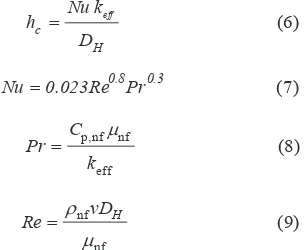
In order to find the heat transfer coefficient of the air, the universal, UA heat transfer coefficient can be determined from,
The heat exchanger (radiator) effectiveness can be determined by, substituting in the following equation [3],
(16) )
-(
Q İCmin Tnf,in Tair,in
III. RESULTS AND DISCUSSION
Fig. 1 shows the enhancement of nanofluid thermal conductivity with particle volume fraction. By suspending 10% of copper nanoparticles in water, the thermal conductivity of the nanofluid can be enhanced more than 100%. The result proved that the thermal conductivity of nanofluid is increasing significantly with nanoparticles concentrations. The increasing size of nanoparticles has decreased the thermal conductivity of nanofluids. The smallest copper diameter of 10 nm demonstrated highest thermal conductivity enhancement compared to others.
The localized convection in the coolants because of nanoparticles Brownian motion is one of the reasons that enhance the thermal conductivity [10]. Besides, the formation of interfacial layer between the copper nanoparticles and basefluid (water) is also contributing to the percentage of enhancement. The interfacial layer thermal conductivity (kl) is two times higher as compared to the basefluid [10]. Therefore, instead of depending on the nanoparticles concentrations and particle sizes, interfacial layers are also contributing to improve the overall thermal conductivity of nanofluids.
By using different nanoparticle volume fraction, the viscosity of nanofluids is also increasing and influencing the values of Reynolds number. The viscosity of nanofluids solely depends on nanoparticle volume fraction according to Brinkman model. By increasing the viscosity, the Reynolds number should be smaller. However, another important thermal physical property that need to be considered in determining the Reynolds number is the density of nanofluids. The greater effects on density due to nanoparticle suspension have increased the Reynolds number in this study.
✒ ✔ ✕
more contacts occurred between the nanoparticles and tubes wall. This contributes to higher heat transfer rate in the cooling process.
Figure 2. Nanofluid thermal conductivity as a function of nanoparticle
volume fraction
Figure 3. Overall heat transfer coefficient as a function of nanoparticle
volume fraction
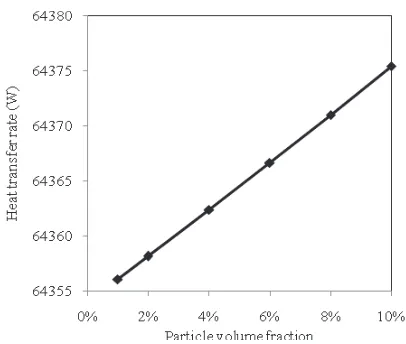
Fig. 3 shows overall heat transfer coefficient of nanofluid with the effect of particle volume fraction. The heat transfer coefficients are increasing with particle concentration. It started almost 9 % of percentage enhancement, and constantly increasing up to 92 % with 10 % of nanoparticle suspension. The heat transfer rate of the radiator is also increasing from 64356 W to 64376 W as shown in Fig. 4. The overall heat transfer rate enhancement shows insignificant value which is about 0.03 %. There are many factors contributed to this result. The one that is concerned is the flow rate of the outside air. This study assumed that the air flow rate is constant by focusing the influence of particle concentration on the thermal conductivity and heat transfer coefficient of nanofluid.
The temperature of coolants should be varied due to operating temperature and air flow. Higher temperature and air flow tend to increase the heat transfer rate. The fins construction is also one of the important factors that
could influence the heat transfer rate. By extending the surface area and choosing high conductive material, the heat transfer rate can be enhanced accordingly. This study showed that nanofluids as the advanced coolant has increased the heat transfer rate of the radiator. Therefore, the combination of the major factors that influence the heat transfer characteristics of the radiator will produce high energy-efficiency heat exchanger.
Figure 4. Heat transfer rate of a louvered-fin and flat tube radiator
IV. RECOMMENDATION FOR FUTURE WORK
Radiator is a component of the automotive cooling system. There are other components that linking to each other such as water pump and hoses. By using nanofluid as the new coolant, there are possibilities of nanoparticles agglomeration and sedimentation inside the tubes, hoses and clogging the water pump. The erosion issue on the system cannot be neglected as adding metallic particle will risk the existing system. These will lead to parts wear, increased pressure drop, and more energy consumption. Therefore, more investigations on other parts need to be done to introduce nanofluid as the advanced-coolant in the cooling system. It is important to have practical knowledge of nanofluids performance in real world cooling system so that the important aspects such as fuel consumption, construction cost, quality and safety can be identified before high-volume production is proposed.
V. CONCLUSION
3 International Conference on Engineering and ICT (ICEI2012) Melaka, Malaysia
4 ! 5 April 2012
✒ ✔ ✖
REFERENCES
[1] Choi S.U.S. Developments and applications of non-newtonian flows, ASME FED, 66 (1995) 99!105.
[2] R. Saidur, K. Y. Leong, H.A. Mohammad, A Review on Application and Challenges of Nanofluids, Renewable and Sustainable Energy Reviews 15 (2011) 1646 !1668.
[3] K.Y. Leong, R. Saidur , S.N. Kazi, A.H Mamun, Performance Investigation of an Automotive Car Radiator Operated with Nanofluid-based Coolants (Nanofluid as a Coolant in a radiator), Applied Thermal Engineering 30 (2010) 2685! 2692.
[4] Waterloo Maple Inc. (2008). Designing a more effective car radiator, Retrieved Dec 2, 2011 from http:// www.maplesoft.com/view.aspx?SF=6403/Radiator.pdf [5] Wong, K.V., & Leon, O.D., Review article- Applications of
nanofluids: Current and future, Advances in Mechanical Engineering (2010)doi:10.1155/2010/519659
[6] Choi S. Nanofluids for improved efficiency in cooling systems, Retrieved Dec 2, 2011 from
http://www1.eere.energy.gov/vehiclesandfuels/pdfs/hvso_2006 /13_choi.pdf.
[7] Mare, T., Halelfadl, S., Sow, O., Estelle, P., Duret, S., Bazantay, F. Comparison of the thermal performances of two nanofluids at low temperature in a plate heat exchanger,
Experimental Thermal and Fluid Science 35 (2011) 1535!1543 [8] Calvin, H. L., & Peterson G.P. Experimental studies of natural convection heat transfer of Al2O3/DI water nanoparticle suspensions (Nanofluids), Advanced in Mechanical Engineernig, (2010) 1535-1543 doi:10.1155/2010/742739 [9] Yunus A. Cengal, Heat Transfer ! A Practical Approach.MC
Graw-Hill, Singapore, 2004.
[10] K.C Leong, C. Yang, S.M.S. Murshed, A Model for Thermal Conductivity of Nanofluids ! The Effect of Interfacial Layer,
![Table 2. Properties of coolants and nanoparticle [9]](https://thumb-ap.123doks.com/thumbv2/123dok/559811.66070/2.595.305.525.105.362/table-properties-of-coolants-and-nanoparticle.webp)