SH ALLOT FARM I N G PERFORM AN CE I N JAV A
I N D ON ESI A
Su sa n a w a t i1 *, Ja m h a r i2, M a sy h ur i2 a nd D w idj on o2
* Corresponding Aut hor: Susa na w a t i,susanaw at i@um y.ac.id
Research Paper
In order to develop shallot production in Indonesia, it is necessary to conduct research on farming performance of the commodity seen from the profit, feasibility, and the constraints of the production. The sample of the farmer was taken with purposive sampling method of 30 people in each location. The research used primary data and was analyzed with descriptive. The result of the research showed that the age of the farmer in Nganjuk regency was the youngest. The level of education of the farmer in Brebes regency was the best and had the most experience in planting shallot. The widest field ownersip of the farmer was in Cirebon regency and the status of the field domination of the farmer in the three regencies was mostly at rent. The highest profit of the shallot farmer belonged to Nganjuk. The wage of the workers gave the highest contribution towards the total cost of shallot farming in Java. Shallot price in the regencies of Cirebon, Brebes and Nganjuk must not consecutively decrease more than 34,69%; 35,45%; and 39,39%, so that the farmers did not suffer from loss. Shallot farming in Java was feasible to work and develop for. Shallot farmers in Cirebon and Brebes regencies should pay attention on the factors like the kind and the fertility of the soil, while for the farmers in Nganjuk regency, they should notice the availability of the pesticide and fertilizer, as well as the existence of the farmer group.
Keyw ords: Farm ing perform ance, Profit , Feasibilit y, Shallot
ISSN 2320-3730 www.ijasvm.com Vol. 4, No. 3, August 2016 © 2016 www.ijasvm.com. All Rights Reserved
1 Faculty of Agriculture, Muhammadiyah University of Yogyakarta, Indonesia, Jl, Lingkar Selatan Tamantirto Kasihan Bantul Yogyakarta,
Indonesia.
2 Faculty of Agriculture, Gadjah Mada University of Yogyakarta, Indonesia, Jl, Flora Bulaksumur Yogyakarta, Indonesia.
I N TROD U CTI ON
Vegetable is commonly rich of vitamin A, B, C, D, E, and K that can help to protect the body from many diseases (Agusiobo, 1994). Shallot (Allium ascalonicum L) is one season vegetable that has layered tuber, hairy root, hollowing cylindrical leaf . Shallot has also many advantages as sources of carbohydrate and
commodity so that its domestic and foreign market is widely open (Nidausholeha, 2007).
The center areas of shallot production in Indonesia are still concentrated in Java island. According to the data of BPS and the General Director of Horticulture (2012), the areas in Java island that produce shallot are the provinces of West Java, Middle Java, Special Region of Yogyakarta, East Java, and Banten. During 2010-2012, Middle Java Province gave the highest contribution towards the shallot production in Java, and then was followed by East Java, West Java, Special Region of Yogyakarta and Banten. The region that has the biggest shallot production in Middle Java was Brebes with contribution of 67,83% towards the total production of the province during 2011-2012. In the same time, Nganjuk region became the biggest contributor for shallot production in East Java with contribution 75,48%. During 2005-2009, Cirebon regency became the biggest shallot producer in West Java because it had the highest average of production level compared to Majalengka, Bandung and Garut. In the same time, the regency in the Special Region of Yogyakarta with the highest shallot production level was Bantul, and was then followed by the regencies of Kulonprogo, Gunungkidul, and Sleman.
Shallot farming needs high production cost and has high production risk. The impact is the income received by the farmer becomes smaller. The cost has very important role in the decision making of farming. The cost spent to produce something determines the basic price (cost per unit) of the product which was produced (Soeharjo and Patong, 1973). If the increase of output price received by the farmers is not equal with the increase of production input price that has to be paid, it makes the farming income
become low (Sumaryanto, 2004). Based on the situation, this research in general tried to discover the performance of shallot farming in Java that was explained specifically including the profit of the farmers, feasibility, and the constraints of shallot production in Java. The result of the research could be used: (1) to give information for the farmers in decision making about the use of technology and the best priority choice in the future so that the production and the income of the shallot farmers can increase. Moreover, the life quality of the farmers was improved; (2) to be materials for the government in the formulation of the policy in order to increase the motivation of the farmers especially in farming the shallot.
RESEARCH M ETOD OLOGY
The basic method used in this study was descriptive analysis. The objective of the descriptive research is to make description, systematic picture, factual and accurate facts, the characteristics and the relation among the phenomena under (Nazir, 1989). In the descriptive method, the researcher could compare certain phenomena so it becomes a comparative study. The data collected are arranged, described and then analyzed. The descriptive method has some advantages, i.e. (1) it has detailed measurement towards social research (Singarimbun and Effendi, 1989), (2) it can describe the relation among the phenomena, hypothesis test, and policy implication (Nazir, 1989), (3) the data analysis is conducted with descriptive analytical approach to produce correlation or comparison among the variables (Widodo and Mukhtar, 2000), and (4) the result of the research is in the form of conclusion that is deductive in nature (Subyantoro and Suwarto, 2007).Brebes, and Nganjuk because the areas became the big three of shallot production centers in Java even in Indonesia. The farmer sample taking was conducted with purposive technique. It was with the criterion that the farmers who planted rice or cash crops first before shallot, so that the real cost of the cultivation of the field could be known. The number of the farmer sample used in this research was presented in Table 1.
The research activity was conducted in September - November 2012. The data used in the research was primary data collected by interview technique related to the number of production means usage, input price, and constraint factors in shallot production in Java. The approach on number was used to count the cost and the profit of the farming with formula as (Suratiyah, 2011):
Profit = TR – TC ...(1)
= Py . Y – (TEC + TIC) ...(2)
= Py . Y – TEC + TIC ...(3)
Note:
Py = cost production (Rp/kg); Y = production number (kg);
TR = Total Revenue (Rp)
TC = Total Cost (Rp); TEC =Total Explicyt Cost (Rp);
TIC = Total Implicyt Cost (Rp)
Pi = order of input price (the- 1st, 2nd, …);
Xi = order of input number (the- 1st, 2nd, …).
One of the techniques in studying the relation between cost, revenue and production volume was with the analysis on Break Event Point (BEP) (Hermanto, 1989; in Kariyasa et al., 1993; and Hariadi and Suratiyah, 1997). This research conducted three kinds of BEP analyzes, i.e., BEP in production and cost. After BEP analysis, price changing analysis was conducted by observing the comparison between the shallot price at BEP and the actual price when the research was conducted. The feasibility analysis on shallot farming in the study used four criteria. They are (1) R/C ratio > 1; (2) revenue > revenue BEP; (3) Production (kg) > production BEP (kg); and (4) Price (Rp/kg) > Price BEP (Rp/kg), and (5) revenue (Rp) > land rental value (Rp).
The constraint faced by the shallot farmers in Java was analyzed qualitatively with the score of 5 scales, i.e., (1) very unimportant; (2) unimportant; (3) quite important; (4) important; and (5) very important. The value of the score would be counted to get the average and then be ranked to determine the priority of the constraint.
RESU LTS AN D D I SCUSSI ON
The Characteristics of Shallot Farmer in
Java
Farmers as the people in shallot farming had
Regency Sub-district Village Farmers
Pabedilan
Kaler 10
Pabedilan
Wetan 10
Gebang 10
Pagejugan 15
Limbangan
Kulon 15
Nganjuk Rejoso Sukorejo 30
90 Total
Cirebon Pabedilan
Brebes Gebang
Brebes
Ta ble 1 : Th e N u m be r of Sh a llot Fa r m e r Sa m ple in Ja v a
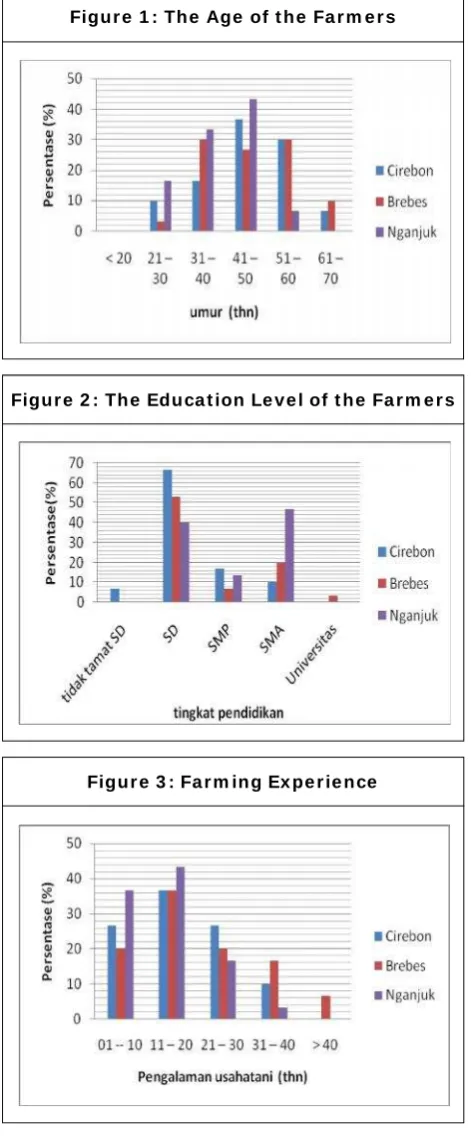
the status. The description about the characteristics of the farmers can be seen in Figures 1-5.
Figure 1 showed that all shallot farmers in Java were in productive age, i.e., around 31-60 years old. The farmers in Cirebon regency were dominant at the age of 41-60 years old, while the farmers in Brebes regency were in the range of 31-60 years old. The farmers in Nganjuk regency were dominant at young age with range of 31-50 years old. The condition showed that the farmers in Cirebon regency were regarded as the oldest and the youngest ones were in Nganjuk regency.
In Figure 2, there were about 66% of the farmers in Cirebon regency and 53% of the Figu r e 1 : Th e Age of t h e Fa r m e r s
Figu r e 2 : Th e Edu ca t ion Le v e l of t h e Fa r m e r s
Figu r e 3 : Fa r m in g Ex pe r ie n ce
important role in achieving the optimal production level. The characteristics of the farmers were seen from the age, education level, farming experience, the width of the land domination and
Figu r e 4 : La n d Te n u r e
farmers in Brebes regency had elementary school education. So, it could be said that the education level in the two areas was still low, even though in Brebes regency, there were 3,33% of the farmers have studied in university. Around 40% of the farmers in Nganjuk regency had elementary school education and 46% has graduated from senior high school. The data showed that the education level of the shallot farmers in Brebes regency was better than the two other regencies in Java.
Based on Figure 3, the farming experience of shallot farmers in Cirebon and Brebes regencies was dominant at the range of 1-30 years, while in Nganjuk regency, it was in the range of 1-20 years. The condition showed that the shallot farmers in Brebes and Cirebon regencies grew shallot earlier than those in Nganjuk regency. The picture 4 showed that the land that the farmers worked on, in Brebes and Nganjuk regencies was dominant at the range of width of < 2.500-5.000 m2. The condition was different from that of the farmers in Cirebon regency that was dominant at the range of width of 2.500-10.000 m2. Based on the number, it could be concluded that the land domination of the shallot farmers Cirebon regency was the widest compared to the other two regencies in Java. The farmers in three regencies dominantly planted shallot in the land belonged to other people or rented.
The Analysis of Shallot Farming in Java
Family farm has a final goal in the form of farmer income, so that if the income is still positive then the farming keeps going on. This is because farmers would not do strike (Suratiyah, 2011). The analysis on the cost and the revenue of shallot farming in this research was conducted in different planting seasons. They were the second planting season (September-October 2012) for
Cirebon regency, second planting season (July-August 2012) for Nganjuk regency, and third planting season (October-November 2012) for Brebes regency.
Based on Table 2, the highest shallot productivity in Nganjuk regency almost reached 21 tons, and was then followed by Cirebon and Brebes regencies. The condition occured because the farmers in Nganjuk regency used soybean plant first before shallot. So, it could help
Cirebon Brebes Nganjuk
Total Production (kg) 16.26 13.135 20.571
Price (Rp/kg) 5.463 5.363 4.308
A.Revenue (Rp) 88.828.380 70.443.005 88.619.868
B.Cost (Rp)
a. Seed 13.712.963 11.212.620 15.359.705
(23,38) (24,66) (28,48)
b. Fertilizer
Organic 567.571 73.752 384.274
Manufactured 5.560.951 4.952.005 2.966.394
(10,45) (11,05) (6,21)
c. Pestic ide & other
c omponents 6.087.096 4.486.987 2.347.363
(10,38) (9,87) (4,35)
d. Workers 27.305.200 21.794.057 19.852.803
(46,55) (47,93) (36,81)
e. Land Rental 3.498.015 2.029.933 8.144.180
(6,03) (4,46) (15,16)
Total Explic it Cost 56.731.796 44.549.354 49.054.719
a. Individual land rental 1.044.067 896.341 4.615.873
(2,19) (1,97) (8,56)
b. Decrease 243.478 24.855 33.734
(0,18) (0,05) (0,06)
Total Implicit Cost 1.287.545 921.196 4.469.607
Total Cost 58.019.331 45.470.550 53.704.326
C. Revenue (Rp) 30.809.049 25.893.651 39.565.149
D. Profit (Rp) 29.521.504 24.972.455 35.095.542
Research Location
to trap Nitrogen element in the soil. Besides, the kind of the shallot planted was the import variety of Thailand kind whose productivity was higher. Cirebon regency was in the second place for the productivity because there were some farmers in the area that planted sugar cane first before shallot. So, the long root of the sugar cane can help to absorb the nutrient in the soil better, even though the shallot planted was local variety of Bima Curut kind whose size was relatively smaller than the import variety of Thailand kind. All this time, Brebes region known as the ‘storehouse’ of shallot in Indonesia was in the third place in the productivity instead. It was because there was too much chemical fertilizer and pesticide used by the farmers and the variety planted was local one like Bima Curut kind whose size was smaller than Thailand kind. However, according to the consumers, its aroma was sharper and its price was higher.
The highest selling price of shallot in farmer level was in Cirebon regency, then followed by Brebes and Nganjuk. The high and low amount of the selling price determine the big and small amount of the revenue of shallot farmers. The highest revenue value of the farmers was in Cirebon regency, then followed by Nganjuk and Brebes. The high revenue of shallot farmers in Cirebon was caused by the selling price in farmer level was also the highest one, even though the production was lower than that of Nganjuk. The revenue of shallot farmers in Brebes was low because the production and the selling price in farmer level was also relatively low. The revenue of the farmers in Nganjuk was categorized as high because the production was the highest one, even though the selling price in farmer level was the lowest.
In order to count the revenue of the shallot farmers, it was necessary to see the amount of
production cost spent by the farmers, both constant and variable cost. The highest total cost of shallot farming was in Cirebon, the followed by Nganjuk and the lowest one was in Brebes. The average of shallot farmer revenue in Nganjuk was the highest, then followed by Cirebon and the lowest one was in Brebes. The high revenue was caused by the farmer revenue which was relatively high and the total cost which was relatively low. The revenue level of shallot farmers in Brebes was the lowest compared to the other two areas. It was caused by the high cost of the farming spent by the farmers. Besides, the revenue and the selling price were also relatively low.
If seen from the farming structure, the wage of the workers gave the highest contribution towards the total cost of shallot farming in Java, with average contribution of 43,76% and the highest one was in Brebes regency that reached 48%. The second place was occupied by the seed, then followed by the fertilizer and pesticide for farming in Cirebon and Brebes regencies. The result was in apt with the research of Nurasa and Darwis (2007) and Triyonoet al. (2010) in Brebes regency that state that in shallot farming, the expense for the workers gives the highest contribution towards the total production cost, then followed by the seed cost, pesticide, and fertilizer. This condition was different from what happened to the shallot farming in Nganjuk regency, in which after the wage of the workers and the seed, the next contribution towards total farming cost was land rental, then followed by fertilizer and pesticide. The big amount of the land rental cost was in Nganjuk regency caused by the high value of land rental in the area.
Generally, the dedication of the workers can be differentiated into three kinds of work, i.e., (1) seed preparation and land cultivation including seed splitting, ditch making, land mellowing, planting line making, herbicide giving, pre-planting herbicide giving, and basic fertilizer giving, (2) plant and cultivation including planting, continuation fertilizer giving, pesticide and glue spraying, watering and weeding, (3) harvest and post-harvest including harvesting, sorting, weighing, and harvest transporting.
BEP Analysis in Shallot Farming in Java
BEP analysis model could be used by the farmers to plan anything related to farming (Suratiyah, 2011). The complete result about BEP analysis in shallot farming Java was presented in Table 3. It showed that the highest revenue of BEP value was in Nganjuk regency and the lowest one was in Brebes regency. The revenue BEP value in Brebes regency was the lowest because the value of constant cost was the smallest compared to the other two regencies. The highest production BEP was in Nganjuk regency and the lowest one was in Bantul. The high amount of production BEP value in Nganjuk was caused by the low farming total cost and shallot selling price in farmer level, and even it was the lowest for the selling pric e in f armer level. The low value of production BEP in Bantul was because the farming total cost was the lowest, while theselling price in farmer level was relatively high. The highest BEP value of price was in Brebes and the lowest one was in Nganjuk. The high value of price BEP in Brebes was caused by the total farming cost which was relatively high and the production level which was relatively low. BEP value of price in Nganjuk was the lowest because the total farming cost which was relatively low and the shallot production level which was the highest.
Analysis on Price Changing
Analysis on Farming Feasibility
The shallot farming feasibility in this study used five criteria. They were R/C ratio, comparison between revenue and BEP of revenue, comparison between production and price and BEP value of each, and comparison between revenue and land rental value. The result of the analysis on shallot farming feasibility in Java was presented in Table 5. The highest R/C ratio value was in Nganjuk regency because the revenue of the farmers was relatively high even though it was lower than that of Cirebon, but the total cost spent by the farmers was lower than that of Cirebon and Brebes. The highest comparison value between revenue value and BEP of revenue was in Nganjuk. The biggest comparison value between production value and BEP of production was in Nganjuk regency, then followed by Cirebon and Brebes. The biggest value of the comparison between the price at BEP and when the research was on progress was in Cirebon regency, then followed by Nganjuk and Brebes regencies. The biggest value of the comparison between revenue and land rental value per season was in Cirebon, then followed by Nganjuk and Brebes. Based on the result, it could be concluded that based on the four criteria of feasibility used in the research, the feasibility level of Brebes was relatively the lowest compared to the other two areas. This
condition was shown by the low value of R/C ratio, comparison between revenue and BEP of revenue, comparison between production and BEP of production, comparison between price and BEP of price, and comparison between revenue and the land rental value.
The Constraint of Shallot Production in
Java
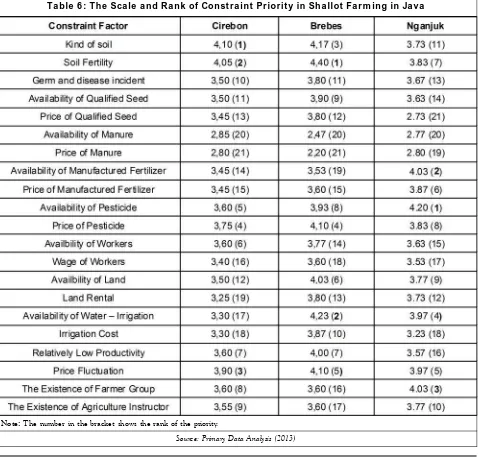
The success of farming in certain agricultural commodity including shallot is not free from many problems or constraint factors. According to Shanner (1982), the factors include physical environment (land and agroclimate), biology, watering condition, technology availability, and supporting system (debt capital, input market, output, information giving, and farmer resources). The result of the analysis on the constraint of shallot production in Java was presented in Table 6. It showed that the factors of kind the soil, soil fertility, and price fluctuation became the three main constraints of shallot farmers in Cirebon regency. Three main constraints for the shallot farmers in Brebes regency were soil fertility, water availability- irrigation, and kind of the soil. Therefore, the factors of kind of the soil and soil fertility became the constraints for the farmers in Cirebon and Brebes regencies, even though with different rank. Water availability for farmers in
Cirebon Brebes Nganjuk
R/C ratio > 1 1,53 > 1 1,55 > 1 1,65>1
Production > BEP of production 16.260 >528,91 13.135>454,76 20.571>2.400,35
Actual price > BEP of price 5.463>3.568 5.363>3.462 4.308>2.611
Revenue > land rental 30.809.049>3.498.015 25.893.651>2.029.933 39.565.149>8.144.180
Revenue > BEP of revenue 88.828.380>2.900.186 70.443.005>2.422.543 88.619.868>10.257.495
Conclusion Feasible Feasible Feasible
Feasibility Criteria
Research Location
Brebes regency became the second constraint after soil fertility factor and it was not the main constraint for the farmers in Cirebon regency. It was because the central area of shallot in Cirebon regency was in northern coast line near water source.
The factors of pesticide availability, manufactured fertilizer availability, and the existence of farmer group became three main constraints in shallot production system in Nganjuk regency. Pesticide and fertilizer, even
though only covering less than 12% of the part of the cost, became the determining factor of shallot production system in the two research locations. The existence of the two in sufficient amount became main requirement to achieve high production level. If pesticide and fertilizer were not available in sufficient amout and in the appropriate time, the shallot production system would be disturbed. Besides, the existence of farmer group became the supporting factor for the success of shallot production system. It was
Constraint Factor Cirebon Brebes Nganjuk
Kind of soil 4,10 (1) 4,17 (3) 3.73 (11)
Soil Fertility 4,05 (2) 4,40 (1) 3.83 (7)
Germ and disease incident 3,50 (10) 3,80 (11) 3.67 (13)
Availability of Qualified Seed 3,50 (11) 3,90 (9) 3.63 (14)
Price of Qualified Seed 3,45 (13) 3,80 (12) 2.73 (21)
Availability of Manure 2,85 (20) 2,47 (20) 2.77 (20)
Price of Manure 2,80 (21) 2,20 (21) 2.80 (19)
Availability of Manufactured Fertilizer 3,45 (14) 3,53 (19) 4.03 (2)
Price of Manufactured Fertilizer 3,45 (15) 3,60 (15) 3.87 (6)
Availability of Pesticide 3,60 (5) 3,93 (8) 4.20 (1)
Price of Pesticide 3,75 (4) 4,10 (4) 3.83 (8)
Availbility of Workers 3,60 (6) 3,77 (14) 3.63 (15)
Wage of Workers 3,40 (16) 3,60 (18) 3.53 (17)
Availbility of Land 3,50 (12) 4,03 (6) 3.77 (9)
Land Rental 3,25 (19) 3,80 (13) 3.73 (12)
Availability of Water – Irrigation 3,30 (17) 4,23 (2) 3.97 (4)
Irrigation Cost 3,30 (18) 3,87 (10) 3.23 (18)
Relatively Low Productivity 3,60 (7) 4,00 (7) 3.57 (16)
Price Fluctuation 3,90 (3) 4,10 (5) 3.97 (5)
The Existence of Farmer Group 3,60 (8) 3,60 (16) 4.03 (3)
The Existence of Agriculture Instructor 3,55 (9) 3,60 (17) 3.77 (10)
Ta ble 6 : Th e Sca le a n d Ra n k of Con st r a in t Pr ior it y in Sh a llot Fa r m in g in Ja v a
Note: The number in the bracket shows the rank of the priority.
because in the group, the farmers could share information to each other and it became a place for the farmers to get new technology.
CON CLU SI ON
1. The youngest shallot farmers were in Nganjuk regency, then followed by Brebes and Cirebon regencies. Based on the education level, the farmers in Brebes regency were the best because some of them used to study in university, then followed by farmers in Nganjuk and Cirebon. The farmers in Brebes regency had the longest experience in growing shallot, then the next place were occupied by the farmers in Cirebon and Nganjuk regencies. The widest land domination was in Cirebon regency, then followed by the farmers in Brebes and Nganjuk. The status of land domination among the shallot farmers was mostly rental and the biggest one was in Nganjuk regency.
2. The biggest profit of shallot farming were in Nganjuk regency, then followed by Cirebon and Brebes. The wage of the workers gave the highest contribution to the total farming cost. The highest value of BEP of revenue and BEP of production was in Nganjuk regency, while the highest value of BEP of price was in Brebes. In order to avoid loss, the shallot farmers in regencies of Cirebon, Brebes, and Nganjuk kept the price of the shallot in the three areas. They must not consecutively decrease more than 34,69%; 35,45%; and 39,39%. The shallot farming in Java was feasible to work on and to develop for.
3. The main constraints in shallot production Cirebon and Brebes regencies weres the kind of the soil and soil fertility. Meanwhile, the availability of pesticide and fertilizer as well as
the existence of farmer group became the three main constraints to the farmers in Nganjuk regency. The farmers in Brebes regency should improve the condition of the soil fertility because the productivity has decreased. Some solutions that could be done were crop rotation like the farmers in Nganjuk regency did, giving more organic fertilizer, and managing the planting time. The local government in Cirebon, Brebes and Nganjuk regencies should make policy to prevent the decrease of shallot price from happening in the three areas consecutively more than 34,69%; 35,45%; and 39,39%.
ACKN OW LED GM EN T
The researcher would like to express their gratitude to Dr. W itono Adiyoga, MS from Vegetable Research Office in Lembang, Bandung; Prof. Dr. Ir. Siti Subandiyah, MS; and Prof. Dr. Ir. Masyhuri from Faculty of Agriculture of UGM who have given opportunity to the writers to join ACIAR (Australian Centre for International Agriculture Research) project during 2012-2015. The writers would also like to express their gratitude to ACIAR that has given financial support to conduct this research.
REFEREN CES
1. Agusiobo O H (1994), “Sustainable Food Production, Role of UNAAB Graduates”,The Harvest Publication of National Association of Agricultural Student (NAAS), Vol. 1, No. 1, University of Agricultural Chapter.
2. Anyanwu B O (2003),Agricultural Science for School and College, Africa First Publisher, Onistha, Nigeria.
4. Bappeda Jatim (2011), “Kabupaten Nganjuk Dalam Angka”, www.bappedajatim.go.id, Diakses tanggal 9 Mei 2013.
5. Direktorat Jenderal Bina Produksi Hortikultura (2012), Departemen Pertanian, Jakarta.
6. Hariadi M dan Suratiyah K (1997), “Manajemen Finansial”, Jurusan Sosial Ekonomi Pertanian, Fak. Pertanian. UGM. Yogyakarta, Tidak dipublikasikan.
7. Kariyasa K dan Sudana (1993), Analisis Kelayakan Usahatani Padi dan Kedelai di Kabupaten Subang, Jawa Barat, Prosiding Perakitan dan Pengembangan Teknologi Sistem Usahatani Tanaman Pangan, Buku 1, Puslitbang Tanaman Pangan.
8. Nazir M (1989), “Metode Penelitian”,Ghalia, Indonesia, Jakarta.
9. Nidausholeha O (2007), “Perilaku Harga dan Keterpaduan Pasar Komoditas Bawang Merah”, Jurnal Agro Ekonomi, Vol. 14, No. 2, Jurusan Sosial Ekonomi Pertanian, Fakultas Pertanian UGM, Yogyakarta.
10. Nurasa T and Dan V Darwis (2007), “Analisis Usahatani dan Keragaan Marjin Pemasaran Bawang Merah di Kabupaten Brebes”, Jurnal Akta Agrosia, Vol. 10, No. 1, Hlm 40-48.
11. Rahayu E dan Nur Berlian (1998),Bawang Merah, Penebar Swadaya, Jakarta.
12. Shanner H W (1982), Farming System Research and Development Guidelines for Developing Countries, West View Press, Colorado, USA.
13. Singarimbun M and Dan S Effendi (1989), Metode Penelitian Survei, Lembaga Penelitian dan Pendidikan dan peneangan Ekonomi Sosial (LP3ES), Jakarta.
14. Subyantoro A and dan F X Suwarto (2007), Metode dan Teknik Penelitian Sosial, Andi Yogyakarta, Yogyakarta.
15. Suharjo A and dan D Patong (1973), Sendi-sendi Pokok Usahatani.
16. Sumaryanto (2004), Usahatani dan Pendapatan Rumah Tangga Petanin Padi: Studi Kasus di Persawahan DAS Berantas, Dalam:Ekonomi Padi dan Beras Indonesia, Badan Litbang Pertanian, Hal 225-252.
17. Suratiyah K (2011),Ilmu Usahatani, Penebar Swadaya, Jakarta.
18. Thompson H C and Kelly C N (1987), Vegetable Crops, 5th Edition, McGraw Hills Book Coompany, Toronto London, New York.
19. Triyono Rosyadi I and dan Ahyani F (2010), Efisiensi Pengelolaan Pasar Bawang Merah, Dinamika Sosial Ekonomi, Vol. 6, No. 1, Edisi Mei.