UNIVERSITI TEKNIKAL MALAYSIA MELAKA
DESIGN MONITORING POSITION SYSTEM OF UTeM BUS
This report submitted in accordance with requirement of Universiti Teknikal Malaysia Melaka (UTeM) for Bachelor’s Degree Electronic
Engineering Technology (Electronic Telecommunication) Hons.
by
NOOR AIMAN BIN MOHD AZMAN
B071210191
930208-10-6113
FACULTY OF ENGINEERING TECHNOLOGY
i
ABSTRAK
ii
ABSTRACT
iii
DEDICATION
Special dedication to:
My mother, father, siblings, housemate, friends and her who always support and encourage me through my education journey.
My supervisor Mr. Chairulsyah Wasli
To other lecture Dr. Abdul Kadir and Mr. Win Adiyansyah Indra
iv
ACKNOWLEDGMENT
In the name of Allah, the Most Beneficent and Most Merciful.
First of all, all praised to Allah with the Most Kindness for giving me a chance to finish and completed this project.
Besides, for my supervisor, I would like to thanks to you for supervised, guide, support and ideas that you give to me in order to ensure this project can be accomplished. I also asking apologized to my supervisor in case I am doing wrong. Thank you again for spent time for me to help encounter several problems happen during this project carried out.
Other than that, I would like to say thank you to other lecturer that give their help to me especially to Dr. Kadir and Mr. Win Adiyansyah Indra. Both of them very help in finishing this project.
v
LIST OF ABBREVIATION, SYMBOL AND NOMENCLATURE... xi
LIST OF APPENDICES ... xii
vi
2.1 Global Positioning System ... 5
2.1.1 GPS Error ... 6
2.1.2 How GPS Works ... 7
2.1.3 Accuracy in GPS ... 8
2.2 Global System for Mobile Module (GSM Module) ... 10
2.3 Satellite Communication ... 12
2.3.1 LEO, MEO and GEO Satellite ... 13
2.4 Base Transceiver Tower, BTS ... 14
2.5 Loss in Satellite Communication ... 15
2.5.1 Free Space Loss ... 16
2.5.2 Atmospheric Loss ... 17
2.5.3 Pointing Loss ... 18
2.5.4 Local Loss ... 18
2.6 Bus Monitoring System Topology ... 19
2.6.1 Network Connection between Satellites to the Bus ... 20
2.6.2 Network Connection between Buses to the PC ... 20
vii
RESULT AND DISCUSSION ... 30
4.1 Introduction ... 30
4.2 Tracking System Hardware ... 30
4.3 Theoretical Calculation ... 33
4.3.1 Time Interval of Data ... 33
4.3.2 Free Space Loss ... 34
4.4 Software Measurement ... 35
4.4.1 GPS Accuracy ... 35
4.4.2 Free Space Loss ... 37
4.5 Hardware Simulation... 38
4.5.1 Time Interval of Data ... 38
4.5.2 GPS Accuracy ... 38
4.6 Arduino Coding ... 40
4.6.1 GSM ... 40
4.6.2 GPS ... 41
4.6.3 Receiving SMS and Sending GPS Flowchart ... 42
4.7 Tracking System Hardware not Fully Operated. ... 43
4.8 Route Map from UTeM Sri Utama to Kampus Teknologi UTeM ... 44
CHAPTER 5 ... 45
viii
5.1 Introduction ... 45
5.2 Analyze... 45
5.3 Discussion ... 46
5.4 Conclusion ... 49
5.5 Recommendations ... 50
REFERENCES ... 51
APPENDIXES ... 53
Appendix A: Gantt Chart ... 53
Appendix B: Mathematical Formula ... 53
Appendix C: Arduino Coding ... 53
Appendix D: GPS Specifications ... 55
Appendix E: GSM Specifications ... 57
ix
LIST OF TABLE
2.1 Losses in satellite communications 16
x
2.6 uplink and downlink transmission 12
2.7 LEO, MEO, and GEO position in orbit 14
2.8 BTS tower 15
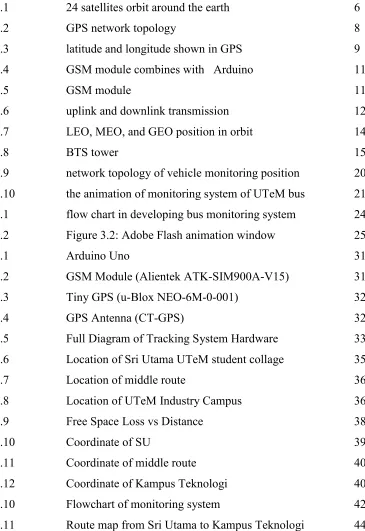
2.9 network topology of vehicle monitoring position 20 2.10 the animation of monitoring system of UTeM bus 21 3.1 flow chart in developing bus monitoring system 24
3.2 Figure 3.2: Adobe Flash animation window 25
4.1 Arduino Uno 31
4.2 GSM Module (Alientek ATK-SIM900A-V15) 31
4.3 Tiny GPS (u-Blox NEO-6M-0-001) 32
4.4 GPS Antenna (CT-GPS) 32
4.5 Full Diagram of Tracking System Hardware 33
4.6 Location of Sri Utama UTeM student collage 35
xi
LIST OF ABBREVIATION, SYMBOL AND
NOMENCLATURE
UTeM Universiti Teknikal Malaysia Melaka
GPS Global Positioning System
GSM Global System for Mobile
LEOSATS Low Earth Orbit satellite MEOSATS Medium Earth Orbit satellite GEOSATS Geosynchronous Satellite
Km Kilo Meter
ms mili second
xii
LIST OF APPENDICES
1
CHAPTER 1
INTRODUCTION
1.1 Background
Roughly, this project developed in order to overcome problem regarding unknown specific current position of UTeM bus location. Unknown current position of UTeM bus location give quite huge problem especially to UTeM management in order to ensure their bus following the schedule provided. Basically, what is going to do is to develop a kind of system that contain communication path between UTeM bus and university management to monitor current location of the bus. The thing that should be done to make this project is searching a lot of information regarding monitoring system such as Global Positioning System, (GPS), and Global System for Mobile Communication, GSM module and Arduino since this project used Arduino as microcontroller. The information collected will be used for the next activity which is calculating, measuring and simulating.
2
transmitters installed inside the bus and PC used to display the current location of the bus by using GSM 900 module.
1.2 Problem Statement
The main problem face before this project developed is the bus did not follow the schedule made by university management due to several reason like traffic congestion and else. Therefore, this project will help the university management to ensure their bus following the schedule provided. Besides, in this project, a monitoring (global positioning system) GPS with good overall performance will be used.
1.3 Objectives
1. To the gain knowledge about the role of GPS in monitoring moving object like, UTeM bus.
2. To make an animation about the UTeM bus monitoring system for better understanding about this project.
3. To develop a coding that used for Arduino in order to monitor the position of moving object like UTeM bus.
1.5 Project Scope
3
While, in animation section, the will be an animation develop to represent the project developed. This main purpose of this animation is to give a graphical approach to the panel or viewer. So that, with the graphical approach the panel or viewer can gain more understanding about how this project or system operated. For the design section, most of the activities are about design. The design is including on the system and hardware. The design task usually required a lot of time due to idea, error and repairmen. There were several design developed. However, only a well project design will be selected and proceed with the next process.
The design project needs to pass through some inspection like calculation, simulation and measurement. The project design need to be tested with some calculation related to monitoring position. The calculation used like the calculation of return loss by using formula found from the book. Besides, simulations also need to be done to find out whether the project designs operate according to desire operation. Other than that, measurements also need to carry out in order to check whether the value required in this project is obtained or not. The example of the measurement is on output frequency and input impedance. All of three tests which are calculation, simulation and measurement will be repeated again if the test is not fine.
Once all the result and information gain from previous operation. The result and information will need to analyze. The main purpose of analyze is to observe the result obtain and use the observation to make the discussion about the project. The analysis done also to compare between the results obtain with the theoretical result. Other than that, analysis also carried out to find the solution on certain problem happen.
4
generate the hardware used. Last but not least is about thesis writing. Thesis writing is the part where the documentation of the project develops is written. With thesis writing, all of the information regarding project developed such as result, analysis and animation can be view and read to get further understanding about the project. This project scope limited to a UTeM bus only where the coverage area is the daily route used by UTeM bus.
1.6 Thesis Outline
5
CHAPTER 2
LITERATURE REVIEW
2.1 Global Positioning System
Global Positioning System or GPS is kind of system that has been used to support a wide variety of application, such as high efficiency positioning and navigation (Aly M. El-Nagar 2011). The basic values that needed in positioning and navigation is the latitude and longitude values. Each GPS has its own accuracy depending on the value of data transferred per second.
6
Figure 2.1: 24 satellites orbit around the earth (www.quora.com, 2014)
2.1.1 GPS Error
Global Positioning System (GPS) measurement can be corrupted by several error sources (Aly M. El-naggar, 2011). These errors categorized as biases and random error. Common-mode error between the reference and the rover GPS station caused from Ionospheric and tropospheric refraction and delays, satellite and receiver clock biases, and orbital errors. The Ionospheric delay in the propagation of Global Positioning System (GPS) signal is one of the main sources of error in GPS precise positioning and navigation.
7
remove the correlated bias terms between receivers. The ionospheric effect became the biggest source of error in GPS positioning and navigation.
2.1.2 How GPS Works
First, the GPS satellite broadcast radio signal providing their location, status and precise time from onboard clock. Then the GPS radio signals travel through space at the speed of light which is more than 299,792 km/s. A GPS device receives the radio signals, accepts nothing except their exact time arrival, and uses these to calculate its distance from each satellite in view. Once a GPS device knows its distance from at least four satellites, it can use geometry to determine its location on earth in three dimensions. A GPS device applies this formula to the satellite’s signal in order to calculate its distance from a satellite.
Time = distance / rate (2.1)
Rate = speed of light, [m/s]
Time = time signal travel through space, [s] Distance = distance GPS from satellite, [km]
8
Figure 2.2: GPS network topology (www.gps.gov, 2013)
2.1.3 Accuracy in GPS
The positioning accuracy has been achieved with the Global Positioning System (GPS) in continuously operating GPS network has been considerably improved during the last few years. The rapid development of the positioning accuracy with GPS, mainly under the umbrella of the international GNSS Services for Geodynamics consortium, provide more précised determination of satellite orbital parameters, through the enlargement of the GPS satellite constellation, and the improvement of the global Continuous GPS (CGPS) tracking system coverage (U. Dogan et al 2014).
9
different antennas can be eliminated fixed, stable pillars antenna. Below is the formula and calculation in order to measure the accuracy of the GPS.
Circumference of the earth = 40,075 km (2.2) Degree of the earth circumference = 180
180 = 40,075 km 1 = 222.64 km
According to GPS reading, the reading up to 0.000001 which is . Then,
Accuracy = 222.64 km /
= 0.2 meter
Just to be informed that the accuracy of the GPS in seasonal change also can be investigated, analyzed and measured. Each season will give different accuracy of GPS due to several factors like temperature, humidity and cloud thickness. The accuracy of the GPS measured based on the seasonal variations, the observing session duration and baseline length. The reading of latitude and longitude of the location can be vied like in figure 2.3 below.
10
2.2 Global System for Mobile Module (GSM Module)
Human machine communication represented the Global System for Mobile (GSM) that acts as an intermediate between owner and system (N. Kiruthigaet al. 2015). GSM is the worldwide accepted standard for digital cellular communication. GSM modems are most frequently used to provide mobile internet connectivity and many are used for sending and receiving Short Message Services (SMS).
A wireless link is provided between the owner’s cell phone and MCU (Microcontroller Unit) by GSM (Global System for mobile) module. It is similar to dial-up modem. The main dissimilarity between them is that in dial-up modem transmission and reception of data is through fixed telephone line whereas wireless modem uses radio waves. PIC uses AT (Attention) command to control modem. The figure of GSM module combined with Arduino can be viewed in figure 2.4 while single figure of GSM module can be viewed in figure 2.5. GSM modem maintain set of standard AT commands. The functions of AT commands are given below:
a) Reading writing and deleting SMS messages b) Sending SMS message
c) Monitoring the signal strength
11
Figure 2.4: GSM module combine with Arduino (www.rhydolabz.com, 2013)