THE COMPARISON OF THEME IN “THE ROCKING
HORSE-WINNER” AND IN “THE SCARLET IBIS”
Ciko Permana Sidiq
103026027647
ENGLISH LETTERS DEPARTMENT
“ADAB” AND HUMANITIES FACULTY
STATE ISLAMIC UNIVERSITY
“SYARIF HIDAYATULLAH”
THE COMPARISON OF THEME IN “THE ROCKING
HORSE-WINNER” AND IN “THE SCARLET IBIS”
A Thesis
Submitted to “Adab” and Humanities Faculty
In Partial Fulfillment of the Requirements for
the Degree of “Sarjana Sastra”
Ciko Permana Sidiq
103026027647
ENGLISH LETTERS DEPARTMENT
“ADAB” AND HUMANITIES FACULTY
STATE ISLAMIC UNIVERSITY
“SYARIF HIDAYATULLAH”
ABSTRACT
Ciko Permana Sidiq. The Comparison of theme in “The Rocking Horse Winner” and ”The Scarlet Ibis”. Thesis. English Letters Department. Adab and Humanity Faculty. State Islamic University Syarif Hidayatullah Jakarta, 2008.
APPROVEMENT
THE COMPARISON OF THEME IN “THE ROCKING HORSE-WINNER”
AND IN “THE SCARLET IBIS”
A Thesis
Submitted to “Adab” and Humanities Faculty
in Partial Fulfillment of the Requirements for
the Degree of “Sarjana Sastra”
Ciko Permana Sidiq
103026027647
Approved by:
Advisor
Drs. A. Saefuddin, M. Pd,
NIP. 150 261 902
ENGLISH LETTERS DEPARTMENT
“ADAB” AND HUMANITIES FACULTY
STATE ISLAMIC UNIVERSITY
“SYARIF HIDAYATULLAH”
LEGALIZATION
The thesis entitled “The Comparison of Theme in “The Rocking Horse-Winner” and in “The Scarlet Ibis” has been defended before the Letters and Humanities Faculty’s Examination Committee on August 21, 2008. The thesis has already been accepted as a partial fulfillment of the requirement for the “Sarjana Sastra” degree in English Letters Department.
Jakarta, August 21, 2008
Examination Committee
Chair Person, Secretary,
Dr. H. Muhammad Farkhan, M. Pd. Drs. A. Saefudin, M. Pd. NIP. 150 299 480 NIP.150 261 901
Members
Examiner I Examiner II
DECLARATION
I hereby declare that this submission is my own work and that, to the best of my knowledge and belief, it contains no material previously published or written by another person nor material which to a substantial extent has been accepted for the award of any other degree or diploma of the university or other institute of higher learning, except where due acknowledgment has been made in the text.
Jakarta, August 21 2008
ACKNOWLEDGEMENT
In the name of Allah, the Beneficent, the Merciful. All praises are due to
Allah, the Almighty, and the Lord of all that exist. May Allah’s peace and blessing
be upon His final Prophet and Messenger, Muhammad, his family and his
companions
This
thesis
is presented to the English Letters Department of the Faculty
of “Adab” and Humanities, UIN “Syarif Hidayatullah” Jakarta as a partial
fulfillment of the requirements for sarjana degree (S1).
It is a great honor for the writer to make acknowledgment of indebtedness to convey his sincere gratitude to Drs. A. Saefudin, M. Pd., who has patiently given valuable advice and guidance to accomplish this thesis.
The writer also would like to convey his sincere gratitude particularly to:
1. Drs. H. Abd. Chair, MA, as The Dean of “Adab” and Humanities Faculty.
2. Drs. H. M. Farkhan, M. Pd., as the Head of English Letter Department.
3. Drs. A. Saefudin, M. Pd., as the Secretary of English Letters Department.
4. All the lecture of English Letters Department for their encouragement to the writer
5. The writer’s beloved parents, Bibin Zaenudin and Mimah.
6. His beloved brothers and sisters, Lina Idamayanti, Dian Hartono, Ade Shinta
7. His beloved girl friend, Indah Pratiwi for the love
Jakarta, August 21 2008
TABLE OF CONTENTS
ABSTRACT ... i
APPROVEMENT ... ii
LEGALIZATION ... iii
DECLARATION ... iv
ACKNOWLEDGMENT ... v
TABLE OF CONTENTS ... vii
CHAPTER I INTRODUCTION ... 1
A. The Background of Study ... 1
B. The Focus of Study ... 3
C. Research Question ... 4
D. The Objective and Significance of Study... 4
E. The Methodology of Study ... 5
CHAPTER II THEORITICAL FRAMEWORK ... 7
A. Definition of Theme ... 7
B. The Important of a Theme in a Story ... 11
C. The Ways of the Author Use to Develop a Theme ... 13
D. The Method of Comparison ... 14
CHAPTER III RESEARCH FINDING ... 20
A. Data Description……….. 20
B. Analysis……….. 27
1. The Ways the Author Use to Deliver the Theme in the two short stories ... 27
2. The Themes of the Two Short Stories ... 27
a. The Similarities of Themes ... 28
CHAPTER IV CONCLUSION ... 52 BIBLIOGRAPY ……… 54 APPENDIXES (THE SHORT STORIES) ... 56 The Rocking Horse-Winner
CHAPTER I INTRODUCTION
A. The Background of Study
Family relationship often bears conflict because of the lacking of understanding among each other. It is a small part but essential in every body’s life. Family’s life and its various problems are mostly portrayed in a literary work such as short stories.
In this research the writer has chosen two short stories to be analyzed, because The Rocking Horse Winner by D>H Laurence and The Scarlet Ibis by James Hurst talk about conflict family relationship, both have common issues that disorientation pursuing love make both characters in both stories died young.
The Rocking-horse Winner by D.H. Lawrence is a reflection of society’s
materialism, the search for material happiness and in the some time ignoring the real matter of life. The people are looking for happiness in the wrong place The Rocking
Horse Winner tells about a family who pretends to have a life full of luxury while their
Another short story the writer will analyze is the Scarlet Ibis by James Hurst. This story has been chosen by writer because It focuses on the troubled relationship between two young boys: the narrator and his mentally and physically disable brother, Doodle. It explores the conflict between love and pride and draws attention to the effect of familial and societal expectation on those who are handicapped.
In this research, the writer will analyze theme that occurs in both short stories. Stories that are written are entirely to teach a moral lesson in the relationship among the member of the family. The lesson could be the problem of life, love, or even conflict within family relationship.
There are several lessons we may gain regarding family relationship. As we know that family is the smallest unit in social life. It is the beginning of a person’s life, a place where personality, education, and attitude are formed. The relation among members of family not always goes on well. The problems always occur in everyday among them. Conflicts often appear in family relationship from mother-daughter, husband-wife, mother-son, even within brother. The problem of life and the obsession of one of the member of the family may lead the conflict in the family relationship.
The Rocking Horse Winner and the Scarlet Ibis have common that is a conflict
On the other hand, in The Scarlet Ibis, the conflict that occurs is within two young brothers. Brother forced his physically and mentally disabled younger brother to do cruel things. He teaches his disabled younger brother to walk, run, swim, and climb trees and fight. He does it in order to pursuit his expectation of making his brother to be just like other normal children.
The writer is interested to analyze two short stories that are The Rocking Horse
Winner by D.H. Lawrence and The Scarlet Ibis by James Hurst, because the writer
found deep and interesting issues in both short stories. Since both stories have common in conveying the values of life. Both stories picture the life of two young men. Both tell their experiences as passing from childhood to maturity. In that journey they are pursuing the standard of person they love. They put high standard that both young men struggle to achieve.
It is important for the writer to bring up the values of life revealed in both short stories. It is needed to be shared to people who read it, their relation among others. Furthermore, the writer also wants the reader to have a reflection for themselves after reading it.
B. The Focus of the Study
C. The Research Question
Based on the background of the research and the focus of the study above, the research questions are:
1. How do the authors deliver main theme in The Rocking Horse Winner and The Scarlet Ibis?
2. What are the similarities and the differences of sub-themes between the two short stories?
D. The Objective and Significance of Study
The objectives of study are to know about the similarities and differences of theme occurred in The Rocking-Horse Winner and The Scarlet Ibis.
The significance of study is classified into two, the academic and practical significance of study. The academic significance of study is to fulfill one of the requirements for “SI” degree to the Faculty of “Adab” and Humanities of the State Islamic University “Syarif Hidayatullah” Jakarta. The practical one is to broad up the researcher’s knowledge regarding to the comparison themes in the two short stories.
E. The Methodology of Study
1. The Method of Research
Ibis. In the analytic descriptive, the writer described some facts and also the result of analysis.1 The writer will describe some quotations in the stories to support the similar themes and difference themes that have been found.
2. Instrument of the Research
In this research, the instrument of the research is the writer himself. The writer used relevant materials that related with the study. The data that related to the study collected from library.
3. The Unit of Analysis
The units of analysis in this research are two short stories, The Rocking
Horse Winner by D.H. Lawrence which was published in the 1926 in Harper’s
Bazaar magazine and The Scarlet Ibis by James Hurst which was first published
in July 1960 by the Atlantic Monthly Magazine.
4. The Time and Place of the Research
The skripsi is accomplished in 2007/2008 in English Letters Department, “Adab” and Humanities Faculty. This skripsi is conducted at Islamic State University Jakarta Library and other university‘s library in Jakarta, which provide the information and references about the material that the writer needs, such as the Library of Catholic Atmajaya, the Library of UI, and Library of UNJ.
1
5. The Technique of Data Analysis
CHAPTER II
THEORETICAL FRAMEWORK
A. The Definition of Theme
The theme of the story is basically a kind of message and ideas from the author to the people who read it. This is supported by James Pickering H. and D. Hoeper, as they said in their book “it is the author’s way of communicating and sharing ideas, perceptions and feelings with his readers”.2
In literature, a theme is abroad idea in a story, or message or lesson conveyed by a work. This message is usually about life, society or human nature.3 Theme is not just the central of a story at whole; it also contains moral lessons that can be applied in everybody’s life. The idea of a story can be a way to learn and to teach in improving someone’s attitude. The ideas bear interpretation of people’s experience as it is supported by Robert and Warren that, “the theme is what a piece of fiction stacks up to, it is the idea, the significant, the interpretation of person and events, the pervasive and unifying view of life, which is embodied in total narrative”.4
In a short fiction, theme may be found more than one as Henry Tarigan states that, “… bahwa dalam karya fiksi mungkin saja ditemukan lebih dari satu tema…”5
. As it is also stated in a site that a theme as an idea or main concept of the story in many novels or short stories, may contain more than one theme.6 It is
2
James H. Pickering and Jefeery D. Hoeper, Concise Companion to Literature, (New York: Macmillan Publishing Co., Inc., 1981), p. 61
3
http://en.wikipedia.org/wiki/Theme_%28literature%29 on December.
4
Warren, Robert P., Understanding Fiction, (New York: Appleton-Century-Crofts, Inc., 1969), p. 273.
5
Henry Guntur Tarigan, Prinsip-Prinsip Dasar Sastra, (Bandung Angkasa, 1991), p. 120.
6
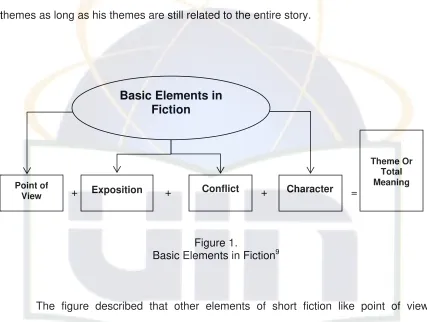
now known that two or more themes can be revealed in a story. As Kennedy states “theme of the story is whatever general idea or insight the entire story reveals.”7 It has been stated also by Nurgiyantoro that “makna cerita dalam sebuah karya fiksi-novel, mungkin saja lebih dari satu, atau lebih tepatnya: lebih dari satu interpretas.”8 From this fact, the writer believes that every person reads the literary work may obtain different themes as long as his themes are still related to the entire story.
+ + + =
[image:18.612.90.517.190.512.2]Figure 1.
Basic Elements in Fiction9
The figure described that other elements of short fiction like point of view, exposition, conflict, character are part of elements that supporting themes. In other words, theme is the total meaning of those elements. It revealed from those elements.
Theme is the total meaning of the story. It is the underlying significance of the experience the story relates; it is an interpretation of human life: it is the author’s
7
X J. Kennedy, An introduction to Fiction, (Boston, Toronto: Little, Brown and company, 1979), p.103
8
Burhan Nurgiyantoro, Teori Pengkajian Fiksi, (Yogyakarta: Gajah Mada University Press. 2002.), p. 82
9 Marguerite Smith Holton, English Composition Book II, (New York: G. P. Putnam’s Sons, 1996), p. 62
Point of
View Exposition Conflict Character
Theme Or Total Meaning
Basic Elements in
comments of human values; it is the sum total of all the elements in the story. It is an implicit idea with universal overtones made manifest through the lives and thoughts of the characters.10 To sustain his theme, the other select a particular point of view, inserts information, creates particular conflicts.
In literary work, either short story or novel always has a theme because theme is the center of idea in a literary work. There are various theories of themes the writer found in the book of literary.
One of them is stated by William Kenny that “theme is one of the most important elements of a novel to make the matter simple; theme is the meaning of the story. It also means something that can be derived from the story and may be defined on the central idea in a work of literature”11. As it is supported by James Pickering and D. Hoeper that “Theme is the central idea or statement about life that unifies and control the total work”12. In Kamus Istilah Sastra, it has been similarly defined that, “Tema adalah gagasan, ide atau pikiran utama di dalam karya sastra yang terungkap ataupun tidak.
Tema dapat dijabarkan dalam beberapa pokok.”13
Other theorist, Sylvan Barnet et al in their book said that “usually, a story is about something, it has a meaning, a point-theme.”14 William Kenny had some ideas about theme that “theme is the total meaning discovered by the writer in the process of writing and by the reader in the process of reading.”15
The theme is term which has various meaning for different people, “theme is also used sometimes to refer to the basic issue, problem, or subject with which the works
10
ibid
11
William Kenny, How to Analyze Fiction, (New York: Monarch Press,, 1996), p. 89
12
James H. pickering and Jefeery D Hoeper, op. cit p., p.61.
13
Panuti Sudjiman, Kamus Istilah Sastra, (Jakarta: PT. Gramedia, 1984), p. 74
14
Silvant Barnet et al, An Introduction to Literature (New York: Monarch Press, 1961), p.15.
15
concerned”, said D. Hoeper and Pickering.16 In addition, the theme is considered as the important information taken from the literary work. The information can be the human experience, the comment on principle of individual characteristic and behavior, and the conception of the person’s experience in the world.
According to Cleant Brooks, theme is an interpretation of the story itself. He continues, it is an interpretation of the world beyond the story. So, the story may be interpreted because it has what we call a theme, as Brook defined, the governing idea implicit in the original situation of conflict that becomes the focal idea in the end of the story.”17Hence, the idea of a story could be interpreted beyond the story itself to reveal the values of life.
The writer recognizes that theme must have accordance to the kind of the story itself, whether it is comedy, horror or romantic. Theme can be built from other elements of the story. It means theme is the story and the story is the theme. According to Brook that “Only when the theme is implicit in the other elements of a play and a dynamic progression of the story can the story be said to exist at all”18. So, it can be said that “the story is the theme and theme is the story.”19
From several definitions of theme above, it can be concluded that every story does not contain only one theme. It may contain more than one. Moreover, the theme itself is every main point or the central insight revealed along the story that bring value of life that can be a moral lesson for the readers.
B. The Importance of Theme in a Story
16
James H. pickering and Jefeery D Hoeper, op. cit., p.61.
17
Cleanth Brooks, Joan Thibaut Purser, Robert Penn Warren, An Approach to Literature, (New Jersey: Prentice-Hall, Inc, Englewood Cliffs, 1964, 1967 ), p. 15
18
Ibid., p.17.
19
The writer thinks that story must have a theme because of what has been written by X.J. Kennedy, that “theme is a center, moving force, the principle of unity.”20 In the story, therefore, by having theme, it means that story has one center, in which all the elements of stories meet. So, it has values to be shared to the people who read it. Conversely, if story doesn’t have a theme, it means that story runs in many ways and does not have one center where all the elements of the story meet. So, it would be meaningless and the readers would not get something from what they read. As it stated by Brooks and Warren that, “Themes as one essential part of short story is what is made of the topic. It is the comment on the topic that is implied in the process of the story. The theme does not easy to shown. It shall be comprehended and interpreted through other data and story”.21
It is often hard for the readers to know theme of a story by comprehending the content of the story as unity, however theme will be easier to be found. Reading the story repeatedly also helps to obtain the theme and understand the story.
Next, it is important for people to know and get a theme in a story because it is the way to make people have better awareness about anything they have understood after they read a story. The writer thinks that the elements in a story are also important. For instance characters and plot must relate to the theme.
If the author uses any piece element that is not related to the theme, it would make confusion for the readers, and as a result they will not be able to get the idea of the stories. If a theme is about the goodness versus the badness, some characters must reflect the good attitude and some reflect the bad attitudes. The good characters must describe that they really have positive sides to be against others who have negative sides. Therefore, they will support the theme. So, every element of story must relate
20
X.J. Kennedy, op. cit., p. 104. 21
each other as stated by James Pickering H. and Jeffery D. Hoeper as they say in their book Concise Company of Literature, also said that “all parts of the piece of work should contribute to develop, or relate to the theme in some way.”22
Here are some ways to uncover the theme in a story:
1. Check out the title, sometimes it tells you a lot about the theme
2. Notice repeating patterns and symbols, sometimes these lead you to the theme
3. What allusion is made throughout the story? 4. What are the details and particulars in the story? 5. What greater meaning may they have?23
It is needed to remember that theme, plot, and structure are inseparable. All are helping to inform and reflect back on each other. Also, it needs to be aware that a theme determine from a story never completely explains the story. It is simply one of the elements that make up the whole.24
C. The Ways the Author Deliver the Theme
There are two ways that are used by the authors in conveying theme. In “Concise Companion to Literature” Pickering and Hoeper said that “the theme must be explicitly stated by one of the characters (who serves as spokesman for the author) or by the author in the guise of an omniscient narrator.25 However, they also said that people must be aware of theme in a story because without considering other elements of a story, the characters and narrators alone can be unreliable and misleading.
On the other hand, according to theme, some themes are not stated, but those are implied, revealed gradually through the treatment of characters and incidents and by the progress and movement of a story. They also gave the reason for this,“ this is particularly true of works in which theme is tied to the revelation character and/or what
22
James H. pickering and Jefeery D Hoeper, op. cit., p.19
23
http://www.learner.org/exhibits/literature/read/theme1.html Accessed on January 2008
24
Ibid
25
that character may imply about people or life in general.”26 As it is supported by Robert and Warren that, “the theme is what is made of the topic. It is the content on the topic that is implied in the process of the story.”27
The theme may be explicitly stated by one of the characters (who serve as a spokesman for the author) or by the author in the guise of an omniscient narrator. Even though such explicit statements must be taken seriously into account, a degree of caution is also necessary, for as it is known that characters and narrators alike can be unreliable and misleading. In most cases, however, theme is not stated but implied by the work’s total rendering of experience; it is only gradually revealed through the treatment of character and incident and by the progress and movement of the story. This is particularly true of works in which theme is tied to the revelation of character and takes the form of a statement about that character and/or what that character may imply about people or life in general.
Furthermore, in one story, there may more than one theme. This statement is strengthened by X. J. Kennedy in his book, Literature: An Introduction to Fiction, Poetry and Drama. He says that, “Great short story, like great symphonies frequently have more than one theme.”28 For example, in a novel or a short story, they would be several themes. It depends on how the authors present their messages or ideas.
D. The Methods of Comparison
Comparison is such a familiar everyday activity. However, it may be difficult for people to think of comparison itself as an important mental process. Furthermore, without ability to perceive the similarities, people could not classify, define, or generalize.
26
Ibid.
27
Warren, Robert, op cit, p. 272
28
And without the ability to perceive differences, people could not analyze, define, or describe.
In comparing two short stories, there are two ways, the first one is “a common but inferior, way is to make your points first about one work and then do the same for the other. This method makes your paper seem like two big lumps, and it also involves much repetition because the same points must be repeated as treating the second subject. The first method is only satisfactory”29. So, in comparing themes, it would be necessary to make points of themes that could be revealed by the character of the story or in other elements of the story.
And the second one, “the superior’s method is to treat your main idea in its major aspects and to make references to the two (or more) writers as the reference illustrates and illuminates your main idea. After pointing the themes, the next steps are taking the references from the story and making them into major aspects and illuminate them.30
The comparison of theme may be used to compare and contrast different authors, two or more works by the same author, different drafts of the same wok, or characters, incidents, and ideas within the same work or in different works.31 The comparison –contrast that is not only popular in literature courses, but it is one of the commonest approaches people will find in other disciplines. The ideas of philosophers may be compared, or the approaches of two schools of psychology, or two conflicting economic theories. The possibilities for using comparison-contrast are extensive.32
Comparison and contrast are the important means to gain understanding. First when people start comparing the two short stories, however they will immediately notice things that people may not have noticed at first. Making a comparison and contrast in
29
Ibid. 30 Ibid, p. 114.
31
Ibid.
32
this way enables people to see each short story in perspective, and therefore more clearly.33
The comparison-contrast method is similarly rewarding whenever people apply it, for perhaps the quickest way to get at the essence of an artistic work is to compare it with another work. The comparison-contrast method is closely related to the study of definition, because definition aims at the description of a particular thing by identifying its properties while also isolating it from everything else. The problem is to select the proper material-the grounds of the discussion. It is useless to try to compare dissimilar things, for then conclusions will be of limited value. It is needed to put the works or writers which are comparing onto common ground. Compare is like, idea with idea (themes with themes), characterization with characterization, imagery with imagery, point of view with point of view, problem with problem.34
There are two steps in using comparisons-contrast method. Firstly, it is needed to state what works, authors, characters, and ideas are under consideration, then to show how the basis of the comparison have been narrowed. The central idea will be a brief statement of what can be learned from a research; the general similarities and differences that have been observed from the comparison and or the superiority of one work or author over another.35
It is any point may be chosen for comparison it might be comparing two works on the basis of point of view or imagery, two authors on ideas, or two characters on
character traits. When it is comparing the ideas in two different works, the first part of
theme might be devoted to analyzing and describing the similarities and dissimilarities of the ideas as ideas. Interest here is not so much to explain the ideas of either work separately as to explain the ideas of both works in order to show points of agreement
33
Ibid, p. 112
34
Ibid.
35
and disagreement. A second part might be given over to the influences of the ideas on the point of view of the particular works; that is, people might discuss how the ideas make the works similar or dissimilar. If we are comparing characters, our point might be to show similarities and dissimilarities of mental and spiritual qualities and of activities in which the characters engage.36
In the conclusion of comparison research, it is comparatively free to reflect on others ideas in the works that have been compared, to make observations on comparative qualities, or to summarize briefly the basis grounds of comparison. The conclusion of an extended comparison-contrast theme should represent a final bringing together of the materials. In the body of the theme people may not have referred to all the works in each paragraph; however, in the conclusion people should try to refer to them all.37
Comparison is process of examining two or more things in order to establish their similarities or differences. Both the word similarity and the word difference conjure up all sorts of interesting images in the imagination, images that reflect their widespread use in everyday thinking. Although similarity and difference are closely related, as being different mental processes.38
In actually, any relationship between two or more things will involve some degree of similarity as well as some degree of difference. In situations where there is both similarity and difference between two things, a relation known as polarity exists between them.39
In exploring a subject by using the topic of comparison, a sequence of steps would probably be followed below:
36
Ibid.
37
Ibid.
38
Frank J. D’Angelo, Process and Thought in Composition, (Cambridge: Winthrop Publisher, Inc, 1977), p. 195
39
1. Choose subjects that are interesting enough to challenge your imagination. 2. Try, if you decide to compare two commonplace subjects, to look at them
from a fresh point view.
3. Consider your purpose and your angel of vision. What particular point of view, what particular insight you can give your readers to make them see what you see.
4. Be certain that there are enough aspects of the things to be compared to make a valid and interesting comparison. An aspect is a characteristic or feature of the thing to be compared, considered from one point of view. 5. Choose only the most significant aspects of a subject to compare40.
To compare is to show how items are alike. To contrast is to show how items are different. Thus comparison and contrast involve pointing out the similarities or differences between two (or more) items. To help make the comparison as precise as possible, the items compared are usually the same kind or class or things.
When deciding upon what to compare, it is needed to be sure that both items are in the same general category and share many points in common. People can usually compare two paintings more precisely than people can compare a novel and a painting.
Once two closely related items have been picked out, it is needed to explain as clearly as possible the ways in which the items are alike or different. In any given piece of writing, people may use comparison only- or contrast only. Or people may decide to use some of both in the same research41.
There are some various way to compare things, they are:
When the writer compares (or contrast) to object item by item, it is called the
alternating or point-by-point method. If the writer prefers second type of
organization, the block method, he or she explains all the characteristics of the first item together in a block and than explains all the characteristics of the second items in a corresponding block. Third “mixed” method is useful when the writer wants to both compare and contrast in the same paragraph. All the similarities of the two items may be explained first and then all the differences. (Of course, if the writer chooses, the differences may be explained first and then similarities).42
40
Frank J. D’Angelo, Process and Thought in Composition, (Cambridge: Winthrop Publisher, Inc, 1977), p.197
41
Mary Lou Conlin, Patterns a Short Prose Reader, ( Boston: Houghton Mifflin Company, 1983), p. 153
42
Comparison and contrast are such useful technique for explanation that college instructors in many differences fields like to construct research questions that call for a comparison or contrast in the answer.
The most important thing in analyzing a comparison and contrast is to make sure that author organize the short fiction around certain definite point of comparison. That is, people should always base the comparison on specific points that can be discussed about both sides of the issue. To help readers to see the differences or the similarities clearly, the researcher generally should deal with each of these points of comparison in the same order for each half of the comparison.43
Comparison is a basic procedure of explanation and analysis. A comparison presents two or more objects and describes and analyzes their similarities and differences. In other words the writer will not only explain the similarities and differences between the two (or more) works (or themes or plots or characters or other elements of fiction that have been chosen to discuss) but also explain the significance of the comparison itself.
Hence, the comparison-contrast method is a ground method very often to be appeared in any field including literature. It is an important means to gain understanding to notice things that people may not have noticed at first. Making a comparison and contrast in this way enables people to see each short story in perspective, and therefore more clearly.
43
CHAPTER III
RESEARCH FINDING
A. DATA DESCRIPTION
To support this analysis in this research the writer uses the following data
description containing similarity and difference of themes that are found in The
Rocking Horse Winner and The Scarlet Ibis. The writer will have two tables as
data description to be analyzed then. The first table contained similarity of
[image:29.612.94.536.271.716.2]themes that are found in two short stories. The other one contained difference of
themes that are conveyed in the two short stories.
TABLE I
THE SIMILARITIES OF THEMES
NO
THEMES CORPUS
LINES
Paul . . . handed over five thousand
pounds to his uncle, who deposited it with
the family lawyer, who was then to inform
Paul’s mother that a relative had put five
thousand pounds into his hands, which
sum was to be paid out a thousand
pounds at a time on the mother’s
birthday, for the next five years.
So, she’ll have a birthday present of a
thousand pounds for five successive
years.
However, “Paul’s mother had had a long
interview with the lawyer, asking if the
whole five thousand could not be
advanced at once, as she was in debt”.
(The Rocking Horse Winner)
246 -
253
1 Unending
Dissatisfaction
Leads
Disharmonious
Family
. . . “I made him swim until he turned blue
and row until he could not lift an oar…his
face turned red and his eyes become
glazed. Once he could go no further, so
he collapsed on the ground and began to
cry”
(The Scarlet Ibis)
. . . Mother, did I ever tell you? I am lucky!" "No, you never did," said the mother. But the boy died in the night. (The Rocking Horse Winner)
446 -
449
And even as he lay dead, his mother heard her brother's voice saying to her: "My God, Hester, you're eighty-odd thousand to the good, and a poor devil of a son to the bad. But, poor devil, poor devil, he's best gone out of a life where he rides his rocking-horse to find a winner." (The Rocking Horse Winner)
450 -
453
. . . I began to believe in my own
infallibility and I prepared a terrific
development program for him, unknown
to Mama and Daddy, of course. I would
teach him to run, to swim, to climb trees,
and to fight. He, too, now believed in my
infallibility, so we set the deadline for
these accomplishments less than a year
away . . .
(The Scarlet Ibis)
184 -
187
2
Killed by Love
"Don’t hurt me, Brother," he warned.
"Shut up. I’m not going to hurt you. I’m going to teach you to walk." I heaved him up again, and again he collapsed. This time he did not lift his face up out of the rubber grass.
(The Scarlet Ibis)
116 -
118
. . . “And aren’t you lucky either, mother?
“I can’t be, if I married an unlucky
husband,”
“But yourself, aren’t you?”
“I used to think I was, before I married.
Now I think I am very unlucky indeed.”
(The Rocking Horse Winner)
79 - 83
. . . I’m a lucky person.”
“why?” said his mother, with a sudden
laugh
He stared at her. He didn’t even know
why he had said it.
“God told me,” He asserted, blazening it
out.
“I hope He did, Dear!”, She said, again
with a laugh, but rather bitter.
(
The Rocking Horse Winner
)
88 - 92
3 Mistreating
Children
. . . then said, “It’s not mine.”
“It is,” I said. “And before I’ll help you
down from the loft, you’re going to have
to touch it.”
“I won’t touch it,” he said sullenly.
“Then I’ll leave you here by yourself,” I
threatened, and made as if I were going
down,. Doodle was frightened, of being
left. “Don’t go leave me.
(The Scarlet Ibis)
. . . he cried, and he leaned toward the
coffin. His hand, trembling, reached out,
and when he touched the casket, he
screamed . . . he clung to me, crying,
“Don’t leave me. Don’t leave me.”
(The Scarlet Ibis)
99 - 103
. . . he said stoutly, "I'm a lucky person." "Why?" said his mother, with a sudden laugh.
He stared at her. He didn't even know why he had said it.
"God told me," he asserted, brazening it out.
(The Rocking Horse Winner)
88 - 91
"I never told you, Mother, that if I can ride my horse, and get there, then I'm
absolutely sure—oh, absolutely! Mother, did I ever tell you? I am lucky!"
"No, you never did," said the mother.
But the boy died in the night.
(The Rocking Horse Winner)
445 -
449
. . .
I did not know then that pride is awonderful, terrible thing, a seed that bears two vines, life and death . . . Occasionally I too became discouraged because it didn’t seem as if he was trying, and I would say, "Doodle, don’t you want to learn to walk?"
(The Scarlet Ibis)
124 -
128
4
Too Much Pride
Can Kill.
.
. . . I began to believe in my own infallibility and I prepared a terrific development program for him, unknown to Mama and Daddy, of course. I would teach him to run, to swim, to climb trees, and to fight. He, too, now believed in my infallibility, so we set the deadline for these
accomplishments less than a year away . . . (The Scarlet Ibis)
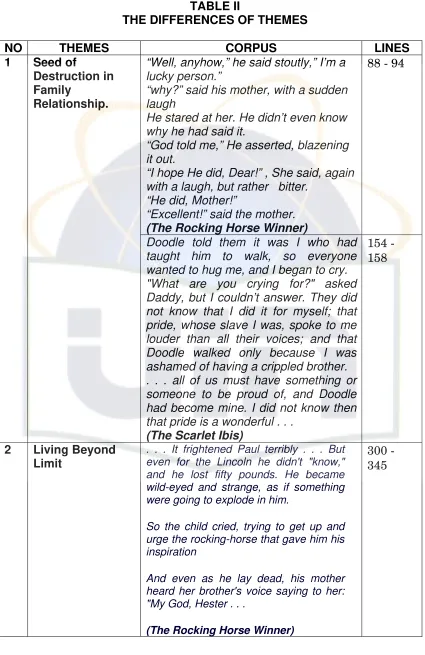
TABLE II
THE DIFFERENCES OF THEMES
NO THEMES
CORPUS
LINES
“Well, anyhow,” he said stoutly,” I’m a
lucky person.”
“why?” said his mother, with a sudden
laugh
He stared at her. He didn’t even know
why he had said it.
“God told me,” He asserted, blazening
it out.
“I hope He did, Dear!” , She said, again
with a laugh, but rather bitter.
“He did, Mother!”
“Excellent!” said the mother.
(The Rocking Horse Winner)
88 - 94
1 Seed
of
Destruction in
Family
Relationship.
Doodle told them it was I who had
taught him to walk, so everyone
wanted to hug me, and I began to cry.
"What are you crying for?" asked
Daddy, but I couldn’t answer. They did
not know that I did it for myself; that
pride, whose slave I was, spoke to me
louder than all their voices; and that
Doodle walked only because I was
ashamed of having a crippled brother.
. . . all of us must have something or
someone to be proud of, and Doodle
had become mine. I did not know then
that pride is a wonderful . . .
(The Scarlet Ibis)
154 -
158
2 Living
Beyond
Limit
. . . It frightened Paul terribly . . . But even for the Lincoln he didn't "know," and he lost fifty pounds. He became wild-eyed and strange, as if something were going to explode in him.
So the child cried, trying to get up and urge the rocking-horse that gave him his inspiration
And even as he lay dead, his mother heard her brother's voice saying to her: "My God, Hester . . .
(The Rocking Horse Winner)
"Shut up, I'm not going to hurt you. I'm going to teach you to walk,"
(The Scarlet Ibis)
117
. . . "it's because your father has no luck."
The boy was silent for some time.
"Is luck money, mother?" he asked, rather timidly.
"No, Paul. Not quite. It's what causes you to have money."
Then what is luck, mother?"
"It's what causes you to have money. If you're lucky you have money. That's why it's better to be born lucky than rich. If you're rich, you may lose your money. But if you're lucky, you will always get more money."
"Oh! Will you? And is father not lucky?"
"Very unlucky, I should say," she said bitterly . . .
(
The Rocking Horse Winner)59 - 73
He was a burden in many ways. The doctor had said that he mustn’t get too excited, too hot, too cold, or too tired and that he must always be treated gently . . . all of which I ignored once we got out of the house . . .
(The Scarlet Ibis)
66 - 68
. . . I
was embarrassed at having abrother of that age who couldn’t walk, so I set out to teach him. (The Scarlet Ibis)
104 -
105
3 Strains
effect
different way
. . . I had succeeded in teaching
Doodle to walk, I began to believe in
my own infallibility
and I prepared a
terrific development program for him,
unknown to Mama and Daddy, of
course. I would teach him to run, to
swim, to climb trees, and to fight. He,
too, now believed in my infallibility . . .
(The Scarlet Ibis)
. . . what are you going to do with your
money?" asked the uncle. "Of course,"
said the boy. "I started it for mother.
She said she had no luck, because
Father is unlucky . . .
(The Rocking Horse Winner)
290 -
292
Paul, at the other's suggestion, handed over five thousand pounds to his uncle, who deposited it with the family lawyer, who was then to inform Paul's mother that a relative had put five thousand pounds into his hands, which sum was to be paid out a thousand pounds at a time, on the mother's birthday, for the
next five years. (The Rocking Horse
Winner)
246 -
251
4
A Shortcut to
obtain love and
Pride
When Doodle was five years old, I was embarrassed at having a brother of that age who couldn’t walk, so I set out to teach him.
That winter we didn’t make much progress, for I was in school and Doodle suffered from one bad cold after another. But when spring came, rich and warm, we raised our sights again. (The Scarlet Ibis)
104 -
105 a nd
189 -
190
B. ANALYSIS
1. The Way Authors Use to Deliver the Themes in the Two
Short Stories
At first, the writer will analyze about how the themes are delivered
in both stories. In the story
The Rocking Horse Winner
D H Lawrence
does not state the themes of the story directly. The writer has done the
steps to find out the theme of the story. The writer has read it entire story
be explicitly stated by one of the character
. They are implied. The author
only uses his description to convey the themes through character and
other elements of story that help the writer to find out the theme. Thus,
people must read carefully and think further in order to get the theme.
It is similar to DH Lawrence in delivering themes in the story;
James Hurst in the story
The Scarlet Ibis
also uses indirect way to state it.
He uses the elements of a story, such as the characters, plot, and so on to
convey the themes. Even though, the themes were implied, the other
element of story was very helpful to find out the theme.
2. The Themes Of The Two Short Stories
In D.H. Lawrence’s short story, “The Rocking-Horse Winner”, and
James Hurst’s “The Scarlet Ibis”, there were many issues to consider.
Although these two short stories are different, the main theme is similar. It
is a seed of destruction in a family relationship that lead to the downfall of
other family members.
It can be seen in Paul’s relationship with his mother in “The
Rocking Horse Winner”, and Doodle’s relationship with his brother in the
story “The Scarlet Ibis”. Both Paul and Doodle are controlled by a
A. The Similarities of Themes in “The Rocking Horse Winner” and in
“The Scarlet Ibis”.
1. Unending Dissatisfaction Leads Disharmonious Family
The setting in The Rocking-Horse Winner starts with the mother,
who is described as beautiful but shown as having no luck. She has a
very handsome husband and 3 beautiful children, a boy and 2 girls.
They live in a pleasant home, with a garden and discreet servants.
They live in style with little income and felt superior to anyone in their
neighborhood. In this story, the one who is never satisfied is Paul’s
mother. She is a mother of one son and two daughters who is never
satisfied of what she has already had in her household. She always
needs more money to fulfill her desire of luxury. However, her husband
earned less so she debt large mount of money that she can’t pay and
blame her husband as an unlucky person who cannot earn much
money.
People can see from this quotation, “the mother, who had a
great belief in herself, did not succeed any better, and her tastes were
just as expensive. And so the house came to be haunted by the
husband, one son and two daughters. The lack of money leads
dissatisfaction in her self. It effected to her son who define money as
luck. Paul does
the rocking horse race
to pursue the love of her mother
by giving her money to let her know that he is a lucky boy. However,
after Paul gave her the money through his uncle. She wanted more
and more. As quotation below:
Paul, handed over five thousand pounds to his uncle, who
deposited it with the family lawyer, who was then to inform
Paul’s mother that a relative had put five thousand pounds into
his hands, which sum was to be paid out a thousand pounds at
a time on the mother’s birthday, for the next five years.
So, she’ll have a birthday present of a thousand pounds for five
successive years.
However, “Paul’s mother had had a long interview with the
lawyer, asking if the whole five thousand could not be advanced
at once, as she was in debt”.
It was all not sufficient because, the voices in the house
suddenly went mad, like a chorus of frogs on the spring evening. It
made Paul try harder to find out the next winner in next rocking
horse race to gain more money to disappear the voices.
The attitude of his mother who spends money lavishly he
had given caused the house screaming “there must be more money
no, more than ever”. The dissatisfied of the mother of money led
Paul to earn more money with hard struggling and it caused him
into death.
Doodle to be able to walk. As people can see in this quotation,
“Once I had succeeded in teaching Doodle to walk, I began to
believe in my own infallibility and I prepared a terrific development
program for him, unknown to Mama and Daddy, of course. I would
teach him to run, to swim, to climb trees and to fight”. (p.56) He
does not satisfied of just making Doodle able to walk. He wanted
more progress. Then he forced the clapped Doodle to do hard
activity like swimming, as people can see in this quotation, “I made
him swim until he turned blue and row until he could not lift an
oar…his face turned red and his eyes become glazed. Once he
could go no further, so he collapsed on the ground and began to
cry” (p.62)
.
The fact that Doodle can walk after being taught by his
brother does not make his brother satisfied. In fact, he taught
Doodle roughly to swim. He wanted more progress of Doodle’s
ability. However, the dissatisfaction of Doodle’s brother has hurt
Doodle. Brother realizes that it hurt Doodle. His desire of being
proud as someone who can make Doodle to be a normal boy make
him ignored Doodle’s painful.
Doodle’s brother did not feel grateful of the fact that he can
make his handicapped brother able to walk. It was actually a
more pride from every body around him including their parents. The
greed of pride urged him to teach many other treatments.
From the explanations above the writer can see that Mother
in The Rocking Horse Winner has the same attitude with Doodle’s
brother in The Scarlet Ibis. They force the person they love to fulfill
their desire. Their unending dissatisfaction hurt their family
member. Even more, it caused them died in very early age.
2. Killed by Love
Both stories describe death in the end of the stories. Both are
two young men who were struggling to pursue love and care from the
person they love. Paul in The Rocking Horse Winner and Doodle in
The Scarlet Ibis died in early age because of a journey in pursuing the
love of a mother and an older brother. Paul struggled to find luck in
order to get his mother’s love. Doodle struggle to be a normal boy in
order to be accepted by his brother who was ashamed to have him as
a crippled brother. Both were killed by the journey to obtain love and
care from the person they love.
Paul’s mother always feels lacking of money in her life. It
caused her accept the risk which is losing her son’s life.
Actually, if Paul’s mother stop to feel lacking of money, Paul
might not worry and would not try very hard guessing The Rocking
-Horse Winner to earn more money to give it to his mother. Since after
worse because money is just like ecstasy. As we can see in the
quotation below:
“Paul's mother touched the whole five thousand. Then something very curious happened. The voices in the house suddenly went mad, … simply trilled and screamed in a sort of
ecstasy: "There must be more money! Oh-h-h; there must be
more money. Oh, now, now-w! Now-w-w—there must be more
money!—more than ever! More than ever!"
It gave Paul anxiety because he desired to obtain more money
to recover the condition of the house. As it is told in the story, “It
frightened Paul terribly”. This condition makes him force himself to
know the winner of the rocking horse race to win the race. The
dissatisfied feeling of his mother that cause Paul try harder to obtain
money make his mother even has to get the risk to lose her son’s life.
Even though, he could guess the winner and win over eighty thousand
pounds, he should pay it with his life. And his mother who always lacks
of money had to get the risk lose her son’s life, to lose everything.
Because money has no more value when her son’s life has been taken
away. As it can be seen in the quotation below:
"I never told you, Mother, that if I can ride my horse, and get
there, then I'm absolutely sure—oh, absolutely! Mother, did I
ever tell you? I am lucky!"
"No, you never did," said the mother. But the boy died in the night.
And even as he lay dead, his mother heard her brother's voice saying to her: "My God, Hester, you're eighty-odd thousand to the good, and a poor devil of a son to the bad. But, poor devil, poor devil, he's best gone out of a life where he rides his rocking-horse to find a winner."
In the scarlet Ibis, the dissatisfied feeling is owned by Doodle’s
brother who embarrassed to have a crippled bother like Doodle and it
brother. However, the little progress got by Doodle is not enough for his
brother. He wanted Doodle to be normal like others. The greedy
ambition brings death to Doodle because he could not do all the tough
activities that forced by his brother. The dissatisfied feeling of Doodle’s
brother can be seen when he forced Doodle to swim. Doodle’s brother
thought that he had succeeded to teach Doodle to walk.
“At breakfast on our chosen day, when Mama, Daddy, and Aunt Nicey were in the dining room, I brought Doodle to the door in the go-cart just as usual and had them turn their backs, making them cross their hearts and hope to die if they peeked. I helped Doodle up, and when he was standing alone I let them look. There wasn’t a sound as Doodle walked slowly across the room and sat down at his place at the table. Then Mama began to cry and ran over to him, hugging him and kissing him”.
But, it is not enough for him, it is the happiness and pride that
Doodle’s brother got in making Doodle could swim, run, climb, fight,
and row.
“Once I had succeeded in teaching Doodle to walk, I began to believe in my own infallibility and I prepared a terrific development program for him, unknown to Mama and Daddy, of course. I would teach him to run, to swim, to climb trees, and to fight. He, too, now believed in my infallibility, so we set the deadline for these accomplishments less than a year away, when, it had been decided, Doodle could start to school”.
One day, without considering the physical condition of Doodle,
he was sure that Doodle would be able to swim. As the result, Doodle
warned his brother not to hurt him by forcing him to swim. As in the
below quotation:
"Don’t hurt me, Brother," he warned.
"Shut up. I’m not going to hurt you. I’m going to teach you to walk." I heaved him up again, and again he collapsed. This time he did not lift his face up out of the rubber grass.
It seemed so hopeless from the beginning that it’s a miracle
The dissatisfied feeling of doodle’s brother ended when the
activities set up by him brought Doodle into death. Doodle’s brother
supposed to be realistic to see Doodle’s physical condition. It supposed
to sufficient to see Doodle was able to walk as a progress. However,
Doodle’s brother wanted more. He wanted his crippled brother to be
able to do activities that are usually done by other normal boys. The
dissatisfaction didn’t bring any advantages. Even more, it makes his
lost everything by the death of his brother.
In both short stories, high ambition bring little grateful of the
small result and lead to get the risk of loosing everything because of
the dissatisfaction of Paul’s mother in The Rocking Horse Winner and
of Doodle’s brother in The Scarlet Ibis. Both characters in each story
lost person they love. Their high ambition brings death to them.
In both stories the writer sees the sub themes similarity that is
something that is gained with voraciously even will end disaster. In both
stories, it was described that Paul’s mother in The Rocking Horse
Winner and Doodle’s brother in The Scarlet Ibis pursued their desire
voraciously until they even lose their member of family.
3. Mistreating Children
wrong way is Paul’s mother. She explained Paul about luck and
money badly. She also makes Paul penetrate the fact that money is
luck. The father lacks of luck so the family lack of money. It means
that they lack of luck. As quotation below:
“And aren’t you lucky either, mother?
“I can’t be, if I married an unlucky husband,”
“But yourself, aren’t you?”
“I used to think I was, before I married. Now I think I am very
unlucky indeed.”
“Why?”
“Well- never mind! Perhaps I’m not really” she said.
She even doubted Paul to have luck. Paul dislikes it and
pursues luck to prove to his mother that he is lucky.
“Well, anyhow,” he said stoutly,” I’m a lucky person.”
“why?” said his mother, with a sudden laugh
He stared at her. He didn’t even know why he had said it.
“God told me,” He asserted, blazening it out.
“I hope He did, Dear!” , She said, again with a laugh, but
rather bitter.
“He did, Mother!”
“Excellent!” said the mother.
The boy saw she did not believe him; or rather, that she paid
no attention to his assertion. This angered him somewhat,
and made him want to compel her attention.
The first knowledge for kids is what they get from their
parents.
Mother
in The Rocking Horse Winner explained his son
about luck and money unwisely. It makes Paul has a wrong point of
view about money and luck. He penetrated his mother’s words that
someone who can earn much money is someone who is lucky.
Paul thought that he can prove this mother that he is lucky and
The older person who is expected to behave more sensibly
in the story “The Scarlet Ibis” is Doodle’s brother, because he
supposed to except his crippled bother as the way he is. However,
Doodle’s brother in the name of pride set a rude practice for Doodle
in order to make him just like other normal kids, to be able to walk,
to swim and to do more activities.
Once, Doodle’s brother had urged Doodle to touch his
mahogany box (Doodle has been predicted to have short life, until
his parents had prepared him a coffin). Doodle was terrified and did
not want to do that. But, Doodle’s brother threads to leave him
alone near the coffin.
Doodle studied the mahogany box for along time, then said,
“It’s not mine.”
“It is,” I said. “And before I’ll help you down from the loft,
you’re going to have to touch it.”
“I won’t touch it,” he said sullenly.
“Then I’ll leave you here by yourself,” I threatened, and
made as if I were going down,. Doodle was frightened, of
being left. “Don’t go leave me.
Brother, he cried, and he leaned toward the coffin. His hand,
trembling, reached out, and when he touched the casket, he
screamed. A screech owl flapped out the box into our faces,
scaring us and covering us with Paris green. Doodle was
paralyzed, so I put him on my shoulder and carried him
down the ladder, and even we were outside in the bright
sunshine, he clung to me, crying, “Don’t leave me. Don’t
leave me.”
The quotation above proved that Doodle’s brother as the
older person could not behave more sensibly. Even more, he
course, it was terrifying. Doodle should not have to be treated that
way by his elder brother.
The more quotation proves the unexpected attitude of
Doodle’s brother is when he taught Doodle to swim. He ignored the
inability of Doodle to cope with the cold in the pool and keep on
urging Doodle to learn to swim by saying,
“Aw, come on Doodle,” I urged. “You can do it. Do you want
to be different from everybody else when you start school?
“Does it make any difference?”
“It certainly does, “ I said. “Now, come on,” and I helped him
up.
The question of Doodle’s brother above actually is from his
heart. He felt embarrassed to have crippled brother. He wanted
Doodle to try harder to learn to swim to be just like other normal
boys. As the older person, he is not expected so, since it made
Doodle depressed and lost his confident. His brother supposed to
support him to do activities that helped him to adapt with other
normal boys well.
The way he treated Doodle and trained Doodle, had proven
that he did love Doodle but was ashamed of him at the same time.
Pride has blinded Doodle’s brother to see that Doodle’s life is more
precious than proving to others that he could train his brother to be
just like other normal boys.
person in the family relationship. However they did not treat kids
like Paul and Doodle wisely. They just care about what they
wanted.
4. Too Much Pride Can Kill.
In The Rocking Horse Winner, the writer can see that after
discussing about luck with his mother, Paul has faith. He
encourages himself to find out luck and make himself as a lucky
person. His self-confident increases when he involved himself in a
rocking-horse race. Then he told to his mother that he is a lucky
boy as in the quotation below:
"Well, anyhow," he said stoutly, "I'm a lucky person.""Why?" said his mother, with a sudden laugh.
He stared at her. He didn't even know why he had said it. "God told me," he asserted, brazening it out.
"I hope He did, dear!", she said, again with a laugh, but rather bitter.
"He did, mother!"
"Excellent!" said the mother.
“In his green pajamas, madly surging on the rocking-horse. The blaze of light suddenly lit him up, as he urged the wooden horse, and lit her up, as she stood, blonde, in her dress of pale green and crystal, in the doorway.”
"It's Malabar!" he screamed in a powerful, strange voice. "It's Malabar!"
His eyes blazed at her for one strange and senseless second, as he ceased urging his wooden horse. Then he fell with a crash to the ground, and she, all her tormented motherhood flooding upon her, rushed to gather him up.
"I never told you, Mother, that if I can ride my horse, and get there, then I'm absolutely sure—oh, absolutely! Mother, did I ever tell you? I am lucky!"
"No, you never did," said the mother. But the boy died in the night
It all proves that Paul who is too proud of himself for making money for his mother by gaining luck in a race got an accident that make him look foolish that he dead by surging on the rocking-horse to find out the winner of the race. He won the money but he should pay it with his life. He got the luck but he did not get what he wanted from his mother; love.
because of his desire to more increase his own pride. Doodle’s brother feels useless with what he had taught to Doodle. As the quotation below:
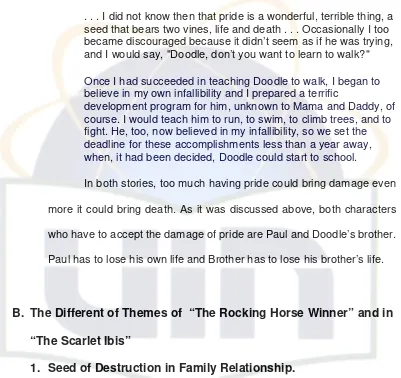
. . . I did not know then that pride is a wonderful, terrible thing, a seed that bears two vines, life and death . . . Occasionally I too became discouraged because it didn’t seem as if he was trying, and I would say, "Doodle, don’t you want to learn to walk?"
Once I had succeeded in teaching Doodle to walk, I began to
believe in my own infallibilityand I prepared a terrific
[image:48.612.114.515.152.530.2]development program for him, unknown to Mama and Daddy, of course. I would teach him to run, to swim, to climb trees, and to fight. He, too, now believed in my infallibility, so we set the deadline for these accomplishments less than a year away, when, it had been decided, Doodle could start to school.
In both stories, too much having pride could bring damage even more it could bring death. As it was discussed above, both characters who have to accept the damage of pride are Paul and Doodle’s brother. Paul has to lose his own life and Brother has to lose his brother’s life.
B. The Different of Themes of “The Rocking Horse Winner” and in
“The Scarlet Ibis”
1. Seed of Destruction in Family Relationship.
Both stories has different root of problems which was driving
the conflict in a family. In
The Rocking Horse Winner
, the character
who drives conflict is Paul’s mother. Her big desire of money makes
her give a wrong perception to her son about luck and money. She
cares nothing but money.
She tells clearly to his son that her husband is unlucky
disrespect to her husband in front of her son. Paul feels
disappointed of listening what his mother said about his father then
he tells his mother that he is actually a lucky person.
“Well, anyhow,” he said stoutly,” I’m a lucky person.”
“why?” said his mother, with a sudden laugh
He stared at her. He didn’t even know why he had said it.
“God told me,” He asserted, blazening it out.
“I hope He did, Dear!” , She said, again with a laugh, but
rather bitter.
“He did, Mother!”
“Excellent!” said the mother.
From the conversation above, Paul feels that he has been
doubted by his mother because her mother cynically says
I hope
He did dear
when Paul tells her that God has told him that he is a
lucky person. It makes Paul get great effort to pursue luck through
money to get his mother’s attention. However, Paul’s mother is
busy to fulfill her desire of luxury lifestyle. It makes her ignore her
duty to give attention, good advice, and a good example to respect
the father to her children.
The first knowledge accepted by a child is in family. The first
knowledge Paul recognize from his conversation with his mother is
that money will follow luck. If someone were lucky, he must have
lots of money. Therefore, Paul tries to find luck and he finds it in a
rocking horse race. A game, must not be played by a boy like Paul.
money he earned he will prove to his mother that what he had said
to his mother that he is a lucky person was definitely true.
The fact that can be seen in The Rocking Horse Winner is;
money
is the reason for Paul to have a distance with his mother. It
is the seed of destruction in Paul’s family. He tried to break the
distance by trying to prove to his mother that he can get what his
mother has been doubted:
luck
. Unfortunately, the little boy got his
luck through doing gambling in a rocking horse race.
On the other side, the seed of destruction found in family
relationship in
The Scarlet Ibis
is
pride.
Pride is the motivation of
the brother who tried very hard to make his crippled brother
(Doodle) to be normal just like other normal boys.
Brother feels that pride is something pleasant. It feels good
for him to show to every body that he is the person who can make
his brother able to walk. The needs of pride grew eventually. It can
be seen by the way he arranged the cruel treatments to teach
Doodle to run, to climb, to fight, and to swim. He did it to show to
every body that he can make his brother to be normal just like other
normal boys. He did it for pride ignoring the physical condition of his
brother.
Doodle told them it was I who had taught him to walk, so
everyone wanted to hug me, and I began to cry.
and that Doodle walked only because I was ashamed of
having a crippled brother.
. . . all of us must have something or someone to be proud
of, and Doodle had become mine. I did not know then that
pride is a wonderful . . .
Pride has become the reason for Brother to push Doodle to
do cruel activities to train him to be a normal boy. It makes Doodle
exhausted