INCREASING STUDENTS VOCABULARY ACHIEVEMENT THROUGH FLASHCARD AT THE FITH YEAR OF MADRASAH IBTIDAIYAH
BANDAR LAMPUNG
By:
Anis Chalawiyah HD
However, elementary school students still have weakness in vocabulary such as lack of vocabulary and lack of understanding of the meaning. One way to overcome this problem is through flashcard, because flashcard encourages
students to expand their vocabularies in mastering pronunciation and the meaning of the word.
was satisfactory. It could be seen from the difference between pretest and posttest score. The lowest score improved from 20 to 60 and the highest score improved from 88 to 100. The numbers of students scored less than 65 in pretest are 29 (78.38%) but in the posttest only 7 students scored less than 65 (18.92%).
The improvement shows that the learning process through flashcard technique achievement. It is supported by the t-test result, t-ratio was higher than t-table; the result was 11.052>2.14. So, it can be concluded that there is significant development in the application of flashcard toward
1. The Examiner Committee
The Chief : Prof. Dr. Cucu Sutarsyah, M.A.
The Examiner : Drs. Sudirman, M.Pd.
The Secretary : Drs. Ramlan Ginting Suka
2. The Dean of Teachers Training and Education Faculty
Dr. H. Bujang Rahman, M.Si. NIP 19530528 1981031 002
By:
Anis Chalawiyah HD
A Script
Submitted in Partial Fulfillment of The Requirement for S-1 Degree
in
The Language and Arts Department of The Faculty of Teachers Training and Education
LAMPUNG UNIVERSITY BANDAR LAMPUNG
1.1 Background
Vocabulary acquisition crucial in any language acquirement, English of course included. As Harmer 1993: 153 says that, if language structures make up the skeleton of language, then it is vocabulary that provides the vital organs and the flesh. Vocabulary includes collection of words. The words are known not only as individual words, but also as a group of words that have meaning. According to Hatch & Brown (1995), vocabulary is the list of words that speakers of a particular language use. context, we do not mean only items consisting of one word but also strings of words which together form one lexical item.
By having a lot of vocabularies, the students can express more idea. As, Rivers (1970:462) stated that it would be impossible to learn a language without
vocabulary. Vocabulary is the content of language. When we want to construct a sentence to express our idea, we need to know adequate vocabularies that are able to represent our idea. If we do not have any vocabularies in certain language, of course we will not be able to speak that language.
speaking, reading and writing vocabularies and can improve comprehension and production in L2. Nation (2001:27) distinguishes between receptive and
productive vocabulary
recognizing the form of a word while listening or reading and retrieving meaning. Productive vocabulary use involves wanting to express a meaning through
speaking or writing and retrieving and producing the appropriate spoken or
2001) also commonly refer to three aspects of vocabulary knowledge: form, meaning and use.
In reality, teaching English to elementary student is not easy. There are many problems occur during the process since English is a new language for them. The less of English vocabulary and the lack of teaching techniques variation in teaching English vocabulary become the prominent problems. Moreover sometimes, the young learners do not have enough attention to learn English.
Vocabularies that are commonly taught in elementary school classified into
media is required to attract the students attention to learn and motivate the students to develop their own vocabulary.
Allen (1983: 12) states that in classes where no one language is known by the entire student, the teacher needs particular skill. The teacher must provide
definition in English, using words the class can understand vocabulary lessons for
creating conditions which encourage vocabulary expansion, and well-chosen
Media
through flashcard. Flashcard, as visual aids is an interesting picture that can activate the learners in teaching and learning process. The presence of visual aids is valuable, especially flashcard help the students in memorizing the English words. By using flashcard, the students will have better learning experience. Hamalik (1980:45) states that learning experience can be acquired through substitute models or pictures. This also means that in learning something, the students get experience not only through real objects but also through substitute models, or pictures of things. The colorful picture
they are eager to learn. Kusniah (2002) conducted the
So the writer assumes that flashcard will be appropriate to be applied in classroom activity. Based on the fifth grade year student curriculum, here is more specified on content word included concrete nouns and action words. These words divided into two topics, things at home and things at school. This vocabulary chosen since they are commonly used in everyday conversation for elementary level. It is hoped that by using flashcard the students will be able to memorize and reproduce the words they have learned easier than by memorizing a list of words.
1.2 Research Problem
Considering the background above, the writer formulates the problem of the research as stated below:
Can flashcard be used to increase elementary achievement dealing with noun, verb, adjective ?
1.3 Objective
As stated in the background and the formulation of problem, the researcher states the objective of the research is to find out whether flashcard can be used to achievement on vocabulary dealing with noun, verb, and adjective ?
The writer described the uses of the research as below:
1. Theoretically, the result of the research is expected to gives information to the teacher whether flashcard is applicable or not to increase
vocabulary achievement.
2. Practically, the result of the research can be used as an alternative for the s performance in teaching vocabulary.
1.5 Scope
The researcher conducted the research for three weeks at the fifth year of
ul Anwar SG Bandar Lampung. There were two classes as the sample of this research which consist of 37 students each class. This research focused on teaching English vocabulary concerning the concrete noun by using flashcard. The materials were taken based on the 2004 Basic Course Outline (BCO/GBPP) of English for Elementary School. The source of data of the
research was taken from two classes, one as experimental class and other as tryout class. The researcher used one pretest, a set of treatments and a posttest to find out
2.1 Concept of Vocabulary
Vocabulary functions as a basis without which any language could not exist. Speaking would be meaningless and perhaps impossible having only structure without vocabulary. This statement is supported by the linguist Wilkins (1983:3) who says that without grammar little things can be conveyed, without
vocabularies nothing can be conveyed. It means that one could not express something without vocabulary. Even though we master the grammar of a certain language but we do not have any knowledge on its vocabulary, we will not be able to communicate or to express our idea using that language. In other words, if you spend most of your time studying grammar, your English will not improve very much. You will see most improvement if you learn more words and expressions. For, you can say very little with grammar, but you can say almost anything with words.
or their combinations in a particular language. However, we should remember as Ur (2000: 60) stated, that one item of vocabulary can consist of more than one word.
- Vocabulary
The main reason is the fact that it is a medium, which carries meaning; learning to understand and express the meaning is what counts in learning languages. There has been increased focus on teaching vocabulary recently, partly as a
development of new approaches to language teaching, which are much more -centered
2.1.1 Aspects of Words
What does teaching vocabulary actually involve? Is it enough for the learner to know the form of the word and one or more of its meanings? In fact, teaching vocabulary is more of a complex matter: Ur (2000: 60-62) and Harmer (1993: 156-157) agree in listing the fundamental features, which need to be included within vocabulary teaching: Besides knowing the form of the word, learners also need to be familiar with its grammar. Learners need to know e.g. irregular forms of verbs or plural nouns, the position of adjectives etc. Another aspect in teaching vocabulary is the word formation. Learners should know how to change a word form and when to use it (gerund, the past Teaching the meaning includes mainly connecting a word with its equivalent in the real world. It is called
denotation. Apart from denotation, connotation of the word (associations and feelings, which arise when the word is heard) should be taught. Many vocabulary items have several meanings depending on context. To make it even worse, meaning is frequently stretched through the use ofmetaphorandidiom (Harmer 1993:157). Furthermore, learners need to be provided with the word sense relations to other words. There are various relationships such as synonyms, antonyms, hyponyms etc.
That means he or she needs to know which words can be used in connection with
each be
informed that one cantakea picture, notmakea picture. On top of that, the student needs to acquire the ability to recognize when it is appropriate to use a particular word - speaking or writing, informal conversation with a friend or formal polite conversation (Ur 2000: 60-62; Harmer 1993: 156-157).
To sum this up, it is not enough to learn just the form of a new vocabulary item and its denotation. In order to be able to understand properly and to use a new item of vocabulary in a given language correctly, the learner must be familiar with the word connotation, grammar and formation as well as its collocation and the right way and appropriateness of use.
2.1.2 Classification of Words
There are some types of vocabulary in English. Fries (1970:45) classifies English words into four groups, they are:
a. Content words
Content words represent the name of subject or things, that is concrete nouns (table, cupboard, radio), action done by with these things, that is verbs (wash, eat, sit), and the qualities of these things, that is adjectives (big, thick, small)
Function words are those words, which are used as a means of expressing relation of grammar structure, such as conjunction (and, but, because), article (a, an, the), auxiliaries (do, does, did).
c. Substitute words
Substitute words are those, which represent the individual things or specific action as substitutes for whole form classes of words, that is, identifies (anybody, anyone)
d. Distributed words
Distributed words are those are distributed in use according to grammatical matter as presence of a negative, such as, an, either, too, or, yet.
From explanation above, the researcher conducted the research dealing with content words especially focused in concrete nouns. As we know, concrete noun is part of Noun. Noun is the part of speech (or word class) that is used to name or identify a person, place, thing, quality, or action. Most nouns have both a singular and plural form, can be preceded by an article and/or one or more adjectives, and can serve as the head of a noun phrase. A noun or noun phrase can function as a subject, direct object, indirect object, complement, appositive, or object of a preposition. In addition, nouns sometimes modify other nouns to form compound nouns.
2.1.3 Types of Nouns
should note that a noun will belong to more than one type: it will be proper or common, abstract or concrete,andcountable or non-countable or collective.
2.1.3.1 Proper Nouns
We always write a proper noun with a capital letter, since the noun represents the name of a specific person, place, or thing. The names of days of the week,
months, historical documents, institutions, organizations, religions, their holy texts and their adherents are proper nouns. A proper noun is the opposite of a common noun. Example: Last year, I hadMoslemas roommates.
2.1.3.2 Common Nouns
A common noun is a noun referring to a person, place, or thing in a general sense-usually; you should write it with a capital letter only when it begins a sentence. A common noun is the opposite of a proper noun. Example: According to thesign, the nearesttownis 60milesaway.
2.1.3.3 Concrete Nouns
2.1.3.4 Abstract Nouns
An abstract noun is a noun which names anything which you can not perceive through your five physical senses, and is the opposite of a concrete noun. Example: John is amused by people who are nostalgic aboutchildhood.
2.1.3.5 Countable Nouns
A countable noun (or count noun)is a noun with both a singular and a plural form, and it names anything (or anyone) that you cancount. You can make a countable noun plural and attach it to a plural verb in a sentence. Countable nouns are the opposite of non-countable nouns and collective nouns. Example: We painted thetablered and thechairsblue.
2.1.3.6 Non-Countable Nouns
A non-countable noun (or mass noun)is a noun which does not have a plural form, and which refers to something that you could (or would) not usually count. A non-countable noun always takes a singular verb in a sentence. Non-countable nouns are similar to collective nouns, and are the opposite of countable nouns. Example: Joseph Priestly discoveredoxygen.
2.1.3.7 Collective Nouns
A collective noun is a noun naming a group of things, animals, or persons. You could count the individual members of the group, but you usually think of the group as a whole is generally as one unit. You need to be able to recognize
similar to a non-countable noun, and is roughly the opposite of a countable noun. Example: Theflockof geese spends most of its time in the field.
Since vocabulary for the beginner level usually belong to concrete noun, the researcher focused her attention on the vocabulary dealing with concrete nouns which is classified into content word. Those vocabularies are commonly taught at the fifth grade, especially nouns (knife, spoon, fork, kettle, etc.) and action words (cook, wash, eat, use, etc).
2.2 Concept of Learning Vocabulary
Knowing a word is one thing but how is that knowledge acquired? In learning their first language the first words that children learn typically those used for labeling, that is, mapping words on to concepts so that the concept, for example, of dog has a name, dog or doggies. But not all four legged animals are dogs: some may be cats, so the child then has to learn how far to extent the concept of dog, so
pictures of dogs. In other words, acquiring a vocabulary requires not only labeling but categorizing skills.
course
decides on emphasis given ns and Redman, 1992: 54)
2.2.2 Usefulness
When making a decision about what vocabulary to teach preferentially, the teacher should take into consideration mainly usefulness of the words. Yet, what words are actually useful? To be able to answer this question, it might be helpful to look into several aspects. In the first place, the teacher should consider the
pointed out that it is useful to provide the learner just at the early stages of the course. She continues that it is important for the teacher to predict what words the student needs to know for talking about everyday life, people and things surrounding
immediately be put to (Allen, 1983: 108).
frequency in which the particular item is used in common language.
commonly used are the ones we should teach f , 1993: 154) However, most frequent words do not usually convey much information, being so- (i.e. grammar words) and to be able to communicate, learners need considerable amount of words bearing some meaning. (McCarthy, 1992: 82) Another aspect to consider is coverage. As Harmer (1993: 154) stated, the words cove meaning. E.g. the word
vocabulary with a restricted range, since the wider range an item has, the more useful it is likely to be.
2.2.3 Learn-ability
- which
chosen vocabulary will be taught. There are a lot of reasons why words might be easy or difficult to learn. Of them all, let us mention that complicated spelling, pronunciation or meaning might be a reason for a word to be difficult to remember. Generally, concrete things are more learnable then abstract ones, therefore they re always taught first (McCarthy, 1992: 86).
Learning a language means learning thousands of vocabulary items. Everyone has his or her own way of learning vocabulary. For some people random word lists will seem to be the most appropriate, usually with a translation into the mother tongue. Some learners will find it effective to use vocabulary exercise in order to acquire new vocabulary, while others will use vocabulary cards and regularly test themselves to check whether new items have been learnt. All of these methods are effective in their own right and will suit different individual in different ways.
Based on the statement above (Scott, 2003) says that there are five basic
instructional methods for learning and teaching vocabulary. These methods are: 1. Definitional methods include anything where a student is given a word and a
2. Contextual methods of vocabulary instruction ask students to create a meaning for a word based on the rest of sentence paragraph. This instructional method also teaches students how to use a new vocabulary word in the right context by writing original sentences using the new word.
3. Organizational, or semantic framework instruction, students learn relationships between and among similar words. This type of instruction includes the use concept maps, semantic maps, and other graphic organizers. 4. Mnemonic instructional methods make use of visual images as a way to help
students learn and remember new terminology. Instead of memorizing abstract definitions, students are encouraged to picture something that helps them associate a word with a meaning.
5. Structural methods of vocabulary instruction show students how to look at the parts of the word for clues about what the word means. They are taught to look at root words, suffixes, affixes, and prefixes.
All of the ways above can be used in teaching-learning vocabulary process, but in this research the writer used the definitional method and Mnemonic instructional method. Flashcard is part of Mnemonic instructional. It is visual aids with colorful
writer assumes by this learning method, the students would be much easier to memorize the vocabulary and also they would be much more understood about the meaning if they meet with the context.
In general there are three steps in teaching vocabulary; firstly, teaching the word form that are spelling and pronunciation. The teacher can teach the spelling of the word by writing it on the blackboard. While, in teaching pronunciation, the teacher can pronounce the word loudly in front of the class, and then asks the students to repeat after the teacher.
Secondly, teaching the meaning of the word. In teaching the meaning of the word, the teacher can ask the students to look up in the dictionary. If students have any difficulties, then the teacher may help the students by giving them the meaning of the words or the teacher can also directly tell the students what its meaning. Thirdly, teaching the use of the word. In teaching the use of the words, the teacher may provide the students the real example in sentence form, and provide them some exercises in using those words.
It suggests that English teacher should find an alternative method or media that at least covers the three steps above in teaching vocabulary. Then, this research will focus on the teaching the shape or the form of the word, teaching the sound or the pronunciation of the words and also teaching the meaning of the word
individually and the words in context. Therefore, after the meeting is over the
words.
Flashcards are set or cards with a word or phrase on one side and its meaning usually in translation on the other ( Lado, 1964:197). Flashcard is taken from
of stiff paper or thin cardboard, as used for various purposes. Lado also states flashcard may have a picture or native language word on one side and the second language word on the other. Flashcard is a card with a picture on one side and a word or phrase in the second and native language on the other.
It is visible t
function of flashcard in teaching English vocabulary is as one of visual aids. Weaver (1959:1) says that a visual aid is any specially prepared drawing, illustration, model, motion picture, or other devices that will be easily learnt through the sense of vision.
Watton (1966:186) classifies the kinds of visual aids as follows:
1. Symbolic aids, i.e. those aids that supplement the written and spoken words. They are pictures, maps, globes, charts, flashcards, and graphs. 2.
whiteboard, Monitor, Screen, LCD, and televisions.
The ideas above clearly show that flashcard as one of visual aids is very important in teaching English vocabulary. As stated before, flashcard is one visual aids, the message of the card is brief and to the point. Flashcard is card bearing numbers, words or pictures that someone briefly displays to another as learning aid
(Webster, 1984:514). Flashcards have varied sizes according to the picture or the native language word and the second language on the button of the picture. .
Wright (1968:73) says that a flashcard printed with words and pictures can be handled easily by the teacher. The sizes of the picture vary according to the
pictures or words shown. Basically they are of a size easy for the teacher to handle and to flash at the students. He also says that the procedures of teaching
vocabulary through flashcard are as follows:
First the teacher asks the students to remember the pictures and words. Then the teacher picks one up, conceals the pictures and asks them to say what it is. Each student makes a guess. Then the teacher look at the picture on the card he has taken and asks the stud The students repeat to say what the picture is. Here is an example of flashcard.
C L O C K
The procedures of teaching vocabulary through flashcard are as follows:
- Pre activity:
1. Teacher: Give greeting to the students.
Students: Answer the greeting from the teacher. 2. Teacher: Pray before starting the activity.
- While Activity:
3. Teacher: Show flashcard to the students and ask them to repeat after klæk
Students: Look at the picture of a clock on the flashcard and repeat after the teacher to prono klæk
4. Teacher: Ask the students to recall the pictures and the words the teacher has shown.
Students: Recall the pictures and the words the teacher has shown. Clock/ klæk/, bed/bed /, spoon/ spu:n/.
5. Teacher: Pick up one flashcard with the picture of a bed, conceal it and
Students: it is
6. Teacher: Divide the class into two groups.
7. Teacher: Ask the members of group 1 to mention the name of the
things this thing
Students:
8. Teacher: Uncover the word broom on the flashcard.
This activity is done by the two groups in the turns, so there is a competition between the two groups.
- Post Activity:
10. Teacher: Distribute the task and ask them to do it. Students: The students doing the task.
11. The teacher gives chance to address question about the topic they have learnt that day.
12. The teacher closes the meeting.
The teacher continues to show other flashcards that belong to the things around us by applying the procedure above. The teacher teaches 22 words of things at home on the first meeting. 22 words related to the things at school on the second
meeting. At the last meeting, teacher review the all the words.
2.6 Theoretical Assumption
Based on the frame of theories, flashcard is a media that can be used to teach vocabulary. Flashcard which is small compact brings and idea. The message of the flashcard is brief and to the point. The writer considers that the vocabulary on the flashcard is useful for getting new words and their meaning. It means that
drill or review of words that have been learned.
Through flashcard, the students will be more interested in learning vocabulary and they will give high attention to learn a new vocabulary because the colorful
Finally, the researcher assumes that flashcard can be used to increase students achievement of the vocabulary dealing with concrete nouns significantly.
2.7 Hypothesis
Concerning to the problems, theories and theoretical assumptions above, the writer formulates the hypothesis as follow:
Flashcard can be used to increase elementary
3.1 Research Design
In conducting the research, the writer used the experimental research withone group pre test and post test design. In the form of objective test, the researcher gave a pre test before treatments and a post test after the three treatments (Hatch and Farhady, 1982). The sample of the research was one class only and the design can be presented as follow:
(T1 X1 X2 X3 T2)
Note:
T1 : Pre test
T2 : Post test
X1, 2, 3 : Treatments
The treatment in this research divided into three meetings of activities. In each meeting, the length of each treatment was 2 x 45 minutes. The overall treatments had been given about three weeks. In a week, English lesson taught two days in 3 hours. On February 07th, 2011 the researcher started the research by trying out the
test and in February 09th
,the researcher administered the pre test to measure the
next meeting on February 12th, 14th, and on February 16th
,2011. At the last
meeting, on February 18th, 2011 the researcher conducted the post test to know the
3.2 Population and Sample of the Research
The population of this research was the fifth year elementary students of
in academic year of 2010-2011. There has been one class as the sample, namely experimental class. The sample of the research has been chosen randomly from two classes, class A and class B by using lottery because the participants have similar chance to be chosen and in order to avoid the subjectivity in the research (Setiyadi, 2006:39). Class V B of the Fifth Year is used as sample of this research.
3.3 Variables
The research consists of the following variables: 1.
2. Flashcard as independent variable (X).
3.4 Data Collecting Technique
In order to collect the data, the researcher applied some techniques as follows:
1) Pre test
by using flashcard. The test has been in the multiple-choice form with four options (A, B, C, and D) and the sum of the test was about 50 items with 30 multiple choices and 20 in form of matching tests. The time allocation has been 80 minutes. The result of the pre test has been compared with the post test result to find out their achievement. The scoring system was the load of each correct answer is two point five. Therefore, if one participant answers all the items correctly, s/he will get 100 points (2 X 50).
2) Post test
After conducting the teaching or the treatment, a post test had been administered. The post test consisted of 50 items in the form of multiple choices with four options and time allocation was 80 minutes. It has been
nt after having the treatment. The questions in post test have been the same as the pre test.
However, the researcher has changed the questions and the distracters in other number differ than those in pretest. This test has had the same difficulty as pre test
have been tested, the writer has
Statistical package for Social Sciences (SPSS) version 15.0. 3) Conducting the treatments
3.5 Research Instrument
In this research, the researcher has administered three tests: try out test, pre test and post test. Try out test was given to know how the quality of the test which has been used as the instrument of the research. Pre test was given in order to know
test was given in order to vocabulary achievement after the treatments. The form of the try out test, pretest, and the post test has been multiple-choice and matching tests. The total number of the items of the tryout test has been 50 items, and the total number of the pre test and post test has been 50 items. The try out test has been administered about 80 minutes, and pre test - post test has been administered about 80 minutes.
3.6 Try Out Test
The try out has been needed to be done to prove whether the test had good quality or not. The test was said to have a good quality if it has a good validity, reliability, level of difficulty and discrimination power. The try out was held to different class from the experimental class. There have been some elements that have been tested as follows:
1. Validity
whether the test had a good validity, the writer has seen the content and the constructs validity.
a. Content validity
Content validity is extended to which a test measures representative sample of the subject matter contents, the focus of the content validity is adequacy of the sample and simply on the appearance of the test (Hatch and Farhady, 1982:251). It means that the test should be correct and represent the materials that have been taught such as concrete and
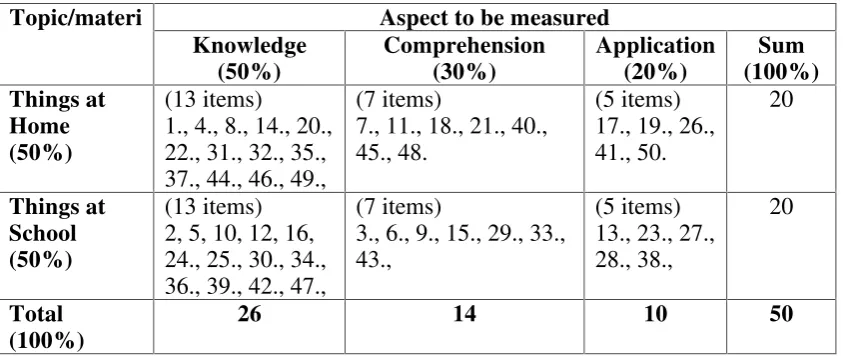
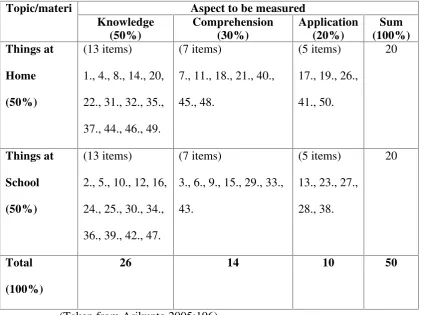
abstract nouns. To get the content validity, the test has been adapted from has been determined according to the material that has been taught to the students. In other words, the writer has made the test based on the materials in the 2004 English Curriculum for the fifth grade of Elementary School students. Beside that, the writer also makesa table of specificationto judge the content validity already good or not).
Table 1. Specification that was used to judge the content validity of the vocabulary test concerning concrete nouns
Topic/materi Aspect to be measured
Knowledge
(Adopted and developed from Arikunto 2005:196)
Construct validity focused on the kind of test that was used to measure the ability. It was used to the research that has many indicators.
According to Setiyadi (2006:26), if the instrument just measures one aspect, for example vocabulary, the construct validity can be measure by
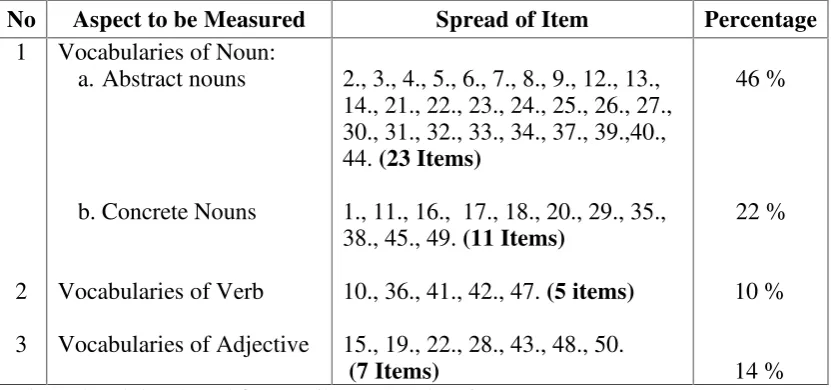
mastery, this instrument has fulfilled construct validity. In this research, the all items had measure vocabulary mastery, so it has fulfilled construct validity. It can be seen from the Specification table of Construct validity below. Moreover to decide the construct validity of the test, the
researcher has used three raters, they are, teacher, researcher and colleague. This is also called as an inter-rater. By using this method, it was hoped that the items of the test has fulfilled the construct validity.
Table 2. Specification that was used to judge the construct validity of the vocabulary test concerning noun, verb, adjective
(Adopted and developed from Arikunto 2005:196)
2. Reliability
No Aspect to be Measured Spread of Item Percentage
Shohamy (1985:70) writes, That reliability refers to the extent to which is consistent in its score, and it gives one an indication of how accurate the test
ty stems from the idea that no measurement is perfect, even if one goes on the same scale today and then again tomorrow, there will always be differences in his weight which is a result of the fact that measuring instrument are not perfect. A score of a student on a test consists of a true score and error. Reliability helps us estimate the error part of the scores. Since there are different sources of error for different types of tests, there are also different types of reliability.
To find the reliability of this test the writer used Split Half Method, which is has two steps, they are:
1. First, using Pearson Product Moment Correlation, we should find the coefficient correlation between Odd and Even Number of the items.
2
rxy : Coefficient of reliability between odd and even number.
∑x2 : Total Square of x (total score of odd number).
∑y2 : Total square of y (total score of even number).
∑xy : Total score of odd and even number items.
2. Second, after we get the coefficient Correlation between Odd and even Number, we continue to put them into the Reliability Formula.
xy
r11 : Reliability Coefficient
rxy : Coefficient between odd and even number.
The criteria of reliability In this research, the result of the reliability was 0.99. it can be concluded that the test has very high reliability in which criteria for very high reliability is in the range 0.80 1.00. It indicated that this instrument would produce consistent result when administered under similar condition, to the same participant and in
different time (Hatch & Farhady, 1982:286). So, it can be stated that the test has fulfilled the criteria of reliability. In other words, the test was reliable. The calculation of reliability of try out test is shown on Appendix 5.
3. Difficulty Level
In determining the level of difficulty of the test, the writer has used the following formula:
N R LD
LD : Level of Difficulty.
R : The number of the students who answer correctly. N : The total number of the students.
The criteria are:
0.00 0.30 : difficult. 0.31 0.70 : average. 0.71 1.00 : easy.
(Arikunto; 1997:121)
Based on the try out test result related to those criteria there were 29 easy items (2., 3., 6., 8., 10., 12., 14., 15., 16., 17., 19., 20., 21., 22., 25., 26., 31., 32., 33., 36., 37., 39., 40., 42., 44., 45., 48., 49., 50.), 15 average items (4., 5., 7., 9., 11., 13., 18., 23., 29., 30., 38., 41., 43., 46., 47.), and 6 difficult items (1., 24., 27., 28., 34., 35. ). Some items which were easy and difficult were dropped and replaced, meanwhile for the items which were average in difficulty level used in pre test and post test. The results of try out test difficulty level are shown in Appendix 3.
4. Discrimination level
To estimate the discrimination power of the tests, the writer has used the following formula:
N : The total number of the students. The criteria are:
0.00 0.20 : poor. 0.21 0.40 : satisfactory. 0.41 0.70 : good. 0.71 1.00 : excellent.
(Arikunto; 1992:221) Based on the try out test result related to those criteria there were 23 items (1., 6., 7., 8., 14., 15., 16., 17., 19., 23., 26., 27., 28., 30., 31., 35., 37., 38., 40., 41., 45., 46., and 49. ) were poor, 6 items (4., 12., 18., 20, 25., and 47.,) were good, 14 items (2., 5., 9., 10., 13., 21., 22., 29., 32., 33., 39., 43., 48., and 50. ) were satisfactory and 7 items (3., 11., 24., 34., 36., 42., and 44.,) were have negative discrimination power.
Negative discrimination items were dropped and replaced, meanwhile for the items good and satisfactory were administered. Some of items, which have poor discrimination power, were revised and used in the pre test and post test. The total items that were administered for pre test and post test were 25 items (2., 4., 5., 6., 9., 10., 12., 13., 18., 20., 21., 22., 29., 31., 32., 33., 37., 38., 39., 43., 45., 46., 47., 48., and 50. ).
3.7 Research Procedure
The procedures of this research are as follows:
The writer chose two classes of the fifth year at Madrasah Mathla
SG Bandar Lampung, which was divided as experimental class, and tryout class.
2. Trying out the instrument
The instrument, vocabulary test, was tried previously in the tryout class. It was aimed at making sure the tests in this study are valid and reliable. The number of the items was 50 items in form of multiple choices test. The scoring system for each correct answer was two. So, if one participant
answered all items correctly, s/he got 100 points (2 x 50). The time allocation for the try out test was 80 minutes. The try out was held to find out the quality of the test and to determine the items that should be revised for the pre test and the post test.
3. Administering Pre test
The purpose in giving pre test was to
vocabulary before being taught by using flashcard. So that, the writer able to compare the result with the post test results later. The pre test was an objective test in form of multiple choices with 50 items. In addition, it has been
administered for 80 minutes in the experimental class. 4. Arranging the materials to be taught
The writer arranged the material that has been taught based on the 2004 curriculum for the fifth year of Elementary students. The material was about things around us which were divided into two topics, things at school and things at home. The vocabularies taught to the student classified into content words, especially concrete nouns.
The experimental class has been taught by using flashcard. While the teaching and learning occurs, the writer observed the whole process.
6. Administering post test
The post test was administered to the experimental class. The result of the test was compared with the pre test to find out whether there was any significant increase from the post test and the pre test result. It was in objective test in form of multiple choices that consist of 50 items. The post test has been administered about 80 minutes.
7. Analyzing the data
The data was analyzed by comparing the average score (mean) of pre test and post test to know whether there was
vocabulary achievement taught through flashcard. 8. Reporting the result
In reporting the data, the data has been arranged systematically based on the pre test and post test to see whether there was
vocabulary achievement.
3.8 Data Analysis
After collecting the data, the researcher has calculated by:
1. Scoring pre test and post test.
To compute the average score or mean of the pre test and post test, the writer used a very simple formula as follows:
N X M
In which:
M : (Mean) Average score ∑X : T
N : Total number of the students.
vided by total number of the students. (Hatch and Farhady, 1982:55)
3. Drawing conclusion from the tabulated result of the pre test and post test administered. The data has been analyzed by using statistical computerization
Repeated Measures t-test of SPSS 15 for Windows i.e.
D
whether the difference between pre test and post test was significant or not, in which the significance was determined by p < 0,05 (Hatch and Farhady, 1982:114). Since the data was gained from one group and the research was intended to find out whether there was
vocabulary achievement.
3.9 Data Treatment
According to Setiyadi (2006:168-169), using Repeated Measures t-test for hypothesis testing has three basic assumptions, namely;
- The data is interval or ratio
- The data is distributed normally.
Therefore, the writer will use these following procedures: 1. Random test
Run test was used to make sure whether the data random or not. The writer used SPSS version 15 to help her. In this case, the writer used the mean as the cut point run t-test. The hypothesis for the random test was formulated as follows:
Ho : The data are random Ha : The data are not random
In this script, the criteria for the hypothesis are:
Hois accepted if Sig. > . In this case, the researcher used the level of
significance 0,05.
From the result (see Appendix 14), we can see that Sig. > in all test (pre test
and post test) in the experimental class. It proved thatHowas accepted. In other words, all the data were random.
2. Normality test
The writer used normality test to know whether the data in the pre test and the post test are distributed normally. The hypothesis for the normality test was as follows:
Ho : The data are distributed normally. Ha : The data are not distributed normally. In this script, the criteria for the hypothesis are:
Hois accepted if Sig. > . In this case, the researcher used the level of
From the result (see Appendix 15), we can see that Sig. > in all test (pre test
and post test) in the experimental class. It proved thatHowas accepted. In other words, all the data were distributed normally.
3.10 Hypothesis Testing
The researcher compared pretest and posttest to know the gain. The researcher did the t-test (Repeated Measured T-test) toward the average score of pretest and posttest. The result of t-test also used to know the significance of treatment effect and to prove whether the proposed hypothesis was accepted or rejected.
H :
of the student vocabulary achievement concerning noun, verb, and adjective after being taught using flashcard
The criterion for accepting the hypothesis: Ho is accepted if t-ratio is higher than t-table Ho is rejected if t-ratio is lower than t-table
5.1 Conclusions
5.1.1 Flashcard can be used to
concerning noun, verb, and adjective. It could be seen from the result of pre test and post test that there was an improvement from the average score in pre test 54.27 (see appendix 6 ) the highest score was 88 and the lowest was 20,to the post test 76.86 ( see appendix 7) the highest score was 100 and the lowest was 60. That was 22.59 points or increased about 41.6 %, the result of hypothesis test was significant; hence flashcard can be used to improve the achievement of vocabulary concerning noun, verb and adjective.
5.1.2 Flashcard can be used to teach vocabulary concerning noun, verb, and adjective. This research focused on teaching noun, verb, and adjective to the students, which was divided in two topics, things at school and things at home. Of course, in the process, the teacher taught the pronunciation first then taught the meaning and the used of the words in the sentences. Flashcard very useful for teaching new words of noun, verb, and adjective and their meaning, since its colorful picture of the flashcard attracts the students to learn new vocabulary of noun, verb, and adjective. effective in drilling or reviewing the
5.2 Suggestions
Considering the result of the research, the research would like to propose some suggestions as follows:
5.2.1 Suggestions to the teacher:
a. The researcher suggested the teacher to use flashcard as an alternative in teaching vocabulary. Since flashcard can be used to increase the
can motivate the students to learn new vocabularies concerning noun, verb, and adjective. b. Flashcard needed adequate time to be applied. The teacher should be
able to manage the time when using flashcard and the teacher should not teach too many materials at the same time, so the time allocation that was given by school is enough.
c. The writer suggested the teacher to use colorful picture in flashcard in
5.2.2 Suggestions for further research:
a. The writer applied flashcard g
with noun. Other researchers can apply flashcard technique in other kinds of vocabulary, for example dealing with adjective, since flashcard technique can help the students to develop their vocabulary. b. Further researcher should conduct this method on different level of
Allen, Virginia French. 1983. Techniques in Teaching vocabulary: Teaching techniques in English as a second or foreign language. New York: Oxford University Press.
Arikunto, Suharsimi. 2005. Dasar-Dasar Evaluasi Pendidikan Edisi Revisi. Jakarta: Bumi Aksara.
August, Diane, Carlo, Maria, Dressler, Cheryl & Snow, Catherine (2005). The critical role of vocabulary development for English language learners. Learning DisabilitiesResearch and Practice, 20, 1, 50-57.
Burton. S. H. 1982. Mastering in Education. Englewood Cliffs. New Jersey: Prentice Hall, Inc.
Cameron, L. (2001). Teaching languages to young learners. Cambridge: Cambridge University Press.
Fries, Charles C. 1970. Teaching and Learning English as Foreign Language. Ann Arbor: The University of Michigan Press.
Gairns, Ruth. Redman, Stuart. 1992.Working with Words: A guide to teaching and learning vocabulary. Cambridge: Cambridge University Press.
Hatch, E. & Brown, C. (1995).Vocabulary, semantics and language education. Cambridge : Cambridge University Press.
Harmer, Jeremy. 1993. The Practice of English Language Teaching. Essex: Longman Group UK Limited.
Hatch, Evelyn and Farhady, Hossein.1982. Research Design and Statistics for Applied Linguistics.Los Angeles: Newbury House Publishers Inc.
Hornby, A.S. 1985. Oxford Advanced Le . London: Oxford University Press.
Lewis, Richard. 1973.Winter Sleep: Reading for Adults. Longman, London. McCarthy, Michael. 1992.Vocabulary. Oxford: Oxford University Press.
Scott, Vendy A. YTREBERG, Lisbeth H. 2003. Teaching English to Children. Essex: Longman Group UK Limited.
Sudijono, A. 2001. Pengantar Statistik Pendidikan. Jakarta: PT. Raja Grafindo Persada.
Sudjana. 1999. Metode Statistika. Bandung: Tarsito.
Thornbury, Scott. 2004. How to Teach Vocabulary. Essex: Pearson Education Limited.
UR, Penny. 2000. A Course in Language Teaching: Practice and theory. Cambridge: Cambridge University Press.
Wallace. Michael J. 1982. Teaching Vocabulary. New York: Heinemann Educational Book.
I. Chooses one the best answer from the four possibilities given! 1.
a. computer c. keys b. board marker d. whiteboard 2.
a. lamp c. desk
b. book d. calculator 3. We use this thing to tidy up our hair.
a. broom c. keys
b. comb d. hanger
4. This thing we use to write a letter on the paper.
a. pen c. board marker
b. hammer d. fork
13. s kind of a book, used to find more information. It has many colorful What is it?
a. Newspaper c. Magazine
b. Novel d. Comic
14. (guru)
b. majalah d. koran 16.
a. Brown and Pink c. Yellow and blue b. Black and White d. Red and White 17. Apple,
a. Food c. Fruit
b. Flower d. Drink
18. Saya adalah seorang pelajar. (terjemahkan kedalam bahasa inggris) a. I am a student
b. They are football player c. She is ateacher
d. He is my friend
19. Dia(pr)mempunyai sebuah cin-cin. (Translate into English)
a. We have a ring.
21. Wear your jacket, be a. cold
24. Saya mempunyai dua(bh)buku. (Translate into English)
a. air b. hujan c. angin d. api 27.
a. Food b. Vegetable c. Drink d. Fruit
28. .. when I play badminton. a. sticks c. cocks b. clock d. pitches 29. Which sport needs a tent?
a. gardening c. camping
b. walking d. hiking
30. Which sport can be played alone?
a. archery c. tennis
Group A 1.
2. Father uses it to pull in the nail onto the wall.
3. I wo .(Saya bekerja di perpustakaan, saya seorang..
4. 5. 6. 7.
8. People use this thing to take picture.
9. My grandfather is (Petani)
10. 11. 12. 13. 14. 15. 16. 17.
18. party yesterday.
19. Dog and
20. He deliver ( Tukang pos )
d. Fork e. Farmer f. Librarian g. Cup h. Scissor i. Hammer j. Nail k. Library l. TV m. Dishes n. Picture o. Postman p. Typewriter q. Computer r. Dolls s. Flowers t. Fruits u. Vegetables v. Animals w. Toys x. Candles y. Bike z. Engineer
2 B 17 C 2 I 17 R
3 B 18 A 3 F 18 X
4 A 19 B 4 D 19 V
5 C 20 D 5 S 20 O
6 B 21 A 6 N
7 B 22 A 7 A
8 C 23 C 8 C
9 A 24 C 9 E
10 D 25 A 10 L
11 A 26 B 11 H
12 A 27 B 12 K
13 C 28 C 13 M
14 B 29 C 14 Q
Topic/materi Aspect to be measured
Table 2. Specification Table of the construct validity
(Taken from Arikunto 2005:196)
No Aspect to be Measured Spread of Item Percentage
I. INTRODUCTION
1.1. Background of the Problem .. 1
1.2.Problem of the Research 4
1.3.The Objective of the Research . 4
1.4.Uses of the Research . 5
1.5.Scope of the Research .. 5
II.FRAME OF THEORIES
2.1. Concept of Vocabulary .. .. .. 6
2.2. Concept of Learning Vocabulary . 12
2.3. Concept of Teaching Vocabulary . .. 16
2.4. Concept of Flashcard .. 17
2.5. Procedures of Teaching Using Flashcard . 18
2.6. Theoretical Assumption . 20
2.7. Hypothesis . 21
III RESEARCH METHODS
IV. RESULT AND DISCUSSIONS
4.1. Research Results . 38
4.2. Discussions .. 44
V. CONCLUSIONS AND SUGGESTIONS
5.1 Conclusions 49
5.2. Suggestions 50
REFERENCES
APPENDICES
3.4. Data Collecting Technique .. 23
3.5. Research Instrument . 25
3.6. Try Out Test .. 25
3.7. Research Procedures 32
3.8. Data Analysis . .. 34
3.9. Data Treatment .. 35