AN ANALYSIS OF ILLOCUTIONARY ACTS IN DISCOVER MAGAZINE
A THESIS BY
PETRUS SURYO KUNCORO REG. NO 100705016
DEPARTMENT OF ENGLISH
AN ANALYSIS OF ILLOCUTIONARY ACTS IN DISCOVER MAGAZINE
A THESIS BY
PETRUS SURYO KUNCORO REG. NO 100705016
SUPERVISOR CO-SUPERVISOR
Dr. Eddy Setia, M. Ed. TESP Rahmadsyah Rangkuti, M.A. PhD
NIP.195704121984031001 NIP. 197502092008121002
Submitted to Faculty of Cultural Studies University of Sumatera Utara Medan in partial fulfillment of the requirements for the degree of Sarjana Sastra from Department of English
DEPARTMENT OF ENGLISH
Approved by the Department of English, Faculty of Cultural Studies University of Sumatera Utara (USU) Medan as thesis for the Sarjana Sastra Examination
Head, Secretary,
Accepted by the Board of Examiners in partial fulfillment of requirements for the degree of Sarjana Sastra from the Department of English, Faculty of Cultural Studies University of Sumatera Utara, Medan.
The examination is held in Department of English Faculty of Cultural Studies University of Sumatera Utara on 16 July 2014
Dean of Faculty of Cultural Studies University of Sumatera Utara
Dr. H Syahron Lubis, M.A. NIP. 19511013 197603 1 001
Board of Examiners Signature
Drs. H. Muhizar Muchtar, M.S. ( )
Rahmadsyah Rangkuti, M.A. Ph.D ( )
Dr. Eddy Setia, M. Ed. TESP ( )
( )
AUTHOR’S DECLARATION
I, Petrus Suryo Kuncoro, declare that I am the sole author of this thesis except where
reference is made in the text of this thesis. This thesis contains no material published
elsewhere or extracted in whole or in part from a thesis by which I have qualified for
or awarded another degree.
No other person’s work has been used without due acknowledgements in the main
text of this thesis. This thesis has not been submitted for the award of another degree
in any tertiary education.
Signed :
COPYRIGHT DECLARATION
Name : Petrus Suryo Kuncoro
Title of Thesis : An Analysis of Illocutionary Acts in Discover Magazine
Qualification : S-1/ Sarjana
Department : Department of English
I am willing that my thesis should be available for reproduction at the discretion of
the Librarian of University of Sumatera Utara, Faculty of Cultural Studies,
Department of English on the understanding that users are made aware for their
obligation under law of the Republic of Indonesia.
Signed :
ACKNOWLEDGEMENTS
First of all I would like to express my thankfulness to the Almighty God who
always gives me health, patience, strength, and guidance to complete this thesis.
First and foremost, I would like to express my deep gratitude and
appreciation to my supervisor and my co-supervisor, Dr. Eddy Setia, M. Ed.. TESP.
And Mr. Rahmadsyah Rangkuti, M.A., Ph.D. for their advice, guidance, support, and
constructive comments during the process of writing this thesis.
My sincere gratitude also goes to the Dean of Faculty of Cultural Studies,
University of Sumatera Utara, Dr. Syahron Lubis, M. A, the Head and the Secretary
of English Department, Dr. H. Muhizar Muchtar, Ms. and Mr. Rahmadsyah
Rangkuti, M.A., Ph.D. and all of the lectures and staff of English Department for the
valuable knowledge, opportunities, and facilities given to me during my study on this
university.
My special appreciation and thanks also expressed to my beloved parents, I.G
Jokopitoyo and N. Saragi, who always pray, remind, give attention, encouragement,
moral and financial support for me. Also for my beloved brother and sister, Elyas
Subiastoro Pitoyo, Patricia Rizky Mutiara, and Bellarmino Wira Permana, who
always be my motivation to do something better.
Special thanks are also addressed to my beloved and the only one for the love
and affection during the process of writing this thesis. For my special friends, Denny,
and also for the special snack and soft drink that we always clutch while writing this
thesis. For all of the girls on my class, thank you for being spunky.
Other special thanks go to all my dormitory mates, Sarmin 91, thanks for
reminding me to finish this thesis. Also for my friends in English Department and
Faculty of Cultural Studies, whose names cannot be mentioned one by one, thank
you for giving support and prayer in finishing this thesis. May we always have a
great gathering time and build a great friendship forever. Finally, I hope this thesis
will always be useful for the readers and the other student for doing the next
research.
May God bless us. Amin
Medan, 20 July 2014
The writer
Petrus Suryo Kuncoro
ABSTRACT
This thesis entitled “An Analysis of Illocutionary Acts in Discover Magazine”. It is a pragmatic analysis namely the speech acts category with the main subject illocutionary acts. Based on the analysis, the category of illocutionary acts they are: assertives, directives, commissives, expressives, and declaratives performed in Discover Magazine are the main subjects of this thesis. The data are collected and analyzed by using the Qualitative method. In this thesis, the writer used the theory of Searle (1979) for the types of illocutionary acts in this thesis. From the data analysis found there are 52 utterances or sentences that consist of illocutionary acts. From the findings, there are assertive, directives, commissives, and declarations types but no expressive category found from the magazine. Sub-category of assertives found in the magazine namely: alleging, stating, suggesting, asserting, predicting, affirming, insisting, reporting, and complaining. Sub-category of directives found namely: recommending, plead, entreating, and asking. The sub-category of commissives found is promising. The sub-category of declaration found is declaring. The most dominant type of illocutionary acts found in the scientific magazine is the assertives type.
ABSTRAK
Skripsi ini berjudul “An Analysis of Illocutionary Acts in Discover
Magazine”. Skripsi ini merupakan analisis pragmatik yakni kategori tindak
tuturdengan subjek utama tindak ilokusi. Kategori dari tindak ilokusi yakni: asertif, direktif, komisif, ekspresif dan deklaratif yang terdapat dalam Majalah Discover merupakan subyek utama dari analisis skripsi ini. Data- data dikumpulkan dan dianalisis menggunakan metode kualitatif. Untuk tipe- tipe dari tindak ilokusi pada skripsi ini, penulis menggunakan teori Searle (1979). Dari analisis data, ditemukan ada 52 buah ucapan atau kalimat yang mengandung tindak ilokusi. Dari hasil yang ditemukan pada majalah tersebut, terdapat kategori asertif, direktif, dan komisif, dan deklaratif tetapi tidak ada ditemukan kategori ekspresif. Sub kategori dari asertif yang ditemukan dari majalah tersebut yakni: menduga, menyatakan, menyarankan, menegaskan, menekankan, memaksakan, melaporkan dan mengeluh. Sub kategori direktif yang ditemukan yakni: merekomendasikan, mengaku, memohon, dan bertanya. Sub kategori dari komisif yang ditemukan yaitu menjanjikan. Sub kategori deklaratif ditemukan mendeklarasikan. Tipe yang tindak ilokusi yang ditemukan paling dominan ditemukan dari majalah ilmiah tersebut adalah tipe asertif.
TABLE OF CONTENTS
AUTHOR’S DECLARATION ... v
COPYRIGHT DECLARATION ... vi
ACKNOWLEDGEMENTS………..……… . vii
CHAPTER II: REVIEW OF LITERATURE 2.1 An Overview of Pragmatics ... 8
2.2 Speech Acts ... 10
2.3 Types of Speech Acts ... 13
2.3.1 Locutionary Acts ... 13
2.3.2 Illocutionary Acts ... 14
2.3.3 Perlocutionary Acts ... 15
2.4 The Understanding of Illocutionary Acts ... 17
2.4.1 The Definition of Illocutionary Act ... 17
2.4.2 The Categories of Illocutionary Acts ... 18
2.4.4 Performative Utterance ... 26
CHAPTER III: METHOD OF RESEARCH 3.1 Research Method ... 30
3.2 Data and Source of Data ... 30
3.3 Data collecting Procedures ... 31
3.4 Data Analysis ... 32
CHAPTER IV: ANALYSIS AND FINDINGS 4.1Analysis ... 35
4.1.1 Data Description ... 35
4.1.1.1 Assertives ... 36
4.1.1.2 Directives ... 40
4.1.1.3 Commissives ... 42
4.1.1.4 Declarations ... 43
4.1.1.5 Expressives ... 43
4.2 The Intention of Illocutionary Acts ... 44
4.3 Findings ... 57
CHAPTER V: CONCLUSION AND SUGGESTION 5.1 Conclusion ... 59
5.2 Suggestion ... 60
REFERENCES ... 61
ABSTRACT
This thesis entitled “An Analysis of Illocutionary Acts in Discover Magazine”. It is a pragmatic analysis namely the speech acts category with the main subject illocutionary acts. Based on the analysis, the category of illocutionary acts they are: assertives, directives, commissives, expressives, and declaratives performed in Discover Magazine are the main subjects of this thesis. The data are collected and analyzed by using the Qualitative method. In this thesis, the writer used the theory of Searle (1979) for the types of illocutionary acts in this thesis. From the data analysis found there are 52 utterances or sentences that consist of illocutionary acts. From the findings, there are assertive, directives, commissives, and declarations types but no expressive category found from the magazine. Sub-category of assertives found in the magazine namely: alleging, stating, suggesting, asserting, predicting, affirming, insisting, reporting, and complaining. Sub-category of directives found namely: recommending, plead, entreating, and asking. The sub-category of commissives found is promising. The sub-category of declaration found is declaring. The most dominant type of illocutionary acts found in the scientific magazine is the assertives type.
ABSTRAK
Skripsi ini berjudul “An Analysis of Illocutionary Acts in Discover
Magazine”. Skripsi ini merupakan analisis pragmatik yakni kategori tindak
tuturdengan subjek utama tindak ilokusi. Kategori dari tindak ilokusi yakni: asertif, direktif, komisif, ekspresif dan deklaratif yang terdapat dalam Majalah Discover merupakan subyek utama dari analisis skripsi ini. Data- data dikumpulkan dan dianalisis menggunakan metode kualitatif. Untuk tipe- tipe dari tindak ilokusi pada skripsi ini, penulis menggunakan teori Searle (1979). Dari analisis data, ditemukan ada 52 buah ucapan atau kalimat yang mengandung tindak ilokusi. Dari hasil yang ditemukan pada majalah tersebut, terdapat kategori asertif, direktif, dan komisif, dan deklaratif tetapi tidak ada ditemukan kategori ekspresif. Sub kategori dari asertif yang ditemukan dari majalah tersebut yakni: menduga, menyatakan, menyarankan, menegaskan, menekankan, memaksakan, melaporkan dan mengeluh. Sub kategori direktif yang ditemukan yakni: merekomendasikan, mengaku, memohon, dan bertanya. Sub kategori dari komisif yang ditemukan yaitu menjanjikan. Sub kategori deklaratif ditemukan mendeklarasikan. Tipe yang tindak ilokusi yang ditemukan paling dominan ditemukan dari majalah ilmiah tersebut adalah tipe asertif.
CHAPTER I
INTRODUCTION
1.1Background of the Study
Pragmatics is one of the main areas of linguistics study that look at the
knowledge we use both toextract meaning when we hear or read, and to convey
meaning when we speak or write. Pragmatics is a study of speaker meaning (Yule
1996:3). Pragmatics, as the branch of linguisticsis concerned with theuse of these
tools in meaningful communication. Pragmatics is about theinteraction of semantic
knowledge with our knowledge of the world,taking into account contexts of use,
Griffiths (2006:1). Pragmatics is concerned with the study of meaning as
communicated by a speaker (or writer) and interpreted by a listener (or reader). This
study also involving the interpretation of what people mean in a particular context
and how the context influencing the things they said. In this case, the speaker must
be able to organize what they want to say in accordance with the people they are
talking to, where, when, and under what circumstances.
Speech acts is a part of pragmatics discussion which relates to a certain
sentence and utterance that has a certain acts within it. Speech acts is an utterance
that serves a function in communication. Speech acts are the part of our daily life
whether in spoken language or writing. By speaking a language, we will perform the
speech acts such as giving commands, making statements, asking questions or
making promises. In other words, we can do actions or things by using the speech.
In the most basic terms, speech acts involve the act of verbally stating something,
what one does while stating it, and what one hopes to accomplish by stating it. In
are performed are often important for decoding the whole utterance and its proper
meaning. There are various classifications of speech acts that include propositional,
illocutionary, and perlocutionary acts.
In the pragmatic’s theory, there are three types of acts, namely: locutionary,
illocutionary, and perlocutionary act. These three types are called speech acts.
Locutionary act is performing the act of saying something. Illocutionary act is
performing the act in saying something. Perlocutionary is performing an act by
saying something. For the example, locutionary, s says to h that X; illocutionary, in
saying X, s asserts that p; perlocutionary, by saying X, s convinces h that P. Here, the
X is the certain words spoken with a certain sense and reference. Speech acts is the
centre of the pragmatics. Speech acts is the study of how to do things with words.
Actions performed via utterances are generally called speech acts (Yule 1996:47). In
an effort to express themselves, people do not only produce utterance that contains
grammatical structures and words, they perform actions via those utterance.
Commonly, we know the types of utterance namely: requesting, ordering, begging,
inviting, offering, complaining, apologizing, promising, and the others.
Illocutionary act is an act that performed in saying something or in other
words, the illocutionary acts is the action that intended by the speakers or the writers.
The illocutionary acts is performed via the communicative force of an utterance
(Yule: 1996:48). There is an intention of the speaker or the writer in making that
utterance or sentence. Illocutionary acts are considered the core of the theory of
speech acts. As already explained above, the illocutionary act is an action that
performed by the speaker in producing a given utterance. The illocutionary act
requesting, giving commands, threatening for instance. Illocutionary acts also can be
found in the written form such as books, magazines, or in the literary works such as
play, novel, and short story.
Some linguists have attempted to classify illocutionary acts into a number of
categories or types. Leech (1983: 205) classifies illocutionary acts into four, they are:
assertive, directive, commissive, and expressive. Yule ( 1996: 48) categorizes the
illocutionary acts into five main categories, they are: declarations, representatives,
expressive, directives, and commissives. Searle (1979:13-23) categorizes them into
five main categories, they are:assertive, directives, commissives, expressive, and
declarations. The main five categories would show the intention or action of the
writer or the speaker for the reader. For example, in Discover Magazine April 2013
edition page 7,
(1) ‘So please take a minute to share your thoughts and suggestion by email’
The example above is the illocutionary act namely the directive type that meant for
begging or requesting the help from the reader to send their feedback through the
utterance above. As Yule (1996: 48) explains that directive types are the kind of
speech acts that speakers or writers use to get someone else to do something. This
type can be command, order, request, or suggestion. The example above is an
illocutionary act because there is an action namely the action of requesting,
performed by the utterance.
Another example, in Discover magazine April 2013 edition page 7,
(2) “Thankfully, as you pointed out, the medical community is dropping the
This is also the example of illocutionary type namely the expressive of thanking.
Yule (1996:48) explains that expressives are those kinds of speech that state what the
speaker feels. This type expresses the psychological state and can be statement of
pleasure, pain, likes, dislike, joy, or sorrow. The person above is stating his/her
feeling and he/she is thanking. The person above performs the thanking action by
using an utterance as stated above.
Discover Magazine is an American
articles about
in October 1980 by
than
like
interesting topics for the reader because many real fact shown from our daily
activities. Nowadays, this magazine already distributed worldwide. This magazine
provides more useful and popular scientific articles that are interesting to be read.
Not only science, technology, and the future also discussed on this magazine.
Discover Magazine April 2013 edition would be the object of this thesis because on
this edition, there are many topics about the natural environment and many solutions
for solving environment problems and also indirectly asked us to protect the natural
environment around us. This edition would be an interesting object because
environment is related to our daily life.
From this scientific articles can be found many illocutionary cases and would
be an interesting topic because the role of illocutionary acts would be shown through
the articles. Based on the explanations above, the Illocutionary acts found in
Magazine April 2013 edition become the object of this thesis because there are many
illocutionary acts happen in this magazine although it is a scientific magazine. By
using illocutionary, we could ask someone to do some action or we can express an
action just by using an utterance. Illocutionary become the most interesting topic
compared with locutionary and perlocutionary. Locutionary is just an ordinary act
without any certain action intended meanwhile the perlocutionary is an action of
asking someone to do something by using utterances or sentences. As we see,
Illocutionary act is the act that performed through utterances and it is completely
different with the locutionary and perlocutionary act. Illocutionary act become an
interesting topic to be analyzed because we may learn to perform many actions just
by using the utterances or sentences.
1.2Problems of The Study
The problem of the study is an important thing for the thesis in order that the
researcher will not get lost in discussing the main topic of the thesis. Based on the
background above, the problems of the study of this thesis are formed as bellow:
1. What types of illocutionary acts that are found in some selected Discover
Magazine’s articles?
2. What are the intentions of each illocutionary acts performed in some
selected Discover magazine’s articles?
3. What is the most dominant type of illocutionary acts found in some
1.3Objective of the study
The objective of this research is to improve the student’s knowledge about
the illocutionary acts. Discussing about illocutionary acts, there are many types of it.
As stated at the problems of the study above, below are the objectives of the study to
answer the problems of the analysis namely:
1. To find out the number and types of illocutionary acts in some selected
Discover Magazine’s articles.
2. To interpret the intention of each illocutionary acts found in some selected
Discover Magazine’s articles.
3. To determine the most dominant type of illocutionary acts in Discover
Magazine’s some selected articles.
1.4Scope of the Study
It is necessary to limit the analysis to avoid the vagueness since the object of
speech acts is too wide. The analysis would be limited only on the illocutionary acts.
There are only five types of illocutionary will be discussed on this thesis namely:
assertive, expressive, directives, declarative, and commissives. Therefore, the
illocutionary act types and the intention of utterance in Discover Magazine would be
the focus of this thesis. The Discover Magazine on April 2013 edition would be the
object of this thesis. This analysis would be valid only for the Discover Magazine on
April 2013 edition. The object of the analysis is limited only for five selected
articles. Through this scope of analysis, it will help the readers to figure out the
1.5Significance of the Study
From this study, this analysis hopefully gives contribution in developing the
linguistics studies especially about illocutionary acts. This study hopefully could give
a worth significances such as:
1. This study will help the students’ competence in understanding the
illocutionary acts.
2. To enlarge the reader’s knowledge about speech acts namely illocutionary
acts.
CHAPTER II
REVIEW OF LITERATURE
2.1 An Overview of Pragmatics
Pragmatics studies the ability of natural language speakers to communicate
more than that which is explicitly stated. Another perspective is that pragmatics
deals with the ways we reach our goal in communication. Pragmatics explains
language use in context. It seeks to explain aspects of meaning which cannot be
found in the plain sense of words or structures, as explained by semantics.
Pragmatics is regarded as one of the most challenging aspects for language learners
to grasp, and can only truly be learned with experience.
Pragmaticsis concerned with theuse of these tools in meaningful
communication. Pragmatics is about theinteraction of semantic knowledge with our
knowledge of the world, taking into account contexts of use (Griffiths, 2006:1).
For example, the sentence (3) “You get a green light” is an ambiguous sentence.
Without understanding the context, it would difficult to identify the meaning of the
sentence, such as:
a. It could mean that you are getting a green bulb.
b. It could mean that you are getting a green light in the traffic light to drive
your car.
From these interpretations, we may see that the meaning of the sentence is
depending on the context and the intention of the speaker.
According to Yule (1996:3), there are four areas that pragmatics are concern with,
namely:
1. Pragmatics is concerned with the study of meaning as communicated by a
speaker (or writer) and interpreted by a listener (or reader). It has,
consequently, more to do with the analysis of what people mean by their
utterances than what the words or phrases in those utterances might mean
by themselves. Pragmatics is the study of speaker meaning.
2. This type of study necessarily involves the interpretation of what people
mean in a particular context and how the context influences what is said.
It requires the consideration of how speaker organize what they want to
say in accordance with who they are talking to, where, when, and under
what circumstances. Pragmatic is the study of contextual meaning.
3. This approach also necessarily explores how listeners can make inferences
about what is said in order to arrive at an interpretation of the speaker’s
intended meaning. This type of study explores how a great deal of what is
unsaid is recognized as part of what is communicated. We might say that
it is the investigation of invisible meaning. Pragmatic is the study of how
more meaning gets communicated than it said.
4. This perspective than raises the question of what determines the choice
between the said and the unsaid. The basic answer is tried to the notion of
shared experience. On the assumption of how close or distant the listener
is, speakers determine how much needs to be said. Pragmatics is the
study of the expression of relative distance.
Pragmatics is a systematic way of explaining language use in context. It
seeks to explain aspects of meaning which cannot be found in the plain sense of
words or structures, as explained by semantics. Pragmatics is a way of investigating
how sense can be made of certain texts even when, from a semantic viewpoint, the
text seems to be either incomplete or to have a different meaning to what is really
intended. Consider a sign seen in a children's wear shop window:
(4) “Baby Sale - lots of bargains”.
From this sign, we know without asking that there are no babies are for sale. We
will know the things that sold there are items used for babies. Pragmatics allows us
to investigate how this “meaning beyond the words” can be understood without
ambiguity.
2.2 Speech Acts
Yule (1996:47) states that speech act is defined as the action that performed
via utterances. In attempting to express themselves, people do not only produce
utterances containing grammatical structures and words, they perform actions via
those utterances. In English, speech acts are commonly given more specific labels,
such as apology, complaint, compliment, invitation, promise, or request. These
descriptive terms for different kinds of speech acts apply to the speaker’s
that his or her communicative intention will be recognized by the hearer. Both
speaker and hearer are usually helped by this process by the circumstances
surrounding the utterance. These circumstances, including other utterances, are
called the speech events.
For instance, if we work in a situation where a boss has a great deal of power, then
the boss utterance of the utterance bellow is more than just statement:
(5) “You’re fired”
The utterance above can be used to perform the act of ending your employment.
Sspeech act is characterized as an act which characteristically consistsin the
issuance of words in sentences, characteristically succeeds only if the
circumstancesare in some way appropriate, and characteristically comes into being
only if theperson issuing the linguistic token has certain intentions.
According to Yule (1996:48), on any occasion, the action performed by producing
an utterance will consist of three related actsnamely:
1. Locutionary act, which is the basic act of utterance, or producing a
meaningful linguistic expression.
2. Illocutionary acts is an act that performed via communicative force of an
utterance.
3. Perlocutionary act is an act that simply create an utterance with a function
Akmajian (2001:394) states that speech acts are defined as the acts performed in
uttering expressions. According to the theory they have developed,there are four
important categories of speech acts namely:
1. Utterance acts are simply acts of uttering sounds, syllables, words,
phrases, and sentences from a language.
2. Illocutionaryact is an act performed in uttering something.
3. Perlocutionary act is anact performed by uttering something, an act that
produces an effect on the hearer.
4. Prepositional acts is an act that used for referring and predicating.
According to Leech (1983:199), the language provides us with verbs like order,
request, beg, plead, just as it provides us with nouns like puddle, pond, lake, sea,
ocean. In speech acts, Leech categorized into three types namely:
1. Locutionary act is performing the act of saying something.
2. Illocutionary act is performing an act in saying something.
3. Perlocutionary act is performing an act by saying something.
For example:
1. Locution: s says to h that X
3. Perlocution: By saying X, s convinces h that P
Note: (X being certain words spoken with a certain sense and reference)
Austin (1962:108) distinguished a group of things we do in saying something,
namely:
1. Locutionary act, which is roughlyequivalent to uttering a certain sentence
with a certainsense and reference, which again is roughly equivalent to
'meaning' in the traditional sense.
2. Illocutionary acts such as informing,ordering, warning, undertaking, and
so on, for instance, utterances whichhave a certain (conventional) force.
3. perlocutionary acts: what we bring about orachieve by saying something,
such as convincing, persuading,deterring, and even, say, surprising or
misleading.
2.3 Types of Speech Acts
2.3.1 Locutionary acts
Austin (1962:108) Locutionary act, which is roughlyequivalent to uttering a
certain sentence with a certainsense and reference, which again is roughly
locutionary act, which is the basic act of utterance, or producing a meaningful
linguistic expression.For Example:
(6) Mike Uttered the words “Hand some money over to me”, with referring
to Mike.
2.3.2 Illocutionary Acts.
Austin (1962:108) states that Illocutionary acts such as informing,ordering,
warning, undertaking, and so on, for instance, utterances whichhave a certain
(conventional) force. Leech (1983:199) says that Illocutionary act is performing an
act in saying something. According to Yule (1996:48) Illocutionary acts is an act
that performed via communicative force of an utterance.
Austin in Akmajian (1980:395) characterized the illocutionary act as an act
performed insaying something. For instance, in saying:
(7) “Sampras can beat Agassi”,
Someother examples of illocutionary acts are given bellow:
promising threatening
reporting requesting
stating suggesting
asking ordering
telling proposing
2.3.3 Perlocutionary acts
Cruse (2000: 345) states that perlocutionary acts are acts performed by means
of language, using languageas a tool. The elements which define the act are external
to the locutionary act.Take the act of persuading someone to do something, or getting
them tobelieve that something is the case. In order to persuade someone to do
something,one normally must speak to them. But the speaking, even accompaniedby
appropriate intentions and so on, does not of itself constitute the act ofpersuasion.
For that, the person being persuaded has to do what the speaker isurging. The same is
true of the act of cheering someone up: this may well beaccomplished through
language, in which case it is a perlocutionary act, buteven then the act does not
consist in saying certain things in a certain way, butin having a certain effect, which
According to Akmajian (1980:396), perlocutionary act is the act performed by
sayingsomething. For instance, suppose John believes everything a
certainsportscaster says; then by saying:
“Sampras can beat Agassi”,
the sportscastercould convince John that Sampras can beat Agassi. Some
typicalexamples of perlocutionary acts are bellow:
inspiring embarrassing
persuading misleading
impressing intimidating
deceiving irritating
These are some important characteristics of perlocutionary acts:
1. Perlocutionary acts (unlike illocutionary acts) are not performedby uttering
explicit performative sentences. We do not perform the perlocutionaryact of
convincing someone that Sampras can beat Agassi by uttering “Sampras can beat
Agassi”.
2. Perlocutionary acts seem to involve the effects of utterance actsand illocutionary
acts on the thoughts, feelings, and actions of the hearer,whereas illocutionary acts
do not. Thus, perlocutionary acts can be representedas an illocutionary act of the
speaker (S) plus its effects on thehearer (H):
a. S tells + H believes . . . = S persuades H that . . .
2.4 The Understanding of Illocutionary Acts
2.4.1 The Definition of Illocutionary Act
Leech (1983:199) says that Illocutionary act is performing an act in saying
something. According to Yule (1996:48) Illocutionary acts is an act that performed
via communicative force of an utterance.
For example:
(8) I’ve just made some coffee.
We might utter the example above to make a statement, an offer, an explanation, or
for some other communicative purpose. This is also generally known as the
illocutionary force of the utterance.
There are three important characteristics of illocutionary according to Akmajian
(1980:395), namely:
1. Illocutionary acts can often besuccessfully performed simply by uttering the right
explicit performativesentence, with the right intentions and beliefs, and under the
right circumstances.
2. Illocutionary acts (unlike perlocutionary acts) arecentral to linguistic
communication. Our normal conversations arecomposed in large part of
statements, suggestions, requests, proposals,greetings, and the like. When we do
perform perlocutionary acts suchas persuading or intimidating, we do so by
3. The most important, unlike perlocutionary acts, most illocutionaryacts used to
communicate have the feature that one performs themsuccessfully simply by
getting one’s illocutionary intentions recognized.
2.4.2 The Categories of illocutionary Act
Leech (1983:205) classifies illocutionary acts into four corresponding verbs namely:
1. Assertive Verbs normally occur in the construction ‘S verb (…) that X’ , where S
is the subject (referring to the speaker), and where X refers to a proposition,
example: affirm, allege, assert, forecast, predict, announce, insist.
2. Directive Verbs normally occur in the construction ‘S verb (O) that X’ or S’ verb
O to Y’, where S and O are subject and object (referring to s2 and h2
respectively), where that X’ is a non-indicative that-clause, and where to Y’ is an
infinitive clause, such as: ask, beg, bid, command, demand, forbid, recommend,
request. Unlike the that-clauses following assertive verbs, these non-indicative
that-clauses contain a subjunctive or modal like should, since they refer to a
mand rather than to a proposition; for example: We requested that the ban
(should) be lifted.
3. Commisive verbs normally occur in the construction ‘S verb that X’ (where the
that-clauses again non-indicative), or S’ verb to Y’, where to Y’ is again an
infinitive construction; for example: offer, promise, swear, volunteer, vow.
Commisive verbs, which form a relatively small class, resemble directive verbs
in having non-indicative complementizers (that-clauses and infinitive clauses),
than that of the main verb). There is therefore a case for merging the directive
and commisive verbs into one ‘superclass’.
4. Expressive verbs normally occur in the construction ‘S verb (prep) (O) (prep)
Xn’, where ‘(prep)’ is an optimal preposition, and where Xn is an abstract noun
phrase or a gerundive phrase; for example: apologize, commiserate, congratulate,
pardon, thank.
Yule (1996:48) states that one general categories system list five types of
general function performed by speech acts: declaration, representatives, expressive,
directives, and commisives.
Declarations are those kinds of speech acts that change the world via their
utterance. As example in illustrate below, the speaker has to have a special
institutional role, in a specific context, in order to perform a declaration
appropriately.
(9) Priest : I now pronounce you husband and wife.
(10) Referee : You’re out!
(11) Jury Foreman : We find the defendant guilty.
In using a declaration, the speaker changes the world via words.
Representatives are those kinds of speech acts that state what the speaker
believes to be the case or not. Statements of fact, assertion, conclusion, and
descriptions, as illustrated in below, are all examples of the speaker representing the
(12) The earth is flat.
(13) Chomsky didn’t write about peanuts.
(14) It was warm sunny day.
In using a representative, the speaker makes world fit the world (of belief).
Expressives are those kinds of speech acts that state what the speaker feels.
They express psychological state and can be statement of pleasure, pain, likes,
dislike, joy, or sorrow. As illustrated below, they can be caused by something the
speaker does or the hearer does, but they are about the speaker’s experience.
(15) I’m really sorry!
(16) Congratulation.!
(17) Oh, yes, great, mmmm, ssah!
In using an expressive, the speaker makes words fit the world (of feeling).
Directives are those kinds of speech acts that speakers use to get someone
else to do something. They express what the speaker wants. They are commands,
order, request, suggestion, and as illustrated below, they can be positive or negative.
(18) Give me a cup of coffee. Make it black.
(19) Could you lend me a pen, please?
In using the directive, the speaker attempts to make the world fit the words (via the
hearer).
Commissives are those kinds of speech acts that speaker use to commit
themselves to some future action. They express what the speaker intends. They are
promises, threats, refusals, pledges, and, as shown below, they can be performed by
the speaker alone, or by the speaker as a member of a group.
(21) I will be back.
(22) I’m going to get it right next time.
(23) We will not do that.
In using a commissive, the speaker undertakes to make the world fit the words ( via
the speaker).
Searle (1979:13-23) categorizes them into five main categories, they are:assertive,
directives, commissives, expressive, and declarations.
Assertives show thatthe point or purpose of the members of the assertive
class is to commit the speaker (in varying degrees) to something's being the case, to
the truth of the expressed proposition. All of the members of the assertive class are
assessable on the dimension of assessment which includes true and false. For
example, consider: "boast" and "complain".They both denote assertives with the
added featurethat they have something to do with the interest of the speaker.
"Conclude" and "deduce" arealso assertives with the added feature that they mark
certainrelations between the assertive illocutionary act and the restof the discourse or
For Example:
(24) I inform you that our lecturer makes wrong decision.
(25) It’s raining.
Directives is the illocutionary point that consists in the fact that they are
attempts (of varying degrees, and hence, more precisely, they are determinates of the
determinable which includes attempting) by the speaker to get the hearer to do
something. They may be very modest "attempts" as when I invite you to do it or
suggest that you do it, or they may be very fierce attempts as when I insist that you
do it. Verbs denoting members of this class are ask, order, command, request, beg,
plead, pray, entreat, and also invite, permit, advise,dare, defy and challenge.
For example:
(26) Don’t eat that!
(27) Can you reach the salt for me?
Commissives then are those illocutionary acts whose point is to committ the
speaker (again in varying degrees) to some future course of action. The direction of
fit is world-to-word and the sinceritycondition is Intention. The propositional content
is always that the speakerdoes some future action.
For example:
(28) We will complete the task.
Expressives are the illocutionary point to express the psychological state
specified in the sincerity condition about a state of affairs specified in the
propositional content. The paradigms of expressive verbs are thank, congratulate,
apologize, condole, deplore, and welcome. Notice that in expressive types, there is
no direction of fit. In performing an expressive, the speaker is neither trying to get
the world to match the words nor the words to match the world, rather the truth of the
expressed proposition is presupposed.
For example:
(30) I congratulate you on winning the race.
(31) I thank you for paying me the money.
Declarationshas special characteristic of this class that the successful
performance of one of its members brings about the correspondence between the
propositional content and reality, successful performance guarantees that the
propositional content corresponds to the world.
For Example:
(32) I declare that your employment is terminated.
Cruse (2000:342-343) classifies illocutionary acts into five categories such as:
Assertives commit the speaker to the truth of the expressed proposition: state,
suggest, boast, complain, claim, report, warn (that). Notice that boast and complain
also express an attitude to the proposition expressed other than a belief in its truth.
Directives have the intention of eliciting some sort of action on the part of the
hearer: order, command, request, beg, beseech, advise (to), warn (to), recommend,
ask, ask (to).
Commissives commit the speaker to some future action: promise, vow, offer,
undertake, contract, threaten.
Expressives make known the speaker's psychological attitude to a
presupposed state of affairs: thank, congratulate, condole, praise, blame, forgive,
pardon.
Declaratives are said to bring about a change in reality: that is to say, the
world is in some way no longer the same after they have been said. Now in an
obvious sense this is true of all the performative verbs: after someone has
congratulated someone, for instance, a new world comes into being in which that
congratulation has taken place. . So, if someone says / resign, then thereafter they no
longer hold the post they originally held, with all that that entails. resign, dismiss,
divorce (in Islam), christen, name, open (e.g. an exhibition), excommunicate,
2.4.3 Illocutionary Force Indicating Device (IFID)
The most obvious device for indicating the illocutionary force (the
Illocutionary Force Indicating Device, or IFID) is an expression of the type of
shown below where here is a slot for a verb that explicitly names the illocutionary act
being performed. Such a verb can be called a performative verb (Vp).
(34) I promise you that…
(35) I warn you that….
In the preceding examples, 34,35 ‘promise’, and ‘warn’ “I am that doctor.’would be
the performative verb and, if stated, would be very clear IFIDs. Speakers do not
always ‘perform’ their speech acts so explicitly, but they sometimes describe the
speech act being performed. Imagine the telephone conversation in (36), between a
man trying to contact Mary, and Mary’s friend.
(36) Him : Can I talk to Mary?
Her : No, she is not here.
Him : I’m asking you—can I talk to her?
Her : And I’m telling you—she’s not here!
In this scenario, each speaker has described, and drawn attention to, the illocutionary
force (‘ask’ and ‘tell’) of their utterances.
Most of the time, however, there is no performative verb mentioned. Other
IFIDs which can be identified are word order, stress, and intonation, as shown in the
(37) You’re going! (I tell you “You are going”)
(38) You’re going? (I request confirmation about “You are going”)
(39) Are you going? (I ask you if “You are going”)
While other devices, such as a lowered voice quality for a warning or a threat,
might be used to indicate illocutionary force, the utterance also has to be produced
under certain conventional conditions to count as having the intended illocutionary
force.
2.4.4 Performative Utterance
One way to think about the speech acts being performed via utterance is to
assume that underlying every utterance (U) there is a clause, similar to (34,35)
presented earlier, containing a performative verb (Vp) which makes theillocutionary
force explicit. This is known as the performative utterance and the basic format of
the underlying clause is shown in (37,38,39 ).
I (hereby) Vp (that) I (U)
In this clause, the subject must be first person singular (‘I’), followed by the adverb
‘hereby’, indicating that the utterance “counts as” an action by being uttered. There is
also a performative verb (Vp) in the present tense and an indirect object in first
person singular (‘I’). This underlying clause will always make explicit, as in (41) and
(40) Clean up this mess!
(41) I hereby order
(42) The work was done by Elaine and myself. you that you clean up this mess.
(43) I hereby tell
Examples like (41) and (43) (normally without ‘hereby’), are used by speakers
asexplicit performatives. Examples like (40) and (42) are implicit performatives,
sometimes called primary performatives.
you that the work was done by Elaine and myself.
The advantage of this type of analysis is that it makes clear just what
elements are involved in the production and interpretation of utterances. In syntax, a
reflexive pronoun like ‘myself’ in (42, 43) requires the occurrence of an antecedent
(in this case ‘I’) within the same sentence structure.
The explicit performative in (42) provides the ‘I’ element. Similarly when the
speaker says to someone, ‘Do it yourself!’, the reflexive in ‘yourself’ is made
possible by the antecedent ‘you’ in the explicit version (‘I order you that you do it
yourself’). Another advantage is to show that some adverbs such as ‘honestly’, or
adverbial clauses such as ‘because I may be late’, as shown in (44, 45), naturally
attach to the explicit performative clause rather than the implicit version.
(44) Honestly, he’s a scoundrel.
(45) What time is it, because I may be late?
In (44) it is the telling part (the performative verb) that is being done ‘honestly’ and
in (45), it is the act of asking (the performative again) that is being justified by the
There are some technical disadvantages to the performative hypothesis. For
example, uttering the explicit performative version of a command (41) has a much
more seriouos impact than uttering the implicit version (40). The two versions are
consequently not equivalent. It is also difficult to know exactly what the
performative verb (or verbs) might be for some utterances. Although the speaker and
hearer might recognize the utterance in (46) as an insult, it would be very strange to
have (47) as an explicit version.
(46) You’re dumber than a rock.
(47) I hereby insult you that you’re dumber than a rock.
The really practical problem with any analysis based on identifying explicit
performatives is that, in principle, we simply do not know how many performative
verbs there are in any language. Instead of trying to list all the possible explicit
performatives, and then distinguish among all of them, some more general categories
of types of speech acts are usually used.
The types of illocutionary acts and how they are performed would be the
main focus of this analysis. This analysis would use the qualitative method (content
analysis). Each types of illocutionary acts would be analyzed from each chapter of
the magazine and classify them into a specific category and show how they are
performed in the text. From the theory above, Searle (1979:13-23) categorizes them
into five main categories, they are:assertive, directives, commissives, expressive, and
declarations. The theory of Searle would be used for finding the types of
illocutionary acts performed on the magazine. For finding the meaning or the
would be used. This analysis is rather different with the other previous study because
on this analysis, the five types of illocutionary acts are tried to be found and
analyzed, not by choosing just one type of illocutionary acts to be analyzed. Some
articles of the Discover Magazine would be analyzed to find every single types of
CHAPTER III
METHOD OF RESEARCH
3.1 Research Method
In completing this thesis, the qualitative method is used. Miles & Huberman
(1994: 1) say that data of the qualitative method usually in the form of word rather
than numbers. The qualitative data are the source of well-grounded, rich description
and explanations of process in identifiable local context. With the data from
qualitative method, people can preserve chronological flow, see precisely which
events led to which consequences, and derive fruitful explanation. Words, especially
organized into incidents or stories, have a concrete, vivid, meaningful flavor that
often proves more than convincing to a reader, another researcher, a policy maker, a
practitioner, than pages of summarized numbers.
3.2 Data and Source of Data
The data presented in this analysis are the Illocutionary acts from selected
articles of Discover Magazine. The source of the data in this research is the utterance
and sentence found in some subthemes of the Discover Magazine which contains the
illocutionary acts. The source of data in this research is taken from the Discover
Magazine published on April 2013 edition. There are five articles which are used as
the data source. They are:
2. Annual Checkups Are a waste of Time (page 20)
3. How I Rediscovered The Enduring Importance of Neighborhoods (page
21)
4. What is Fanning His Temper (page 28)
5. It’s Years of lab Work and Green House Work Destroyed. There Won’t Be
Any Results (page 41)
3.3 Data Collecting Procedures
The selected articles from the Discover Magazine are chosen by using
purposive sampling. Arikunto (2006 : 139) defines that Purposive sample is done by
taking the subject is not based on any strata, random or region but a particular
purpose. This technique is usually done because of several considerations, such as
limited time, energy, and funds. Therefore, it cannot take larger and further sample.
The five articles of Discover magazine are selected for a particular consideration and
3.4 Data Analysis
After collecting the data from the data source, the analysis then continue to
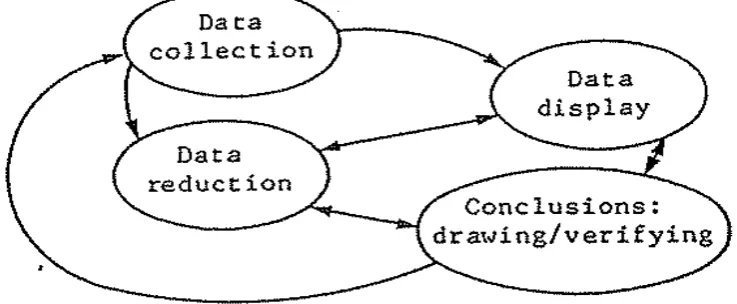
the analyzing the data. Miles and Huberman introduce about the qualitative method
based on content analysis. According to Miles & Huberman (1994: 10-11), there are
three concurrent flows of activity: data reduction, data display, and conclusion
drawing/ verification.
The first step is reducing the data by the process of selecting, focusing,
simplifying, and transforming the data that appear in written up-filed notes or
transcriptions. Data reduction is a form of analysis that sharpens, shorts, focuses,
discards, and organizes data in such a way that “final” conclusions can be drawn and
verified.
The second step is data display. After reducing the data, the analyst has to
display the data whether in tables, matrices, graphs, charts, and networks. All are
designed to assemble, compact form so that the analyst can see what is happening
and either draw justified conclusions or move on to the next step of analysis the
display suggests may be useful.
The third step is conclusion drawing and verification. Conclusions are also
verified as the analyst proceeds. Verification may be as brief as a fleeting second
thought crossing the analyst’s mind during writing. Final conclusion may not appear
Below are the components of data analysis: interactive model (Miles & Huberman,
1994:12)
Figure 3.1: Components of Data Analysis: Interactive Model
From: Miles and Huberman (1994:12)
The systematic procedures in this research namely:
1. Reading the selected articles of Discover Magazine.
2. Identifying the illocutionary acts existed in the five selected articles of Discover
Magazine.
3. Categorizing the utterances found in the selected articles into the type of
illocutionary acts.
illocutionary acts.
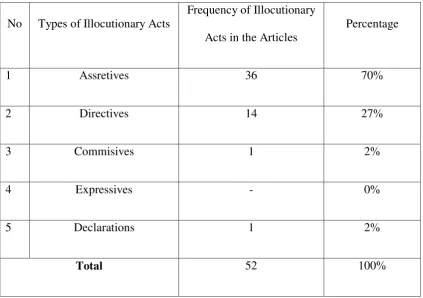
5. Identifying the most dominant types of illocutionary acts by using Malo’s formula
(1986:200). The Formula is:
�
� x 100% = N
Notes:
X: number of particular type of illocutionary acts
Y: number of all data
N: percentage of the type of illocutionary acts
6. Making summary of the analysis and draw a conclusion based on the findings of
CHAPTER IV
ANALYSIS AND FINDINGS
4.1 Analysis
In this subchapter, the material namely the illocutionary acts performed in
Discover Magazine on April 2013 edition would be the main part to be analyzed. The
data would be classified into five types of the illocutionary acts based on the theory
of Searle (1979:13-23) namely:assertive, directives, commissives, expressive, and
declarations. The theory of Searle is used in classifying the types of illocutionary acts
because he categorizes it into five types, meanwhile Leech (1983:205) only classifies
it into four category. Yule also categorizes it into five types but for the consideration,
according to the year, Searle introduces the theory first. That is the main reason of
choosing the theory that used in this thesis.
4.1.1 Data Description
Below are the data of illocutionary acts performed in the Discover Magazine
on April 2013 edition. The data would be inserted in the table and classified into
4.1.1.1 Assertives
NO Utterances
Page in magazine
1
“Stem cells function far differently in mice than monkeys”, says
biologist Shoukhrat Mitalipov, a senior scientist in the Division of
Reproductive and Developmental Sciences at Oregon National
Primate Research Center and lead author of the monkey study.
12
2
“If we are going to bring stem cells to human clinic, we need to
know exactly how those stem cells will work.”
12
3
“In mice, you can inject pluripotent cells from a black mouse into
the embryo of an albino mouse (in the womb of a mother mouse)
and they will get along well, and you’ll end up with a
black-and-white-spotted mouse chimera.”
12
4
“In the monkey, when we tried injecting 20 or 30
laboratory-cultured pluripotent stem cells, nothing happened.”
12
5 “The stem cells seemed to disappear; maybe they died” 13
6
Even rhesus Macaques, he says, “are not the ideal nonhuman
primate to study, since they are not as closely related to us as
chimpanzees.”
13
7
“We need to ask if we’d learn more if we studied other
animals-more expensive animals that are closer to humans.”
8
“If our ultimate goal is to take human cells and transplant them
into human subjects, we want to know ahead of time that they
will behave and integrate well.”
13
9 “Stem cells therapies hold great promise,” he says 13
10
“No drug could restore functional tissue the way that stem cells
could,”
13
11
“We will see if these three monkeys can have normal offspring.
We will want to see if these chimeras persist through the
generations,” Mitalipov says.
13
12
“More is not always better,” says Domhnall MacAuley, a
physician and editor at the British Medical journal who wrote an
editorial accompanying the study.
13
13
While the findings are counterintuitive, “the study adds to
growing evidence that periodic exams in otherwise healthy adult
are a waste of money and may even lead to overdiagnosis and
unnecessary treatments,“ says medical researcher Lasse
Krogsboll of the Nordic Cochrane Centre in Copenhagen.
20
14 “I’ve always been a hard-ass,” he said. 28
15 “That’s just my style. And no one ever complained before.” 28
16
“It’s years of lab work and green house work destroyed,” says
Uwe Schrader, one of the farm’s two managers
17 “There won’t be any results” 40
18
“They targeted these particular trials to weaken research in
Germany,” says Kerstin Schmidt, CEO of biovativ.
40
19
“We had to go out into the fields and do it in a very public way,
so the population wouldn’t see us as criminals,”Grolm says.
41
20
“If they send me to jail again, I’ll go in smiling, and come out
smiling,” he says.
41
21 “I don’t think it’s a sincere effort to do science,” he says. 41
22
“There’s no good gene technology. It’s like atomic energy-once
you open the door, you can’t close it,” he says.
42
23 “we can’t get rid of it once it out in the world” 42
24 “That’s not our thing, but you can’t really control it,” he shrugs. 42
25
“We may be at high tide now, but ebb tide could soon set in if we
become complacent and relax our efforts,” he said.
43
26
“These companies keep calling for coexistence, but I call it
KO-existence,” beekeeper says.
44
27
“They just want to knock us out-it’s biological equivalent of
locking a wolf and a sheep in a pen together to see which one
survives.”
44
science,” says Hans-jorg Jacobsen, a voluble researcherat Leibniz
Universitat Hannover whose specialty is transgenic legumes.
29
“The agricultural environment in which we produce our food
doesn’t exist in nature,” says Swiss plant ecologist Bernhard
Schmid.
45
30
“In most cases we’re working with varieties where the genes and
their product have been consumed for millennia,” he says
45
31
“Genetic engineering is fundamentally different. It’s
disingenuous to say this is a new and more precise way to do
breeding,” Gurian-Sherman says
45
32
“I don’t think it’s as inherently risky as some people say, but I do
think the risks are higher.”
45
33 “For a scientist, science looks obvious,” he says 46
34
“Europe was traumatized. Government regulators told consumers
they had nothing to fear, and they did,” Paarlberg says.
46
35
“We have no problem with genomics,” says Kirtana
Chandrasekaran, a campaigner for the London-based Friends of
the Earth. “Our problem is with their application in GMOs.”
46
36
“Every week they’re photographed from every corner and every
side, like models on the catwalk,” Puzio says with pride.
Assertives show thatthe point or purpose of the members of the assertive
class is to commit the speaker (in varying degrees) to something's being the case, to
the truth of the expressed proposition. All of the members of the assertive class are
assessable on the dimension of assessment which includes true and false. For
example:state, suggest, boast, complain, claim, report, warn, affirm, allege, assert,
forecast, predict, announce, insist. Above are the illocutionary acts namely assertives
type applied in the magazine.
4.1.1.2 Directives
NO Uterrances
Page in magazine
37
“Calling for systematic assembly-line health checks consumes
precious medical resources- in doctors’ time and unnecessary
treatments and test- that could be better used elsewhere.”
20
38
“Many adults don’t need an annual checkup, but they do need to
see their doctors frequently enough to get the preventive
services- mammograms, screenings for sexually transmitted
diseases- that we know work,” LeFevre says.
20
39
If you let loose a kid who appears to be lost on a street, will an
anonymous stranger ask, “Can I help you? Are you lost?”
21
40 If a stamped, addressed envelope is found on the street-
something we actually tested- will someone pick it up and put it
in a mailbox?
41
“I just have two questions for you. First, what the hell is wrong
with him?
28
42
“And second, can it be fixed? If not, he’ll have to leave the firm.
We had enough.”
“Let’s put it in this way. “Steve said.“I’ve had people pound on
the walls of the hotel rooms at night complaining that I was
keeping them awake.”
30
48
“Does your wife ever notice that you stop breathing while you
are sleeping?”
30
49
“If I were a scientist that really wanted to study this, what would
I do?”
41
50 “What kind of agriculture do we want?” 45
Directives is the illocutionary point that consists in the fact that they are
determinable which includes attempting) by the speaker to get the hearer to do
something. They may be very modest "attempts" as when I invite you to do it or
suggest that you do it, or they may be very fierce attempts as when I insist that you
do it. Verbs denoting members of this class are ask,ask (to), order, command,
request, beg, plead, pray, entreat, invite, permit, advise,dare, defy, challenge,
beseech, warn (to), and recommend. Above are illocutionary acts namely directives
type applied in the magazine.
4.1.1.3 Commissives
No Utterances
Page in magazine
51
“When I can, I dry seeds without electricity. I use the sun, the
wind,” he says
44
Commissives then are those illocutionary acts whose point is to committ the
speaker (again in varying degrees) to some future course of action. The direction of
fit is world-to-word and the sinceritycondition is Intention. The propositional content
is always that the speakerdoes some future action such as: promise, vow, offer,
undertake, contract, threaten. Above is illocutionary act namely commissive type
4.1.1.4 Declarations
NO Uterrances
Page in magazine
52 “I’m the guy the mayor turns to for legal advice when your
clowns get yourselves into trouble.”
28
Declarationshas special characteristic of this class that the successful
performance of one of its members brings about the correspondence between the
propositional content and reality, successful performance guarantees that the
propositional content corresponds to the world such as: resign, dismiss, divorce (in
Islam), christen, name, open (e.g. an exhibition), excommunicate, sentence (in court),
consecrate, bid (at auction), declare (at cricket).Above is illocutionary act namely
declaration type applied in the magazine.
4.1.1.4 Expressives
4.2. The Intention of Illocutionary Acts
As explained in the previous chapter, illocutionary acts can be categorized
into five categories. Searle (1979:13-23) categorizes them into five main categories,
they are:assertive, directives, commissives, expressive, and declarations. In analyzing
the intention, the theory of Searle (1979) and Cruse (2000) are used. Both Searle and
Cruse introduce five types of illocutionary acts. Cruse defines each type more
specific for the intention of the illocutionary acts. Below are the analyses of the
illocutionary acts based on the data in Discover Magazine’s some selected articles.
1.“Stem cells function far differently in mice than monkeys”, says biologist
Shoukhrat Mitalipov, a senior scientist in the Division of Reproductive and
Developmental Sciences at Oregon National Primate Research Center and lead
author of the monkey study.
In data 1, the type of assertive means asserting. Mitalipov performs an action
of asserting. He asserts the stem cells function far differently in mice than in
monkeys. The intention of this illocutionary act is asserting.
2. “If we are going to bring stem cells to human clinic, we need to know exactly how
those stem cells will work.”
In data 2, the type of assertive means suggesting. Mitalipov performs an
action of suggesting. He suggests us to know exactly how long the stem cells will
work when we are going to bring the stem cells to human clinic. The intention of this
3. “In mice, you can inject pluripotent cells from a black mouse into the embryo of
an albino mouse (in the womb of a mother mouse) and they will get along well, and
you’ll end up with a black-and-white-spotted mouse chimera.”
In data 3, the type of assertive means announcing. Mitalipov performs an
action of announcing. He announces that we may inject pluripotent cells from a black
mouse into embryo of an albino mouse (in the womb of a mother mouse) and they
will get along well, and we will end up with a black-and-white spotted mouse
chimera. The intention of this illocutionary act is announcing.
4. “In the monkey, when we tried injecting 20 or 30 laboratory-cultured pluripotent
stem cells, nothing happened.”
In data 4, the type of assertive means reporting. Mitalipov performs an action
of reporting. He reports that in the monkey, from the 20 or 30 laboratory-cultured
pluripotent stem cells experiment, nothing happened. The intention of this
illocutionary act is reporting.
5. “The stem cells seemed to disappear; maybe they died”
In data 5, the type of assertive means alleging. Mitalipov performs an action
of alleging. He alleges the stem cells may be died when it’s disappeared.The
intention of this illocutionary act is alleging.
6. Even rhesus Macaques, he says, “are not the ideal nonhuman primate to study,
since they are not as closely related to us as chimpanzees.”
In data 6, the type of assertive means asserting. Jason Robert perfoms an