UNIVERSITI TEKNIKAL MALAYSIA MELAKA
ANALYSIS ON KENAF FIBER EFFECT TOWARD
COMPRESSION CHARACTERISTICS
This report submitted in accordance with requirement of the Universiti Teknikal Malaysia Melaka (UTeM) for the Bachelor Degree of Engineering Technology
(Maintenance Technology) (Hons.)
by
MOHD AZDHARI BIN MOHD SALLEH B071210538
910726-07-5443
UNIVERSITI TEKNIKAL MALAYSIA MELAKA
BORANG PENGESAHAN STATUS LAPORAN PROJEK SARJANA MUDA
TAJUK: ANALYSIS ON KENAF FIBER EFFECT TOWARD
COMPRESSION CHARACTERISTICS
SESI PENGAJIAN: 2015/16 Semester 2
Saya MOHD AZDHARI BIN MOHD SALLEH
mengaku membenarkan Laporan PSM ini disimpan di Perpustakaan Universiti Teknikal Malaysia Melaka (UTeM) dengan syarat-syarat kegunaan seperti berikut:
1. Laporan PSM adalah hak milik Universiti Teknikal Malaysia Melaka dan penulis. 2. Perpustakaan Universiti Teknikal Malaysia Melaka dibenarkan membuat salinan
untuk tujuan pengajian sahaja dengan izin penulis.
3. Perpustakaan dibenarkan membuat salinan laporan PSM ini sebagai bahan pertukaran antara institusi pengajian tinggi.
4. **Sila tandakan ( )
SULIT
TERHAD
TIDAK TERHAD
(Mengandungi maklumat yang berdarjah keselamatan atau kepentingan Malaysia sebagaimana yang termaktub dalam AKTA RAHSIA RASMI 1972)
(Mengandungi maklumat TERHAD yang telah ditentukan oleh organisasi/badan di mana penyelidikan dijalankan)
( )
Alamat Tetap:
NO. 109 Jalan Tanjung Indah ,
Taman Tanjung Indah, 09000
Kulim, Kedah .
Disahkan oleh:
( )
Cop Rasmi:
DECLARATION
I hereby, declared this report entitled “ANALYSIS ON KENAF FIBER EFFECT
TOWARD COMPRESSION CHARACTERISTICS” is the results of my own research
except as cited in references.
APPROVAL
This report is submitted to the Faculty of Engineering Technology of UTeM as a partial fulfillment of the requirements for the degree of Bachelor of Engineering Technology (Maintenance Technology) (Hons.). The member of the supervisory is as follow:
I
ABSTRACT
II
ABSTRAK
III
DEDICATIONS
IV
ACKNOWLEDGMENTS
V
CHAPTER II : LITERITURE REVIEW 2.1 Kenaf... 5
2.2 Natural Fibers... 5
2.2.1 Bast Fibers... 6
2.3 Composite... 7
VI
2.4 Polyester Resin... 8
2.4.1 Resin... 9
2.4.2 Polyester... 9
2.4.2.1 Polyester Characteristics... 9
2.5 Fabrication... 10
2.6 Universal Testing Machine (UTM )... 11
CHAPTER III : METHODOLOGY 3.1 Research Design... 13
3.2 Flow chart of process... 14
3.3 Material Preparation... 16
3.4 Methods Compression Molding... 18
3.5 Test Specimens... 21
3.6 Calculation Concept... 22
VII
CHAPTER IV : RESULT AND DISCUSSION
4.0 Introduction... 25
4.1 The comparison of a sample of kenaf mixture with polyester resin... 25
4.2 The Effect of Fiber Adhesive/Bonding... 26
4.2.1 The comparison of the most highest and the lowest strength ... 27
CHAPTER V : CONCLUSION 5.0 Introduction ... 28
5.1 Summary of Research... 28
5.2 Achievement of The Objective ... 29
5.3 Recommendation... 29
APPENDICES APPENDIX A... 31
APPENDIX B... 33
APPENDIX C... 37
VIII
LIST OF TABLE
3.3 The percentage composition... 17 3.4 The method to do the proportion of kenaf fiber
and polyester resin... 18 3.5 The specimen measurement that needed to
IX
LIST OF FIGURES
1.1 Kenaf plant leave and flower... 1
1.2 Classification of fibers... 2
2.4 Polyester structure... 8
2.5 Compression Test... 12
3.1 Flow chart of the research design... 14
3.3 Kenaf fibers 3mm,1.5mm,6mm,20mm and polyester resin... 16
3.3.1 Pipet and Digital Analyzer balance ... 16
3.4 Mold Fabrication... 20
3.4.1 Mold Fabrication for 3 view... 20
3.5 Test Specimens specifications, as follow from ASTM is D695 21 3.7 Universal Testing Machine (UTM )... 23
4.1 Graph of kenaf strength by use the Universal Testing Machine... 25
4.2 Drawing mold that need to fill in the material and occur adhesive... 26
X
LIST OF ABBREVIATION , SYMBOLS AND
NOMENCLATURE
BC -Centuries
UTM -Universal Testing Machine QC -Quality Control
R & D -Research and Development
ASTM -American Standard of Testing Method µ -Micro
± -Plus minus
CS -Compression Strength W -Mass of example V -Volume of example In -Inch
1
CHAPTER 1
INTRODUCTION
1.1 Kenaf Plant
Towards green technology, composite fatigue life and kenaf fiber-reinforced is one way investigated. The point of this study is to dissect the fiber modification effect trought mechanical characteristics of kenaf fiber strengthened polyester resin composites. Primary materials utilized as a part of this undertaking is a polyester resin and saturated kenaf fibers. Kenaf is a material that perform high load pressure for the compression test .
Figure 1.1 : (a) Kenaf plant leave and (b) flower (lembaga kenaf malaysia ,2015)
2
1.2 Natural fibers as Major type of Fibers.
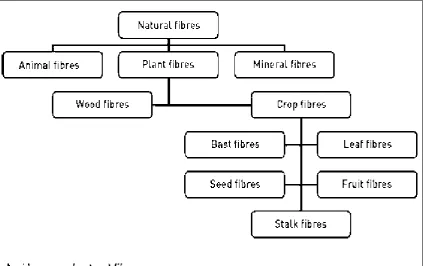
Figure 1.2 : Classification of fibers. (Textile Learner , 2014)
Natural fibers are extraordinarily extended substances created by plants and creatures that can be spun into fibers, string or rope. Woven, weaved, tangled or reinforced, they frame fabrics that are vital to society.
3
The most established fleece material, found in Denmark, dates from 1500 BC, and the most seasoned fleece floor covering, from Siberia, from 500 BC. Filaments, for example, jute and coir have been developed since relic.
While the techniques used to make fabrics have changed significantly from that point forward, their capacities have changed almost no: today, most common filaments are still used to make dress and holders and to protect, mollify and adorn our living spaces. Progressively, notwithstanding, customary materials are being utilized for modern purposes and additionally in segments of composite materials, in medicinal inserts, and geo- and agro-materials.
They go from cotton, which overwhelms world fiber creation, to other, forte filaments, for example, cashmere which, however created in far littler amounts, have specific properties that place them in the extravagance materials market.
1.3 Problem Statement
Currently this time , fiber are widely utilized as a part of the composite innovations as the substitution of traditional fiber that can lessen the creation expense of the composite item. Worldwide natural issues have prompted a replenished enthusiasm for bio-based materials, with the attention on renewable crude materials can be biodegradable or recyclable at sensible expense (C.K. Hong et, al. 2007).
4
The great properties of kenaf fiber incorporate great particular qualities and modulus, sparing suitability, low thickness and low weight . However, there are relatively few exploration done to the size and measurement of the fiber utilized as a part of the natural fiber reinforced polyester resin based on the effect . In this venture, the impact of the fiber estimate on mechanical properties can influence the properties of the composite created.
1.4 Objective of Research
• To analyze kenaf effect of fiber towards compression characteristics.
• To find effect of kenaf fiber strength by using universal test machine
• To compared the best composition of kenaf with polyester resin sample .
1.5 Scope of Research
i. Preparing of kenaf fibers (focus on 3mm )and polyester resin in quantities in the form of percentages with mass .
ii. A testing will be conducted by using the Universal Testing Machine (UTM) that range is 50KN maximum.
5
CHAPTER 2
LITERITURE REVIEW
2.1 Kenaf
Kenaf principal scientific name Hibiscus L. cannabinus is a plant that originated in Africa. This plant has already been identified almost 4000 years ago. The results of scientific research, Kenaf is a plant that is classified in the group of the families Malvacea Hibiscus.
Reaching a height of 3.7-4.3 meters in just 4 weeks. This plant is only capable of flowering day. The kenaf plant stalk consists of two types of fibers that are useful in the outside of the fibers and the fibers within.
Fiber external skin or known as fiber containing 40% by weight of the dry stalk weight and size of the fiber length is regularly 2.6mm when prepared. The fiber is suitable for use as a raw material in the manufacture of paper . Capable of producing fibers which are 6mm .
2.2 Natural Fibers
Natural fiber braced composites polymer are going upper mind blowing diversions of all substances specialists and researcher of late in light of the necessity for building up an earth all around arranged material, and not entirely substituting starting now used glass for composite stronghold [ Li Y, Mai Y W 2006 ].
6
2.2.1 Bast Fibers
Bast fiber (additionally called phloem fiber or skin fiber) is plant fiber gathered from the phloem (the "inward bark", once in a while called "skin") or bast encompassing the stem of certain dicotyledonous plants. They bolster the conductive cells of the phloem and give quality to the stem.
A large portion of the financially critical bast strands are gotten from herbs developed in agribusiness, concerning case flax, hemp, or ramie, additionally bast filaments from wild plants, as stinging bother, and trees, for example, lime or linden, wisteria, and mulberry have been utilized as a part of the past[Mary Dusenbury (1992] Bast filaments are delegated delicate filaments, and are flexible.[Esau, K. (1977)] Strands from monocotyledonous plants, called "leaf fiber", are named hard strands and are stiff.[Esau, K. (1977)]
Since the important filaments are situated in the phloem, they should frequently be isolated from the xylem material ("woody center"), and now and then likewise from epidermis. The procedure for this is called retting, and can be performed by smaller scale creatures either ashore (these days the most critical) or in water, or by chemicals (for occasion high pH and chelating specialists) or by pectinolytic proteins. In the phloem, bast strands happen in packages that are stuck together by pectin and calcium particles.
7
2.3 Composite
Composite (material structure, likewise called or abbreviated to composite) is material made of two or more constituent materials with qualities altogether diverse physical or compound, which when joined, produce a substance that has distinctive attributes than the individual parts , Individual segments stay separate and unmistakable in structure prepared. New material is favored for some reasons: regular cases incorporate materials that are more grounded, lighter or less expensive when contrasted and conventional materials.
2.3.1 Commonplace building composite materials including:
1. Composite building materials, for example, bond, concrete
2. Fortified plastics, for example, fiber strengthened polymer Metal Composites
3. Earthenware composite (fired and metal lattice composites)
8
2.4 Polyester Resin
Polyester resin is a sap framework that is most broadly utilized, especially in the marine business. So far the dominant part of dinghies, yachts and timber boats manufactured in the composite occupation utilizing this pitch framework.
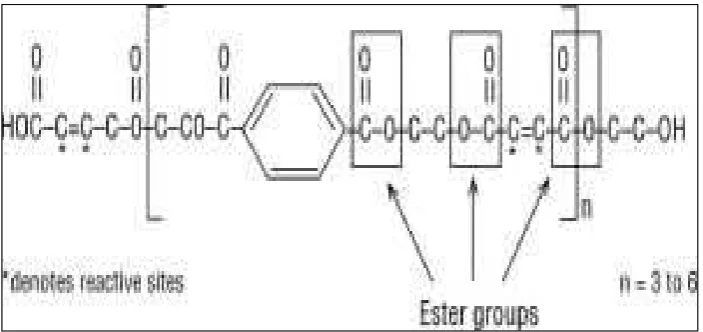
There are two regulation sorts of Polyester resin used as overlaying systems standard as a piece of the composites business. Orthophthalic Polyester resinthe standard monetary pitch used by various people. Isophthalic Polyester pitch is at present transforming into the material of choice in business ventures, for instance, sea where pervasive water resistance is alluring.
The figure2.4below demonstrates the substance structure perfect for polyester type.
9
2.4.1 Resin
Resin, is mean for uncommon wording, is numerous plants of a hydrocarbon , and it is a coniferous tree. It vary to another fluid found by plants, for example, elastic, or bodily fluid.
A wide and "resin" are also used for dense liquids, other than it is a basic synthetic polymer (synthetic resin), which is used in normal circumstances, be hard on a solid transparent or non-transparent.
Natural plant resins evaluated for chemical properties and the right things, for example the production of adhesives, varnishes .
2.4.2 Polyester
Polyester is regularly characterized as long-chain polymer science involving 85%
by weight of in any event dihydric alcohols and esters and Terephthalic corrosive" .also, it
likewise means to unite a percentage of the ester in the fiber. This is the family's most
widely used and economical resin. It is widely used in reinforced plastics.
2.4.2.1 Polyester Characteristics
1. Strands and fabrics are extremely solid.
2. It is effortlessly washed and dried.
3. Hydrophobic in nature and snappy drying. It can be utilized for protection by
10
4. Keep up its shape and subsequently it respects make outerwear for the cruel
atmosphere.
5. Extremely tough impervious to most chemicals, extend and therapist,
wrinkle-safe, mold and scraped spot safe.
2.5 Fabrication
Molded products are regularly alluded to as a board. For specific geometries and material blends, it can be alluded to as an electrical switch.
In the mold, support and framework materials are consolidated, compacted, and cured (handled) to experience combination occasions. After the show of solidarity, frame the base set, despite the fact that it can twist under certain procedure conditions. For thermoset polymer grid material, the curing response blend is started utilizing extra warmth or synthetic re activity, for example, a natural peroxide. thermoplastic polymer grid material, the solidarity of this nation is the hardening of fluid. metal grid materials, for example, titanium thwart, the solidarity is to consolidate at high weights and temperatures close to the softening point.