!" #$
" %&&&&&&&&'' " ( %&&&&&&&&'' ) %&&&&&&&&''
*+" ,+- .- / (* 00 ,1" 2( 3+,1 12.*4( "" 20 52 ,+- 2( "1 5
(22- +6 +- (1 4+""+(
1
!" 7 #
0
. 1
% & '
# ( % ) * + , - . $ #
$ #
) $
$ / & - / & 0 ' #
% $ & ( 0 1
# # #
2 $ &
#
@ && &
( & & & &
! & $ *
& & & & & @ &&
& & & @
& $ & & & &&
898 : ;$ && <5563 = 8=4 < ; 45563 >
848 < ; $ &
& & & & & &
! & & & & & &
* & & &&
3 " #
3 "
' 1
45563 - #
7 $ #
)# 898 : ;$
<5563 = 8=4 < ; 45563 > 848 < ;
) $ #
#
# "
#
#
!/32)0)" 7 !/! 3)" 7
)3@ 7 2/!A/-/ " #
),3"0)3" #
#
37 "/ " #
2 " 7% "),2/ '
2 " 7% % AB0/ '
2 " 7% )((/ ! C '
= = 9
= 8 7 # 9
= 9 ( 9
8 5 1 " :
8 = 1 D
8 8 3 " E
8 8 = F # 0 =5
8 8 8 F # 0 =5
9 = 2 3 =G
9 8 ( =E
9 8 = ! /' H!7/ =4
9 9 3 " 8=
9 9 = / 88
9 9 8 " 8<
9 9 9 " ( " 8G
9 : 3 8E
9 : = " ( 2 % 95
9 < 3 # /' 9=
9 < = ( 9=
: = ! /' 0 9:
: = = % ) 9D
: 8 1 " 94
: 8 = " 7 I %*" 94
: 8 8 " 7 - "*" :=
: 9 ) - :9
: : :4
This research is about gas carburizing effects on impact toughness of low carbon
steel; using the impact test and the heat treatment include two processes which are
carburized and uncarburized.
Low carbon steels can be treated to develop a hard surface or “case”, while the
interior of the steel or core is unaffected and retains its normal ductility and toughness.
Surface hardening (or case hardening) processes may be divided into two classifications
a) those in which the composition of the surface materials must be changed, and b) those
in which the composition of the surface materials is not changed (Chapman.W.W, 2004).
Carburizing, nitriding, carbonitriding and cyaniding processes are used to satisfy
the first classification, and flame hardening and induction hardening can be used to create
the characteristics of the second classification (Chapman.W.W, 2004). The process of
low carbon steel such as stampings, forgings and it applications in industrials are
seamless tube, boiler, plate, chain, sprockets, bearing, roller, chain, rivets, nails, wire,
pipe and others. The advantages of low carbon steel are process good formability, process
good weld ability and best of all metals, easy to handle and low cost and rated at 55%
2
Heat treatment can be define as an operation or set of operations in a metal
involving heating and controlled cooling. Transformation in the solid state can be
obtained using heat treatment procedures, which cause changes in microstructure
resulting in materials with a wide range of hardness and mechanical properties. Although
an exact relationship between hardness and wear performance does not exist, hardness
has traditionally been the properly used for quality control, selection of steel, and heat
treatment and performance evaluation (Totten. G.E. and Liang. H, 2004).
Gas carburizing is a surface hardening process in which steel or an alloy of
suitable alternative compositions is exposed at elevated temperature to a gaseous
atmosphere with high carbon potential, hardening of the resulting carbon rich surface
layer is accomplished by quenching the part from the carburizing temperature or by
reheating and quenching (Tomsis. J.L and Hodder. R, 2000). Gas carburizing expose the
steel parts to carburizing gases such as methane, propane, butane or from vaporized
hydrocarbon liquids. The process can be performed in either batch of continuous furnaces
and case depths, with depth being dependent on time and temperature.
Impact test meant to determine the behavior of materials when subjected to high
rates of loading, usually in bending, tension or torsion. The quantity measured is the
energy absorbed in breaking the specimen by a single blow (Tomsis. J.L and Hodder. R,
2000). These tests are used to indicate the toughness of materials and particularly its
capacity of resisting mechanical shock. In impact test however the unsatisfactory material
would prove to be extremely brittle as compared with the correctly treated one, which
would be tough. The Charpy impact test is used to determine the amount of energy
absorbed by a material during fracture. This absorbed energy is a measure of a given
material’s toughness and widely applied in industry because of easy to prepare and
treatment which is evaluated using the Charpy V9notch impact testing.
In this study, gas carburizing treatment and Charpy impact test had been done on
low carbon steel materials. The carburization of impact specimens was done at two
differences temperature of 500 oC for 1 hour and 900oC for ½ hour and the result were
compared and discussed statistically.
!
Low carbon steel are process good formability, process weld ability and best of all
metals, easy to handle and low cost rated at 55% until 60% machine ability. Gas
carburizing had been identified as one of the noble method to provide material with hard
surface but at the same time keeping the ductility at material. Thus, carburized steel has
high9carbon content on outer surface and maintaining low9carbon in the interior. In the
process of carburizing, steel is heat treated, the case is hardened while the core remains
4
" # $
% !
Heat treatment is defined as a physical process which entails the controlled
heating and cooling of material, such as metal or alloys to obtain desired properties. Heat
treating is an energy intensive process that is carried out in difference furnace such as
electric and gas. Shortening heat treated treatment cycles can provide great environment
and financial benefits through energy saving. Many texture detail furnace equipment and
its design but little to no literature review can be found on furnace method (Boyers et al.
1985) and (Cubbery et al. 1981).
The heat treatment processes described thus far involve microstructure alterations
and properties changes in the bulk of the materials or component by means of through
hardening. It is not desirable to through harden parts because a hard part lacks the
necessary toughness for these applications, a small surface crack could propagate rapidly
through such a part and cause total failure. In many cases, however, alteration of only the
surface properties of a part is desirable. This method is useful particularly for improving
resistance to surface indentation, fatigue, and wear. Typical applications for case
hardening are gear teeth, cams, shafts, bearings, fasteners, pins, automotive clutch plates,
containing elements such as carbon, nitrogen or boron that alter the composition,
microstructure and properties of surface. For steels with sufficiently high carbon content,
surface hardening takes place without using any these additions elements. Only heat
treatment processes described are needed to alter the microstructure, usually by either
flame hardening or induction hardening. Because case hardening is a localized heat
treatment, case hardened parts have a hardness gradient. Typically, the hardness is a
maximum at the surface and decrease below the surface, with a rate of decrease that
depends on the compositions of the metal and the process variables. Surface hardening
techniques also can be used for tempering to modify the properties of surface that have
been subjected to heat treatment. Various other processes and techniques for surface
hardening, such as shot peening and surface rolling, improve wear resistance and various
other characteristics (Kalpakjian. S & Schmid. S.R, 2006). Shot peening can be effective
to decrease austenite content because the surface deformation causes the mechanical
transformation from austenite to martensite, producing compressive residual stress in the
surface as well as increase of fatigue life (Krauss. G, 1995).
Decarburization is the phenomenon in which alloys containing carbon lose carbon
from their surface as a result of heat treatment or of hot working in a medium usually
oxygen that reacts with the carbon. Decarburization is undesirable because it affects the
hardenability of the surface of the par by lowering its carbon content. It also adversely
affects the hardness, strength, and fatigue life of steels by significantly lowering their
endurance limit. Decarburization is best avoided by processing the parts in an inert
atmosphere or a vacuum or by using neutral salt baths during heating heat treatment
6
& ' ( ! !)
In many industrial applications it is necessary to develop a high surface hardness
on a steels part so that it can resist wear and abrasion. This can be achieved by increasing
the hardness of high carbon steel, but high hardness is then accompanied by low ductility
and toughness (Chapman. W.W, 2004). Surface hardening a process which includes a
wide variety of techniques is used to improve the wear resistance of parts without
affecting the softer, tough interior of the part. This combination of hard surface and
resistance and breakage upon impact is useful in parts such as a cam or ring gear that
must have a very hard surface to resist wear, along with a tough interior to resist the
impact that occurs during operation. In ordinary carbon steels, these two different sets of
properties are found only in materials of different carbon content. Thus, steel with about
0.1 percent carbon will be tough; with 0.9 percent carbon will be very hard when suitably
heat9treated (Higgins. R.A, 1997). Further, the surface hardening of steels has an
advantage over through hardening because less expensive low9carbon and medium9
carbon steels can be surface hardened without the problems of distortion and cracking
+
( !
, !
High carbon steel AISI 1050 –
AISI 1080
Primary used for tools such drill bits and
other cutting tools due to their ability to
achieve high hardness.
Medium carbon
steel
AISI 1035 –
AISI 1050
Used in automotive industry, such as front
wheel drive components and drive shaft.
Low carbon steel AISI 1020 –
AISI 1035
Used where toughness rather than high
hardness is required such as in clutch plates
or pins for farm equipment.
*The table had shown about the chemical composition of
case hardening steels.
8
- ,
This energy absorbed by the specimen, as it breaks, can qualitatively be related to
it's fracture mode (ductile or brittle.) Ductile fracture, which involves substantial plastic
deformation, would require much more energy than brittle fracture. Note that the fracture
energy measured in a Charpy impact test is a relative energy and can only be used to
compare dimensionally identical specimens; it cannot be easily used directly in
engineering calculations (R.E. Reed9Hill, 1973).
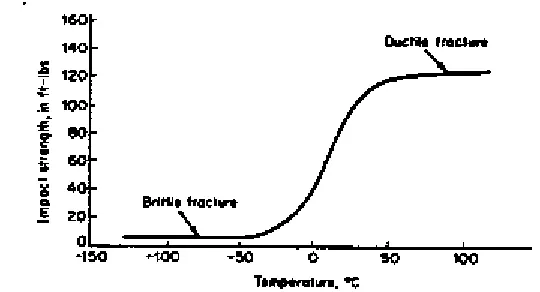
By testing the fracture energy of a sample at many different temperatures, a curve
such as Figure 3 can be developed. Because the transition from completely brittle (low
impact energy) to completely ductile (high impact energy) occurs over a broad range of
temperatures, several procedures exist for the determination of the actual "transition
temperature." One way is to examine the fracture surface. A brittle failure, where the
sample cleaved, will be shiny. A ductile failure, where the surface was plastically
deformed, will be dull. Often, a sample will display both types of failure. In the middle
of the sample, where a triaxial9type constraint on the stress is highest, the fracture will be
brittle and the fracture surface shiny and highly faceted. At the edge of the sample,
where the triaxial constraint is partially relieved, the failure may be ductile, leaving a dull
surface. See Figure 2.2. The transition temperature is sometimes determined to be the
temperature when the fracture surface is 50% ductile (R.E. Reed9Hill, 1973).
A second definition, and the one that will be used here, is that the transition
temperature is the temperature where the fracture energy is half way between the pure
brittle and pure ductile impact energies. This can be determined using a plot of the
Figure 2.1: Representative Charpy impact test results
(Source: R.E. Reed9Hill, 1973)
Figure 2.2: This figure show the fracture appearance charts and percent
shear fracture comparator.
10
.& ! &
The quantitative result of the impact test the energy needed to fracture a material
can be used to measure the toughness of the material and the yield strength. Also, the
strain rate may be studied and analyzed for its affect on fracture.
The ductile9brittle transition temperature (DBTT) may be derived from the temperature
where the energy needed to fracture the material drastically changes. However, in
practice there is no sharp transition and so it is difficult to obtain a precise transition
temperature. An exact DBTT may be empirically derived in many ways: a specific
absorbed energy and change in aspect of fracture (Meyers. M.A and Chawla. K.K, 1999).
.& &
The qualitative results of the impact test can be used to determine the ductility of
a material (Mathurt. K.K et al. 1994). If the material breaks on a flat plane, the fracture
was brittle, and if the material breaks with jagged edges or shear lips, then the fracture
was ductile. Usually a material does not break in just one way or the other, and thus
comparing the jagged to flat surface areas of the fracture will give an estimate of the
percentage of ductile and brittle fracture (Meyers. M.A and Chawla. K.K, 1999).
& / !)
Carburizing is one of these treatment promoting high surface hardness, strength,
fatigue resistance, and wear resistance. Therefore, it is used in highly stressed
components such as shaft, bearings and gears. Carburizing process include pack
carburizing, gas carburizing, and salt bath. It is applied to low carbon steels, about 0.2%C
Carburizing increase the surface carbon content of low carbon steel (0.1 91.2%C)
by 0.7 91% in a carbon medium. This medium can be solid, molten salt, a gaseous or
plasma medium. At low temperatures carbon will not diffuse into steel. Both the steel and
carburizing material must be heated during carburizing to an elevated temperature. In
practice, carburizing is done at temperatures between 9000C and 9500C (Prabhuder. K.H,
2000). Gas carburizing is carried out in both continuous and batch type furnace. The
gases naturally used are the hydrocarbons methane and propane (product of petroleum
production). This should be of high purity otherwise oily soot may be deposited on the
work pieces (Higgins. R.A, 1997).
Advantages of gas carburizing are time – temperature cycles can be determined
accurately for close control of the case depth. Composition of the carburizing gas can be
varied to provide a close control of the carbon content of the case, the whole charge is
heated to a carburizing commences. It is hence possible to obtain a uniform degree of
case depth that is not obtained by any other method, part handling is clean and relatively
efficient, the process is readily adaptable for continuous operation, and requires minimum
floor space, less time is required and direct quenching of the charge from the carburizing
temperature reduces the heat treatment cost and also results in minimum distortion. The
limitations of gas carburizing are high capital investment for the furnace, a generator is
required and baskets and fixture are expensive (Prabhuder. K.H, 2000).
Totten. G.E. and Liang. H. (2004) indicates that the influence or retained austenite
or wear resistance, in the case of carburized steel or hardened steel, has long been a
controversial subject. This situation occurs because of the complexity of the mechanisms
involved in the wear of the materials. In addition, there is the interaction of factors such