DOI: 10.12928/TELKOMNIKA.v14i2A.4331 223
Fusion Algorithm of Self-adaptive Cubature Kalman
Smoothing of Multi-sensor
Jiang Jing*1, Ali Kanso2
1
Nanjing forest police college, Nanjing, China
2Lockheed Martin Aeronautics Company, Texas, USA
*Corresponding author, e-mail: [email protected]
Abstract
Aiming at drunk-driving test system of traditional single-point automobile which has neglected the influence of flow of in-car airflow on test precision and accuracy, this paper puts forwards in-car drunk-driving measurement and control method that is based on fusion technology of multi-sensors by exploration. Based on information fusion algorithm of D-S proof theory design, main hardware system and working mode of drunk-driving measurement and control system has been designed; scheme design of automobile drunk-driving test and control system that is based on multi-sensor test has been completed. When system model of cubature Kalman smoothing is instable or abnormal, smoothing divergency will occur. In order to solve this problem, fusion algorithm of self-adaptive cubature Kalman smoothing is put forwarded. Noise system statistical estimator has been designed to carry out on-line real-time estimation about statistical characteristics of noise; smoothing process shall be modified by adopting modified function when measurement is abnormal, so that precision of smoothing estimation and suppression ability for smoothing divergency are both improved.
Keywords: Kalman smoothing; Drunk-driving measurement and control; Self-adaptive; Modified function; Data fusion
1. Introduction
With the development of automobile industry and transport industry, demanded amount for automobile is increasing day by day. It is not uncommon to see a series of traffic accidents caused by performance of automobile and human factors, so that resources are wasted. Aiming at this situation, this paper researches a kind of automobile pre-warning system based on fusion technology of multi-sensor [1-5].
This system collects data and transmits to MSP430 single-chip to deal with in low level automobile; raise the alarm and carry out initiative treatment by controlling launching equipment after comparing of data treatment in the end; therefore, hidden dangers caused by drunk-driving, overload, excessive high temperature can be avoided to certain degree and safety can be improved in the end [6-7].
This paper pus forward alcohol pre-warning system and overload pre-warning system aiming at defects existing in present system, so that passive pre-warning can be converted into active warning. This is innovation point of this paper. According to demand of system and module analysis, this paper has designed drunk-driving pre-alarm module, pre-warning test module for overload, pre-warning test module for temperature, pre-warning module for speed and distance of automobile, display module, alarm module and expanded voice alarm module [8].
This paper researches automobile pre-warning system based on fusion technology of multi-sensor; makes use of design construction of hardware circuit, including module circuit of sensor and interface connection of PCB panel; carries out simulation running of compilation of software system, including burn-in procedure of IAR and MSP430 and simulation emulation. Complete debugging of system items by using electronic instrument like oscilloscope, logic analyzer and digital multi-meter in the end.
sensor and the maximum measurement distance is 500 cm; when distance is less than 50cm, pre-warning system will send out alarming treatment. Test part of pre-warning system in the end and the measurement results reflect that pre-warning effect is stable and response time is very short; functions of pre-warning system can be realized.
2. Research Method
Consider the following discretized dynamic system:
1 1 1
(
,
)
k k k k k
x
f
x
u
w
(1)(
,
)
k k k k k
z
h x u
v
(2)Therein, nx
k
x is
n
x dimension state vector at k moment; nuk
u means known certainty control input vector, : nx nu nx
k
f and : nx nu nz
k
h are known mapping at k moment, respectively used to describe transferring of system state and measurement characteristics of sensor. When system is non-linear, at least one of fk and hk is non-linear
mapping.
z
n k
z is measurement vector of sensor or other information source at k moment; {wk} and { }vk respectively are system noise and measurement noise and they usually has normal distribution, but their mean value and covariance matrix usually are hard to be determined and may be time-varying. Supposed that {wk} and { }vk are time-varying and have no relationship with each other and supposed that:
[ ] , [ ] , [ ] ,
[ ] , [ ] 0
T
k k k j k kj k k
T T
k j k kj k j
E w q E w w Q E v r
E v v R E w v
(3)
In the formula,
kj is function ofKronec
ker
.As for cubature Kalman smoothing, basic cubature point and corresponding weight number of integral of weighting function to standard Gaussian distribution function density shall be firstly calculated:
1
2[1 ] ; , 1, 2,...,
i m i wi m i m
(4)
Therein, m is number of cubature point, generally m2nx; [1] is a matrix of nx2nx
dimension and [1][eye n( x),eye n( x)]; [1]i means
i
line of [1]. Supposed that { , } 1 kk i i i
I u z means all collection of controlling input and measurement until k moment and supposed that posterior probability p x( k|Ik)N x x( k;ˆk k| ,Pk k| ) at k moment is subject to Gaussion distribution;
| k k
S is Cholesky decomposition factor ofpk k| . Therefore, as for modules given by formula (1) and (2), operation process of self-adaptive cubature Kalman smoothing is as follows:
Time renewing process:
Step 1: carry out Cholesky decomposition to pk k| :
| | |
T k k k k k k
P
S
S
(5)Step 2: calculate Cubature point:
, | |
ˆ
|,
1, 2,...,
i k k k k i k kStep 3: Take Xi k k, | into non-linear state equation of state, get Cubature point after spreading:
*
, 1| 1
(
, |,
)
,
1, 2,...,
i k k k i k k k kX
f
X
u
q
i
m
(7)Step 4: calculate single-step state forecast:
1 *
1| 1 , 1|
ˆ
k k m i k k ki
x
m
X
q
(8)Step 5: calculate covariance of state forecast error: (9)
1 * *
1| 1 , 1|
(
, 1|)
ˆ
1|ˆ
1|m T T
k k i i k k i k k k k k k k
P
m
X
X
x
x
Q
(9)measures renewal process:
Step 1: carry out Cholesky decomposition to
p
k1|k:1| 1| 1|
T k k k k k k
p
S
S
(10)Step 2: calculate Cubature point:
, 1| 1|
ˆ
1|,
1, 2,...,
i k k k k i k kX
S
x
i
m
(11)Step 3: take Xi k k, | into non-linear state equation of state, get Cubature point after spreading:
*
, 1| 1
(
, 1|,
)
,
1, 2,...,
i k k k i k k k kZ
h
X
u
r i
m
(12)Step 4: calculate measurement forecast:
1 *
1| 1 , 1|
ˆ
k k m i k k ki
z
m
Z
r
(13)Step 5: calculate covariance of innovation:
1 * *
1| 1 , 1|
(
, 1|)
ˆ
1|ˆ
1| mz T T
k k i i k k i k k k k k k k
P
m
Z
Z
z
z
R
(14)Step 6: calculate cross-covariance:
1 * *
1| 1 , 1|
(
, 1|)
ˆ
1|ˆ
1| mxz T T
k k i i k k i k k k k k k
P
m
X
Z
x
z
(15)Step 7: calculate smoothing gain:
1 1 1|
(
1|)
xz z k k k k k
G
P
P
(16)Step 8: estimate system state of present moment:
1| 1 1| 1 1 1|
ˆ
k kˆ
k k k( )(
kˆ
k k)
Step 9: calculate covariance matrix of error:
1| 1 1| 1 1| 1
z T k k k k k k k k
P
P
G
P
G
(18)Because mean value of noise and statistical characteristics of covariance is time-varying, namely, value of k,q Q rk, k, kandRk is different at different moment. Therefore, in the
process of smoothing, they will be estimated and modified at any time and they will be close to real-time statistic characteristics of noise. Therefore, precision of smoothing will be improved and smoothing divergency will be suppressed effectively. This can be realized by constructing a set of noise statistical estimator.
This paper combines Sage-Husa suboptimum unbiased maximum posterior (Maximum a posteriori, MAP) estimation algorithm and gets a set of time-varying noise statistical estimator
1 ˆ 1 1
ˆk , k ,ˆk
q Q r and Rˆk1; computational formulas are shown as formula (19)-(22). Noise statistical estimator estimates mean value and covariance of noise by making use of information like measuring data and history smoothing process; it can decrease the deviation of system model from measurement model and improve stability of smoothing process. Recursion formula of noise statistical estimator is simple and easy to be realized in engineering and its estimation to noise statistics is unbiased about suboptimum.
1 1| 1
1
1 , | 1
ˆ (1 )ˆ [ˆ
( , )]
k k k k k k
m
k i k k k
i
q d q d x
m f X u
(19)1 1 1 1 1 1| 1
1 * *
, 1| 1| , 1| 1|
1
ˆ (1 ) ˆ [
ˆ ˆ
( )( ) ]
T T
k k k k k k k k k k
m T
i k k k k i k k k k
i
Q d Q d G z z G P
m X x X x
(20) 1 1 11 , 1| 1
1
ˆ
(1
)
ˆ
[
(
,
)]
k k k k k
m
k i k k k
i
r
d
r
d
z
m
h
X
u
(21)1 1 1
1 * *
, 1| 1| , 1| 1|
1
ˆ (1 ) ˆ [
ˆ ˆ
( )( ) ]
T
k k k k k k
m T
i k k k k i k k k k
i
R d R d z z
m Z z Z z
(22)Time-varying characteristics of noise statistic determine that influence of latest data to smoothing is relatively great, so weight of latest data in smoothing shall be increased, but function of old data will be decreased gradually. This will be realized by fading memory index weight; therefore, introduce weight coefficient dk (1 b) (1bk1) into noise statistical estimator, with forgetting factor b, generally 0.95 b 0.99; the greater b is, the more the function of latest data in the process of smoothing estimation is emphasized. When statistical characteristics of noise change relatively fast, greater value of b shall be selected; otherwise, smaller value of b shall be selected. Therein, zk1zk1zˆk1|k is measurement forecast error.
When filter convergence, the following equation is valid:
1 1
( [
1 1])
T T
k k k k
z
z
Tr E z
z
(23)Therein, 1 is adjustable coefficient; when =1, formula (7) is strict convergence data; Tr( ) means seeking for track of a matrix. No matter function of smoothing is smoothing, estimation or forecast, process of smoothing is based on measuring data. When measurement is abnormal, smoothing process will be greatly influenced. If measuring data is normal, than:
1
1|
k T z
j j k k k j l
Therein, L is length of sliding window; whenkL, l k L 1, or l1;when wild-value of measurement occurs, formula (23) will not be valid any more. At this moment, difference of two sides of equation shall be defined as self-adaptive adjusting factor ߮, namely:
1
1|
1
(
)
k T z
k
L
j k Lz z
j jP
k kR
k
(25)Obedience degrees of freedom of statistical characteristics of k is
2
distribution of
n
z;z
n is dimensionality of measurement vector. Track of k can be used to test whether abnormal
value exists in the measurement: when measurement is normal, then 2
( k) ( z)
Tr n ; when measurement is abnormal, then 2
(k) (z)
Tr n and smoothing process shall be modified at the moment, method is as formula (16), namely, add a modified function ( )k to gain of smoothing, definition as follows:
1 2
2
1 ( ) ( ) ( )
( )
1 ( ) ( )
T
k k k k z
k z
z z Tr n
k
Tr n
,
, (26)
Because gain of smoothing is actual weight coefficient of measuring data in the process of smoothing, modified function is adjustment function of influence to measuring data in the process of smoothing in essence. Decrease the influence of measuring abnormal condition to the process of smoothing and realize the objectives of improving estimating precision of smoothing and suppressing divergence of smoothing by judging whether measuring data is normal and modifying gain of smoothing by self-adaption.
Compared with smoothing process of standard CKF, the best characteristic of above said smoothing process of self-adaptive CKF is adding a set of noise estimator and modified function. Noise statistical estimator provides accurate noise statistic characteristic information needed by smoothing estimation and decreases influence of system model error. Modified function adjusts the weight of measuring data in the process of smoothing by self-adaption according to abnormal measuring data. Greatly increase fault error and inhibiting ability of self-adaptive CKF to system model and smoothing divergence by introducing noise estimator and modified function.
3. Application and Simulation Analysis
3.1. Motion State Model and Measuring Equation of Drunk-Driving Vehicles
Navigation and location to vehicles generally adopt GPS/DR integrated navigation system. Because American military possesses control power for GPS, so military application tries to decreases reliance to GPS. Beido Navigation and Location System (BDS) is in the completion phase; basic navigation and location functions have already covered all areas of our country, but location precision is not satisfied. Therefore, adopt GPS/BDS/DR constituting navigation system and smooth and integrate navigation data of the three kinds of sensors by making use of soothing method of multi-sensor combination based on self-adaptive CKF in order to improve navigation and location precision.
If elevation changes are not taken into account, motion of vehicles can be regarded as motion on two-dimension plane; fix a certain point as origin of coordinates and establish geodetic coordinate system by taking due east and due north directions as coordinate axis; state vector of vehicle kinestate can be selected as [ , , , , , ]T
e e e n n n
x s a s a . Therein, each vector respectively means coordinate, speed and accelerated speed in the due east and due north directions, units respectively: m m s, / , 2
/ ,
m s m, m s/ , 2
/
m s ; set sampling time interval is T according to Newton’s laws of motion and present statistical model. State model of vehicle motion after divergence is as follows:
1 1
(
,
)
1k k k k k k k k k
3.2. Simulation Experiment and Result Analysis
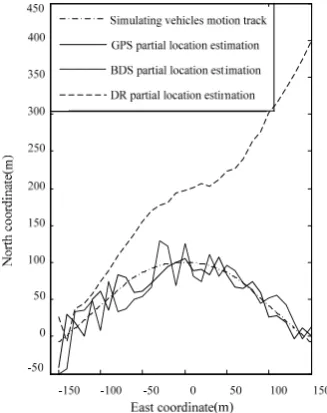
Figure 1 reflects track estimation curve based on partial observation of all sensors and smoothing process to partial data of all sensors adopts self-adaptive CKF algorithm. It is observed that estimated track is close to real track obtained based on observation data of GPS and BDS; estimated track is different from real track obtained based on observation data of DR. What’s more, rear-half part is totally separated from real track and corresponding estimated error curve of north-direction coordinate is shown as Figure2.
Therein, estimated error curve based on GPS and BDS shows a decreasing status, which benefits from modification of self-adaptive CKF algorithm to measuring model; however, DR error curve is divulged gradually; main reason leading to this result is that navigation and location calculation is a process of accumulation. Error of any sensor in system will give rise to accumulation of error, making location accuracy lower, but self-adaptive adjusting function in self-adaptive CKF algorithm can not identify abnormal measurement in DR system, therefore, smoothing process based on DR measuring data can not be modified effectively.
Figure 1. Simulating vehicles motion track and track curve based on partial smoothing
estimation of all sensors
Figure 2. Track curve of gps/bds/dr combination smoothing respectively adopting self-adaptive CKF and EKF
(a) GPS error curve (b) BDS error curve (c) DR error curve
(a) GPS error curve (b) BDS error curve (c) DR error curve
Figure 4. Relative error curve of north speed estimation based on partial data smoothing of all sensors
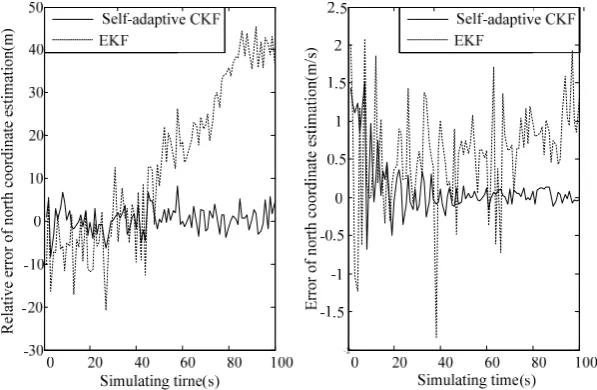
Figure 1 and Figure 2 reflect the estimated track curve and estimated error curve of corresponding north coordinate of GPS/DBS/DR combination navigation system by respectively adopting self-adaption CKF and EKF smoothing method. As is shown in the curves, precision of self-adaptive CKF smoothing method is higher than that of EKF smoothing method;in the process of EKF smoothing, even smoothing divergence phenomenon occurs; comparing Figure 2 with Figure 3, estimated smoothing precision that is obtained by combining information of GPS/BDS/DR, is higher than that of any single sensor. However, combined smoothing method based on self-adaptive CKF sensor system is superior to that of multi-sensor system based on EKF in performance.
Above said simulation results show that information can be described more accurately and station of supervised objects can be estimated more accurately by integrating information of all sensors in multi-sensor system, which will be realized on the premise of reasonable fusion methods that are adopted. Self-adaptive CKF more adapts to smoothing when system model and measuring equation are inaccurate compared with classic non-linear smoothing method EKF and has fine suppressing function to smoothing divergence. Combined smoothing method of multi-sensor system based on self-adaptive CKF can integrate sensor information effectively and improve precision of information. What’s more, smoothing process of self-adaptive CKF is easier; it has higher calculating efficiency and it can be realized easier in engineering and practical application compared with EKF.
Figure 5. GPS/BDS/DR combined smoothing respectively estimates coordinate relative error by adopting self-adaptive CKF and EKF
Figure 6. GPS/BDS/DR combined smoothing respectively estimates speed relative error by
4. Conclusions
This paper improves cubature Kalman smoothing algorithm by adding a set of noise statistical estimator and modified function and puts forward self-adaptive cubature Kalman smoothing algorithm on how to prevent drunk driving. Aiming at combined smoothing problems of multi-sensor system of self-adaptive cubature Kalman smoothing, it researches combined smoothing structure about multi-sensor system and puts forward multi-sensor calculation method of data fusion based on cubature Kalman smoothing. Simulation results show that methods put forward in this paper have excellent effects on suppressing divergence of smoothing, improving precision of smoothing estimation and combined smoothing of multi-sensor system, etc. Self-adaptive cubature Kalman smoothing algorithm supposes the relative ideal condition that noise statistic characteristics comply with normal distribution; therefore, in worse circumstance of other conditions, this method is not applicable. What’s more, this paper does not involve combined smoothing problem in multi-sensor system in the correlated condition of all sensors.
References
[1] Aluvalu Rajani Kanth, Vanraj Kamliya and Lakshmi Muddana. HASBE Access Control Model with Secure Key Distribution and Efficient Domain Hierarchy for Cloud Computing. International Journal of Electrical and Computer Engineering (IJECE). 2016; 6(2): 770-777.
[2] T Sutikno, D Stiawan, IMI Subroto. Fortifying Big Data infrastructures to Face Security and Privacy Issues. TELKOMNIKA (Telecommunication Computing Electronics and Control). 2014; 12(4): 751-752.
[3] Jiang D, Ying X, Han Y. Collaborative multi-hop routing in cognitive wireless networks. Wireless Personal Communications. 2015: 1-23.
[4] Hui Z. The Design of Electronic Toll Collection System Based on Radio-Frequency Identification.
Bulletin of Electrical Engineering and Informatics, 2013, 2(4): 286-292.
[5] Jiang D, Xu Z, Chen Z. Joint time-frequency sparse estimation of large-scale network traffic.
Computer Networks. 2011; 55(15): 3533-3547.
[6] I.M. Alsofyani, N.R.N. Idris, Y.A. Alamri, T. Sutikno, A. Wangsupphaphol, N.M. Nordin. Comparison of Estimated Torques Using Low Pass Filter and Extended Kalman Filter for IM Drives at Low Speed.
International Journal of Power Electronics and Drive Systems. 2015; 6(1): 92-99.
[7] Lin Y, Yang J, Lv Z. A Self-Assessment Stereo Capture Model Applicable to the Internet of Things.
Sensors. 2015; 15(8): 20925-20944.