WiMAX: Network Entry Phase Optimization for Bandwidth
Improvement Solution
Mohamad Firdaus Ghazali, Abdul Samad Shibghatullah, Shahrin Sahib@Sahibuddin
Department of Computer Systems and Communications, Faculty of Information and Communication Technology,
Universiti Teknikal Malaysia Melaka, Melaka, Malaysia.
[email protected], [email protected], [email protected]
Keywords: IEEE 802.16, WiMAX, network entry, ns-3
Abstract
Worldwide Interoperability for Microwave access (WiMAX) service providers is concerned about having enough Internet-backbone to support a potentially large number of users. Network entry process directly influences the initial delay that users are experiencing. Therefore, efficiently combine DCD interval, UCD interval and initial ranging interval in network entry process is predicted to influence the network performance, as presented in this paper.
1 Introduction
Worldwide Interoperability for Microwave Access (WiMAX) is a technology based on IEEE 802.16 Standard [1]. The name WiMAX was created by the WiMAX Forum, which was form in June 2001 by companies in the industry to promote conformity and interoperability of IEEE 802.16 Standard for the development and deployment of WiMAX systems. The IEEE 802.16 specifies the Air Interface for Broadband Wireless Access Systems including the medium access control (MAC) layers and physical (PHY) layers for Metropolitan Area Network (MAN). It was designed to provide high speed Internet and data access as alternative to traditional wired networks [2].
In WiMAX, the MAC protocol plays a significant role in determining the performance of whole network. Network entry process directly influences the initial delays that users are experiencing. This crucial process is the first step required for Subscriber Station (SS) to register themselves with the WiMAX networks. Every single message exchanged experiences a certain delay from the time it enters the sender’s MAC sending queue until it is received by the reveiver. The overall time to join the network needs to take this delay into account for all message exchanged [3].
The remainder of this paper is organized as follows. Firstly this paper will discuss on the brief operation of network entry and initialization in WiMAX. Then other related works are presented before outlining our proposed adjustment for the improvement of WiMAX network entry and initialization
phase. Finally, a brief description of simulation scenario and expected results is presented.
2 Network entry and initialization phase
Network entry process is the first step for SS joining the WiMAX network. It is refers to the early procedure SS perform to register themselves with the Base Station (BS) that controls the 802.16 network. When SS acquires the network, it first scans for downlink (DL) channel and establish synchronization with the BS. The next step is to obtain the uplink (UL) parameters decoded from various control messages, such as FCH, DCD, UCD, DL-MAP and UL-MAP. Once acquired, the ranging process will be performed. Ranging is the process to obtain the relative timing and power-level adjustment so that the SS’s transmissions are aligned with the BS. After ranging, the SS inform the BS about its basic capabilities and the BS will respond to it to find the intersection of the SS’s and BS’s capabilities.
On powered up or after signal loss, the SS scans the allowed DL channel to determine whether it is presently within the coverage of a suitable WiMAX network. The SS stores a non-volatile storage that list of all operational parameters used previously and first attempts to reacquire this DL channel. If this fails, the SS scan other channel it can synchronize with the valid DL channel. Once it obtains DL synchronization, the SS listens to the various control messages to acquire the various PHY and MAC related parameters for the DL and then the UL.
The MAC shall search for the DL-MAP control messages. The SS obtain MAC synchronization once it has received DL-MAP that defines access to the DL information. The DL channel remains in synchronization as long as SS continue to receive DL-MAP and DCD messages.
Once synchronization is achieved, the SS performs initial ranging with the BS to obtain the relative timing and power-level adjustment required to maintain the UL connection with the BS. First, an SS shall synchronize to the DL and learn the UL channel characteristics through the UCD MAC management message. At this point, the SS shall scan the UL-MAP message to find and initial ranging interval that was allocated by the BS.
3 Related works in network entry optimization
Most of existing researches regarding to network entry phase optimization mainly focus on initial ranging connectivity. Latkoski provided an introduction about a new UCD-aware initial ranging transmission opportunity slots distribution [4]. He proposed a new protocol algorithm utilizable in the network entry process of the IEEE 802.16 communication system.
Meanwhile, a dynamic contention window adjustment for initial ranging has been proposed in [5] as well as [6] that aiming to reduce the delay in initial ranging. Those work proposed a contention model of initial ranging and algorithm that efficient in terms of retransmission, access delay and resource utilization.
Base from the idea of previous research, this paper propose to analyze key parameters that influence the network entry procedure which are DCD interval, UCD interval and initial ranging interval [4]. All of these parameters are being tuned to result a better performance of network entry process as a suggestion for bandwidth improvement solution.
4 Propose scheme and simulation scenario
The process of designing and efficient system model for network entry phase calls for investigation of innovative and practical techniques that can improve IEEE 802.16 networks. The propose scheme implement an efficiently combine DCD interval, UCD interval and initial ranging interval to optimize the network entry process that can improve the WiMAX system performance.
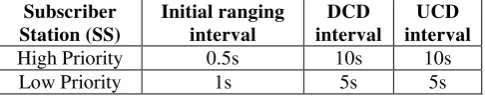
A given different priority of SS with different parameter tuning regarding to network entry process can significantly enhance the performance of network entry procedure for particular SS. A high priority SS is given to use a shorter value of initial ranging interval period and maximum value of DCD interval and UCD interval period. This mean a high priority SS will wait less during time it entering the network which implicates better communication system’s Quality of Service (QoS) and also bandwidth allocation [4].
The experimentation is done using ns-3 [7] simulator. A simulation module of the IEEE 802.16 WiMAX is implemented as described in [8] and [9] with main features of MAC implementation for IEEE 802.16 Standard. The module has carrying out the Point-to-Multipoint (PMP) and and the
Wireless MAN-OFDM PHY layer. We are focus on DCD, UCD and ranging signalling messages.
Figure 1: Network simulation topology.
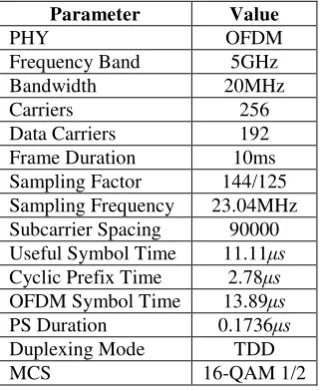
The network simulation topology we use in simulation scenario can be shown as Figure 1 where there are 10 SSs and one BS. The summary of WiMAX network traffic parameters used in simulation is listed in Table 1. In order to adjust the delay of the SS caused by the MAC layer on initial steps of the network entry procedure, modification can be made on DCD interval, UCD interval and initial ranging interval. In this simulation, a high priority SS will be assigned with different configuration than priority SS. Parameter configuration used for the experiment is shown as Table 2.
Parameter Value
PHY OFDM
Frequency Band 5GHz Bandwidth 20MHz
Carriers 256
Data Carriers 192 Frame Duration 10ms Sampling Factor 144/125 Sampling Frequency 23.04MHz Subcarrier Spacing 90000 Useful Symbol Time 11.11μs Cyclic Prefix Time 2.78μs OFDM Symbol Time 13.89μs PS Duration 0.1736μs Duplexing Mode TDD
MCS 16-QAM 1/2
Subscriber Station (SS)
Initial ranging interval
DCD interval
UCD interval
High Priority 0.5s 10s 10s
Low Priority 1s 5s 5s
Table 2: Parameters configuration in simulation.
The parameter tuning for high priority SS is expected to provide better result when compared to a low priority SS. It means that high priority SS can send more data and have a significant MAC delay. A significant MAC delay for high priority SS will improve their network entry delay which implicates for better bandwidth allocation than low priority SS.
4 Conclusion
In this paper we presented a simulation model on WiMAX network entry phase that compare a tuning parameters between high priority SS and low priority SS. We found that assigning a shorter initial ranging interval and maximum value for DCD interval and UCD interval can decrease the SS network entry delay. This approach is expected to optimize the network entry phase and relevant to provide better bandwidth utilization for WiMAX networks.
References
[1] IEEE Std. 802.16-2009, IEEE Standard for Local and metropolitan area networks, Part 16: Air Interface of Broadband Wireless Access Systems, May 2009.
[2] Abdulrahman Yarali and Saifur Rahman, “WiMAX Broadband Wireless Access Technology: Services, Architecture and Deployment Models”, Proceedings of CCECE/CCGEI May 5-7 2008 Niagara Falls, Canada.
[3] Matthias Hollick, Parag S. Mogre, Christian Schott, and Ralf Steinmetz, “Slow and Steady: Modelling and Performance Analysis of the Network Entry Process in IEEE 802.16”, Quality of Service, 2007 Fifteeth IEEE International Workshop, June 2007.
[4] Pero Latkoski and Borislav Popovski, “Communication Protocol Engineering and Optimization of Network Entry Process in IEEE 802.16 Based Systems”, International Journal of Multimedia and Ubiquitous Engineering, Vol. 4, No. 2, April 2009.
[5] Lidong Ling, Weijia Jia, Bo Han, and Lizhou Zhang, “Performance Improvement using Dynamic Contention Window adjustment for Initial Ranging in IEEE 802.16 P2MP Networks”, Proceedings of WCNC 2007.
[6] Wenyan Lu, Weijia Jia, Wenfeng Du and Lizhou Zhang, “Performance Analysis of The Contention Resolution Scheme in IEEE 802.16”, Journal of Software, Vol. 18, no. 9, 2007.
[7] The ns-3 network simulator, http://www.nsnam.org, 2009.
[8] Jahanzeb Farooq and Thierry Turletti, “An IEEE 802.16 WiMAX Module for the ns-3 Simulator”, Proceedings of SIMUTools 2009, Brussels, Belgium, 2009.