__________________________________________________________
ONLINE BANKING SERVICE QUALITY: A REVIEW
RAJIV SINDWANI*
DR. MANISHA GOEL**
__________________________________________________________
ABSTRACT
The service quality has been widely used to assess the performance of various service
organizations including banks .The widespread use of Internet in the service sector posed various
challenges to service quality researchers. Various models of online service quality have been
proposed time to time by various researchers. Internet banking is one of the growing services that
need to provide better service by improving online service quality for higher customer satisfaction
and retention. This paper reviews some of the important studies conducted in various countries
across the world for finding the dimensions of online banking service quality. On the basis of
review, it has been found that there is no consensus among researchers on dimensions of online
banking service quality. The paper suggests the need for further research to develop a generally
accepted scale based on standard dimensions for measuring online banking service quality.
KEYWORDS: Online Banking, Service Quality Dimensions.
* ASSISTANT PROFESSOR, YMCA UNIVERSITY OF SCIENCE AND TECHNOLOGY, FARIDABAD.
__________________________________________________________
INTRODUCTION
Quality of services has been the focus of research during the last many decades. With time
various models have been developed to explain the quality of services. Two main
conceptualizations of service quality mainly exist in the literature, of which one is based on the
disconfirmation approach (Scale to measure difference between Perception and Expectations),
and the other is based on performance only approach (Scale to measure only Perception). Both
these scales have been used extensively for measuring service quality. The dimensions and
measurement scale of the service quality help the service organisations to improve service quality
and customer satisfaction. Every automated service delivery channel has its own attributes
(Dabholkar,1996) and hence it is required to separate out the individual attributes of every
delivery channel or other compounding factors which affect the perception of quality. The
increased importance of information and communication technology for the delivery of financial
services has led to the growing interest of researchers and managers in e-banking quality issues
(Jayawardhena,2004). Online banking acceptance among people is growing day by day and this
growth has been accompanied by increased business interest in measuring and managing online
banking service quality. This interest is also reflected in a large number of academic studies
pertaining to measuring online banking service quality. With time various scales and dimensions
of online banking service quality have been proposed by various researchers. This paper aims at
reviewing various online banking service quality scales and their dimensions proposed by various
researchers.
LITERATURE REVIEW
In the present paper we have reviewed 12 studies on online banking service quality conducted in
different countries across the world over a period of more than 10 years. Details of these studies
are given below.
Jun and Cai (2001) conducted research for finding the key determinants of Internet banking
service quality. Customer anecdotes of critical incidents in Internet banking were
__________________________________________________________
service quality. These are reliability, responsiveness, competence, courtesy, credibility, access,
communication, understanding the customer, collaboration, continuous improvement, content,
accuracy, ease of use, timeliness, aesthetics, security and divers features. They suggested that
some dimensions like responsiveness, reliability and access are critical for both traditional and
Internet banks. They identified seventeen dimensions could be divided into three categories:
customer service quality, online systems quality and banking service product quality. They also
revealed that, in terms of frequency of references to the 17 dimensions, no substantial differences
exist between Internet-only banks and traditional banks offering Internet banking service. The
most frequently mentioned dimensions, as the main sources of satisfaction or dissatisfaction, were
reliability, responsiveness, access, and accuracy.
Broderick and Vachirapornpuk (2002) conducted qualitative research in UK on Service quality in
Internet banking taking into consideration the importance of customer role. Drawing on
theoretical frameworks of service quality and adapting these to particularly reflect the remote
delivery format of the Internet, this study proposed and tested a service quality model of Internet
banking. Their research used participant observation and narrative analysis of a UK Internet
banking Web site community to explore how Internet banking customers perceive and interpret
the elements of the model. Findings showed that the level and nature of customer participation had the greatest impact on the quality of the service experience and issues such as customers‟ zone of tolerance, the degree of role understanding by customers and emotional response
potentially determined, expected and perceived service quality. Their study revealed that the
dimensions important to the online banking customers are reliability, efficiency, responsiveness,
assurance, ease of use and information.
Jayawardhena (2004) transforms the original SERVQUAL scale in the Internet context and
develops a battery of twenty-one items to assess service quality in e-banking. By means of an
exploratory (EFA) and confirmatory factor analysis (CFA), these twenty-one items are condensed
__________________________________________________________
Yang et al. (2004) attempted to set forth a reliable and valid means of measuring online service
quality based on a broad conceptual framework which integrates theory and conceptualization in
customer service quality, information systems quality, and product portfolio management, into
online service quality. Authorsconducted ethnographic content analysis of 848 customer reviews
of online banking services to identify salient online service quality dimensions. The most
frequently cited online service quality attributes, along with literature review and personal
interview results were utilized to develop the survey questionnaire. Subsequent to the pre-test, a
Web-based survey was undertaken to verify and test the online service quality model. A
confirmatory factor analysis produced six key online service quality dimensions: reliability,
responsiveness, competence, ease of use, security, and product portfolio.
Han and Baek (2004) introduced the modified version of the SERVQUAL instrument for online
banking and, from the exploratory and confirmatory factor analysis, their study suggested a
four-factor model of SERVQUAL including Tangibles, Reliability, responsiveness, and Empathy.
Data for model testing were obtained through an online survey. With the help of one of the major commercial banks in Korea, a survey was administered via the bank‟s website.Furthermore, they explored the relationships among customer satisfaction, customer retention, and service quality.
Liao and Cheung (2005) presented a user-based core framework for evaluating service quality in
internet banking. They designed a questionnaire to solicit information on the individual
perceptions regarding service quality in Internet banking. Respondents were requested to submit
their assessments based on a seven-point Likert scale ranging from “strongly disagree” to “strongly agree”. The questionnaire was distributed to 500 individuals with experience of Internet banking in Hong Kong. 120 meaningful replies were received. Empirical results suggest that
perceived usefulness, ease of use, reliability, responsiveness, security and privacy, and continuous
improvement of e-banking services significantly influence customer attitudes towards Internet
__________________________________________________________
Sohail and Shaikh (2007) used empirical research to analyse service quality of internet banking
services provided by banks in Saudi Arabia. The instrument used for the survey consisted of 27
items, with responses recorded on a seven-point scale with “1” indicating “strongly disagrees” and “7” indicating “strongly agree”. Overall, 2,000 questionnaires were distributed and 939 responses were received. Of these responses 319 were non-users and the remaining 620 were
complete responses. Results based on a factor analysis identified three factors that influence users‟ evaluation of service quality of internet banking services. These factors were labelled as “efficiency and security”,“fulfilment” and “responsiveness”.
Wu et al. (2008) used ZPM E-Service Quality Model as the foundation to assess websites. They
generalized factors that influence customers' quality satisfaction towards services and carried out
questionnaire survey on the users, administrators, and employees of Internet bank. A service
quality table that assesses Internet bank was established through the evidence-based study result.
Researchers also verified that information gap, design gap and fulfillment gap are significant. The
result found out eight dimensions, including "efficiency", "reliability", "privacy",
"compensation", "responsiveness", "contact", "sense of beauty" and "individualization", are the
key factors that influence the service quality of Internet bank.
Loonam and O‟Loughlin (2008) investigated customers‟ perceptions of internet banking self
-service within the Irish financial -services sector. This qualitative study of the Irish retail banking sector explored consumers‟ e-banking interactions and experiences in addition to assessing the dimensions critical to banking service quality. Based on an extant review of the literature ten
e-service dimensions were proposed and evaluated empirically in the context of e-banking e-service
quality. Ten dimensions are web usability, security, information quality, access, trust, reliability,
flexibility, responsiveness, service recovery, and personalisation/ customisation. They also found
Overall, process quality emerged as key within the online context, with nine out of the ten
__________________________________________________________
Khan et al. (2009)aimed at evaluating the service quality of internet banking (i-banking) services
in India from customer‟s perspective. A structured questionnaire containing 44 quality items was
administered to various target groups. Seven quality dimensions, viz. reliability, accessibility,
user friendliness, privacy/security, efficiency, responsiveness and fulfilment, were identified
based on principal component factor analysis. Authors conducted Demographic analysis of data
and found that gender is hardly a bias for use and evaluation of service quality of i-banking in
most of the cases across various categories of customers. Authors proposed a valid mathematical
model to assess the overall service quality using regression analysis. The results showed that
customers are satisfied with quality of service on four dimensions such as reliability, accessibility,
privacy/security, responsiveness and fulfilment, but least satisfied with the „user-friendliness‟
dimension.
Ho and Lin (2009) developed a multiple item scale for measuring internet banking service quality.
This research used Taiwan‟s internet banking users as survey targets for its empirical studies.An
online questionnaire was used as the data collection instrument for this study. The sample
consisted of 500 individuals who were randomly selected from a consumer panel of 500 e-bank
users. The number of respondents was 135. After deducted five invalid questionnaires from
respondents, the number of valid questionnaires was 130, and the Response rate was 26 percent.
Through the process of factor analysis, the refined scale was identified. Authors identified five
dimensions and 17 items in the measurement scale for measuring the service quality of internet
banking. The five dimensions were named customer service, web design, assurance, preferential
treatment, and information provision.
Sadeghi and Farokhian (2011) developed a service quality model for online banking based on
different service quality models and theories such as technology acceptance model (TAM), theory
of reasoned action (TRA) and theory of planned behaviour (TPB). They developed a model with
7 factors on the following dimensions: Convenience, accessibility, accuracy, security, usefulness,
bank image and web site design.They also found that some of these factors have a significant
__________________________________________________________
DIMENSIONS OF ONLINE BANKING SERVICE QUALITY
With time various researchers have developed various scales to measure online banking service
quality. On the basis of review of the above mentioned studies on online banking service quality,
it has been found that different studies have considered different service quality dimensions of
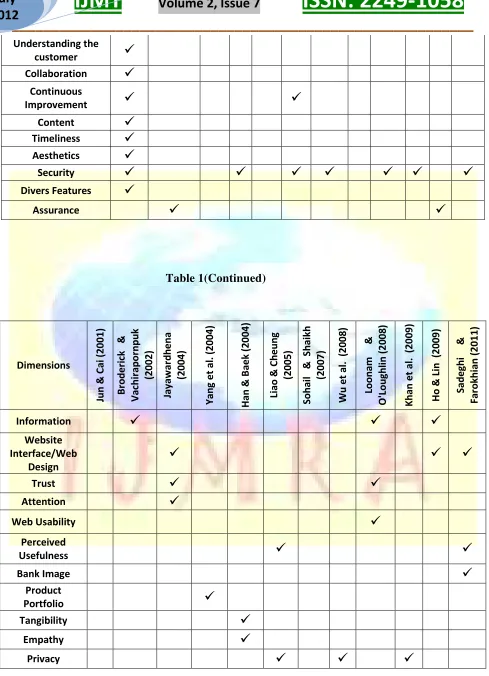
online banking. The various dimensions proposed by various researchers have been mentioned in
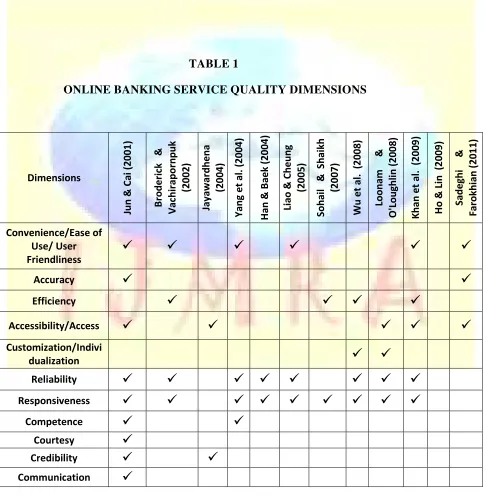
Table 1. Chart 1 shows the frequency of all the dimensions found on the basis of above 12
[image:7.612.63.549.214.717.2]studies.
TABLE 1
ONLINE BANKING SERVICE QUALITY DIMENSIONS
Dimensions Ju n & C a i (2 0 0 1 ) B ro d e ri ck & V a ch ir a p o rn p u k (2 0 0 2 ) Ja y a w a rd h e n a (2 0 0 4 ) Ya n g et al . (2 0 0 4 ) Ha n & B a e k (2 0 0 4 ) Li a o & C h e u n g (2 0 0 5 ) S o h a il & S h a ikh (2 0 0 7 ) W u et al. ( 2 0 0 8 ) Lo o n a m & O' Lo u g h li n ( 2 0 0 8 ) K h a n et al. ( 2 0 0 9 ) Ho & L in (2 0 0 9 ) S a d e g h i & Fa ro kh ia n ( 2 0 1 1 ) Convenience/Ease of Use/ User Friendliness
Accuracy
Efficiency
Accessibility/Access
Customization/Indivi
dualization
Reliability
Responsiveness
Competence
Courtesy
Credibility
__________________________________________________________
Understanding the
customer
Collaboration
Continuous
Improvement
Content
Timeliness
Aesthetics
Security
Divers Features
Assurance
Table 1(Continued) Dimensions Ju n & C a i (2 0 0 1 ) B ro d e ri ck & V a ch ir a p o rn p u k (2 0 0 2 ) Ja y a w a rd h e n a (2 0 0 4 ) Ya n g et al . (2 0 0 4 ) Ha n & B a e k (2 0 0 4 ) Li a o & C h e u n g (2 0 0 5 ) S o h a il & S h a ikh (2 0 0 7 ) W u et al. ( 2 0 0 8 ) Lo o n a m & O' Lo u g h li n ( 2 0 0 8 ) K h a n et al. ( 2 0 0 9 ) Ho & L in (2 0 0 9 ) S a d e g h i & Fa ro kh ia n ( 2 0 1 1 )
Information
Website Interface/Web
Design
Trust
Attention
Web Usability
Perceived
Usefulness
Bank Image
Product
Portfolio
Tangibility
Empathy
[image:8.612.61.550.37.713.2]__________________________________________________________
Compensation
Contact
Sense of Beauty
Fulfilment
Flexibility
Service
Recovery
Customer
Service
Preferential
Treatment
CHART 1
__________________________________________________________
In these 12 studies the number of online banking service quality dimensions varies from 3 to 17.
There are in total 39 online banking service quality dimensions proposed by researchers in these
studies. Whereas out of these 39 dimensions, only 4 dimensions namely Responsiveness,
Reliability, Security and Convenience have been included in majority of the studies.
CONCLUSION
On the basis of review, it may be concluded that there is no consensus among researchers with
regard to dimensions of online banking service quality. For the purpose of measurement of
service quality of services involving face-to-face interactions between the service provider and
the customer, SERVQUAL and SERVPERF scales are most commonly used. But there are no
generally accepted dimensions and no such standard scale for measuring service quality in case of
online banking. So it is suggested that there is need forfurther research in order to develop a scale
based on standard dimensions that can be universally applied for measuring online banking
service quality.
REFERENCES
Broderick, J.A. and Vachirapornpuk, S. (2002), “Service Quality of Internet banking: The Importance of Customer Role”, Marketing Intelligence and Planning, Vol.20, No.6, pp 327-335.
Dabholkar P. A. (1996) “Consumer evaluations of new technology based self service options: An investigation of alternative models of service quality” International Journal of research in
Marketing Vol. 13, No 1 pp 29-51.
Han, S. and Baek, S. (2004), “Antecedents and Consequences of Service Quality in Online Banking: An Application of the SERVQUAL Instrument”, Advances in Consumer Research, Vol. 31, pp. 208-214.
__________________________________________________________
Jayawardhena, C. (2004), “Measurement of service quality in internet banking: the development of an instrument”, Journal of Marketing Management, Vol. 20, No.1-2, pp. 185-207.
Jun, M. and Cai, S. (2001), “The Key Determinants of Internet Bank Service Quality: A Content Analysis” International Journal of Bank Marketing, Vol.19, No.7, pp.276-291.
Khan, M.S. , Mahapatra,S.S. and Sreekumar (2009) , “Service quality evaluation in internet banking: an empirical study in India” , Int. J. Indian Culture and Business Management, Vol. 2 No. 1, pp. 30-46.
Liao, Z. and Cheung, M.T. (2005), “Service Quality in Internet e-Banking: A User-based Core Framework” ,IEEE Xplore.
Loonam, M. and O‟Loughlin, D. (2008), “Exploring e-service quality: a study of Irish online banking” , Marketing Intelligence & Planning, Vol. 26 No. 7, pp. 759-780.
Sadeghi, T. and Farokhian, S. (2011), “Services quality model for online banking services by behavioral adoption theories and comparative study”, African Journal of Business Management,Vol.5 No. 11, pp. 4490-4499
Sohail, M.S. and Shaikh, N.M. (2007) , “Internet banking and quality of Service: Perspectives from a developing nation in the Middle East” , Online Information Review, Vol. 32 No. 1, pp. 58-72.
Wu,Y. ,Chang M.C.S., Yang P. and Chen Y.(2008), “The Use of E-SQ to Establish the Internet Bank Service Quality Table” , IEEE Xplore.
Yang,Z., Jun,M. and Peterson, R.T. (2004), “Measuring customer perceived online service quality-Scale development and managerial implications” , International Journal of Operations