FARM PROFITABILITY AND RESOURCE USE IN RUBBER
AND OIL PALM SMALLHOLDERS OF BATANG HARI,
JAMBI, INDONESIA
TRIANA GITA DEWI
GRADUATE SCHOOL
BOGOR AGRICULTURAL UNIVERSITY BOGOR
Profitability and Resource Use in Rubber and Oil Palm Smallholders of Batang Hari, Jambi, Indonesia submitted to fulfill a requirement for the award of Master of Science in Agribusiness from Bogor Agricultural University is my own piece work produced through the guidance of my academic advisor and to the nest of my knowledge. It has not been submitted for the award of any degree in other academic institutions. This thesis does not contain any piece of work of the person, except those are acknowledged and referenced in the text.
I hereby assign the copyright of my thesis to Bogor Agricultural University.
Bogor, Oktober 2014
pada Petani Karet dan Kelapa Sawit di Batanghari, Jambi, Indonesia. Dibimbing oleh RITA NURMALINA, AMZUL RIFIN, MATIN QAIM, dan VIJESH KRISHNA.
Fenomena perubahan penggunaan lahan semakin menjadi perhatian karena selalu dikaitkan dengan kegiatan penebangan hutan. Karet dan kelapa sawit adalah beberapa tanaman utama yang bertanggung jawab atas perubahan ini. Komoditas ini adalah komoditas yang sangat berkembang di Indonesia. Namun, peningkatan kebutuhan lahan untuk produksi karet dan kelapa sawit yang mengarah pada ekstensifikasi pertanian menjadi salah satu alasan perubahan penggunaan lahan.
Provinsi Jambi merupakan salah satu sentra produksi karet dan kelapa sawit di Indonesia. Berdasarkan produksi, Kabupaten Batanghari menjadi salah satu sentra produksi karet dan kelapa sawit. Kelangkaan lahan di Jambi menyebabkan petani kecil karet dan kelapa sawit harus menggunakan lahan yang tidak produktif atau bersaing satu sama lain untuk mendapatkan lebih banyak lahan. Insentif moneter merupakan faktor yang dapat mempengaruhi arah perubahan penggunaan lahan. Oleh karena itu, dalam untuk mengetahui arah perubahan penggunaan lahan di masa depan, diperlukan analisis profitabilitas karet dan kelapa sawit pada petani kecil. Selain itu, faktor-faktor yang menentukan produksi karet dan kelapa sawit di Batanghari juga perlu dianalisis. Melalui peningkatan produksi, petani dapat meningkatkan keuntungan dari usahatani mereka.
Berdasarkan perumusan masalah, tujuan penelitian ini antara lain (1) menganalisis karakteristik usahatani serta petani karet dan kelapa sawit di Batanghari, Jambi, (2) menghitung dan membandingkan laba yang dihasilkan dari usahatani karet dan kelapa sawit (3) menganalisis faktor penentu produksi karet dan kelapa sawit. Perbandingan karakteristik petani dianalisis secara deskriptif. Penjelasan profitabilitas usahatani karet dan kelapa sawit dihitung dengan Net Present Value (NPV), Internal Rate of Return (IRR) dan Gross Benefit Ratio (gross B/C). Analisis faktor-faktor yang menentukan produksi karet dan kelapa sawit dilakukan dengan menggunakan fungsi double log. Metode OLS juga digunakan untuk membangun jenis fungsi ini.
dengan NPK, sedangkan usahatani kelapa sawit menggunakan lebih banyak NPK dari pada Urea. Hal ini disebabkan karena adanya perbedaan nutrisi yang dibutuhkan oleh pohon karet dan kelapa sawit. Biaya tenaga kerja adalah biaya variabel terbesar dalam budidaya karet dan kelapa sawit. Dilihat dari jumlah rata-rata per tahun, biaya tenaga kerja usahatani karet lebih tinggi dibandingkan dengan biaya tenaga kerja usahatani kelapa sawit. Berdasarkan analisis keuangan seperti NPV, IRR dan gross B/C, usahatani kelapa sawit lebih menguntungkan daripada usahatani karet. Dengan demikian, lahan yang tidak produktif akan lebih banyak digunakan untuk pengembangan usahatani kelapa sawit dibandingkan untuk pengembangan usahatani karet, bahkan konversi lahan pertanian akan terjadi dari lahan karet menjadi lahan kelapa sawit.
Berdasarkan fungsi double log yang dihitung dengan menggunakan metode OLS, terdapat 2 faktor penentu produksi karet yaitu area produksi dan tenaga kerja yang digunakan. Elastisitas masing-masing variabel adalah 0,582 dan 0,377. Berbeda dengan fungsi sebelumnya, produksi kelapa sawit dipengaruhi oleh area produksi, urea, NPK dan herbisida dimana elastisitas masing-masing variabel adalah 1.019, 0.084, 0,107 dan -0,207. Meskipun usahatani karet kurang menguntungkan dibandingkan dengan usahatani kelapa sawit, produksi karet dapat ditingkatkan dengan mempertimbangkan beberapa faktor yang mempengaruhi produksi. Untuk mencegah eksploitasi penggunaan lahan yang dapat menyebabkan deforestasi, pengembangan kelapa sawit harus difokuskan pada intensifikasi daripada ekstensifikasi.
Palm Smallholders of Batanghari, Jambi, Indonesia. Supervised by RITA NURMALINA, AMZUL RIFIN, MATIN QAIM, and VIJESH KRISHNA.
Land use change phenomena are getting more attention since it is always associated with deforestation. Rubber and oil palm are major crop responsible for these changes. These commodities are two of some commodities which have been developing in Indonesia. However, an increase in land requirement for rubber and oil palm production lead to the agricultural extensification, one of land use change reasons.
Jambi province was classified as one of production center of rubber and oil palm in Indonesia. Based on production, Batang Hari regency became one of rubber and oil palm production center. Land scarcity in Jambi leads rubber and oil palm smallholders to use unproductive lands or compete one another to get more land. The monetary incentive is the most influencing factor which can determine the direction of land use changes. Therefore, in order to discover the direction of land use change in the future, it is required to analyze the profit of rubber and oil palm smallholders. Factors determining rubber and oil palm production in Batang Hari, Jambi are also needed to be analyzed. Through improving production, farmers can increase production and profit of their farms without extending production area.
Based on problem statement, objectives of this research are (1) to analyze the characteristics of rubber and oil palm farms and farmers in Batang Hari, Jambi, (2) to compute and compare the profit generated from rubber and oil palm farms and (3) to analyze factors determining rubber and oil palm production. This research was conducted by using some processing data techniques. Comparisons of farmer characteristics were analyzed descriptively. Profitability explanations of rubber and oil palm farms were calculated by Net Present Value (NPV), Internal Rate of Return (IRR) and Gross Benefit Ratio (gross B/C). In order to analyze factors determining rubber and oil palm production, double log functions were applied. OLS method was used for constructing these kinds of function.
farms took more NPK than Urea. It was caused by the differences of nutrient needed by rubber and oil palm trees. Labor costs were the largest variable cost in rubber and oil palm cultivation. Seen from the average per year, labor costs of rubber farms was higher than that of oil palm farms. Based on the financial analysis such as NPV, IRR and gross B/C, oil palm farms were more profitable than rubber farms. Unproductive land would be more widely used for the development of oil palm farms than for the development of rubber farms, even the conversion of agricultural land would occur from rubber to oil palm farms.
Regarding double log function calculated by OLS method, 2 factors determining rubber production were production area and labor used. The elasticity of each variable was 0.582 and 0.377, respectively. Different with previous function, oil palm production was influenced by production area, urea, NPK and herbicide where their elasticities were 1.019, 0.084, 0.107 and -0.207, respectively. Although rubber farms were less profitable than oil palm farms, Rubber production could be improved by considering some factors influencing production. In order to prevent the land use exploitation that could cause deforestation, the development of oil palm should be focused on intensification rather than extensification.
© Bogor Agricultural University Right Reserved, 2014
Copyright Reserved
Prohibited to cite a part of or entire of this thesis without inclusion or mentioning the source. The citation is only for academic, research, scientific writing, reporting, criticism writing or a problem reviewing and the citation does not inflict a financial loss in the proper interest of Bogor Agricultural University.
FARM PROFITABILITY AND RESOURCE USE IN RUBBER
AND OIL PALM SMALLHOLDERS OF BATANG HARI,
JAMBI, INDONESIA
TRIANA GITA DEWI
A thesis
Submitted to the Graduate School in Partial Fulfillment of the Requirement for Master of Science Degree
in
Study Program of Agribusiness
GRADUATE SCHOOL
BOGOR AGRICULTURAL UNIVERSITY BOGOR
Registration Number : H451110091
Approved by
Advisory Committee,
Prof. Dr. Ir. Rita Nurmalina, MS Chairman
Dr. Amzul Rifin, MA Member
Prof. Matin Qaim Member
Dr. Vijesh Krishna Member
Agreed by
Coordinator of Major Agribusiness Dean of Graduate School
Prof. Dr. Ir. Rita Nurmalina, MS Dr. Ir. Dahrul Syah, MscAgr
All praise to Allah who the most precious and the most merciful for His blessing and guidance to finish this thesis. The theme of this research which was started on June 2013 is profitability and resource use in smallholder farming.This research is my piece of work but it would have been impossible without support many people. Hence, I would like to appreciate everything they have given to me.
First of all, I am indebted to my families who always give me love, advice, and support which always encourage me to learn and appreciate my life. I dedicate this thesis to my beloved parent.
I would acknowledge to my supervisor from Bogor Agricultural University, Prof. Dr. Ir. Rita Nurmalina, MS and Dr. Amzul Rifin, SP, MA for their support academically and mentally in thesis writing from the beginning until the last step. I would like also to thank to my supervisor from Georg-August University of Goettingen, Prof. Matin Qaim and Dr. Vijesh Krishna for their insight and valuable comment to my thesis.
My sincere thank further to the Collaborative Research Center (CRC), Georg-August University of Göttingen, especially for CRC team leading by Prof. Matin Qaim for providing valuable data that I used for this thesis. I would like also to thank to Dr. Ir. Supijatno, M.Si who give me data and information related to commodities used in this thesis.
My gratitude is also given to Indonesian Planning and Cooperation of Foreign Affairs (BPKLN) and Directorate General of Higher Education (DIKTI) which always provide scholarship for my entire graduate school period. This research was also conducted well due to the research financial support of them.
Bogor, Oktober 2014
LIST OF TABLES xvi
LIST OF FIGURES xvi
LIST OF APPENDIXES xvii
1 INTRODUCTION 1
Background 1
Problem Statement 4
Research Objectives 5
Research Benefits 5
Research Scope 6
2 LITERATURE REVIEW 6
Land Use Changes across The World 6
Land Use Changes in Indonesia 7
Planting System of Rubber and Oil Palm 8
Input Use 8
Profitability of Rubber and Oil Palm Smallholders 9 Factors Determining Rubber and Oil Palm Production 10
3 RESEARCH FRAMEWORK 11
Theoretical Framework 11
Profitability 11
Cost and Benefit 12
Production Function 13
Production Factors 17
Operational Framework 18
Hypothesis 20
4 RESEARCH METHOD 20
Types and Sources of Data 20
Data Processing Techniques 21
T Test for Descriptive Analysis 22
Profitability 23
Double Log Function 27
Basic assumptions 31
5 THE CHARACTERISTICS OF RUBBER AND OIL PALM
SMALLHOLDERS 31
Farm Characteristics 31
Farmer Characteristics 33
6 PROFITABILITY ANALYSIS OF RUBBER AND OIL PALM
SMALLHOLDERS 35
Cash Flow Projection 35
Inflow Projection 35
Outflow Projection 37
Profit Analysis of Oil Palm Smallholders 41
7 FACTORS DETERMINING PRODUCTION OF RUBBER AND OIL PALM FARMS
42
Production Function of Rubber 42
Classic Assumption Test of Rubber Production Function 42 Model Significance Test and Goodness of Fit of Rubber
Production Function 44
Factors Determining Rubber Production 45
Production Function of Oil Palm 48
Classical Assumption Test of Oil Palm Production Function 48 Model Significance Test and Goodness of Fit of Oil Palm
Production Function 50
Factors Determining Oil Palm Production 50
8 CONCLUSIONS AND RECOMMENDATIONS 55
Conclusions 55
Recommendations 55
REFERENCES 56
APPENDIX 62
LIST OF TABLES
LIST OF FIGURES
1 Land use in 5 district in jambi province (ha) 3 2 Production area of rubber and oil palm farms in batang hari, jambi
(2000-2011)
5
3 Cashflow components 24
4 Variable explanation 28
5 Alternatives for t test 30
6 Farm characteristic comparisons 33
7 Farmer characteristic comparisons 34
8 Model estimation result of factors determining rubber production 43 9 Hypothesis test summary of kolgomorov-smirnov test for rubber
double log function
44
10 ANOVA of regression model for glejser test of rubber double log function
44
11 Model estimation result of factors determining oil palm production 49 12 Hypothesis test summary of kolgomorov-smirnov test for oil palm
double log function
50
13 ANOVA of regression model for glejser test of oil palm double log function
50
1 Production area of rubber and oil palm smallholders in indonesia (000 ha)
1
2 Bokar and palm oil production in indonesia (000 ton) 2 3 Rubber and oil palm production each Regency in Jambi Province 3
4 The fixed, variable and total cost curves 13
5 Neoclassical Three-Stage Production Function 14
6 TVP, TFC, VMP. MFC and Profit 16
7 Operational framework 19
8 Business period 23
9 Percentage of farms based on production area 32 10 Percentage of farms based on plantation age 32
11 Ethnicity of rubber and oil palm farmers 34
12 Migration 34
13 Land certification ownership of rubber and oil palm farmers 35 14 Rubber and oil palm trees production per ha per year 36 15 Variable cost of rubber and oil palm smallholders 39
16 Bokar price data in 2012 40
17 Fresh fruit bunches price data in 2012 41
LIST OF APPENDIXES
1 Production center of rubber in Indonesia 62
2 Production center of oil palm in Indonesia 62
Background
Land use change phenomena are getting more attention since it is always associated with deforestation. Deforestation mostly occurred in Sumatera, one of the largest islands in Indonesia. It was mainly caused by the wide land required. In Indonesia, loggers, smallholders, and estate crops were the main driving actors of deforestation (Pagiola S 2000). In 1995, logging gave a high incentive for loggers to export timber because of low fee charged by the government. In smallholder side, many of agricultural land use alternatives let smallholder to use forest more than before, which could be found as jungle rubber or rubber monoculture. In comparison to smallholder farming, plantation estates have a larger role in determining the land use changes, where oil palm is often cited as a major crop responsible for these changes. However, the high incentive of this commodity attracted many smallholders to built their farms and become a threat to the forest.
The land use of plantations is conducted by the two parties, ie companies that have large plantation and smallholders which have smaller scale plantation. The large plantation estates usually have a legal entity. They are also use a very wide production area (> 10 ha) and capital intensive. In contrast, smallholder plantations are established in a small area (<10 ha). It is labor intensive and without legal entity. In Indonesia, smallholder plays an important role. In 2012, total production area used by smallholders is only 6 948 000 Ha. It means that total production area used by smallholders is higher than that by estates whereas smallholders are cultivated in small scale plantation. It informs that there are many people work as rubber and oil palm farmers and usually, farming is their main income generator.
Figure 1. Production Area of Rubber and Oil Palm Smallholders in Indonesia (000 Ha)
Source: BPS RI 2013 (a)
0 500 1000 1500 2000 2500 3000 3500 4000
2000 2001 2002 2003 2004 2005 2006 2007 2008 2009 2010 2011 2012
00
0
Ha
In 2011, 42.29 percent of smallholder plantations were used for rubber and oil palm farms with 18.55 percent and 23.74 percent respectively (BPS RI 2013 (a)). Moreover, the land use movement between rubber and oil palm smallholders was different (Figure 1). Land used for oil palm highly rised from 2000 to 2012. The average growth of oil palm land was 10.39 percent per year. On the contrary, production area of rubber smallholders was slightly declined from 2000 to 2012. The average decrease of rubber land was 0.21 percent per year.
Nevertheless, rubber and oil palm are still two of some commodities which is developing in Indonesia. According to figure 2, productions of these commodities increased from 2000 until 2011, although the additional of rubber production was less than that of oil palm production. In 2011, rubber production reached 2 359 800 ton while palm oil production reached 8 797 900 ton. Most rubber farmers sold their product in bokar (rubber material) form while most oil palm farmers sold their product in FFB (fresh fruit bunches) form. Bokar is rubber material (latex) collected by farmer from several days. Latexs that are collected are formed in a big bucket or ground hole and then they are mixed with coagulant. Meanwhile, FFB is bunch containing oil palm fruit. Oil palm fruits much grow in small size, approximately 2-3 cm and gather in one bunch.
Figure 2. Bokar and Palm oil Production in Indonesia (000 ton)
Source: BPS RI 2013 (b) Malaysia. Indonesia and Malaysia were able to produce 87 percent of oil palm to the world, even they dominated 91 percent of oil palm trading in the world (Rifin 2010). The high export opportunity will drive many people, either smallholder or big company to increase rubber and oil palm production.
An increase in land requirement for oil palm and rubber production, leads to the agricultural extensification, one of land use change reasons. The more demand for those commodities, the more land will be needed.
0
2000 2001 2002 2003 2004 2005 2006 2007 2008 2009 2010 2011 2012
00
0
To
n
One of provinces that experience these phenomena in Indonesia is Jambi Province. Based on agricultural ministry, Jambi province was classified as one of production center of rubber and oil palm in Indonesia (Appendix 1 and 2). In 2008-2012, production share of rubber and palm oil in Jambi were 11.07 percent and 7 percent (Pusdatin 2013 (a) and Pusdatin 2013 (b)).
Table 1 shows that land use of forest was reduced significantly from 1992 to 2012. In contrast, land use of oil palm, jungle rubber and rubber monoculture were increasing. It indicates that there were large-scale changes in the land use system.
Table 1. Land Use in 5 District in Jambi Province (Ha)
Properties 1992 2002 2012 Change 1992-2012 (%)*
Oil Palm 46 628 98 751 136 899 193.60
Jungle Rubber 73 836 85 887 84 452 14.38
Rubber Monoculture 139 805 165 436 166 244 18.91
Forest 167 179 79 120 44 694 -73.27
Bare Land 76 088 71 209 64 638 -15.05
Paddy 16 523 13 514 9 204 -44.30
Other Agriculture 6 064 5 868 6 096 0.53
Other 20 034 36 482 45 470 126.96
Source: Gatto 2013 *Own Calculation
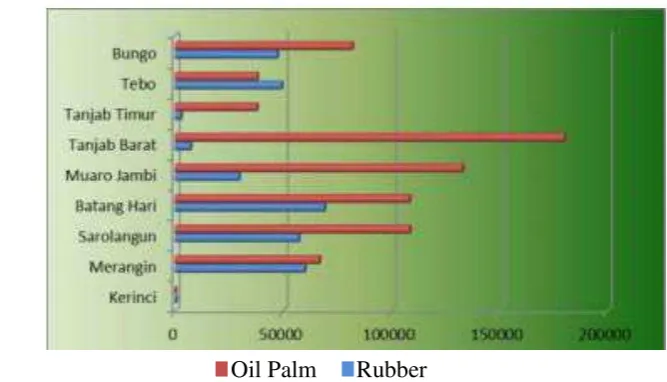
Rubber and oil palm production in Jambi province spread in almost all regencies, because they have topography and climate which are suitable for rubber and oil palm cultivation. Based on production, Batanghari regency became one of rubber and oil palm production center (BPS Jambi Province 2012). Batanghari regency was fourth ranking as rubber producer in Jambi followed by Tanjung Jabung Barat, Muaro Jambi and Sarolangun regencies. Batanghari regency also was first ranking as oil palm producer in Jambi (Figure 3).
Figure 3. Rubber and oil palm production each Regency in Jambi Province
Source: BPS Jambi Province 2012
In the early of 20th century, rubber (Hevea brasiliensis) was introduced in Jambi province by using jungle rubber system. Jungle rubber is a form of rubber farm which is combined with other useful trees like timber, fruit, rattan and bamboo (Feintrenie and Levang 2009). A large expansion of rubber commodity, which was occurred because of its high incentive from international market caused some land use changes. Farmers’ fields for temporary cultivation were converted to permanent jungle rubber, which after the intensification rapidly altered complex jungle rubber to a simple monoculture rubber in later years. On the other hand, oil palm, introduced to farmers of Jambi about 20 years ago, fast became one of the new land use change alternatives. The high demand of oil palm, domestically and internationally, was a strong incentive to boost its production. The export of this product has also increased until now, due to its high utilization as cooking oil, soap, plastic, cosmetics, and biofuel.
The high incentive of rubber and oil palm induces the land use change in Jambi particularly from forest area. The land scarcity phenomena lead the rubber and oil palm smallholders to compete each other to get more unproductive land or even to convert from one to another.
Problem Statement
Jambi are one of the provinces which develops rubber and oil palm plantation because those commodities can generate high regional income. In Batanghari regency, government trie to encourage the production of rubber and oil palm. It can be seen from Table 2 which describes that the average of rubber and oil palm production area increased from 2000 until 2011, even though the enhancement of rubber production area was less than that of oil palm production area.
Land scarcity in Jambi leads rubber and oil palm smallholders to use unproductive lands or compete one another to get more land. Based on Decree No. 421/Kpts-II/1999, Jambi has no more compatible production forest. The compatible production forest is the production forest which can be converted for agriculture activities (Ministry of Forestry 2012). Hence, to develop more rubber and oil palm, the smallholders only depend on unproductive land or convert the land from one to another type of commodity.
Some land use determinations were settlement history, agricultural intensification, non-traditional land use, crop productivity, tenure insecurity, fuelwood extraction and rural in-migration (Aguiar et al. 2007). The monetary incentive is the most influencing factor which can determine the direction of land use changes.
Table 2. Production Area of Rubber and Oil Palm Farms in Batanghari, Jambi (2000-2011)
Year Rubber Oil Plam
Production Area (Ha) Growth (%) Production Area (Ha) Growth (%)
2000 94 761 59 660
2001 96 902 2.26 59 780 0.20
2002 100 112 3.31 63 934 6.95
2003 109 331 9.21 57 706 -9.74
2004 109 058 -0.25 61 170 6.00
2005 108 805 -0.23 63 199 3.32
2006 108 960 0.14 63 503 0.48
2007 108 297 -0.61 62 620 -1.39
2008 109 007 0.66 63 511 1.42
2009 111 523 2.31 63 632 0.19
2010 111 619 0.09 66 838 5.04
2011 112 093 0.42 77 748 16.32
Average 1.57 2.61
Source: BPS Kabupaten Batanghari cited in Wahyudi 2013
The land scarcity and the high demand of rubber and oil palm processed product lead farmers to improve their farm production. Through improving production, farmers can increase production and profit of their farms without extending production area. Hence, factors determining of rubber and oil palm production in Batanghari, Jambi are needed to be analyzed.
Research Objectives
Referring to the problem statement, the research objectives are:
1. To analyze the characteristics of rubber and oil palm farms and farmers in Batanghari, Jambi.
2. To compute and compare the profit generated from rubber and oil palm farms. 3. To analyze factors determining rubber and oil palm production.
Research Benefits
This research is expected to be able to give benefits for many parties, such as:
1. Farmers.
This research results can provide information for farmers about financial condition of rubber or oil palm farms. It can be a consideration to evaluate their farms. Besides, farmers also can know what factors which encourage production of their farms. Hence, they can rise their profitability.
This research results can be an input for improvement of policy and agricultural development priority through superior commodity in rural area. This result also can help them to evaluate the existing policy.
3. Researcher
This research can improve knowledge and experiences of researcher. Writting ability and communication skill also can be encouraged through conducting this research. The last, this research is a part of study activities in which researcher is be able to apply many theories to real conditions.
4. Readers
This research result can become supporting data for other researcher in their own field. Hence, this research is expected to be able to contribute for developing sciences and technology.
Research Scope
This research is conducted in Batanghari regency, Jambi province. It states that this research result cannot be used for concluding the condition of other area. Besides, this research is also limited by profitability, resource use and factors determining of rubber and oil palm production. This research will not explain more about cultivation those commodities. Factor determining of rubber and oil palm smallholder analysis just consider about economic and social characteristics, while genotype characteristics will be not analyzed.
2 LITERATURE REVIEW
This chapter contains some previous researches related to the land use changes in Indonesia and in other countries. The comparison of oil palm and rubber smallholders with the land use also become part of this chapter, where the comparison is divided into crop system and financial condition. The last analysis are determinant profit factor will be explained.
Land Use Changes across The World
Land use change issue had become an environmental and developmental concern mainly since 1990s, particularly in Indonesia and Brazilian Amazonia since they had very large natural forest. Actually, peat swamp forest and cropland could also be converted for many reasons (Wicke et al. 2010), but the number of natural forest changes had been more than the other changes. Thus land use changes were always associated with deforestation.
ecosystem health. At last, in social side, land use change also generated land tenure and human right conflict, such as conflict between ministry and provincial or district government (Crosthwaite et al. 2004; Wicke et al. 2010; Pagiola 2000; Feitrenie and Levang 2011).
Another focus of previous studies was the determination factor of land use changes. Determination factors of land use changes were divided into: 1) Biophysical variables, such as soil quality and vegetation type, 2) transportation-related variables, such as road network density in the area and in its neighbours, 3) government-related variables such as development policies (Pfaff 1999 as cited in Aguiar et al. 2007), 4) Social variables, such as settlement history, agricultural intensification, non-traditional land use, crop production, tenure insecurity, fluid extraction and rural in-migration (Perz and Skole 2009 as cited in Aguiar et al. 2007).
Land Use Changes in Indonesia
In colonial phase, there was a dualism agrarian law in Indonesia. Those were west agrarian law which were applied to western people in Indonesia and adat (custom) agrarian law which was applied for Indonesia people. After the independence of Indonesia, land policy reform started to build. The basic agrarian law of 1960 was built to manage land and natural resources. The state reserved the right to reclaim any land for purposes of the national good. In new order period, Indonesian economic growth was sustainable and attracted the foreign investment. During this period, environmental costs such as converting rainforest to rubber or oil palm were high. In reformation period, decentralized form of government started to be build up based on Laws No. 22 and No. 25. District and municipal governments could manage their resources and set the policy. Unfortunately, it also was also not going well because of many distortions. In 2001, government issued Decree No. IX/MPR/2001 of agrarian reform and management of natural resources (Thorburn 2004).
Rubber (Hevea brasiliensis) was introduced in Jambi province, in the early of 20th century. As mentioned before, rubber plantation is divided into two types, jungle rubber and jungle monoculture. Jungle rubber produces high levels of forest biodiversity. Therefore, that it also has a role as a buffer zone around the primary forests (Feintrenie and Levang 2011). Unfortunately, productivity of rubber was low by this system. In order to improve productivity of rubber, clonal rubber was developed from a rubber monoculture which then produced up to three times more than on the previous type (William et al. 2001). In 1950s, jungle rubber started to be replaced by rubber monoculture which generated higher return to land (Feintrenie and Levang 2009).
Levang 2009). Recently, land-use is changing rapidly with high conversion of forest to rubber monoculture and oil palm.
Planting System of Rubber and Oil Palm
Papenfus (2000) divided perennial crop period into two parts: immature and mature period. Immature period is years when smallholders have not get income yet (but incur cost of production), while mature period is years when smallholders get income from the cultivation.
The length of immature period will be an important consideration for smallholders because they have to use their own money for preparing and maintaining the farms without income. On rubber farms, the first tapping usually occured in 5 or 6 years after planting and the tree will be productive until 30 years old. on the other hand, oil palm farms, the first harvesting is performed in 4 years after planting and the tree will be productive until 25 years old (Wulan et al. 2006; Papenfus 2000). These statements show that rubber tree and oil palm tree have different length of immature period.
Although rubber has relatively longer immature period, it can be harvested/tapped every day, while oil palm tree can only be harvested twice a month. Actually in the harvest season, rubber and oil palm can complete each other because they have different production season. In rainy season, oil palm tree can produce more Fresh Fruit Bunches (FFB) than that in the dry season. Water is important factor for its production that has to be provided every time. On the contrary, rubber tree cannot be tapped in rainy season because it will produce low quantity and quality rubber (Feintrenie and Levang 2009).
Input Use
Different crop enterprises have different labor requirement. They are involved in different activities. In rubber farms, labors are more required in pre-production period. Land preparation is the first thing needed to be performed in this period. After, some cultivating and planting activities become important. Fertilizers are added four times a year in the first two years. Some treatments, such as weeding, fertilizer and herbicide application, and tapping are conducted in production period every day.
Murdiyarso et al. (2002) showed that average labor used for rubber farms in the immature period were 344 person-days per Ha per year. They were more than that in mature period which used 166 person-days per Ha per year. Furthermore, Papenfus (2000) informed that rubber monoculture required more people than jungle rubber did.
used less labors than estate oil palm, during both immature and mature period. The same with rubber farms, immature period of oil palm farms also need more labor that mature period.
Beside labor, inputs involved in variable cost are seed or seedling (planting material), fertilizers, pesticides that mainly include herbicides. Rubber or oil palm seeds were used in the first planting and replanting activities. Fertilizer, herbicide and pesticide were the most important input. Papenfus (2000) stated that in oil palm farms those input costs were the largest share of initial establishment cost by 62.4 percent. Purwonugroho et al. (2012) in their research revealed that from all input costs, fertilizer was the highest variable cost. This result was in line with the estimation of global fertilizer use which stated that Indonesia was the second highest NPK fertilizer user for oil palm crop in the world (Heffer 2009). Rubber farms use more single fertilizer than compound fertilizer such as urea, KCl, and SP36 fertilizer where the highest fertilizer cost was cost for SP 36 (Wijayanti and Saefuddin 2012).
Profitability of Rubber and Oil Palm Smallholders
Profitability analysis can provide figure to discover the direction of land use change. There are many ways to calculate profitability. Farm income, investment criteria, return to land, and return to labor are some of them. In some literatures, profitability analysis for perennial crops usually uses investment analysis criteria, such as Net Present Value, Internal Rate of Return, and Net B/C.
Anwar (2006) had investigated profitability of rubber farms in Indonesia with various scenarios. With discount rate 18 percent and normal condition, 1 ha rubber farms could generate NPV, IRR, and Net B/C, Rp 19 200 000, 31.5 percent and 1.17 respectively. According to investment criteria, where NPV was more than zero, IRR more than the market rate of interest, and B/C more than 1, rubber farms were economically feasible. Zen (2008) also had conducted analysis of profitability of oil palm production in Labuhan Batu Regency, Indonesia. The result showed that in 30 years this commodity could generate NPV, IRR and Net B/C, respectively are Rp 634 236 100.2, 8.31 percent, and 9.16. Based on investment criteria, this commodity was feasible to develop as well. These researches gave a conclusion that individually, rubber and oil palm are profitable to run.
Limited land available force smallholders to choose which commodity will give more profit than another. Therefore it is necessary to do further research in profitability comparison. Freitrenie and Levang (2009), in some of their papers figured the return to land and return to labor of rubber and oil palm in every single year until the end of production period.
Factors Determining Rubber and Oil Palm Production
The determinant factor of rubber and oil palm production is essential to be analyzed. There are some previous studies have analyzed what factors influencing the production quantity.
Production area was an important factor which determines production. Giroh et al. (2014) and Mesike et al. (2009) stated that production area significantly influenced rubber production in Nigeria. These researchers using cobb-douglas as a production function showed that there was positive relationship between production area and rubber production. The more production area, the more production of rubber was. Hasiholan (2005) and Septianita (2009) obtained the same result for oil palm farms. These research results stated that production area influenced positively and significantly to oil palm production. Opposite result showed by Fitriani et al (2013) and Efendi (2012) which stated that production area did not significantly influence rubber and oil palm production. In rubber estate plantation, production was based on harvested area which can different over the year. Harvested area changes according to situation and company plan. Hence, the increasing of production area is not always followed by the increasing of latex production. Compared with production area, oil palm more influence by land condition. Oil palm requires fertile, flate and well drainased land.
Rubber and oil palm production are also determined by applied input. Fitriani et al. (2013) explained that urea fertilizer significantly affected rubber production with positive relationship. Nevertheless, its effect was not too high. If fertilizer increases 1 percent, the production of rubber just increased 0.026 percent. Different with urea fertilizer, TSP fertilizer did not significantly determine to production, because this type of fertilizer was just used for land fertilization. Hence, it did not directly influence to latex generated by rubber tree. Efendi et al. (2012) stated in his paper that the frequency of fertilizer applied gave significant effect to oil palm production with positive relationship. Oil palm fertilization should be done in 2-3 times. It depended on land condition, fertilizer quantity, age, and plant condition. Herbicide and pesticide did actually not significantly influence oil palm production (Septianita 2009). They gave negative effect to oil palm production. Hence, the increasing of herbicide declined oil palm production.
3 RESEARCH FRAMEWORK
Theoretical Framework
This chapter provides the theoretical framework which generally consists of farmer economic measurement, in particular about profitability, factors determining of production and smallholder farming. Profitability calculation for rubber and oil palm smallholders use net present value and other investment criterias because they are perennial crops. Calculation is conducted by totalling some account (cost, benefit and profit) over the business period. To understand what factors determining rubber and oil palm production, some theories are also applied such as production function to know about relationship between input and production, demand-supply theory to inform the relationship between price and production and adoption of innovation to understand about the intern factors of farmers which influence production.
Profitability
Similar with other economic actors, a farmer has a personal and a household goal such as profit maximization as rate of return on capital. Ellis (1996) stated that it is difficult to define profit for household production because of the differences between peasant households and capitalist enterprises. Due to that, there are some initial understandings about farmer profit maximization, which are: (1) the profit maximizing hypothesis does not require the existence of profit in the form of a sum of money. (2) Profit maximization has both a behavioral content (motivation of the household) and a technical-economic content (farm economic performance as a business enterprise). (3) Profit maximization condition on the goals, constraints, and markets may exist even if strict efficiency is not observed.
Warren (1998) defined profit as the divergences between revenue (the output value) and cost (the input value) during production period. In general, profit consists of gross margin and net farm income. Gross margin is a difference between total income and total variable costs. Further, net farm income (NFI) is gained from subtracting gross margin with total fixed costs such as depreciation, net inventory changes, and value products consumed at home. The return to farm owner, management and equity capital used in farms can be reflected from NFI; hence it is the best measurement of profit in the accounting period (Johnson, 1982 and Kay, 1986 cited in Onoja et al. 2012).
1. Inflation
Inflation will cause the value of money smaller over time, because the resources will be more expensive than before. If some farmers want to invest or lend their money, they expect that the return of money will be more than amount of money they invested or lent. It is caused by the number of product which can be bought in the future is less than nowadays.
2. Consumption
If some farmers want to invest or lend their money, there are some current consumption which should be postponed. Consumption postponement has opportunity cost because there are risk and uncertainty in the future. Thus, holding money nowadays is more valuable than having it in the future.
3. Productivity
If some farmers want to invest their money in a plantation, it means that their money is activated to generate profit in the future. Earning power of
These costs consist of material for business asset formation such as warehouse and material of physical inputs which are needed for production function. 2. Labor
Labor has so many classifications. Based on the level of education, labor consists of non-educated labor and educated labor. Educated labor generally has high mobility while non-educated labor has low mobility.
3. Land
Land is a component which is not exhausted over the business period. Thus, in a business plan, the cost of the land will be returned in the form of Salvage value.
4. Unexpected costs
These costs need to be considered in a business plan because it often changes during the business period. These changes consist of physical changes such as inputs applied are much more than the estimation and price changes such as input prices are higher than the estimation.
5. Sunk Cost
Based on characteristics, cost is divided to two types such as variable cost and fixed cost (Colman and Young 1990). Variable cost (VC) is cost influenced by the number of output generated. For example is purchase cost of production factors such as seed, fertilizer, herbicide and wage of variable labor. Fixed cost (FC) is cost which is not influenced by the number of output produced. This cost is associated with all fixed input such as rent and depreciation of building. The sum of fixed cost and variable cost is called total cost (TC). This cost is total cost incurred for the production process. The interaction of these costs can be seen from the short-run total cost curve in Figure 4.
Benefit is anything that is generated from business. Benefit consists of 3 types such as tangible benefit, intangible benefit and indirect benefit (Nurmalina et al. 2010).
1. Tangible benefits are benefits that can be measured. Tangible benefits can be generated due to increased production, improved product quality, time and location of sales changes, and product transformation. These benefits can also be caused by a reduction in costs caused by the mechanization of agriculture, reduction of transportation costs, and decreasing losses.
2. Intangible benefits are real benefits that are difficult to be measured. Examples of these benefits are beauty, convenience, freshness, health, and education. 3. Indirect benefits are perceived benefits beyond the business that affect outer of
the business. For example, irrigation which is built to increase crop production can also increase the availability of water for households
Figure 4. The fixed, variable and total cost curves
Source: Colman and Young 1990
Production Function
Production function tries to describe the maximum amount of output that can be produced with a given set of inputs (Baye, 2010). Debertine (1986) stated that production function describes the technical relationship that transforms input into output. The rage of function consists of each output level (y) that results from each level of input (x) being used. To measure productivity, there are some terms that have to be described obviously. In agricultural term, total physical product (TPP) is referred to yield level of commodities. Total Physical Product (TPP) is maximum amount of product that can be generated from a given amount of input (Baye, 2010).
Quantity (Q) Quantity (Q) Quantity (Q)
FC
VC
TC
The relationship between single input and output produced can be derived. This relationship is denoted as y = f(x1∣ x2, x3, x4, x5, x6, x7). In this function, x1 is
considered as variable input, while x2, …., x7 are treated as fixed inputs. Variable
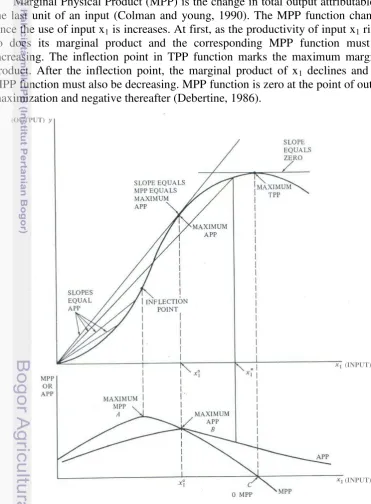
input can be controlled by farmers or they can alter the level of use. Fixed inputs are classified as uncontrolled input for some reason. This relationship also can be described by graphic (Figure 5). Based on figure 5, the more input (x1) is used, the
more output (y) increases until maximum TPP. After this point, the additional of input will decrease output generated. Noted that TTP curve is depicted for given state of technology and fixed factors.
Marginal Physical Product (MPP) is the change in total output attributable to the last unit of an input (Colman and young, 1990). The MPP function changes since the use of input x1 is increases. At first, as the productivity of input x1 rises,
so does its marginal product and the corresponding MPP function must be increasing. The inflection point in TPP function marks the maximum marginal product. After the inflection point, the marginal product of x1 declines and the
MPP function must also be decreasing. MPP function is zero at the point of output maximization and negative thereafter (Debertine, 1986).
Figure 5. Neoclassical Three-Stage Production Function
Source: Debertin (1986) (OUTPUT)
(INPUT)
Average Physical Product (APP)is a measure of the output produced per unit of input (Colman and Young, 1990). APP also changes since the use of x1
increases, although APP is never negative. APP is calculated with dividing the total product with the amount of variable input. Therefore, APP is the ratio of output to input (y/x1). APP for a selected point on the production function can be
illustrated by drawing a line out of the origin of the graph to the selected point. The slope of this line is y/x1 and corresponds to the values of y and x1 for the
production function (Debertine, 1986).
Point informs that y/x = dy/dx. Any point less than , the slope of the production function is greater than the slope of the line drawn from the origin to the point. Hence APP must be less than MPP prior to . As the use of x1
increases toward , APP increases, as does the slope of the line drawn from the origin. After , the slope of the production function is less than the slope of the line drawn from the origin to the point. Hence, MPP must be less than APP after
. As the use of . As the use of x1 increasebeyond , the slope of the line
drawn from the origin to the point declines and APP must decline beyond . However, APP is always positive while MPP becomes negative beyond point of maximization.
The relationship that exist between the APP and MPP states that the MPP function first increases as the use of the input is increased, until the inflection point of the underlying production function is reached (point A). Here the MPP function reaches its maximum. After this point MPP declines, reaches zero when output is maximum (point C) and the turns negative. The APP function increases past the inflection point of the underlying production function until it reaches the MPP function (point B). After point B, APP declines but never becomes negative.
Besides TPP, MPP and APP, elasticity can also be derived from production function. Elasticity is defined as the percentage change in output divided by the percentage change in input, as the level of input use is changed. It also one way to measure how responsive the production function is to changes in the use of the input. A large elasticity (more than 1) implies that the output responds strongly to increases in the use of the input. An elasticity of production of between zero and one suggests that output will increase as a result of the use of x, but the smaller the elasticity, the less the response in terms of incresed output. A negative elasticity of production implies that as the level of input use increases, output will actually decline. Elasticity is calculated as
Profit is the difference betwen return and cost. In this section, total return is known as total value of product (TVP) while total cost is known as total factor cost (TFC). The total production sold is TVP. This value is obtained by transforming the amount of product in the form of currency by multiplying it with the price per unit. If the price is constant, the shape of the TVP curve is the same as the curve TPP.
required, the more TFC issued. However TFC curve has a constant slope if we assume that factor price is constant.
The profit function is easily figured because this curve is resulted from substracting the TVP and TFC vertically. Figure 6 informs that if TVP is less than TFC, the profit generated is negative. Hence, the profit curve lies below the horizontal axis. This condition happen in the beginning stage and late stage. If TVP is greater than TFC, the profit gained is positive. Hence, the profit curve lies above the horizontal axis. Positive profit is generated in the middle stage. Profit is aqual to zero when TVP is aqual to TFC. This condition appears when profit curve cut the horizontal axis. Profit curve also has zero slope. It occurs when the slope of TVP and TFC is the equal. There are two point of zero slope of profit curve. The first point shows the minimum profit while the second point shows the maximum profit. The relationship might be expressed by
Figure 6. TVP, TFC, VMP. MFC and Profit
Source: Debertin (1986) (VALUE)
(INPUT) (INPUT)
Production Factors
Agricultural commodity has different amount of production even though the kind of commodity cultivated is the same. Production factors are an essential part to determine production of a commodity, either quantity or quality of the product. Production factors affecting the production levels are (Soekartawi 2002):
1. Agricultural Land.
Land is an essential part of farm. Fertile land and suitable with the characteristics required by the commodity will produce a good product with high quantity. In general, the effect of land on the production is positive. That means that the higher land used, the higher the amount of production is.
Ellis (1996) stated that production area has significant influences with opposite direction on productivity. That means the more production area utilized, the less productivity is. The small farms use resources more efficiently than larger farms. The proximate technical reasons for this proposition collected by various studies, which are: (1) The underutilization of the total land area leads to declining in land productivity, (2) The large farm is more directed to the land extensive enterprises, (3) The large farms use less variety of crops than the small farm does, for the same crop, (4) The small farms have more fertile soils than the large farms on average because the large farms only develops the best part of its land and ignores the less favourable land within its total farm area, (5) Perhaps, not all land of large farms are irrigated, (6) The large farms use less labor per unit area than the small farms do. Soekartawi (2002) also mentioned that the more land used, the less efficiency of that land, because: (1) lack of supervisor to production factor utilization, (2) availability limitation of labor and capital.
2. Capital
Agricultural capitals are divided into two types: fixed capital and non-fixed capital. Fixed capitals are generally categorized as investment costs and fixed costs. Examples of fixed capitals are land, buildings, machinery and agricultural equipment. Non-fixed capital is classified as a variable cost. Examples of non-fixed capital are seed, fertilizer, pesticides and labor.
Fertilizer is one source of nutrients for plants. Fertilizer is divided into two type such as organic fertilizers and inorganic fertilizers (Sutejo 2002 in Rahim and Hastuti 2008). Organic fertilizer is result of plant and animal decomposition such as manure, compost and bone flour meal. Inorganic fertilizers are artificial fertilizers such as urea, NPK and TSP. Besides fertilizer, seed also determines quality of production. Good seed (eg resistance to pests) will produce a good product. Herbicide is material used for eradicating weed in farm area. This is called as chemical weed eradication. There are several methods to eliminate weed from farm area such as manual weeding, biological weeding, and technical culture (Alamprabu 2013).
3. Labor
work-days (HOK). Small farming usually use family labor because it does not need many labor and non-mechanism farming, while big farming use more hired labor. Furthermore, in labor has to be divided to man, woman, kid and livestock. This classification is based on differences in every step of cultivation. Land cultivation is usually conducted by man or livestock while planting and land clearing are usually conducted by woman. Hence, the wage of them is also different (Soekartawi 2002).
In general, family labor are not calculated as farming costs whereas the time spent by family members who work in farming should be used for work in other sectors and generate revenue. Therefore, in the analysis of profit, family labor has to be calculated as a component of farming costs. The farm household behavior, according to family labor use, was explained by Chayanov model. This model stated that utility (happiness) of farm household is determined by income and leisure time. Subjective wage level shows the amount of income which the household would need to gain in order to compensate for the loss of one unit of leisure (Ellis 1996).
Farmers should have the advanced view, thus the adoption of new innovations is also relatively high. This will help farmers to increase agricultural production, both quality and quantity. Furthermore, farmers are able to increase their farm income. Education is one of factors encouraging Soekartawi (2002) states that older farmers tend to be difficult to change their mind set, work pattern, and way of life because they are too fanatic with the tradition. It also led to low interest in the new technology.
4. Management
Management plays roles in several aspects such as planning, organizing, controlling and evaluation. Management is related with term efficiency. If fertile land, capital and labor are well available but there is miss management, the high production will not be generated. Unfortunately, this variable is hard to be analyzed and included to the production function. This difficulty appears when there is multicollinearity between management and other independent variables (Soekartawi 2002).
Operational Framework
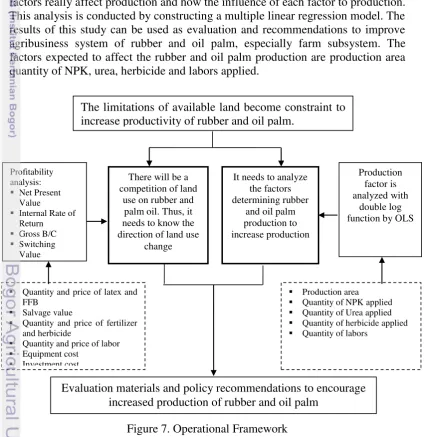
To determine the direction of land use changes, profit analysis is essential to be conducted. The profit is one of incentives which will be earned by farmers and become stimulus of land use. Profit comparison of rubber and oil palm farm will provide an overview whether rubber farm is converted into oil palm farm or vice versa. Profit calculation is conducted by net presnt value (NPV), internal rate of return (IRR) and gross B/C. The influence of output price is analyzed by switching value. This calculation is also used to compare the sensitivity of rubber and oil palm profit. Input component is one of components determining the amount of profit. Thus, in this analysis we will also be discussed regarding the use of each input in farming. Data used for this analysis are quantity and price of latex and FFB, salvage value, quantity and price of fertilizer and herbicide, quantity and price of labor, equipment cost and investment cost.
The higher profit, the higher encouragement to cultivate a commodity is. Limited land is a barrier to increase rubber and palm oil production. It causes the need of production increases, thus the total production and profit will increase without increasing land use. To increase production, farmers need to know what factors really affect production and how the influence of each factor to production. This analysis is conducted by constructing a multiple linear regression model. The results of this study can be used as evaluation and recommendations to improve agribusiness system of rubber and oil palm, especially farm subsystem. The factors expected to affect the rubber and oil palm production are production area quantity of NPK, urea, herbicide and labors applied.
Figure 7. Operational Framework
The limitations of available land become constraint to increase productivity of rubber and oil palm.
There will be a
Evaluation materials and policy recommendations to encourage increased production of rubber and oil palm
Hypothesis
Hypothesis is used as temporary answer which guides researcher. It is arranged based on theory and previous literature. There are differences between profit generated by rubber smallholders and oil palm smallholders where oil palm smallholders can obtain higher profit than rubber smallholder.
Beside those, hypothesis for factors determining rubber and oil palm production are:
1. Production Area (X1)
Production area is expected to have significant relationship with rubber and oil palm production with positive sign.
2. Urea (X2)
Quantity of urea fertilizer is expected to have significant relationship with rubber and oil palm production. It can have positive or negative relationship. 3. NPK (X3)
Quantity of NPK fertilizer is expected to have significant relationship with rubber and oil palm production. It can have positive or negative relationship. 4. Herbicide (X4)
Quantity of herbicide is expected to have significant relationship with rubber and oil palm production. It can have positive or negative relationship.
5. Labor (X5)
Quantity of labor is expected to have significant relationship with rubber and oil palm production. It can have positive or negative relationship.
4 RESEARCH METHOD
This chapter described all methods used in this study. Started from research design such as when and where the data were collected, what kind of data was used in this study until how the data would be processed to get results. The data processing and analysis consisted of profitability analysis and determinant factor analysis.
Types and Sources of Data
The data used in this study were cross section data that were collected at one time and included many objects. The type of data used was secondary data which were taken by others where the researchers were not involved in the data collection. Data processing and analyzing was conducted from June 2013-June 2014.
In general, secondary data were published by government agencies or some organizations, thus the data can be used by other researchers. There were two types of secondary data used in this study, non-published secondary data and published secondary data.
the Collaborative Research Center (CRC), Georg-August University of Göttingen in October-December 2012. This team was incorporated in a large research project titled Determinants of Land Use Change and The Impact on Household Welfare among Smallholder Farmers. This study was focused on rural areas and lowland in Jambi Province. From 9 regencies in Jambi Province, there were 5 regencies which were suitable with these criteria. Batanghari regency was selected to be analyzed because it was the regency that represents rubber and oil palm producer. This is due to the high production of rubber and palm oil in Batanghari. Published secondary data were collected from several institutions such as the Statistics of Indonesia (BPS), statistics of Batanghari regency, Batanghari in figure, the provincial government of Jambi, the International Rubber Study Group and several online articles. Literature reviews were also conducted to obtain several secondary data and better understanding.
CRC data used in this study were (1) the average price and production of rubber and palm oil per hectare per year, (2) the average price and quantity of variable inputs used in rubber and palm oil farms per hectare per year and (3) the average wage and quantity of labor in rubber and palm oil farms per hectare per year, (4) farmer age, (5) farmer education and (6) characteristics of farm and farmer in Batanghari Regency. Published data used in this study were (1) the average price and fixed inputs used and (2) investment costs incurred. Published data were used as a complementary data to estimate the benefits of both farms because of the data absence of fixed costs and investment costs of farmers.
Data Processing Techniques
In general, this study was conducted with three analysis such as descriptive analysis to compare the characteristics of rubber and oil palm farms, profitability analysis to compare the profit generated by both farms and regression analysis to determine the factors that influence the production of both farms.
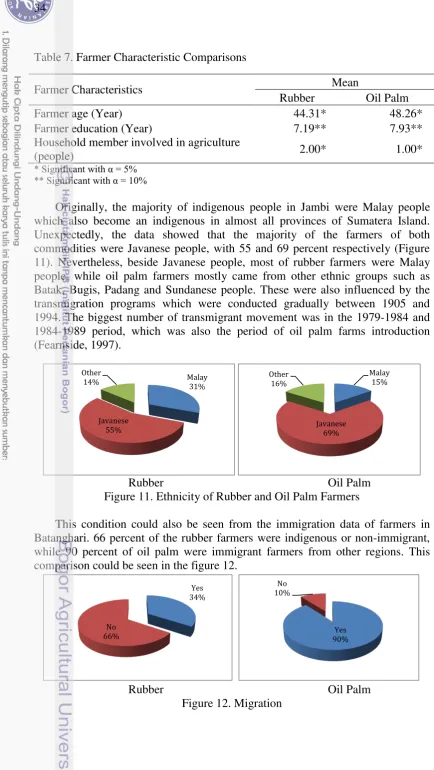
Descriptive analysis was conducted by describing the characteristics of each farm. Some of the characteristics that will be discussed were land area, farmer age and education, ethnicity of farmers, land ownership certificates and migration. Mean value was used to compare the land area, farmer age and farmer education because they were metrics variable, whereas the percentage of farmers was used to compare the ethnicity farmers, land ownership certificate and migration since they were categorical variable. This data will be calculated by SPSS 20 software and Microsoft Excel.
Multiple regression analysis was calculated using OLS (Ordinary Least Square). OLS was a method to construct a multiple regression model that produces the smallest error squares. Several expected factors affected the production of rubber and palm oil were land area (ha), the use of fertilizers (Kg), herbicides (liters) and labor (working days) and production (Kg). This data were analyzed quantitatively by SPSS 20 software.
T Test for Descriptive Analysis
Hypothesis test was used as a complementary method to know “are there significant difference between characteristics of both commodities?” (Lind, et al. 2008). There were 5 steps to test the differences between rubber and oil palm.
a. State null hypothesis and alternative hypothesis (H0 and H1).
b. Select a level of significance
Significance level (α) explained the error probability when statistical result stated that we had to reject null hypothesis whereas it was true (Lind, Marchal, Wathen, 2008). Selecting significance level depended on the confident interval desired by researcher but the common significance level were 5 percent.
: the variance of the first sample. : the variance of the second sample.
: the number of observations in the first sample. : the number of observations in the second sample. : the pooled estimate of the population variance d. Formulate a decision rule
This decision rule would be decided based on value of t table. To get this value, we had to determine degree of freedom (df) which was equal to the total number of items sampled minus the number of samples (n1+n2-2) and
significance level (α). Significance level was set at the 5 percent level. e. Make a decision
value and p value were calculated by software of SPSS 20. From its result, decision was made.
Profitability
To compare the profit of rubber and oil palm farms, there were several methods that could be used such as the Net Present Value (NPV), Internal Rate of Return (IRR) and Net B/C. Before discussing about these three methods, further explanation on cash flows was essential.
Cash Flow
Cash flow represented the amount of money which was incoming and outgoing. It also informed the types of costs incurred, thus it provided an overview of the cash changes and the reason for these changes by showing where the sources were and how the cash was used (Kashmir and Jakfar 2010; Umar 2003). Cash flow consisted of income (inflow) and cost (outflows). Inflow was income generated during the business running, while outflows were cost used for business activities (Nurmalina et al. 2010). Inflow consisted of total production value, loans, grant, leasing income and salvage value. Outflow consisted of investment costs, production, maintenance, labor land, materials, debt service and taxes. Components of cash flow could be seen in Table 3.
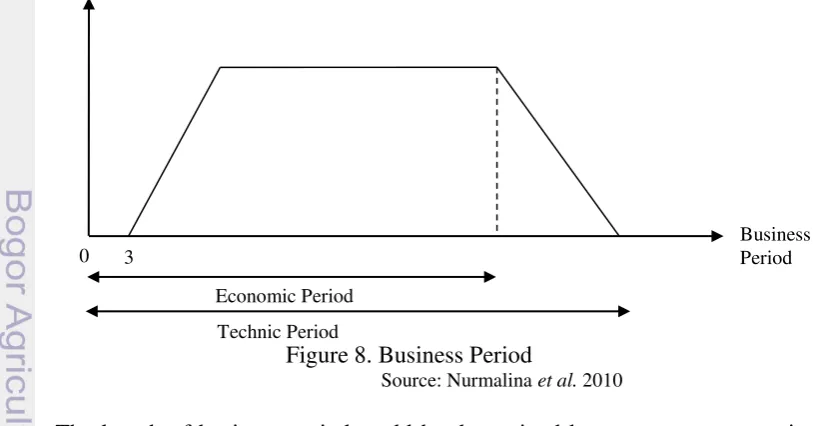
Profit calculation of rubber and oil palm should be calculated by sum up all profit generated over time until the end of business period due to the existing of production cycle. Production cycle caused there were differences of profit generated in different year. Moreover, there were two phases of rubber and oil palm production, immature phases and mature phases which led the need of overall calculation.
Figure 8. Business Period
Source: Nurmalina et al. 2010
The length of business period could be determined by two ways: economic period and technic period. Economic period was determined based on economic period of the biggest asset used in the business, while technic period was set until the biggest asset could not be used. In general, technic period was longer than
0 3
Economic Period
Technic Period
economic period. The relation of both periods could be seen in figure 8. If economic of technic period was more than 25 years, business period was set until 25 years, because present value after 25 years was too small.
In arrangement of oil palm cash flow, there were some unknown data which were in 11th, 17th, 18th, 22th and 25th year. Interpolation method was used to know these values. This method was used to determine the points between two points by a straight line approach. The formula used was:
Where:
y : empty data
x : data influenced y. For production data, x used was year, while for input and labor data, x used was production.
Table 3. Cashflow Components
Account Business Period
I Inflow 1 2 3 ... ... n
1. Total Production Value
2. Loan
3. Grant
4. Income from Leasing
5. Salvage Value
Inflow Total
II Outflow
1. Investment
2. Operational
2.1 Variable Cost
2.2 Fixed Cost
3. Debt Service
4. Replacement
Outflow Total
III Benefit = (I-II)
IV DF
V NPV = (III) (IV)
Source: Nurmalina et al. 2010
Net Present Value