Technological
>>> Dates:
June 23-June 28, 2
>>> Venue:
The International Conference
at NPUST, Pingtung, Taiwan.
International Conference Amongst Tihe SQUtheaste n
, t
ian
TeVoc - International 2002
THE 2002 INTERNATIONAL CONFERENCE AMONGST
THE SOUTHEASTERN ASIAN COUNTRIES ON
TECHNOLOGICAL AND VOCATIONAL EDUCATION
Sponsor: The Ministry of Education, Taiwan, ROC
Organizer:NationalPingtung University of Science and Technology (NPUST)
Themes:
I: Technological and Vocational Education Systems in the Participating Countries
ii: TV E andEconomic Collaborations
III: TV E Joint-degree Systems between Countries
IV- ExchangePrograms for TV E
TeVoc - International 2002 7
THE 2002 INTERNATIONAL CONFERENCE AMONGST
THE SOUTHEASTERN ASIAN COUNTRIES ON
TECHNOLOGICAL AND VOCATIONAL EDUCATION
Contents
Agenda ...
1** Keynote speeches
n Highlight the relevancy of Taiwan's Technological and Vocational
Education in the Southeastern Asia ... 1
n Role of Basic Education in Middle-level Manpower Development ... 6
n Concept and Needs for the Consortium of the Southeastern Asian Countries on Technological and Vocational Education • • . • • Theme I: Technological and Vocational Education Systems in the Participating Countries 7 n Technological and Vocational Education in 13 Taiwan ... n Technological and Vocational Education in Malaysia . . . 23
n Technological and Vocational Education in Thailand ... 37
n Technological and Vocational Education in Singapore . . . 43
n Technological and Vocational Education in the Philippines . . . 49
n Technological and Vocational Education in Brunei Darussalam ... 63
Technological and vocational education (TVE) has played a veryimportant role in the development of Taiwan's economy. TVE has, cultivated many excellent and talented
people and has been the backbone of Taiwan's economic l.grotyth. Many Southeast Asian countries have tried to
adopt Taiwan's model of education due to its significant `` co°ntcibution to social and economic developments. This
uuhas;a,allawed TVE to enter the international arena and
demnonstrate its success.
During the 21st Century, we have been living a 'knowledge-based society. The spectrum of knowledge is
indispensable to modern society.. Accordingly, the goal of TVE is clearly defined to cultivate skilled. workforce in various sectors. In addition, Taiwan's economic structure has gone through huge changes; WE, therefore, has faced tremendous challenges. TVE's reform should respond Yoiheneed of the public and promote economic prosperity as well a soeialdeuelopment, I
The current challenges encountered by TVE are multiple: First, it is urgent to reform the curricula of TVE focus on technology, and industrial restructuring and to clearly identify the drrecfion, g-dal,'and `fanction. of TVE. Secondly, methods of evaluation are continuously used to addressCTVE's problems, A diverse evaluation system should be developed to assure effective evaluation and. maintain monitoring functions. Third is to improve and integrate a diversified entrance procedure to recruit students with relevant courses. Fourth;'topf6motar diversity and quality TVE to enhance basic skills and whole ,person education, jAcademicJnmoyation and,enhancement should be encouraged. Fifth,
to "promote lifelong learning and build a learning society" with the purpose is to develop different "types' dfli'eadiing'` ipst toles 'and" acknowledge the public's achievement on learning. Last, to,eneouragebuildingpup schools educational partnerships with domestic and foreign schools, companies, and training institutes that promote the sharing of relevant academic ana'woik'experience.
Educational resources )iavw:bceh "shared through programs such as "on the job" training, cerfaip : modules,. and exteps o al credit. Practical arts programs provide disadvantage students a c ianceto acquire useful skills and improve their lives. Our vision in the 21st ce'ritury''is'to stress hole person education, an active campus community, and lifelong, learning with the hope of creating better educated, happier learner who will b ecome productive members as well as leaders of a more vigorous
Taiwanese society in the future. ,
C
TeVoc - International 2002 a
Technical and Vocational Education in Malaysia
Prof.
Dr. Mohd. Ruddin Ab. Ghani
Prof.
Ismail Hassan
Prof.
Dr. Abu Abdullah
Kolej Universiti Teknikal Kebangsaan Malaysia
(KUTKM)
Ayer Keroh,
75054Melaka,
MALAYSIA
"..the most important resource of any nation must be the talents, skills,creativity and will of its
people... our people is our ultimate resource. Without a doubt,in the 1990s and beyond, Malaysia
must give the fullest emphasis possible to the development of this ultimate resource"
Data'Seri Dr. Mahathir Mohamed
(the Prime Minister of Malaysia^ Vision 2020 statement
28 February 1991)
C
ABSTRACT
In Malaysia, technical and vocational education is accorded a high priority in the nation's industrialization agenda. With the vision of becoming an industrialized nation in 2020, Malaysiamost prepare a well-educated, skilled and competitive workforce. Thus, the government has placed human resource development as a major emphasis and a strategic policy to enhance
Malaysia's competitive edge over other developing countries. In the era of globalization and
k-economy, the future of Malaysia's competitiveness depends on the skills of its workforce. The impact ofglobalizationand K-economyhas led to aheightenedawareness of the needto develop a competent, disciplined and highly skilled labor force with strong ethical and moral values and commitment to excellence.
INTRODUCTION
TeVoc - International 2002 [T1
Technical and Vocational Education in Malaysia
Prof.
Dr. Mohd. Ruddin Ab. Ghani
Prof.
Ismail Hassan
Prof.
Dr. Abu Abdullah
Kolej Universiti Teknikal Kebangsaan Malaysia (KUTKM)
Ayer Keroh,
75054Melaka,
MALAYSIA
C
"..the most important resource of any nation must be the talents, skills,creativity and will of its
people... our people is our ultimate resource. Without a doubt, in the 1990s and beyond, Malaysia must give the fullest emphasis possible to the development of this ultimate resource"
Dato'SeriDr. MahathirMohamed
(the Prime Minister of Malaysia's Vision 2020 statement
28 February 1991)
C
ABSTRACT
In Malaysia, technical and vocational education is accorded a high priority in the nation's industrialization agenda. With the vision of becoming an industrialized nation in 2020, Malaysia must prepare a well-educated, skilled and competitive workforce. Thus, the government has placed human resource development as a major emphasis and a strategic policy to enhance Malaysia's competitive edge over other developing countries. In the era of globalization and k-economy, the future of Malaysia's competitiveness depends on the skills of its workforce. The impact of globalization and K-economy has led to a heightened awareness of the need to develop a competent, disciplined and highly skilled labor force with strong ethical and moral values and commitment to excellence.
INTRODUCTION
As Malaysia enter 21st century, human resource development will continue to remain a key strategy in ensuring that all Malaysian share in the nation's prosperity and develop a dynamic labour force that is globally competitive.The development of a knowledge-based economy coupled with emerging technologies and globalization will influence future growth trends in demand for skills and expertise as well as creating new economic opportunities that can be translated into
L
-K
TeVoc - International 2002income improvements for all Malaysian.
Malaysia is a multiracial country with a population of 23 million. Constitutionally, education in
Malaysia is the prerogative of the federal government. Historically, the British introduced formal
vocational education in Malaysia in 1897 to train Malay youths as mechanics or fitters to manage the railway lines (Federation of Malaya, 1956; Zakaria, 1988). However, it was not until 1906
when the first public technical school was opened to train technicians to work in various
government departments that vocational training began to have an impact (Lourdesamy, 1972). In
1926, the first trade school was opened in Kuala Lumpur, thus marked the beginning of public vocational education in Malaysia (Ministry of Education, 1967). The trade schools offered courses
for fitters, electricians,carpenters,bricklayers, and tailors.
The period 1961-1965 was a transitory period, where a number of changes being introduced to adapt the education system to meet the needs of a rapidly developing nation. Following the recommendation of the Education Review Committee in 1960, the trade schools, which provided two-year courses, were converted into Rural Trade School offering apprenticeship programs for
rural Malay youths who had completed six years of elementary education (Ministry of Education, 1967).
A major change in the vocational educational program occurred in 1965 when the comprehensive
education system was introduced. The new system, which raised the school-leaving age to 15,
was designed to change the form and content of secondary-level education by expanding and diversifying the range of courses offered. Students received general education with a vocational
or technical emphasis in industrial arts (woodwork, metalwork, electricity, and power mechanics),
agriculture science, commercial studies, and home science (Kee, 1973; Lourdesamy, 1972; Ministry of Education, 1967; Zakaria, 1988).
In 1987, a new vocational education system was introduced. Under this system, vocational
students are given a choice; either to enroll in vocational program, which at the end of the two-year duration the students will take the Malaysian Certificate of Vocational Education (SPMV)
examination, or to enroll in the skills training program at the end of 2-year training period, the
students will take the National Industrial Training and Trade Certification Board (NITTCB) examination. The NITTCB was set up by the National Advisory Council of Industrial Training to provide common trade standards and to improve the training institutions throughout the country (Ministry of Education, 1989).
In the vocational track, students are given emphasis on academic subjects with the purpose of providing them a better foundation should they decide to continue their higher education in technical colleges or polytechnics, without affecting vocational skills development at the lower level. In the skills training track,students are given more time and emphasis on skills training and
development as required by industry. At the end of the course, the skills track students will take the NITTCB examination. Opportunities are given to students in this track to have advanced and specialized training after completing the two-year basic skills training program. Completers of the skills training program are most likely to enter job-market immediately after graduation.
TeVoc - International 2002 wag
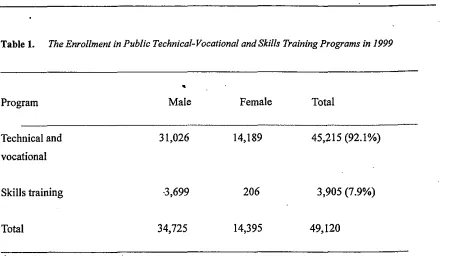
Table 1. The Enrollment in Public Technical-Vocational and Skills Training Programs in 1999
Program Male Female Total
Technical and 31,026 14,189 45,215 (92.1%)
vocational
Skills training -3,699 206 3,905 (7.9%)
Total 34,725 14,395 49,120
Note. From Malaysian Educational Statistics, 1999.
Continued efforts have been made to expand the supply of skilled and semi-skilled human resource through increased enrollment in the public secondary technical and vocational schools. In 1995, there were 9 technical and 69 vocational schools as compared to 58 vocational and 9 technical schools in 1990. The enrollment in these schools increased from 30,940 in 1990 to 48,800 in
1995, while the output was 13,500 for secondary technical schools and 82,700 for secondary vocational schools for the 1990-1995 period (Economic Planning Unit, 1996). The majority of
the graduates from secondary technical schools continued their studies in various post-secondary institutions,while the graduates from vocational and skill programs were mainly absorbed into the workforce.
The emergence of three technical universities that will focus on the industry-university partnership is the latest commitment of Government. Courses offer by these technical universities will have a component of practical or `hands-on' approach and jointly developed between the university and industry.
C
TECHNICAL AND VOCATIONAL EDUCATION SYSTEM
Currently there are four(4) government departments involved in technical and vocational education include the Ministry of Education, the Ministry of Human Resource, the Ministry of Entrepreneurial Development; and the Ministry of Youth and Sports.
The formal technical and vocational education system under the Ministry of Education starts at the upper secondary level, which consists of secondary technical and secondary vocational schools. These schools offer courses in three streams: a) technical educational stream; b) vocational education stream; and c) skill training stream. The technical and vocational streams offer a course structure that covers the same core subjects as in other upper secondary academic schools. In addition to these core subjects, the vocational stream student selects a package of vocational subjects in accordance with the vocational course he is following. In the technical stream, the technical subjects offered are less practical in nature and more engineering and commerce or agriculture based. In the skill-training stream, more emphasis is given to practical work to develop competency in trade skills as required by related industries.
25
ZJTeVoc - International 2002
There are wide variety ofinstitutions, which providepost secondary education and training. They include schools, polytechnics and other publicly funded institute, private colleges, state skills development centers and binational technical institutes.
Majlis Amanah Rakyat (MARA)under the Ministry ofEntrepreneurialDevelopment plays a key
role in providing skills training for Malaysia's indigenous people.
TECHNICAL SCHOOLS
In 1996, the Ministry of Education has made a dramatic shift to upgrade technical education, not only because of the requirements of the economy but also to increase more science and technical human resource (Economic Planning Unit, 1996). In this regard, 22 secondary vocational schools were converted into secondary technical schools for the 1996 school session.
In the vocational education stream, emphasis is given to general and technical subjects in order to provide students with a good foundation for admission into polytechnics and other institutions of higher learning without significantly affecting their vocational skills development. The courses are of two-year duration and prepare students for the Malaysian Certificate of Education in Engineering Trades, Commerce, Home Economics, and Agriculture Science.
In 2000, the conversion increases technical schools to 77 and reduces vocational schools to 4 (Malaysian Educational Statistics, 2000). At the same time, engineering technology and technical drawing subjects were also introduced in selected academic secondary schools. The move was to open up opportunities for academic students who inclined to be in technical areas as well as to prepare them to continue their studies in various science and technical-related disciplines at the post-secondary level (Economic Planning Unit, 1996). However, this conversion was criticized by vocational educators who perceive that the shift will severely restrict the future supply of blue-collar skilled workers that are already in severe shortage (Abdul Raof, 1996).
POLYTECHNICS
Since 1969, the Ministry of Education has established 12 public polytechnics, consisting of 10 main polytechnics and 2 city polytechnics as post-secondary learning institutions for technical and commercial training. On the development of main polytechnics, currently, 5 under construction, 3 are being planned, and 4 are proposed under for the Eight Malaysian Plan. The main objective is to train secondary school leavers to become qualified technical assistants, technicians, technologists, paraprofessionals, and business personnel. The Ministry of Education internally accredits polytechnics and many have received external ISO 9002 certification.
The primary objectives of polytechnics are to:
a. Provide broad-based education and training to upper-secondary school-leavers to enable them to acquire the necessary skills to become technicians and technical assistants in the various engineering fields or junior and middle-level executives in the commercial and service sectors,
b. Provide relevant technological or entrepreneurial education and training to upgrade the basic skills.
c. Promote collaboration with the private or public sector through Time-Sector Privatization as well as research and development programmes.
TeVoc - International 2002 W1
duration, while most diploma programs are of three-year duration; with the exception of Diploma in Marine Engineering (4 years) and Diploma in Secretarial Science (2 years). Industrial training where students work in an industry setting for a period of one semester is a requirement for all programs. The industrial training allows students to experience working conditions and to expose them to the realities and demands of the industrial and commercial sectors (Ministry of Education,
1994).
POST-SECONDARY ADVANCED SKILLS TRAINING
PROGRAMS
Advanced public and private skills training institutions have been established to supply adequate skilled workers to meet the expanding industrial sector. Various measures were taken to increase training capacity through the expansion of existing facilities and the establishment of new institutions. The intake of trainees was also increased through the introduction of double-shift training sessions and the implementation of weekend classes. These measures may result in an
increase inthe output of trainees from 21,169 in 1990 to 51,983 in 2000 as shown in Table 2. In general, public training institutions show an increase in the output in 2000 especially in printing trades and skill upgrading programs. Private training institutions, however, show an increase in
the output in electricalengineeringprograms and printing trades.
TABLE2, OUTPUT OF SKILLED A ND SEMI-SKILLED GRA DUA TES FROM PUBIJCA ND PRIV A TE TRA INING INSTITUTIONS
1990 2000
Program Public Private Total Public Private Total
Engineering: 15,076 2,715 17,791 22,994 15,078 38,072 Mechanical 9,661 709 10,370 11,862 3,378 15,240 Electrical 5,230 1,936 7,166 10,896 11,551 22,447
Civil 185 70 255 236 149 385
Building _
Trades 2,686 110 2,796 3,954 412 4,366
Printing
Trades 29 9 38 2,392 51 2,443
Others 18 429 447 4,984 1,158 6,142
Skill-Upgrading 97 n.a. 97 960 n.a. 960
Total 17,906 3,263 21,169 35,284 16,699 51,983
Note: From Economic Planning Unit, 1996.
To meet the needs for higher skilled workers especially in the new technology clusters and to take advantage of advanced technology in developed countries, advanced skilled training institutes were established with the cooperation of the Federal Republic of Germany, France and the United Kingdom. MARA heads this cooperation. The German-Malaysian Institute (GMI), established in 1992, offered advanced skill training, particularly in production technology and industrial electronics. The institute, with a maximum enrollment capacity of 450 trainees, produced its first
TeVoc - International 2002
batch of 57graduatesin 1995. TheMalaysian-France Institute (MFI), began operation in October 1995, had a capacity of 600 trainees and offered courses at advanced level in areas such as
maintenance of automated mechanical systems, electrical equipment installation and welding
technology. The establishment of the British Malaysia Institute (BMI) in 1999 will focus on the
trainings in Electrical, Electronics and Information and Communication Technology (ICT) at
certificate and diploma levels.
The Ministry of Human Resource through the Manpower Department continues to build and upgrade technical and vocational training institutions under its purview to further increase capacity and quality for learning. At present,there are fourteen (14) Industrial Training Institutes(TIIs) four (4) Advance Technology Centers(ADTEC), a Japan-Malaysia Technical Institute and a Center for Instructor and Advanced Skills Training (CIAST). Meanwhile, under the Eight Malaysian Plan (8MP), the Ministry of Human Resource is planning to build more training institutes in order to further escalate training capacity. Withthe completion of the new training institutes under 8MP, the training capacity under the Ministry ofHuman Resource will increase by twofold from existing
14,000 training places.
TECHNICAL UNIVERSITY
a)
Concept and Features
In the Malaysian context a technical university may be broadly defined as one that focuses on higher technical education with significantly heavy emphasis on practical-oriented learning and applications while maintaining strong theoretical foundation. Another important feature of a technical university is the industrial exposure to be gained by the students. A technical university is designed to produce competent highly skilled technical professionals who would adapt easily in the industrial environment.
Technical University Colleges (TUCs),which were just recently established in Malaysia, serve to embody the full features of a technical university but with focus on specific niche areas and with necessarily limited student population. The emergence of TUCs in Malaysia is the consequence of government's determinationto fulfill the Malaysian Industry's needs for"shop floor engineers" to complement engineers who have been trained in the more traditional ways.
Important features of a technical university may be summarized as follows:
(a) Courses are specialized and designed to meet industrial needs. The curriculum emphasizes practical work and industrial applications with projects involving the solution of problems faced by industry.
(b) The learning process adopts " hands on" approach to complement theory comprising of work in laboratories, workshops, studios, teaching factories and industries. Further, the learning process is designed to develop competency, and is problem-cantered, action-oriented,and experiential and may be simulation-based.
(c) There is close collaboration with industry to support the university's academic, training and research and development activities as well as programmes that benefit the industry. (d) Graduates are technically competent and highly skilled, suitable and relevant to industrial
needs, flexible and able to apply theory to practical situations, skilful with a balanced knowledge of both skill and theory and are innovative and creative in solving problems.
TeVoc - International 2002F^V-j
Universiti Kejuruteraan Utara Malaysia (KUKUM). All three TUCs offer only technical and information technology courses.
Besides implementing different teaching approaches TUCs also provide wider opportunities for graduates of polytechnics and vocational institutions to pursue higher technical education. In fact TUCs provide a new route to university education for vocational students.
b)
Industrial Needs
Scientific strength and technical competency are primary requirements for an engineer to posses in order to perform useful functions in the industry. Engineering graduates from normal universities are usually well equipped with theoretical fundamentals but lack practical skill and exposure. They may find suitable employment as "Engineering Scientists or Research Engineers" but would not immediately fit into an industrial environment to work as the so called "shop floor engineers". In striving to achieve developed nation status by the year 2020, Malaysia finds growing needs to have the second category of engineers to support her rapid industrialization process, hence the establishment of technical university colleges.
The two categories of engineers can play effectively complementary roles in the industrial development of a country as proven in industrially progressive countries like Germany and France. In Germany for instance two-thirds of the engineers are products of Fachochschulen in the applied science and technical universities while only one-third are from other universities. Outstanding features of the Fachochschulen system of technical education are the close collaboration between university and industry and the system has served Germany's industrial needs with excellent results.
c)
University-Industry Partnership
It is obvious that close collaboration between university and industry can help produce relevant graduates. A technical university should get the continuous support of industry to help serve the latter's needs. In Malaysia the relationship between university and industry has still to make an impact and needs to be steadily nurtured for it to flourish.
To be sustainable, the collaboration between the two parties must be mutually beneficial. In fact both university and industry can derive immense benefits from their close relationship. In
KUTKM there is a concerted effort towards forging smart partnership between university and industry and has established a "University-Industry Centre" (UNIC) to manage the collaboration.
University-Industry smart partnership may serve both parties beneficially in the following ways:
(a) The use of Industrial Advisory Panel to guide the university in the development of curriculum and syllabus.
(b) Use of university expertise, facilities and manpower for the solution of industry's problems. This includes consultancy as well as research and development work.
(c) Support of industry in the provision of industrial training places for university students and faculty members.
W] TeVoc - International 2002
(d) Use of industrial experts as occasional faculty members to teach advanced subjects with industrial applications.
(e) Mutual exchange of staff for short or long stint to work on specific projects or for mere exposure.
d)
Critical Success Factor
In the establishment of a technical university the following critical success factors must be appropriately addressed:
Low students:staff ratio.
Well-equipped and generously endowed laboratories and workshops. Highly qualified staff with wide industrial experience.
Continuous active support from industries.
Creative teaching and learning approaches and techniques.
THE EMPLOYMENT
j TeVoc - International 2002
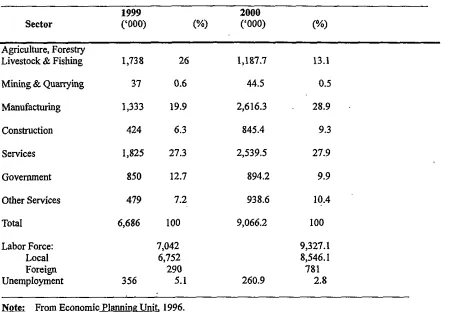
Table 3. Numbers of Employment in Different sectors, 1990-2000
1999 2000
Sector ('000) NO ('000) NO
Agriculture, Forestry
Livestock & Fishing 1,738 26 1,187.7 13.1
Mining & Quarrying 37 0.6 44.5 0.5
Manufacturing 1,333 19.9 2,616.3 28.9
Construction 424 6.3 845.4 9.3
Services 1,825 27.3 2,539.5 27.9
Government 850 12.7 894.2 9.9
Other Services 479 7.2 938.6 10.4
Total 6,686 100 9,066.2 100
Labor Force: 7,042 9,327.1
Local 6,752 8,546.1
Foreign 290 781
Unemployment 356 5.1 260.9 2.8
Note: From Economic Planning Unit. 1996.
Because of high growth of the working-age population, an increase in the labor force participation rate from 66 percent in 1990 to 66.9 percent in 1995, and large inflows of foreign labor, the labor force increased at an average annual rate of 2.9 percent during 1990-1995 (Economic Planning Unit, 1996). The labor force participation is expected to reach 68 percent in the year 2000. The male labor force participation rate increased from 86.3 percent in 1990 to 86.8 percent in 1995, while the rate of females increased from 45.8 percent to 47.1 percent during the same period (Economic Planning Unit, 1996). The educational profile of the labor force shows a progressively more educated workforce. About 55 percent of the labor force had secondary education in 1995 as compared to 52 percent in 1990. In addition, while 5.3 percent of the labor force had college or university qualification in 1990, the proportion was 6.3 in 1995. Despite this increase, the proportion was still relatively low compared to developed nations. Therefore, systematic plan should be made to increase the supply of highly educated human resource (Economic Planning Unit, 1996).
To compete and survive in the era of K-Economy and globalization, Malaysia needs to find a new niche, as it can no longer rely on being a low cost producer or the center for cheap labor. It is important for the country to embrace knowledge in all factors of production in order to create value added products as well as services. The Government has laid a foundation for the economy to transform from a P-based to a K-based economy. Nevertheless, there are many challenges and issues that need to be address before the country can move successfully to K-Economy. The Government is responsive toward ensuring that the country adapt and embrace the information age and new economy and has laid out several policies and incentives to ensure that the progress toward the new development phase is achieved. Among the important steps that have been taken
aj
TeVoc -International 2002include the setting up of the National Information Technology Agenda, Multimedia Super Corridor and the Master Plan for the K-Economy. The Government has also laid out basic ICT infrastructure, which is the most important factor in K-Economy. Nevertheless,there are several challenges that the country will face and need to address before it can move successfully into the K-Economy. The new global market calls for visionary leadership and the adoption and application of new management and organizational principles. The old command-and-control management system that many Malaysian organizations are used to will not work in a new competitive environment. K-Economy has required knowledgeable, skilled, dynamic, creative and innovative human resources. Thus, the education, training, and employment policies have to change. Employers need to recruit"knowledge" workers for higher skills jobs. This requires our education system to produce graduates with relevant knowledge, critical skills, and proper attitudes. Teacher training program must also undergo substantial transformation especially in technical and vocational education. The current technical education and training systems in Malaysia need to be improved to ensure that skilled and knowledge workers' shortages will not pose a serious bottleneck to future industrialization.
C
ISSUES AND CHALLENGES
a)
Shortage of Technical Manpower
With rapid industrial growth, the demand of technical manpower in the last few years far exceeds the supply provided by both private and public institutions.Projections indicate that the demand for technical manpower in the future is also going to far exceed the supply. The rapid changes of technology, especially in manufacturing that has started utilising automation and robots require a workforce that is flexible, highly skilled and competent.At the same time, there is a decline in the number of students choosing science and mathematics at the secondary level. These problem, if not resolved, will seriously hinder the country's progress towards industrialisation
b) Shortage of Technical Teaching Staff
In the technical and vocational education system, there is an acute shortage of qualified technical and vocational teachers and lecturers. Most staff are recruited directly after they graduate from universities and colleges based on their academic qualifications and do not have industrial work experience. At the same time, qualified personnel with work experience are not willing to become teachers due to unattractive salary scheme. Despite incentives the technical staff turn over is high and the Ministry is exploring ways and means to attract and retain quality-teaching staff. One way to retain and attract staff is to provide salary incentives: Teachers with vocational skills are now categorised as critical and are being provided with an allowance of 5% on top of their salaries as compared to their counterparts academic teachers. Technical and vocational teachers are mostly sent abroad for their training and skill upgrading.
c)
High cost of technical and vocational education
TeVoc - International 2002
I
capability to meet the required demands, the work situation and technological changes have move ad)
Coping with the information explosion
The rapid growth of information related technologies with easy access to all types of information have raised concerns regarding the suitability of material especially to school children. The growth of the Internet, for example, has resulted in easy communication through e-mail and convenient access to information of all types.The dilemma facing policy makers is how to provide access to such facilities without compromising basic moral and ethical values that differ from those in western societies.
e)
Need to Strengthen Industrial Linkages
Another issue facing technical and vocational education is to design a closer link between education and the world of work. Programs must be developed that are relevant to employment requirements and ultimately, to work performance. Yet, to respond to workplace demands and technological changes is never easy. In most instances, when the school system develops its
step further. In fact, this expectation is a high order idea, which in reality is difficult to achieve by a school system on its own unless there is extensive support from the industries as in the German dual system.
CONCLUSION
The current technical education and training systems in Malaysia is strongly supported by Government's policy and can be improved to ensure that skilled and knowledge workers' shortages will not pose a serious bottleneck to future industrialization. What is required is more systematic coordination between public technical education and training and the private sectors. School-to-Work strategies call for a planned and structured work experience that has productive educational value and is carefully coordinated with the learning-taking place in the classroom. Further, what is required is better rapport between the technical education systems and the employers. More receptive and proactive attitudes among employers and educators must take place with respect to skills and vocational training. Finally, the employers should not only be at the receiving end but must also involve in the educational process in order to adequately prepare our youth to face rapid-changing workforce.
' TeVoc -International 2002
REFERENCES
Abdul Manab, N., & Othman, A. (1999, December). The implementation of information and communication technology in nurturing smart school learning environment in Malaysia: The TigerWebpr iect. Paperpresented at the MERA Conference,Melaka, Malaysia.
Ali, A. H. (2000). Towards Malaysia's knowledge empowerment in the 21n century. Access, empowerment and governance in the information age. Kuala Lumpur, Malaysia: National Information Technology Council.
Badawi, A. (2000, September). 4th National smart partnership dialogue. Keynote Address. Kuala Lumpur,Malaysia.
Bank Negara Malaysia (2000). Annual report 1999. Kuala Lumpur, Malaysia: Bank
Negara Malaysia.
Embong, A.R. (2000). Wacana Globalisasi. Dalam Noraini Othman & Sumit Mandal.
Malaysia menangani globalisasi: Peserta atau mangsa? Bangi, Malaysia: Penerbit UKM.
Govindan, K. (2000). Globalization, k-economy. and the virtual state. Paper presented at
the 12th National Real Estate Conference,Kuala Lumpur,Malaysia.
Infosoc Malaysia (2000). Access and equity: Benchmarking for progress. Kuala Lumpur, Malaysia: National Information Technology Council.
Ismail,L. (2000, June 8). Bumiputra masih ketinggalan dalam internet. Megabait Utusan Malaysia, pp. 1.
Jaafar, A.S. (2000, June). K-Economy: Issues and challenges. Paper presented at the National Seminar on Strengthening the Macroeconomic Fundamentals of the Malaysian Economy, Kuala Lumpur,Malaysia.
Lourdesamy, I. (2000, December 12). Jobs in the new order. The New Straits Times. Means, B. (2000). Technology in America's schools: Before and after Y2K.
In R.S. Brandt(Ed.), Education in a new era.Alexandria,VA: ASCD.
Muhamed, A.H., Hasan, H., Dzakiria,H., & Kassim, A. (1999, October). IT impact on schools: Overcoming barriers in integrating computers in the Malaysian primary schools. Paper presentedat TAWITIConference,Bangi, Malaysia.
Mustapha, R. (1999). The role of vocational and technical education in the industrialization of Malaysia as perceived by educators and employers. Doctoral dissertation, Purdue University.
National Center for Education Statistics. (1999, February). Internet access in public schools and classrooms : 1994-1998. Http://www.nces.ed.gov/
TeVoc - International 2002 64
OECD (1996). The 1996 science, technology and industry outlook. Paris: OECD.
Rinalia, A. R. & John, K.J. (2000). Access, empowerment and governance in the
informationage. Kuala Lumpur, Malaysia: NationalInformationTechnology Council.
Special Economic Issue (2000, August). Economic Research Services Department,
Bumiputra-CommerceBank, Vol. 5.
Star(2000, September7). Malaysianeeds to restrategise for K-economy.