UNIVERSITI TEKNIKAL MALAYSIA
MELAKA
Fencing Improvement at Palm Oil Mill to Reduce Costly Waste
Thesis submitted in accordance with the partial requirements of the
Universiti Teknikal Malaysia Melaka for the
Bachelor of Manufacturing Engineering (Manufacturing Process)
By
Mohd Khairul Al’fat’hah bin Izman B050910125
900107055241
Faculty of Manufacturing Engineering
FENCING IMPROVEMENT TO REDUCE WASTE AT
PALM OIL MILL
Mohd Khairul Al’fat’hah bin Izman
B050910125
DECLARATION
I hereby, declare this project study entitled “FENCING IMPROVEMENT TO REDUCE WASTE AT PALM OIL MILL” is the results of my own research Except
as cited in the reference.
Signature : ……….
Author Name : ………
Date : ………
APPROVAL
This thesis submitted to the senate of UTeM and has been accepted as part Fulfillment of the requirements for the degree of Bachelor of Manufacturing Engineering (Manufacturing Process). The members of the supervisory committee are as follows:
Signature : ……….
Supervisor: : ………
Date : ………
EN ALAMIN BIN MOHAMED SULTAN
i
ABSTRAK
Projek kajian ini membentangkan penambahbaikkan ‘pagar’ di kilang minyak sawit untuk mengurangkan sisa/baziran. Umumnya, bahan pagar yang dipanggil logam berkembang diperbuat daripada keluli lembut menemui kegagalan dalam perkhidmatan aplikasi pagar itu. Kegagalan ini menyumbang perbelanjaan besar yang sia-sia dan membazir dalam penyelenggaraan pagar di stesen pemprosesan. Kegagalan pagar juga menyumbang kepada sisa seperti sisa masa, sisa tenaga, sisa pengangkutan, sisa menunggu, sisa kecacatan produk, dan lain-lain. Kegagalan pagar ini juga member kesan kepada kualiti Buah Tandan Segar (BTS) produk akhir iaitu kualiti minyaknya. Alat pembuatan Lean seperti kaizen adalah pendekatan terbaik untuk menyelesaikan isu yang berkaitan dengan bahan buangan.
Pendekatan Kaizen digunakan dengan bantuan analisis kegagalan bahan untuk mengenalpasti punca kegagalan logam berkembang dan menjalankan beberapa analisis. Untuk itu, sampel yang diambil dari pagar akan menjalani penyediaan sampel, prosedur pembersihan, ujian tanpa musnah, ujian mekanikal, ujian kimia, ujiaan makro dan mikrostruktur untuk mengenalpasti tingkahlaku dan ciri-ciri sampel untuk diakses ke dalam Perisian Cambriged Pemilih (CES).
ii
ABSTRACT
This project study presented a fencing improvement at palm oil mill to reduce costly waste. Typically, fencing material called expanded metal made of mild steel comes to failure in service. The failure contributes great unnecessary expenditure on process station maintenance. The failure of fencing also contribute to waste such as time waste, energy waste, transportation waste, waiting waste, product defect waste, etc. The failure also affects the quality of Fresh Fruit Bunch (FFB) end product. Lean manufacturing tool such as kaizen is the best approach to solve issue related with waste. Kaizen approach is used with the aid of material failure analysis to identify the root cause of expanded metal failure and undergo some analysis. For that matter, the sample taken from fencing has undergo sample preparation and cleaning procedure, follow up by mechanically test, chemical test, and micro and macro examination. The behavior, characteristic of sample also has been identified. Testing analysis was compiled and the type of failure is justified.
iii
DEDICATION
First and foremost, , I would like to express my greatest appreciation to Universiti
Teknikal Malaysia Melaka for giving me the opportunity to undergo my final year
“Projek Sarjana Muda” under the supervision of Mr. Al Amin bin Mohamed Sultan.
A special thank you also goes to my supervisor Mr. Al Amin bin Mohamed Sultan
and Co. Supervisor, Professor Qumrul Ahsan for their dedication and guidance
during the period of undergoing my project. Last but not least, I want to thank my
mom and dad for their support as well as to all my friends who never give up
encouraging me to complete this report.
iv
ACKNOWLEDGEMENTS
I wish to acknowledge and express my gratitude and appreciation to my supervisor, Mr. Al Amin b. Mohamed Sultan for his supervision, encouragement, suggestion and assistance through the final year project study. Next, my parents, Mr. Izman b. Sudin and Madam Huriah bt.Abd Majid whose is constantly giving encouragement, faith and confidence along with continuous moral support. After that Mr. Wan Shahril Izan b. Wan Sobri, the Senior Manager of Sua Betong Palm Oil Mill, Sime Darby Plantation Sdn. Bhd. for permitting the final year project implementation at the Sua Betong mill.Then, Mr. Mohd Aerman b. Ahmad , the Senior Assistant Manager of Maintenance Department of Sua Betong Palm Oil Mill, Sime Darby Plantation Sdn. Bhd. for the lesson and ample opportunity to facilitate fruitful project study and last but not least Prof. Qumrul Ahsan, being my co-supervisor for his full encouragement besides significant contribution in proof reading the manuscript were tremendous contribution.
v
List of Abbreviations, Symbols and Specialized Nomenclature xiv
vi
2.4 Fencing/ Expanded Metal Characteristic needed for this Application 28
2.5 Failure of Material 30
2.6 Metal Failure Analysis 30
2.6.1 Technique for Failure Analysis 32
2.6.2 Procedure for Failure Analysis 32
2.7 Failure Mechanism 35
2.7.5 Elastic Distortion Failure 39
vii
3.3.2.2Cause and Effect Diagram 51
3.3.2.3Histogram 52
3.3.3Interview 52
3.3.4Time Study 52
3.4 General Sources of Failure 53
3.5Sample preparation 54
3.5.1Tensile and Flexural specimen 54
3.5.2Microhardness and Microstructure specimen 55 3.5.2.1 The sequence of Mounting Process 55 3.6General Practice Conducting a Failure Analysis 57 3.6.1 Collection of background information 58
3.6.2Preliminary visual examination 58
3.6.3Mechanical Testing 59
3.6.3.1MicrohardnessTest 60
3.6.3.2Tensile Test 61
3.6.3.3Flexural test 62
3.6.4Selection and Preservation of Specimen 66
3.6.5Sectioning Specimen 67
viii
3.6.7.Microscopic Examination 68
3.6.8. Metallography 69
3.7.Chemical Test 70
3.8Experimental Tools and Machines 70
3.8.1Energy Dispersive X-Ray (EDX) 70
4.2 Result of Tabulated Data & Cost Consume 76
4.2.1 Data Collected for Pareto Chart 76
4.7 Collection of background Data 83
4.7.1 Process manufacturing & metallographic examination 83
4.7.2 Material 84
4.7.3 Expanded Metal Fencing period application 85
4.7.4 Preliminary Visual Examination 85
4.7.5 Microhardness Testing 85
4.7.5.1 Result of Vickers Microharness test 87
4.7.5.2 Analysis and Discussion 87
4.7.6 Selection & Preservation of Specimen 88
4.7.7 Mechanical Testing 88
ix
5.3 Classification of Family Material 105
x
LIST OF FIGURES
1.0 Fencing failure at reception station 5
2.1a TQM tools flow chart 9
2.1b One offormat of a cause and effect diagram 11
2.2 Lean manufacturing tools 13
2.3a Standard expanded metal 18
2.3b Flattened expanded metal 18
2.3c Knuckle 18
2.3d Short way measurement (SWM) 19
2.3e Position of LW and SW 20
2.6 The various aspect of engineering design, manufacturing, and performance are steps in a chain of a continuous process 33 2.7a Example of Brittle Fracture Surface of a High-Strength Chain. Fracture
Began in a Small crack 39
2.7b Example ofyielding failure of Shaft 40
2.7c Fatigue loading cycle 45
3.2a Sime Darby Plantation Sdn. BhdSuaBetong Palm Oil Mill 50 3.2b The flow chart of methodology procedure step towards achievement of
objective of project study 52
3.3 Cause and effect diagram for Quality of FFB 55
3.5.1a Measuring specimen dimension 58
3.5.1b Tensile Specimen 58
3.5.2.1 Sample preparation procedure 60
3.5.2a Final specimen after surface grinding 61
3.6.3.1 Microhardness test machine 65
3.6.3.1 How the indenter working 65
3.6.3.3a Universal Testing Machine (UTM) 67
xi 3.6.3.3c Standard test configuration of the flexure test (ASTM E 290-97a) 68
3.6.3.3d Sample of the measured specimen 69
3.6 Typical scanning electron microscope use for microscopic analysis of a
fracture surface 73
3.8a Energy Dispersive X-ray (EDX) machine 75
3.8b Principle operation of SEM (http://www.purdue.edu) 76
3.8c Incident beam(http://www.purdue.edu) 77
3.8d SEM machine (carleton.edu) 77
3.8.3 Optical microscope (OM) 79
4.2 Pareto Chart of Frequency (RM) and Percentage (%) vs Maintenance Part at
Fruit Reception Station 82
4.4 Histogram of Frequency (RM) vs Maintenance Part of Fruit Reception
Station 84
4.5a Cause and Effect diagram for Quality of FFB 85
4.5b Cause & Effect Diagram for Waste Identified at Reception Station 85
4.7.2 Mild steel 89
4.7.5a Micro Vickers Hardness Testing Machines 91
4.7.5b Indent process on the specimen surface 91
4.7.5c Diamond indentation on the surface of the sample 92
4.7.7a Graph of Force (kN) vs Stroke (mm) 95
4.7.7b Specimen equippedonthe tensile test machine 96
4.7.7c The specimen in test progress 96
4.7.7d The specimen after the test 96
4.7.7e Specimen is equipped with Flexural test machine 98
4.7.7f Graph of Force (kN) vs Stroke Strain (%) 98
4.7.7g Thespecimen undergo 3 point bend test 99
4.7.8a Optical Microscopy 100
4.7.8b Cleaning process 100
xii
4.7.8b Discontinuities on the surface 1 101
4.7.8c Discontinuities on the surface 2 101
4.7.8.1a Line force across the surface 103
4.7.9a SEM and EDX equipped together for microstructure testing 104
4.7.9b Image taken from SEM (Spectrum 1) 105
4.7.9c Graphical result of spectrum 1 105
4.7.9d Image taken from SEM (Spectrum 2) 106
4.7.9e Graphical result of spectrum 2 106
4.7.9f Image taken from SEM (Spectrum 3) 107
4.7.9g Graphical result of spectrum 3 107
4.7.10 pH paper used in chemical test 109
4.7.10 FFA sample from reception station 109
xiii
LIST OF TABLES
3.3a The maintenance expenditure initial record data sample of FFB reception
station at Sime Darby Plantation, SuaBetong Mill 54
3.3b Time study sample for FFB to fall and fill up conveyor 57
3.6.3.3The measurement of the specimens 69
4.2 Data Collection for Pareto Chart 81
4.3 The historical record data on financial expenditure of maintenance at
reception station 83
4.6 Time Study for FFB to fall and fill up conveyor 87
4.7.2a Show the chemical properties 89
4.7.2b Show the mechanical properties 89
4.7.5 Vickers Hardness Test Result 92
4.7.7a Result of Tensile test 94
4.7.5b Result of Flexural test 97
4.7.9a Tabulated data of spectrum 1 reading 105
4.7.9b Tabulated data of spectrum 2 reading 106
4.7.9c Tabulated data of spectrum 3 reading 107
5.2 KNL Table data 112
5.4a Translation table 115
xiv
LIST OF ABBREVIATIONS, SYMBOLS, SPECIALIZED
NOMENCLATURE
ASM - American Society for Metal
ASTM - American Society of Test and Material CES - Cambridge Education Selector
CPO - Crude Palm Oil
DOBI - Deterioration Of Bleach Index EDX - Energy Dispersive X-ray
ETP - Economic Transformation Programme FFA - Free Fatty Acid
FFB - Fresh Fruit Bunch
ICP - Inductively Coupled Plasma
JCPDS - Joint Committee for Powder Diffraction Standards KER - Kernel Extraction Rate
KNL - Know Need Learning issue
LW - Long Way
LWM - Long Way Measurement NKEAs - National Key Economic Areas OER - Oil Extraction Rate
OES - Optical Emission Spectrometry OM - Optical Microscope
PBL - Problem Based Learning PDA - Pulse Distribution Analysis
PDF - International Powder Diffraction File POM - Palm Oil Mill
PV - Peroxide Value
RIR - Reference Intensity Ratio SEM - Scanning Electron Microscope
SW - Short Way
xv TQM - Total Quality Management
UTeM - UniversitiTeknikal Malaysia Melaka UTM - Universal Testing Machine
1
CHAPTER 1
INTRODUCTION
1.1 Overview of Study
This report presents a study on problem identification skill using quality tools in industry
based-problem at one of palm oil mill process stations. The problem solving skill such as
Kaizen is implementing in order to reduce waste at a palm oil mill. The material failure
analysis approach also is used to aid the Kaizen process. The following result will later
determine the most suitable solution to solve the failure problem faced by fencing
(expanded metal) and outline several prevention methods and improvement of the
material. In this chapter, the report will present about some background of this study, the
problem arises in the palm oil mill. This chapter also highlights the objective of the
study and also the limitation of this study.
1.2 Background of study
Palm oil mill has several process stations that will process the Fresh Fruit Bunch (FFB)
from Palm Oil Estate into a major product which are Crude Palm Oil (CPO) and Kernel
Palm Oil. The first operation carried out on FFB in a palm oil mill is the loading of FFB
into the ramp or hopper at the reception station. The reception facilities are designed to
accommodate the type of FFB transport system adopted by supplying estates whether in
2 the quality of its produce is very much dependant on the standard and quality of crop
that is processed.
Maycock .J.H (1994) has shown that the vast area of the reception station ensures a
quick turnaround of transport to unload the fruit into a ramp. The ramp is also designed
to minimize the spillage of loose fruits that sometimes carried either separately or along
the FFB. The ramp is also known as FFB storage which hold the FFB under certain time
before letting it go through conveyor at the bottom of the ramp. The conveyor at the
bottom of the ramp is heading to the next station which performs FFB sterilization
process. The ramp in this mill has a steep shape design for a certain reason to enable free
falling impact of the FFB and loose fruit in the end of the ramp.
At the end of the ramp, there are two portion areas that help in holding the numerous
amount of FFB and loose fruit which are the top portion consist of fencing and the
bottom portion consist of barricade door. The fencing acts as barricade at the top portion
to block all the FFB and loose fruit from continuous flow in the conveyor. The hydraulic
system is used to move the flat barricade door at the bottom portion up and down to
control and minimize the movement of FFB or loose fruit fill up in the conveyor.
The conveyor used to deliver the FFB and loose fruit is designed to partition of
compartment and has a capacity limitation whereby each compartment can only be filled
up to approximately 180 kg which is equal to 5-6 bunch of FFB at a time. Therefore the
flowing of FFB and loose fruit into the conveyor must be controlled carefully to prevent
any incoming maintenance problem due to overload matter. The fencing and flat
barricade door are simply made up of mild steel in same design and thickness.
Recht. R and Wilderom. C , (1998) has written that Lean manufacturing is a systematic
approach used to identify and eliminate the waste and enabling to make continuous
improvement. Several maintenance is performed at process station in order to repair
damage occur while fruit processing take place in a mill. Quality tool can be used in
3 higher maintenance cost. As an alternative, there are 3 major quality tools which are
Pareto Chart, Histograms, Control Charts and Cause and Effect Diagram.
Hicks B.J (2007) has stated that the major waste at the focus process station can be
determined by using quality control tools. Hence, the identified problem can be solved to
reduce costly waste by suggesting improvement through engineering approach such as
material failure analysis to increase efficiency of focus area in the mill process cycle.
There are 7 types of major waste identified in lean manufacturing which are over
production waste, waiting waste, inventory waste, over or less processing waste,
transportation waste, defect waste and energy waste.
Recht. R and Wilderom. C , (1998) classifies that in order to solve problem
identified from statistical quality control tool, another lean manufacturing approach is
used. Kaizen is an excellent technique for reducing or eliminating rework. Kaizen is a
system of continuous improvement in quality, technology, processes, company culture,
productivity, safety and leadership. The word Kaizen means “continuous improvement”
in Japanese. Kaizen is an intensive and focused approach to process improvement. In
this matter the studies of material failure analysis will aid in suggesting the best kaizen
approach to solve the problem along with the waste occur.
1.2 Problem Statement
Fencing of the ramp at the FFB reception station need to be repaired and replace. The
flat barricade door at the bottom portion of fencing is powered by hydraulic power and is
controlled by a worker at a time. As the time passed, the fencing act as a barricade to
hold against the palm oil fruit is swollen, expanded and broken. The fencing is suspected
to be a failure due to impact force by the FFB that falling into the ramp but the
investigation has been carried out to determine whether the material is failure before or
4 Initial inference stated that the fencing might come into failure due to material failure or
design failure or both. However, after the observation has been made on the surface of
the fencing there are brownish color surface appear on the surface of fencing which is
known to be rusty. A corrosion phenomenon has always been a nightmare in the
industrial environment, especially when it involved withdelaying processing time as it
absolutely affecting the quality of a product later. Design of a product gives a great
impact on product to carry out their task upon given application. A product is a failure
when it cannot achieve its service life when it is expected to be.
Due to this situation, when the fencing comes into failure, the flat barricade door is stuck
under the expanded fencing failure when worker in charge undergoes their duty to
release the FFB from the ramp. As a result there is a delay time of operation at that
station which contributes to high lead time for a process station. As the barricade door
doesn't open the fruit cannot be released and the worker needs to manually pull out the
fruit out of the cage. The station has more than one barricade door so this problem may
not seem as a huge matter so the process still can be proceed as long as there is another
functional barricade door but the station with damage flat barricade door cannot proceed
along the FFB will remain there until a maintenance worker fix the fence. While waiting
the fencing getting fixed at the end of the week the quality of fruit decrease as the FFB
processing period prolonged. The free fatty acid content is higher for late process of
FFB. In addition there is several waste identified along with the problem such as energy
waste, time waste, waiting waste, talent waste and transportation waste.
As getting inspiration from this kind of situations, this paper consists research of this
wear mechanism and in the mean time includes the investigation of root cause failure of
expanded metal that is used in fencing application at reception station.This collaborative
project is held with one of Sime Darby Palm Oil Milllocated at Sua Betong, Negeri
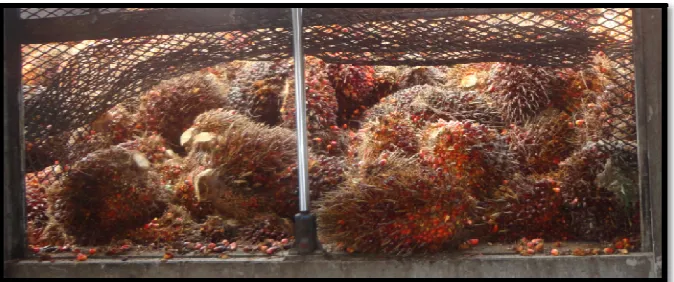
5
Figure 1.0: Fencing failure at reception station
1.3 Objective of study
The objectives of this study are:
a) To investigate the root cause of fencing (expanded metal) failure at the reception
station by using material failure analysis approach.
b) To suggest a Kaizen strategy for fencing (expanded metal) to overcome the failure
problem.
1.4 Scope of study
The project studies for this final year project only cover one station in Sime Darby (Sua
Betong) palm oil mill. Due to company rule and regulation, there is some constraint has
been put through on other processing station to protect confidential information.
Therefore the only case study that can be carried out is at the reception station of FFB.
The case studies only cover the material area in order to fulfill the final year project
requirement level. The tools used also focus only Kaizenin lean manufacturing. Machine
use to study about material behavior is by using either Scanning Electron
Microscope(SEM) or Optical Microscope (OM) and other material failure analysis field