A Review of UWB MAC Protocols
Mohd Shahril Izuan Mohd Zin, Martin Hope
Informatics Research Institute,
The University of Salford, Salford, M5 4WT, United Kingdom
[email protected], [email protected]
Abstract—In this paper, we review several ultra-wideband (UWB) medium access control (MAC) protocols that have been proposed to date. This review then considers the possibility of developing an optimal MAC layer for high data rate UWB transmission systems that transmit very little power especially in application to mobile devices. MAC in UWB wireless networks is necessary to coordinate channel access among competing devices. Unique UWB characteristics offer great challenges and opportunities in effective UWB MAC design. We first present the background of UWB and the concept of MAC protocols for UWB. Secondly, we summarize four UWB MAC protocols that have been proposed by other researchers and finally, a conclusion with a view to the planned future work. The main contribution of this paper is that it presents a summarised version of several MAC protocols applicable to UWB systems. This will hopefully initiate further research and developments in UWB MAC protocol design.
Keywords-Ultra-wideband (UWB); medium access control (MAC); low-power consumption; UWB MAC review
I. INTRODUCTION
Ultra-wideband (UWB) has emerged as a technology that offers great promise to satisfy the growing demand for low-cost, high data rate, short range wireless transmission systems such as digital wireless indoor and home networks. The growing numbers of media-intensive devices such as mobile phones, PCs, digital cameras, high-definition TVs and gaming systems have increased the need for high-bandwidth wireless solutions that provide easy connection and efficient media exchange. UWB presents a unique opportunity to become a widely adopted radio solution for wireless personal networking technology because of the enormous bandwidth available, the potential for high data rates, and the prospect of small size and low power requirements along with low implementation cost.
This paper is organized as follows: Section II describes a brief overview of UWB MAC. Section III considers an overview of UWB MAC protocols. Four proposed UWB MAC protocols are discussed in Section IV. We summarize the paper and then present future work in Section V.
II. OVERVIEW OF UWB
UWB is defined as any transmission that occupies a bandwidth of more than 20% of its centre frequency, or
more than 500 MHZ [1]. In 2002, the Federal Communications Commission (FCC) mandated that UWB radio transmission can legally operate in the range 3.1 to 10.6 GHz at a transmitter power of -41.3 dBM/MHz. The use of UWB technology under the FCC guidelines can provide huge capacity over short ranges. Currently, UWB is able to support various data rates, ranging from 110 to 480 Mbps, over distances up to 10 meters [1].
The basic idea of UWB can be traced back to the first wireless communication system in the late 1890s [2]. However the main concept of UWB was developed only in early 1960s through research in time-domain electromagnetic systems, where impulse measurement techniques were used to characterise the transient behaviour of a certain classes of microwave networks [1]. Similar to spread spectrum or code division multiple-access (CDMA), UWB technology was firstly used in a military environment and just recently introduced in the commercial market. Today, UWB has been considered as one of the most promising candidates for wireless communications within a short-range RF environment and has been creating a lot of interest from research community worldwide.
UWB system implementation at the physical layer can be achieved either by using a pulse-based approach [3], [4], [5] or a multiband-orthogonal frequency-division multiplexing (MB-OFDM)-based approach [6], [7]. UWB technology is attractive for high-rate (over 100Mb/s) short-range (less than 10 m) or low-rate (less than a few Mb/s) moderate-range (100 to 300 m) because of the large bandwidth and low transmission power density [2], [8]. Among potential UWB applications are multimedia services such as voice and video conversations, video streaming and high-rate data transfer. In addition to these conventional applications, UWB can also be utilized in industrial automation and control, medical monitoring and vehicular radar systems [9].
Several attempts have been made by IEEE to incorporate UWB into the technical standards as the physical layer technology after the FCC’s authorization of UWB in 2002. The standardization groups include: IEEE 802.15.3a for short-range, high data rate wireless personal area networks (WPANs) and IEEE 802.15.4a for short-range low data rate WPANs.
The IEEE 802.15.3a task group (TG3a) for WPANs was established in November 2001 to identify a higher data rate modification to IEEE 802.15.3 for an alternate physical layer. Two UWB-based proposals backed by two different industry alliances competed for the final approval. The DS-UWB based proposal, backed by DS-UWB Forum is designed to offer maximum data rate of 1320 Mbps while MB-OFDM, backed by MultiBand OFDM Alliance (MBOA) supports data rate up to 480 Mbps. Neither of the two protocols is compatible with each other. TG3a was officially disbanded in 2006 after compromise between the two proposers broke down, resulting in IEEE standardization deadlock. UWB Forum became defunct after Motorola and Freescale left the group in 2006. MBOA merged with the WiMedia Alliance in March 2005 and their MB-OFDM standards ECMA 368 was accepted as ISO/IEC standard [10].
III.OVERVIEW OF UWB MAC PROTOCOL
In UWB wireless networks, the medium is shared among multiple mobile nodes. Interference or collisions can occur if access to the medium is not controlled. The function of medium access control (MAC) is to coordinate the access among the competing nodes in a systematic and efficient approach. UWB MAC research has been generally divided into two major directions, IEEE 802.15.3 [11] and an alternative MAC specification defined by MBOA [12]. However, by taking into account the unique UWB characteristics, such as large bandwidth, low power requirements, pulse transmission, precise positioning capability, and long acquisition time, there are still a lot of open issues to improve and enhance UWB MAC especially in four major areas: multiple access, overhead reduction, resource allocation, and quality of service (QoS) provisioning [9].
Multiple access techniques for UWB can also fall into two main categories: centralized and distributed MAC protocols. Centralized MAC protocols rely on the aid of a central controller such as a base station or access point. The central controller collects information about the state of the network and determines the resource-sharing manner of all mobile nodes by polling, reservation, or demand assignment. It then informs the nodes of the scheduling decisions. In distributed MAC protocols, nodes are responsible for managing access to the medium on their own.
Centralized MAC protocols offer high throughput and quality of service (QoS) guarantees for smaller networks, since information is collected about the state of the network. Here, collisions can be avoided because the central controller guarantees exclusive access to the channel. These protocols are often adopted for WPANs for multimedia devices and low-latency computer peripherals where such networks are usually limited to less than ten devices to reduce overhead and maintain serviceability [13]. The IEEE
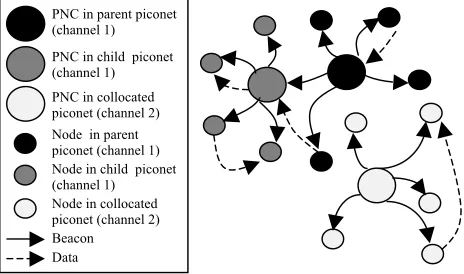
802.15.3a standard for WPANs with UWB radios is a centralised protocol that utilises both time and code division multiple access [14]. Figure 1 shows an 802.15.3a network which consists of several piconets. Each piconet consists of one or more logically associated devices sharing the same channel. The MAC protocol is time-division multiple access within a piconet while collocated piconets operate on different code channels to avoid interfering with one another. Centralised coordination is provided by the piconet coordinator (PNC) which will assigns code channels, enforces QoS requirements, control power saving modes and manages access to the piconet. The role of PNC will be taken by a device within the piconet where any transfer of data is not required to pass through PNC. Interpiconet communications however occur through a gateway node which is a normal node in the parent piconet but a PNC in the child piconet. The child piconet operates on the same channel as the parent and is synchronized to avoid interference with the parent piconet. All communications within the child piconet occur during time slot assigned by the parent piconet.
Fig. 1. Piconets defined in IEEE 802.15.3a
In a distributed MAC protocol, each node makes an independent decision to transmit without any central guidance, thus eliminating central point of failure and central synchronisation. Security is improved since the network cannot be attacked at a specific point. Distributed protocols also can be easily scaled to arbitrarily large networks, especially huge robust networks since these protocols cannot provide strict QoS guarantees. Random access protocols such as ALOHA and its slotted version [15] constitute the main part of distributed MAC protocols. Carrier-sense multiple access (CSMA) based protocols [16] improve on the problem of collision in ALOHA through the mechanism for a node to sense the channel before the transmission to make sure the channel is available and then defer transmission if the channel is busy. To contend with the hidden terminal and exposed terminal problems, handshaking based on request-to-send/clear-to-send (RTS/CTS) is also adopted, and collision resolution can be
PNC in collocated piconet (channel 2) PNC in child piconet (channel 1) PNC in parent piconet (channel 1)
achieved by using back-off and/or persistence mechanisms [16], [17].
The MAC protocols provide the upper layer with a bit pipe in the traditional layered architecture of data networks and are independent of the lower physical layer. The existing solutions typically designed for wireless networks can be directly incorporated into the design of a UWB MAC if the same approach is applied to MAC in UWB [18]. Recent research however has suggested that UWB characteristics should be considered and taken into account in MAC to achieve superior and efficient system implementations. UWB systems exhibit distinctive physical layer characteristics such as the low-power requirement and precise positioning capability, which are different from conventional narrowband or wideband networks [9], thus needing a novel MAC protocol to fully exploit these unique characteristics.
IV. COMPARATIVE STUDY
This section summarized comparisons between UWB and established wireless technologies such as Bluetooth and Wi-Fi especially in terms of power consumption.
Bluetooth, defined in the IEEE 802.15.1 standard is based on a wireless radio system designed for short-range communications. It is intended to replace cables for computer peripherals and mobile devices where the applications are deployed over a wireless personal area network (WPAN). Wi-Fi, on the other hand, serves the needs to wirelessly connect computers and mobile devices to the network and the Internet where the range of these applications is deployed over a wireless local area network (WLAN). Wi-Fi is defined in the IEEE 802.11a/b/g standards. Table I summarizes the main differences among Bluetooth, Wi-Fi and UWB [19].
Bluetooth is intended for portable devices and portable products with limited battery power that needed short-range low data rate communications. Consequently, it offers very low power consumption and measurably will not affect battery life. Wi-Fi on the other hand is designed for a high data rate long-range communications and supports devices with a substantial power supply. On the other hand, UWB will offer the highest data rate when compared to Bluetooth and Wi-Fi, but the connection range is in between the two technologies. In terms of protocol complexity, a comparison is made based on the numbers of primitives and host IEEE 802.15.1 is the most complicated protocol.
TABLE I
COMPARISON OF BLUETOOTH, WI-FI AND UWB PROTOCOLS
Standard Bluetooth Wi-Fi UWB
IEEE spec. 802.15.1 802.11a/b/g 802.15.3a Frequency
basic cell Scatternet ESS Peer-to-peer Maximum
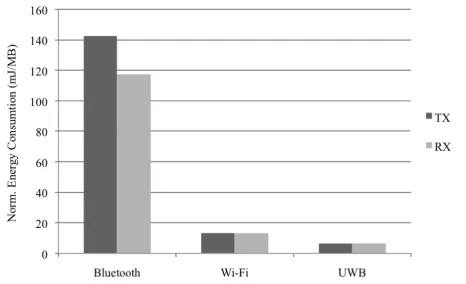
IEEE Spec. 802.15.1 802.11a/b/g 802.15.3 IEEE Spec. Primitives 151 32 77 MAC primitives respectively. Table III summarize the current consumptions of transmit (TX) and receive (RX) conditions for each technology while Figure 2 shows the comparison of the normalised energy consumption.
TABLE III
POWER CONSUMPTION OF EACH CHIPSET FOR EACH PROTOCOL
Standard Bluetooth Wi-Fi UWB
Chipset BlueCore2 CX53111 XS110
VDD (volt) 1.8 3.3 3.3
TX (mW) 102.6 722.7 750.1
RX (mW) 84.6 709.5 750.1
Fig. 2. Normalized energy consumption for each protocol
Obviously, Bluetooth protocols consume less power compared with Wi-Fi and UWB. However, a comparison of normalised energy consumption based on bit rate shows that UWB offers the best efficiency in energy consumption although having a slightly complex protocol (based on 802.15.3b) compared to Wi-Fi. Based on the comparison of protocol complexity and power consumption, there is a possibility that an optimal MAC for UWB with reduced complexity can further decrease the power consumption of UWB devices while achieving higher data rate.
V. REVIEW OF PROPOSED UWB MAC PROTOCOLS
Existing wireless MAC protocols are either not applicable or not optimized for the UWB systems because of the unique characteristics of UWB as discussed in previous sections. Therefore a MAC designed specifically for UWB characteristics is needed. This section will review several MAC protocols that have been proposed for UWB technology.
A. Enhanced WPAN-Based Mac
FCC restrictions on the UWB range mean that most applications for UWB are going to be in the category of either short-range Wireless Personal Area Networks (WPAN) or medium-range Wireless Local Area Network (WLAN). Therefore, IEEE and several other organisations are looking into adapting existing narrowband WPAN MAC or the 802.15.3 standard for use in UWB technology. One such approach has been carried out by the European funded Ultra Wideband Concepts for Ad-hoc Networks (UCAN) project group funded by Information Society Technologies [23]. UCAN adheres to the single band model where UWB is implemented as Impulse Radio (IR) as opposed to Direct Sequence Spread Spectrum (DSSS). In DSSS, the data bit rate is spread into a sequence of chips, and the chip rate is directly related to the bandwidth which is roughly the inverse of the chip rate, while in IR, the bandwidth is decoupled from the chip rate by the introduction of an idle period after transmitting a pulse. The period between two
consecutive pulses is called Pulse Repetition Period (PRP). IR offers higher bandwidth and processing gain compared to DSSS, in addition to lower chip rate resulting in lower complexity.
Adaptations to IEEE 802.15.3 standard were needed because it was originally designed for narrowband 2.4GHz WPAN, and was very likely to need modifications for UWB WPAN especially as the UCAN platform may need to impose some restrictions. UCAN is also taking into account the unique properties of UWB technology not currently addressed in IEEE 802.15.3 that can enhance MAC. MAC architecture in UCAN focuses solely on short and medium range applications as cited above. UCAN also adds ranging and relaying features and is able to cope with asynchronous data transfers and multimedia applications with Quality of Service (QoS). For coexistence of multiple WPANs, UCAN uses time-hopping (TH) code division as against to frequency division multiplexing.
As in the IEEE 802.15.3 standard, the MAC protocol is centrally coordinated using a PNC that is dynamically chosen when a piconet is created. A piconet is a single-hop network consisting of one master and up to seven slaves, and it can be extended to form scatternet by sharing slaves. The PNC handles the main part of the processing power as it synchronises devices and allocates resources. In the case of a PNC disappearing, another station can take on its role as all devices have the same hardware configuration. This is the main advantage over a static centralised management system. However, although the MAC protocol is centralised, the topology can be formed in an ad-hoc manner and communications are in a peer-to-peer mode.
The targeted applications have eliminated collision-based access protocol such as CSMA/CA because voice and video cannot cope with high transmission delays and jitters. Therefore, Time Division Multiple Access (TDMA) is chosen for intra-piconet communications while Time Hopping-Code Division Multiple Access (TH-CDMA) is utilised for inter-piconet communications.
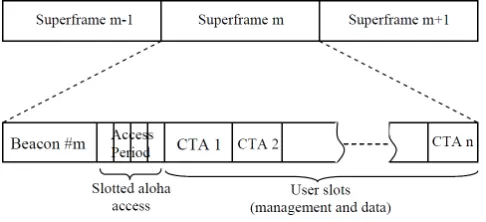
Timing within UCAN piconet is similar to IEEE 802.15.3, where it is based on the superframe divided into three parts: beacon, random access phase, and channel time allocation (CTA) slots, as shown in Figure 3. Theoretically, all durations for the three parts in the superframe are variable. However, for simplicity of implementation in UCAN, the superframe is fixed to 10 ms while the access period is also fixed to about 800 µs. Three types of frame formats are used: • control frames that are used for DEVs to communicate
with the PNC
• data frames that are used in peer-to-peer communication between DEVs
The PNC ensures resource allocation efficiency by dynamically allocating resources when a device wants to relay messages. Priority is given to relaying streams over new streams in order to avoid the half-way blocking problem when devices that need two hops are allocated resources only for the first hop.
For routing, UCAN also defines a routing metric based on the several parameters such as power efficiency, synchronisation overhead, multi-user interference, end-end delay, route quality, and traffic balancing. The routing strategy chooses the path with the minimal cost as computed by the routing metric. The routing algorithm utilises the positioning information based on UWB ranging capability. However it also provides for position-independent routing in the case of a UWB network where such information may not be readily available such as during the initial start-up phase. An on-demand routing protocol similar to the Location Aided Routing (LAR) protocol is chosen since reactive algorithms are proved to be better than proactive algorithms, especially in small ad-hoc networks where reactive protocols adapt better to fast topology changes. Two main modifications were needed to optimize the original protocol and adapt it to the UCAN scenario:
Fig. 3. UCAN superframe structure
The routing protocol uses UWB ranging and positioning information to define a forwarding zone based on source and expected destination position. The original LAR was modified to permit intermediate nodes to forward more than one packet related to the same request. Routing can be made power efficient by selecting an optimized cone-shaped request zone that guarantees route request packets sent during a route discovery procedure are as minimum as possible.
One of the main advantages of the UCAN approach is that it utilizes the localisation properties unique to UWB for ranging, distance measurement, and routing. The piconet approach makes synchronisation relatively easy, and it also offers interoperation with established IEEE WPAN technologies such as Bluetooth since it is based on the same guidelines. However, the piconet approach is suitable only for short-range networks such as WPAN, so its usage is limited and non-scalable to larger networks.
B. Time-Hopping-Based Distributed MAC Protocol
Cuomo et al. [24] discussed a time-hopping-based distributed MAC protocol that was proposed in the WHYLESS project. This project is sponsored by the European Union to examine the potential of UWB for Open Mobile Access Network development.
In this project, UWB waveform is implemented as impulse radio utilizing extremely short pulses between 0.1 to 1.5 nanoseconds, giving rise to a wide spectral occupation in the frequency domain with bandwidth from near DC to a few GHz. The typical pulse, called ‘monocycle’, has a Gaussian spectrum with centre frequency of 1GHz, fractional bandwidth nearly 1 and average power of 1 mW giving rise to µW per MHz with a processing gain greater than 50 dB. The monocycle is normally obtained by using pulse position modulation (PPM). Multiple accesses to the radio resource by several users are established by using time-hopping (TH) codes chosen in a pseudo-random way, and collisions are compensated for by transmitting several impulses for the same bit.
The MAC protocol employed in this project has the following main characteristics:
• allows the development of a wireless network involving a large number of radio nodes controlled by several operators
• offers flexibility in terms of resource utilization and topology definition
• allows for ease of scalability, reconfigurability, and self-organization
• shall co-exist with other radio systems within the defined constraints of a specific wireless area such as power and spectrum occupation
• allows for support of quality of service (QoS) in the internet
A distributed MAC model is used although this introduces complexity in controlling the radio resource. The network is composed of TermiNodes (TN), which are small personal devices that perform both as node and terminal. A TN that acts as a terminal will operate with the typical behavior of an end-system that initializes a communication with another end-system, regulates the emitted traffic flows, transmits and receives data, and controls the radio access. On the other hand, the main task for a TN that acts as a node is forwarding the incoming data to an outgoing link.
typically by each TN. This domain exists for each TN, centered on the TN itself but also includes the area where transmission of TN has an impact on the transmission/reception of other TNs. Therefore, in each MAC domain, the multiple access shall operate in order to share the capacity among the TNs belonging to the area.
To fully utilise the flexibility offered by the UWB, all MAC and networking functions are distributed in the TNs that control their own MAC domain. A packet-switching operation mode that supports both the typical “best effort” IP traffic and some classes of traffic with QoS guarantees is proposed where the MAC entity manages radio resource by dividing it into two parts, Reserved Bandwidth (RB) and Dynamic Bandwidth (DB).
The first part, RB is negotiated with the Network layer and once allocated, it will remain valid for the entire session. RB can be adjusted only according to an explicit QoS request from the Network layer per session. This MAC class is used to map the QoS classes of the IP layer and has the added overhead of reserving this bandwidth, even though it may not be utilized. The second part, DB can dynamically vary depending directly on the MAC. It can be reconfigurable by the MAC on a per-packet duration based on two parameters, the number of DB packets waiting for a transmission, and the interference level in the MAC domain. This MAC class is used to map the best-effort traffic in the IP layer.
There are two types of logical channels, the signaling and traffic channels. The signaling channels are supported by the Physical Common Control Channels (PCCC) or Physical Dedicated Control Channels (PDCC). PCCCs are usually accessed by all the TNs in a MAC domain set of TH codes and mainly used for the set-up procedures while PDCCs support dedicated control information relevant for an active data communication between TNs. On the other hand, the traffic channels, supported by the Physical Common Control Channels (PDTC), are obtained by utilizing a set of appropriately configured TH codes.
The proposed protocol architectural model contains several functional entities that belong to Radio Resource Control (RRC), RLC/MAC layer, or physical layer. RRC optimizes multiple access by varying parameters like family of time-hopping codes, number of time-hopping codes assigned to a user, number of transmitted pulses per bit, distance between two pulses, period of time-hopping code, impulse shape and duration, time shift associated with transmission of 0 or 1, and the transmission rate. The main functional entity in RRC is RRC Coordinator, which handles the radio capacity configurability and is able to determine the available capacity in the system. It performs radio resource control by differentiating the RB and DB service classes. RRC Coordinator also interacts with the RLC Control, Capacity Manager, and Signalling Manager in order
to perform a resource handling that is adaptive to the amount of traffic for both the DB and retransmission buffers. RRC has an interface to the Physical Layer through the Multiple Access Manager by which it controls the UWB parameters selection and it receives some physical measurements.
The RLC/MAC layer is composed of three main functional entities, the RLC entities, MAC-traffic server and MAC-signaling server. The RLC entities implement fragmentation/defragmentation function and the ARQ procedures required by RLC Control. They also monitor retransmission buffers and signal the occupancy status to RLC Control. The MAC-traffic server serves the RB and DB service classes with the capacity value assigned by the Capacity Manager and adopts a priority policy between those classes.
The MAC-signalling server buffers signalling packets, implements ARQ mechanism for them, and forwards them to the component of the physical layer depending upon whether a common or dedicated signaling channel to be used.
The key benefit of this approach is that it is a distributed protocol and thus can be used in different topological configurations. The MAC protocol is power efficient because it selects optimal power level and transmission parameters. Thus, the network can have a higher capacity. However, this issue makes it complex to implement and has a high network overhead in terms of synchronization of nodes. This approach also does not take full advantage of the UWB technology like localization and low probability of detection and jamming.
C. A Proactive and Adaptive UWB MAC Protocol
Raja Jurdak et al. [25] proposed a proactive adaptive protocol known as Ultra Wideband MAC (U-MAC) in which nodes periodically declare their current state, so that neighbors can proactively assign power and rate values for new links locally in order to optimize global network performance. The protocol main unique contributions are:
• Minimizing control message overhead by introducing adaptive periods for hello messages in UWB networks. • Fair access to the medium among nodes in UWB
networks regardless of the distance
• Better network efficiency as compared to a reactive protocol regarding control overhead, link setup latency, network throughput and adaptability
• The protocol can work in centralized as well as decentralized mode
reaches a specified minimum value based on the level of instability. A transmission of hello messages advertising a new state to all neighbor nodes will be triggered if a change happens in an otherwise stable node. The node can determine the interference levels based on the state information received by a node from its neighbors, and figure out the power and rate that it can permit for a new link or adjust the power and rate of existing links for best effort traffic. A burst of hello messages may occur if the addition of a new link causes state changes in a number of nodes. To avoid the burst and hence prevent further interference, hello messages on state changes are transmitted only after a random backoff time. Hello messages can also be used by nodes to determine the distance of the neighbor from which it received the message by examining the received signal strength. By applying the appropriate propagation model, path loss to that neighbor can then be computed based on the current distance information.
Among the important information contained in hello messages are Mean Time Between Failures (MTBF), dynamic bandwidth (DB) links, Maximum Sustainable Interference (MSI), and aggregate power level of all active links. MTBF is a measure of how reliably a node can communicate while DB links indicates the number of active DB links for the node. MSI information contains information about the upper bound of the tolerable interference at a neighbouring node. Every node also broadcasts the aggregate power level of all active links in its range that provides neighboring nodes with recent interference levels. This information is very useful for selecting rates and power values locally.
U-MAC introduces a novel mechanism to control the radius around a receiver within so that all nodes get fair access to the receiver. To support multi-user media access, time-hopping (TH) codes with pulse position modulation are used where one code is reserved for the control channel while another code is used for the hello messages. A node will switch to centralized mode if a node hears hello messages from an access point (AP).
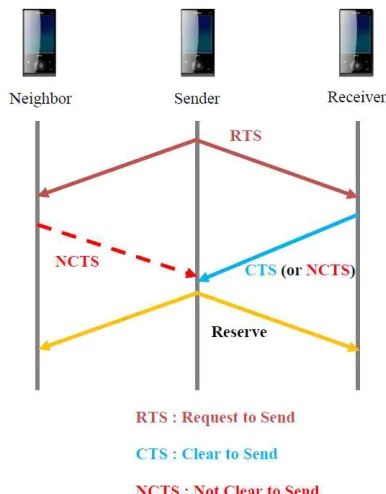
Figure 4 illustrates the exchange of a control message in U-MAC. To establish a new link, a link request is sent by sender S in the form of a Request To Send (RTS) message containing the rate and power values to the receiver R. On receiving the RTS, R and all other nodes neighbouring to S check whether the requested link is acceptable based on the interference and the Signal to Noise Ratio (SNR) values. If so, R informs S with a Clear to Send (CTS) control message. Other neighbours of S avoid from sending any replies if the link parameters are acceptable. If R or any other neighbour of S does not agree with the parameters of the new link, then that node will notify S with a Not Clear to Send (NCTS) message to ask for S to reduce either the transmit power or rate or both. After all replies are collected by S, it declares
the duration and parameters of the new link, which may have changed according to neighbour replies, in a Reserve message, and the new link will be immediately set up. On receiving the Reserve message, the receiver synchronized with the TH code of the sender. All nodes that hear the reserve message will update their interference levels, and if the update is significant, than the node will transmit a hello message after the link setup is completed.
Fig. 4. Exchange of a control message in U-MAC
As a summary, U-MAC optimizes both transmission power and rates where it utilizes the ranging capability of UWB to calculate the path loss based on distances and to determine the optimal transmit power. Control overhead adapts to network stability because the periodicity of the hello messages is adaptive. U-MAC also addresses QoS and fairness issues. According to the simulations that have been done, this protocol performs better than reactive approaches in terms of link set-up latency, network throughput, and adaptability to high network loads. However, the simulations and design are done only for a single-hop case, although the authors mention that the scheme can also be generalized to multi-hop. On the other hand, U-MAC still does not address security and how to use UWB to facilitate it.
D. MAC Protocol for Low Power Mobile Ad-Hoc UWB
Networks
rate by allowing interfering sources to transmit simultaneously if they are outside the ‘exclusion’ region of a destination, and this is done by dynamically adapting the channel codes depending on the interference. The exclusion region is a circular area around the destination within which temporal exclusion between two sources results in a better throughput than resolving the interference caused by simultaneous transmission. A ‘private’ MAC protocol that involves nodes trying to transmit to the same destination simultaneously is used to deal with the interference within the exclusion region. Using this technique, it is claimed that the achievable bit rate for the specified power is in the range of 1-18Mbps.
The UWB signal is represented by pulse position modulation (PPM) where the sources transmit at full power and adapt the channel code, allowing a common destination to distinguish between interfering signals. The channel code selected also changes the bit rate of the transmission, allowing it to be varied based on the interference by varying the channel code. The proposed protocol optimizes the UWB MAC by allowing transmissions at full power, permitting simultaneous interfering transmissions outside the exclusion region and using temporal exclusion with the exclusion region.
The MAC protocol is designed to attain maximum flow control within the limitation of very low power transmission. This is accomplished by the following approaches:
• applying an interference mitigation procedure at the demodulator
• implementing dynamic channel coding and incremental redundancy
• private MAC within the exclusion region
For the first approach, a channel encoder is used before the modulator that selects an encoding rate and encodes an incoming block of data blocks. The PPM form is then converted by the modulator for transmission over the physical medium. In order to achieve data rates within a specified range, Rate Compatible Punctured Convolutional Codes (RCPC) are used to provide variable encoding. A source transmits one pulse per frame, and a time-hopping sequence is then used to establish which chip in each frame to transmit the pulse in. Note that increasing the pulse repetition period (PRP) not only decreases the bit rate but also decreases multiple-user interference. Interference mitigation has to be performed within the exclusion region, and this is done by executing an erasure at the symbol level on a chip if the signal strength detected is higher than a specified value.
The second approach is by using dynamic channel coding and incremental redundancy. Channel coding is constantly adapted to the highest attainable rate code that allows precise decoding of the packet at the destination. In case of deterioration of channel conditions, a safety margin is used
to mitigate or reduce the probability of retransmissions. If conditions deteriorate significantly and decoding fails despite the safety margin, then additional information is transmitted. This is done until the packet can be decoded or no more redundant information is available and the transmission fails.
For the third approach, a private MAC is needed to resolve contention between multiple sources and a single destination and this is done by using a combination of receiver-based and invitation-dependent selection of time-hopping sequences (THS).
It is claimed that the main advantage of this approach is that the MAC adapts to the varying channel, therefore supporting medium mobility levels and ad-hoc mode. No power control is used, reducing the complexity of the design. There is also no separate control channel used as is done in U-MAC. This protocol takes full advantage of UWB’s interference resistance property to reduce the exclusion region to a minimum, thus increasing the channel capacity. However, this design does not include routing, flow control, or multiple service classes. The requirement for large PRPs also restricted this protocol from achieving high rates of the other protocols. Resynchronization is also assumed for every packet, and this will result in a high overhead. It can be improved by having synchronization only for a session or resynchronization in case of channel loss. There is also concern for latency issues because since broadcast THS is different, a receiver has to synchronize with both broadcast THS and data THS.
VI.CONCLUSION AND FUTURE WORK
In this paper, we have presented an overview of UWB and the proposed protocols for UWB. MAC plays a very significant role in UWB networks to ensure efficient communications, and it is essential to coordinate channel access among devices. The distinctive UWB characteristics present great challenges and opportunities in efficient UWB MAC design and this is shown in the proposed protocols that have been reviewed.
network throughput can be achieved compared to traditional approaches
As for future work, we will explore the possibility of designing an optimal medium access control (MAC) layer for high-data-rate UWB transmission systems that transmit very little power especially in application to mobile devices. The design should not only take advantage of the localisation properties of UWB as shown in UCAN and U-MAC, but also utilise the imperceptibility property of UWB. The implementation of dynamic channel coding will also be considered as this has been proven to enhance and improve the network throughput significantly. We also intend to investigate one area that is very important to our research which is the effect of mobility in the MAC protocol. UWB’s ranging capability can be used to provide positional reliability by keeping track of mobile nodes. Therefore, it will be interesting to explore the techniques that implementing this ranging capability and the impact of mobility on the protocols behaviour.
ACKNOWLEDGEMENT
The authors would like to thanks Government of Malaysia and Universiti Teknikal Malaysia Melaka (UTeM) for funding the research through a PhD scholarship.
REFERENCES
[1] W. P. Siriwongpairat and K. J. R. Liu, Ultra-Wideband Communications Systems, 1st ed., New Jersey: John Wiley and Sons, 2007.
[2] R. C. Qiu, H. Liu, and X. Shen, “Ultra-wideband for multiple-access communications,” IEEE Communications Magazine, vol. 43, no. 2, pp. 80-87, Feb. 2005.
[3] M. Z. Win and R. A. Scholtz, "Ultra-wide bandwidth time-hopping spread-spectrum impulse radio for wireless multiple-access communications," Communications, IEEE Transactions on, vol. 48, pp. 679-689, 2000.
[4] L. Yang and G. B. Giannakis, Ültra-wideband communications: An idea whose time has come,” IEEE Signal Processing Magazine, vol. 21, no. 6, pp. 26-54, Nov. 2004.
[5] W. Zhuang, X. Shen, and Q. Bi, “Ultra-wideband wireless communications,” Wireless Communications on Mobile Computing, vol. 3, no. 6, pp.663-685, Sep. 2003.
[6] A. Batra, J. Balakrishnan, G. R. Aiello, J. R. Foerster, and A. Dabak, “Design of a multiband OFDM system for realistic UWB channel environment,” IEEE Transactions on Microwave Techniques, vol. 52, no. 9, pp. 2123-2138, Sep. 2004.
[7] E. Saberinia and A. H. Tewfik, “Pulse and non-pulsed OFDM ultra wideband wireless personal area networks,” in Proceeding of IEEE UWBST’03, Nov. 2003, pp. 275-279.
[8] S. Roy, J. R. Foerster, V. S. Somayazulu, and D. G. Leeper, “Ultra-wideband radio design: The promise of high-speed, short range wireless connectivity,” Proceeding of IEEE, vol. 92, no. 2, pp. 295-311, Feb. 2004.
[9] X. Shen, W. Zhuang, H. Jiang, and J. Cai, “Medium access control in ultra-wideband wireless networks,” IEEE Transactions on Vehicular Technology, vol. 54, no. 5, pp. 1663-1677, Sep. 2005.
[10] Standard ECMA-368: High Rate Ultra Wideband PHY and MAC Standard, 1st Edition, Dec. 2005.
[11] IEEE Std 802.15.3TM-2003: Wireless Medium Access Control (MAC) and Physical Layer (PHY) Specifications for High Rate Wireless Personal Area Networks (WPANs), Sep. 2003.
[12] “Multiband OFDM Alliance,” [Online]. Available: http://www.multibandofdm.org/. [Accessed: September 9, 2008] [13] C. W. Cheol, N. J. August, and H. D. Sam, "Signaling and multiple
access techniques for ultra wideband 4G wireless communication systems," Wireless Communications, IEEE, vol. 12, pp. 46-55, 2005. [14] "Draft Standard for Telecommunications and Information Exchange
Between Systems -- LAN/MAN Specific Requirements -- Part 15.3: Wireless Medium Access Control (MAC) and Physical Layer (PHY) Specifications for High Rate Wireless Personal Area Networks (WPAN) Replaced by IEEE 802.15.3-2003," IEEE Std P802.15.3/D17, 2003.
[15] N. Abramson, "Multiple access in wireless digital networks," Proceedings of the IEEE, vol. 82, pp. 1360-1370, 1994.
[16] L. Kleinrock and F. Tobagi, "Packet Switching in Radio Channels: Part I--Carrier Sense Multiple-Access Modes and Their Throughput-Delay Characteristics," Communications, IEEE Transactions on Communication, vol. 23, pp. 1400-1416, 1975.
[17] T. Nandagopal, T. E. Kim, X. Gao, and V. Barghavan, “Achieving MAC layer fairness in wireless packet networks,” in Proceeding of ACM MOBICOM’00, 2000, pp. 87-98.
[18] L. De Nardis and M. G. Di Benedetto, “Medium access control design for UWB communication systems: Review and trends,” J. Communication Networks, vol. 5, no. 3, pp. 240-247, Sep. 2003. [19] L. Jin-Shyan, S. Yu-Wei, and S. Chung-Chou, "A Comparative Study
of Wireless Protocols: Bluetooth, UWB, ZigBee, and Wi-Fi," in Industrial Electronics Society, 2007. IECON 2007. 33rd Annual Conference of the IEEE, 2007, pp. 46-51.
[20] Conexant, Single-Chip WLAN Radio CX53111. Newport Beach, CA, 2006.
[21] Freescale, XS110 UWB Solution for Media-Rich Wireless Applications. San Diego, CA, Dec. 2004.
[22] M. Yao, F. Chin, B. Kannan, and S. A. P. S. Pasupathy, "Acquisition performance of an ultra wide-band communications system over a multiple-access fading channel," in Ultra Wideband Systems and Technologies, 2002. Digest of Papers. 2002 IEEE Conference on, 2002, pp. 99-103.
[23] F. Legrand, I. Bucaille, S. Hethuin, L. De Nardis, G. Gaincola, M. Di Benedetto, L. Blazevic, and P. Rouzet, “U.C.A.N.’s Ultra Wide Band System: MAC and Routing Protocols,” in International Workshop on Ultra Wideband Systems, June 2003.
[24] F. Cuomo and C. Martello, “MAC principles for an Ultra wide Band wireless access,” in Proceedings of IEEE GLOBECOM 2001, November 2001.
[25] R. Jurdak, P. Baldi, and C. V. Lopes, “U-MAC: A Proactive and Adaptive UWB Medium Access Control Protocol,” in Special Issue in UWB Communications, 2005.