• Tidak ada hasil yang ditemukan

Antibacterial Activity of Ethanolic Extract of Leaves and Bulb of Allium sativum Linn. against Shigella sonnei

N/A
N/A
Protected

Academic year: 2017

Membagikan "Antibacterial Activity of Ethanolic Extract of Leaves and Bulb of Allium sativum Linn. against Shigella sonnei"

Copied!
6
0
0

Teks penuh

(1)

The 2nd International Conference on Science, Technology, and Humanity ISSN: 2477-3328

Antibacterial Activity of Ethanolic Extract of Leaves

and Bulb of

Allium sativum

Linn. against

Shigella

sonnei

Dewi Sacharina, Safitri Nur Anggraeni*, Suci Miranda Asmitha, Deandra Nobela, Ika Trisharyanti D.K.

Universitas Muhammadiyah Surakarta, Faculty of Pharmacy Jl. A.Yani Tromol Pos 1 Pabelan Kartasura 57162

*[email protected]

Abstract

Garlic (Allium sativum Linn.) is widely known by people as herb, besides having antibacterial property. Alisin is one of antibacterial active substance contained in garlic. The purpose of this study was to test the antibacterial activity of ethanol extracts of garlic leaves and bulbs against Shigella sonnei or dysentery bacteria. The determination of antibacterial activity was conducted by using disk diffusion and dilution methods. Antibacterial test results which had the best inhibitory activities against Shigella sonnei were shown by the extracts of 8% garlic bulbs and 4% garlic leaves with inhibition zone respectively 16mm and 19mm. The result showed the MIC of garlic bulbs extract was 0.5% and garlic leaves extract was 0.25%. The smallest concentration which could kill (MBC) Shigella sonnei was garlic bulbs extract 1% and garlic leaves extract 0.5%. This study showed that the ethanol extracts of garlic leaves and bulbs had antibacterial activity against Shigella sonnei.

Keywords: antibacterial activity, Allium sativum, Shigella sonnei, MIC, MBC

1.

Introduction

Garlic is often known by the public as a spice in the kitchen, but it also has many properties that make it as a useful raw material for making herbal medicines. Garlic is known to help maintain normal cholesterol levels, but it has antibacterial activity against several types of bacteria. Garlic is shaped like a top, has strong-smell, is white, from familia Alliaceae, and its Latin name is Allium sativum Linn. Garlic contains volatile oil, diallyl sulfide, aliin, alisin, alinase enzymes, saponins, flavonoids, polyphenols, vitamins A, B, and C (Indonesia, 1995).

One of the active substance contained in garlic that functions as an antimicrobial in addition to the essential oil is alisin. Alisin can effectively kill microbes, such as bacteria causing flu infection, gastroenteritis or fever. Alisin could kill gram-positive and gram-negative bacteria (Syamsiah, 2003). The antibacterial effect of garlic is caused due to the presence of compounds such as alisin tiosulfinat; when alisin diallyl disulfide is reduced, the antibacterial activity will increase. Alisin inhibits the growth of bacteria by directly inhibiting synthesis of RNA. Even though the synthesis of DNA and protein synthesis is also inhibited, the synthesis of RNA are the prime targets of alisin (Durairaj, S., Srinivasan, S., and Lakshmanaperumalsamy, 2010).

(2)

The 2nd International Conference on Science, Technology, and Humanity ISSN: 2477-3328

caused by Shigella sp. exacerbated by the emergence of resistant Shigella sp. to some antibiotics like ampisillin, tetracycline, trimethoprim and sulfamethoxazole. Based on the above review, research needs to be done to test the potential of ethanol extract of leaves and bulbs of garlic as an antibacterial herbal medicine against Shigella sonnei.

2.

Materials and Methods

2.1 Tools

The research utilized rotary evaporator, water bath, petri dishes, test tubes, glass spreader, micropipette, incubators, and chamber.

2.2 Ingredients

The ingredients of the research were garlic, leeks, 96% ethanol, the culture of Shigella sonnei, BHI, MH (Mueller Hinton), blank disk, distilled water, DMSO, silica gel GF254 plate, ethyl acetate, and methanol.

2.3 Making Ethanol Leaf Extract and Garlic Bulbs

Maceration was done by weighing as much as 1 kg of garlic bulbs that had been peeled and cleaned and then crushed, and put in a vessel. Ninety-six percent of ethanol was added as much as 7.5 liters (1 part materials using 7.5 parts solvent), allowed to stand for 5 days while stirring often (Departemen Kesehatan RI, 1979). Maserat was obtained by filtering the mixture by using a Buchner funnel to separate the pulp, then evaporated. The evaporated mixture was heated over a water bath to obtain a thick extract of garlic bulbs. The maceration of leeks was conducted by weighing 1 kg of leeks that had been dried, then crushed and put in a vessel. The next step was similar to the steps of making the bulb of garlic extract.

2.4 Antibacterial Activity Test (Diffusion method)

MH Media inoculated with the bacteria Shigella sonnei 108 CFU/mL then the disk that had been added by each concentration of the 10 mL DMSO extract of the leaves and bulbs of garlic was placed on the media. It was incubated for 24 hours at 37°C. Furthermore, the researchers observed the presence or absence of inhibition zone in the disk. The zone of inhibition was measured by using calipers.

2.5 Antibacterial Activity Test (Dilution Method)

(3)

The 2nd International Conference on Science, Technology, and Humanity ISSN: 2477-3328

2.6 TLC test

Ethanol extract of bulbs of garlic was dissolved in methanol, and then spotted on a silica TLC plate and inserted into the chamber that was already saturated with mobile phase of ethyl acetate: methanol (with ratio 1:1).

3.

Result and Discussion

Garlic bulbs were tested by TLC to determine the content of alisin. Elution that was done by using a mobile phase of ethyl acetate: methanol (with ratio 1:1) could not separate the active components of the substances in garlic. The results of TLC showed that there was only one spot that did not split. It could be seen in Figure 1.

Figure 1. Results of TLC ethanolic extract of garlic bulbs

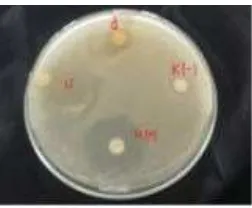
Antibacterial activity test by disk diffusion method obtained inhibitory zone diameters. Ethanol extract of each leaf and bulb of garlic made a series of concentration dissolved in dimethyl sulfoxide (DMSO). The diameter of inhibition zone with the concentration of ethanol extract in 40 mg/mL of leaves and ethanol extract in 80 mg/mL of garlic bulbs against Shigella sonnei were 19 ± 1.0 mm and 16 ± 2.1 mm (Figure 2). The results of inhibition zone diameter could be seen in Table 1 and the diameter of inhibition zone of combinations of the ethanol extract of the leaves and bulbs of garlic could be seen in Table 2.

Figure 2. The diameter of inhibition zone ethanol extract of the leaves and bulbs of garlic against

(4)

The 2nd International Conference on Science, Technology, and Humanity ISSN: 2477-3328

Table 1. Inhibition zone diameter (mm) of ethanol extract of the leaves and bulbs of garlic (mg/mL) against Shigella sonnei

Table 2. Diameter of inhibition zone of combinations of the ethanol extract of the leaves and bulbs of garlic

Ratio ethanol extract of garlic bulbs:garlic leaves

Extract concentration (% w/v) Diameter of inhibition zone

(mm) Bulbs of garlic Leaves of garlic

1:1 2 2 11±0.5 mm

1:2 1 2 12±1.5 mm

2:1 2 1 13±0.5 mm

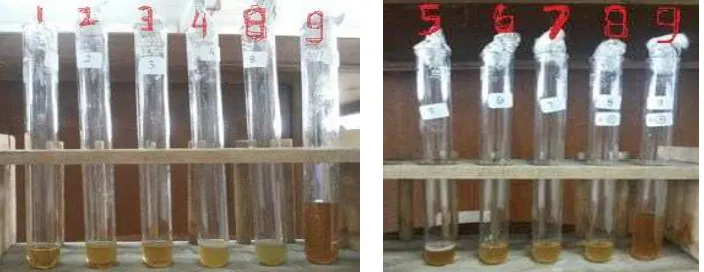
The ethanol extract bulb of garlic and leeks with a ratio of 2:1 had the greatest inhibition zone, and then the antibacterial activity was tested by using the dilution method. The results of the MIC using dilution method were 0.5% ethanol extract of garlic bulbs and 0.25% ethanol extract of garlic leaves, which was shown in the tube 3 (figure 3). The MIC results obtained MBC, which was then calculated from the ethanol extract of garlic bulbs and ethanol extract of garlic leaves against Shigella sonnei, respectively by 1% and 0.5% obtained from the MBC tube 2 (Figure 4).

(5)

The 2nd International Conference on Science, Technology, and Humanity ISSN: 2477-3328

Figure 4. Results MBC ratio of the ethanol extract of garlic bulbs and ethanol extract of garlic leaves (2:1)

4.

Conclusion

The research findings showed that ethanolic extract of the leaves and bulbs of garlic (Allium sativum Linn.) had antibacterial activity against Shigella sonnei.

Acknowlegment

Authors were grateful to University of Muhammadiyah Surakarta that had been the facilitator of this study as well as to the Ministry of Research, Technology and Higher Education of the Republic of Indonesia that had been making grants so that it could carry out many useful researches.

References

Ankri, Serge and Mirelman D., 1999, Antimicrobial Properties of Allicin From Garlic,

Departemen of Biological Chemistry

Bakht, J., Tayyab, M., Ali, H., Islam, A., and Shafi M., 2011, Effect of different solvent extracted sample of Allium sativum (Linn) on bacteria and fungi, African Journal Of Biotechnology, 10 (31), 5910–5915.

Departemen Kesehatan RI, 1979, Farmakope Indonesia, III., Indonesia.

Durairaj, S., Srinivasan, S., and Lakshmanaperumalsamy P., 2010, In vitro Antibacterial Activity and Stability of Garlic Extract at Different pH and Temperature, Electronic Journal Of Biologi, 6 (4), 92–91.

Gangadhar, M., Shraddha, K and Ganesh M., 2012, Antimicrobial screening of Garlic (Allium sativum) extracts and their effect on Glucoamylase activity in-vitro, Journal of Applied Pharmaceutical Science, 2 (1), 106–108.

Gould, D and Brooker C., 2003, Mikrobiologi Terapan untuk Perawat, 252, Penerbit Buku Kedokteran EGC, Jakarta.

Hilman, Yusdar, Hidayat, Achmat. and S., 1997, Budidaya Bawang Putih di Dataran Tinggi, Balai Penelitian Tanaman Sayuran Pusat penelitian Dan Pengembangan Hortikultura, Bandung.

Houshmand B. M.F. and D.O., 2013, Antibacterial Effect Of Different Concentrations Of Garlic (Allium Sativum) Extract on Dental Plaque Bacteria, Indian Journal Of Dental Research, 24, 71–75.

(6)

The 2nd International Conference on Science, Technology, and Humanity ISSN: 2477-3328

Pharmaceutical Research and Opinion

Pratiwi T., 2008, Mikrobiologi Farmasi, Erlangga, Jakarta.

Qu F., Bao C., Chen S., Cui E., Guo T., Wang H., Zhang J., Wang H. T.Y. and M.Y., 2012, Genotypes and antimicrobial profiles of Shigella sonnei isolates from diarrheal patients circulating in Beijing between 2002 and 2007, Diagnostic Microbiology and Infectious Disease, 74 (2), 166–170.

Schroll, C., Barken, K. B., Krogfelt, K. A., & Struve C., 2010, Role of Type 1 and Type 3 Fimbriae in Klebsiella pneumoniae Biofilm Formation, accessed on 8 September 2015, 1471–2180.

Gambar

Figure 2. The diameter of inhibition zone ethanol extract of the leaves and bulbs of garlic against  Shigella sonnei
Table 1. Inhibition zone diameter (mm) of ethanol extract of the leaves and bulbs of garlic (mg/mL) against Shigella sonnei

Referensi

Dokumen terkait

As conclusion, the Garlic ( Allium sativum ) extracts had bactericide effects, especially on Staphylococcus aureus , and Streptococcus pyogenes ; the is positive correlation

Key words: breast cancer, colon cancer, cytotoxic, ethanolic extract of Arcangelisia flava

Kadar air ekstrak kering (ekstrak air) bawang putih lanang ( Allium sativum Linn) yang diperoleh sebesar 2 %, nilai ini masih memenuhi persyaratan kadar air untuk

This study aimed to determine the potential antibacterial effect of Averrhoa bilimbi (A. bilimbi) leaves ethanol extract against Salmonella typhi (S.. Methods: This was

No significantly different in number of new blood vessels was observed between the garlic ethanolic extract and positive control groups compared to negative control group both on D-

Bila dibandingkan dengan kelompok kontrol, kelompok jus bawang putih (Allium sativum Linn) memiliki penurunan jumlah leukosit yang cukup bermakna.Sehingga kesimpulannya

ANTIDIABETIC ACTIVITY OF ETHANOLIC EXTRACT OF Kalanchoe pinnata LEAVES IN ALLOXAN INDUCED HYPERGLYCAEMIC RATS Tri Yuliani, Indah D.. Dewijanti, Sofna

Kematian sel fibroblas gingiva manusia tersebut kemungkinan disebabkan oleh kandungan pada bahan yang berpotensi menyebabkan sitotoksik yaitu, allicin pada ekstrak Allium sativum Linn.,