REPORT
SHANK1
Deletions in Males
with Autism Spectrum Disorder
Daisuke Sato,1 Anath C. Lionel,1,2 Claire S. Leblond,3,4,5 Aparna Prasad,1 Dalila Pinto,1 Susan Walker,1 Irene O’Connor,6 Carolyn Russell,6 Irene E. Drmic,7 Fadi F. Hamdan,8 Jacques L. Michaud,8
Volker Endris,9 Ralph Roeth,9 Richard Delorme,3,4,5,10 Guillaume Huguet,3,4,5 Marion Leboyer,11,12 Maria Rastam,13 Christopher Gillberg,14,15 Mark Lathrop,16 Dimitri J. Stavropoulos,17
Evdokia Anagnostou,18 Rosanna Weksberg,19 Eric Fombonne,20 Lonnie Zwaigenbaum,21
Bridget A. Fernandez,22 Wendy Roberts,7,18 Gudrun A. Rappold,9 Christian R. Marshall,1,2 Thomas Bourgeron,3,4,5 Peter Szatmari,6,* and Stephen W. Scherer1,2,*
Recent studies have highlighted the involvement of rare (<1% frequency) copy-number variations and point mutations in the genetic etiology of autism spectrum disorder (ASD); these variants particularly affect genes involved in the neuronal synaptic complex. The SHANK gene family consists of three members (SHANK1,SHANK2, andSHANK3), which encode scaffolding proteins required for the
proper formation and function of neuronal synapses. AlthoughSHANK2andSHANK3mutations have been implicated in ASD and
intellectual disability, the involvement ofSHANK1is unknown. Here, we assess microarray data from 1,158 Canadian and 456 European
individuals with ASD to discover microdeletions at theSHANK1locus on chromosome 19. We identify a hemizygousSHANK1deletion that segregates in a four-generation family in which male carriers—but not female carriers—have ASD with higher functioning. A de novoSHANK1deletion was also detected in an unrelated male individual with ASD with higher functioning, and no equivalentSHANK1
mutations were found in>15,000 controls (p¼0.009). The discovery of apparent reduced penetrance of ASD in females bearing in-herited autosomalSHANK1deletions provides a possible contributory model for the male gender bias in autism. The data are also infor-mative for clinical-genetics interpretations of both inherited and sporadic forms of ASD involvingSHANK1.
Autism is the prototypic form of a group of conditions, also known as ‘‘autism spectrum disorders’’ (ASDs [MIM 209850]), that share common characteristics (impairments in socialization and communication and a pattern of repet-itive interests and behaviors) but differ in developmental course, symptom pattern, and cognitive and language abilities. Other ASD subtypes include Asperger disorder (which has less severe language and cognitive deficits) and pervasive developmental disorder not otherwise spec-ified (PDD-NOS; subthreshold symptoms and/or later onset). Subclinical forms of ASD are often characterized as the broader autism phenotype (BAP).1Twin and family studies provide evidence of the importance of complex genetic factors in the development of both sporadic and inherited forms of idiopathic autism. An enigma in ASD is the 4:1 male to female gender bias, which might rise to 11:1 when Asperger disorder is considered.2
Rare copy-number variations (CNVs) and sequence-level mutations have been identified as etiologic factors in ASD.3–5 De novo CNVs are observed in 5%–10% of ASD cases.6–10 A relative enrichment of CNVs disrupting synaptic complex genes11,12 is observed, and NLGN3 (MIM 300336), NLGN4 (MIM 300427),13 NRXN1 (MIM 600565),14 NRXN3 (MIM 600567),15 SHANK2 (MIM 603290),9,16,17 and SHANK3 (MIM 606230)18–20 have been identified as highly penetrant susceptibility loci for ASD and intellectual disability (ID). The SHANK gene family,21,22which also includes SHANK1 (MIM 604999), encodes scaffolding proteins that localize to postsynaptic sites of excitatory synapses in the brain.
We describe seven individuals with deletions involving SHANK1. Four male cases have ASD with higher
function-ing or the BAP and are from a multigenerational family (see family 1 inFigure 1) that carries inherited gene deletions,
1The Centre for Applied Genomics and Program in Genetics and Genome Biology, The Hospital for Sick Children, Toronto, ON M5G 1L7, Canada;
2Department of Molecular Genetics and McLaughlin Centre, University of Toronto, Toronto, ON M5G 1L7, Canada;3Human Genetics and Cognitive
Func-tions, Institut Pasteur, 75015 Paris, France;4University Paris Diderot, Sorbonne Paris Cite´, Human Genetics and Cognitive Functions, 75013 Paris, France; 5URA 2182 ‘‘Genes, Synapses, and Cognition,’’ Centre National de la Recherche Scientifique, Institut Pasteur, 75015 Paris, France;6Offord Centre for Child
Studies, Department of Psychiatry and Behavioural Neurosciences, McMaster University, Hamilton, ON L8S 4K1, Canada;7Autism Research Unit, The Hospital for Sick Children, Toronto, ON M5G 1X8, Canada;8Centre of Excellence in Neuroscience of the Universite´ de Montre´al, Sainte-Justine Hospital Research Centre, Montreal, QC H2L 2W5, Canada;9Department of Human Molecular Genetics, Heidelberg University, 69120 Heidelberg, Germany; 10Department of Child and Adolescent Psychiatry, Robert Debre´ Hospital, Assistance Publique-Hoˆpitaux de Paris, 75019 Paris, France;11Psychiatry Genetic
Team, Institut National de la Sante´ et de la Recherche Me´dicale U955, 94010 Creteil, France;12Fondation FondaMental, 94000, Creteil, France;13 Depart-ment of Clinical Sciences in Lund, Lund University, SE-221 00 Lund, Sweden;14Gillberg Neuropsychiatry Centre, University of Gothenburg, SE- 411 19 Go¨teborg, Sweden;15Institute of Child Health, University College London, London WC1N 1EH, UK;16Centre National de Ge´notypage, 91057 Evry, France; 17Department of Pediatric Laboratory Medicine, The Hospital for Sick Children, Toronto, ON M5G 1L7. Canada;18Bloorview Research Institute, University
of Toronto, Toronto, ON M4G 1R8, Canada;19Program in Genetics and Genome Biology and Division of Clinical and Metabolic Genetics, The Hospital for Sick Children, Toronto, ON M5G 1X8, Canada;20Department of Psychiatry, Montreal Children’s Hospital and McGill University, Montreal, QC H3Z 1P2, Canada;21Department of Pediatrics, University of Alberta, Edmonton, AB T5G 0B7, Canada;22Disciplines of Genetics and Medicine, Memorial University of Newfoundland, St. John’s, NL A1B 3V6, Canada
*Correspondence:[email protected](S.W.S.),[email protected](P.S.)
an unrelated fifth ASD male case has a de novo deletion at the same locus (see family 2 inFigure S1, available online), and two female individuals from family 1 (Figure 1) have theSHANK1deletion but no ASD or BAP.
The ASD dataset examined in this study was composed of 1,158 unrelated Canadian individuals (898 males and 260 females) and 456 unrelated European individuals (362 males and 94 females). All individuals with ASD were diagnosed by expert clinicians on the basis of the Autism Diagnostic Interview-Revised (ADI-R) and/or the Autism Diagnostic Observation Schedule (ADOS).23 Canadian cases were recruited from five different sites: The Hospital for Sick Children, Toronto, Ontario; McMas-ter University, Hamilton, Ontario; Memorial University of Newfoundland, St. John’s, Newfoundland; University of Alberta, Edmonton, Alberta; and the Montreal Chil-dren’s Hospital of the McGill University Health Centre, Montreal, Quebec. The European ASD subjects were re-cruited by the PARIS (Paris Autism Research International Sibpair) study and several other sites at specialized clin-ical centers dispersed in France, Sweden, Germany, Finland, and the UK. In Sweden, for some cases, the Diagnostic Interview for Social and Communication Disorders (DISCO-10) was applied instead of the ADI-R. The ID dataset consisted of 185 mostly French Canadians (98 males and 87 females) and 155 German nonsyn-dromic ID cases (93 males and 62 females). Further descriptions of these datasets and the assessment proce-dures used are available elsewhere.16,24 Approval was obtained from the research ethics boards at The Hospital for Sick Children (Toronto) and McMaster University for
the study, and informed written consent was obtained from all participants.
For the assessment of the presence of CNVs on a genome-wide scale, DNA from the Canadian ASD dataset was genotyped at The Centre for Applied Genomics, Tor-onto with one of three high-resolution microarray plat-forms: Affymetrix GeneChip SNP 6.0, Illumina Infinium 1M single SNP, or Agilent SurePrint G3 Human CGH (comparative genomic hybridization) 1x1M. The probe coverage of these platforms at the SHANK1 region is shown in Figure S2. CNVs were analyzed with published methods.9,25,26 Briefly, CNV calling was performed with a multialgorithm approach that used at least two different algorithms for the three array platforms: Affymetrix 6.0 (Birdsuite, iPattern, and Genotyping Console), Illumina 1M (PennCNV, QuantiSNP, and iPattern), and Agilent CGH 1x1M (DNA Analytics and CBS from DNAcopy package). Subsequent analyses focused on those CNVs spanning five or more array probes and detected by at least two algorithms. Independent validation of the deletion at the SHANK1 locus in family 1 was performed with SYBR-Green-based real-time quantitative PCR (qPCR), for which two independent primer pairs were placed at the SHANK1 locus and the FOXP2 (MIM 605317) locus as
a negative (diploid) control (Figure S3). All primers used in qPCR validation and breakpoint mapping are listed in
Table S1.
Using the Illumina Human 1M-Duo BeadChip, we geno-typed DNA from the European ASD dataset at the Centre National de Ge´notypage at the Institut Pasteur. CNVs were analyzed with previously published methods.9
63.8kbdel
63.8kbdel 63.8kbdel
63.8kbdel 63.8kbdel
NA
NA NA
I
II
III
IV
1 2
1 2 3 4 5
1 2 3 4 5 6 7
63.8kbdel
1 2 3 4 5
WT
WT
WT WT WT WT
WT WT
WT
WT
Figure 1. Pedigree of Family 1
Validation of the array CNV calls was performed with qPCR in a similar way as described above; two independent primer pairs were placed at theSHANK1locus and at the exon 18 locus ofSHANK1as a negative (diploid) control (Figure S3).
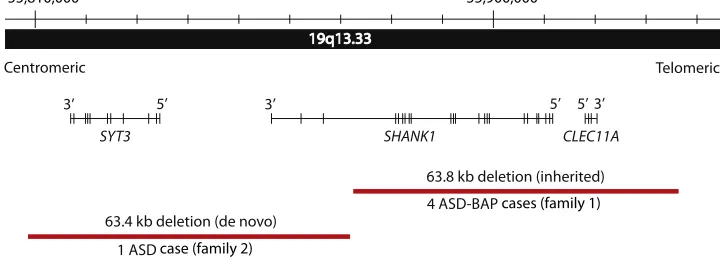
We initially identified a hemizygous microdeletion in chromosomal region 19q13.33 in ASD proband III-5 from the Canadian cohort (see family 1 in Table 1 and
Figure 1). The deletion, which was determined to be
63.8 kb, eliminated exons 1–20 of SHANK1 and the Clinical Details
Diagnosis IQa Languageb Adaptive Behaviorc Brain Imaging
Family 1d
I-1 (male) BAP: shy, reserved, and reluctant to approach people; amassed a large stamp collection; deceased
– – – –
IV-1 (male) ASD: Asperger disorder (ADI-R; SRS: 68T/mild
IV-3 (male) ASD: Asperger disorder (ADI-R and ADOS-3)
II-4 (female) non-ASD and non-BAP; anxiety and shyness
– – – –
III-2 (female) non-ASD and non-BAP; social anxiety disorder and generalized anxiety disorder; shy as a child
– PPVT: RV¼111 (77th% ile) – –
Family 2f
II-1 (male) ASD with higher functioning
Refer to pedigrees inFigure 1(family 1) andFigure S1(family 2). The following abbreviations are used: IQ, intelligence quotient; ASD, autism spectrum disorder; %
ile, percentile; and PET, positron emission tomography.
aIQ was measured with an age-appropriate Weschler scale (WPPSI, Wechsler Preschool and Primary Scale of Intelligence; WISC, Wechsler Intelligence Scale for
Children; or WASI, Wechsler Abbreviated Scale of Intelligence). Standard scores and percentiles are presented for full-scale IQ (FSIQ), verbal IQ (VIQ), and/or performance IQ (PIQ). FSIQ is not a valid estimate of IQ when significant discrepancy exists between VIQ and PIQ. Leiter International Performance Scale-Revised
(Leiter-R) is a measure of nonverbal IQ (NVIQ) only. Percentile classifications are the following: very superior (VS;>98th% ile), superior (S; 91st–97th%
ile), high average (HA; 75th–90th% ile), average (A; 25th–74th% ile), low average (LA; 9th–24th% ile), borderline (B; 2nd–8th% ile), and extremely low
(EL;<2nd% ile).
bLanguage was measured with the Oral and Written Language Scales (OWLS). Standard scores and percentiles are presented for total language (TL), receptive
language (RL), and/or expressive language (EL). Language was rated as nonverbal, average, or delayed (%16th% ile). The Peabody Picture Vocabulary Test
(PPVT-4thedition) measured receptive vocabulary (RV).
cAdaptive Behavior was measured with the Vineland Adaptive Behavior Scales (VABS). Standard score and percentiles are presented for adaptive behavior
composite (ABC), communication (COM), daily living skills (DLS), socialization (SOC), and motor (MOT; only for children 7 years old or younger).
dLanguage details for IV-2 (female) in family 1 are the following: (OWLS) RL = 87 (19th% ile) and EL = 108 (70th% ile) and (PPVT) RV = 103 (58th% ile).
eThe autism-spectrum diagnosis is based on the Autism Diagnostic Interview-Revised (ADI-R) and the Autism Diagnostic Observation Schedule (ADOS; one of four
possible modules is administered on the basis of age and language level). In some cases, the Social Responsiveness Scale (SRS) was administered, and reported
T-scores represent average skills (%59T), mild to moderate concerns (60T–75T), or a severe range (76Tor higher). Also, the diagnosis for II-1 in family 2 was based
on the Childhood Autism Rating Scale (CARS).
fII-3 (female) in family 2 was diagnosed with ASD (ADI-R; CARS: mild autism). Her WIPPSI IQ details are the following: PIQ = 99 (50th% ile) and VIQ = nonfunctional
neighboring CLEC11A (MIM 604713), which codes for a growth factor for primitive hematopoietic progenitor cells (Figure 2). Subsequent genotyping in family 1 revealed that the deletion was also present in males I-1, IV-1, and IV-3 as well as in females II-4 and III-2 (Figure 1). At 16 years of age, proband III-5 was first assessed by a child psychiatrist and was initially given a clinical diag-nosis of PDD-NOS. Starting at an early age, there was evidence of impairment in social communication, but there were not enough repetitive stereotyped behaviors for a diagnosis of autism or Asperger disorder. The ADI-R and the ADOS were completed when the proband was 25 years old. The ADI-R indicated that the parents first became concerned when their son was 12–24 months old, a period during which III-5 engaged in repetitive play and speech. He spoke in single words at 24 months of age and spoke in phrases by 36 months of age. He has never lost language or other skills. He has no history of echolalia, pronoun reversal, or neologisms. His eye contact has always been poor, and he has persistently lacked social smiling, facial affect, joint attention, and empathy. His interests during childhood and adolescence included video games, movies, and sports cards. He graduated from high school, and now, at age 32, he lives independently and works in a sheltered workshop. When III-5 was 25 years old, the ADI-R and ADOS diagnosed him with autism according to the cut-offs, but his current best-estimate diagnoses are that of Asperger disorder (in view of the normal language development) and a separate anxiety disorder; anxiety disorders are common comorbid condi-tions but are not considered part of the ASD clinical spectrum.
An extensive battery of questionnaires and tests were administered to III-5’s parents, and both scored in the typical range. His mother (II-4) has exhibited anxiety and shyness for most of her life but would not be considered to have ASD or BAP. His 40-year-old sister (III-2) is married with one son (IV-1) with Asperger disorder, a neurotypical daughter (IV-2), and a son (IV-3) with ASD. III-2 completed university and worked as a school teacher for years. She has
a diagnosis of social anxiety and a generalized anxiety disorder for which she has taken antianxiety medication. Assessment by interview and questionnaire indicated that she was typical for all measures and did not show evidence of ASD or the BAP.
III-5’s maternal grandfather (I-1) passed away when he was 95 years old. Little is known about his childhood other than that he had difficulty in school. Throughout his adult life, he had been quiet and withdrawn. He did not develop close relationships. He was a truck driver and spent most of his time away from home. There was no history of psychiatric illness. He was an avid stamp collector but did not use this interest to engage in social interactions. His children were interviewed so that a diagnosis of ASD could be determined; based on this interview, our clinical impression is that he most likely had, at the very least, the BAP or, possibly, high-func-tioning ASD, which could not be determined under the circumstances.
IV-1 was clinically diagnosed with Asperger disorder when he was 8 years old. He was born by cesarean section 10 days late. Early developmental milestones were within normal limits. When he was 3 years old, his parents detected developmental differences by noting that he was not interested in other children and was preoccupied with objects. He had an encyclopedic knowledge of cars. He would approach other children but tended to play beside them and became upset with changes in routine. He exhibited difficulties with eye contact and under-standing social cues and rules.
Additional assessments were conducted when he was 10 years old. He met all the cut-offs for an autistic disorder on the ADI-R except for the nonverbal total. The ADOS scores were below the cut-off for a diagnosis of ASD because of his strengths in the communication domain. Descriptive gestures were present but were vague and infrequent, accounting for his communication score of 1 (the cut-off is 2). Impairments in reciprocal social inter-action continued to be evident. His score on the perfor-mance intelligence quotient (IQ) component (score¼86)
19q13.33 19q13.33
5’ 3’ 5’ 5’
3’ 3’
SYT3 SHANK1 CLEC11A
63.8 kb deletion (inherited)
63.4 kb deletion (de novo)
4 ASD-BAP
1 ASD
Centromeric Telomeric
55,810,000 55,900,000
case (family 2)
cases (family 1)
Figure 2. Rare Deletions atSHANK1Locus in the Two ASD-Affected Families
Chromosomal position of rare deletions ofSHANK1and adjacent genes in ASD. The accurate coordinates for family 1 were mapped by
score on the verbal IQ subtests (score¼114). IV-1 qualified
for a diagnosis of Asperger disorder.
Individual IV-3 was first evaluated when he was 3 years old. When he was 18 months old, his parents became con-cerned because he was not talking. He developed single words at 24 months. He communicated by leading his parents by the hand and exhibited repetitive behaviors. He did not offer comfort or empathy and did not initiate social interaction, although he would play with his parents. Certain noises such as the washing machine or the toilet flushing would bother him; he became upset if his mother had her hair down or a jacket unzipped.
Assessment when he was 5 years and 8 months old indi-cated that he was positive on the ADI-R for autism and for ASD on the ADOS. He had made good progress in social interaction and language. His expressive language con-sisted of short sentences and phrases and some echoed speech and mild articulation difficulties. His IQ and expressive and receptive language scores were in the low-average range, leading to a best-estimate diagnosis of Asperger disorder.
In separate microarray experiments examining 456 ASD-affected individuals from Europe, we identified a 63.4 kb hemizygous CNV in individual F2-II-1 from family 2; this CNV deleted the last three exons ofSHANK1and the entire centromeric synaptotagmin-3 (SYT3[MIM 600327]) gene, which plays a role in Ca2þ
-dependent exocytosis of secretory vesicles (Table 1,Figure 2). Haplotype analysis revealed that the deletion resided on the chromosome originating from the mother (who was shown to carry two copies of SHANK1), so it was presumed to be a de novo event (Figure S1). The deletion was not in F2-II-3.
Male individual F2-II-1 (Table 1andFigure S1) was the first child born to a 20-year-old mother. He has a younger maternal half-sister (II-3) with autism and mild ID. F2-II-1 was born two months before term. Developmental abnormalities were identified during his first year. He did not babble, made no eye contact, and refused to be touched. He started to walk at two years of age, but his motor coordination was poor. He started to talk at 2.5 years of age, which astonished the parents because until then, he had been extremely quiet. He developed a formal, pedantic style of speech with abnormal prosody. He was uninter-ested in other children. He repeated routines and rituals and accumulated facts on certain subjects such as astronomy. When upset, he flapped his hands or moved his body in a stereotypic fashion. Lately, he has had periods of depression. His IQ is in the normal range and shows that he has good verbal ability. The best estimate diagnosis for F2-II-1 is autism with higher functioning.
No deletion equivalent to those described in families 1 or 2 was observed in 15,122 control individuals. These controls included 2,026 healthy individuals from the Children’s Hospital of Philadelphia,272,493 controls geno-typed at the University of Washington,28 and 10,603 population-based controls8,9,25 whose microarray data
1,123 controls from northern Germany,291,234 Canadian controls from Ottawa,301,120 population controls from Ontario,311,056 HapMap samples,324,783 controls from the Wellcome Trust Case Control Consortium,33 and 1,287 controls recruited by the Study of Addiction: Genetics and Environment consortium.34Control individ-uals were predominantly of European ancestry, which was comparable to the ancestry of the ASD subjects. We also examined the Database of Genomic Variants35,36 for previously reported CNVs at the SHANK1 locus. One study37reported an unvalidated 109.1 kb deletion encom-passing the entire SHANK1 gene in a Japanese female HapMap individual (NA18942). We obtained this DNA sample and performed qPCR by using two independent primer pairs at the SHANK1 locus; we were unable to confirm the deletion, indicating that it was a false-positive call (Figure S3).
The frequency of deletions at theSHANK1 locus is sig-nificantly higher in ASD cases than in controls (2/1,614 cases versus 0/15,122 controls; Fisher’s Exact test two-tailed p¼ 0.009). No other obvious potentially etiologic
CNV was observed in any of the individuals with ASD in families 1 or 2 (Tables S2 and S3). Therefore, at this resolu-tion of analysis, the rare deleresolu-tions of common segments of SHANK1were the only common events observed between
the two unrelated ASD families.
To test for potential damaging sequence-level mutations inSHANK1, we used Sanger sequencing to examine all 23 exons and splice sites in 509 unrelated ASD (384 male and 125 female) and 340 ID (191 males and 149 females) individuals. The rationale forSHANK1mutation screening of ASD and ID cases arises from our previous observation of rare truncating nonsense and/or frameshift mutations in SHANK216andSHANK318,19,38in both of these disorders.
We used Primer3 software v.0.4.0 to design PCR primers. We performed PCRs by using standard conditions, and we purified and sequenced products directly by using the BigDye Terminator sequencing (Applied Biosystems, Foster City, CA, USA). Variant detection was performed with Seq-Scape software from Applied Biosystems. We validated variants detected in the cases but not previously reported in the Single Nucleotide Polymorphism Database (dbSNP) build 130 by resequencing samples from the proband, both parents, and the siblings when available. All primers used for Sanger sequencing ofSHANK1andPCDHGA11are listed inTable S4.
(or BAP) fathers. No significant mutation was found on the nondeleted allele of proband III-5.
We also conducted whole-exome sequencing in individ-uals III-5 and IV-3 from family 1 to search for potential mutations in other genes (Table S6). We performed target enrichment by utilizing the Agilent SureSelect 50Mb Human All Exon kit (Agilent Technologies, Santa Clara, CA, USA), and we conducted paired-end sequencing on a Life Technologies SOLiD5500XL (Life Technologies, Foster City, CA, USA) platform. Protocols for sequencing and target capture followed specifications from the manu-facturers.
A nonsense mutation (Tyr313*) predicted to introduce a stop codon in the PCDHGA11 prodocadherin gene in chromosomal region 5q31.3 was identified. PCDHGA11 is a member of the protocadherin gamma gene cluster thought to have an important role in establishing connec-tions in the brain.39The nonsense variant inPCDHGA11 (MIM 606298) was validated by Sanger sequencing. The mutation was found to segregate precisely with the SHANK1deletion. BecauseSHANK1andPCDHGA11reside
on different autosomes, we tested for translocation or transposition and ruled out such linkage (Figure S6). It is possible that the Tyr313* mutation inPCDHGA11works in concert with theSHANK1deletion to modify (positively or negatively) the extent of the phenotype or that they are just randomly cosegregating (a 1/262,144 chance). We have not detected CNVs or sequence-level mutations in PCDHGA11in family 2 or in any other ASD subject
exam-ined. We have also tentatively ruled out the role of the X chromosome in family 1 given that different X chromo-somes were observed in ASD males (by comparing SNP genotypes), and no pathogenic CNV, mutation, or genetic linkage was observed at the X chromosome (Figure S7). The PCDHGA11 and SHANK1 loci at 5q31.3 and 19q13.33,
respectively, represented two of five chromosomal regions in which maximal linkage was detected (Figure S7). No other obvious damaging sequence mutations or CNVs were found in genes in the other three putative linkage regions.
We provide here a description of hemizygous deletions of SHANK1 in ASD. Such findings have, perhaps, been anticipated given that mutations leading to haploinsuffi-ciency of SHANK2 and SHANK3 have been previously described in ASD. The striking segregation of ASD in only maleSHANK1-deletion carriers in family 1 represents, to our knowledge, the first example of autosomal sex-limited expression in ASD.40 Our finding of an unrelated ASD-affected male carrying an independent de novo deletion ofSHANK1supports our interpretation that theSHANK1 CNV segregating in family 1 is indeed the primary etiologic event leading to ASD. Additional case reports of other multigenerational families will be required for substanti-ating our findings of gender-influenced autosomal pene-trance differences at theSHANK1locus in ASD.
Our data indicate thatSHANK1deletions are associated with ASD with higher functioning in males. Insofar as all
affected males have an IQ in the typical range and have good verbal ability (with a lack of clinically significant language delay), they would also qualify for a diagnosis of Asperger disorder. The one other male (individual I-1) had a diagnosis of the BAP (although this diagnosis was based only on retrospective reports, which preclude the potential for an ASD diagnosis). The female carriers do not show evidence of ASD or the BAP but have suffered from anxiety, which is considered to be an unrelated phenotype to ASD (Table 1). It is surprising that, compared to other studies of inherited CNVs,3 this pedigree shows little variability in clinical features among affected individuals.
We note that the neuronal genesPCDHGA11andSYT3 could also contribute to aspects of the ASD phenotype in families 1 and 2, respectively. Moreover, subtler muta-tions,41,42or combinations of mutations,17might also be involved. The latter possibility might be particularly rele-vant given early findings that suggest potential multigenic effects includingSHANK2in ASD risk.17Paternal silencing or imprinting ofSHANK1, as well as potential transmission distortion with respect to cosegregation of SHANK1 and PCDHGA11, also needs to be considered, but at least for
the former, there is insufficient evidence for this.43 Consistent with our findings in humans, Shank1-null murines have deficits in several elements of social com-munication and developmental milestones.44 They also exhibit increased anxiety-related behavior and impaired memory.45Shank2 and Shank3 offer immature excitatory synapses with unique properties that facilitate synapto-genesis. Shank1 has the important, but perhaps less critical, structural role of ‘‘consolidating’’ novel synaptic contacts via capping Shank2 and Shank3.22,46Mutations in SHANK1 might be predicted generally to have less of an impact on synapse morphology and stability and, there-fore, a less severe phenotype than do similar alterations in SHANK2 or SHANK3. Given that SHANK2 and SHANK3
mutations are observed in ID16,38 and schizophrenia (MIM 181500),47 it is possible that SHANK1 mutations will also be similarly found in other brain disorders.
There are currently three prevailing theories explaining the gender bias in autism. The ‘‘extreme brain’’ theory proposes that autistic behaviors are an exaggeration of typical male personality traits.48A second theory suggests that given the established genetic basis of autism, it is possible that the sex bias lies in the sex chromosomes. Rare mutations in some X-linked genes such as NLGN3 and NLGN413 and the PTCHD1 locus (MIM 300828)49 have been shown to confer risk to idiopathic ASD in male carriers. A third theory50 posits a sex-specific multiple-threshold model in which females need to carry more genetic liability than males in order to develop ASD. Some protective factor must exist to account for that higher threshold. Our discovery of rare autosomal SHANK1deletions associated with ASD or the BAP that is
These results will also have immediate relevance for clinical genetic testing in ASD.
Supplemental Data
Supplemental Data include seven figures and six tables and can be found with this article online athttp://www.cell.com/AJHG.
Acknowledgments
This work was supported by grants from the University of Toronto McLaughlin Centre, NeuroDevNet, Genome Canada and the Ontario Genomics Institute, the Canadian Institutes for Health Research (CIHR), the Canadian Institute for Advanced Research, the Canada Foundation for Innovation, the government of Ontario, Autism Speaks, and The Hospital for Sick Children Foun-dation. S.W.S. holds the GlaxoSmithKline-CIHR Chair in Genome Sciences at the University of Toronto and The Hospital for Sick Chil-dren. G.A.R. was supported by Deutsche Forschungsgemeinschaft and the BMBF/NGFNplus (German Mental-Retardation Network). T.B. was supported by Agence Nationale de la Recherche (ANR-08-MNPS-037-01—SynGen), Neuron-ERANET (EUHF-AUTISM), and Fondation Orange. We are indebted to the individuals and their families for participating in this study and to The Centre for Applied Genomics at The Hospital for Sick Children. We thank A. Fiebig, A. Franke, and S. Schreiber at POPGEN (University of Kiel, Kiel, Germany), A. Stewart, R. McPherson, and R. Roberts of the Univer-sity of Ottawa Heart Institute (UniverUniver-sity of Ottawa, Ottawa, Canada), the Wellcome Trust Case Control Consortium, and the Study of Addiction: Genetics and Environment consortium for providing control data. A provisional patent has been filed for The Hospital for Sick Children in S.W. Scherer’s name.
Received: February 17, 2012 Revised: March 9, 2012 Accepted: March 19, 2012 Published online: April 12, 2012
Web Resources
The URLs for data presented herein are as follows:
Database of Genomic Variants,http://projects.tcag.ca/variation/
dbSNP,http://www.ncbi.nlm.nih.gov/SNP/
Online Mendelian Inheritance in Man (OMIM), http://www. omim.org/
References
1. Losh, M., Childress, D., Lam, K., and Piven, J. (2008). Defining key features of the broad autism phenotype: A comparison across parents of multiple- and single-incidence autism fami-lies. Am. J. Med. Genet. B. Neuropsychiatr. Genet. 147B, 424–433.
2. Gillberg, C., Cederlund, M., Lamberg, K., and Zeijlon, L. (2006). Brief report: ‘‘The autism epidemic’’. The registered prevalence of autism in a Swedish urban area. J. Autism Dev. Disord.36, 429–435.
3. Scherer, S.W., and Dawson, G. (2011). Risk factors for autism: Translating genomic discoveries into diagnostics. Hum. Genet.130, 123–148.
Autism Spectrum Disorder. Curr. Opin. Genet. Dev., in press. 10.1016/j.gde.2012.03.002.
5. Cook, E.H., Jr., and Scherer, S.W. (2008). Copy-number varia-tions associated with neuropsychiatric condivaria-tions. Nature
455, 919–923.
6. Sebat, J., Lakshmi, B., Malhotra, D., Troge, J., Lese-Martin, C., Walsh, T., Yamrom, B., Yoon, S., Krasnitz, A., Kendall, J., et al. (2007). Strong association of de novo copy number mutations with autism. Science316, 445–449.
7. Levy, D., Ronemus, M., Yamrom, B., Lee, Y.H., Leotta, A., Ken-dall, J., Marks, S., Lakshmi, B., Pai, D., Ye, K., et al. (2011). Rare de novo and transmitted copy-number variation in autistic spectrum disorders. Neuron70, 886–897.
8. Marshall, C.R., Noor, A., Vincent, J.B., Lionel, A.C., Feuk, L., Skaug, J., Shago, M., Moessner, R., Pinto, D., Ren, Y., et al. (2008). Structural variation of chromosomes in autism spec-trum disorder. Am. J. Hum. Genet.82, 477–488.
9. Pinto, D., Pagnamenta, A.T., Klei, L., Anney, R., Merico, D., Re-gan, R., Conroy, J., Magalhaes, T.R., Correia, C., Abrahams, B.S., et al. (2010). Functional impact of global rare copy number variation in autism spectrum disorders. Nature466,
368–372.
10. Sanders, S.J., Ercan-Sencicek, A.G., Hus, V., Luo, R., Murtha, M.T., Moreno-De-Luca, D., Chu, S.H., Moreau, M.P., Gupta, A.R., Thomson, S.A., et al. (2011). Multiple recurrent de novo CNVs, including duplications of the 7q11.23 Williams syndrome region, are strongly associated with autism. Neuron
70, 863–885.
11. Toro, R., Konyukh, M., Delorme, R., Leblond, C., Chaste, P., Fauchereau, F., Coleman, M., Leboyer, M., Gillberg, C., and Bourgeron, T. (2010). Key role for gene dosage and synaptic homeostasis in autism spectrum disorders. Trends Genet.26,
363–372.
12. Bourgeron, T. (2009). A synaptic trek to autism. Curr. Opin. Neurobiol.19, 231–234.
13. Jamain, S., Quach, H., Betancur, C., Ra˚stam, M., Colineaux, C., Gillberg, I.C., Soderstrom, H., Giros, B., Leboyer, M., Gill-berg, C., and Bourgeron, T.; Paris Autism Research Interna-tional Sibpair Study. (2003). Mutations of the X-linked genes encoding neuroligins NLGN3 and NLGN4 are associated with autism. Nat. Genet.34, 27–29.
14. Szatmari, P., Paterson, A.D., Zwaigenbaum, L., Roberts, W., Brian, J., Liu, X.Q., Vincent, J.B., Skaug, J.L., Thompson, A.P., Senman, L., et al; Autism Genome Project Consortium. (2007). Mapping autism risk loci using genetic linkage and chromosomal rearrangements. Nat. Genet.39, 319–328. 15. Vaags, A.K., Lionel, A.C., Sato, D., Goodenberger, M., Stein,
Q.P., Curran, S., Ogilvie, C., Ahn, J.W., Drmic, I., Senman, L., et al. (2012). Rare deletions at the neurexin 3 locus in autism spectrum disorder. Am. J. Hum. Genet.90, 133–141.
16. Berkel, S., Marshall, C.R., Weiss, B., Howe, J., Roeth, R., Moog, U., Endris, V., Roberts, W., Szatmari, P., Pinto, D., et al. (2010). Mutations in the SHANK2 synaptic scaffolding gene in autism spectrum disorder and mental retardation. Nat. Genet. 42,
489–491.
17. Leblond, C.S., Heinrich, J., Delorme, R., Proepper, C., Betan-cur, C., Huguet, G., Konyukh, M., Chaste, P., Ey, E., Rastam, M., et al. (2012). Genetic and Functional Analyses ofSHANK2
18. Durand, C.M., Betancur, C., Boeckers, T.M., Bockmann, J., Chaste, P., Fauchereau, F., Nygren, G., Rastam, M., Gillberg, I.C., Anckarsa¨ter, H., et al. (2007). Mutations in the gene encoding the synaptic scaffolding protein SHANK3 are associ-ated with autism spectrum disorders. Nat. Genet.39, 25–27. 19. Moessner, R., Marshall, C.R., Sutcliffe, J.S., Skaug, J., Pinto, D.,
Vincent, J., Zwaigenbaum, L., Fernandez, B., Roberts, W., Szat-mari, P., and Scherer, S.W. (2007). Contribution of SHANK3 mutations to autism spectrum disorder. Am. J. Hum. Genet.
81, 1289–1297.
20. Gauthier, J., Spiegelman, D., Piton, A., Lafrenie`re, R.G., Lau-rent, S., St-Onge, J., Lapointe, L., Hamdan, F.F., Cossette, P., Mottron, L., et al. (2009). Novel de novo SHANK3 mutation in autistic patients. Am. J. Med. Genet. B. Neuropsychiatr. Genet.150B, 421–424.
21. Sheng, M., and Kim, E. (2000). The Shank family of scaffold proteins. J. Cell Sci.113, 1851–1856.
22. Grabrucker, A.M., Schmeisser, M.J., Schoen, M., and Boeckers, T.M. (2011). Postsynaptic ProSAP/Shank scaffolds in the cross-hair of synaptopathies. Trends Cell Biol.21, 594–603.
23. Risi, S., Lord, C., Gotham, K., Corsello, C., Chrysler, C., Szatmari, P., Cook, E.H., Jr., Leventhal, B.L., and Pickles, A. (2006). Combining information from multiple sources in the diagnosis of autism spectrum disorders. J. Am. Acad. Child Adolesc. Psychiatry45, 1094–1103.
24. Hamdan, F.F., Daoud, H., Piton, A., Gauthier, J., Dobrzeniecka, S., Krebs, M.O., Joober, R., Lacaille, J.C., Nadeau, A., Milunsky, J.M., et al. (2011). De novo SYNGAP1 mutations in nonsyn-dromic intellectual disability and autism. Biol. Psychiatry
69, 898–901.
25. Lionel, A.C., Crosbie, J., Barbosa, N., Goodale, T., Thiruvahin-drapuram, B., Rickaby, J., Gazzellone, M., Carson, A.R., Howe, J.L., Wang, Z., et al. (2011). Rare copy number variation discovery and cross-disorder comparisons identify risk genes for ADHD. Sci Transl Med.3, 95ra75.
26. Pinto, D., Darvishi, K., Shi, X., Rajan, D., Rigler, D., Fitzgerald, T., Lionel, A.C., Thiruvahindrapuram, B., Macdonald, J.R., Mills, R., et al. (2011). Comprehensive assessment of array-based platforms and calling algorithms for detection of copy number variants. Nat. Biotechnol.29, 512–520.
27. Shaikh, T.H., Gai, X., Perin, J.C., Glessner, J.T., Xie, H., Murphy, K., O’Hara, R., Casalunovo, T., Conlin, L.K., D’Arcy, M., et al. (2009). High-resolution mapping and analysis of copy number variations in the human genome: A data resource for clinical and research applications. Genome Res.
19, 1682–1690.
28. Itsara, A., Cooper, G.M., Baker, C., Girirajan, S., Li, J., Absher, D., Krauss, R.M., Myers, R.M., Ridker, P.M., Chasman, D.I., et al. (2009). Population analysis of large copy number vari-ants and hotspots of human genetic disease. Am. J. Hum. Genet.84, 148–161.
29. Krawczak, M., Nikolaus, S., von Eberstein, H., Croucher, P.J., El Mokhtari, N.E., and Schreiber, S. (2006). PopGen: Population-based recruitment of patients and controls for the analysis of complex genotype-phenotype relationships. Community Genet.9, 55–61.
30. Stewart, A.F., Dandona, S., Chen, L., Assogba, O., Belanger, M., Ewart, G., LaRose, R., Doelle, H., Williams, K., Wells, G.A., et al. (2009). Kinesin family member 6 variant Trp719Arg does not associate with angiographically defined coronary artery disease in the Ottawa Heart Genomics Study. J. Am. Coll. Cardiol.53, 1471–1472.
31. Zogopoulos, G., Ha, K.C., Naqib, F., Moore, S., Kim, H., Mont-petit, A., Robidoux, F., Laflamme, P., Cotterchio, M., Green-wood, C., et al. (2007). Germ-line DNA copy number variation frequencies in a large North American population. Hum. Genet.122, 345–353.
32. Altshuler, D.M., Gibbs, R.A., Peltonen, L., Altshuler, D.M., Gibbs, R.A., Peltonen, L., Dermitzakis, E., Schaffner, S.F., Yu, F., Peltonen, L., et al; International HapMap 3 Consortium. (2010). Integrating common and rare genetic variation in diverse human populations. Nature467, 52–58.
33. Craddock, N., Hurles, M.E., Cardin, N., Pearson, R.D., Plagnol, V., Robson, S., Vukcevic, D., Barnes, C., Conrad, D.F., Gian-noulatou, E., et al; Wellcome Trust Case Control Consortium. (2010). Genome-wide association study of CNVs in 16,000 cases of eight common diseases and 3,000 shared controls. Nature464, 713–720.
34. Bierut, L.J., Agrawal, A., Bucholz, K.K., Doheny, K.F., Laurie, C., Pugh, E., Fisher, S., Fox, L., Howells, W., Bertelsen, S., et al; Gene, Environment Association Studies Consortium. (2010). A genome-wide association study of alcohol depen-dence. Proc. Natl. Acad. Sci. USA107, 5082–5087.
35. Iafrate, A.J., Feuk, L., Rivera, M.N., Listewnik, M.L., Donahoe, P.K., Qi, Y., Scherer, S.W., and Lee, C. (2004). Detection of large-scale variation in the human genome. Nat. Genet.36, 949–951.
36. Zhang, J., Feuk, L., Duggan, G.E., Khaja, R., and Scherer, S.W. (2006). Development of bioinformatics resources for display and analysis of copy number and other structural variants in the human genome. Cytogenet. Genome Res.115, 205–214.
37. Park, H., Kim, J.I., Ju, Y.S., Gokcumen, O., Mills, R.E., Kim, S., Lee, S., Suh, D., Hong, D., Kang, H.P., et al. (2010). Discovery of common Asian copy number variants using integrated high-resolution array CGH and massively parallel DNA sequencing. Nat. Genet.42, 400–405.
38. Hamdan, F.F., Gauthier, J., Araki, Y., Lin, D.T., Yoshizawa, Y., Higashi, K., Park, A.R., Spiegelman, D., Dobrzeniecka, S., Piton, A., et al; S2D Group. (2011). Excess of de novo delete-rious mutations in genes associated with glutamatergic systems in nonsyndromic intellectual disability. Am. J. Hum. Genet.88, 306–316.
39. Phillips, G.R., Tanaka, H., Frank, M., Elste, A., Fidler, L., Ben-son, D.L., and Colman, D.R. (2003). Gamma-protocadherins are targeted to subsets of synapses and intracellular organelles in neurons. J. Neurosci.23, 5096–5104.
40. Zhao, X., Leotta, A., Kustanovich, V., Lajonchere, C., Gesch-wind, D.H., Law, K., Law, P., Qiu, S., Lord, C., Sebat, J., et al. (2007). A unified genetic theory for sporadic and inherited autism. Proc. Natl. Acad. Sci. USA104, 12831–12836.
41. Durand, C.M., Perroy, J., Loll, F., Perrais, D., Fagni, L., Bour-geron, T., Montcouquiol, M., and Sans, N. (2012). SHANK3 mutations identified in autism lead to modification of dendritic spine morphology via an actin-dependent mecha-nism. Mol. Psychiatry17, 71–84.
42. Berkel, S., Tang, W., Trevin˜o, M., Vogt, M., Obenhaus, H.A., Gass, P., Scherer, S.W., Sprengel, R., Schratt, G., and Rappold, G.A. (2012). Inherited and de novo SHANK2 variants associ-ated with autism spectrum disorder impair neuronal morpho-genesis and physiology. Hum. Mol. Genet.21, 344–357.
43. Gregg, C., Zhang, J., Weissbourd, B., Luo, S., Schroth, G.P., Haig, D., and Dulac, C. (2010). High-resolution analysis of parent-of-origin allelic expression in the mouse brain. Science
J.N. (2011). Communication impairments in mice lacking Shank1: Reduced levels of ultrasonic vocalizations and scent marking behavior. PLoS ONE6, e20631.
45. Hung, A.Y., Futai, K., Sala, C., Valtschanoff, J.G., Ryu, J., Woodworth, M.A., Kidd, F.L., Sung, C.C., Miyakawa, T., Bear, M.F., et al. (2008). Smaller dendritic spines, weaker synaptic transmission, but enhanced spatial learning in mice lacking Shank1. J. Neurosci.28, 1697–1708.
46. Grabrucker, A.M., Knight, M.J., Proepper, C., Bockmann, J., Joubert, M., Rowan, M., Nienhaus, G.U., Garner, C.C., Bowie, J.U., Kreutz, M.R., et al. (2011). Concerted action of zinc and ProSAP/Shank in synaptogenesis and synapse maturation. EMBO J.30, 569–581.
47. Gauthier, J., Champagne, N., Lafrenie`re, R.G., Xiong, L., Spiegelman, D., Brustein, E., Lapointe, M., Peng, H., Coˆte´, M., Noreau, A., et al; S2D Team. (2010). De novo mutations
SHANK3 in patients ascertained for schizophrenia. Proc. Natl. Acad. Sci. USA107, 7863–7868.
48. Baron-Cohen, S., Lombardo, M.V., Auyeung, B., Ashwin, E., Chakrabarti, B., and Knickmeyer, R. (2011). Why are autism spectrum conditions more prevalent in males? PLoS Biol.9,
e1001081.
49. Noor, A., Whibley, A., Marshall, C.R., Gianakopoulos, P.J., Piton, A., Carson, A.R., Orlic-Milacic, M., Lionel, A.C., Sato, D., Pinto, D., et al. (2010). ). Disruption at the PTCHD1 Locus on Xp22.11 in Autism spectrum disorder and intellectual disability. Sci. Transl. Med.2, 49ra68.