A DESCRIPTIVE STUDY ON THE X MIA 1 STUDENTS’ ABILITY IN WRITING RECOUNT TEXT AT MAN 1 JEMBER
IN THE 2014/2015 ACADEMIC YEAR
THESIS
Proposed to Fulfill One of the Requirements to Obtain the Degree of S1 at the English Education Program, Language and Arts Department, Faculty of Teacher
Training and Education, Jember University
By
IVAN NURYANTO NIM 080210491055
ENGLISH EDUCATION PROGRAM LANGUAGE AND ARTS DEPARTMENT
FACULTY OF TEACHER TRAINING AND EDUCATION JEMBER UNIVERSITY
CONSULTANT’S APPROVAL
A DESCRIPTIVE STUDY ON THE X MIA 1 STUDENTS’ ABILITY IN WRITING RECOUNT TEXT AT MAN 1 JEMBER
IN THE 2014/2015 ACADEMIC YEAR
THESIS
Name : Ivan Nuryanto
Identification Number : 080210491055
Level : 2008
Place, Date of Birth : Jember, August 7th, 1990 Department : Language and Arts
Program : English Education
Approved By:
Consultant 1 Consultant 2
EXAMINERS’ APPROVAL
The thesis entitled “A Descriptive Study on the X MIA 1 Students’ Ability in Writing Recount Text in the 2014/2015 Academic Year” is approved and accepted by the Faculty of Teacher Training and Education, Jember University on:
Date : March, 10th 2015 08th 2011
Place : The Faculty of Teacher Training and Education, Jember University
The Team of Examiners:
The Chairperson, The Secretary,
Asih Santihastuti, S,Pd.M.Pd NIP. 19630323 198902 2 001 NIP. 19800728 200604 2 002
The members, Signatures
1. Dra.Musli Ariani, M.App.Ling 1 . ………
NIP. 19680602 199403 2 001
2. Drs. Bambang Arya WP. Dip.Ed, P.hD 2 .……….. NIP. 19601231 198802 1 002
The Faculty of Teacher Training and Education The Dean
Prof. Dr. Sunardi, M.Pd NIP 19540501 198303 1 005 Dra. Made Adi Andayani T, M.Ed
STATEMENT OF THESIS AUTHENTICITY
I certify that this thesis is an original and authentic piece of work by the author himself. All materials incorporate from secondary sources have been fully acknowledged and referenced.
I certify that the content of the thesis is the result of work which has been carried out since the official commencement date of the approved thesis title, this thesis has not been submitted previously, in whole or in part, to qualify for any other academic award, ethnic procedures and guidelines of thesis writing from the university and the faculty have been followed.
I am of the potential consequences of any breach of the procedures and guidelines, e.g. cancellation of my academic award.
I hereby grant to the University of Jember the right to achieve and to reproduce and communicate to the public my thesis to project in whole or in part in University/Faculty Libraries in all forms of media, now or here after known.
DEDICATION
This thesis is honorably dedicated to:
1. My beloved parents Bagong Budiarjo and Bibit Puji Astutik, thanks for your
loves and spirits every time. You are giving your best to take care of me. This
thesis is proudly dedicated to you for your everlasting love.
2. My fiancée Titik Retno Ningsih, thanks for always support me. You always
make me smile when I was down.
3. All of my friends who cannot be mentioned one by one, thanks for your
MOTTO
Keep Moving Forward!
ACKNOWLEDGEMENT
First and foremost, I would like to express my greatest gratitude to Allah SWT, the most Gracious and the most Merciful. Because of His countless Blessing, Mercy and Grace, I can accomplish the writing of this thesis.
I also would like to express my great appreciation and sincerest gratitude to the following people:
1. The Dean of the Faculty of Teacher Training and Education, Jember University.
2. The Chairperson of the Language & Arts Department. 3. The Chairperson of English Education Study Program.
4. My Academic Advisor, Dra. Made Adi Andayani T. M.Ed. for giving me guidance and valuable suggestion in writing this thesis.
5. My first Consultant, Dra. Musli Ariani, M. App. Ling. And my second Consultant Asih Santihastuti. S.Pd. M.pd, for their guidance, advice and motivation in accomplishing this thesis. Their valuable counseling and contribution to the writing of this thesis are highly appreciated.
6. The Examination Committee.
7. The Headmaster and the English teachers of X MIA 1 of MAN 1 Jember for giving me an opportunity, help, and support to conduct this research.
8. All of my friends, starting from elementary until this university level. I love you so much guys.
Finally, I hope this thesis will provide some advantages for the writer as well as the readers. Any constructive suggestions or criticisms will be respectfully welcomed and appreciated to make this thesis better.
Jember, April 14th, 2015
TABLE OF CONTENTS
Page
CONSULTANTS’APPROVAL ... i
EXAMINERS’ APPROVAL ... ii
STATEMENT OF THESIS AUTHENTICITY ... iii
DEDICATION ... iv
MOTTO ... v
ACKNOWLEDGEMENT ... vi
TABLE OF CONTENTS ... vii
THE LIST OF TABLES ... xi
THE LIST OF CHARTS ... xii
THE LIST OF APPENDICES ... xiii
SUMMARY ... xiv
CHAPTER 1. INTRODUCTION 1.1Background of the Research ... 1
1.2Problem of the Research ... 5
1.3Objective of the Research ... 6
1.4 Significances of the Research ... 6
1.4.1 The English Teacher ... 6
1.4.1 The Students’ Class X MIA 1 ... 6
1.4.1 The Other Researchers ... 6
1.5 The Scope of the Research ... 7
CHAPTER 2. REVIEW OF RELATED LITERATURE 2.1 Writing Ability ... 8
2.2 Writing Achievement ... 9
2.2.1 Content ... 10
2.2.2 Organization ... 11
a. Unity ... 11
b. Coherence ... 11
2.2.3 Grammar ... 12
2.2.4 Vocabulary ... 14
2.2.4 Mechanic ... 16
2.4 Writing for EFL Learners ... 18
2.5 Definition of Text ... 19
2.6 Recount Text ... 20
2.6.1 Types of Recount Text ... 22
2.6.1.1 Personal Recount ... 23
2.7 The Teaching Writing to the Tenth Grade Students of Man 1 Jember ... 24
2.8 The Assessment of Writing Recount Text at MAN 1 Jember ... 26
CHAPTER 3. RESEARCH METHODOLOGY 3.1 Research Design ... 28
3.2 The Operational Definition of the Terms ... 28
3.4.1 Descriptive Study ... 28
3.4.2 Recount Text ... 29
3.4.3 Writing Ability ... 29
3.3 Area Determination Method ... 29
3.4 Respondent Determination Method ... 30
3.5 Data Collection Methods ... 31
3.5.1 Writing Test of Recount Text ... 31
3.5.1.1 The Test Criterion and the Assessment of the Test ... 33
3.5.2 Interview ... 35
3.6 Data Analysis Method ... 37
3.6.1 The Analysis of the Primary Data ... 37
3.6.2 The Analysis of the Supporting Data ... 42
CHAPTER 4. RESARCH RESULTS AND DISCUSSION 4.1 The Result of the Primary Data ... 44
4.1.1 The Results of the Analysis of the Students’ Recount Text Writing Test ... 44
4.1.2 The Results of the Analysis of the Students’ Recount Text Based on the Writing Aspect ... 51
4.1.2.1 The Students’ Ability in the Aspect of Content ... 52
4.1.2.1 The Students’ Ability in the Aspect of Organization ... 52
4.1.2.1 The Students’ Ability in the Aspect of Grammar ... 53
4.1.2.1 The Students’ Ability in the Aspect of Vocabulary ... 54
4.1.2.1 The Students’ Ability in the Aspect of Mechanic ... 55
4.2 The Results of the Supporting Data ... 56
4.2.1 The Result of the Interview ... 56
4.2.2 The Results of Documents ... 56
4.3 Discussion of the Research Result ... 57
CHAPTER 5. CONCLUSION AND SUGGESTIONS 5.1 Conclusion ... 61
5.2 Suggestions ... 62
1. The English Teacher ... 62
2. The Students of X MIA 1 ... 63
3. The Other Researchers ... 63
THE LIST OF TABLES
Page 2.1 Recount Text ... ... 21 3.1 The Standard Competence and the Basic Competence of English
For the Tenth Grade ... ... 36
3.2 The Scoring Guide of the Students’ Recount Text Writing ... 38
3.3 The Classification of the Students’ Ability in Writing Recount Text
On the Score ... ... 42
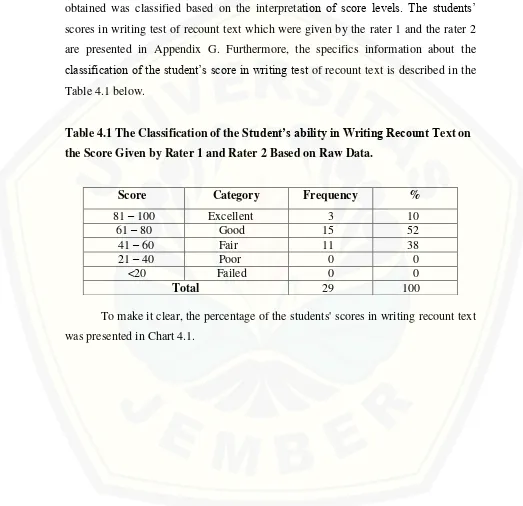
4.1 The Classification of the Students’ Ability in Writing Recount Text
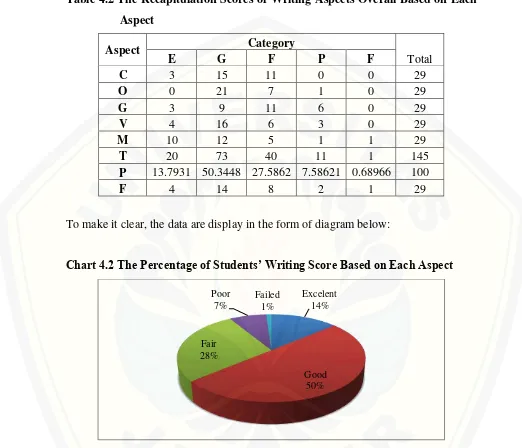
On the Score Given by Rater 1 and Rater 2 Based on Raw Data ... 45 4.2 The Recapitulation Scores of Writing Aspects Overall Based on Each
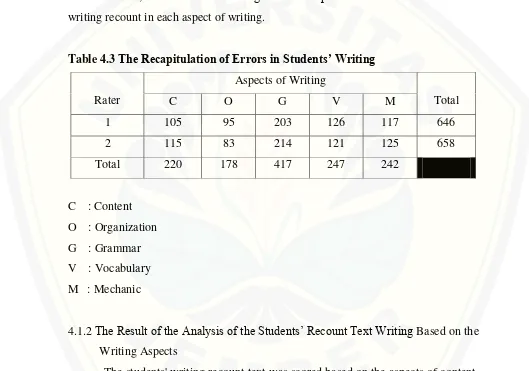
Aspect ... ... 47 4.3 The Recapitulation of Errors in Students’ Writing ... ... 51
THE LIST OF CHARTS
Page
4.1 The percentage of the Students’ Writing Score Given by
Rater 1 and Rater 2 Based on Raw Data ... 46
4.2 The percentage of the Students’ Writing Score Based on Each
Aspect ... 47 4.3 The Percentage of the Students’ Writing Ability in the
Aspect of Content ... 48 4.4 The Percentage of the Students’ Writing Ability in the
Aspect of Organization ... 48 4.5 The Percentage of the Students’ Writing Ability in the
Aspect of Grammar ... 49 4.6 The Percentage of the Students’ Writing Ability in the
Aspect of Vocabulary ... 50 4.7 The Percentage of the Students’ Writing Ability in the
THE LIST OF APPENDICES
Page
A. Research Matrix ... 68
B. Research Instrument ... 69
C. Worksheet ... 70
D. Interview Guide for the English Teacher ... 71
E. The Result of the Interview of the English Teacher ... 72
F. The Name of the Respondents ... 73
G. The Students’ Scores Given by The Scorer 1 and 2 Based on Raw Data ... 74
H. The Students’ Score in the Aspect of Content ... 75
I. The Students’ Score in the Aspect of Organization ... 76
J. The Students’ Score in the Aspect of Grammar ... 77
K. The Students’ Score in the Aspect of Vocabulary ... 78
L. The Students’ Score in the Aspect of Mechanic ... 79
M. The Sample of the Students’ Writing a Recount Text Given by the Rater 1 ... 80
N. The Sample of the Students’ Writing a Recount Text Given by the Rater 2 ... 82
O. The Permission Letter From Jember University ... 84
SUMMARY
A Descriptive Study on The X MIA 1 Students’ Ability in Writing Recount Text at MAN 1 Jember in the 2014/2015 Academic Year; Ivan Nuryanto, 080210491055; 2015; 85 pages; English Education Program; Language and Arts Department, Faculty of Teacher Training and Education, Jember University.
Based on the preliminary study and observation that was done on January, 5th 2015, most of the X MIA 1 students of MAN 1 Jember produced some errors dealing with the writing of recount text especially in grammar, vocabulary, mechanics, content, and organization. The English teacher said that the students often make errors in their writing. It was because most of the students write by translating Indonesian sentences into English not by transferring the meaning from Indonesian into English.
This final project primarily deals with descriptive study. It was describe the X
MIA 1 students’ ability in writing recount text at MAN 1 Jember in the 2014/2015 academic year. This research used a descriptive approach to describe the students’ writing ability of the X MIA 1 students of MAN 1 Jember in the 2014/2015 academic year in their recount text writing. It was chosen to answer the research problem and the research objective of this research. They were” How was the X MIA 1 students’ ability in writing recount text at MAN 1 Jember in the 2014/2015 academic year?” and “To describe the X MIA 1 students’ ability in writing recount text at MAN 1 Jember in the 2014/2015 academic year.”
The students’ writing was analyzed. The writing ability was classified into five aspects. They were content, organization, grammar, vocabulary and mechanic.
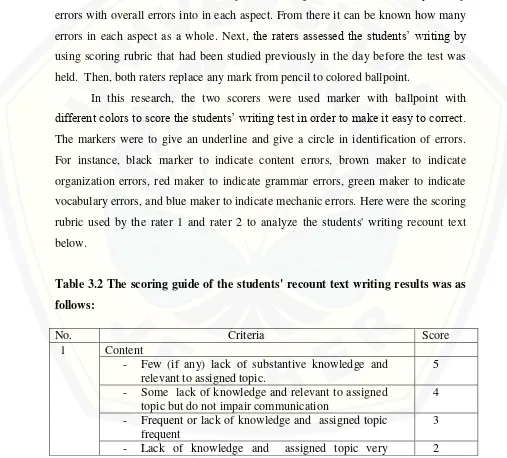
The students’ writing recount text was assessed by using an analytical scoring rubric which required the scorers to give score for each writing aspect. By assessing the
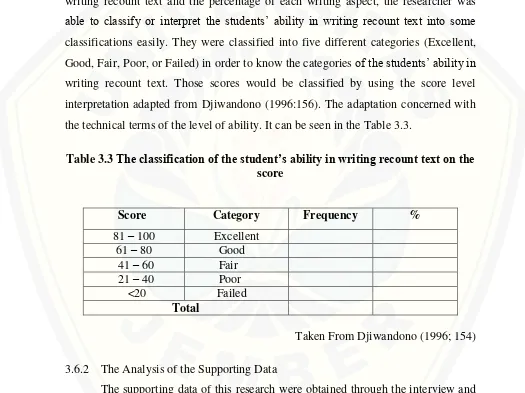
the researcher was able to classify or interpret the students’ ability in writing recount text into some classifications based on the score levels interpretation. The purpose of
the classifying or interpreting the students’ mean score in writing a recount text was to know the students’ ability in writing recount text whether it was excellent, good, fair, poor, or failed.
CHAPTER 1. INTRODUCTION
This descriptive study investigates the phenomenon of students’ recount text
writing in senior high school. Students’ production of writing which was achieved still not as expected in the curriculum. To know the real condition of students’
writing, this research looks at the issue by figuring out the students’ writing ability.
In this case, the pattern of their writing could be understood better. This chapter
presents some aspects dealing with the topic of the research. It includes research
background, the problems of the research, the objective of the research, and the
significance of the research. . They are presented respectively in the following parts.
1.1 Background of the Research
Language is a means of communication. Through language, people are able
to communicate and express their ideas, thoughts, and desires orally or in written
form with others. Dulay et al (1982:6) note that over a billion people in the world
speak more than one language fluently. Furthermore, English, as an international
language, becomes the bridge of communication among people all over the world. It
plays an important role for acquiring and maintaining global communication. English
has four main skills that the learners has to be mastered. one of the main skill is
Writing, Writing is done by everybody everyday. People write a note, shopping list,
prescription, a short message. it is easy to do in their native language, but not in a
foreign languange. A good writing must be easy to understand by the reader in order
to get some information from their writing. The information is in each paragraph.
Besides, in teaching process, writing can be a tool which is used to practice the
students’ knowledge in arranging the words correctly.
It is important for the students to have a good writing ability. According to
about grammar which has been taught by asking them to write the sentences based
on that grammar. Furthermore, he states that writing can also become a means to
practice or research vocabulary. This means that through writing can improve their
grammar and vocabulary. Richards (1990:100) states that it is necessary for the
students to have a good writing ability because it can be useful for their academic
success and a requirement for many occupations and professions. It means that the
students need to learn how to write well because it can be used to enhance their
grammar and vocabulary. Besides it can also be used for their successful in the
future.
For most students, writing is a difficult language skill. According to
Richards (1990:100-101), writing is a difficult task which learner faces and only few
people can fully master that language skill. In addition, he also says that “the process of moving from concepts, thoughts and ideas to written text is complex”. This idea also supported by Langan (2003:13) who notes that it is difficult for most people to
do the intense and active thinking which can be used to produce a good writing.
From those two statements, it can be conclude that the problem which the students
might face in learning to write well is the way of organizing their idea and expressing
it in written form by using the correct sentences.
There are five aspects which should be considered when the students want
to write well. First, they should consider the aspect of content which refers to the
ability to write clearly so that it is easy for the readers to understand their idea. The
content of writing refers to the methods of development and the completeness Camp
(2001:290) emphasizes that the content of a composition must have clarity,
conciseness, and completeness. Second, they need to focus on the aspect of
organization. (Jacobs, 1985:90) states that a piece of writing will have good
organization if all the sentences or the details support the main idea and they relate to
each other, hence, there will be irrelevant sentences in it. In this aspect, they need to
appropriate. Third, the students need to consider the aspect of grammar. According
to Fairbairn and Winch (1996:108) grammar is a set of rules to help the students to
construct sentences that make sense and appropriate with English rules. The students need to consider the aspect of grammar which deals with the students‟ ability to arrange the sentence into English sentence structure correctly. It refers how to form
and to use the words, phrases, clauses, and sentences correctly. Fourth, the students
should make sure that they have ability in the aspect of vocabulary. This is in line
with Bram (1995:48), who says that words are the basic tool for writing, because
words carry meaning where the writer will convey the message. This aspect requires
the students to choose the words appropriately based on the context of the sentence.
Fifth, the students should concern with the aspect of mechanics which focus on the students‟ ability in using the correct word spelling, punctuation, and the appropriate capitalization in their writing. Bramer and Sedley (1981:539) state that someone will
misunderstand the message that is delivered in writing if the writer is unable to apply
the mechanics correctly. Inability to use mechanics correctly will also make a
sentence ambiguous, and its meaning will be unclear. Since there are many aspects to
be needed, writing a good paragraph is not easy.
In the teaching process, the students are expected to be able to write based
on those aspects of writing. It is difficult for them because they have to think about
both the way to expressing their ideas in the written form and the aspects which
should be fulfilled in their writing. However, through a lot of practices, they are
trained to write well based on all of those aspects. Langan (2003:13-14) states that
the process of developing ideas and the expressing them in the written form is not an
automatic process. Furthermore he adds that the students will be able to write better
if they practice writing more since writing is a skill. In line with this idea, Ploeger
(2000:xiii) states that the students cannot learn to write without practicing it because
writing needs concentration to make a draft and revise it. From those two statements,
with a lot of writing exercises.
Based on the 2013 curriculum for the students of Senior High School in the
tenth grade need to write some text types, such as report, narrative, analytical
exposition, hortatory exposition, spoof and recount. This research only focused on
the recount text. Recount is a text which retells the past events or experiences that
have been experienced by the writer. It can be summarized that recount text retells
the events or experiences happened in the past that is written in a chronological order
with the purpose to inform and to entertain the readers. In teaching process, the
students are able to comprehend the language features and generic structures of
recount text and write a recount text based on those language features and the generic
structures.
The teacher taught a recount text to the students because of some reasons.
First, based on the curriculum, a recount text is one of the types which taught in the
tenth grade. Second, the teacher wants to make students understand the generic
structure and the language features of the recount text. Third, through the teaching of
writing a recount text, the students are expected to be able to write a recount text
based on the generic structure and language features.
Relating to the previous relevant research conducted by Lisyulianti entitled “A Descriptive Study on The Tenth year Students‟ Recount Text Writing Ability at MAN 2 Situbondo in the 2012/2013 Academic Year”. She found that 45% of
students‟ ability in writing recount of that school was categorized as poor. Similar
result was also found by Andayani entitled “A Descriptive Study on the X-8 year Students‟ Recount Text Writing Ability at SMAN Arjasa in the 2012/2013 Academic Year”. She found that 42% of the students‟ writing recount text was in the range score 40 - 59. As a result, the students‟ writing recount text ability at SMAN Arjasa
was poor. Besides, those previous researchers found that the most difficult aspect
encountered by students in writing recount text was grammar. Most students make
previous researches was poor. Hence, it was important to conduct the further research to solve the students‟ problem in writing especially in the aspect of grammar.
Based on the informal interview with the English teacher of MAN 3 Jember,
it was known that the teacher taught writing by providing some words related to the
topic given in order to help the students developed their writing. The words were in
the form of adjective, verb, and adverb. But then, the students still faced difficulties
in writing and mostly students made mistakes in the term of the structure, the
spelling, and also the words choice.
Considering the above description, the researcher was interested in
conducting the research entitled “A Descriptive Study on the X MIA 1 Students‟
Ability in Writing Recount Text at MAN 1 Jember in the 2014/2015 Academic
Year”. In this research was concluded by providing the explanation concerning on the classification of the students‟ ability in writing a recount text as well as a brief description about how well they wrote a recount text. A descriptive study was chosen
because the researcher wanted know and describe the ability of the X MIA 1 students
in writing recount text related to the aspects of writing. Further, this research
described the class X MIA 1 students‟ ability in writing recount text since the
material of recount text had been provided in the English curriculum of Senior High
School for the tenth grade particularly the standard competency of writing in the first
semester. Then, it was conducted through writing test in which the result of the test
was analyzed by using an analytic scoring rubric.
1.1 The Problem of the Research
Based on the research background above, the problem of the research was
stated as follow:
1.2 The Objective of the Research
The objective of this research was to describe the X MIA 1 students' ability in
writing recount text at MAN 1 Jember in the 2014/2015 Academic Year based on the
aspect of content, organization, grammar, vocabulary and mechanic.
1.4 The Significance of the Research
This research was expected to give benefit for the English teacher, the
students, and the other researchers.
1.4.1 The English Teacher
Hopefully, the research finding was able to use by the English teacher as an
input in the teaching of writing skill. The result of this research was expected to give
valuable contribution to the English teacher, to know their students ability in writing
a recount text, and for the improvement of their students' ability in writing a recount
text.
1.4.2 The Students‟ Class X MIA 1
The result of writing test was hoped to be useful for the students as
information to know their ability in writing a recount text and as motivation to
improve their writing skill by mastering the five aspects of writing.
1.4.3 The Other Researchers
Hopefully, the result of this research could be useful information and a
reference for other researchers in conducting a further research on how to improve
the students' writing skill with different research design, such as an experimental
research or classroom action research, applied to different level of students and using
1.5 The Scope of the Research
The scope of this research focused on describing the students‟ ability in
writing recount text based on the five aspects of writing. There are 3 types of recount
text: personal, factual, imaginative recount text. This research only focused on
personal recount text. There were some topics those were My Unforgetable
Moments, My Terrible Day, My Fantastic Holiday, My Birthday party, My funny
experience. The students were required to write a recount text by chosing one topic
CHAPTER 2. REVIEW OF THE RELATED LITERATURE
This chapter presents some theories underpinned the topic of the research.
The discussions are divided into some subheadings; namely writing ability, writing
achievement, the aspects of writing, writing for EFL learners, Recount text, and
types of recount text. The points are described respectively in the following section.
2.1 Writing Ability
Experts have posed many definitions or ideas related to writing.
Furthermore, Wingersky et al (1999:4) say that writing is a process through which
the writer discovers, organizes and communicates his or her thoughts to the readers.
Writing is an activity to create a sequence of sentences organized in a specific
instruction and related together in certain ways. It means that the writer
communicates with other persons and transfers the messages through writing. It
shows that in writing a writer expresses his or her thoughts and ideas to the readers.
In other words, writing is a process of communicating to others in which the writer
sends his ideas and thoughts in written form to the readers.
Writing is one of the media that leads us to transfer the ideas in writing form
between the writer and the reader, so that we can communicate well with other
people. It is supported by Fairbairn and Winch (1996:32) writing is about to
conveying meanings by selecting words and putting them together in a written and
printed form. Further, Davies (1996:120) states that in everyday life, we are more
likely to use writing not only to remember things but also to organize our ideas.
Reflect our experiences, communicate with others, clarify ideas, report events, share
opinions, entertain, inform, and persuade. Based on the definitions above, writing is a
process to communicate through written ideas or thought which should be done in a
Another expert, Richards (1990:100-101), states that “learning to write well
is a difficult and lengthy process, one that induces anxiety and frustration in many learners, even for the natives”. Writing is used as indication of successful learning and as a mean of learning. Because writing provides feedback to the teacher and
learner on what has been understood. It needs more competency, skill and curiosity
to be a good writer because that is not easy to master in writing. There are some steps
to write; find the ideas, make a topic, make sentences, and create a paragraph and so on. Furthermore, McWhorter (2001:4) says that “writing takes practice”. The more practice in writing, the more successful you will be as a writer. The writer needs to
practice three basic buildings to communicate the ideas that are the sentence, the
paragraph and the essay. It means that practicing in writing English can develop the
writing skill. More practice more success because writing English means practice
frequently because writing is a complex skill.
The students should have the ability in writing sentences to express their
purposes and opinions for the interaction and good communication with the reader.
Through writing, students can communicate to one another by giving information,
persuading, amusing, entertaining, and instructing. In the process of writing, the
students should have knowledge of a topic and select relevant information to be
included in their writing. The processes of selecting information require the students
to understand the information well.
2.2 Writing Achievement
The term achievement here relates to the result of writing test after the
students being taught recount text. According to Hughes (2003:13), the term “achievement” is related to the test that is done to discover how succesful students have accomplished the objectives of a course of a study. Meanwhile, as stated in
school-based 2013 Curriculum, the objectives of writing are to express any function,
texts in the form of report, narrative, analytical exposition, hortatory exposition,
spoof and recount Among those texts, the recount text will be the focus of this study. In this research , the students‟ achievement in writing recount text was scored based on the five aspects of writing. The aspects include content,
organization, grammar, vocabulary, and mechanic. Each aspect was scored based on
the value range one to five. The researchers were used inter-rater scoring system to score the students‟ writing test. The first rater was the researcher and the second rater was the English teacher. Concerning with the scoring system, analytical scoring was
used to score the students‟ recount writing in this research to got more valid result.
Analytical scoring was a method of scoring which requires a separate score for each
number of aspect of the task (Hughes, 2003: 100-102). There were five aspects that
were scored analytically, namely content, organization, grammar, vocabulary, and
mechanic.
2.3. The Aspects of Writing
In order to produce a good writing the writer needs to consider some aspects
of writing. Those aspects of writing are content, organization, grammar, vocabulary,
and mechanic:
2.3.1 Content
Content is one of the important aspects in writing that should be noticed by
students when they are writing. Content in writing deals with the ability to give clear
information related to the topic of writing. Furthermore, it belongs to the important
aspect in writing because it also refers to the clarity of the paragraph. Brannan (2003:
46) notes that clarity is a crucial component in writing as it includes an explanation
about examples, reasons and word choice. To have a good content in writing, writers
need to write clearly by completing their explanation with the additional information
to make the readers more understand to the idea of writers. For example, if writers
include to mammals, explain the reasons of why the animals mentioned belong to mammals‟ category and pay attention to word choice.
To conclude, the content of this research referred to the students‟ ability in writing recount text which was relevant to the assigned topic. The students were
required to write a recount text with a good content in which all sentences of a text
relate to the topic, describe the topic, and tell about their experiences. Moreover, they
had to write a good content of recount text by giving clear information and
explanation of their experiences relating to the topic that chose by students.
2.3.2 Organization
Organization skill refers to the ability to organize the ideas in logical
sequence paragraph (Hartfield et al, 1983:204). The sentences in the paragraph
should be organized in logical sequence to make united contribution to the whole
paragraph. According to Kanar (1998:74), a well-organized paragraph should have
unity and coherence. In addition, Oshima and Hongue (1991:17) state that a good
paragraph also has the elements of unity and coherence.
a. Unity
Unity is an important element of a good paragraph. Every good paragraph
has unity, which means that in each paragraph, only one main idea is discussed. If
you start to discuss a new idea, begin a new paragraph, (Oshima et al,1981:29). The
unity is synonymous with oneness. It means oneness to express the ideas in one
paragraph. All sentences in a paragraph should state on the one thing in the topic
sentence. All of the sentences stick together.
b. Coherence
Another requirement of well-organized paragraph is coherence. Kanar (1998:77) says that “a paragraph has coherence when it is so well organized that the evidence seems to follow smoothly and to stick together”. “Coherence, therefore, is
these bring up right back to the issue of genre and text constructions. It is precisely
because different genres provoke different writing (in order to satisfy the
expectations of the discourse community that is being for) that coherence is achieved”. (Harmer, 2004:25). Another expert, (Brannan, 2003) states that “If unity relates to ideas, then coherence relates to the paper‟s structure, what holds the sentences together”.
In developing a coherence paragraph, a writer should know some writing skills. According to Wong (1999: 369), “coherence means that the ideas and sentences flow together smoothly in a logical, organized manner”. In addition, Wong also says that developing coherence in the body of a paragraph requires the following
writing skills:
1. Knowing how to organize information chronologically, spatially and in order of
importance frequency.
2. Knowing how to use sentence variety and how to combine sentences.
3. Knowing how to connect ideas and sentences by using transition words.
To conclude, the organization of writing recount text in this research meant that
the students need to write a recount text in a god organization. Their writing had to
consist of complete generic structure of recount text. Besides, their writing should
have clear supporting details and use o correct transition to create coherent paragraph
in a text.
2.3.3 Grammar
Grammar refers to the patterns or rules which are used to construct the
sentences in English correctly and acceptably. Thornbury (1991:1) states that
grammar is the study of the forms or structure which are used in a language. In
addition, he adds that grammar is the rules which is used as a guidance to form the
language sentences. Furthermore, Fairbrain and Winch (1996:108), grammar is a set
acceptable way. This means that the grammar is a guide that can lead the people to
make the correct sentences which are acceptable in English.
As one of the important aspects in writing, grammar needs to be mastered to
the students when they are writing. Fairbrain and Winch (1996:108), states that the
students should try to write grammatically. In addition, they add that the study of
grammar is a complex and the students do not need to take the English grammar
before they write. However, the students need to try to follow the grammatical rule in
their writing for the best of their writing ability. This idea is also supported by
Harmer (2004:31) who says that when the students write, they need to focus on the
accurate language use. This means that the students cannot ignore using the correct
grammar in their writing. After all, students have to be able to write grammatically
correct in order to produce meaningful sentences.
In this research, the students need to write correctly sentences by using
Simple Past Tense. They wrote correct sentences of Simple Past Tense since this
research focused on writing recount text in which most of sentences in a recount text
were in the form of simple past tense. Generally, Simple past tense indicates an
action that happens in the past. It is also used to express past events or actions in
different situations. Pardiyono (2001:59-60) explains that the functions of Simple
Past Tense are as follows:
a. Describing an activity happened at a specific time in the past.
Example: Reza went to Papuma beach with his family last week.
b. Expressing the past incident or the past event.
Example: Stefani won the competition and she got a special prize.
c. Describing a situation or a condition happened in the past.
Example: It rained very hard last night, so I did not come to my friend‟s birthday
party.
Afterwards, students also need to know the patterns of Simple Past Tense.
following explanations are patterns used to construct sentences in the form of Simple
Past Tense.
a. Pattern of simple past tense with the main verb.
Examples: 1. Sinta bought a pair of shoes yesterday.
2. Shinta did not buy a pair of shoes yesterday.
3. Did Shinta buy a pair of shoes yesterday?
b. Pattern of simple past tense with the verb “be”.
Examples: 1. Brian was a singer 3 years ago.
2. Brian was not a singer 3 years ago.
3. Was Brian a singer 3 years ago?
The time signal: Yesterday, ago, last, and so on.
2.3.4 Vocabulary
Vocabulary deals with the words in a language. According to Linder (2005:
121), vocabulary is a collection of words in a language known by people. This means
that vocabulary can be defined as all words known by people. Through words that
people know, they can describe, express or even convey their feeling. For example,
there is a girl who gets a doll from her parents as a present of her birthday.
In writing, vocabulary deals with the choice of words. Langan (2008:439)
states that the writer should choose the words carefully in writing. This statement
describes that students need to pay attention on the words that they use when they are
writing because each word may represent a different meaning. For example, the use
of the words listen and hear in a sentence is different although both of them are the
same verbs that involve the sense of hearing. It can be illustrated in the following
sentence, but the “present verb” is change into “past verb”. It helps the learner
understand the different meaning of those words in the form of sentence.
a. Vina listened to the music on her iPod last night.
The first sentence show that the word listened indicates an activity done
intentionally. The use of the word listened in the one hand means that people
consciously pay attention and try to understand the music. On the other hand, the
words heard indicates an activity done unintentionally. The second sentences shows
that Vina does not intend to hear that sound. Further, it will be inappropriate if
writers use the word heard in the first sentence because it causes an incorrect
meaning. For that reason, students need to use the appropriate vocabulary in order
that the meaning of words in any sentences can be understood. Moreover, the
precision of words is a crucial tool of communication in writing because the words
used in a sentence have to represent an intended meaning of a sentence in order that
the readers get the idea.
Since students need to pay attention to word choice when they are writing, it
will be hard for students who only know a few words in English to express the right
term that is meant by students. Thornbury (2002: 2) believes that it is frustrating to
find the precise words used in writing to fit intended meaning when the words known
by someone is limited. It shows that lack of vocabulary makes students difficult in
choosing and using correct words for a particular meaning in a sentence. However,
having a great number of vocabularies will help students use them properly in their
writing.
Considering that vocabulary refers to a set of words, Kennedy (2003: 59)
classifies words into eight different words that are familiar for most people. Those
words are as follow:
a. Nouns : table, chair, pencil, bag
b. Verbs : work, sleep, study, play
c. Determiners : this, that, the, any
d. Prepositions : on, in, at, between
e. Adjectives : beautiful, sweet, bad, warm
g. Conjunctions : and, but, because, or
h. Adverbs : carefully, happily, yesterday, soon
To summarize, this research only focused on the use of nouns, verbs, adverbs,
adjectives, pronouns and conjunctions appropriately in the sentences written by
students since the language features of recount text covers those words. In the
aspects of vocabulary the students were also required to use a variety words to use
the appropriate words in sentences, and to use the correct word spelling. Moreover,
they had to use the correct words that refer to the intended meaning.
2.3.5 Mechanic
Mechanics in this research refers to the correct use of punctuation, Spelling
and capitalization enable the reader to recognize what the writer intends (Bramer and
Sedley, 1981:539). Someone will misunderstand the message that is delivered in
writing if the writer is unable to apply the mechanics correctly. Inability to use
mechanics correctly will also make a sentence ambiguous, and its meaning will be
unclear. Furthermore, the use of correct punctuation in writing is important to guide
the readers to the intended meaning of the sentences. As an illustration, there are two
examples of the same paragraph taken from the textbook entitled Scaffolding
(English for Senior High School Students) Grade X, written by Priyana, et al. (2008:
85).
a. Last week my uncle asked me to go fishing with him in the river near his house he also told me that the scenery there is beautiful I was excited because I had never gone fishing before therefore he taught me how to do it very well
b. Last week, my uncle asked me to go fishing with him in the river near his house. He also told me that the scenery there is beautiful. I was excited because I had never gone fishing before. Therefore, he taught me how to do it very well.
The first paragraph shows that there is no punctuation used. Certainly, the
in the paragraph. On the contrary, the second paragraph is completed by punctuation
in every sentence. As a result, they can get the ideas of the writers and catch any
information in that writing when they read the second paragraph.
There are many kinds of punctuation commonly used by the writers. Swick
(2010:127) identifies the punctuation marks in writing including: period (.), question
mark (?), exclamation point (!), comma (,), colon (:), semi colon (;), parentheses (( )), brackets ([ ]), apostrophe („), hyphen ( - ), dash (_), double quotation marks (“ ”) and single quotation marks („ ‟). This research only focused on the use of some of
the punctuations such as period or full stop (.), comma (,), quotation mark (“..”), apostrophe („) and exclamation point (!). Because they are the most common punctuation used in the recount text.
Spelling refers to the ability to write words into correct letter. According to Fairbairn and Winch (1996:83), “Bad spelling creates a bad impression in writing”. It means that the students must avoid making errors in spelling if they want to have a good impression in their writing, such as „speeking‟ instead of „speaking‟. Also, Bram (1995:83) states that to spell well is something that cannot be ignored. Every
writer must write the words in the correct spelling to avoid having misunderstanding
of the message that is conveyed in writing. The examples of the difference spelling
of words which is almost the same in the pronounciation:
1. The cake is too sweet for me.
2. After jogging, the sweat flooded my body.
The above sentences use two different words that are sweet and sweat. The first
sentences uses the word “sweet” whichmeans “manis” and the second sentence uses
the word “sweat” which means “keringat”. Both of them have different spelling and meaning so that each word cannot replace one to another in a sentences. In summary,
the students have to write the words in correct spelling and put correct punctuation to
Another mechanic element in writing is capitalization. It deals with an act to
write with a capital letter. Bailey (2003: 117) notes that writing by using capital
letters include the first word of a sentence, titles, names of organizations, days,
months, nationality words and names of people or places.
Example : Do you have pencils? (Question mark)
My friends and I went to the beach last week. (Full stop)
Her name is Maria. (Capital letter)
Besides, according to Smith (2003: 109-113), another word that should be preceded
with a capital letter are pronoun I, names of holidays, names of cities, buildings,
institutions, trains, ships and other modes of transportation. Therefore, when students
need to write those words, they must begin with a capital letter.
2.4 Writing for EFL Learners
Most students in Indonesia who learn English as a foreign language consider
that writing is difficult skills to master as compared to the other language skills
because there are many aspects that must be applied in writing. They are afraid to
make mistakes when they are writing in English. It is supported by Bram (1995:25),
he says that “for most beginning writers whose mother tongue is not English, to express what they intend is sometimes difficult”. It means that when someone is writing, they should have some vocabularies and understand about the grammatical
role of writing because they must master that before they write. The writer must
make the best uses of sentences to express the aim of the writing and make the
readers understand with the purpose. This activity needs a long time and need trial
and errors, again and again. In line with that idea, Langan (2008:15) confirms that “when we write for others, it is crucial to know both your purpose for writing and the audience who will be reading your work”. It means that we must have the capability to adjust our writing to suit the purpose and audience so the audience has understood
The other expert, Raimes, (1983: 3) states that “When we learn a second
language, we learn to communicate with other people: to understand them, talk to
them, read what they have written and write to them. There is an additional and very
important reason why writing help the students learn. First, writing reinforces the
grammatical structures, idioms, and vocabulary that we have been teaching our
students. Second, when our students write, they also have a chance to be adventurous
with the language, to go beyond what they have just learned to say, to take risks.
Third, when they write, they necessarily become very involved with the new
language; the effort to express ideas and the constant use of eye, hand, and brain is a unique way to reinforce learning”. It means that writing is an important to be learned by the students because when writing, the students create a long and mutually
process. Besides learning about vocabulary and grammatical roles, the students also
use their imagination about the words (idiom) and the last; they also use all of their
body to create the writing. They use their eyes, hand and brain when they are writing.
2.5 Definition of Text
Nunan (1999:315) states that text is the written record of a communicative
vent that conveys a complete message. Texts may vary from single words, for
example, “Stop!, Exit!” to books running to hundreds of pages. Furthermore, Hornby
(2008:459) states that text is the main written of printed part of a book or page,
constructed with notes , illustrations, etc, a piece of writing about which questions
are asked in an examination or a lesson a passage. There are several types of texts,
namely, narrative, recount, descriptive report, explanation, analytical exposition,
hortatory exposition, procedures, discussion, review, anecdote, spoof, and news item.
Form those kinds of text, the text that had been learn by the tenth grade students are
2.6 Recount Text
Recount text is one of the English text types stated in curriculum (2013) for
Senior high school. Recount text is a text which retells the past events or experiences
that have been experienced by the writer (Hyland, 2003:25). From the definition of
the text above, it can be summarized that recount text as an English text types taught
in Senior high school retells the events or experiences happened in the past that is
written in a chronological order with the purpose to inform and to entertain the
readers. As an English text types taught to the student, recount text has a generic
structure and language feature. As Stubbs (2000, 9) notes that the generic structure
and language features of recount text are stated as follows:
Generic structure of recount text:
1. Orientation : provides the setting and introduces participants
2. Events : tell what happened in what sequence.
3. Re- orientation : optional closure of events
Language feature of recount text
1. Using Simple Past Tense to indicate the events happened in the past;
2. Using action verbs to describe the events;
3. Using adjectives and adverbs to describe noun and to indicate place or time;
4. Using conjunction and time connectives to sequence the events;
5. Using nouns or pronouns to identify people or animals involved.
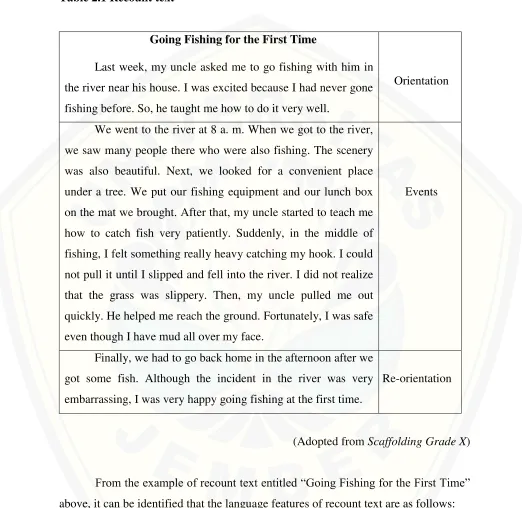
The following text is an example of recount text with the main components
adopted from English textbook entitled Scaffolding (English for Senior High School
Students) Grade X written by Priyana, et al. (2008: 85). Some adaptations of this text concerning with the content of the story. For example writer‟s personal comment is added in the text in order to make the readers clearly understand with the events of
Table 2.1 Recount text
Going Fishing for the First Time
Last week, my uncle asked me to go fishing with him in
the river near his house. I was excited because I had never gone
fishing before. So, he taught me how to do it very well.
Orientation
We went to the river at 8 a. m. When we got to the river,
we saw many people there who were also fishing. The scenery
was also beautiful. Next, we looked for a convenient place
under a tree. We put our fishing equipment and our lunch box
on the mat we brought. After that, my uncle started to teach me
how to catch fish very patiently. Suddenly, in the middle of
fishing, I felt something really heavy catching my hook. I could
not pull it until I slipped and fell into the river. I did not realize
that the grass was slippery. Then, my uncle pulled me out
quickly. He helped me reach the ground. Fortunately, I was safe
even though I have mud all over my face.
Events
Finally, we had to go back home in the afternoon after we
got some fish. Although the incident in the river was very
embarrassing, I was very happy going fishing at the first time.
Re-orientation
(Adopted from Scaffolding Grade X)
From the example of recount text entitled “Going Fishing for the First Time” above, it can be identified that the language features of recount text are as follows:
1. The sentences in the recount text are in the form of simple past tense. For
his house”. That sentence is in the form of simple past tense because the verb used is “asked” as the past verb from of the verb “ask”;
2. There are some action verbs used in the text above such as “went, got, taught,
looked for, put, started, pulled, slipped, fell and helped”;
3. There only eight adjectives used in that text: “excited, beautiful, convenient,
heavy, slippery, safe, embarrassing andhappy”. Moreover, the adverbs of the text
entitled are “last week, well, patiently and quickly”;
4. There are some conjunctions used in the text such as “and, so and because” in
which the function is to link the clauses within the sentences. Besides, there are
time connectives used in the text above. They are “next, then, after that and
finally” in which the function of the connectors are to connect the separate event of a paragraph into a cohesive text;
5. The sample text above uses pronouns: “I, my uncle and we”. They function to
introduce the personal participants of the text.
2.6.1 Types of Recount Text
There are some types of recount text that students need to know. According
to Barwick (1998: 4), recount text consists of personal, factual and imaginative
recount. Barwick (1998: 6) classifies recount text into three different types based on
the audience of the story, the tense used, the language used, the participant of the
story, the additional details of story and the series of events that include the sequence
details of who, what, when and where the events of story happened.
This research only focused on writing personal recount since the writing of text based on students‟ personal experience. It would be interested, because every student certainly has an experience. Moreover, by writing personal recount about
their experience, hopefully it helped students develop the idea of story easily because
2.6.1.1 Personal Recount
Personal recount is retelling the events that have been experienced by the
writer himself. It means that the writer has been personally involved in this type of
recount. It is usually written in the first person (i.e., I and we). Moreover, since
writers sometimes choose an interesting idea by adding some humors for the content
of story, both children and adults can read this text. Next, the tense used in this type
of recount is past tense and the language focuses on the use of emotive language to
influence the readers‟ feeling. For example, I was very tired with all of activities and
I was disappointed with my exam score. It is generally found in diary entry and letter.
The following text is an example of personal text “Diary Entry” adopted from
an English textbook entitled English on Sky 2, written by Mukarto, et al. (2004: 106).
The adoption of the text below was dealing with the content of the story. It included
the rearrangement of some sentences in a text and the additional of time connective
to make it clearer.
Diary Entry
Dear diary,
This morning, my friends and I went to the arts camp by bus. It
took an hour to get there. We were welcomed by some people there as
our guides during our visit.
First, we went to the arts studio to see the paintings and statues.
Then, we continued our tour to the film and music studio. We saw a
film making and tried some music instruments there. On the way to the
dormitory, we stopped in the shop to buy souvenirs. After that, we
walked to the dormitories through a small beautiful garden. There were
two dormitories, one for male students and the other one for female
students. From the dormitory, we went to the beautiful lake. We saw
Finally, we had lunch with Shanti as the owner of the arts studio
and took some photos before we got back to our bus. It was a tiring day
but we were very excited. We also planned to join the program there.
(Adopted from English on Sky 2)
2.7 The Teaching Writing to the Tenth Grade Students at MAN 1 Jember
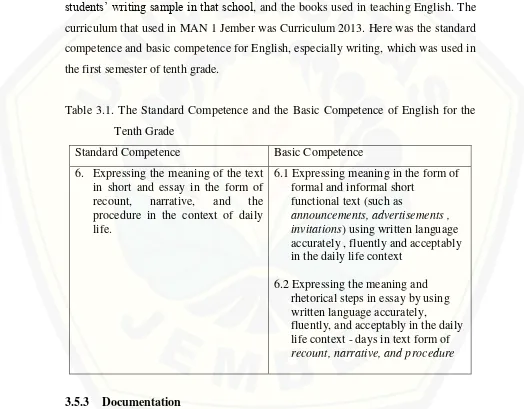
MAN 1 Jember applied the 2013 Curriculum which one in the first year
students, a set of teaching writing activities has been listed in the curriculum. This
curriculum also covers teaching writing recount text to the students. Teaching writing recount text to the students can be conducted through students‟ personal experiences. Therefore, teaching writing recount text about the personal experience
has been stated in curriculum 2013 for Senior High School.
Based on the result of an interview with the English teacher of the X MIA 1 Students‟ in MAN 1 jember, it was known that teaching writing recount text to the tenth grade students of MAN 1 Jember was focused on the personal recount text.
Through personal recount text the English teacher that her name is Mrs. Lutfi asked
students to write recount text based on their own experiences of holiday. This means,
the students wrote the activities that they did or the events happened when they
enjoyed their holiday.
The English teacher also explained that teaching and learning writing recount
text was conducted in two meetings. Each meeting consisted of two hour lessons in
which one hour is about 45 minutes. To sum up, the process of teaching and learning
of writing recount text to the tenth grade students of MAN 1 Jember took about 4
hours with the time allocation was 180 minutes.
There were some steps done by the English teacher in teaching and learning
process of writing recount. In the first meeting, the English teacher started the lesson
make the students understand with the story and the students listened the story of the
English teacher. After she finished telling her story, she asked some leading questions related to the English teacher „story with the purpose to give them a view to the material that they would learn. Mrs. Lutfi let some students answer those
questions then she explained that her experiences and her activities happened could
be developed into written text called as recount text.
She continued the lesson by explaining the definition of recount text
including the purpose of that recount text to the students. She showed the students a simple of personal recount text provided in the textbook entitled “English Alive” by presenting it in LCD projector. Before she continued the teaching by analyzing the
generic structure and language features of the text, she asked to the students about
the difficult words. She asked them to find the meaning of those words in the text by
using their dictionary and also asked them to write those difficult words with the
meaning in their book. Then, she explained the generic structures to the students and
showed the example of sentences or paragraph of each part in generic structure of
recount text. Eventually, the explanation of generic structure of recount text was the
last explanation in the first meeting. In the closure, she reviewed the lesson about
recount text by asked them the definition of recount text, the purpose of the text and
the generic structure of the text.
In the second meeting, The English teacher did not forget to review the lesson
or explanation about recount text in previous meeting by asked them again the
questions relating to the topic. Then, she continued the lesson by giving explanation
to the students about the language features of recount text gradually. Finally, at the
end of recount text explanation, the English teacher asked them to write their own
recount text based on the events that they had been experienced.
In summary, since the writing of recount text is stated in the 2013 curriculum
for senior high school, the teaching and learning writing recount text had been
writing recount text of the tenth grade students in MAN 1 jember had been
conducted in two meetings with the focus on the personal recount. In the first
meeting, the English teacher focused on the explanation of definition, the purpose,
the text example and the generic structure of recount text. In the second meeting, the
English teacher continued the lesson by explaining the language features of recount
text and asked students to write their own recount text based on their experience.
Thus, the procedure of teaching and learning writing recount text to the tenth grade
students of MAN 1 Jember had been done through the clear steps with the sequential
activities.
2.8 The Assessment of Writing Recount Text at MAN 1 Jember
The assessment of writing recount text of the tenth grade students in MAN 1
Jember was carried out by the English teacher of that class at the end of the lesson. The teacher assessed the students‟ writing recount text by considering some writing aspects. Those aspects were content of writing, the word choice, the sentence
structure, the mechanic, the coherence and the unity of the text. However, all those
writing aspects were not assessed individually by the teacher. She assessed the students‟ writing by including all the aspects on the criteria of writing assessment and considering all of them simultaneously.
Since the teacher did not score the aspect of writing separately, the score of the students‟ writing recount text was certainly in the form of a single score. The single score given by the teacher to the students‟ writing was an overall score of five writing aspects. Therefore, it was known that the teacher assessed students‟ writing recount text based on the scoring method called as a holistic scoring method.
In summary, the assessment of writing recount text of the tenth grade students
at MAN 1 Jember used holistic scoring rubric. The teacher scored the students‟
writing samples by considering all of writing aspects in which all those aspects were
could assess the students‟ writing quickly. It did not need more time because the teacher was only required to make one single score for each writing sample as a
whole score. However, the students certainly would not know in what aspects they
needed to improve because there were no detail score on each aspect of writing.
CHAPTER 3. RESEARCH METHODOLOGY
These chapters are presented the research methodology applied in this
research. It covered research design, the operational definition of the terms, area
determination method, subject determination method, and data collection methods.
3.1 Research Design
This research was intended to describe the tenth year students' writing ability
at MAN 1 Jember in 2014/2015 academic year.
The research design was conducted based on the following steps:
1. Determining the research area purposively
2. Collecting Supporting data by interview and documentation
3. Determining the respondents of the research, the class X MIA 1 students of
MAN 1 Jember by using Purposive Sampling.
4. Constructing the research instrument in the form of recount text writing test to get the main data of students‟ writing ability.
5. Consulting the research instrument to the teacher and the consultants
6. Collecting the primary data by giving writing test to the respondents
7. Analyzing the results of the test
8. Classifying the result of the data analysis based on the classification of the score
levels quantitatively
9. Concluding the research result descriptively to answer the research problem.
3.2 The Operational Definition of the Terms
Operational definitions of the term were intended to avoid misunderstanding of
the concepts used in this research. The terms that were necessary to be defined
operationally were as follow:
Descriptive study in this research means a type of research that tried to
describe the real condition in the field that was the students' ability in writing a
recount text.
2. Recount text
Recount text is a text which retells events or experiences in the past. Its
purpose is either to inform or to entertain the audience. Recount generally
begins with an orientation which gives the reader the background information
needed to understand the text. It tells about who involved and where it
happened. Here the recount text used was personal recount text. This research
only focused on one type of recount text, namely personal recount text. It has
been choosen because of some reasons. The first, it was taught in the first
semester of the class 10 and also it was appropriate for the students‟ level. The
second, recount text was related to their experience, since the text which retell
the past events or experiences that have been experienced by the writer.
3. Writing Ability
In this research writing ability referred to the students' ability in writing a
recount text in the form of scores measured by writing test on the aspects of
content, organization, vocabulary, grammar, and mechanics. The writing test
was limited with the minimum of 10 sentences written by the class X MIA 1
with chose only one of the five topics given.
3.3 Area Determination Method
The area determination method was determined by using purposive method.
According to Arikunto (2002:127), a purposive method is a method used based on a
certain purpose and reason. In this research, the area of the research was MAN 1
Jember. It was determined as the area of this research form some reasons. Those
reasons were as follows: