T
eja
Tscharntke,
Christoph
Leuschner,
Manfre
dZell,el
Edi Guhardja,
Arifuddin
Bidin
(Eds.)
I
Stability
of
Tropical
Rainforest
Margins
Linking
Ecological, Economic and
Social
Constraints
of
Land
Use
and Conservation
With 89 Figures, I in colour
Aspringer
PROPERTYOF
Epmons:
Pnor. Dr Trlr Tscrunxrxe
AcRoecolocy Cnoup
UNlvensrry or GOTTTNGE^*
W^LDWEG 26,
37073 GOrfl Ncex, GeR}rexy
E-mail: tt [email protected]
Pnor. Dn- CunrsropH LEUscHNER
DEPanrlrrlr oF PLrr...r ScrENcEs UNlvERsrry oF GOTTINcET{ UNTERE K^Rsp0LE 2
37073 ftTilNGEN, Genxrxv
E-mail: [email protected]
PROF. DR- MANpg.6p lrr r rR
INsnrLrrE oF AGRICULTUML EcoNoMtcs
AND SoclAL SCIENCFJ tN THE TRoplcs AND
Suatnortcs, UNIvERsrfi oF HourNHrru
(4e0)
70593 STurrG^RT, GERM ANY
E-mail:
PRoF. DR- Eor Guneno,a
CrNren ron TRoptclL FoREsr MeecrN,
INsrrrur PErraNl,tN BocoR (lpB), II.
R.AYI GUNUNG GEDE, BocoR 16153,
lxpoNrste
E-mail: storma- [email protected]
Dn- Antruoptx BrorN
UrrvensrT^s TADUL^Ko, Keupus
Buur Toxoo, PALU 941 18,
IxpoNEsra
E-mail: [email protected]
ISSN lE63-5520
ISBN
lO
3-540-30289-I
Springer Berlin Heidelberg Newyork
ISBN
l3
978-3-540-30289-6 Springer Berlin Heidelberg Newyork
Librery of Congress Control Numbcr: 200693t194
This work is subta ro copyrfhr. All rights erc rescrvcd, whethcr the whole or part of the mtrerial is
concerncd, rPc,cificrlJy thi riglrtr of traiuhtion, rcprinting, reuse of illustretioni rccitstion, broad-c.strn& rcProduction on microfilm or in eny othcr rey, end storrq" in &t. brnts. Duolicrtion of
thir publicetioa or perrr thcrcof is pcrmincd only undlr the proviiions of the Ge-rmen'Coorie hr l:w
o[Scptcmbcr 9, 1965, in iu currurt vttrbn, rnd icrmission for usc must dwevr bc obrein'ch fro-Springer-Verleg. Viohtions ert lirblc to pruccuiion undcr the Gcrmen Copyfight I-rw.
Spriagcr ir.e prrt ofSprlngcr Scicacc+Buriocrs Mcdie tpnnteronhnc.€om
G Springer-Verhg Bcrlin Hcidelbcrg 2007
Tbc-usc ofgcnerel descriptiw nrores, regirtcttd nrmes, tndemrrks, ctc. in this publicrtion doer not imply, evcn in thc ebrcnci of r spgcific cirtcmcnt, thel such nunes rrc cr.mpt 6om the rdcy.ot
pro-Itctiythws rnd rcguletions end:thereforc frec for gencre.l usc.
C,ovcr design: E Kirchner, Heidelbcrg Production-: A. Oelschllaer
Typcsctting: Crmerr.rcidy by Dr. Stclla Arpclrncier
Contents
.zl
The
stability
oftropical
rainforest margins,linking
ecological,economic and sociar constraints
of
land
use and cJnserva"tion-
anintroduction
Teja Tscharatke,
Ch*toph
Leusclmer, A{onfid. Zeller. Ed.i Gulnrd,ja,Arifuddin Bidin.
Part
I
Ecologicaland
socio-c'conomic impactsof different
f".*,
use intensitic's
Ecosl'steni decal'
of
Ar,azorria,
forest fragrnents: implicationsfor
conserlationlltilliamF.Laumnce
._....
ll
Moths
at
tropical forest
nrargins-
rrow mega-diverse insect assemblages respondto
forest disturbance and recoveryKonmd. Fiedler, l,{adtnc
Htlt.
Cunrar Brc.ltm, Ctti.cJlianH.
Schulze. ...
.
39Amphibian
communitiesin
disturbed
forests: lessonsfrom
the
Neo- andAfrotropics
Raffoel Entst,
K.
Eduatd Linsenmair, Roquel Thomas, Ma*-OliuerReidel'
....
6r
Fine
root
rnass,distribution
and
regenerationin
disturbed
primary
forests and secondary fioresisof the moist
tropicsaebich
Herlel, chrbtoph l*tschner, Morieke Horteueld,, Mariowicas.
ggSurface soil organlc carbon pools,
mineralization and
CO2effiux
rates.underdifferent
land-use typesirr
CentrJ
F;;-,',"
VI
ContentsForest
structure
as influenced bydifferent
types of communityforestry
in
a
lower montanerainforest
of
Central
Sular*'esi,lndonesia Johonnes Dietx ,
Amran
Amir
..Dirk Hokcher. Chr*topit Leuschner, Adam
t{aiik.
l'{'Impact of
forest disturbance andland
use change on soil andlit[qarthropod
assemblagesin
tropical rainforest
margins Sonfi )?rgge-Kleian. Lars l1'oltmann. Iswandi Anas, Vlenke Schulz'Economic erraluation
of
ecosystem services asa
ba-sisfor
stabilizing rainforest
margins?The
exampleof
pollination
s€rvices and pest management
in
coffee landscapesRolond Olschewslci, Teja Tschoratke, Poblo
C'
Beaitez, Stefonr33
149
Andre.a S tein grebe, Iv.f otthias S ch aef er
Flom
ecologicalto
political
buffer zone:ethnic politics
andforest encroachment
in
UplandCentral
SulawesiIletaniAbdulkadir'Sunito, ll.T.Feltr
Sitorus
'''''167
Assessing economic preferencesfor
biological
diversity
andecosystem services
at
thecentral
Sulawesirainforest
margin-
a choice experiment aPProachJon
Barlqnann, Klous Glenk. Hondian Hondt, Leti Sundouati,Jon-Patrick l4tttte, Roiner
llarygrul
""" "
181Forest
Products
and Household Inconres: Evidence fronrRural Househol& Living
in the Rainforest lr{arginsof
CentrdlSulawesi
Sfelan Schuarze.
Bliirn
Schtppers. Roberl ll'cher.
Hciko Faust. .ldhilya ll'ardhono, tlanlrct Zeller, ll'enrerKrcuel'
' " "
' 209Part
II
Sustainable management ofagroforestry
s1'stenrs Shaded coffeeand the
stability of
rainforest margins
innorthern
Latin
AmericaIuette Perfecto, Inge Armbrecht, Stacy
lt.
Philpott, Lorena Soto-Pinto,Thomas V. Dietsch. 227
Schworze,
Alaotdn
Moria Klein 26sInsect
diversity
responsesto
forest
conversion and agroforestry.. managemeuttini*
tl.
gis, Potri*
H6hn, Shahabuddin Saleh, Borb Biche'Contents
Pla-nt
diversity
in
homegardensin
a
socio-economic and agro-ecological contextKatla Kehlenbeck, Hadi Susilo
Arifin,
Brigitte L.l{aass
...2g7
Tbee species
diversity relative
to
humanland
usesi.
tropical
rain
forest marginsin
Central SulawesiS. Robberl Grodstetn, llichael Kessler. Ramadhantl
pitopang
. . . .321A
{rrnat
ivesrto slash-and-burnin
forest-based fallow systemsof the
east'ernIlrazilian
Amazon regiorr: Technology andpolicy options
to halt
ecological degradationand
improverural
welfareJon B6rner, Monfred Denich, Ar*be l{endoza-Escalonte, Bettina
Hedden-Dunkhorst, Tatiana Deane de
AbrctSd....
...335
Protecied Area
Management and Local Benefits-
A
casestudy from
Madagasca.rKlas Sonder, l{onfred
Zeller.
...365
Part
III
Integrated
conceptsof
land usein
tropical
forest marginsPotentials
to
reduce deforestation by enhancingthe
technicalefficiency
of
cropproduction
in
forest margin areasAlwnKcil.
RcginaBiraer,l{anfrcdZellcr.
...3g1
WI
Migration
and use change inlndonesia
ethnicity
ascultural
impact
factorson
landthe
rainforest marginsof
Central
Sula*,esi,Robcrl ll'cber,
He*o
Faust, Bliirn Schippers, Sulaiman Atamar.Endrialno SularTo, ll'erner
Krciset
...417
Flom
globalto
regional scale: Remote sensing-based conceptsand methods
for
mapping land-cover and land-cover changein
tropical
regionsstetoa
Enxni,
I*{arrin Koppas, Andrd rwele, ttuhommad Adiansyah..43r
Effects
of
land-use chgng€ onmatter
end energy exchaugebetween
eccysternc
in
the
rain
forrestmargin and
theatmosphere
Andrcas lbtom, Alesander Olhhea, Tonia June, Thomas Rnss, Heiner
Krcilein, Ulrike Folk, Johonne-s Ma&ein, Andr6 Twele, Gohm
Ra*hibl4 Stefgn Grote,
Ab&l
Rauf, Gode Gmvenhorst ..
- . . . . iOfScience
and technolory
and sustainable developmentin
Brazilian
AmazonVIII
Contentslndexofkeyu'ords....
...513
List
of Contributors
Melani Abdulkadir-Sunito
Department of Comn.runication and Conrmunity Developnrent, Facultl' of Human Ecolog', Bogor Agricultural Unir.ersit1., Indonesia
Tatiana
Deane deAbreu
Sd Enrpresa Brasileira de PesquisaA gropecuriria, Embrapa Sede.
P;rrrlrre Estagao Biol6gice
-
PqEB s,'n.. Bra-sflia-DF.-
Brazll-
CEP7077G901
Di6genes S. Alves
Instituto Nacional de Pesquisas
Es-paciais
(l\PE).
Av d<x; Astrorrautas 1758. CEP 12227-010 Sio Jose dosCampos SP, Brazil
M.
Amran
Amir
Institute of Forest hlanagenrent, Faculty of Agriculture, Bumi Tondo Carnpus, TMulako University, Palu 94118, Indonesia
Iswandi
AnasLaboratory of Soil Biology, Soil Department, Faculty of Agriculture,
Institut
Pertaoian Bogor (IPB), Darmaga Campus, Bogor 16680, Indonesia
lrtluharnmad Ard iansyah Institute of Soil Sciences, Bogor Agricultural Univemitl' (IPB).
Bogor, Indonesia
Hadi
SusiloArifin
Departrnerrt of Landscape
Architec-ture, Facult.v of Agriculture, IPB.
Bogor, Indonesia
Lrge
Armbreclrt
Dcpartanrento de Biologia, Universi-dad de \/alle, Apartado A6rc.o 25360.
Cali, Colorrrbia
Jan Barkmann
Junior Scientist Croup "Economic
\taluation of Ecooystem F\rnctions and Services" and Environmentai and Rq;ource Economics, Depart-ment of Agricultural Economics and Rural Development, University of Gottingen, Platz der G<ittinger Sieben 7, D-37073 Grittingen, Germany
Pablo
C.
BenftezDepartment of Economics, Uni-versity of Victoria, PO Box 1700
STN CSC, Victoria BC V8W 2Y2,
C*rd"
X
List of ContributorsArifuddin Bidin
Unit ersitas Tadulako, Kampus Bumi Tondo, Palu g4i18, Indonesia (Sulteng)
Regina
Birner
International Food policy Research
Sili;:lr.PRr),
lvashington, . 7Jan Bcirner
Center for Deveiopment Research
(ZEF), Universitl' of Bonn,
\Va.lter-Fiex-Str. 3, 53113 Bonn, Cermanl.
Ivlerijn
M.
BosInstitute of Agroecolop., University
of Gcittingen, Waldweg 26, D-37073
G<ittingen. Germany
Gunnar
BrehmInstitut
fiir
Spezielle Zoologie unrj Evolutionsbiologie nritplr-r.le-tischern l\luseunr, Universitl. of Jena, Erbertstrasse
l,
02745 Jena. German.t.Damayanti Buchori
Department of Pest and plant
Diseases, Faculty of Agricutture IpB,
Bogor Agricultural University, Jl. Kamper Kampus,
IpB
Darmaga, Bogor 16680, IndonesiaBoris
BiicheAgroecologi, Unirrersity of G6ttingen, Waldweg 26, D-ITOZJ ()iittingen, Germany
Manfred
DenichCenter for Development Research
{ZEF), University of Bonn,
Walter-Flex-Str. 3,
53ll3
Bonn, CermanyThomas
V.
DietschInstitute of the Environmen[. Center for Tlopical Research, Universitv of California, Los Angeles. La Kreiz Hall, Suite 300, Box g51496. L,os Angeles. California 90095_1496. USA
Johannes
Dietz
Tropical Silviculture. Institute of
-S-ilviculture, Universiry of Giittingen. Biisgenweg
l,
JT\TT Gcittingen. Cernrany andPlant Ecolog'.
Albrecht-von-Haller-Institute of Plant Sciences.
Universitl' of Gcittingen, Untere
.Karspiile 2, 3Z0IJ Grirtingen, Germany
Stefan Erasmi
hrstit ute of Geograph"r.. Departnrenl
of Cartographl', GIS an<l Rcrrrolc
Serrsirrg. Ulrir.eruit1. of Crittilrgt,rr.
Goldschmidtstr. 5, 37077 Gcittirrgen.
Cerrnan-r'
R.affael
Ernst
Departmerrt of Aninral Ecologr. and
Tropical Biologr.. Bioct,nter Urri_
tcrsit-r' of \\'iirzburg, .{nr Hubland
9707.1 \\'iirzburg. Gerrnanr.
Ulrike
FalkInstitute of Bioclimatolog.,
Uni-versitl' of Gcittingen, Biisgenneg 2.
Gcittingen, Gernranl'
Heiko Flaust
Department of Cultural and Social Geography, Institute of Geography, University of Gcittingen, Gold-schmidtstr. 5, D3TOTI Ccittingen, Germany
konrad
FiedlerDepartment of Population Ecologr,
University of Vienna, Alth""<trasse
Klaus Glenk
Junior Scientist Group "Economic
Valuation of Ecosystem Fulctions
and Sen'ices" and Enr.ironmental
and Resource Economics, Deparf-Dlent of Agriculrural Economics and Rural Development, University
of Gdttingen, PlaLz der Gcittinger
Siebert.
D-37073 Gdrringen. Germanl'S.
Robbert
GradsteinInstitute of Plant B.ieoc"s,
Univer-sitl' of Gdttingen, Untere Karspiile
2. 37073 Gottingen, Germanl'
Gode Gravenhorst
Institute of Bioclimatologr,
Uni-versitl' of Gcittingen, Biisgenweg 2,
Ccittingen. Germany Stefan Grote
Irrstitute of Bioclimatolory,
Uui-versitl' of Giittingen, Biisgenn'eg 2,
Gottingeu. Gernranl'
Edi
GuhardjaKaurpus IPB Baranang Siang,
Ex-.{,ula Kanlor Pusat, Institut Per-tani:rrr Bogor. JL Ral'a Pajajaran, Bogor
16l{{.
Indonq;ia (Jabar)Handian Handi
Laboratorl' for Social Forestry,
Fac-ultl' of Forestry', Institute Pertanian
Bogor. Bogor. Indonesia
Marieke Harteveld
Plaot Ecologi, Albrecht
rron-Haller-Institutc of Plant Scieuces,
University of G<ittingeu, Untere
Karspiile 2, 37073 G6ttingen, Germany
Bettioa
Hedden-DunkhorstFederal Agency of Nature
Conser-vation (BSI), Konstaatinstr. 110,
53179 Bonn, Germany
List of
Contributors
XIDietrich
HertelPlant Ecology,
Albrecht-von-Haller-Institute of Plant Sciences,
University of Gcittingen, Untere
Karspiile 2, 37073 Giittingen, Germanl'
Nadjne
Hilt
Ch'air of Animal F,colog' I,
Univer-sity of Bal,reuih, 95440 Ba1'reuth, Germany
Patrick
H6hnAgroecolog', Universitl' of
G<ittingen, Waldweg 26, D-37073 Grittingen, Germany
Dirk
HdlscherTtopical Silviculture, Irutitute of
Silr.iculture, University of Gcittingen. Biisgenn'eg
l,
37077 Gottingen,German.r'
Andreas
Ibrom
Institute of Bioclimatologl',
Uni-versity of Giittingen, Biisgenweg 2.
G<ittingen, Qsrman)' and Riso National Laboratory, Fled-eriksborgvej 399, DK-4000 Rmkilde, Denmark
Tania June
Southeast Asian N{inisters of &luca-tion Organization Regional Centre
for Tbopical Biolory (SEAMEO
BIOTROP), BTIC Builrli"g, Jl. Raya
T[jur
Km.6, Bogor, Indonesiaand
:Faculty of Mathematics and Natural
F[esources, Bogor Agricultural
XII
List of ContributorsMartin
KappasInstitute of Geographl', Department
of Cartography, GIS and Remote Sensitg, University of Gdttingen. Goldschmidrstr. 5, 37077 Gtittingen, Gernranl"
K^B
KehlenbeckDepdrtrnent of Crop Sciences: Tropi-cal Crops, University of Gottingen, Grisebachstr. 6, D-37077 Giittingen,
Genuan\'
Alwin Keil
Institute of Agricultural Economics and Social Sciences in the T\'opics and Subtropi<s, University of Ho
henheim (490). D-70593 Stuttgart,
Germant'
Ir{ichael Kessler
Institut! of Plant Scicnces.
Uuivcr-sitl
of G<ittingcn. Ulrtert- KarsJliile2. 37073
Gi5ttingen. Germant'
Alexandra-Ir{aria
Klein
Agroc.colop'. Llnitersit)' of Giittingen, \\hldweg 26, D-37073 Giittingen, Germany
Heiner
Kreilein
Institute of Bioclimatologr,
Uni-versity of G<ittingen, Biisgenweg 2,
Giittiagen, Germany
'Werner Kreisel
Department. of Cultural and Social GeographS Institute of Geography, University of Gittingen, Gold-sctrmidtstr. 5, D-37077 Giittingea,
Germany
William
F.
LauranceSmithsonian Tlopical Research
Institute, Apartado 2072, Balboa, Republic of Panamii and
Biological Dynamics of Porest Frag-ments Project, National Institute for Amazonian Research (INPA), C.P. 478, It{anaus, AIU 69011-970, Brazil
,,7
Christoph-L-euschner Plant Ecolog', Albredrt-von-Haller-Institute of Plant Sciences,
University of Gi5ttingen, Untere
Karspiile 2, 37073 Giittingen,
Germany
K.
Eduard LinsenmairDepartment of Animal Ecolog' and Tlopical Biologr, Bioceuter
Uni-vcrsitl'of Wiirzburg, Am Hubland
97074 \\'iirzburg. Germany
Brigitte L.
Ir{aassDcpartment of Crop Sciences:
Tropical Crops,
Universitl' of Gcit tirrgeu, Grisc..
baclrstr. 6, D-37077 Giittingen,
Gcrtnanl'
Adam
Mdik
lnstitute of Forest lr{anagement, Faculty of Agriculture, Bumi Tondo Campus, Tadulako University, Palu 94118, Indonesia
Sulaiman Mamar
Department of Anthropolory, Universita.s TMulako, Kampus Bumi
Tondo, Palu 94118, Indonesia
Ra.iner
Marggraf
Environmental and Resource Eco
uemics, Department of Agricultural Economics and Rural Development, University of GSttingen, Platz der
Gittinger Sieben 7,
Arisbe
Mendoza-EscalanteCenter for Development Researclt
(ZEF), University of Bonn,
ldialter-Flex-Str. 3, 53113 Bonn, Gerrnanl'
Johannes
Merklein
Institute of Bioclimatolog',
Uni-versitl' of Gcittingen, Biisgenweg 2.
Gdttiaren, Cermen)'
Sonja Migge..Kleian
Ecology Croup, Institute of Zoolog',
Universitl' of Ccittingen. Berliner
Str.asse 28, 37073 Giittingen,
Germany,
Roland Olschewski
Institut.e of Forest Econourics. University of Giittingen, Biisgenweg 5, D-37077 Giittingen, Gernranl'
Alexander Oltchcv
Irutitutc
of Bioclimatolo6'. Uni-vercit1' of Gcittingen. Biisgenscg 2.Grittirrge:r. Ccrnranl and
A.\.Severtsov Insrir ulc of Ecologr.
and Evolution of the Russiona
Acadann' of Sciencts (IiAS). 33
lrninskiv
Prtxp.. \l.xcorv I 19071. RuqsiaElise Pendall
Departnrent of Botanr.. 1000 E.
University At.e., Unirersitl- of W1'onring. Laramie,
\\Y
82071. USAIvette
PerfectoSclool of Natural Resources and
Environment, Dana Building,
Uni-versity of Michigan, 440 Church St. Ann Arbor, MI48109, USA
Stacy
M. Philpott'
Smitbsoniai Migratory Bird Center, National Zoologicat Park, 3001 Con-necticut Avenue NW, Washingtoa, DC 2OOO8, USA
List of Contributors XIII
R-a.madhanil Pitopang
Department of Forest l{anagameut
and Herbarium Celebense, Tadulalio University. Palu, Indonesia
Catherine
Potvin
Departruent of Biolop', tr{cGill
Univemity, i205 Docteur Penfield, Ilontreal. Quebec/^{3A 1 B 1, Canada
Golam R^akkibu
Iustitute of Bioclimatolog,,
Uni-versity of G<ittingen, Biisgenweg 2,
Ciittiugen, Cermany
Abdul
R-aufTadulaku University (UNTAD),
Kantpus Bumi Tadulako Tondo, Palu
-
9lll8,
IndonesiaIrlark-Oliver
R6delDeJrartnrent of Aninral Ecolog' and Tropical Biolop', Biocenter
Uni-versitl' of \\Iiirzburg. Am Hubland 9707{ \\'iirzburg. Gerrrranl'
Thomas Ross
Insl itute of Bioclirrratologt'.
Uni-versitl' of Gcittingen, Biisgcnu.eg 2,
Gcittiugen, Germrn)'
Shahabuddin Saleh
Faculty of Agriculture, University of
Tadulako, Kampus Bumi Tadulako Tondo, Palu-lndonesia
Klas Sander
Forest Economist, Environment
Department, The World B8nk, 1818
H Street NW, Washington DC, USA
Matthias
SchaeferXtV
List of ContributorsBjiirn
SchippersDepartment of Cultural aad Social Geography, Institute of Geographl,, University of Giittingen. Gold_
schmidtstr. S, D-37OTI G<ittingen,
Germany
Wenke Sdrufz
Potilb
Group, Institure of Zoology, Uaiversity of G<ittingen, BerlinerStrasse 28, STATJ G<ittingen, Germaay
Christiarr
H.
SchulzeDepartment of Populatiou Ecolog.,
Unirersitl' of Vienna, Althanstrasse
14, 1090 Vienna, Austria
Stefan Schwarze
Institute of Rural Development. Uliversit_y of G<ittingen, \\'ald*.eg 26. D-37073 Gottingen,
German_r-Luitgard
Schwendenmann Tropical Silviculture. Institute of Siiviculture, Universitl. of Grittingen. Biisgenwegl,
37022 Gcittingen.Germanl-Ir{.T.Felix
SitorusDepartment of Communication and
Community Development, Facultl. of
Hunran Ecolog', Bogor Agricultural
University, Iudonesia
Lorena Soto-Piato
El
Colegio de ta Ftontera Sur,Unidad Sau Cristobal, Carretera Panamericnna
y
perif6rico Sur, ApartadoP6t8l
68. C.p. ?f/Z9O,San Cristdbal de las Casas, Chiapas, M€xico
Ingolf
Steffan-Dewenter Agroecologr, University of Grittingen, Waldweg 26, >37ATlG<ittingen, Germauy
Andrea Steingrebe
Ecolog, Group. Institute of Zoolog1.,
University of Gcittingen, Berliner Strasse 28, 37073 G<ittingen. Germany
Leti
Sundag'atiLaboratorl' for Social Fo;estr1., Fac_
ultl' of Forestrl.. Institut'e p-egtanian
Bogor, Bogor, Indonesia
Endriatmo Sutarto
Department
of
AgriculturalSocio-Economic Sciences, Institut
Pertanian Bogor, Jl. Raya pajajaran, Bogor 16143, Indone;ia
R^aquel Thomas
In'okrama Internationai Centre for Rain Forest Conscnation alrd Devel_
oprrrent, 77 IIigh Street, Kingstor. Georgeton'n, Gu1-ana
Teja Tscharntke
.{grocrologr'. Unir.ersitl. <lf
Giittiugen, \\'aldweg 26, D-37073
Gcitt ingetr.
Cernran.r-Andrd
Tr,r.elehNtitute of GrograJrh.t., Departnrent
of Cartographl', GIS and Remote Seusing, Universitl- of Gcittingen, GoldsdrmidtsLr. S, 3707T Gcittingen, Germany
Adhitya
WardhonoInstitute of Rural Development,
University of Ckittingen, Waldweg
26, D.3707 3 G<ittingen,' Germany
Robert
WeberDepartment of Cultural and Social Geography, Institute of Geography, University of Gittingen,
e-E
A
/--r,<
$ =\
-a
i'X
S(o
--o
$.1
;L ,\ <- \J
a)iY
(-,
>
\J
d
"\
tF
Plant diversity
in
homegardens
in
a
socio-economic
and agro-ecological
context
I
Katja Kehlenbeckr'. Hadi Susilo Arifin2, and Brigitte L. \Iaa^s-sr
!
Departnrent <.rf Crop Scierrces: Tropical Crops. Georg-August.-Universit1..Grisebachstr. 6, D-37077 Giittingen, Gernran5'
2 Departrnent of Landscapc .{rchitecture, Faculty of Agriculture, IPB, Bogor, Indonesia
*correspon<ling author: Katja Kehienbeck, phone +49-(0)5 1 1-393750, Email: ka tj a }ehlenbed< IO)'ahoo. de
Summary
Homegardens are generalll. regarded a^s
a
very conrplex, species-richagro-forc'stry' systenr managecl in a sustainable ruarurer over r]eearles or even
cell-turies.
In
nranl'densell. populated tropical regions, ltomegardens appeal to be the last fore;t-like islands surrounded by increasingll' extended, unifortn staple crop fields.With
their nrulti-layered vegetation structure, homegar-dens serve as an important habitat for wild flora and faunain
these areas.They fulfii not only iurportant ecological, but also rnan5' social and cultural functions. However, the major purposes o[ homegardens are subsistence
pre
duction atrd inconte generation, particularly in rural areas.At
forest rnargiu.s.high production levels
in
ltomegarden^s nright helpto
reduce dcfore.station.F\rrthertrtore, homegardens should be considered as a modcl [<rr sustainable
agroforestry syst.etns. integrating both econonric an<l ecological advantages. Plant diversity, as a basis for homegarden productivity and susiainabilitl" is
influenced by a combination of agpecological as well as socioecononric
[ac-tors. The complex interacLion^s of all these factors are not yet fully understood.
This paper presents an overview of the existing knowledge and identifies gaps
regarding the factors determining plant species diversity and compoition in homegardens. We further illustrate this with two case studies kom Indonesia
(Central Sulawesi and West Java), in which temporal and spatial variations were inv.estigaUed. In conclusiou, plant diversity was mainly inffuenced-by ele
r"ation as well &s commercialisation, urbanisation, and fragrrientation.
It
wasfairly dlrramic or.er time, particularly, when commercialisation wa.s pmsible'
To preserve the sustainability of homegardens and their suitability for in situ
Tschoralke
T,
Lesxschner C, Zeller M. cuhardla E. Bidtn A (*d"),The s|abtlily ol trcptcnl mtnfort,sl nrargrrls, lrnhr.ng ecologtcal, etanomtc and soclal con-sttzinLs ol198
K. Kehlenbech et al.tons€rvation of plant genetic resources, any promotion
to
iniensifl' produc-iion in ho*eg..derrs should consider the overall ecological functioning of the ;ystem in a landscaPe context.Keywor*: agro-biodiversity, agl&.ecosystem, agroforestrl'. commercialisation, iun-ction, homegarden,
in
situ conservation, plant diversity, plant genetic re-iources, species composition, sustainabilitl'. urbanisation. r'eget.at ionstruc-, ur",
*r"!i"tron
o)'namlc:;1
Introduction'
Honregardens are one of the nrost ionrplex and diverse agricultural s1'sLems
worl6wi6e. As their appearance is highll'r'ariable. tltere-are several definitions
,r[ this s1.stem. Honregarden-s are nrost]y defined a-s a piece of land
surroulrd-ing a homestead
tliai
is cultivated with a diverse mixture o[ perennial and apnual plant specie; arranged in a multi-la1'ered r,ertical structtlre' often in r:ombination *-ith raising livrxtock (Christantl' 1990, Kumar autl Nair 2004,Joemarwoto 1g87). Homegarden s1'stem-s have existed for ntillcnlria (lirtnlar and Nair 2004, Soeurarwoto an{ Conu,al' 1992) in many troPical regiotrs, r*'here
rhey' plal'ed an inrportant role tou,ards the development of earll' agricrtlture :rnd clometication o[crops and fruit trees (lr{iller and Nair 2005). Individual homegardens have been cont,inuously cultivated for nlany decacles and even centuiies, for example, in Sri Lanka (Hochegger 1998). For this rea^son, home-gardens are generally regarded as sustainable production systetns (clrristanty
igg0,
Kr-*
and Nair 2004, Landauer and Brazil 1990, Soemarwoto andCon-way 1992, Torquebiau 1992). However, quantitative srrpport for this statcnrent
is iare, a-s most of the published homegarden studies are rather de*;criptive- In addition, no long-term quantitative studl' of the sanre hotnegarden lur^s becn reported. This niight be due to the difficultiss in measuring sustainability per .r., rc"rlting in an inflirect asse;-sment by usilg more or letis widelt' accepted
sustainability indicaLors (Kumar and Nair 2004). Torquebiau (1992) and Hux-ley (1999) suggested several sustainabilitf indicators relatc'cl to thc resource t ase (e.g., soil, climale, biodiversity), the system's functioning (e'S'' manage!'
,r,".rt, outputs), and the impact of homegardens on oLher systenrs (e.g., forests, wildlife). Kumar ancl Nair (2004) present extensive data
of
several recent homegarden studies that mainly describe soil-related and socio-economicas-pects of sustainability. Biodiversity, particularly plant species diversity, is the sspect probably most frequeutly assessed in homegarden research. Numerous
prUti*tio*
described plant species and their uses in homegardens worldwide,".g., io Indonesia (AbJoeUah et al. 2002, Arifin et at.
1998, Kehlenbeck apd
M;
2004, Soemarworo 1987), vietnam(tlinh
et
al. 2003), fndia (Peyreer al. 2005), Sri Lanka (Hochegger 1998), Ethiopia (Tesfaye Abebe 2005),
Ghana (Bennett-Lartey et al. 2002), Tanzania (Hemp 2005), N{exico (Vogl et al. 2002), Brazil (Albrrquerqrre et al. 2005). Penr (coomes and Ban 200{). and
q
u
*
E
f
I I ! i
i ,
I
1
i i I I
l
Plant diversitf in hornegardens 299
Cuba (Castiieiras
et
a:..2002,\Vezel and Bender 2003). Because oftheir largecrop species and mrietal dir,ersity, honregardens are also regarded as an ideal
p.oductio., system for in situ conservation of plant genetic resources (Tbinh et
ut. ZOOS, \\ratson and E1'zaguirre 2002), crucial for the long-term
sustainabil-ity of agro.ecs).stern-s. L, udditioo, homegardens can contribute suhstantially
to the consenation of forest tree species, particularly where natrrral forests have larselv beeu replaced b1' agricultural fields (Hemp 2005)'
to
ilio'oi"
and ma*1- other tropical regions, the con'ersion of prin:aryforct
to
frequentll. unsustainable agricultural lands has increaseddramati-calll'. Forest margins are particularll' concerned due to eas)' access' evetl iIt
p.oiect"d area^. sircl, ,r-s natio'al parks. Sustai.able and producti'e
agricul-iural s1-stems urge't11. nee6 to be promoted in such agricultural frontier
ar-eas to re<l,ce t1e prcsrrre on further forest'conversion. Agroforqitry s]'stems
like honregardeus an<l forest gardens could sen€ as a rnodel for such sl'sterrts bccause ther. ofter an alterDative Iueasure for sustairtable use o[ natural
re-sources. However. ueither tlte functioning nor the potential o[ hornegardens |ave bcen sufiicier:t11'studied. Re;earch is nec{ed, particularll', cotrcerttittg ttu-trient and water balances, carbon sequest,ration, the value of non-conventional producis and services. sYstetn productivity, and sustairlability, iDcluding
teDr-poral changes (Kumar and Nair 2004)' Especially, changes of plant diversitl' and its <lriving factors Deed to be emp]rasised. This paper pres'ents firstly an
o'ervie*
of the existing knowledge on roles and functioning of homegardeus' Factors determining ptant species diversity and composition in homegardetr^sare discu:;-sed
in
nrore detail. Secondly, we illu^strate the complex influencco[ certain agro-ecological and socio-economic farctorc on plant diversity with tu,o case studies from ln4onesia (central Sulawe;i ancl west Java), in which
temporal and spatial variations were investigated'
2
State of
the
art in
homegarden research
2.1 The multiple
rolesof tropical
homegardensThe basic function of homegardens, especially
in
rural areas, is subsistence production (Figure 1) (Kumar and Nair 2004, soemarwoto and conway 1992).-g""uu""
of the high piant species diversity existing
in
homegardens' a wide spectrum of multiple-use products can be generated with relatively low labour,ca-sh or other external inputs (christanty 1990, Hochegger 1998, soemarwoto
and Conway 1992). Homegardens generally serve as a complement to staple crop fields by p.roducing
*Lnly
fruits, vegetables' spices, and many non-foodp.oiucts (figure
t)
(Ai-buquerque et al' 2005, Karyono 1990, Kehlenbeck andirlu*"
2964, Kumar a.,ditalr
2004, Michon andMary
1994' Peyre"et al'rc
:lili,3 ::"' j]00
K. Kehlenbeclt etal-products, including tho-se from animals
reard
in the gardens' have a ratherLigh nutritionat value in terms of protein' minerals' and vitamins
(Soemar-wotoandConwaylgg2).Asthesediverseproduclsareavailableyear-round' homegardens also contribute to food security in time-s or seasons of scarcity
(ChriJtaaty 1990, Karlono 1990)' Therefore, the importance of homegardens io, couoteiing malnutiition and food insecurity has attracted-increasing
at-rentiou- (Kumar and Nair 2004). This, for example, has resulted
in
several;;;;;t'i;;ir,"
p.on otion of growi.g vegetablesi.
tropical homegardens. as compiled b1' Helen Keller International (2004)'Homegarden
I
Subsistence
Commerce
ISocio-culture
+
@@
. Fruits
. Vegetables
. Spices
. Medicine
. Staple food
. Stimulants
. Timber
. Fodder
. Cash income . Gifls
. Sacrifices
. Pride
. Pleasure
. Aesthetics
. Employment
. Socialising
I
EcologY
i. Habitat for wild
flora + fauna
. Pest + disease
control
. Nutrient cYcling
. Microclimate
. Soil erosion
control
Fig. 1. Main functions of honregardens and selected products/outputs'
The second irnportant function of ho:negardens is the generation of ca'sh income, particrrlarlf in regions n'ith good nrarket acceas (Figure 1) (Christanty ct al. 1986, Ir1icho, uud tIu.1' 199{, Tesfal'e Abebe 2005' Tiinh et al' 2003)' l\,lost of the income is said to be derived from perennials suc]r as
fruit
trees' cacaor and coffee, but in peri-urban areas or tourist centres, also vegetables and ornamentals are frequently grovrn as cash crops (Abdoellah etal'
2002' Soemarwoto andCo'*ay
tOSi). 1.Ue portion of income from a homegardenmay vary from only l-7% (Ardn et al- 2005) to.more than 50% of the
house-holi's total income (Ttinh et al. 2003), depending on market &ccess, among
other factors.
In
additionto
the production, homegardern have important social and cultural functions (Abdoellah et al. 2002, christanty 1990, soemarwoto.andCon**y 1992). Thby are mostly 'open' for ever)'one' thus' providing a place
Plant diversity irr hornegardens 301
traditir,lal
weieties. Honregardens also serve as status s1'mbol arrd theas-thetic purpose partly outs,eigh the productive function, especially
in
urbanareas and better-off households (Arifin et al. lgg8. Karyono 1990). Sonre plant
species in homegardens are believed to have a rrragical value (Abdoellah et al. 2002), others are nece;sar)'for religious ceremorrie;, e.g., Hinclu Balinese farn-ilies need their homegardens as $urce and place for nraking sacrifices (Arifin et al. 2002, Kehlenbeck unpublished).
Hort"garden-s also
fulfil
ecological frrnctions (Figurel),
particularlr. in landscapes n'here large. ulotlotonous, and nronofurrctiorrirl agricultural fields dotuinate (Christanty 1990). The nrulti-la1'crcd vegetation structure o[lronre-gardelx is said to resenrble natural forests anrl offers a lra]litat for a diversc conrrnunitl' of rvild'plants and auinrals (-A.lbuquer<1rre et al. 2005, Hcnrp 2005.
Karl'ono 1990, Itlichon alrd
l\lan'
199,1). This structure al)l)ears to contritrutesubstantialll' to the sustainabilitl' o[ ]rornegarrlen s-r'sterrrs.
2.2 Biodiversity
as asustainability indicator
The multi-la1'ered vegetation structure iu honrcgai-dens. creatcd b1' the rvide
spectrurn of cultivated arrd rvild plants. al)l)ears t.o be responsible for nranl-other benefits/advantages of t his s)'stem. Tlie corrtribut ion of (uS.*)
biodiver-sity to (agro-)ecosystent functioning and sustainablc production is more and n)ore recognised both for man-nrade ancl uatural systens (Atta-Krah et al. 200{, Clergue et al. 2005. illain 1999, Schs'artz et al. 2000). On the one hand, intra-specific diveruitf is not onll'a ke1'soulce for breeding, but also inrportant for sustainabilitl' because
it
enables indivi<lual species to adapt [o a changing environment and, therefore, en.sures their long-tcrni survival (At,ta-Krah et al. 2004. lt{ain 1999). Inter-specific diversitl'. on the othcr hand, learls to impor-tant synergistic ecological proces.ses and enables ecos)'stem functioning. Thisrefers to eflicient, complementan' rssource utilisation. efficient nutrient
recl'-cling, and a low risk of soil erosion (Clergue et al. 2005, l\{ain 1999, Kumar
and Nair 2004, Soemarwoto and Conwar. 1992, Torquebiau lgg2, Wiersum
2004).
In
additionto
ccological aspects of sustainatrilitl', biodivcrsity also con-tribu tes to socio-economic sustai nabilitl.
of agro-ecos)'stenls. Prod ucti vi t1' ofa species-rich agro-ecosl.stern is generalll' rather high and stable because the multi-species system forms a btrffer against biotic (pasts and diseases) and
abi-otic (storms and droughts) stress (Atta-Krah et al. 2004. Clergue et al. 2005.
Wiersum 20[,4). Recent studies demonstrated the importance and monetary
rralue of plant diversity for pollination services; and pest control in agroforestry
sl.stems (Bos et al., this volrrme. Olschewski et al.. this volume). A diverse. multri-species production s):stem reduces the risk
of total
crop failure and' provides year-round arailable producls of high nutritional value. Thtrs, plant diversity contributes to su.stainabilitl,in
the aspect of household food302 K. Kehlenbeck et al.
wiersum (2004) stressed a further potential of multi-specie; agroforestry
s1's-tems torvards sustainability: a diverse range o[ useful plant species in a system enables its effective adjustment to changing socio-econotnic conditions and de' mands of future generations. Nevertheless. the suitabilitl' of biodiversity as an indicator to assess sustainabilitl' might be criticalll' examined because there
is no threshold yalue for an ideal number of species in a sustainable system (Ir{ain 1999). Biodiversitl. also seems to be highll' r'ariable over tinre, while
homefiden research has so far neglected to quantif-1'such changes'
2.3
Factorsinfluencing plant diversity
in
houlegardensGarden diversit.r' varies depending on a conrbinatiotr of extertral and intrinsic factors
thai
are related to garden featurt's. agro-ecolog'. and socioecotlotll-\'(Christanty et at. 1986. Hodel et
al.
1999). HoNt'r,er, plzillt diYcrsitf is not onl1. ilfluenced by clearly iden{ifiable sirrgle factors btrt ratlter l.ry' a cornplex interaction between several of thern. This irrteract.ion is not 1'et underrstood. a1d additional intrinsic factors, like inclividual 1>rc'ferettccs alrtl practiccs ofthe gardener, may even plal' an overriding role for the colnposition and level
of plant dir.ersity (Abdoellah et al. 2002. Castirrcir:us
ct
al. 2002, Hodel etal.
1999).In
addition, these factorsnla-\'r'ar)'itt thcir
relativc inlPortance over time and, thus, affect plant di..'ensitl'(Figurc 2). A better understandingof these interrelationships and the processes lezrding to them would help to
assess the sustainabilitl' of the s)'stem a-s u'ell as
its
suitabilityfor
in
sitttconservation of plant genetic resourcqs. 11e11' 5slsctc<l factors influence plartt
diversity in homegardens is presented below itr trtore dctail.
A gro - eco logi cal
f
act o r sAgro-ecological factors such as elevation. clirnate, or soil
fertility
might linrit plant diversityin
homegardens (Figure 3). I'lany homegarden studies havehighlighted the effect of elevation on plant diversity, u'hich, in te rms of specias
richness, generally decrea-ses with increasing elevation (0-1000 m) due to
de-crea^sing mean temperature (Hodel et al. 1999. Karyono 1990). 1'esfa1'e Abebe
(2005) also reported lower diversity indices
in
higher elevations (i500-2000 m). Lassfruit
tree species. but more vegetables antl nre<licinal plant speciesq'ere cultivated in homegardens of higher elevations (Castineiras eL al. 2002, Shrestha
et
al.2N2, Soemarn'oto and Conrval' 1992). However, research re'sults of Quiroz et al. (2002) in venezuela suggested that the highest diversity is found in homegardens of intermediate elevation (600-1300 m), where gar-deners have the opportunity to
cultinte
both tropical and subtropical usefulo'"lf,;
only temperature,
but
also precipitation influences plant diversity.Homegardens in West Java harboured higher plant diversity in the wet, than
in the dry season (Soemarwoto and Conway 1992). Plant diversity of
Ghana-ian homegardens was higher in the humid forest ecozones than in the hot and
l i l l l
l
I
i
Plant diversitv in honregardens 303
Fig. 2.
Schenratic illustration of the relatir.e inrport.ancc of different factors onplalt diyersity in homegardens and their tenrporal charrges. Here, the inrportance
o[ socic>econonric f:rctors (e.g., eornrnercialisation) itrcreases over tinre, while t,hat of
agr<recological cltaracteristics (e.g., infertile soil) decreases, for exanrple due to the
usc <-rf industrial fertiliser.
(lry sa\anna zones (Bennett-Lartel'
et
al. 2002).In
contrast, Cubanhome-gardcns harboured higher diversitl' urrder senriari<! conditions as conrpare(l
to humid conditions, caulied though
bf
irrigation (Wezel and Bender 2003)' Hou,ever. \?riation in plant. diversit)' might occur also due to small-scale cli-nlat.ic variatiou, like droughts caused, for example, bi' El Nino events (Figure 3).Soil fertilitl. is another agro-ecological factor that generates variation of plant cliversitl'.
but its
influence has not yet been studiedin
detail. Hodelct al. (1999) simpll'as-sumed an influence of soil factors on diversity *'ithout
quantif).ing t[is. In forest gardel.s, Kaya et al. (2002) reported lo*'er species
di-versitl. on marginal soils compared to more fertile soils. Ir{any crrltirated plant species, particularl)'vegetables end spices, do not give adequate yield under unfavourable soil conditious such as low pH value
or
P content. Therefore, gardeners might stop cultivating these species while switchingto
a reduced set of crops that can cope with low soilfertility.
.Gard.en feotutus
Within
the major factors influencing plant diversitn garden size is one ofthose frequently analy"sed. Among others, Abdoellah et al. (2002), Hodel et
{r
Agro- Socio-\
/tr:;\
/l
Plant
diversity
15
Plant
diversity
/
"
'i
so"ioi
304 K. Ketrlenbecli et. al
al. (1999), and Quiroz et al- (2002)
reportd
a positive relationship betrveengarden size and plant species richness.
In
snrall homegardeus, particularly iree species richnas decreased. resulting in a poor vertical vegetationstruc-ture. However, diversitf indices such as the Shannon index decreased u'ith
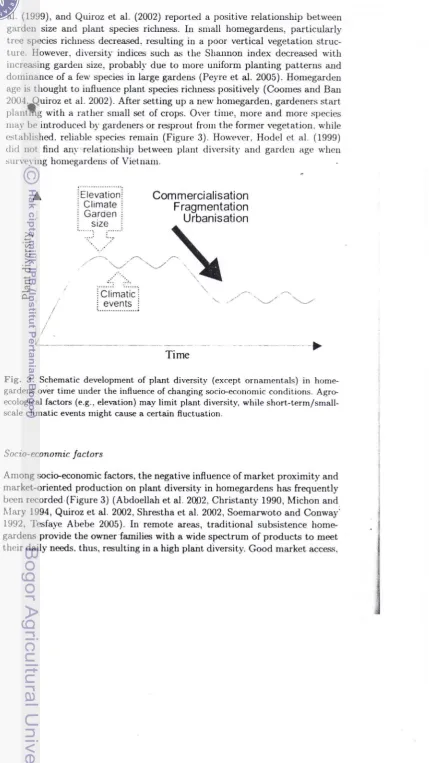
iucreasing gardeu size, probabll'due to nrore uniform planting patterns and dominance of a ferv specie; in large garderrs (Peyre et al. 2@5). Homegarden age is thought to influence plant specie; richncs positively (Coomes and Bau 2004-Quiroz et al. 2002). After setting up a ne\+' homegarden. gardeners start plantlfig u'ith a ratlrer srtrall set of crops. Over tirrre, ntore and nrorc species
ntay be introduced b1' gardeners or resprout front the former vegetation. while
e;tablished. reliable specics renrain (Figure 3). Ho*'ever. Hodel et al. (1999)
did not find an1' relat.iorr-ship betrveen plant diversitl' and garden age s'hen surveving homegardens of Vietuanr.
A
1
I
'6,
Lo,
EI
c
(!t
o.,
t/
:Elevation;
: Climate ,
:
Garoen i:
SlZe
:?/-\
-\
\/
.:. ,1..:Climatic .
i
events :1...
Commercialisation
Fragmentation
Urbanisation
i
ii
I lme
Fig. 3. Schematic development of plant diversity (except ornamentals) in home.
gardens over time under the influence of changing socio-economic conditions.
Agro-ecological factors (e.g., elewation) may limit plant diversity, while
short-term/small-scale climatic events might cause a certain fluctuation.
Socio- economic lactors
[image:21.595.87.517.39.803.2]Plant div-ersity in homegardens 305
on the other hand, ruight pruh gardeners fronr subsistence to serui-commercial
or cemmercial production. Pelre et al. (2005) and Shrestha et al. (2002) ar-gued that cultivation of cash crops. particutarll' of annual vegetables, leads to
decreasing numbers of perennials such as
fruit
and timber trees. Therefore. commercial hornegardens oft.en ladi the upper vegetation strata. The foctrs ofdevelopment agencie; on improring nutrition and income through the prome tion of mostly exotic, annual vegetables, might lead to such uegative effects
(Sluesthlet al. 2002). But also a slight.ll' positive relationship of plant species
ricltuess
*rd
the alnount of cash irrconre generatedin
the homegarden is rc'"ported (Hodel et al. 1999. Quiroz et al. 2002. Tiinh et al. 2003). This effect u'as explained br. higher labour investrneut in the conrrnercial honregardens. frorn which also suhslstence crops could profit. Possibll', a well-balarrced mix of subsistence and ca^sh crop procluction miglrt lead to higher platrt divemitr.. Besides commercialisation. the scarcitv of land generalll' alrc reduces the
biodiversit)' in honregardens. Faurilies rvith in^sufricient staple crop fields are forced to grorv high proportion^s of staples in their honregardens (Soentar*,ot.o
and Conn'a1, 1992). As manv staple food crops are light-dcrnanding, pereunials
like
fruit
or timber trees <lisappear from such hornegardens (Kar1'ono 1gg0).Urbanisation is alrc said to reduce plant. species diversitl. (Hodel et al. 1gg9,
Karyono 1990, trlichon and \I2'1' 1994). In peri-urban regious u'ith good acceris
to large nrarkets in the citl'. rnanl'traditional honregardens are converted into commercial
fruit
trc.eor
vegeiable garderLs, therebl' losing most of the lessproductive subsistence plarrts. At the highest urbanisation level, homegalden^s
are generally rather small and donrinated by ornanrentals. givirrg priority tr.r
the aqsthetic function instead o[ subsistence productiorr.
C ardeners' characteistics
Certain characteristics of the gardener and his/her household are known to in-fluence plant diversity iu homegarden-s. A gardener's age can influence plant diversitl' positively (Quiroz
et
al. 2002), possibll. becarrse. over the r.ears,gardeners
tri'to
cultivate nerv crops *'hile thel'continrre t.o plant rvell-tried species. In addition, older gardeuers often have more time for horrregardening and are supported by thcir gro$'n-up children. Conscquenlly, higher timeal-location to homegardening leads to higher plant diversiti' (Hodel et al. 1gg9,
Quiroz et al. 2002). Therefore, also large households with large labour force generally maintain a higher species richness
in
their homegardens &s com-pared to small, labour force-constrained hotneholds (Quiroz et al. 2002,Tes-fale Abebe 2005). Farmers as compared
to
non-farmers might meintain ahigher plant diversity in their homegardens due to higher time allocation and experience of the farmers (Arifin et al. lggT).
How formal education or sex of the gardener influence plant diversity in
homegardens is
still
uncertain (Castifreiraset
al.
2002, Hodelet al.
1999,306
I(. Kehlenbedi et al.households are said
to
harbour fer*'er food-produciug plant species becausesuch households purchase food and prefer ornamentals (Hodel
et al.
1999,KaryoDo, 1990). In other c8s€s. higher plant divemitl' found in homegardens
of ,*,ealth-y faurilies was related to larger garden sizes and larger landholdings
suitable for staple crop production (Coomes and Ban 2004, Sluestha et al' 2002).
Ethnicity of the gardener rna)' also be a factor explaining variation in plant
divemitlof
homegardens (Hodel et al- 1999, Soeurarwoto and Conway 1992)' Etlrrric?ra
cuttu-ral in-fluences are particularl.r' irrtportatrt[or
plant specie;composition. Difierent ethnic groups prefer different prliurt products and,
therc--[ore. cultivate for example more vegetables or nrore nre<licinal plalrts in tireir Somegardens (Cl'istani5' et al. 19E6,
Sl*otla
et al' 2002, Soeurarwoto andcorr*,.v 1992,
Tri[h
et al. 2003). \ligration ca.u. tltus. Itave a positive effecton pl,.rrt diversitf irr homegardelN. a-s long as the plant species brouglrt from
the migrant.s' honre regiorx e;tablish succersfullf iD the new ettvirotrttrent' On
the other hand. migrants also adopt usefrrl plants froru irl<ligenous galdeuers' However. plant divemitl, in nrigrarrt homegardens could be rather lorv due to povertl. and discrimination (Hociel et al. 1999), e.g., b)' ansigning iand of Poor soil quality for settlement to suc[ groups. Besides, s[ortage of labour for honre'
garden management alrd poor access to suitable agricultural land for staple
Iood
..op,
might furfher decreas,e plant diveruitf irr urigrant houregardcns'In
conclusion, no individual factor alone deterrninm the plant divemity found in horuegarderls, but rather a courplex coml)ination o[ agro-ecological, socieeconomic, cultural, and political factors causs spatial and tenrporalvariation of plant species. In the following [wo sectiorus, this is illu-strated by
recent
roults
of homegarden research in Sulawe;i and Java'3
case
study
1:
Plant
diversity
in rural
homegardens
of
Central
Sulawesi, Indonesia
In
associationwith
the collaborative research program STORIr{A, sclcctcd homegardens on the island of Sulawqsi were studied, focussing on the d1'namics in diversity of cultivated plants over time and the specific influences of selected factors on plant diversity. The stucly was condttctc<l from 2001 to 2004 in the Naprr Valley (elertrtion about 1100 m), central sulawesi, described in more <letail by Kehlenbeck and lr{aass (2004' 2006)'Ten households with homegardens were randomly selected from each of five villages difiering
in
their market acc€ss and origin of inhabitants (Table 1)'T'he-study included interviews with gardeners, mea-surement of homegardeu size, and complete inventories of useful plants (i.e.,'excluding ornamentals and weeds). In:three villages, homegardens were studied over time (Kehlenbeck
Plant diversity in hornegardens 307
(lr{agurran 1988). For a-ssessing changes
of
plant species composition over time. a principal conrponent anall'sis (PCA) u'a-s carried out, based on t.hemean abundance of cultirated plant specie; per village in the 30 homegardelrs rer.isited.
Tbble 1. Characceristics of five villages studied in the Napu valley, Central Sularve;i.
in 2004.
t
Wuasa Rornpo
\\ angaSilis'anga
Tarnadue-Trans)'ear o[
f<-rundation 1892
l9l5
1923
1992
1991Inhabitants (no")
2.600
.100
350
600
700Ethnicitl'
90% locals 90% locals 75% locals 957c rrrigrants 99% nrigrarrlsDistance to
paved
road
0km
5km
0km
0knr
5 kntMarket
access
Good
Poor
lr{edium
Medium
PoorSources: STORI,IA surve,\' data (subproject A4 'Economic Analysis of Land Usc
Systerns of Rural Hou-scholds') and Kehlenbeck (unpublished).
In 2004, homegarden sizes ranged frorn 250 rn2 to 2,400 nr2 (rtrediarrs per village are given in Table 2). and the-r' were established 2-40 years ago
(rlre-dian
:
1I
1,ears). In the 50 homegardens, a combined total of 206 plant specie;!*,ere grown, including about 42 wild species (nrainly used as fucl woc'<l/tirnbcr,
medicine, or vegetable) and many underutilised specie.s (ntainll' used as
veg-etable).
In
addition to the 206 useful plant species, 162 ornamental and 58rveed species were identified in the homegardens.
3.1 Variation of
plant
diversity
overtime
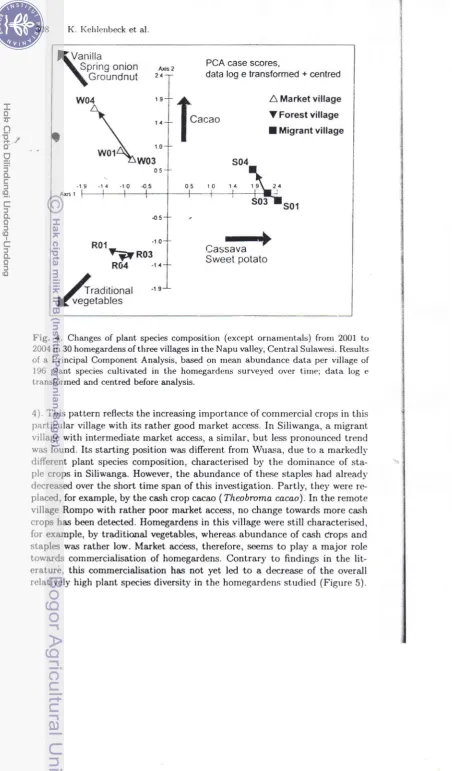
Prirrcipal Component Analysis trased on plant species conrposition resuhed in a clear distinction of the three villagex; aiong the ordination axes (Figure 4). Despite temporal change;, villages renrain clearly scparated in the ordination space. Axis
I
explains about 50% of the total variability and is positivell' cor-related *.ith some staple crops, particularly paddy rice (Orizo satiua), c&qsa\a(Manihot escdento), and sweet potato (lpomoeo bototas). Axis 2, explaining abouL 20Ya of the total variability, is negatively correlated with certain tradi-tional vegetable species, such as Clerd,endrcn minohassoe, eggplant (Solonum mocrocoryon) and yard-long bean {Vigno rtngticulota),
but
positively with the cash crop species gloundnut (Aruchis hypogoeo), vanilla (Vonilla planifo-lia), and spring onion(/llium
fistulosum). Thus, anis 2 can be interpreted asreflecting the continuum from traditional subsistence crops towards modern
ca^sh crops.
In
Wuasa, homegardens were characterised by a rather small portion of308 K. Kehlenbeck et al
I
3
i i
PCA case scores,
data log e transformed + centred
A Market village Y Forest village
f
Migrant village->
Cassava Sweet potato
Ax:x::*'
\+**;rl"il
Rol
-1 o [image:25.595.63.516.10.782.2]ftnor
R04
-1 1Fig. 4. Changes of plant species composition (except ornamentals) fronr 2001 to
2004 in 30 homegardens of three villages in the Napu valley, Central Sulawesi. Results
of a Principal Component Analysis, based on nrean abundance data per village of 196 plant specie; cultivated in the homegardens surveyed over tilne; data log e
transformed and centred before analysis.
4). This pattern reflects the increasing importance of commercial crops in this particular village with its rather good market access. In Siliwanga, a migrant village with intermediate market accesl, a similar, but less pronounced trend was found. Its starting position was different from Wuasa, due to a markedll' different plant species composition, characterised by the dominance of sta-ple crops in Siliwanga. However, the abundance of these staples ha<l already' decreased over the short time span of this investigation. Partly, they were
rc!-placed, for example, by the cash crop cacao ( Theobrcma cacao).In the remote
village Rompo with rather poor market access, no change towards more cash
crops has been detected. Homegardens in this village were still characterised,
for example, by traditional vegetables, whereas. abundance of cash crops and staples was rather low- Market aciess, therefore, seems to play a major role
towards commercialisation of homegardens. Contrary
to
findingsin
thelit-eratur6, lhis commercialisation has not yet led
to
a decrease of the overallrelatively high plant species diversity in the homegardens studied (Figrrre 5).
:r;
,al
lo0
EO
60
/r0
20 0
i
t-iE lo lo
t:
l'
ID
t;
l! lD lo
l>
Plant diversitS, in homegardens 309
,*l
120 1
B,*
=808oo
&lo
a
m
U
Wuaqa_ Silrwarga
Density of individuals Species diversity inde x
Rornpo Siliwarpa Rompo Siliwryrga'
Fig. 5. Diversitl' pararneters of plant species (except ornamentals) of 30
honregar-<lens in three villages of the Napu ralley, Central Sulawesi, from 2001 to 2004. (ln
villages follorved bv an asterisk. changes of the respective variable over tinre were
siguificant at P<0.05 by Friednran test).
Plant speciex; ricltne.rs in the homegardens revisited even increased markedll' over time both per village and per garden (Figure 5).
In
the three villages, a combined total of 152. 171. and 178 useful plant species were identified in 2001. 2003. and 2004, respecti\€l)'. lr{ean density of plant individuals increased over time only in the market village. Changes in Shannon diversity index were not clear except in the migrant village Siliwanga, where the index increased significantlr,. In the latter village. horvcver. plant species richness and Shannon index continued to be markedll lorver than in the two local villages.3.2 Spatial
differencesof plant diversity
When compariug homegardens
in all
five research villages, marked differ-encesin
their plant diversity became apparent.In
homegardens of the two migrant villages, Siliwanga and Tarnadue,Tlaru, diversity parameters were mostly lower than in those of the three local villages that did noldiffer signif-icantly from each other (Table 2). In addition to diversiQr parnmeters, plant species composition was clearll'different between the five villages studied in 2004. Sorensen's coefficient shoned a higher similarity between the three localHean species richness
Wr6a' Rompo' Siliwanga' 50
c
€40o
o >1n
c cim o_"
8,,
[image:26.595.28.520.14.623.2]310
K. Kehlenbeck ei al.Table 2. lr{cdian size. mean plant species (except ornamentals) richness, nredian
density of plant individuals. as r,r'el[ as median Shanrnon diversity index (ranges irr
brackets) of 48 hornegardens in fir'e villages of the Napu valley, Central Sulawesi, in
2004.
t
HG lr{ediansize(rn2)
740
660 600
Ir{ean plant
species
nunrber
4E.5a
(23-68){{.9ab
(28-65)JE.tab (13-56)
Ivledian no.
of plant indi-viduals/lO0 ml
69.0a
(29-3947{
5a
(39-96)3.0ab (1.5-3.s)
3.0a
(2.4-3.3)3.Iab
(1.5-3.3)2.6ab (2.3-3.0) Median
Shannon
index H'
\\iua-sa (local)
llornpo (local)
\\:anga (local)
Siliu'anga
(rnigrant)
Tarnaduc'
( rrrigrarrr)
37 Oab (20-l l7)
900
35.9ab(22-41)
{25ab
(13-ll0)2250 33.0b (22-s0) 22.sb
(7-46)
2.3b
(2.1-2.9)lr{edians u'ere used, u'hen variables rx'ere not nornrally distributed. lr{eans and
nredi-ans in a column f<rllowed by diflerent letters are significantly different at P<0.05 (by
Tuke-v HSD for plant species nunrber: Nenrenf i tast for density o[ plartt individuals
and Shattnon index).
villages (0.724.76) than betn'een these and the two migrant
villagc
(0.58* 0.63) or bet*'een the two migrant villages (0.64).3.3 Identification
and discussion ofmain
factorsinfluencing plant
diversity
in
homegardens ofCentral
SulawesiThe influenc* of several agrlecological, garden-ba^"ed, and socio-economic
factors as well a.s gardeners' characteristics on plant species richness and
Shan-non diversity index were
anal)'d
by multivariate regression analysis, basedon data of all 48 homegardens studied in 2004.
A g ro - eco logicol Ttorcmeter s
As eleration and climate were roughl)'constamt throughout the research area, only the influence of the factor 'soil fertility' on plant diversity was
investi-gated in this study. The follon'ing soil fertility parameters were tested: sand content, content of C 6sg1 and plant available P (Bray
I),
pH value (H2O)'ef-fective cation exchange capacit]' (CEC .6 ), and base saturetion. Plant species richness was not affected by the tested parameters. C content influenced the
Shannon index negatively. This unexpectd negative influence of C content
[image:27.595.63.458.17.819.2]Pl;,rrrt. diversity in honregardens 311
salne time, plant diversitf in nrany of tbese homegardens was rather lou' (Ta-ble 2), caused b1'the dominance of staple food or cash crops in man)'migrant homegardens (see below).
Garden feature.s
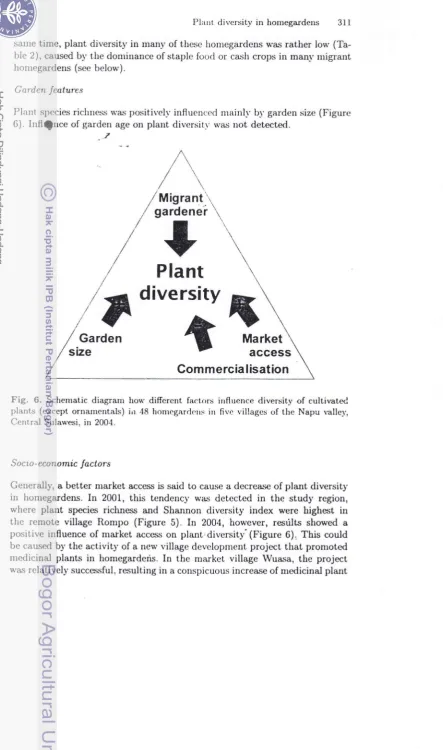
Plant specis richna;.sTva-s positivelv influenced nraitrl]' b1'garden size (Figure
6).
Infllnce
of garden age on plant diversit_r' rvas not detected.7
/\
Fig.
6. Schenratic diagram hou' diffcrcnt factors influence diversity of cultivated plants (except ornarnentals) i,r ,18 honregardens in five villagcs of the Napu ralley,Central Sula*'esi. in 200.1.
S ocio - economic loctors
Generally, a better ruarkeL access is said Lo cause a decrease of plant diversity
in
homegardens.In
2001, this tendency wa.s detecLedin
the study region, where plant species richaess and Shannon diversity index r*'ere highest inthe remote village Rompo (Figure 5).
In
2004, however, rest{ts showed apositive influence of matket &ccess on plant.diversity (Figure 6). This coutd be caused by the activity of a new I'illage development project that promoted
medicinal plants
in
homegardens.In
the market village Wuasa, the projectwas relatively successful. resulting in a conspicuous increase of uredicinal plant
[image:28.595.70.514.22.773.2]Z
ll2
K. Kehlenbecl< etal-;pecies richness from 3 (mean in 2001) to about 8 species per garden in 2004'
lommercialisation, on the other hancl. influenced plant' diversitl' negaLivell'"
,n homegardens dominated b1' cash crops like cacao or coffee- plant diversitl'
.vas markedll' Io*'er than in subsisience lionregarden's'
G orden er s' c h aroct eristic s
ysl1hsfiou-sehold-related features (e.g.. Sousehold size or wealth status) nor 5ardeners' characteristics.(y'g.. age. sex. levci of formal education) plal'ed a .ignificant role for plant diversit--1'. apart front the origin of the gardener' In
itJmegarder$ of nrigrants. siguificantll' lo*cr plant divemit]' could be expected
,han in houregardens of locals (Figure 6). Drre to ecolrontic con-strailrt's after
uriva!. rnanl- Drigrants in tlie studr- area focu.rsed strorrgll' ort staple food (iu
iiliu,anga) or cash crop procluction (in Tanradue) iD their ltolltcgardcns. Plant
li'ersitl'
rlig[t
increa-seint[e
future, rvherr migrant farlrilies-establisir staple.,rop 6"i.1.,
oi
plantations in the surroundings of theirvillagc.
hr Siliwanga..,,,.ir.r,
increaseof
pla-nt diversitl'alrearll'occurrc<l over titue (Figure 5)' Hou,ever. the situation in migrant homegardens of the Napu vallel' was quit'elar a\,!'ay from statements in the literature that such ltotnegardens generalll'
harbour higher plant diversit.l' than honregardens of locals
4
case
study
2:
Plant
diversity
in
hornegardens
of
west
Java, Indonesia
ln
West-Jara, changesof
homegarderus' plant diversity $'ere studic<l alongan urban-rural continuum as well as along an elevation gradient' For the invex;tigation of urbanisation effects, the vegetation structure an{ composition
of l15lomegardeD-s in six villages were studied (Arifin et al. 1998). The six
village; aifieied
in
their
urbanisation levcl. One wasa
rural village, threewere characterised a^s internrediatell' urbanised, and two a-s ttrllan villages,
foundcd
in
the 1940s, the 1950s. and thc.1980/1990s. re;pectively'In
eachhomegardeu, both useful and ornamental plants were inventoried' Overall,
homelarden sizes ranged
fro'r
30 m2 to 4000 m2, with means per village from 70 m2 to 530 m2 (Table 3). A combined total of 440 plant species were grownin the 115 homegardens, about half of the species being ornamentals'
For the studf of elevational effects on plant divemity, 30 homegardens each were investigated in three villages in the sarne watershed. The villages were
Plant diversitl- in homegardens 313
4.1 Spatial
differencesof plant diversity
Ruxil-urban continuutn
Plant species number waried largeli'among the 115 homegardens studied (Ta-bie 3). Irlean species number per honregarden did not differ markedll'between the rural. the internrediate, or tlre urban irouregardens. Hoq'ever, urban gar-dens
iraloured
a prarkedlf irigher number of ornanretrtal plant species per honregarden than rural garders. JPaddition, the proportion-s of bothorna-niental species and inclividuals incrersed u'ith a higher level of urbanisation
(rural: 40% of total--spccio and 47%. of
total
individuals \\'ere orllanlentals:urban: 70% of total ife.cies and > 80% o[ total irrdividuals \{ere orlrarnentals). Honregardett size decrea-sed continuousll'from rural to urban siles (Table 3)'
\rertical vegetation structure decrea^sed
in
conrplexitl' from ruralto
rtrban.Consequentll', urban |onregardens nrostll' lacked the strata above 5 m. and
strata above 2 ur *'cre reprsrenld b1'onli' fe*' individuals.
Table
3.
h{ean size and nrean diversity characteristics of trseful and ornarnental planr species (range in brackets) o{ll5
homegardens studied in six villages with different urbanisation levels in Cianjur and Bogor. \\'est Java, in 1995.Village urbanisation
HG
Total plant No. of No.level
size
spp.no.
ornamental total plarrt ornamental(n,')
perHG
spp.,'HG
individuals individualsIntermediate
I
(N: 2l) 380
49(32-79)
25Internrediate 2 (N
: l0) 190
32 (7-85) Internrediate 3 (N =20) 130
20 (2-53)L4
1l
58
3472
40107
59280
233240
201Urban I Urban 2
(N: 10) 70
34 (18-63) (N =24) 90
37 (16-78)21 26
Rural hornegardens were distinguished from the urban ones by their
domi-nant function in subsistence production, expressd b1'the rather high number and abundance of useful plants, particularly
fruit
tree;, vegetables, and sta-ple crops. In urban homegardens with their representative, aesthetic function, plant diversity was composed mainll' of ornamentals.Dleoqtion
gtdient
Plant species richness
in
homegardens decregsed continuously from. low to high elevations (Table 4). In the intermediate and high elerations, homegar-dens were markedly smaller than in the lowlands. Despite their rather small size, homegardens of intermediate eleration harboured much more plant [image:30.595.47.436.69.768.2]314 K. Kehlenbeck et al
was markedly lower in homegardens of the lon'lands than in higher eler..ations.
Ho*€ver, ttre highest densitl' *.as found in homegardens of intermediate al-titude. Plant species conrposition was different along the elevation graclient. Homegardern in the lorvlands sere dominated b1. perenniat
fruit
trees. and in the highlands b1' r'egetables.Table
4.
llean size and mean diversit-r' charact-eristics of useful and ornanrental plantilpecies (range irr brackets) of g0.fonregardens studied in three villagcs of different eleration in Cianjur *'aterched, \\:esf java, in 2000.illage
eleration
level
HG sizr:
(rr.,') spp. no
per IIC
plant No. of tota No. of tot
plant individuals Jrlant indir.iduals/ per IiG 100 rrr?
High
(130Orn;N:30) I rrt.errned iat.e
(950nr;N:30)
[,ow
(300m:N=30)
27
(r4-36)
ZSO lrOZ<zn)40
(27-64)
190 (22s 77r)190 150
2'20
60
220
560
44(26-74)
350 r82,867)4.2
Discussionof main
factors influencingplant diversity of
homegardens
in
JavaA g ro - eco logi cal T,a;rumeter s
Eleration negatively influenced plant species richness in homegardens. How-ever, thc lower plant diversity in highland homegardens might also be caused
b1' their relatively srnaller size as compard to the lowland ones. This positive
relationship betu'een Lortregarden size and plant species rictrness is w-ell docu-nrerrtcd irr the literature (Section 2.3). The statcmcnt br. euiroz et al. (2002)
that the highest plant diversity is found in the hornegardens of intermediate
elevations (i.e., 600-1300 m) is only partly confirmed by this study. Although density of plant individuals was highest in homegardens of intermediate ele. vation, species richness r*'as not.
Socio- economic factors
urbaqisation affected the richness and abundance of useful plant species
neg-ativelS but those of ornamentals positivell.. As in the erevation gradient, these results might be confounded with the decrease of homegarderilire along the
[image:31.595.88.511.30.822.2]