CHAPTER II
LITERATURE REVIEW
2.1Introduction
This chapter studies the earlier research related to the definition of private label brand, the importance of private label brand and former studies of private
label brand. The information was collected from several sources such as journals, books, and other trustworthy source from the internet. Factors that influence attitude towards private label brand preference (i.e., demographic,
product attributes, price loyalty, belief and perceptions of private label brands, and private label brand names recognition) as the measurement influences
would be studied here.
2.2Defining Private Label Brand
Private label brand products existed in Indonesia as the result of the
market expansion by the European, Asian and American retailer. Marketing expert Kotler and Amstrong (2012) define private label brand as brands which made and owned by retailers. Usually these brands are only available at the
specified chain store only (for instance, brand labeled as Carrefour Discount only for sale at Carrefour chain store).
Private label brands have characteristics which noted by Lupton et. al. (2010) with no packaging promotion such as advertising and the quality of the products are mostly perceived as inferior quality compare to manufacturer‟s
than a century ago and more popular in countries with high retailer
concentration (Hyman et. al., 2009; Nenycz-Thiel, 2011).
Private label brand meaning formulated by Hoch (1993) product that is
exclusive, included in retailer programs, it can be developed by third parties, and private label brands can be a measurement of exclusivity to the retailer that runs it. And Hoch (1996) explains why private label brand as a brand can
offer local exclusivity for the retailer that carries (De Wulf, 2005; Nenycz-Thiel, 2011), it is because some retailers bring private label name that
provides trademark, e.g.: Carrefour private label brand name either Carrefour or Carrefour Discount.
Furthermore, from explanation above the researcher agreed that private
label brand is a brand which cost less than national brand or even international brand. Schiffman and Kanuk (2010) reveal that this happens because the
producers or the retailer wants to create a customer value. As both of them explain that the customers‟ perceived benefits (economical, functional and psychological) and resources (money, time, effort and psychological) to get
those benefits creates customer value.
Therefore, Dhar and Hoch (1997) says elaborate private label brands
existence in more categories will increase the private label brand perception and validate the investment and resources dedicated to private label. And they pointed out that the retailers guarantee the store brand because named after the
Meanwhile, as described in Corstjens and Lal (2010), retail‟s pattern of expansion is puzzling, for instance Wal-Mart doesn‟t operate in either Europe or Japan. Carrefour, the world‟s second largest retailer from France, doesn‟t have a presence in the U. S., Japan, or Germany. Britain‟s Tesco, the world‟s
third largest chain, has no longer in the European line of work and lately
developed a small presence in Japan and the United States.
Nevertheless, together these marketing and retailing professors in their article wrote that every retailer has tastier successes and failures in other
regions. Wal-Mart has succeeded in Canada and Mexico, but had to eliminate their existence in Germany and South Korea. Tesco has shown in South Korea and Malaysia, but missed to establish its brand in France or Taiwan. Germany‟s Metro businesses flourish in Poland and Romania, but its missions
in the UK and Denmark ended in disappointment. Carrefour has gone out for
more than a few markets in Europe, including Austria, the Czech Republic, Norway, Portugal, Slovenia, and the UK. But it has broken through in others, such as, Spain, Belgium, Greece, Italy, Romania, Poland, and Turkey during
the same period.
Moreover, Hoch (1996) sets out that private label brands are the only
products for which retailer absorbs all marketing and inventory investments. This fundamental difference from national brands internalized the retailer‟s decision making process. With a national brand the retailer has little or no
Thus, according to him retailers can have more control but at the same
time take a bigger risk which is cost inventory. On the other hand, retailers can choose a quality level and investment levels for other mutually dependent
marketing activities. Private label is guaranteed full distribution and better shelf placement. Retailers usually sign long-term sourcing contracts with
private label suppliers at specified quantities, prices, and committed to the retailer in the development of the product.
Private label brands are brand (Kumar and Steenkamp, 2007). Brands
give meaning. In societies, brand in some way defines individuals whether they are seeing as „the have‟ or just ordinary people by the brand they use or wearing. Any product that is not considered as brand will make persons
reluctant to buy. For the reason mentioned before to be considered, brand is not always manufacturer brands.
Pricing policy of private label brand. A traditional view on private label
brands is that it has been priced 20%-30% below national brands (Hyman et. al., 2009). The price difference caused by the retailer savings including: not
spending money on advertising, tiny amount of investment in product innovation and the use of plain packaging (Nenycz-Thiel, 2010).
Intrinsic cues and extrinsic cues of private label brands. If intrinsic cues
or physical characteristics of the product (size, color, flavor, and aroma) are unavailable, consumers would likely to use extrinsic cues to judge the quality
product quality and cues related to the external things of the product, such as:
price, store image or brand image.
However with private label brands, there is some evidence that extrinsic
cues influence consumer judgment even when intrinsic cues are available. As noted by Richardson et. al. (1994) he found that extrinsic cues influence consumers‟ judgments of (private label brand) quality above the product
ingredients. This has most likely happened because of private label brand low price strategy. This low price-low quality reaction occurs even when a list of
ingredients is given to customers (Nenycz-Thiel and Romaniuk, 2011). Since private label brands are usually priced lower than national brands, are not as seriously advertised, and have less good-looking packaging makes lower
perceived quality is more common in purchasing private label brands than national brands.
Private label brand development. Retailers are in control for private label
brand development for circulation over pricing, warehousing, merchandising and marketing going-on (Dhar and Hoch, 1997). There are three reasons why
the relationships between supermarket and brand image is more relevant for national brands (Nenycz-Thiel and Romaniuk, 2012); (1) Selective distribution. For instance, customers can come upon private label brands only in conjunction in the supermarket. (2) The majority of private labels includes the supermarket name or logo, in the brand or on the packaging. (3) Private label brand rarely receives supermarket independent advertising that would allow the brands develop their own identity free from the image of the
Deal prone consumer. Burton et. al. (1998) sees it from many literature
notes that being made by him which led to an idea where deal proneness has a specific type to attract consumers. According to his summaries there are two „deals‟, (1) lower purchase price using discounts and coupons for promotions
and (2) no direct price incentives for instance, free gift and lottery. Deal prone
consumers can also make categorization of product into expensive and inexpensive and it is called as categorical reasoning. In his study Chernev (2012) have found categorization influence on how an individual judging
product. His research demonstrates that categorization might not always work every day. When an expensive item is bundled with a cheap product this kind
of bundling will lead to unwillingness to purchase by the customers.
Transaction utility is defined by Burton et. al. (1998) as the need or
unhappiness coming from the transaction associates with the regular price that
being paid. Transaction utility indicates efforts performed by a person related to mental arithmetic. Mental arithmetic is a method to judge the importance of purchasing a product. This action will lead to a „smart shopper‟-minded individuals, the characteristics are: take a pride in their decision making skill, not easily influenced by the ad campaign, less impulsive on buying things, and
can make logical choices between numerous brand choices without being drawn by national brand product images. This kind of action occurs when that
Private label purchase as smart shopping (Kumar and Steenkamp, 2007).
The past few years private label brands were produced directed to people who are coming from a low income household. But today, even though people who
are reflected as poor still buy the private label brand, however, more individuals who are considered as the „the have‟ become more and more eager to buy a private label brand for their repertoires. It happens because private label brand products offer value for money. As a result, buying private label brand or “smart-shopping” is for the reason that the comparable quality in a
much lower price rather than high-priced manufacturer price.
Perceived risk and familiarity. Perceived risk according to Stone et. al.
(1993, cited in Sheau-Fen et. al., 2012) is a theory used by consumer behavior
academics to describe consumer perceptions of uncertainty and costs that should be considered for buying a product or service. In other hands,
familiarity reveals consumers‟ understanding of a product and the information available to the consumer (Baltas, 1997).
Harmonizing to Baltas, Alba and Hutchinson (1987, cited in Sheau-Fen et.
al., 2012) pointed out familiarity is accumulated learning of brand over consumption experience or marketing communication. Product familiarity has
proven to be one of the most important factors concerning the differences between store brands and national brands (Mieres et. al., 2006 cited in Sheau-Fen et. al., 2012). As summarized by Sheau-Sheau-Fen et. al. (2012) consumers are
Rejection on using private label brand. Janakiraman et. al. (2009, cited in
Nenycz-Thiel and Romaniuk, 2011) showed that consumers are likely to transfer consumption familiarities across comparable products. The umbrella
branding of private label brands within a store, where private label brand's offerings across different categories have the same or similar brand name
(commonly happen to private label brands). That makes a bad/ good perception of private label brands in one category to spread across other categories.
Nevertheless, Nenycz-Thiel and Romaniuk (2011) explains that the most common reasons for brand rejection on private label brand relates to a bad past experience. After a bad past experience, the most common reasons for
rejection were low product quality, with the main judgments based mainly on the extrinsic cue of low price (cheap means low quality product). Private label
brand rejection mostly happens before the product trial rather than after a brand experience and because of lower product quality perception and negative opinion. As a result, before many people try the product they are
already have a bad image for private label brand, even before they use the
product.
Price Sensitivity and Perceived Quality. Steenkamp and Kumar (2007) divide buyers into four types (main buyers are those who are in the gray areas). These are the four types of buyers:
b. Brand buyers are consumers who have low price sensitivity and realize the
quality difference between manufacturers‟ brands and the store brand. They will buy a manufacturers product.
Figure 2.1 Four Types of Buyers
C
onsume
r pr
ice
se
ns
it
ivi
ty Low
Random buyers Brand buyers
H
igh Private label buyers Toss-ups
Small Large
Perceived quality gap with manufacturer brand Source: Steenkamp and Kumar (2007)
c. Private label buyers are price sensitive consumers who notice quality
similarity between manufacturer brands and the store brand. They will purchase store brand.
d. Toss-ups are a consumer who is high price sensitivity and identifies
quality differences between manufacturer brands and the store brand.
Random buyers are usually more attracted to in-store cue such: shelf facings, shelf tag-ons, and end-of the aisle displays. However, the toss-ups
prefer to purchase manufacturer brand since they believe that quality is more important than others. Furthermore by Kumar and Steenkamp (2007), there is
some consideration; store loyalty is lower in personal care than in household care and food and beverages. Personal care is typically much higher on
2.3The Importance of Private Label Brands to Retailers
Retailers face a tight competition based on the number of retailer rivals and similar product offers in their market shares (Dhar and Hoch, 1997). For
example, in European food retailing, some retailer uses store brands to differentiate themselves from the big competition.
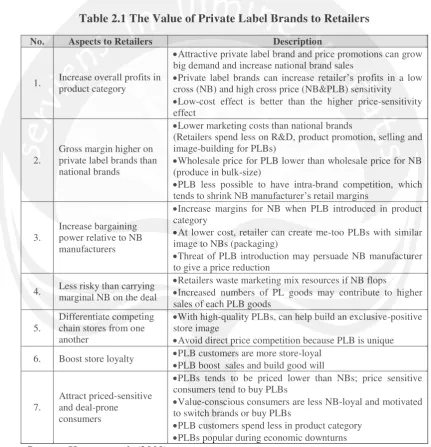
Table 2.1 The Value of Private Label Brands to Retailers
No. Aspects to Retailers Description
1. Increase overall profits in
product category
Attractive private label brand and price promotions can grow big demand and increase national brand sales
Private label brands can increase retailer‟s profits in a low
cross (NB) and high cross price (NB&PLB) sensitivity Low-cost effect is better than the higher price-sensitivity effect
2.
Gross margin higher on private label brands than national brands
Lower marketing costs than national brands
(Retailers spend less on R&D, product promotion, selling and image-building for PLBs)
Wholesale price for PLB lower than wholesale price for NB (produce in bulk-size)
PLB less possible to have intra-brand competition, which tends to shrink NB manufacturer‟s retail margins
3.
Increase bargaining power relative to NB manufacturers
Increase margins for NB when PLB introduced in product category
At lower cost, retailer can create me-too PLBs with similar image to NBs (packaging)
Threat of PLB introduction may persuade NB manufacturer to give a price reduction
4. Less risky than carrying
marginal NB on the deal
Retailers waste marketing mix resources if NB flops
Increased numbers of PL goods may contribute to higher sales of each PLB goods
5.
Differentiate competing chain stores from one another
With high-quality PLBs, can help build an exclusive-positive store image
Avoid direct price competition because PLB is unique
6. Boost store loyalty PLB customers are more store-loyal PLB boost sales and build good will
7.
Attract priced-sensitive and deal-prone
consumers
PLBs tends to be priced lower than NBs; price sensitive consumers tend to buy PLBs
Value-conscious consumers are less NB-loyal and motivated to switch brands or buy PLBs
Furthermore, De Wulf et. al. (2005) investigated the importance of private
label brands to the retailer is on the way to increase overall profits in product category. The effect of lower cost is greater than the effect of higher price
sensitivity. It can express that the retailers use private label brands to promote limited products and set apart the store image to the customers. Baltas (1997)
describes in his study that at a lower price the retailers can create threatening me-too (store) brands with similar images to manufacturer‟s brand and more benefits for the retailers is that private label brands can attract price sensitive
and deal prone consumers.
As a result, from the side of economies scale Dhar and Hoch (1997) give details that large retailers are better positioned to build scale economies than
smaller ones. Huge retailer thought of private label brands are lower printing cost of packaging and better prices from suppliers in line for bigger production
runs (cheaper) and these scale economies allow the retailer to provide better value for the money to the customers.
Table 2.2The Value of Private Label Brands to Manufacturers and Retailers
No. Aspects to Manufacturers and
Retailers Description
1. Increase category expenditure
PLB and NB price and non-price promotions can increase category expenditures
When NB manufacturer supplies retailer with comparable quality of PLBs, and both have market power, product category prices are higher.
2. May increase profits and market
shares for both NB and PLB
When advertising combined, increased expenditures for either or both leads to expand consumer demand for NBs and PLBs.
PLB and NB prices higher when PLB of high quality
3. Allows segmentation of
consumers by price sensitivity
Unadvertised, quality equivalent PLB allows price discrimination between customers who wants versus do not want an advertised NB.
Hence, the advantage of the existence of private label brand is both for
retailers and manufacturers can allow price sensitive consumers to make segmentation. Hyman et. al. (2009) explains why, it is because unadvertised
brand (store brand) and the quality (manufacturer brand) that can be comparable. It makes private label brands allow price perception among
consumers who are willing versus unwilling to pay for a premium price that designed for an advertised brand and all this leads to greater overall category prices (Mills, 1995; Dhar and Hoch 1997 cited in Hyman et. al., 2009).
2.4The Importance of Private Label Brands to Manufacturers
Private label brand's production can increase profits. Manufactures could gain more profits from the sales of lower cost product. But also losses may
occur from the cannibalization of consumer who devoted to national brands (Tarzijan, 2004 cited in Hyman et. al., 2009). National brand manufacturers
can use private label brands to skim price-insensitive consumers from the market (Wedel, 2004 cited in Hyman et. al., 2009).
Table 2.3 The Value of Private Label Brands to Manufacturers No. Aspects to Manufacturers Description
1. PLB production may increase manufacturer‟s revenue
May result in lower unit production costs, non-production of PLBs by competitors and retailer cooperation
Non-leading-rather than leading-manufacturers best served by producing PLBs
2. Excuse to raise NB price
Controlling for product-quality, positive
relationship between PLB introduction and NB prices
For premium-priced but not second-tier NBs, lower long-term price sensitivity and higher revenues
3. Can reduce inter-manufacturer
competition
Introduction of PLB by one manufacturer signals commitment not to engage in promotions, thereby decreasing incentive of other manufacturers to engage in promotions
Meanwhile, Dhar and Hoch (1997) conclude that that brand competition
such national brands influence private label brand performance directly with the customers. Hoch and Banerji (1993) express concern about the
manufacturers of national brands, private label brands because the store brand create an important source of competition, and manufacturers must have a
2.5Types of Private Label Brand
There are several types of private label brand according to Steenkamp and Kumar (2007).
Table 2.4 Types of Private Label Brands
Generic
Private Label Brands Copycat Brands
Premium Store
Brands Value Innovators
Examples
No name, black and white packages, bread and shampoo.
Carrefour Discount Body Shop IKEA
Strategy Cheapest –
undifferentiated
Me-too brand at cheaper
price Value added
Best performance – price ratio
Objectives
Provide consumers with a low-price option to enlarge customer base
Increase negotiating power against the manufacturer and increase retailer share of category profits
Provide added-value products, differentiate store, increase category sales
Provide the best value, build customer loyalty to store, and generate word of mouth
Branding No brand name
Umbrella store brand (same name for all product categories) or category specific own labels
Store brand with sub brand or own label
Meaningless own labels to demonstrate variety
Pricing Large discount, 20%-50%
below brand leader
Realistic discount, 5%-25% below brand leader
Close to or higher than brand leader
Large discount, 20%-50% below brand leader
Category coverage
Basic functional product categories
Originates in large categories with the strong brand leader
Image-forming categories, often fresh products
All categories
Quality to
brand leader Poor quality
Quality close to branded manufacturers
Quality on relatively good or better, advertised as better
Functional quality same with brand leader but with no “useless” features and imagery
Product development
None; product put up for contracts to manufacturers with lagging technology
Reverse engineered using manufacturers with similar technology (Free ride on manufacturer‟s investments in research, product development, and advertising)
A considerable effort to develop better products with similar or better technology
Considerable effort and innovation in terms of cost-benefit analysis
Packaging Cheap and minimal As close to brand leader
as possible
Unique and source of differentiation
Unique but cost efficient Shelf
placement Poor; less visible Next to brand leader
Prominent eye-catching positions
Normal as all over store
Advertising/
promotions None
Frequent price promotions Featured in advertisements but limited price promotions
Store not own label advertising, normal promotion schedule
Customer proposition
Sold as cheapest-priced product
Sold as same quality but lower price
Sold at best products to market
Sold at best value-price of generics but the objective quality on par with brand leaders
2.6The Measurement Factors of Private Label Brands
The current research is a modified replication of Robert A. Lupton, David R. Rawlinson and Lori A. Barunstein‟s study (2010); the following
measurements were adapted from the original study. Based on the previous study review the variable consists of: demographic, product attributes, price loyalty, belief and perceptions of private label brands, and private label brand
name recognition.
2.6.1 Demographic Factors
Aliawadi et. al. (2001) follows the seven demographic characteristics (income, employment status, children in the household, type of residence, age, gender, and education) to identify demographic characteristic, the benefit and
cost of store brand and deal. However, the this study is a modified replication of Robert A. Lupton, David R. Rawlinson and Lori A. Barunstein‟s study
(2010) and the participants were college students, so the following characteristics are: age, gender, university, overall GPA, majority and hometown.
2.6.2 Product Attributes
Packaging. In his book Schiffman et. al. (2010) stated that packaging must
express the image of the brand to buyers. The perceptions and familiarity can define the brand. Kumar and Steenkamp (2007) pointed out that private label
brand somehow removes the elements of manufacturer images like the expensive packaging and unimportant features of it. The packaging simply combined the store name with a huge capitalization with one or two pops of
color (red, blue or the color used on the store logos).
Quality of the product. Perceive quality of a product is how well the
product performance related to its function. Store brands are not always competing with famous national brands only on price. Evidence of Hoch and Banerji (1993) study has shown that product quality is more important than
price in store brand buying behavior. They view quality as positively related to store brand market share across 180 product categories.
Moreover, in their study Hoch and Banerji found that quality is more
important than price in shaping the success of the store brand. Anyway, private label brand with low product quality in the U. S. (Based on Consumer
Report Magazine cited in Kumar and Steenkamp, 2007) Winn-Dixie‟s chocolate ice cream taste better than Breyers; Wal-Mart‟s Sam‟s Choice is more preferable than Tide detergent; and Krogers Potato Chips claimed tastier
than Pringles. Semeijin et. al. (2004, cited in Sheau-Fen et. al., 2012) made a statement that national brands beat store brands because consumers cannot see
Also, Richardson et. al. (1994) viewed quality consciousness can hold
back the consumers from using store brands because the brands are perceived as inferior in quality. Perceive quality of the product has intrinsic and extrinsic
cues. Schiffman et. al. (2010) mentioned the intrinsic cues are the color, flavor, and size of the product. Because, consumers are likely to believe what
they see, taste and feel can make them choose the brand wisely (whether they want to take it or not) and makes them feel better at choosing the product (because they including their senses to pick the product). And the extrinsic cue is the brand. Many studies reported that when someone‟s got blind test, he
cannot figure out which one tap water and which one mineral water from high
mountain glacier. The point is that it does not matter what kind of taste the water but more like a pleasure one‟s felt when he taste the product.
Pricing of the product. Attitudes to private label brands are related by a
consumer orientation to perception of product price (Burton et. al., 1998). He expresses three distinct consciousnesses:
1. Price consciousness, the desire to pay low prices-the consumers may see a
positive thing in private label product because the price is 20-30% below the manufacturer one;
2. Value consciousness, willingness in using a ratio to compare the quality received for the price that being paid;
3. Price-quality schema, some customers might think that price is one of the
best indicator to determine the quality of a product.
Thus, according to Aliawadi (2001) price savings are important among
financial difficulties. And Schiffman et. al. (2010) noted that perceived price
should reflect the value that consumers receive from the purchase. As described in his book “Consumer‟s Behavior” perceptions of over-priced affect consumer‟s perceptions of product value and eventually the willingness
to use a product.
Loyalty of the product. The most important element for a private label brand in establishing loyalty is the brand‟s ability to fulfill promises to its
customer base (Pepe et. al, 2011). Consumers have a trend to be brand loyal
thru numerous product categories, and it shows product development or consumer characteristic (Burton et. al., 1998). Increased customer loyalty, has
two important effects to the retailers: First, it can lead to a gradual increase in the brand‟s customer base which is necessary in a low sales growth area. Second, the longer the customer remains loyal to the brand, the larger profit
they can carry out from each individual (Pepe et. al., 2011).
Schiffman et. al. (2010) expresses the loyalty from two different sides: (a) Behavioral scientist who believes that the loyalty of a product comes from a product sample that believed by the happiness of the customer that leads to repeated purchase. Behavioral definition perceived the loyalty of the product
caused by a habit or because of the product is the only product that available in the store. (b) Cognitive researchers perceive the product loyalty comes from the mind. Because individual believes that the product preference as a
difference from competitors and help the product itself to build consumer
loyalty (Aliawadi, 2001).
Brand Names. The two main possibilities for consumers to interact with
brands are directly through brand and indirectly such as advertising and word-of-mouth. Individuals might believe differences from those who bought the
private label brand (using word-of-mouth) and one who did not. Most of consumers‟ interactions with the brand, outside of consumption, are within the supermarket. So that the non-user of private label brands perceive private
labels linked to their perception of the supermarket. Because, consumers who directly experience the brand they can develop a stronger association with the
brand itself (Nenycz-Thiel and Romaniuk, 2012).
Purchase incentives. Purchase incentives use as an important indicator for
estimating consumer behavior. For instance as quoted from his book
Schiffman et. al. (2010) “consumers can be encouraged to try new product through promotional tactics as free samples, coupons, and sale prices”.
2.6.3 Price Loyalty
Dick, Jain and Paul (1996) consider that consumers who come to store somehow expect that private label brands should be cheaper and offer value
for money. Similarly Ellickson and Misra (2008, cited in Nenyz-Thiel and Romaniuk, 2012) explained that the perception of supermarket that offering value for money is important for its own success, as evidenced by the EDPL
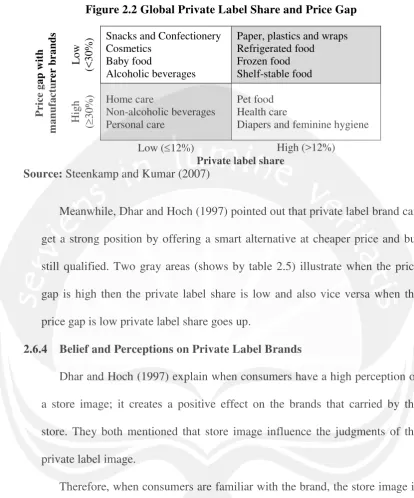
Figure 2.2 Global Private Label Share and Price Gap Pri ce gap w it h m anu fa ct u re r b rands Low (<30 %
) Snacks and Confectionery Cosmetics
Baby food
Alcoholic beverages
Paper, plastics and wraps Refrigerated food Frozen food Shelf-stable food H igh ( 30 %
) Home care
Non-alcoholic beverages Personal care
Pet food Health care
Diapers and feminine hygiene
Low (12%) High (>12%)
Private label share Source: Steenkamp and Kumar (2007)
Meanwhile, Dhar and Hoch (1997) pointed out that private label brand can
get a strong position by offering a smart alternative at cheaper price and but still qualified. Two gray areas (shows by table 2.5) illustrate when the price gap is high then the private label share is low and also vice versa when the
price gap is low private label share goes up.
2.6.4 Belief and Perceptions on Private Label Brands
Dhar and Hoch (1997) explain when consumers have a high perception of
a store image; it creates a positive effect on the brands that carried by the store. They both mentioned that store image influence the judgments of the
private label image.
Therefore, when consumers are familiar with the brand, the store image is one of the factors for a quick judge of private label brand. If the store image is
2.6.5 Private Label Brand Names Recognition
Sayman, Hoch, and Raju (2002) explained if prices are the same, all consumers would prefer the brand with higher quality. Competition between
private label brands and national brands is more likely competition between vertically differentiated brands (low price low quality, higher price better
quality and durability).
However, private label brand is the only brand that continues in store. No other brand name appears in many product categories. A consistent name
strengthens the private label brand and creates a positive and negative effect as well and brand extension opportunities (Hoch, 1996)
2.7Previous Studies on Private Label Brand
Quality related factor. (1) High quality private label brands help retailers
to differentiate the store image (Richardson et. al., 1994). High quality private
label brand can get benefit from various kinds of customers in case willingness to purchase. Hoch and Banerji (1993) they concluded that quality is more important than price in describing store brand success. Because in line
with what Hyman et. al. (2009) goes on to argue, that unadvertised private label brands allow those who want and do not want to purchase over the
advertised national brand. (2) Consistent quality, to maintaining private label brand sales, retailer better to standardize the quality of its product. Because
what retailers often faced is that problems concerning quality standard (Sipahutar, 2013). (3) Quality accessible from written description alone. Experience characteristics lead to high perceived-quality variability and higher
purchases (Suarez, 2005 cited in Hyman et. al., 2009). Consumers who rely on
quantifiable experience attributes tend to choose national brands, and consumer who focus on thinking rather than feeling tend to choose private
label brands (Collins-Dodd, 2005 cited in Hyman et. al., 2009). Because, buying private label brand involve logical thinking (calculating and comparing
the prices over national brand) but in the other hand manufacturer brand appeals to the feeling that may lead to impulsive buying behavior.
Price related factor. (1) Everyday low price position, Dhar and Hoch
(1997) set out that the price differences between national brands and private label brands can accentuate private label brands more; since the private label brands priced 20-30% below the national brands, without promotion activity,
and simple merchandising tactics. (2) Narrow Assortment. Everyday low price position also comes up with a typical store brand positioning which is
narrow assortment.
Dhar and Hoch (1997) pointed out that this kind of product arrangement gives private label brand a special treatment. Consequently that the private
label brand does not positioned next to the leading national brands. (3) Price gaps and promotion. Dhar and Hoch (1997) mentioned that the price gap
Product category-related factors. (1) High variety in product category.
Retailers can create economies of scope and signal a good promise to a private label brand through varied private label brand offerings. In hope the customer would see retailers‟ passion in creating a qualified product in reasonable price
(Sethuraman et. al., 1999 cited in Hyman et. al., 2009). (2) In low risk product category. Toiletries are not a big deal regarding to a baby food. An impact on
choosing a wrong baby food can lead to a serious disease and impact on choosing a cheap toilet tissue is nothing (Hyman et. al, 2009). (3) In popular,
high margin product category. Retailers more emphasize on popular product
categories (Richardson et. al., 1994). For instance, Carrefour Indonesia
best-selling private label brand products such as: rice, soy sauce, cooking oil, sugar, and meat floss (Sipahutar, 2013).
Retailer related factors. (1) Similar positional strategy to national brand.
Private label brand or store brand often imitates the category leader, to signal a quality but at a lesser price (Schmalensee, 1978 cited in Sayman, Hoch, Jagmohan, 2002). Some retailers adopt imitating strategy over shelf close
location and similar packaging to make consumer purchase private label brand. In their study Sayman, Hoch, Jagmohan (2002) describe where brands
are positioned closer to each other it reveals higher cross-price sensitivity; for instance, positioned a private label brand next to national brand results in
higher price sensitivity between the two brands. Thus distance position determines the cross price sensitivity between the private label brand and national brand. (2) Many private label brands in diverse product categories.
expertise, trustworthiness and commitment to the market, which in turn
induces a positive brand image (Putsis, 1999 cited in Hyman et. al., 2009).
Consumer related factors. (1) Many lower income households. Lower
income consumers are more prices sensitive when a high national brand to private label brand gap exists. Starzynski (1993, cited in Dhar and Hoch, 1997) found that heavy private label users had lower incomes and larger blue
collar households with part-time female heads of households. For the reason of that the typical private label brand sold is inferior goods at a cheap price
and indeed purchased most frequently by price sensitive shoppers (Dhar and Hoch, 1997). (2) Many customers who rejected the price quality relationship. The most common reasons for rejection were low perceived product quality,
meaning cheap worth low quality product (Nenycz-Thiel and Romaniuk, 2011). (3) Many private label brand prone consumers. Proneness is related to
private label brand familiarity. Baltas (1997) pointed familiarity reveals consumers‟ understanding of a product and the information available to the
consumer. (4) Many price conscious customers. Store brands obtained a
higher share when the trading area contained more elderly people, lower housing values and lower incomes, more large families, more working
women, and higher education levels (Dhar and Hoch, 1997). For the reason that these kinds of people are willing to purchase private label brands and
considered as a price conscious customer. Besides, Hoch (1996) himself initiate that stores with larger category price elasticity had higher private label share; moreover, there were systematic differences due to the demographic