LIST OF EDITORS
Proceeding of the 3
rdInternational Seminar on Animal Industry,
Bogor, 17-18 September 2015
Scientiic Editors
Chief : Prof. Dr. Ir. I Komang G. Wiryawan
Secretary : Prof. Dr. Ir. Cece Sumantri, M.Agr.Sc
Members : Prof. Dr. Ir. Bas. Kemp. (Netherland) Prof. Myunggi Baik (Korea)
Prof. Wayne Pitchford (Australia) Prof. Dr. Ir. Wasmen Manalu, M.Sc
Prof. Dr. Ir. Iman Rahayu H.S., MS Prof. Dr. Ir. Nahrowi Ramli, M.Sc Prof. Dr. Ir. Muladno, MSA Prof. (R)Dr. Ir. Bess Tiesnamurti Prof. Dr. Ir. Dewi Apri Astuti, MS Dr. Jean Pierre Bidanel (France) Dr. Anjas Asmara Samsudin (Malaysia) Dr. Kai J. Kuehlmann (Germany) Dr. Ir. Idat Galih Permana, M.Sc.Agr Dr. Tuti Suryati, SPt, MSi
Dr. Indah Wijayanti, S.Tp, M.Si Ir. Anita Tjakradidjaja S., M.Rur.Sc
Technical Editors
Windi Al Zahra, S.Pt, M.Sc.Agr Irma Nuranthy Purnama, SPt, MSi Fitri M. Manihuruk, S.Pt
Himmatul Khasanah, S.Pt Reikha Rahmasari, S.Pt, M.Si Rika Zahera, S.Pt, M.Si
List of Reviewers
Prof. Dr. Ir. Sumiati, M.Sc Dr.Agr Asep Gunawan, S.Pt, M.Sc Prof. Dr. Ir. Dewi Apri Astuti, MS Dr. Tuti Suryati, S.Pt, M.Si Prof. Dr. Ir. I Komang G. Wiryawan Ir. Anita Tjakradidjaja S., M.Rur.Sc Prof. Dr. Ir. Bas. Kemp. (Netherland) Dr. Irma Isnaia Arief, S.Pt, M.Si Prof. Myunggi Baik (Korea) Dr. Ir. Heri Ahmad Sukria, M.Sc.Agr Prof. Dr. Ir. Erika B. Laconi, MS Dr. Ir. Rudi Afnan, M.Sc.Agr Prof. Dr. Ir. Cece Sumantri, M.Agr.Sc Dr. Anuraga Jayanegara, S. Pt, M.Sc Prof. Dr. Ir. Iman Rahayu H.S., MS Dr. Ir. Henny Nuraini, MS
Prof. Dr. Ir. Yuli Retnani, M.Sc Dr. Ir. Rudy Priyanto Prof. Dr. Ir. Wasmen Manalu, M.Sc Dr. Sri Suharti, SPt, M.Si
Prof. Dr. Ir. Panca Dewi M.H.K, MS Dr. Ir. Idat Galih Permana, MSc Agr Prof. Dr. Ir. Luki Abdullah, M.Sc.Agr Dr. Ir. Rita Mutia, M.Agr
Prof. Dr. Ir. Yuli Retnani, MSc Dr. Ir. Dwierra Evvyernie A, MS, M.Sc Dr. Jean Pierre Bidanel (France) Dr. Ir. Hotnida H. C. Siregar, M.Si Dr. Anjas Asmara Samsudin (Malaysia) Dr. Ir. Suryahadi, DEA
Dr. Kai J. Kuehlmann (Germany) Ir. Lucia Cyrilla, E.N.S, M.Si Dr. Ir. Asnath M. Fuah Dr.Ir. Sri Darwati, MSi
Dr. Indah Wijayanti, S.Tp., M.Si Dr. Epi Tauik, S.Pt, MVPH, M.Si Dr. rer.nat. Nur Rochmah Kumalasari, S.Pt, M.Si Dr. Ir. Moh. Yamin, M.Agr.Sc Dr. Ir. Lilis Khotijah, MS Dr. Despal, S.Pt, M.Sc.Agr Dr. Ir. Asep Sudarman, M.Sc Dr. Ir. Niken Ulupi, M.Si Dr. Ahmad Yani, S.TP, M.Si Dr. Jakaria, S.Pt, M.Si
Dr. Ir. Muhammad Ridla, M.Agr Dr. Iwan Prihantoro, S.Pt, M.Si Dr. Ir. Widya Hermana, M.Si Drh. Agus Setiono, MS, Ph.D Dr. Ir. Afton Atabany, M.Si Dr. Ir. Sri Mulatsih, M.Sc.Agr Dr. Ir. Didid Diapari, MS Maria Ulfah, SPt, MSc.Agr
FOREWORD FROM CHAIRPERSON OF
ORGANIZING COMMITTEE
Good morning,
Selamat pagi, salam sejahtera bagi kita semua
Rector of Bogor Agricultural University, Prof. Dr. Ir. Herry Suhardiyanto, M.Sc.
Director General of Livestock and Animal Health, Ministry of Agriculture, Republic of Indonesia, Prof. Dr. Ir. Muladno, MSA.
Dean of Faculty of Animal Science, Bogor Agricultural University, Prof. Dr. Ir. Luki Abdullah, M.Sc.Agr.
All participants of the International Seminar on Animal Industry 2015
Distinguished guests, ladies and gentlemen.
It is my great pleasure to welcome you all, our distinguished guests, speakers and participants, to the Third International Seminar on Animal Industry (ISAI 3rd, 2015) held at the IPB International Convention Center,Bogor Indonesia. This seminar with the theme “Sustainable Animal Production for Better
HumanWelfare and Environment” is organized by Faculty of Animal Science, Bogor Agricultural
University incollaboration with Association of Indonesia Animal Scientist (HILPI).
Following the recommendations from ISAI 1 and ISAI 2, which were held in Indonesia in 2009 and 2012,the strategic issuesof ISAI 3rd is emphasized on animal production systems and technology andthe wise use ofnatural resources in relation with environmental aspects, toward a sustainable animal production. There willbe 98 papers presented during the two days seminar; 9 by invited speakers, 69 for oral and 29 for poster presentations. The speakers came from different coutries including Australia, Egypt, France, Korea, Germany, Netherland, Indonesia, Malaysia, Nigeria, Pakistan, Thailand and USA.
This is a great opportunity for scientist, researchers, private sectors and policy makers to discuss, share information and experienceson interesting topics in animal production in a broad sense, including good farming practices, recent technologies and save animal products. I believe, there is an open window for initiating and strengthening collaboration amongst scientist and institutions during and after the seminar.
On behalf of the Organizing Committee, I would like to express my sincere appreciation and thanks to IPB, and some units within, including Institute of Research and Community Empowerment, Faculty of Animal Science, Department of Animal Production and Technology, Department of Nutrition and Feed Technology, Diploma Program, Management and Bussines Program for all advice and funding support.
The success of this seminar could only be achieved with all the valuable supports and sponsorship we received from some recognized parties and institutions in this country. In this regards, I would like to address my greatful thanks to Directorate General of Livestock and Animal Health, Ministry of Agriculture
Republic of Indonesia for participation and funding support, Infovet and Trobos, Green TV as promotion
agency. To: PT. Sierad Produce, Tbk, PT. Kaltim Prima Coal, Tbk, PT. BRIngin Life, PT. Adaro Indonesia,
Tbk, PT. Trouw Nutrition Indonesia, PT. Nutricell Pasiic, PT. Sweni Transfer Indonesia, PT. Charoen
Phokphand Indonesia, Tbk, PT. Wide & Pin, PT. Pupuk Kujang, Tbk, and PT. ANTAM, Tbk, thank you so much with big appreciation, for having being part of this important event and such enormous contributions.
My recognition and gratitude are also forwarded to the Steering Committee for advice and assistanship,to
international and national reviewers and the Scientiic Committee for hard working and such great support .
iv | Proceeding of the 3rd International Seminar on Animal Industry, Bogor, 17-18 September 2015
To all participants, hopefully, the two days seminar may bring fresh ideas, and enhancing collaborations for future success toward sustainable animal production and industry. Big appologies for any incoveniences during the seminar, wish you all having friutfull discussions and good times.
During your short stay, please enjoy the surrounding of Bogor city, the Museum of Presidential Palace and Historical Botanical Garden of Bogor.
Bogor, September 17th, 2015
The Isai 3rd 2015,
Chairperson of Oraganizing Committee
REMARKS FROM
DEAN OF ANIMAL SCIENCE FACULTY
Prof. Dr. Muladno, MSA
Director General of Livestock and Animal Health-Ministry of Agriculture Republic of Indonesia,
Prof. Dr. Ir. Herry Suhardiyanto, M.Sc. Rector of IPB
Dr. Ir. Asnath Maria Fuah
Chairperson, The 3rd International Seminar on Animal Industry
Our Colleagues from Indonesian universities and research institutes, Distinguished foreign participants and speakers,
Representative of livestock services oficers of local government from all over Indonesia,
Distinguished guests, ladies and gentlemen.
Assalamu’alaikum warahmatullaahi wabarakatuh,
I am pleased to welcome you all to Bogor city for attending “The 3rd International Seminar on Animal
Industry2015” held at Faculty of Animal Science, Bogor Agricultural University (IPB). As the Dean of Faculty, I am also really honored to host this conference.
First, let me introduce briely about Bogor city. Bogor is one of the major scientiic and educational centers in Indonesia. A signiicant part of academic and research base was laid in the period of Dutch colonization.
In particular, since the beginning of the 19th century there were established laboratories and professional
schools focused primarily on improving the eficiency of the colonial agriculture. Similar to the prevailing proile of research and academic activity was retained in Bogor after gaining independence. As in the
second half of 20th century, and in the 2000s strongest areas were Agricultural sciences, Biology, Animal and Veterinary Sciences. The main educational and scientiic center with the utmost national importance is the Bogor Agricultural University (IPB). It is therefore the city regularly hosted various international events, such as international seminars and conferences.
I would like to express my gratitude to IPB for supporting us to hold this conference, and also to the organizing committee of the present conference for their hard work and persistence. I convey my sincere gratitude to all the parties which is supporting this event, such as Directorate General of Livestock and
Animal Health-Ministry of Agriculture Republic of Indonesia, Infovet Trobos, Agrina, Green TV as
promotion agency and Sierad Produce, Kaltim Prima Coal, BRIngin Life, Adaro Indonesia, Trouw Nutrition
Indonesia, Nutricell Pasiic, Sweni Transfer Indonesia, Charoen Phokphand, Wide & Pin, Pupuk Kujang,
and ANTAM thank you so much with big appreciation, for having being part of this important event and such enormous contributions. I am very pleased to see here the delegates from various foreign countries as well as representatives from many domestic institutions.
I hope you ind this conference and the city, both interesting and stimulating and that you enjoy meeting up
with your professional colleagues as well as having pleasure time during your stay in Bogor.
Thank you very much and
Wassalamu’alaikum warahmatulaahi wabarakaatuhu.
Bogor, September 17, 2015
SEMINAR PROGRAM
Conference Program
Thursday, September 17, 2015
Time Slot Venue : IICC Ballroom
Event Speaker
08.00-09.00 Registration Committee
09.00-09.05 Opening Ceremony Master of Ceremony
09.05-09.15 Report from Organizing Committee Dr. Ir. Asnath M.Fuah, MS
09.15-09.25 Welcome Address from Dean Faculty of
Animal Science Prof. Dr. Ir. Luki Abdullah, M.Sc.Agr.
09.25-09.35 Welcome Address from Rector of Bogor
Agricultural University Prof. Dr. Ir. Herry Suhardiyanto, M.Sc
09.35-10.00
Opening and Keynote Speech by Ministry of Agriculture / Directorate General of Livestock and Health Services
Prof. Dr. Ir. Muladno, MSA
10.00-10.05 Appreciation for Keynote Speakers from Dean
Faculty of Animal Science Prof. Dr. Ir. Luki Abdullah, M.Sc.Agr.
10.05-10.20 Sponsorship Appreciation from Chairman of
Organizing Committee Dr. Ir. Asnath M.Fuah, MS.
10.20-10.25 Photo session Photographer
10.25-10.40 Coffee break
Plennary Session 1
Moderator: Prof. Dr. Ir. Komang G. Wiryawan
10.40-11.00 Invited speaker 1
Prof. Dr. Ir. Bas. Kemp
Preserving Health, Welfare and Productivity in a Challenging Environment
11.00-11.20 Invited speaker 2
Dr. Jean Pierre Bidanel
Genomic Selection for More Sustainable Livestock Production
11.20-11.40 Invited speaker 3
Ir. Yunus Triyonggo, MM
Building Human Resources Competency Model in Poultry Industry
11.40-12.00 Discussion
12.00-12.05 Invited Speaker Appreciation from Scientiic
Committee Prof. Dr. Ir. Dewi Apri Astuti, MS.
12.05-12.15 Sponsorship Appreciation from Vice Dean
Faculty of Animal Science Dr. Ir. Moh. Yamin, M.Agr.Sc. 12.15-12.25 Student Plenary
viii | Proceeding of the 3rd International Seminar on Animal Industry, Bogor, 17-18 September 2015
Time Room A
(Theme D)
Room B (Theme B and C)
Session 1 Moderator : Dr. Rajesh Jha Moderator :Ummi Noorhakimah
14.00-14.10
Thongsuk Jetana
Rain Tree Pod in Livestock Feeds: Opportunity, Challenges and Possibility
Yeni Widiawati
Fermentation Kinetics Of Palm Oil Plantation By-Product Based Diet
14.10-14.20
Supriyati Kompiang
Effect of Different Protein and Energy Levels in Concentrate Diets on Performances of Anglo-Nubian Goat During Pregnancy and Lactation Periods
Ainissya Fitri
Utilization Of Haylage Of Local Agro-Industry By product Pretreated With Afex Method
14.20-14.30
Rusdi
Evaluation of Eleutherine (Eleutherine americana) as Feed Additive for Poultry
H. A. Sukria
Physical Quality And Storage Time Pellet Indigofera Spleaves
14.30-14.40 Discussion Discussion
Session 2 Moderator :Thongsuk Jetana Moderator :Imana Martaguri
14.45-14.55
Utsav Prakash Tiwari
Nutrient Proile And In Vitro Digestibility Of Fresh And Ensiled Cassava In Swine
Moh Ali Hamdan
Potential Of Dwarf Elephant Grass
(Pennisetum Purpureum Schum. Cv. Mott) In Dry Land Areas Of Bojonegoro As Forage-Based Feed Sustainability
14.55-15.05
Alif Putri
Effect of Combination Silkworm Pupae Meal and Garlic Meal on Blood Proiles, Visceral Organs and Carcass Broiler
Rido Pande Pardede
Development Of Indigofera Zoolingeriana And Pueraria Javanica On Dry Land Integrated With Teak Forest In Bojonegoro
15.05-15.15
Burhanudin Sundu
The effect of NaOH Concentrations and Polysaccharides Extract of Palm Kernel Meal on Performance of 4 Weeks Old-Broiler Chickens
Malcky Telleng
Growth and Productivity of Different Sorghum Varieties Cultivated with Indigofera in Intercropping System
15.15-15.25 Discussion Discussion
15.25-15.40 Coffee break
Session 3 Moderator : Anis Muktiani Moderator : Lisa T. Praharani
15.40-15.50
Muhamad Nasir Roiq
Combination Effect of Nutritech Feed Additive Containing Saponin, Tanin and Eugenol Essential oils on In Vivo Rumen Methane Production in Dairy Cattle Using Open Circuit Respiration Chamber Technique
Imana Martaguri
Carbon Storage Capacity of Forage Native Grasses Growing in Palm Plantation at Transformation Forest Ecosystem in Jambi
15.50-16.00
Dwi Yulistiani
Nitrogen Utilization and Ruminal
Fermentation of Five Breed of Sheep Fed Concentrate Containing Different Levels of Rumen Undegradable Protein
I Gusti Ngurah Jelantik
Herbage Production and Nutritive Value of Some Forage Legumes as Calf Feed Supplement
16.00-16.10
Sutresniwati
A Willingness to Pay Evaluation for Silage Implementation for Small Dairy Farmers
Riesi Sriagtula
Evaluation of Growth and Production of Sorghum Lines (Sorghum Brown Midrib) at Different of Harvest Time as Feed
16.10-16.20 Discussion Discussion
Session 4 Moderator : Rusdi Moderator: Veronica
16.25-16.35
Anita S. Tjakradidjaja
Fermentability and Digestibility of Rice Straw - Concentrate Base Ration Added with Probiotic
Nur Rochmah Kumalasari
Time Room A
Effects of Solid or Liquid Probiotic Supplementation on Rumen Microbial Population and Enzyme Activity
Khalil
The Diversity and Quality of Forages Used for Feeding of Goat in Payakumbuh of West Sumatra
16.45-16.55
Eissa M. M
Effect Of Ammoniated Straw On Methane Production In An In Vitro System And On Growth Performance
P.D.M.H. Karti
The Addition of Arbuscular mycorrhizal Fungi in Enhancing Productivity and Drought Tolerance Mechanisms of Indigofera zollingeriana
16.55-17.05 Discussion Discussion
Time Ballroom
(Theme A)
Session 1 Moderator : Iis Ariiantini
14.00-14.10
Fuah A.M
Beef Cattle Production, Constraints and Opportunities for Small Farmers in South Central Timor Regency West Timor
14.10-14.20 S.N. Sirajuddin
The Application of Tesang Sharing System at Cattle Farms in Indonesia
14.20-14.30 Niken Ulupi
Production Performance of Laying Hen in Cage System with Different Housing Temperature
14.30-14.40 Lucia Cyrilla
Evaluation of Good Dairy Farming Practice Implementation in Dairy Goat Farm 14.40-14.50 Discussion
Session 2 Moderator : Prof. Cece Sumantri
14.55-15.05
Lindawati Doloksaribu
Constraints to, Challenges of, and Opportunities for Rearing Goats in Bali Province. A case study: Rearing Kids in Karangasem Regency
15.05-15.15 Hearty Salatnaya
Trigona Spppropolis, Pollen, And Honey Production In Two Different Agroecosystem
15.15-15.25 Prabowo, S
Distribution of Thermal Body Surface Ettawah Grade in Different Tropic Microclimates
15.25-15.35 Bram Brahmantiyo
Hycole and Hyla Rabbits Performance were Raised in Indonesia 15.35-15.45 Discussion
15.45-16.00 Coffee break
Welcoming dinner. Venue IICC Ballroom Time Slot Event
18.20-19.00 Registration and Dinner (Instrument from Gentra) 19.00-19.05 Opening by Master of Ceremony
19.05-19.15 Speech from Chairman of Committee 19.15-19.25 Speech from Dean of Animal Science Faculty 19.25-20.00 Gentra Kaheman
20.00-20.20 Prof. Singer
x | Proceeding of the 3rd International Seminar on Animal Industry, Bogor, 17-18 September 2015
Friday, September 18, 2015
Time Venue : IICC Ballroom
Event Speaker
8.00-8.30 Registration Committee
8.30-8.35 Opening Ceremony Master of Ceremony
Plennary Session 2
Moderator: Dr. Jean Pierre Bidanel
8.35-8.55 Invited speaker 1
Prof. Wayne Pitchford
Outcomes of Selection for Residual Feed Intake in Australian Beef Cattle
8.55-9.15 Invited speaker 2
Prof. Myunggi Baik
Molecular Mechanisms Regulating Beef Quality in Korean Cattle
9.15-9.35 Invited speaker 3
Prof. I Wayan Teguh W.
Vaccination and Subclinical Manifestasion of Avian Inluenza in Indonesia
9.35-9.50 Discussion
9.50-10.00 Appreciation to Invited Speaker Prof. Luki Abdullah
10.00-10.10 Coffee Break
Plennary Session 3 Moderator: Prof. Wayne Pitchford
10.10-10.30 Invited speaker 1
Dr. Kai J. Kuehlmann
The Role of Feed Additive in Animal Industry under Tropical Condition
10.30-10.50 Invited speaker 2
Dr. Anjas Asmara Samsudin
Recent Advances in Gut Microbiology Research in Relation to Animal Nutrition
10.50-11.10 Invited speaker 3 Prof. Bustanul Ariin
Social Economic and Policy in Animal Industry 11.10-11.25 Discussion
11.25-11.30 Appreciation for Invited Speaker Prof. Dr. Ir. Sumiati, M.Sc. 11.30-13.20 Lunch and Prayer
Session 5 Moderator: Sutresniwati Moderator : Dr. Irma isnaia Arif
13.50-14.00
Sumiati
Effect of drinking gambir extract (Uncaria gambir Roxb) as Antioxidant on Performance of 40-43 Weeks Old of Laying Hens
Rudi Afnan
Weight Loss And Mortality Of Broiler During Transportation From Different Distances To Slaughterhouse
Skim Milk Powder Substitution With Soymilk Powder Could Improve Physical Properties Of Beef Surimi-Based Sausage
14.10-14.20
Putri O. N
The Effect of Adding Fermented Waste Cabbage in Calf Starter Pellets on Total Lactic Acid Bacteria And Escherichia coli
Iwan Prihantoro
The Potency of Azollapinnataas A High Protein Forage for High Productivity Livestock
14.20-14.30 Discussion Discussion
Session 6 Moderator : Prof. Khalil. Moderator : Salina AB
14.35-14.45
Ninasari Ra
Subtitution of Fish Meal by Cricket or Indigofera Shoot Leaf Meal on Japanese Quail (Coturnix japonica) Performance
Lilis Suryaningsih
Time Room A Gastrointestinal Parasites Infestation of PE Goat
Soenarno Ms
Characteristic Of Lactic Acid Bacteria Isolated From Dangke From Sinjai, South Sulawesi
14.55-15.10
Sri Suharti
Rumen Microbe, Protein Microbial Synthesis, Celullase Activity and Nutrient Digestibility of Bali Cattle Rumen with the Addition of Calcium Soap-Soybean Oil In vitro
M. Aman Yaman
Increase on Commercial Weight, Carcass Quality and Economic Beneit of Selected Local Meat Chicken Fed on Fermented Diet Contained Digestive Enzymes and Probiotics
15.10-15.15 Discussion Discussion
15.15-15.30 Coffee break
Session 7 Moderator : Dr. Lindawati Doloksaribu Moderator : Dr. Asnath Maria Fuah
15.30-15.40
G. F. Bira
Incremental Level Of Chromolaena Odorata In Complete Diet Does Not Impair Intake, Rumen Fermentation And Microbial Protein Synthesis Eficiency In Cattle Protein Balance Of Japanese Quail (Coturnix Japonica)
Hotnida C H Siregar
Effect Of Moisture Reduction Method, Storage Period And Temperature On Honey Quality
15.50-16.00
Mokhamad Faesal R. Hakim
Feeding Ecology of Sumatran Orangutan (Pongo abelii, Lesson 1827) in West Batang Toru Forest Block, North Sumatra
Iman Rahayu
Biodiversity Based On Fatty Acid And Amino Acid Proile Of Indonesian Local Chickens
16.00-16.10 Discussion Discussion
Session 8 Moderator :
Mokhamad Faesal Rakhman Khakim Moderator : Dr. Burhanudin Sundu
16.15-16.25
D. Latipudin
Level Of Malondialdehyde (Mda), Uric Acid And Lymphocyte: Neutrphyl Ratio Of Laying Hen In The Different Temperature Humidity Index (Thi)
I M. A. Sudarma
Weight Loss Of Inter-Island Transported Cattle From Kupang Is Reduced By Feeding High Protein-Mineral Mix Block During Quarantine And Sea Transportation
16.25-16.35
Windi Al Zahra
The Using Of Thermograph As Non-Invasive Method To Observe Subclinical Mastitis In Tropical Dairy Cattle
Physiological Responses And Blood Proiles Of Sheep Fed Cassava Leaves Silage (Manihot Esculenta Sp.) Reared Traditionally In Petir Village
Moh Yamin
Harmony Between Livestock Behaviors: Birth Time and Sites Selection Behaviors in Sheep and Goats
16.45-17.00 Discussion
Erika B Laconi
Strategy of Beef Cattle Development Based on Agricultural Product in Kuningan District, West Java
xii | Proceeding of the 3rd International Seminar on Animal Industry, Bogor, 17-18 September 2015
Time Ballroom
(Theme E and J) Session 5 Moderator :Anneke Anggraeni
13.50-14.00 Surya Nur RahmatullahPhenotypic Variation In Male Local Chicken At Tapin Regency Using Signiicant Analysis
14.00-14.10
Parsaoran Silalahi
Effects Of Selection On The Eficiency And Variability Of Sow Reproduction And Maternal Abilities
14.10-14.20 Oktora Dwi Putranti
Effect Of Caffeine On Morfology Of Epididymis Spermatozoa Of Bali Bull 14.20-14.30 Discussion
Season 6 Moderator :Ir Anita S.T. MRur.Sc
14.35-14.45
Lisa Praharani
Comparisson of Anglo Nubian X Etawah Grade Goats And Saanen X Etawah Grade Goats For Some Reproductive Traits
14.45-15.00
Maria Haryulin Astuti
Service Per Conception In Beef Cattle With Artiicial Insemination In Kapuas Basarang District of Central Kalimantan
15.00-15.10
Anneke Anggraeni
Association Of Growth Hormone (Gh|Mspi) And Growth Hormone Releasing Hormone (Ghrh |Haeiii) Genes With Milk Components Of Hf Cows Under Small Farmers In Lembang, West Java 15.10-15.20 Discussion
15.20-15.30 Coffee break
Season 7 Moderator :Dr. Epi Tauik
15.30-15.40 R.Iis Ariiantini
Hypoosmotic Test In Rabbit Spermatozoa
15.40-15.50 Nalley Wmm
Effect Of Freezing On Bovine Sperm Morphology
15.50-16.00 Tuty L Yusuf
Determination of Soy Extract Concentration In Tris Buffer of Frisian Holstein Chilled Semen 16.00-16.10 Discussion
Season 8 Moderator : Surya Nur Rahmatullah
16.15-16.25
S. Rusdiana
Estimated Value of Live Buffalo Prices In The Economic Analysis Of The Income of Farmers In The Village
16.25-16.35 Aslina Asnawi
Financing Preferences For Cattle Farmers In Bone Regency South Sulawesi
16.35-16.45 Sumarti T
Women, Gender Equality In Livestock Development: Case Study From Papua and Central Java 16.45-16.55 Discussion
Closing Ceremony, Venue IICC Ballroom
Time Slot Event
17.10-17.15 Opening
17.15-17.25 The Best Presenter (Oral and Poster) Announcement 17.25-17.35 Presence of Presents
LIST OF CONTENTS
List of Editors ii
Foreword from Chairperson of Organizing Committee iii
Remarks from Dean of Animal Science Faculty v
Seminar Program vii
List of Contents xiii
Invited Speaker
Preserving Health, Welfare and Productivity in a Challenging Environment. B. Kemp 3
Genomic Selection for More Sustainable Livestock Production: The French Situation. Jean-Pierre Bidanel, D. Boichard, D. Milan
7
Outcomes of Selection for Residual Feed Intake in Australian Beef Cattle. W. S. Pitchford 11
Molecular Mechanisms Regulating Beef Quality in Korean Cattle. M. Baik 16
Vaccination and Subclinical Manifestation of Avian Inluenza in Indonesia. I. W. T. Wibawan 18 The Role of Feed Additives in Tropical Animal Farming Industry with Emphasis on Organic
Acids. Kai-J. Kühlmann
22
Recent Advances in Gut Microbiology Research in Relation to Animal Nutrition. A. Samsudin
28
Theme A. Animal Production, Technology, and Industry
Beef Cattle Production System, Constraints and Opportunities for Small Farmers in South Central Timor Regency, West Timor. A. M. Fuah, M. Baihaqi, R. Priyanto, L. Abdullah & M. Ismail
35
The Performance of Peranakan Ongole (PO) cattle and Their Crossbreeds in Growing and Fattening Periods. R. Priyanto, Jakaria, S. Natasasmita, M. Ismail, I. N. Apriliyani & W. P. Santi
39
Production Performance and Egg Quality of Laying Hens on Cage System with Different Housing Temperature. N. Ulupi, R. Afnan & T. Setiawati
43
Evaluation of Good Dairy Farming Practice Implementation In Dairy Goat Farm. L. Cyrilla, A. Atabany, D. A. Astuti, B. P. Purwanto & A. Sukmawati
47
Performance of Chiken Broiler Using Water Hyacinthasa Substitute for Some Rations. J. R. M. Keintjem, M. Najoan& F. N. Sompie
52
Chemical and Physical Properties of Rex and Satin Rabbits Meat. B. Brahmantiyo & H. Nuraini
57
Propolis, Pollen, and Honey Production on Two Different Agroecosystem. H. Salatnaya, A. M. Fuah, W. D. Widodo
61
Distribution of Thermal Body Surface Ettawah Grade in Different Tropic Microclimates. S. Prabowo, A. Atabany, A. Yani & T. Supriatna
65
Development Strategies of Community Dairy Farms in Karo Regency, North Sumatera. T. Simamora, A. M. Fuah, A. Atabany& Burhanuddin
69
The Effect of Cage Floor Types on Growth Performance and Behaviour of Local Rabbit. M. Baihaqi, M. Yamin, V. M. S. L. Gaol & M. Priwahyuningsih
73
Hycole and Hyla Rabbits Performance were Raised in Indonesia. B. Brahmantiyo, Y. C Raharjo & L. H. Prasetyo
xiv | Proceeding of the 3rd International Seminar on Animal Industry, Bogor, 17-18 September 2015
Constraints to, Challenges of, and Opportunities for Rearing Goats in Bali Province. A Case Study: Rearing Kids in Karangasem Regency. L. Doloksaribu, B. P. McLachlan, R. S. Copland & P. J. Murray
80
Daily Activities and Propolis Production of Trigona Bee Keeping in Three Nest Types. M. Muhsinin, Erwan& D. Kisworo
84
Harmony between Livestock Behaviors: Birth Time and Sites Selection Behaviors in Sheep and Goats. Mohamad Yamin, Graeme Payne& Judith Blackshaw
88
Theme B. Feed Technology
Fermentation Kinetics of Palm Oil Plantation by-Product Based Diet. Y. Widiawati, M. Winugroho, Jafar S. & Sri M.
95
Potential of Papaya (Carica Papaya L.) Leaf Flour in Animal Feed to Increase the Weight and Decrease the Ammonia on Broiler Excreta. A. Rahmawati, M. Hidaningrum, A. Kurniawan
99
Utilization of Haylage of Local Agro-Industrial Byproduct Pretreated with Afex Method. A. Fitri, W. Kurniawan, N. Hidayah, A. Saitri& A. Jayanegara
103
Physical Quality and Storage Time Pellet Indigofera spLeaves. H. A. Sukria, U. I. Sholihah, L. Abdullah
106
Identiication of Substrates of The Yeast Ubiquitin Ligase Rsp5 Under High-Temperature
Stress Conditions. I. Wijayanti& H. Takagi2
109
Feeding Wafer For Sheep. Y. Retnani, K. B. Santoso, N. A. Pramesti, N. N. Khasanah 113
Theme C. Forage Production and Technology
Potential of Dwarf Elephant Grass (Pennisetum purpureumSchum. cv. Mott) in Dry Land Areas of Bojonegoro as Forage-Based Feed Sustainability. M. A. Hamdan, P. D. M. H. Karti & I. Prihantoro
119
Development of Indigofera zoolingeriana and Pueraria javanica on Dry Land Integrated with Teak Forest in Bojonegoro. R. P. Pardede, P. M. H. Karti, I. Prihantoro
124
The Diversity and Quality of Forages Used for Feeding of Goat in Payakumbuh of West Sumatra. Khalil
128
The Addition of Arbuscular mycorrhizal Fungi in Enhancing Productivity and Drought Tolerance Mechanisms of Indigofera zollingeriana. P. D. M. H. Karti, S. Sowmen, L. Abdullah & D. Sopandie
132
Growth and Productivity of Different Sorghum Varieties Cultivated with Indigofera in Intercropping System. M. Telleng, L. Abdullah, I. G. Permana, P. D. M. H. Karti & K. G. Wiryawan2
136
Herbage Production and Nutritive Value of Some Forage Legumes as Calf Feed Supplement.
I G. N. Jelantik, T. T. Nikolaus, C. L. Penu & J. Jeremias
141
Evaluation of Growth and Biomass Production of Sorghum Mutant Lines (Sorghum Brown midrib) at Different of Harvest Time. Sriagtula R, PDMH Karti, L Abdullah, Supriyanto, DA Astuti, S Sowmen & Mardhiyetti
145
Dynamic Respons of Forage Availability to Landuse Exchange in Bogor Regency. N. R. Kumalasari & A. Sopiani
150
The Potency of Azollapinnataas A High Protein Forage for High Productivity Livestock I. Prihantoro, L. Adiyanti, A. T. Permana, M. A. Setiana & P. D. M. H. Karti
153
Theme D. Animal Nutrition
Rain Tree Pod (Samamea saman) In Livestock Feeds: Opportunity, Challenges and Possibility. T. Jetana, S. Uswang, S. Sophon & M. Techakamphu
Effect of Different Protein and Energy Levels in Concentrate Diets on Performances of Anglo-Nubian Goat During Late Pregnancy and Lactation. Supriyati & L. Praharani
163
Evaluation of Eleutherine (Eleutherine americana) as Feed Additive for Poultry. Rusdi, A. Hasanuddin& R. Arief
167
The Effect of NaOH Concentrations and Polysaccharides Extract of Palm Kernel Meal on Performance of 4 Weeks Old-Broiler Chickens. B. Sundu, S. Bahry & R, Dien
172
Combination Effect of Nutritech Feed Additive Containing Saponin, Tanin and Eugenol Essential Oils onin Vivo Rumen Methane Production in Dairy Cattle Using Open Circuit Respiration Chamber Technique. M. N. Roiq, D. S. Wahyuni, W. Negara, S. Matono & R. A. Gopar
176
Growth and Feed Eiciency of Male Lambs Fed on Grass or Enriched Corn Cob Silage
Basal Diet. D. Yulistiani & W. Puastuti
180
Nitrogen Utilization and Ruminal Fermentation of Five Breed of Sheep Fed Concentrate Containing Different Levels of Rumen Undegradable Protein. D. Yulistiani
183
A Willingness to Pay Evaluation of Silage Implementation for Small Dairy Farmersin Central & East Java. Sutresniwati, S. Simanjuntak, N. Hartati & O. D. Fitranto
187
Fermentability and Digestibility of Rice Straw-Concentrate Base Ration Added with Probiotic. A. S. Tjakradidjaja, Suryahadi & G. A. Gultom
191
Effects of Solid or Liquid Probiotic Supplementation on Rumen Microbial Population and Enzyme Activity. G. A. Gultom, A. S. Tjakradidjaja & Suryahadi
195
Effect of Ammoniated Straw on Methane Production in an in vitro System and on Growth Performance. M. M. Eissa, H. R. Metawi, W. M. A. Sadek, A. R. Khattab & M. M. Anwar
199
Effect of Gambir extract (Uncaria gambir Roxb) Supplementation as Antioxidant on Performance of ISA-Brown Laying Hens of 40-43 Weeks Old. Sumiati, F. R. Tera, J. A. N. Made & M. Rita
203
Root Tubers as Alternative Energy Sources in Rabbit Ration: Effect on Growth Performance
and Economic Value. L. Khotijah, D. M. Fassah & N. Apriliawaty
207
Live Weight Gain of Beef Cattle Fed on Complete Feed Silage of Water Hyacinth Suplemented with Mineral Zinc-Proteinate. A. Muktiani, K.G.Wiryawan, B. Utomo & E. Pangestu
210
The Effect of Adding Fermented Waste Cabbage in Calf Starter Pellets on Total Lactic Acid Bacteria and Escherichia coli.O. N. Putri, S. Mukodiningsih& C. S. Utama
214
Subtitution of Fish Meal by Cricket or Indigofera Shoot Leaf Meal on Laying Japanese Quail (Coturnix japonica) Performance. RA Ninasari, A Anggraeny, GE Tresia, AWA Bungsu, S Adah, S Simanjuntak, BD Dianingtyas, YC Sari, Sumiati & DA Astuti
217
Beneit of Kemuning Leaves Meal in Ration Containing Date Fruit Waste to Suppress
Gastrointestinal Parasites Infestation of Goats. G. E. Tresia, D. Evvyernie, E. Harlina& H. A. Sukria
220
Golden Snail Eggs (Pomaceae canaliculata) and Bay Leaf Meal as Natural Feed Supplement to Improve Quail Egg Quality and Reduced Yolk Cholesterol. A. Dharmawan, A. Dwiputra, B. Novandri, Y. A. Sya’ban, A. Zulkarnaen & W. Hermana
224
In Vitro Study of Calcium Soap-Soybean Oil Addition in The Rumen of Bali Cattle on Rumen Microbial Population, Microbial Protein Synthesis, Cellulase Activity, and Nutrient Digestibility. S. Suharti, S. Nurhanah, D. Aryani, S. L. Simanjuntak, D. A. Astuti & K. G. Wiryawan
xvi | Proceeding of the 3rd International Seminar on Animal Industry, Bogor, 17-18 September 2015
Incremental level of Chromolaena odorata in complete diet does not impair intake, rumen
fermentation and microbial protein synthesis eficiency in cattle. G. F. Bira, M. L. Mullik, I .G. N. Jelantik, G. Maranatha, Y. M. Mulik, I. M. A. Sudarma & Dahlanuddin
233
Subtitution of Fish Meal by Cricket or Indigoferasp. Shoot Leaf Meal to Evaluate Protein Balance of Japanese quail (Coturnix japonica). N. M. J. Arini, D. S. Wahyuni, A. S. Putri, A. L. Rahmawati, D. Permatahati, Nurhayu, Y. Purnamawati, M. I. Almai, A. Saepudin, Sumiati & D. A. Astuti
237
The Study of Jack bean (Canavalia ensiformis) Addition on the Performance of Rats as Animal Model. L. Maulana, D. Evvyernie& D. Diapari
241
The Effect of Herbs Supplementation on Egg Quality and Lipid Blood of Laying Quail (Coturnix-Coturnix Japonica). D. M. Suci, I. Purwanto & W. Hermana
245
Effect of Combination Silkworm Pupae Meal and Garlic Meal on Blood Proiles, Visceral
Organs and Carcass Yield of Broiler Chicken. A. S. Putri, Sumiati, & D. A. Astuti
254
Strategy of Beef Cattle Development Based on Agricultural by Product in Kuningan District, West Java E. B. Laconi, S. Mulatsih & F. T. Farda
259
Theme E. Animal Genetic, Breeding, and Reproduction
Analysis of Captive Breeding Management of Silvery Gibbon (Hylobates moloch Audebert 1798). A. P. Dharma, A. M. Fuah, S. S. Mansjoer, E. Iskandar & M. Yamin
265
Phenotypic Variation in Male Local Chicken at Tapin Regency Using Signiicant Analysis.
S. N. Rahmatullah, L. Wardah & A. Sulaiman
269
Effects of Selection on the Eficiency and Variability of Sow Reproduction and Maternal
Abilities. P. Silalahi, M. A. Setiadi, D. Duryadi, J. Gogué, Y. Billon, T. Tribout & J. P. Bidanel
272
Effect of Caffeine on Morphology of Epididymis Spermatozoa of Bali Bull. O. D.Putranti, Soeparna, T.D. Lestari, and L. Adriani
277
Comparisson of Anglo Nubian X Etawah Grade and Saanen X Etawah Grade Goats for Some Reproductive Traits. L. Praharani, Supryati & R. Krisnan
280
Service Per Conception In Beef Cattle With Artiicial Insemination in Kapuas Basarang
District of Central Kalimantan. M. H. Astuti & L. S. Asi
284
Association of GH|MspI and GHRH|HaeIII Genes with Milk Components of Holstein-Friesian (HF) Cows under Small Farmers in Lembang, West Java. A. Anggraeni, D. Widyaningrum, A. O. Rini & C. Sumantri
288
Morphological Genetic Distances of Local Buffalo Subpopulations in Pasaman District, West Sumatera Province. A. Anggraeni, A. Haryadi & C. Sumantri
292
Morphometric Comparative Study of Head Linear Surface Measurement of Thin-Tailed, Batur, Wonosobo and Garut Sheep. R. H. Mulyono, M. Baihaqi & R. Pratiwi
296
Hypoosmotic Test in Rabbit Spermatozoa. Ariiantini R. I, Maulidya I. & Nalley W. M. M 300
Effect of Freezing on Bovine Sperm Morphology. W. M. M. Nalley, I. R. Ariiantini, W. W. Rahmah & E. Sukmawati
303
Determination of Soy Extract Concentration in Tris Buffer of Frisian Holstein Chilled Semen. T. L. Yusuf, I. R. Ariiantini, W. M. M. Nalley & E. Sukmawati
Identiication of Uterin Milk Protein (UTMP) Gene in Bali Cattle by Using Direct
Sequencing. Jakaria, F. Saputra, K. A. Paramitasari, P. P. Agung & Maskur
309
Theme F. Animal Product Technology and Logistic
Weight Loss and Mortality of Broilers during Transportation from Different Distances to Slaughterhouse. R. Afnan, N. Ulupi & F. Sutrisno
317
Meat Quality of Marica Goat (Capra hircus) Meat Fed Different Protein Level. Hajrawati, E. Abustam, M. I. Dagong& M. A. Achmar
321
Skim Milk Powder Substitution with Soymilk Powder Could Improve Physical properties of Beef Surimi-based Sausage. Suharyanto, O. Mega & I. Badarina
325
Effects of Local Flour Types on Physical Properties and Acceptability of Beef Sausage. L. Suryaningsih, K. Suradi, R. L. Balia & E. Wulandari
329
Characteristic of Lactic Acid Bacteria Isolated from Danke from Sinjai, South Sulawesi. M. S. Soenarno, Al Faafa J, Arief II
333
Bacteriological Quality of Se’i Treated with Liquid Smoke. G. E. M. Malelak,I. G. N. Jelantik, G. Maranatha & P. Kune
341
Increase on Commercial Weight, Carcass Quality and Economic Beneit of Selected Local
Meat Chicken Fed on Fermented Diet Contained Digestive Enzymes and Probiotics. M. A. Yaman, Allaily & Y. Usman
344
An Analysis of Cattle Traders Practices on Animal Traceability in Malaysia. A. B. Salina, L. Hassan, A. A. Saharee, M. A. Stevenson& K. Ghazali
349
Effect of Moisture Reduction Method, Storage Period and Temperature on Honey Quality. H. C. H. Siregar
353
Nitrite Residue and Sensory Characteristics of Dendeng With Addition of Strawberry (Fragaria ananassa) as Curing Agent. A. Kosim, W. E. Wibisono, L. Simamora, L. Yulia & T. Suryati
358
Biodiversity Based on Flavor and Amino Acid Proile of Indonesia Local Chickens. I. R. H. Soesanto, S. Darwati, I. I. Arief
361
Moisture, pH Value and Physical Quality Stability of Dendeng During Storage at Different
Temperature. T. Suryati, I. I. Arief, Z. Wulandari & D. Febriantini
364
Milk Production of Sahiwal x Holstein Crossbreed in Two Different Systemon Local Farm Kudat, Sabah-Malaysia. D. S. Hanizar, I. G. Permana & Despal
368
Physical Meat Quality of Kacang Goat and Garut Sheep Fed Sorghum Based Concentrate. S.J. Sianturi, A. M. Fuah, H. Nuraini& D. Diapari
371
Weight Loss of Inter-island Transported Cattle from Kupang Is Reduced by Feeding High Protein-Mineral Mix Block during Quarantine and Sea Transportation. I M. A. Sudarma, M. L. Mullik & T. O. D. Dato
375
Theme G. Animal Physiology, Behaviour, and Welfare
Level of Malondialdehyde (MDA), Uric Acid and Lymphocyte: Neutrphyl Ratio of Laying Hen in The Different Temperature Humidity Index (THI). D. Latipudin, L. Adriani & R. Permana
381
The Using of Thermograph as Non-Invasive Method to Observe Subclinical Mastitis in Tropical Dairy Cattle. W. Al Zahra& H. Susanty
385
Physiological Response and Blood Proile of Sheep Reared in Petir Village and Fed Cassava
Tops Silage (Manihot esculenta sp.). A. Sudarman, M. Hayashida,E. Jatmika, S. Suharti
388
xviii | Proceeding of the 3rd International Seminar on Animal Industry, Bogor, 17-18 September 2015
N2O (Nitrous oxide) Gases Production from Lactating Dairy Cow Feces in Different Management Feeding System. A. Atabany, Muladno, Salundik, W. Alzahra &R. Puspitasari
395
Theme I. Social Economy and Policy in Animal Production
Estimated Value of Live Buffalo Prices in the Economic Analysis of the Income of Farm
-ers in the Village. S. Rusdiana & L. Praharani
401
Women, Gender Equality in Livestock Development: Case Study from Papua and Central Java. T. Sumarti & A. M. Fuah
404
The Application ofTesang Sharing System at Cattle Farms in Indonesia. S. N. Sirajuddin, Muh. Aminawar, A. Amrawaty, St. Nurlaelah
408
Theme J. Animal Health
Cattle Importation and the Trend of FMD Occurrence in Peninsular Malaysia from 2000-2010. U. N. Abdullah, L. Hassan & O. B. Lee
413
List of Participant cdvii
List of ISAI Committee cdxii
Index of Author cdxiv
Proceeding of the 3
rdInternational Seminar on Animal Industry,
Bogor, 17-18 September 2015
Indonesia
Feeding Wafer For Sheep
Y. Retnani1*, K. B. Santoso1, N. A. Pramesti1, N. N. Khasanah1
1 Department of Nutrition and Feed Technology, Faculty of Animal Science,
Bogor Agricultural University, Jl. Agatis, Kampus Darmaga, Bogor 16680, Indonesia 2)Department of Agriculture, Indonesia
*e-mail: [email protected]
Abstract
Thin-tailed sheep is one of local sheep that can support the needs of people’s animal protein. Wafer complete feed of waste vegetable market is one of the feed results of technology that have nutritional value better than feeding a conventional feed i.e. forage and rice bran. This research was conducted at Laboratory of Feed Industry, Faculty of Animal Science, Bogor Agricultural University, Indonesia. The acceptability, performance test were conducted at Gapoktan Farm, Cilangkap-Jakarta, on July-November 2013. Experimental design used randomized block design with 5 treatments and 3 replications. The treatments were wafer feed composition i.e R1 (100% of conventional feed), R2 (75% of conventional feed+ 25% of wafer feed), R3 (50% of conventional feed + 50% of wafer feed), R4 (25% of conventional feed + 75% of wafer feed), R5 (100% of wafer feed). The results in this study indicated that the addition of water on wafer had signiicantly different (P<0.05) on acceptability of sheep at 3 and 6 weeks storage. Wafer of feed were increase the sheep’s inal body weight, but it didn’t have any effect on sheep’s daily consumption. Wafer of feed that was given 100% to the sheep had the lowest feed conversion. Meanwhile, level of 25% of wafer complete feed had the highest value of IOFC.
Keyword: acceptability, body weight, feed conversion, sheep, wafer
Introduction
Sheep population in East Jakarta are 1744 head, this will result the increasing of feed requirements (Central Bureau of Statistics, 2012). Scarcity of forage has caused farmers to utilized waste vegetable from the market as their livestock feed. One of the sheep in East Jakarta is called the thin tail sheep. This sheep has characteristics of short tail and small body, its hair color is generally white, coarse and irregularly in
the body (Ariin et al., 2007). As it is known that forage productivity is seasonal. During the rainy season,
forage stock is abundant, but during the dry season forage stock is only a few or even none so that the sheep productivity will be decreased. Sheep farms are relied heavily on forage productivity that determine succeed of the farm. In order to solve these problems, it needs to look for alternative feed forage in the dry
season. Vegetable waste when it is used as a raw material has several advantages that have economic value
because it can produce a variety of useful products and easily obtainable, cheap, and available, also can reduce the problem of environmental pollution caused by waste (Retnani et al,.2014). The weakness of this
vegetable waste is easy to decay, voluminous (bulky) and the availability is luctuated, so the processing
technology is needed to make this vegetable waste to be durable, easy to stored and easy to given to the animal. In order to solve this problem is by making vegetable waste into wafer feed. A pressing technology can make feed product into a wafer form. The wafer feed must contain energy; mineral; vitamin and protein needed by animal to increase productivity (Retnani et al.,2010a).
Materials and Methods
The experiment used 15 thin heads sheep with average initial body weight around 27.43±5.43 kg. The experimental sheep were maintained individually. The ratio used consisted of two types conventional feed
(ield grass and rice bran) and wafer feed. Nutrient composition of wafer feed (% Dry Matter) is presented
on Table 1.
Table 1. Nutrient Composition of Wafer Feed (% Dry Matter)
Wafer feed Water Content Ash Crude protein Crude Fiber Crude fat NFE
Nutrien 15.79 12.41 16.90 23.04 4.18 43.47
114 | Proceeding of the 3rd International Seminar on Animal Industry, Bogor, 17-18 September 2015
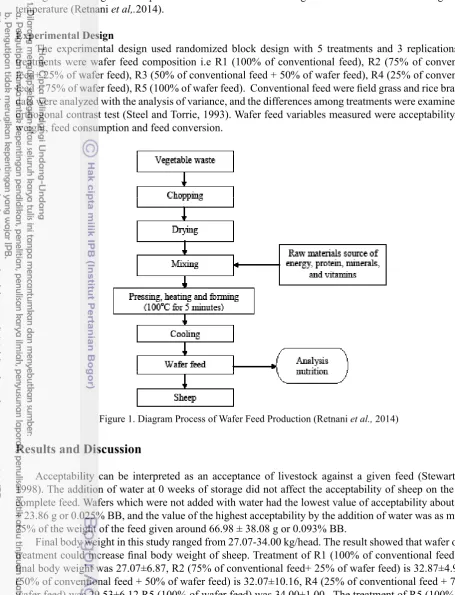
Figure 1 showed that diagram process of wafer feed production by chopping, drying, mixing, pressing, heating and forming with temperature 1000C for 10 minutes to get wafer feed and then cooling in room
temperature (Retnani et al,.2014).
Experimental Design
The experimental design used randomized block design with 5 treatments and 3 replications. The treatments were wafer feed composition i.e R1 (100% of conventional feed), R2 (75% of conventional feed+ 25% of wafer feed), R3 (50% of conventional feed + 50% of wafer feed), R4 (25% of conventional feed + 75% of wafer feed), R5 (100% of wafer feed). Conventional feed were ield grass and rice bran. The data were analyzed with the analysis of variance, and the differences among treatments were examined with orthogonal contrast test (Steel and Torrie, 1993). Wafer feed variables measured were acceptability, body weight, feed consumption and feed conversion.
Figure 1. Diagram Process of Wafer Feed Production (Retnani et al., 2014)
Results and Discussion
Acceptability can be interpreted as an acceptance of livestock against a given feed (Stewart et al. 1998). The addition of water at 0 weeks of storage did not affect the acceptability of sheep on the wafer complete feed. Wafers which were not added with water had the lowest value of acceptability about 18:30 ± 23.86 g or 0.025% BB, and the value of the highest acceptability by the addition of water was as much as 75% of the weight of the feed given around 66.98 ± 38.08 g or 0.093% BB.
Final body weight in this study ranged from 27.07-34.00 kg/head. The result showed that wafer of feed
treatment could increase inal body weight of sheep. Treatment of R1 (100% of conventional feed) have inal body weight was 27.07±6.87, R2 (75% of conventional feed+ 25% of wafer feed) is 32.87±4.91, R3 (50% of conventional feed + 50% of wafer feed) is 32.07±10.16, R4 (25% of conventional feed + 75% of wafer feed) was 29.53±6.12 R5 (100% of wafer feed) was 34.00±1.00. The treatment of R5 (100% wafer feed) has average body weight of the highest compared to other treatments. Sheep were fed by conventional
fed had inal body weight 27.07 kg, meanwhile sheep were fed 100% of wafer feed complete had 34 kg
or 25.6% higher than conventional. According to Purbowarti et al. (2005). body weight thin tail sheep can reach 30-40 kg in males.
The result showed that wafer of feed treatment did not signiicant (P>0.05) on sheep’s daily consumption.
was 1624 ± 117, R4 (25% of conventional feed + 75% of wafer feed) was 1454 ± 138, R5 (100% of wafer feed) was 1487 ± 109.
Feed conversion was affected by feed quality, digestibility value, and eficiency. Increase in feed quality
will improve body weight gain, so feed conversion value will decrease, meaning that the application of feed
is eficient (Pond et al., 1995). Feed conversion depends on dry matter intake and body weight gain. Feed conversion in this study ranged from 9.19-38.50.
Income is one of the main objectives in farm. By knowing the amount of income received by then a farmer can determine if feed costs incurred during the maintenance of livestock or not economical enough. IOFC (Income Over Feed Cost) that calculates the difference between sheep sales revenue minus feed cost incurred during the maintenance process.
The amount of beneits obtained by calculating the value of the business eficiency is the difference
between sheep sales revenue minus feed cost incurred during the process of maintenance. IOFC were Rp. 10.100 (R1), Rp. 164.100 (R2), Rp. 156.800 (R3), Rp. 31.400 (R4), Rp. 146.050 (R5). The highest Income Over Feed Cost feed of sheep fed with 25% of wafer feed was Rp. 164.100,-.
Conclusion
Wafer of feed were able to increase the sheep’s body weight, but didn’t effect on sheep’s daily consumption. Wafer of feed that was given 100% to the sheep had the lowest feed conversion. Meanwhile, level of 25% wafer complete feed had the highest value of IOFC.
References
Ariin A, Isminursiti A, Rianto E. 2007. Protein deposition on thin tail sheep by feeding forage and concentrates with a different presentation methods. National seminar on animal husbandry and veterinary. Semarang (ID). http:// www.peternakan.lit-bang.dep-tan.go.id/full-teks/loka-karya/prork16-17.pdf. [25 Juni 2015]
Central Bureau of Statistics of DKI Jakarta. 2012. Jakarta in Figures 2012. Jakarta (ID): Central Bureau of Statistics of Provincial DKI Jakarta.
Purbowati, 2005. Fattening of Sheep. Penebar Swadaya, Jakarta.
Retnani Y, FP Syananta, L Herawati, W Widiarti, A Saenab, 2010a. Physical Characteristic and Palatability of Market Vegetable Waste Wafer for Sheep. J. Anim. Prod. 12: 29 -33.
Retnani Y, Andi S, Taryati. 2014. Vegetable Waste as Wafer Feed For Increasing Productivity of Sheep. Asian Jurnal of Animal Sciences. 8 (1) : 15-23.
Steel RGD and JH Torrie, 1993. Principles and Procedures of Statistic. 2nd Edn., Graw-Hall, New York.
Proceeding of the 3rd International Seminar on Animal Industry, Bogor, 17-18 September 2015 | cdxxv