
Rethinking theory of mind in high-functioning
autism spectrum disorder
Anke M. Scheeren,
1Marc de Rosnay,
2Hans M. Koot,
1and Sander Begeer
1,2 1VU University Amsterdam, Department of Developmental Psychology, Amsterdam, The Netherlands;2University ofSydney, School of Psychology, Sydney, Australia
Background:The sociocommunicative problems in autism spectrum disorder (ASD) are traditionally linked to impairments in Theory of Mind (ToM), the ability to ascribe mental states to others. Although ToM impairments are consistently reported in young children with ASD, findings on more advanced ToM understanding in older individuals with high-functioning ASD (HFASD) are less straightforward. Therefore, we assessed the advanced ToM abilities of a large sample of school-aged children and ado-lescents with HFASD (n= 194; 6–20 years) and compared them to a typically developing (TD) com-parison group (n= 60). Methods:Participants’ advanced ToM was assessed with five social stories containing second-order false beliefs, display rules, double bluff, faux pas, and sar-casm. Results:Participants with HFASD performed equally well on each of the ToM stories as their TD peers. Consistent age effects were noticed with adolescents outperforming the children. Furthermore, advanced ToM was positively associated with participants’ age, verbal abilities, and general reasoning abilities. Conclusions:Counter to what the ToM theory of ASD would predict, school-aged children and adolescents with HFASD seem to be able to master the theoretical principles of advanced mental state reasoning. However, they may still fail to apply these theoretical principles during everyday social interactions. Keywords: Autism spectrum disorder, advanced theory of mind, children and adoles-cents, high-functioning, social understanding.
Introduction
For nearly three decades, studies on Theory of Mind (ToM) have dominated research on individuals with autism spectrum disorders (ASD; Baron-Cohen, Leslie, & Frith, 1985). Theory of mind classically refers to the ability to ascribe mental states to people and to explain and predict their behavior in terms of underlying mental states (Baron-Cohen et al., 1985). A limited ToM ability may explain the characteristic impairments in sociocommunicative behavior in individuals with ASD. Indeed, young children with ASD generally fail first-order ToM tasks (false belief tasks), but research findings are less straightforward with regard to more advanced ToM understanding in older individuals with ASD of normal intelligence (i.e., ‘high-functioning’ ASD; HFASD). In this study, we examined advanced ToM understanding in a large sample of school-aged children and adoles-cents with HFASD, and a typically developing (TD) comparison group.
Children’s ToM has been examined extensively with first-order false belief tasks (Wellman, Cross, & Watson, 2001; Wimmer & Perner, 1983). These tasks require children to predict a protagonist’s actions or thoughts based on a false belief. Young children with ASD, especially those with an intellectual disability, generally fail these first-order ToM tasks (Baron-Cohen et al., 1985; Yirmiya, Erel, Shaked, & Solo-monica-Levi, 1998) that are mastered by TD children
at 4 or 5 years of age (for a meta-analysis see Wellman et al., 2001). However, once the verbal abilities of children with ASD are equivalent to those of a typical 11- or 12-year-old, they too perform at ceiling on such tasks (Fisher, Happe´, & Dunn, 2005; Happe´, 1995). Hence, children’s success on a ToM task seems in part dependent on their verbal ability. Yet, despite their ultimate success on first-order ToM tasks, children and adolescents with ASD still experience profound difficulties understanding oth-ers’ thoughts and intentions in everyday life (Bauminger & Kasari, 1999; Peterson, Garnett, Kel-ly, & Attwood, 2009). There is a need for more sen-sitive measures which capture putative deviations in ToM understanding in these older groups.
In response to this need, various advanced ToM tests have been developed, such as the Strange Stories task (Happe´, 1994). Advanced ToM tests consist of an eclectic mixture of social stories that all require a form of second-order reasoning: inferences about someone’s thoughts and feelings, which are, in turn, about another person’s mental states (Miller, 2009). In typical development, children are able to infer second-order false beliefs (‘X falsely believes that Y thinks’) when they are 5- or 6-years old (for a review see Miller, 2009). More complex forms of second-order reasoning such as the understanding of ironic remarks occur later in development, al-though exact ages have not yet been pinpointed (Filippova & Astington, 2010; Miller, 2009). Re-cently, advanced ToM tasks have been refined by the addition of physical state stories or questions
Conflict of interest statement: No conflicts declared.
that allow a specific impairment in mental state reasoning to be distinguished from more general impairments in reasoning or text comprehension (Kaland, Callesen, Moller-Nielsen, Mortensen, & Smith, 2008; White, Hill, Happe´, & Frith, 2009).
The relatively small number of studies on advanced ToM in school-aged children (6–12 years) with HFASD indicate some level of advanced ToM impairment when compared with TD children (Beaumont & Sofronoff, 2008; Brent, Rios, Happe´, & Charman, 2004; Kaland et al., 2008; Sobel, Capps, & Gopnik, 2005; White et al., 2009). Yet, White et al. (2009) also underscore the extent of individual dif-ferences in ToM task performance. In their study, a substantial proportion of children with HFASD per-formed similarly or even better than a TD compari-son group on advanced mental state reacompari-soning. At later ages, findings with regard to advanced ToM understanding are more equivocal in HFASD groups. While various studies have highlighted advanced ToM impairments (Baron-Cohen, Jolliffe, Mortimore, & Robertson, 1997; Kleinman, Marciano, & Ault, 2001), others have failed to document any limita-tions in ToM understanding (Ponnet, Buysse, Roe-yers, & De Clercq, 2008; RoeRoe-yers, Buysse, Ponnet, & Pichal, 2001; Senju, Southgate, White, & Frith, 2009; Spek, Scholte, & Van Berckelaer-Onnes, 2010). In sum, there is currently no consensus on whether adolescents and young adults with HFASD are impaired in their advanced ToM understanding. In this study, we examined advanced ToM in children and adolescents with HFASD, and com-pared their performance to a TD group. Because we aimed to test a large sample with a wide age range, we devised a short, yet comprehensive collection of advanced ToM stories that could be administered to individuals between 6 and 20 years of age. First, we included the birthday puppy story, which is one of the most frequently used vignettes targeting second-order false belief reasoning (Sullivan, Zaitchik, & Tager-Flusberg, 1994). Second, we included an
emotional display rule understanding task that highlights one of the most frequent ways of creating false beliefs in daily life: hiding one’s true emotion by modifying one’s facial expression (Begeer et al., 2011). The three remaining stories appeared in the Stories from Everyday Life (Kaland et al., 2008), which is very similar to those of the Strange Stories task. These stories comprised double bluff, social rule violation (faux pas), and sarcasm. Together, these five vignettes comprise a global index of advanced ToM reasoning that represent different, but interconnected domains of mental state knowl-edge, some of which may be mastered earlier on (second order false belief, display rules), and some of which may be mastered relatively late in develop-ment (double bluff, faux pas, and sarcasm).
On the basis of previous findings, we expected that the majority of TD children and adolescents would pass the second-order false belief and emotional
display rule tasks (Begeer et al., 2011; Miller, 2009), but would show more difficulty understanding dou-ble bluff, faux pas, and sarcasm. Compared with TD children, we expected that children with HFASD (6– 12 years) would show impaired performance on all five stories. Furthermore, we expected that adoles-cents with HFASD (>12 years) would only perform more poorly than their TD counterparts on the latter three stories.
This study also allowed us to examine how matu-ration (i.e., chronological age), verbal ability, and general reasoning abilities (i.e., physical state infer-ences) are related to advanced ToM in HFASD across a broad age range. While verbal ability, in particular, has been shown to correlate strongly with ToM understanding in TD children and children with moderate learning difficulties (Fisher et al., 2005; Milligan, Astington, & Dack, 2007; Ronald, Viding, Happe´, & Plomin, 2006), children with HFASD have been shown to need disproportionately advanced linguistic maturity before they can pass standard ToM tasks (Bauminger & Kasari, 1999; Happe´, 1995). It is important to establish, therefore, whether relations between verbal ability and advanced ToM are similarly manifest in both groups.
Method
Participants
Via a specialized school for normally intelligent children with ASD (Berg en Boschschool), we recruited 214 children and adolescents with ASD. School admission criteria included a normal IQ (IQ > 70) and a clinical diagnosis of ASD. The clinical diagnoses were estab-lished prior to the recruitment according to DSM-IV-TR-criteria by psychiatrists/psychologists who worked independently from the school and the authors, and who were unaware of the goals and outcomes of this study. The diagnostic process included anamneses, proxy reports, and psychiatric and neuropsychological examinations. Our strictly high-functioning ASD (HFASD) sample allowed for the inclusion of a com-parison group with a normal IQ (Jarrold & Brock, 2004). The comparison group consisted of 73 TD chil-dren and adolescents and was recruited via public pri-mary and secondary schools.
We decided to exclude 20 of the 214 participants with HFASD from the final analysis due to an incomplete IQ assessment (6), a verbal receptive IQ under 70 (4), or incomplete ToM data (10). Within the TD comparison group, 13 of the 73 participants were excluded from the final analysis due to technical problems (1), incomplete IQ assessment (3), incomplete ToM data (5), or a high level of parent-reported autistic characteristics on the Social Responsiveness Scale (SRS; 4; Constantino & Gruber, 2007). All parents of the final sample of 60 children and adolescents in the comparison group confirmed that their child had no ASD diagnosis.
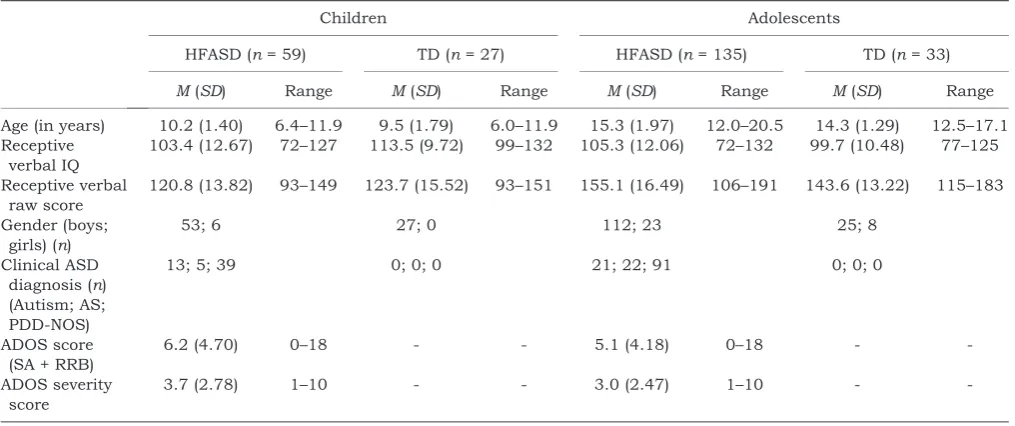
MTD= 105.9,SD= 12.22) and gender ratio (HFASD: 165 boys; TD: 52 boys) were comparable for both groups (see also Table 1). Following Jarrold and Brock (2004), we examined and, if necessary, statistically controlled for the possible influence of participants’ age and verbal ability.
In addition to clinical diagnoses of autism (34), Asperger’s syndrome (27), or PDD-NOS (130), we gained diagnostic information on 178 participants with HFASD (92%) with the Autism Diagnostic Observation Schedule (ADOS; Lord et al., 2000). Despite their clinical diag-noses, admission to specialized education, and parental reports of high autistic traits on the SRS (M= 80.0, SD= 22.41), average ADOS score of the participants (M= 5.5,SD= 4.37) indicated that a large proportion in fact scored below the ADOS cutoff for an ASD (<7). Indeed, 64% (114) of the participants received an ADOS score below the ASD cutoff using the revised ADOS algorithm (Gotham et al., 2008). These results suggest that a majority of our HFASD sample may show rela-tively mild autistic traits. To make sure that any pos-sible group difference on advanced ToM task performance between our HFASD sample and TD sample would not be distorted by the relatively mild autistic symptoms in our HFASD sample, we checked in our statistical analyses whether autism severity had an impact on advanced ToM performance.
Measures
Advanced theory of mind
The five advanced ToM tasks (second-order false belief, emotional display rule understanding, double bluff, faux pas, and sarcasm) appear in the Appendix (Begeer et al., 2011; Kaland et al., 2008; Sullivan et al., 1994). These tasks were chosen because they were expected to elicit the strongest differences in scores between chil-dren with HFASD and TD comparison chilchil-dren (Kaland, personal communication).
All story narratives were read aloud by the experi-menter and followed up with a physical state question (except second-order false belief) and a mental state question. The physical state question required reason-ing about a nonmental event in the story, whereas the mental state question required reasoning about the mental state of the story protagonist. With the exception of the second-order false belief task, which included intermittent control questions, participants received a typed sheet for each story, which they could choose to read simultaneously. The typed sheet was taken away before questioning. Each physical state question was scored 1 (correct) or 0 (incorrect or ‘don’t know’). These scores were summed to yield a 0–4 physical state total index. Similarly, each of the mental state questions was scored 1 (correct) or 0 (incorrect or ‘don’t know’). The creation of a 0–5 advanced ToM index is discussed in the Results. Inter-rater reliability of the mental state questions was moderate to perfect (20% of the ToM data were coded double), with kappa’s ranging from 0.57 to 1.00.
Peabody picture vocabulary test-III-NL
The Peabody Picture Vocabulary Test (Dunn & Dunn, 2004) assesses receptive vocabulary and is highly cor-related with more general measures of verbal IQ (Hodapp & Gerken, 1999). Participants had to select one of four pictures that corresponded with a given word. The test consists of 17 sets of 14 words, which increase in difficulty. On the basis of the PPVT, participants received an absolute measure of receptive verbal ability.
Autism diagnostic observation schedule-generic
The ADOS (Lord et al., 2000) is a diagnostic observation measure to assess the presence and severity of autistic symptoms in the domains of social reciprocity, com-munication, fantasy, and repetitive interests and
Table 1 Description of participants with high-functioning ASD (HFASD) and typically developing (TD) participants, split for children (6–11 years) and adolescents (12–20 years)
Children Adolescents
HFASD (n= 59) TD (n= 27) HFASD (n= 135) TD (n= 33)
M(SD) Range M(SD) Range M(SD) Range M(SD) Range
Age (in years) 10.2 (1.40) 6.4–11.9 9.5 (1.79) 6.0–11.9 15.3 (1.97) 12.0–20.5 14.3 (1.29) 12.5–17.1 Receptive
verbal IQ
103.4 (12.67) 72–127 113.5 (9.72) 99–132 105.3 (12.06) 72–132 99.7 (10.48) 77–125
Receptive verbal raw score
120.8 (13.82) 93–149 123.7 (15.52) 93–151 155.1 (16.49) 106–191 143.6 (13.22) 115–183
Gender (boys; girls) (n)
53; 6 27; 0 112; 23 25; 8
Clinical ASD diagnosis (n) (Autism; AS; PDD-NOS)
13; 5; 39 0; 0; 0 21; 22; 91 0; 0; 0
ADOS score (SA + RRB)
6.2 (4.70) 0–18 - - 5.1 (4.18) 0–18 -
-ADOS severity score
3.7 (2.78) 1–10 - - 3.0 (2.47) 1–10 -
behaviors. During a semistructured observation, the ADOS interviewer offers playful activities (e.g., reading a story book) and topics of discussion (e.g., peer problems) to assess the sociocommunicative abilities of the par-ticipant. Each of the participant’s behaviors is rated on a scale ranging from normal behavior (0) to clearly deviant and autistic behavior (2). An ADOS score of 7 or higher is indicative of an ASD. The ADOS has excellent internal consistency, inter-rater reliability, test–retest reliability, and discriminant validity (Lord et al., 2000).
Social responsiveness scale
The SRS (Constantino & Gruber, 2007) is a parent or teacher questionnaire which assesses autistic traits. The SRS consists of 65 statements about the child’s behavior that can be answered on a four-point scale ranging from 0 (never true) to 3 (almost always true). A higher total score indicates more autistic traits. Good reliability and validity have been reported (Constantino & Gruber, 2007).
Procedure
Upon receiving informed consent from parents and participants over 11 years, each participant was individually tested at school. The advanced ToM tasks were part of a full battery of tests, described elsewhere (Scheeren, Koot, & Begeer, 2012). All interviews were videotaped and transcribed, and coded by graduate students who were blind to the diagnosis of the participants.
Results
Performance on the mental state questions for each ToM story is presented in Table 2 for Group (HFASD vs. TD) and Age (child vs. adolescent) separately. We conducted separate binary logistic regression anal-yses to establish the influence of Group and Age on each of the five stories. Table 2 summarizes each of these models and presents the observed and pre-dicted (conditional) probabilities for passing each task (rather than odds ratios) by Group and Age.
Overall, although some of the advanced ToM stories were clearly more difficult than others, there was no evidence that children with HFASD performed dif-ferently on the mental state questions than their TD counterparts. Furthermore, regardless of the type of story, adolescents performed consistently better than children.
Given such consistency, a composite advanced ToM score was created by summing the scores on the five mental state questions, resulting in a 0–5 score,
M= 3.5, SD= 1.17. Despite the fact that the five stories tap distinct conceptual domains of advanced ToM, and emerge at different times developmentally, a reliability analysis was nonetheless conducted to examine whether any single task elicited qualita-tively different response patterns. The advanced ToM score had a Cronbach’s alpha of .46, which is mod-est, but all items were positively correlated (corrected item-total correlations ranged between .21 and .32) and the overall alpha was not improved by omitting any item. Moreover, these reliabilities confirm earlier findings on advanced ToM stories in ASD (Hughes et al., 2000; Peterson, Slaughter, & Paynter, 2007). Given the theoretical connection between these do-mains, the composite advanced ToM score was thus used in subsequent analyses. Below, we further examine the relation between advanced ToM and Group accounting for (1) chronological age and ver-bal ability, (2) physical state inference scores, and (3) autism severity (ADOS and SRS).
Table 3 shows significant positive correlations between participants’ advanced ToM and their chronological age and verbal ability in both groups. However, partial correlations controlling for verbal ability revealed a non-significant correlation between chronological age and advanced ToM in both groups. Conversely, partial correlations controlling for chro-nological age revealed a significant correlation between verbal ability and advanced ToM in both groups. These analyses clearly illustrate that chro-nological age per se is not critical for advanced ToM understanding, rather it is the level of receptive verbal ability, in absolute terms, that is of
impor-Table 2 Observed and predicted probability (between brackets) of passing the mental state question of each theory of mind story
Children Adolescents Contrastp-values
HFASD (n= 59) TD (n= 27) HFASD (n= 135) TD (n= 33) Group Age
1. Second-order false beliefa .85 (.83) .78 (.81) .95 (.95) .97 (.95) n.s. <.01
2. Emotional display ruleb .92 (.91) .89 (.90) .96 (.97) .97 (.96) n.s. n.s.
3. Double bluffc .46 (.48) .44 (.41) .65 (.64) .55 (.58) n.s. <.05
4. Faux pasd .49 (.50) .44 (.43) .68 (.68) .61 (.62) n.s. <.01
5. Sarcasme .32 (.33) .26 (.24) .62 (.64) .49 (.50) n.s. <.001
HFASD, high-functioning autism spectrum disorder; TD, typically developing.
aThe overall model for 1 was significant,
v2(2)= 10.54,p< .01. bThe overall model for 2 was not significant,
v2(2)= 3.04,p> .10. cThe overall model for 3 was significant,
v2(2)= 8.15,p< .05. dThe overall model for 4 was significant,
v2(2)= 9.27,p< .05. eThe overall model for 5 was significant,
tance for both participants with HFASD as well as TD children and adolescents.
Regarding physical state inferences, an initial 2 (Group)·2 (Age) ANOVA was conducted with
phys-ical state score as a dependent variable. Results showed that there were no differences in physical state inferences between participants with HFASD and their TD counterparts, F(1,253)= 0.00, p= .96,
but there was a strong effect of Age,F(1,253) = 27.18, p< .001. Table 3 shows that advanced ToM and physical state score were significantly positively correlated within both groups, but this association only remained significant for children and adoles-cents with HFASD once chronological age and verbal ability were controlled for using partial correlations. Analysis of variance was used to examine possible effects of Group and Age on the composite advanced ToM score. Again, there was no main effect of Group on advanced ToM, F(1,253) = 2.34,p= .13, but there
was a highly significant effect of Age,F(1,253) = 22.80, p< .001, with adolescents outperforming children. The interaction between Group and Age was not significant, F(1,253)= 0.05, p= .83. We also
con-ducted an analysis of covariance (ANCOVA) to examine potential group effects on the total advanced ToM index, while controlling for the influences of chronological age, verbal ability, and physical state score. There was no main effect of Group,F(1,251)= 1.38,p= .24.
Participants’ scores of autism severity (both ADOS and SRS) were not significantly correlated with advanced ToM (see Table 3). Also, none of the
subscales of the ADOS or SRS correlated signifi-cantly with advanced ToM (r’s ranging from).13 to
.11). In a final set of analyses, we examined whether autism severity nonetheless affected advanced ToM when other important variables were controlled for. We repeated an ANCOVA with advanced ToM score as dependent variable, Group as fixed factor with three levels (HFASD with a high (‡7) ADOS score; HFASD with a low (<7) ADOS score; TD comparison), and chronological age, verbal ability, and physical state index as covariates. Again, no main effect of group was found,F(2,234)= 0.77,p= .46, confirming
that autism severity, as measured on the ADOS, had no significant effect on advanced ToM performance.
Discussion
Compared with the myriad of studies on false belief understanding in children with ASD and varying intellectual abilities, ToM understanding in children and adolescents with HFASD has received relatively little attention. Therefore, we used five advanced ToM stories to examine the performance of a large sample of children and adolescents with HFASD, and compared them to TD peers. Performance on the second-order false belief story and the emotional display rule story approached ceiling, particularly for the adolescents, but the stories about double bluff, faux pas, and sarcasm were more difficult for all participants. However, counter to our expecta-tions, no group differences were found on any of the stories. Furthermore, adolescents performed con-sistently better than children, irrespective of HFASD status. Yet, it was not their age, but rather absolute verbal abilities and general reasoning capacity that appeared to underlie better advanced ToM under-standing.
Counter to some previous findings on advanced ToM in children with HFASD (Beaumont & Sofronoff, 2008; Brent et al., 2004; Sobel et al., 2005; White et al., 2009), we did not find an advanced ToM impairment in children with HFASD (6–12 years). Similarly, although previous results were equivocal concerning advanced ToM abilities in adolescents and adults with HFASD, we did not find support for an advanced ToM impairment in adolescents with HFASD (12–20 years). Both children and adoles-cents with HFASD in our study performed equally well as their TD counterparts. Hence, when ad-vanced ToM is operationalized by a set of complex social stories, high-functioning children and ado-lescents with ASD appear to be equally capable of inferring mental states of story protagonists. Although this finding is incompatible with the ToM theory of ASD, children and adolescents with HFASD may nonetheless show limited ability to infer mental states during social interactions occurring in every-day life. Indeed, parents report everyevery-day mindread-ing problems in their child with ASD, even when the child succeeds on first-order ToM tasks (Peterson
Table 3 Pearson correlations between advanced ToM score, age, receptive verbal ability, physical state score, and autism severity (autism diagnostic observation schedule [ADOS] and social responsiveness scale [SRS])
Advanced ToM score
Absolute receptive verbal ability .38*** .56*** Physical state score .40*** .39**
ADOS severity score ).04
-SRS total score (HFASD:n= 152; TD:n= 47)
).07 .05
Age (controlling for verbal ability) ).01 .12 Age (controlling for physical state
score)
.23** .38**
Absolute receptive verbal ability (controlling for age)
.25*** .31***
Absolute receptive verbal ability (controlling for physical state score)
.22** .47***
Physical state score (controlling for age)
.37*** .17
Physical state score (controlling for verbal ability)
.29*** .19
HFASD, high-functioning autism spectrum disorder; TD, typ-ically developing.
et al., 2009). Also, adults with HFASD who succeed on static advanced ToM tasks such as the Strange Stories, still show ToM problems when evaluating a videotaped social conversation (Ponnet et al., 2008; Roeyers et al., 2001). This apparent discrepancy may be due to the complexity of everyday social interactions compared with the social situations as described in ToM stories. Also, the demands of social interactions are not as explicitly defined as mental state questions. Therefore, other factors such as social attention and motivation may crucially deter-mine whether or not the relatively intact conceptual understanding of mental states is activated and used in individuals with HFASD (Klin, Jones, Schultz, & Volkmar, 2003). Increased attention and motivation might also explain why a substantial proportion of our participants with HFASD only showedsub clini-cal symptoms of autism on the ADOS, a semistruc-tured interaction with an adult experimenter, even though their clinical diagnoses imply that they experience profound social difficulties in their everyday lives.
Several alternative explanations for our nonsignif-icant results will be discussed below. First, because our participants with a clinical diagnosis of HFASD were characterized by relatively mild autism symp-tomatology with a substantial number not reaching the ASD cutoff on the ADOS (<7), this mild autism severity might explain why our HFASD sample per-formed equally well on the advanced ToM task as TD peers. However, it must be noted that children’s autism severity was not related to their ToM task performance, and a considerable number of our participants did meet ADOS criteria for ASD. Hence, mild autism severity in the HFASD group can be ru-led out as an alternative explanation for the results. Second, it may be argued that the participants with HFASD, in particular the adolescent group, had a slight advantage on the advanced ToM task due to their significantly older age than the TD comparison group. However, even after controlling for chrono-logical age, their advanced ToM task performance remained comparable to the TD group. Third, it could be that our measure of advanced ToM was not sen-sitive enough to detect group differences. The ad-vanced ToM task consisted of a collection of five social stories, all derived from previously validated ToM measures (Begeer et al., 2011; Kaland et al., 2008; Sullivan et al., 1994). Possibly, the first two stories were unable to differentiate participants with and without HFASD due to a ceiling effect. However, the same pattern of nonsignificant group differences was found for the latter three stories. Furthermore, each of the stories, except for the emotional display rule story, showed a significant age effect with ado-lescents performing better than children. This shows that the stories are in fact sensitive enough to detect potential group differences.
As expected, children’s ToM task performance was positively associated with their chronological age,
verbal ability, and physical state index (Bauminger & Kasari, 1999; Fisher et al., 2005; Happe´, 1995). Importantly, these links were found in both groups. The positive association between age and ToM could be largely explained by a third factor: verbal abilities. Hence, it is not age per se, but an absolute growth in verbal abilities that increases a child’s success on advanced ToM tasks. This may not be surprising, given the highly verbal nature of the advanced ToM task. However, this finding also raises the interesting question whether differences in performance on an advanced ToM task are first and foremost determined by children’s verbal abilities instead of their mental state reasoning. Future studies should try to include advanced ToM measures that are less intertwined with children’s verbal abilities and more closely re-lated to children’s social competence in everyday life. Positive correlations between physical state and mental state inferences were only found in the HFASD group, controlling for chronological age and verbal ability. This may indicate that children and adolescents with HFASD rely more heavily on their general reasoning abilities than TD peers do to solve advanced ToM tasks. Hence, children with HFASD may use nonsocial heuristics and general logic to understand others’ intentions and desires (Peterson et al., 2009). In typical development, children’s so-cial understanding is embedded in their experience of social interactions (Carpendale & Lewis, 2004). Possibly, a different social interaction pattern from birth onwards results in a more analytical and the-oretical understanding of what drives others’ behavior (Klin et al., 2003). As this study has shown, a different way of understanding other minds may not necessarily impair performance on a static ToM task. However, under less than perfect circum-stances (implicit social demands, time constraints), such is the case with everyday social interactions, individuals with HFASD may still experience pro-found problems understanding the mental worlds of others. Hence, individuals with HFASD seem to master the concept of ToM without mastering the ability to use such insight in the service of their ongoing social interactions.
Acknowledgements
The authors would like to thank all children and ado-lescents and their parents for participating in this study, with special thanks to the Berg en Boschschool. This study was financially supported by Stichting Nuts Ohra (SNO-T-0701-116). The authors have declared that they have no competing or potential conflicts of interest.
Correspondence
Supporting information
Additional supporting information is provided along
with the online version of this article. Appendix S1. Advanced theory of mind stories
Key points
• Impairments in ToM understanding, the ability to ascribe mental states to others, have been consistently
reported in young children with autism spectrum disorders (ASD).
• However, previous studies on more advanced ToM understanding in high-functioning (i.e., normally
intelli-gent) ASD, particularly in adolescents and adults, have produced mixed results.
• This study showed no differences in performance on an advanced ToM task in school-aged children and
adolescents with HFASD compared to typically developing peers. For both groups, advanced ToM was posi-tively associated with verbal abilities.
• Even though children and adolescents with HFASD are able to master the theoretical principles of advanced mental state reasoning, they may still fail to apply these principles in everyday life.
References
Baron-Cohen, S., Jolliffe, T., Mortimore, C., & Robertson, M. (1997). Another advanced test of theory of mind: Evidence from very high functioning adults with autism or Asperger syndrome.Journal of Child Psychology and Psychiatry,38, 813–822.
Baron-Cohen, S., Leslie, A.M., & Frith, U. (1985). Does the autistic child have a ‘‘theory of mind’’?Cognition,21, 37–46. Bauminger, N., & Kasari, C. (1999). Brief report: Theory of Mind in high-functioning children with autism. Journal of Autism and Developmental Disorders,29, 81–86.
Beaumont, R.B., & Sofronoff, K. (2008). A new computerised advanced theory of mind measure for children with Asperger syndrome: The ATOMIC. Journal of Autism and Develop-mental Disorders,38, 249–260.
Begeer, S., Banerjee, R., Rieffe, C., Terwogt, M.M., Potharst, E., Stegge, H., & Koot, H.M. (2011). The understanding and self-reported use of emotional display rules in children with autism spectrum disorders.Cognition and Emotion,25, 947– 956.
Brent, E., Rios, P., Happe´, F., & Charman, T. (2004). Perfor-mance of children with autism spectrum disorder on advanced theory of mind tasks.Autism,8, 283–299. Carpendale, J.I.M., & Lewis, C. (2004). Constructing an
understanding of mind: The development of children’s social understanding within social interaction. Behavioral and Brain Sciences,27, 79–151.
Constantino, J.N., & Gruber, C.P. (2007). Social responsive-ness scale. Los Angeles: Western Psychological Services. Dunn, L.M., & Dunn, L.M. (2004).Peabody picture vocabulary
test (PPVT)-III-NL. Amsterdam: Hartcourt Test.
Filippova, E., & Astington, J.W. (2010). Children’s under-standing of social-cognitive and social-communicative aspects of discourse irony.Child Development,81, 913–928. Fisher, N., Happe´, F., & Dunn, J. (2005). The relationship between vocabulary, grammar, and false belief task perfor-mance in children with autistic spectrum disorders and children with moderate learning difficulties.Journal of Child Psychology and Psychiatry,46, 409–419.
Gotham, K., Risi, S., Dawson, G., Tager-Flusberg, H., Joseph, R., Carter, A., ... & Lord, C. (2008). A replication of the autism diagnostic observation schedule (ADOS) revised algorithms. Journal of the American Academy of Child and Adolescent Psychiatry,47, 642–651.
Happe´, F.G.E. (1994). An advanced test of theory of mind-understanding of story characters’ thoughts and feelings by able autistic, mentally retarded, and normal children and adults.Journal of Autism and Developmental Disorders,24, 129–154.
Happe´, F.G.E. (1995). The role of age and verbal ability in the theory of mind task performance of subjects with autism. Child Development,66, 843–855.
Hodapp, A.F., & Gerken, K.C. (1999). Correlations between scores for Peabody Picture Vocabulary Test-III and the Wechsler Intelligence Scale for Children-III. Psychological Report,84, 1139–1142.
Hughes, C., Adlam, A., Happe´, F., Jackson, J., Taylor, A., & Caspi, A. (2000). Good test-retest reliability for standard and advanced false-belief tasks across a wide range of abilities. Journal of Child Psychology and Psychiatry, 41, 483–490.
Jarrold, C., & Brock, J. (2004). To match or not to match? Methodological issues in autism-related research.Journal of Autism and Developmental Disorders,34, 81–86.
Kaland, N., Callesen, K., Moller-Nielsen, A., Mortensen, E.L., & Smith, L. (2008). Performance of children and adolescents with Asperger syndrome or high-functioning autism on advanced theory of mind tasks. Journal of Autism and Developmental Disorders,38, 1112–1123.
Kleinman, J., Marciano, P.L., & Ault, R.L. (2001). Advanced theory of mind in high-functioning adults with autism. Journal of Autism and Developmental Disorders,31, 29–36. Klin, A., Jones, W., Schultz, R., & Volkmar, F. (2003). The enactive mind, or from actions to cognition: Lessons from autism. Philosophical Transactions of the Royal Society London: Biological Series,358, 345–360.
Lord, C., Risi, S., Lambrecht, L., Cook, E.H., Leventhal, B.L., DiLavore, P.C., ... & Rutter, M. (2000). The autism diagnostic observation schedule – generic: A standard measure of social and communication deficits associated with the spectrum of autism.Journal of Autism and Developmental Disorders,30, 205–223.
Miller, S. (2009). Children’s understanding of second-order mental states.Psychological Bulletin,135, 749–773. Milligan, K., Astington, J.W., & Dack, L.A. (2007). Language
and theory of mind: A meta-analysis of the relation between language ability and false-belief understanding.Child Devel-opment,78, 622–646.
Peterson, C.C., Garnett, M., Kelly, A., & Attwood, T. (2009). Everyday social and conversation applications of theory-of-mind understanding by children with autism-spectrum disorders or typical development.European Child and Ado-lescent Psychiatry,18, 105–115.
Ponnet, K., Buysse, A., Roeyers, H., & De Clercq, A. (2008). Mind-reading in young adults with ASD: Does structure matter?Journal of Autism and Developmental Disorders,38, 905–918.
Roeyers, H., Buysse, A., Ponnet, K., & Pichal, B. (2001). Advancing advanced mind-reading tests: Empathic accu-racy in adults with a pervasive developmental disorder. Journal of Child Psychology and Psychiatry,42, 271–278. Ronald, A., Viding, E., Happe´, F., & Plomin, R. (2006).
Individual differences in theory of mind ability in middle childhood and links with verbal ability and autistic traits: A twin study.Social Neuroscience,1, 412–425.
Scheeren, A.M., Koot, H.M., & Begeer, S. (2012). Social interaction style of children and adolescents with high-functioning autism spectrum disorder. Journal of Autism and Developmental Disorders,42, 2046–2055.
Senju, A., Southgate, V., White, S., & Frith, U. (2009). Mindblind eyes: An absence of spontaneous theory of mind in Asperger syndrome.Science,325, 883–885.
Sobel, D.M., Capps, L.M., & Gopnik, A. (2005). Ambiguous figure perception and theory of mind understanding in children with autistic spectrum disorders. British Journal of Developmental Psychology,23, 159–174.
Spek, A.A., Scholte, E.M., & Van Berckelaer-Onnes, I.A. (2010). Theory of mind in adults with HFA and Asperger
syndrome.Journal of Autism and Developmental Disorders, 40, 280–289.
Sullivan, K., Zaitchik, D., & Tager-Flusberg, H. (1994). Pre-schoolers can attribute 2nd-order beliefs. Developmental Psychology,30, 395–402.
Wellman, H.M., Cross, D., & Watson, J. (2001). Meta-analysis of theory-of-mind development: The truth about false belief. Child Development,72, 655–684.
White, S., Hill, E., Happe´, F., & Frith, U. (2009). Revisiting the strange stories: Revealing mentalizing impairments in aut-ism.Child Development,80, 1097–1117.
Wimmer, H., & Perner, J. (1983). Beliefs about beliefs: Repre-sentation and constraining function of wrong beliefs in young children’s understanding of deception.Cognition,13, 103–128.
Yirmiya, N., Erel, O., Shaked, M., & Solomonica-Levi, D. (1998). Meta-analyses comparing theory of mind abilities of individuals with autism, individuals with mental retardation and normally developing individuals.Psychological Bulletin, 124, 283–307.

![Table 3 Pearson correlations between advanced ToM score,age, receptive verbal ability, physical state score, and autismseverity (autism diagnostic observation schedule [ADOS] andsocial responsiveness scale [SRS])](https://thumb-ap.123doks.com/thumbv2/123dok/323318.113270/5.595.44.286.119.353/correlations-advanced-receptive-autismseverity-diagnostic-observation-andsocial-responsiveness.webp)
