Entropy and thermodynamic probability distribution over phase spaces
ENTROPY AND THERMODYNAMIC PROBABILITY
DISTRIBUTION OVER PHASE SPACES
Ujjawal Krishnam
1, Jason Kristiano
2, Wounsuk Rhee
3, Sridhar VR Prabhu
4, Parth D.
Pandya
5, Josephine Melia
6, Kevin Limanta
77Massachusetts Institute Of Technology,77 Massachusetts Ave, Cambridge, MA 02139, USA 3Seoul National University, 1 Gwanak-ro, Daehak-dong, Gwanak-gu, Seoul, South Korea 1,5The Maharaja Sayajirao University of Baroda, University Road, Vadodara, Gujarat 390002
4University Of Cambridge, Emmanuel College, St Andrew's Street CB2 3AP Cambridgeshire UK
6University of Illinois at Urbana-Champaign Champaign, IL USA 2Universitas Indonesia, Kampus UI, Depok, Jawa Barat, Indonesia
March 14th; 2017
ABSTRACT
Thermodynamic probability
(Ω
) distribution over phase spaces is extensively studied. Entropy change
(∆
S) for
reversible motions in the single(
μ
-space positioning) and multiparticle system is coupled with Schrodinger Equation and
fractional fluctuations in thermodynamical ensemble for better approximations. Einstein
’
s theory on Brownian Motion is
treated with
Γ
-space microstate-macrostate correspondence on experimental relevance. Specifications of classically
defined non-meaningful arrangement of particles are supplemented with considerations of degenerate energy levels and
distinguishability factor among apparently indistinguishable particles. Further in paper, we investigate equivalence of
Sackur-Tetrode equation with classically obtained relation on thermodynamical probability. 3-D Markov Chain and Abel
’
s
summation are introduced over Sterling Approximation for calculation of most probable microstate in the accordance of
Bose-Einstein Distribution. Finally, we introduce abstract algebraic group structurisation on particles
’
motion for abelian
Entropy and thermodynamic probability distribution over phase spaces
I. INTRODUCTION
Statistical Physics aims at studying the parameters on macroscopic scale with supplements of consideration of microscopic properties, where thermodynamics provides us with defined macroscopic measures with independent parameters. However, the equation of state cannot be obtained from the laws of thermodynamics, experimental data play major role. Particularly where the system consists of a large number of particles, ordinary laws of mechanics could not be used, as it is impossible to follow the motion of each particle. Such difficulties can easily be solved with statistical modeling, hence Statistical Mechanics is taken in use to successfully solve problems related to physical systems containing large number of particles. Contrary to the existence of advanced statistics, the approximation and relevance at fundamental level still exist as improperly defined concepts. In this paper, we discuss the entropy for phase space positions for particle systems. Further, we reconsider the existing concept of Thermodynamic Probability and define it with various physical approaches in order to reduce the anomalies and to obtain better approximations. Paper is organized as follows. In Section II, we discuss our methodology. Section III includes discussion on mathematical simulation followed by conclusion.
II. METHODOLOGY
1. Entropy in reversible μ-space positioning
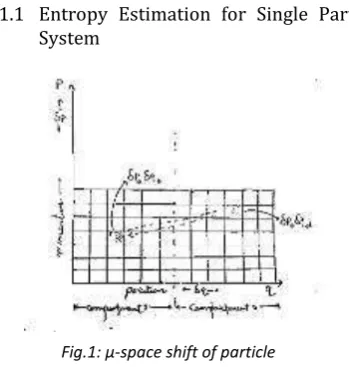
Considering an indistinguishable particle moving
from μ-space δqaδpbof compartment 1 to δqcδpd of
compartment 2 of a vessel(ensemble) and its
return to initial μ-space δqaδpb, at this position, it is
quite important to look at microstate configuration change of the particles(for a single particle and multiparticle system). In our probabilistic determination of entropy change, for single particle system, we use Schrödinger equation to estimate entropy change with mathematical models, and hence we take
Boltzmann-Maxwellian and Clausius
interpretation(s) of Entropy to estimate the entropy change for mutliparticle system.
1.1 Entropy Estimation for Single Particle System
The number of microstates corresponding to specified macrostate in a compartment is given by Thermodynamic Probability, Ω. Schrödinger equation can be written as,
1
Having and ,
where where Hence,
and mathematical treatments lead to, .Hence,
Thus,
. On this line, we get the
proportional equivalence between Thermodynamic probability and position-momenta corresponding to
μ-space, we get
Entropy and thermodynamic probability distribution over phase spaces
1
This results into S=0 for reversible μ-space shifts for a single particle system.
1.2 Entropy Estimation for Multi-Particle System
For a multi-particle system, we consider phase space(i.e. μ-space) positioned particles in a specified ensemble. In such multi-particle system, when a particle changes phase space in the
ensemble it s not completely possible that the
particle will return to its initial phase space ensuring that all particles(which have been displaced from their initial positions in process) will also return to their initial phase spaces. This clearly indicates a certain minute(but not completely negligible) change in microstate in compartmental divisions of the ensemble. Consequently position- momentum coordinates will also be disturbed, hence phase space shifts will occur. Further we consider the paths along which particle can move to attain different phase spaces. Considering here Clausius entropy
concept( ∫ 11 ), we find that entropy can be minimized to zero on reversibility with no energy expenditure, if particle will prefer same path under specified time interval providing constraints remain defined. Contrarily, if particle takes another route and in process spending more energy(no matter it returns approximately to initial phase space finally). Comparatively on large scale, say on multi-particle ensemble level, when large number of particles are considered under defined isothermal and adiabatic conditions, energy interchange cannot be ignored on such a big scale. Hence, consideration of ensemble s internal fluctuations is important. We can assume
S≈0(tending to Zero but not perfectly equal to zero) also the entropy will tend to increase in such cases.
Similarly, considering positional shifts of phase spaces, mathematical chain can be imagined as,
1
While 1 represents the phase space shift from to , the returning route may not be same, hence on probabilistic determination, can be interpreted as,
Hence δS is possible under considerations of
certain conditions only.
As known, 1 . So,
1 1 where c is number of ensemble s
compartments and n indicates number of
distinguishable particles. As ∫
1 1 under normalization conditions where
f defines fractions under fluctuation
consideration, thermodynamic probability can be expressed with provided fluctuations.
So, ( √ ) 1
Now with Clausius and Boltzmann-Maxwellian interpretations on entropy, we estimate the
entropy difference for two random paths a and b between two specified phase spaces. This interprets ≈ 1 with
Clausius interpretations On this line the perfect
nullity on entropy difference cannot be achieved, hence nullifying factor is considerably important. This yields,
Entropy and thermodynamic probability distribution over phase spaces Nullifying factor, as defined, can be calculated with
fluctuation values which cannot be neglected. We can easily correlated fluctuations with
microstate-On this contour, we visualize the estimation of entropy for single and multi-particle system.
2. Thermodynamic probability: Finding
meanings of non-meaningful arrangements
Number of microstates corresponding to specific macrostate is specified by thermodynamic
probability Ω, mathematically defined by Combination as described in 1 considering meaninful arrangement of particles classically On this line, Permutation is not considered which may include so classically defined non-meaningful arrangemnts, as such couting twice for two
particles’ mutually exchanged phase space positions which Combination counts for once. Contrarily, supposition of particles of same element with certain classically suppressible distinguishabilities on their microstate-macrostate correspondence count results into certain anomalies. On a considerable scale, this cannot be neglected, consideration of distinguishability among apparently indistinguishable particles becomes quite important[E.T. Jaynes], hence, in this section, we estimate thermodynamic probability with better approximations on statistical considerations.
2.1 Thermodynamic Probability Estimation on Gamma Space specifications
we discuss a new way of determining the total number of possible arrangements of same particles in a container of volume . Here, we set the distribution of particles as a continuous function of its
momentum, unlike the case in quantum physics where states are discrete and quantized. Also, we will assume a three-dimensional space, small particle density, and no intermolecular interactions. In the infinitesimal momentum range p p δp we will possible number of arrangements, denoted by
p p δp , using the combination function, since we assumed the particles to be identical.
p p δp ≈
In , we used the low-density assumption to approximate the numerator as a power function. We can further approximate this expression by using
Entropy and thermodynamic probability distribution over phase spaces
ln p p δp throughout the possible range, as we follow in
ln ∫ ln p p δp
This way, we obtain the final expression for ln from using the results discussed in and , as follows.
ln Nln eC ∫ ln δp
In addition to that, if we assume that n p is
proportional to N, and define p , we can
simplify the expression obtained in in the form of
ln NlneC NlnN N∫ n p ln
From this expression, we notice the relevance of Sackur-Tetrode equation with our approach, in a way that the entropy or ln includes the term Nln
NlnN C N. This shows reasonable equivalence with quantum mechanical expression under defined restriction on n p .
2.2 Brownian Motion and Thermodynamic Probability Estimation
Here we consider micro canonical ensemble, each summing to form provided ensemble.
Let us define with Γ-space considerations,
∫
Or,
Or,
Taking experimentally verified Einstein’s theory of Brownian Motion, we can calculate the displacement
of particle from one place to another in mean time, as we get,
( ) 1
As particles are in motion, E is solely kinetic, hence calculations yield,
1 ( )1
On the line, Energy as specified by can be taken further in mathematical grasp of , and hence, can obtain better approximation on Thermodynamic Probability Estimation.
2.3 Thermodynamic Probability distribution over Degenerate Energy Levels.
In this sub-section, we consider an energy level(j) with degeneration gj and number of particles Nj.
On this outline, we can obtain a pattern of arrangement of particles in specified energy states, as illustrated as follows,
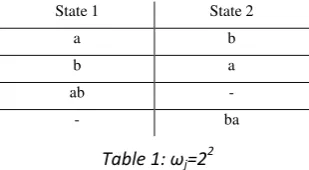
For gj=2 and Nj=2, we tabulate the arrangement
of particles in assumed energy states in Table 1,
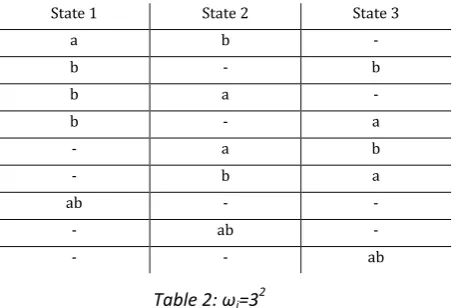
Similarly, we tabulate the energy state distribution for gj=2 and Nj=2 in Table 2,
State 1 State 2
a b
b a
ab -
- ba
Entropy and thermodynamic probability distribution over phase spaces
Hence, we observe a pattern on energy state distribution Table 1 and Table 2, and that brilliantly interprets 1 . Succeeding this, Thermodynamic Probability can be described as,
[∏ ] {∏ }
Where, underlined part of R.H.S. in is distinguishablity factor specifically defined on particles with energy level interchange
correspondence.
ᴨ
as introduced in underlined part, if defined on j=1, reduces to,{∏ }
3. Bose-Einstein Distribution and approximations
BE statistics defines Thermodynamic Probability as follows,
(
1)
(
1)
Where, denotes the number of ways in which ni
particles are to be distributed in gi cells in the ith
compartment.
Most probable microstate corresponds to the state of maximum thermodynamic probability and results into Bose-Einstein’s distribution law for a class of particles among various energy levels for a system obeying Bose-Einstein Statistics. The approximation technique used in process plugged with Lagrangian method of undetermined multipliers is Sterling approximation, and in case used for very large number of particles. Oppositely, if condition includes restricted distribution of selective particles, sterling approximation may not prove to be fruitful. Under this condition, the influential spheres of particles can
be considered with Abel’s summation and Markov
chain applications in three dimensions; and under specified pattern, the bad approximation can be reduced. Despite our efforts to define good approximation, it is still difficult to consider the good outline and boundary conditions of approximations, hence in next section, we investigate the distribution of particles in defined ensemble with pure implications of group structures of abstract algebra.
4. Abstract Algebraic implications on particle movement
Here we define G as a system of particles(i.e. ensemble) . Consideration of ‘n’ number of particles in the vessel as a finite Group and two compartments’ specification are supplemented with an assumption of
n/2 number of particles’ distribution in each
second compartment, for even number of particles.
Entropy and thermodynamic probability distribution over phase spaces second compartment. In case of odd number of
particles, we cannot consider that both compartments have same number of particles.
It is quite important to note here that negative sign is for representational purpose and to indicate only the two particles excluding one among three particles
from the system of n number of particles with
provided thermodynamic variables remain defined.
Existence of Inverse: Mutual phase space shifts of particles from one compartment to another without affecting the ensemble provides us with an insight on existence of inverse.
∊ 1
For indistinguishable particles, the commutativity property holds good defining abelian groups of particles. Contrarily, the correspondence of
particles generalized positions and momenta with non-abelian property defines permutation groups, and hence, can be used for simulated studies of position-momenta shifts with algebraic analogues.
III. RESULTS AND DISCUSSION
Entropy and Thermodynamic probability are reconsidered with mathematical simulations. For a single particle system, or for considerable single particle motion in the ensemble, we find S=0 as
1 tells so. For the multiparticle system, the entropy change is significantly evident on small scale but not totally negligible as we find through mathematical treatments from 1 to 1 . On this line, we introduce nullifying factor taking thermodynamic probabilistic fluctuations on count.
Further, thermodynamic probability is estimated with various measures. In Section 2.1, we estimate thermodynamic probability with 3-D considerations of particles phase shifts.
Entropy and thermodynamic probability distribution over phase spaces understand ensemble conditions for particles
motion.
IV. CONCLUSION
Our studies suggest new methods for thermodynamic probability estimation. Entropy change for a single and multiparticle systems of indistinguishable particles under specified reversible condition is studied and it suggests that fluctuations are important while nullifying entropy change. Approximation method, used in Bose-Einstein Statistics, as Sterling approximation does not seem effective on selective number of particles, hence we introduce Abel s summation and 3-D markov chain outline with influential spheres consideration. Finally, we put forth the implications of abstract algebraic structurisation on particles phase space shifts and consider them under abelian and non-abelian properties, thus, can be useful for understanding thermodynamic probability and phase space shifts.
V. ACKNOWLEDGMENTS
Authors would like to thank Professor Dr Prafulla K. Jha, Department Of Physics, The M.S. University Of Baroda, Professor K. Muralidharan, Department Of Statistics, The M.S. University Of Baroda, Professor Dr Abhas Mitra, HBNI Mumbai, Dr Himadri Barman, IMSc Chennai, Dr Geetanjali Sethi, St. Stephens College, University Of Delhi, for their valuable suggestions and guidances. Authors would like to thank Department Of Physics, Faculty Of Science, The M.S. University Of Baroda and Department Of Science and Technology, Government Of India for academic assistance and project facilitation. One of Authors(U.K.) thanks Academia.edu for editorial privileges and hence, facilitating the project work. Resources made
[3] Ludwig Boltzmann(1896 and 1898). Vorlesungen uber Gastheorie. J.A. Barth, Leipzig.
[4] Ludwig Boltzmann (1866), Über die Mechanische Bedeutung des Zweiten Hauptsatzes der Wärmetheorie". Wiener Berichte. 53: 195–220.
[5] Curtright, T. L.; Zachos, C. K. (2012). "Quantum Mechanics in Phase Space". Asia Pacific Physics Newsletter. 01: 37
[8] Clausius, Rudolf (1850). On the Motive Power of Heat, and on the Laws which can be deduced from it for the Theory of Heat. Poggendorff's Annalen der Physick, LXXIX (Dover Reprint). ISBN 0-486-59065-8
[9] Clausius, Rudolf (1865). Ueber verschiedene für die Anwendung bequeme Formen der Hauptgleichungen der mechanischen Wärmetheorie: vorgetragen in der naturforsch. Gesellschaft den 24. April 1865. p. 46
[10] Hillar, Christopher; Rhea, Darren (2007). "Automorphisms of finite abelian groups". American Mathematical Monthly. 114 (10): 917–923