remote sensing
ISSN 2072-4292 www.mdpi.com/journal/remotesensingArticle
Automated Extraction of Archaeological Traces by a Modified
Variance Analysis
Tiziana D’Orazio1,*, Paolo Da Pelo1, Roberto Marani1and Cataldo Guaragnella2
1 CNR, ISSIA, Via Amendola 122/D, 70126 Bari, Italy; E-Mails: [email protected] (P.D.P.);
[email protected] (R.M.)
2 Politecnico di Bari, DEE, via Orabona, 70126 Bari, Italy; E-Mail: [email protected]
*Author to whom correspondence should be addressed; E-Mail: [email protected]; Tel.: +39-80-592-9442; Fax: +39-80-592-9460.
Academic Editors: Clement Atzberger and Prasad S. Thenkabail
Received: 19 January 2015 / Accepted: 17 March 2015 / Published: 26 March 2015
Abstract: This paper considers the problem of detecting archaeological traces in digital aerial images by analyzing the pixel variance over regions around selected points. In order to decide if a point belongs to an archaeological trace or not, its surrounding regions are considered. The one-way ANalysis Of VAriance (ANOVA) is applied several times to detect the differences among these regions; in particular the expected shape of the mark to be detected is used in each region. Furthermore, an effect size parameter is defined by comparing the statistics of these regions with the statistics of the entire population in order to measure how strongly the trace is appreciable. Experiments on synthetic and real images demonstrate the effectiveness of the proposed approach with respect to some state-of-the-art methodologies.
Keywords: archaeological mark detection; analysis of variance; statistical test; regression analysis; low contrast aerial images
1. Introduction
crucial evidence indicating the existence of archaeological remains. Different types of remote sensing imagery have been used including aerial photographs [1,2], spaceborne optical images [3–6], spaceborne and airborne RADAR images [7], airborne LIDAR images [8,9], airborne imaging spectroscopy and hyperspectral imagery [10,11]. In the literature, much work has been done to develop automatic algorithms to support the digitalization of man-made structures such as buildings and roads [12–17]. On the contrary, the extraction of archaeological traces in aerial or satellite data is a difficult issue for automatic algorithms due to their poor boundary information, discontinuities and their similarity to other features of the scene. In this context, image processing algorithms do not have the same ability of human eyes to pick out subtleties in remotely sensed images. For these reasons, image analysis for trace extraction has been essentially human based. However, this task is time consuming. In order to provide support to the manual task of trace extraction, image processing algorithms have to be tuned to develop automatic extraction methods, providing a set of mark candidates, which can be fast validated by expert archaeologist.
The problem of crop marks detection in aerial images can be considered as a problem of wide line detection in low contrast images with high levels of noise, where lines do not show clear edges from their surroundings and the background presents many artifacts.
Most line detection approaches are based on the analysis of edge images obtained from differential operators on gray level intensities. Among the most popular edge detection approaches are those based on Sobel filters, Roberts filters, Prewitt filters, Canny edge detection scheme, difference of Gaussians, Laplacian of Gaussian, Hessian matrix, and many different combinations of filtering schemes [18–20]. These methodologies rely entirely on the intensity change across boundaries, thus, weaker edges, such as those due to texture variation, may not be detected. Another common problem with these techniques is their sensitivity to noise and uneven illumination [21,22]. Methods based on local thresholding tend to inhibit edges in low luminance regions or, conversely, tend to enhance edges in high luminance ones. In general, edge detection methods that are robust under varying contrast tend to be more affected by noise. The popular family of Hough transform approaches select defined linear and curvilinear structures [23–26] through the analysis of edge images. The success of these approaches depends on the accuracy of the edges while line thickness is not considered. Although this family of methods has been largely applied in many real contexts [27–30], its main drawback is the strict requirement of the complete specification of the target object’s exact shape to achieve precise localization, which is often difficult and not available for complex curvilinear structures in practice.
separation [34–36]. They require manual curve initializations then active contours evolve to fit the object contours according to some criterion of region uniformity or edge discontinuity [37–39]. The main problem of active contour methods is the necessity of some kind of initialization and the limitation in evolving curves when abrupt interruptions occur.
In this paper, in order to improve the performance of classical wide line detection approaches for the digitalization of archaeological traces, we propose a modified methodology by introducing the knowledge of the expected appearance of the crop marks. In this way, all the lines having the shape and appearance which is compatible with the crop mark model are automatically extracted by the images. The archaeologist, by using his domain experience can select those compatible with the un-excavated archaeological sites. The problem of detecting wide marks in the image has been considered through the analysis of pixel variance over a region around a selected point. Line detectors based on the ANalysis Of VAriance (ANOVA) were introduced in [40,41]. A four-way ANOVA was performed in order to detect and locate edges oriented in any of the main directions. The Fisher statistic on the contrast functions was used as threshold for the edge detection step. In [42] the ANOVA was used to find an optimal threshold for image binarization. In this paper, we propose a different way to apply the ANOVA and in particular we propose to modify the procedure that evaluates the variances of regions. Differently from [41], we apply the one-way ANOVA several times to detect the differences among three parallel rectangular regions considering, in particular, the expected shape profile of the lines to be detected in each region. In aerial images, soil and crop marks rarely have sharp edges and do not have uniform intensity along the pixels which compose the wide line. On the contrary, their intensities can be approximated by a parabolic curve corrupted by noise. We introduce a new model for curve fitting to evaluate pixel displacements from this model and estimate the pixel variance within each region. As well, we introduce an effect size parameter η2 that is normally used to estimate how strongly two or more variables are related or how large the difference among groups is. In our caseη2 provides a measure of how strong the line effect is
appreciable by comparing the statistics of the three regions against the statistics of the entire population. In fact, the failure of the Fisher statistics on the contrast function provides only some information about the probability that the null hypothesis is true. In other words, a failure of the test asserts that the three groups belong to different populations, but nothing can be asserted about the magnitude of the effect in order to distinguish between a line or an artifact due to the presence of textured background. The
η2 parameter becomes the real detector which makes the final decision of associating a pixel to a line or to a background region. Several experiments, both on synthetic and real images, demonstrate the effectiveness of the proposed approach with respect to the ordinary ANOVA approach and several state of the art methodologies.
The rest of the paper is organized as follows: Section 2 describes the proposed method; experimental results on synthetic images and real images are reported in Section 3. Concluding remarks are reported in Section 4.
2. The proposed Methodology
information due to noise or vegetation changes is evident. The corresponding line profile, reported in Figure 2, demonstrates that the line cannot be characterized by a sharp and well-defined jump against a uniform background. This observations gave us the idea to modify an ANOVA based approach to consider the expected line shape and detect wide lines in noisy images comparing variances of neighbor regions.
Figure 1. Archaeological traces in the area of Foggia (Italy).
Figure 2. The profile of the trace segment between the two points of Figure1.
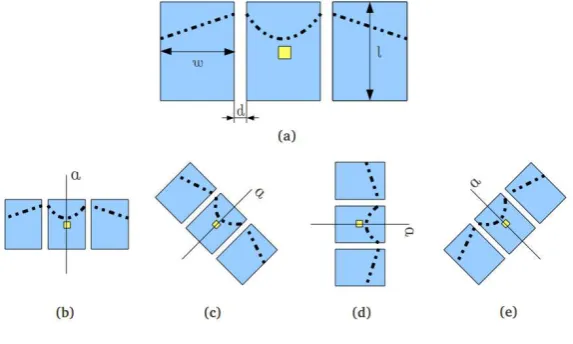
The presence of a line can be locally detected by searching for a pattern composed of three regions with different gray levels.
The proposed algorithm works in the following way. The proposed modified ANOVA approach is applied for each point of the image and for any direction among those possible. Then, at-test is applied on a contrast function that relates the parameters characterizing the three regions. A positive t-test answer means that the three regions belong to the same population (i.e., background region) and a new direction is considered. On the contrary, if t-test answer is negative, it is necessary to understand how much the difference between the three groups is due to the real presence of a line or is simply due to smooth background variations. For this reason the η2 parameter is evaluated to measure the line effect size and decide if the considered point belongs to the line or to the background region.
Figure 3. (a) The three considered regions for the ANOVA evaluation. (w, l) represent the window size, d is the displacements between windows. The last row reports the four directions, denoted by the anglea, where the ANOVA is applied: (b)a = 0◦, (c)a= 45◦,(d)
a= 90◦,(e)a=−45◦.
The main contribution of the paper is the introduction of a modified ANOVA approach that uses a regression method to model the points belonging to the central area of the line with a second order polynomial function. On the contrary, the points belonging to the lateral regions are modelled by a first order polynomial functions. As well, the introduction of the parameter η2 for the comparisons of statistics was done to make the final decision more indulgent or restrictive.
In the remaining part of this section we describe how the standard ANOVA approach was applied in our context, and the proposed modified ANOVA, together with the η2 statistic test which was applied after thet-test to validate the membership of the point to a line or to a background region. The general formulation is finally tested to find more efficient models able to assist the ANOVA formulation.
2.1. The ANOVA Approach
to the other and so to decide whether or not the treatments have produced any significant effects. The modelling of an image using treatments was introduced in [40,41]. The contribution of a treatment to a specified group of pixels is called a treatment effect.
Letx be the gray level of a pixel. Ifxij is the j-th measured value of xin the i-th region, then the mathematical model of ANOVA is
xij =µi+ǫij (1)
where for every i and j, ǫij is normally distributed with expectation 0 and variance σ2. This means that the measured xij for any individual pixel is made up of an effect due to the particular treatment undergone by the i-th region denoted by µi, and a random or error term ǫij due to many unspecified causes. These ǫij are supposed to be uncorrelated to each other. If we consider a problem with three samples, the null hypothesis is that the three groups belong to the same population with meanµ, that is
H0 : µ1 =µ2 =µ3 =µ (2)
The ordinary statistic test of a one way-ANOVA can be used to infer whether to accept or reject the null hypothesis. If the three regions belong to different populations (they are produced by a source of variability,i.e., a treatment, such as the presence of a line), the null hypothesis is rejected.
Let us now consider the total sum of squared deviations (SST) of the whole area from the over-all meanµ¯: it can be divided in part due to the difference between the groups (SSB) and in part due to the difference within the groups (SSW):
X observe that by straightforward calculations the mixed term vanishes:
2 X
i=1,2,3
j=1,...,n
(¯µi−µ¯)(xi,j−µ¯i) = 0 (4)
By dividing SSB and SSW by the correct number of degrees of freedom, respectively p−1 and
nT −p, wherenT is the total number of pixels considered andp= 3is the number of treatments, we get an estimation of the “variance between” and the “variance within”:
s2B = SSB
The ratio between the two variances is F-distributed, where F is the Fisher distribution:
s2
B
s2W ∼ F2,nT−3 (6)
2.2. The Modified ANOVA
In order to have a consistent one-way ANOVA test, two important assumptions are necessary: normality of the distribution of gray levels of any pixel around the constant level µi and constancy of variance in the whole region. In ordinary cases, this assumption is quite restrictive because ridges or valleys, which are objects of investigation in the image, often show a well-defined shape. Pixel gray levels are strongly conditioned by the underlying profile, therefore we clearly commit significant errors in assuming the normality of pixels around constant values, rather than assuming normality around the shape profile. The estimation of the variance is affected by these errors and the homogeneity test fails.
In order to infer a more consistent statistical analysis, we properly reformulate (1) by taking into account the shape of the profile:
xi,j =fi(rj, cj) +ǫi,j (7)
where the functionsfi :R2 →Rare surfaces describing the shape profile of thei-th region calculated in the coordinate rowrj and columncj of a generic pixel of the image. The null hypothesis is the same as (2) but now this condition is transferred onto the parameters which characterize the functionsfiand not onto the means of the three regions. With reference to the real case reported in Figure 2, it is possible to admit that the pixel profiles in the three regions can be modelled using a quadratic surface, whose coefficients have to be determined in the least square sense, thus limiting the noise contribution which affects the image.
As a starting point of the modified ANOVA, a novel domain is defined around any pixel of the image. In this case, the domain is made of nT discrete points, whose position is expressed by the two independent variablesuandv. The two variables are referred to system of coordinates whose origin is in the center of the second region. Moreover, these variables spans uniformly within the limits of the three regions where the ANOVA method will be developed. Specifically, the first region is discretized in n1 points havingu andv spanning between[−32w,−w2]and [−2l,2l], respectively; the second region
has n2 points whose u and v coordinates spans between [−w2,w2] and [−2l,2l]; equivalently, the third
region ofn3terms has a bounded domain whereuandvchanges between[w2,32w]and[−2l,2l]. Note that
the boundaries of the external regions are here defined without any displacement. On the contrary, the displacement term shifts the first region by−dand the third region bydalong theu-axis.
The domain has to be finally rotated accordingly with the specific α orientation considered for the ANOVA computation. Discrete coordinates are thus arranged in column vectors and multiplied by a proper two-dimensional rotation matrix. The resulting discrete coordinates represent the actual indices
uj and vj, j = 1, . . . , nT, where the pixel images can be extracted for the analysis of variances. Each point of the domain is projected on the surface generated by means of a bilinear interpolation on the intensity values of the image. This process produces three new vectors of pixel intensities, labelled as
Yi = [yi,1, yi,2, . . . , yi,ni]
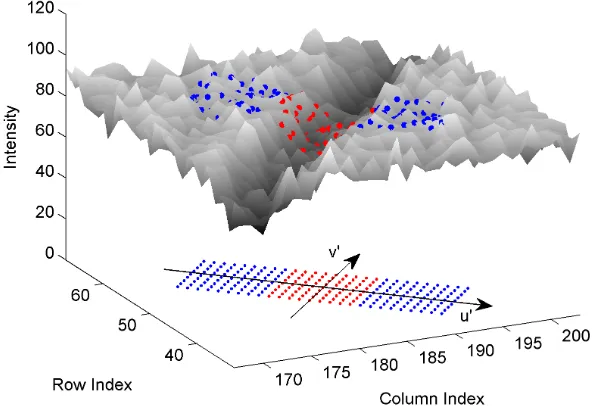
T, where i is the index of the specific region under analysis. An example of 45◦-oriented discrete domain is reported in Figure 4, together with the set of points of the vectors Y
Figure 4.Representation of the discrete domain defined by the span of the variables(u′, v′) within the admissible boundaries. Each coordinate is projected on the surface made by the gray values of the input image. The resulting samples constitutes the three vectorsYi ofni elements (i= 1,2,3.). regions.
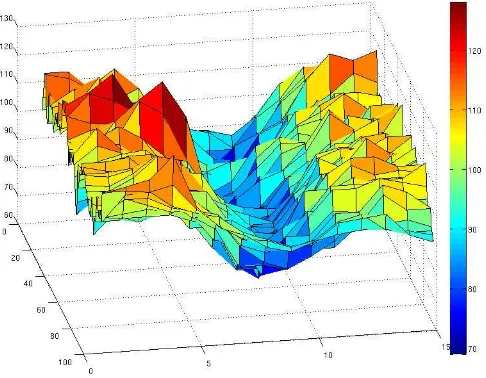
As stated before, the functions fi can be represented as two-dimensional paraboloids whose formulations are straightforwardly equal to:
fi(u, v) =ai,1u2+ai,2v2+ai,3uv+ai,4u+ai,5v+ai,6 (8)
whose average values in the corresponding range of existence of uand v, labelled as µ¯i, are obtained easily by the application of the mean value theorem for integration:
¯
The parameters to be estimated are now expressed in terms of three vectors (A1, A2 andA3), of six
entries each. More specifically, each vector has the form Ai = [ai,1, ai,2, . . . , ai,6]T, and its entries can
be obtained by applying the least squares method, given the input data inYi. LetXibe
Then, by applying the least squares method we can estimate the unknown elements of the vectorsAi:
Figure5reports an example of the fitting paraboloids obtained by the least squared method applied on the data in Figure4.
Figure 5. Surfaces determined by the application of the proposed fit in the three regions. Blue dots are the pixel intensities in the external region, whereas red dots are referred to the central one.
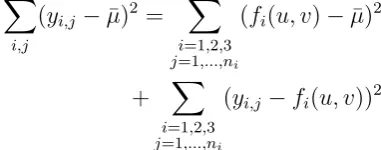
Let us consider again the total sum of squared deviations (SST) of the whole area from the over-all meanµ¯as in (3):
X
i,j
(yi,j−µ¯)2 =
X
i=1,2,3
j=1,...,ni
(fi(u, v)−µ¯)2
+ X
i=1,2,3
j=1,...,ni
(yi,j−fi(u, v))2 (12)
i.e.,SST =SSB+SSW. It is still possible to prove that the mixed term
2 X
i=1,2,3
j=1,...,ni
(fi(u, v)−µ¯)(yi,j −fi(u, v)) = 0 (13)
The equations (5) still give an estimation of the “variance between” and the “variance within”. In order to assert that the source of variability is a line, we have to compare the central region with the two adjacent ones, thus underlining a significant difference. It can be done by using the contrast function
λ :R3 → Rdefined as:
λ(α, β, γ) =c1α+c2β+c3γ (14)
whereci ∈Rfor anyi= 1,2,3. We introduce the test parameter:
¯
t = λ(¯µ1,µ¯2,µ¯3)
sλ
where
is an estimation of the variance of λ. In the null hypothesis, i.e., the contrast function calculated in the three means is zero,tfollows a t-Student distribution withnT −pdegrees of freedom,i.e.,
¯
t∼ tnT−p (17)
In order to have the central region darker than the external ones it must be
¯
µ2 <min(¯µ1,µ¯3) (18)
and, if we choose(c1, c2, c3) = (1,−2,1)the functionλ(¯µ1,µ¯2,µ¯3)must be greater than0.
Under this condition, it is possible to do a one-tailed test in order to verify the null hypothesis or to accept an alternative one. So, at a fixed level of significance, if the experimental parameter t is greater than the critical value, the null hypothesis is rejected.
2.3.η2 Test
Whenever thet-test rejects the null hypothesis, it is mandatory to understand this results is due to the presence of a textured background in the image or to a real variation among the three regions. For this reason, we introduce another test to obtain a greater statistical evidence. This test, named asη2, evaluates the statistical parameters in the following way:
η2 = SSB
SST
(19)
It takes values between0and1and it measures how much of the total variance is due to the subdivision of the whole region. It is indeed the coefficient of correlation between the whole area and a pattern composed by the three regions having the pixels with gray level profiles found by the fitting procedures (f1,f2, andf3). In summary, the parameterη2 permits a more accurate analysis to decide whether accept
the line or not, so it represents the main test for the effective line detector.
2.4. Model Accuracy
Before going through the analysis of results, it is necessary to estimate the accuracy of the fitting model used for the representation of the input pixel intensities. As shown in Equation (8), the model approximates the pixel intensities as a 2D paraboloid. The model is implemented in the three regions where the ANOVA is computed, and it is defined to better detect lines and ridges with weak boundaries. On the other hand, the specific nature of the problem of mark extraction from aerial images of archaeological sites can be exploited to downsize the problem, invoking simpler models. In particular it is possible to introduce three further kinds of functionfi, in addition to the one of Equation (8):
where functions are sorted in descending complexity order. In this casefi(u, v)(1 st
ord)is planar surface
(first order model) in two dimensions. In addition,fi(u)(2 nd
ord)andf
i(u)(1 st
ord)are two different models
of the second and first order, respectively. These functions are curves defined on a 1D domain, obtained by accumulating the image pixels on the discrete values assumed by the variable u. Note that the coefficients of the models are now labelled by the letterbto underline that they belong to a 1D model.
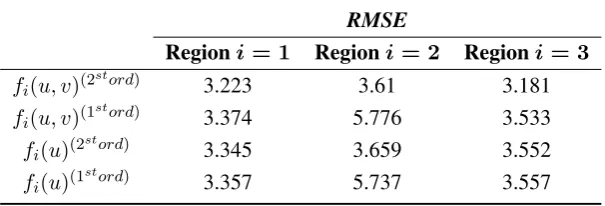
With reference to the actual sample data reported in Figure4, the models have been tested to show their validity to fit the intensities of the pixels. For this purpose, we introduce the root mean square error (RMSE) between the actual observed values and those predicted by the estimator. Results obtained by the application of the four models are highlighted in Table 1 where the analysis is divided for the three regions.
Table 1. RMSE obtained by the application of the four models used for the modified ANOVA.
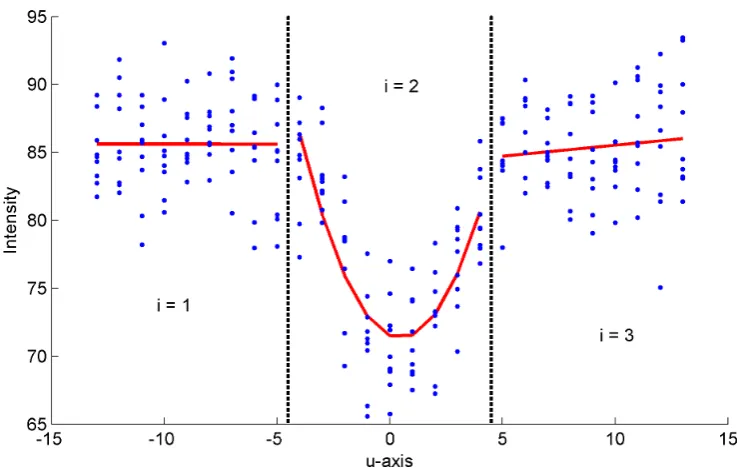
The inspection of Table1demonstrates a first important result: the internal region must be modelled by a second order function, since the RMSE are significantly lower than the ones obtained by the application of a first order function. This is due to the profile of the ridge to be detected within the image, which follows the shape of a parabola. On the contrary, the surrounding regions, i.e., the one addressed by the index i = 1,3, can be modelled by a first order model, which induces a comparable RMSE with reference to those out of the second order models. Another aspect is even more important. The use of a 1D formulation of the domain, obtained by the projection of the span of the variablev on theu-axis, is enough to fit the input intensities. This result can be understood by looking at the surface in Figure4. If the lengthl of the windows is not large, the three regions can be considered homogeneous in the longitudinal direction, so we can use a 1D profile to model the pixels of each region. As a consequence, the pixel intensities of the two external regions are distributed around straight lines, whereas the central region shows a parabolic profile along the longitudinal direction, defined by theu-axis.
Figure 6.Gray level profile of pixels along the direction of the line. The red line is the result of the fit in the three regions, which are separated by dashed lines.
In summary, the fitting model for the approximation of the pixel intensities used in the Equation (12) of the modified ANOVA can be simplified, without altering the final results, but gaining efficiency. As a consequence, the final formulation can be expressed in seven parameters of the coefficient vectors (B1 = [b(1
the three average values of the fitting functions, used in in Equation12, are now expressed as:
¯
Experiments on images will be finally performed using the simplified model proposed, thus giving more efficiency to the modified ANOVA formulation.
3. Experimental Results
3.1. Synthetic Images
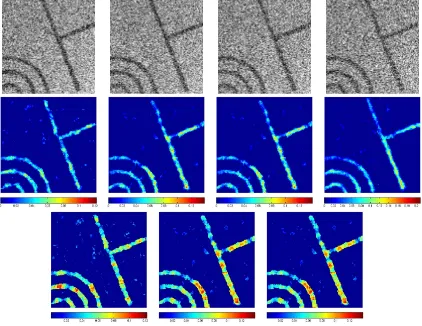
In order to estimate the detector’s efficiency, synthetic images corrupted by different noise levels were considered. The image contains several circles (with different radii) and two intersecting straight lines. Four standard deviation of noise distribution were considered withσ = 0.45,σ = 0.55,σ = 0.65,
σ = 0.75. In the first row of Figure7the sample images are reported. The image dimension is250×250, the lines have a 13-pixel-wide transversal section and have been modelled with a parabolic shape. For each point of the image we consider three windows, as reported in Figure3, having a widthw=l = 13
pixels and a displacementd = 1. On these three regions we applied the ordinary ANOVA as described in Equation (3), and the modified ANOVA described in Equation (12). Then, thet-test, described in Equation (15), was applied on the contrast function to evaluate whether the central region shows a mean value lower than those of the two adjacent ones. The significance level for the t-test of both methods was fixed to 0.01. In case of failure, the null hypothesis is rejected and the η2 statistic is evaluated. In the second and third rows of Figure 7 the final results of the ordinary and modified methods are reported. Colors represent detections as theη2parameter changes. It is clear that the new way to estimate
region variances fitting a shape model makes the modified method more sensitive than the ordinary one: comparing the results with equal η2 parameters, the modified method has greater capability to detect more points of the lines.
In order to evaluate the performances, quantitative tests were carried out by the evaluation of
sensitivity= T P
T P +F N (22)
accuracy = T P +T N
T P +F P +F N +T N (23)
where T P, T N, F P and F N are, respectively, the number of True Positive, True Negative, False Positive and False Negative. The sensitivity is the ratio of the correctly detected line pixels over the total number of pixels labelled as line. If the method finds few False Negative the sensitivity reaches high values and indicates a high number of pixels correctly classified as lines. The accuracy is the fraction of all pixels which are correctly classified.
In Figure 8, the graphs of the accuracy variation as the η2 parameter changes are reported. As
explained before, the η2 test is evaluated only on those points which did not satisfy the null hypothesis. So thet-test has a preprocessing role of eliminating all the background points which have clear evidence of belonging to the same background population. When small values of the η2 parameters are used, the statistical test is no longer selective and all the points that passed the previous t-test contribute to the evaluation of the method’s accuracy. This consideration explains why, in the two graphs, the performances are assessed around constant values in the range94%–96%whenη2 is under0.02. When the η2 parameter increases, the methods become more selective. For the modified ANOVA, if the η2
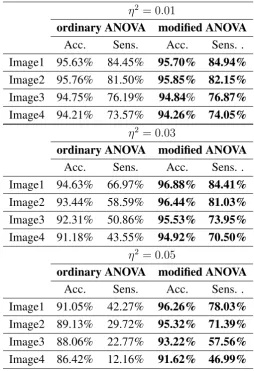
parameters is chosen under the value 0.04, accuracy remains over the 95%. In Table 2 the detection results of the two methods are compared with the sameη2parameters in terms of accuracy and sensitivity.
Figure 7. Results obtained on synthetic images with different noise levels. First row, from left to right: Image1 with noiseσ = 0.45, Image2 with noiseσ = 0.55, Image3 with noise
σ = 0.65, Image4 with noiseσ = 0.75. Second row: results obtained with the ordinary ANOVA. Third row: results obtained with the modified ANOVA.The colors represent the detection of the methods with the variation of theη2parameter.
(a) (b)
Table 2. Ordinary and modified ANOVA: sensitivity and accuracy values evaluated on the four synthetic images .
η2 = 0.01
ordinary ANOVA modified ANOVA Acc. Sens. Acc. Sens. . Image1 95.63% 84.45% 95.70% 84.94% Image2 95.76% 81.50% 95.85% 82.15%
Image3 94.75% 76.19% 94.84% 76.87% Image4 94.21% 73.57% 94.26% 74.05%
η2 = 0.03
ordinary ANOVA modified ANOVA Acc. Sens. Acc. Sens. . Image1 94.63% 66.97% 96.88% 84.41% Image2 93.44% 58.59% 96.44% 81.03%
Image3 92.31% 50.86% 95.53% 73.95% Image4 91.18% 43.55% 94.92% 70.50%
η2 = 0.05
ordinary ANOVA modified ANOVA Acc. Sens. Acc. Sens. . Image1 91.05% 42.27% 96.26% 78.03%
Image2 89.13% 29.72% 95.32% 71.39% Image3 88.06% 22.77% 93.22% 57.56%
Image4 86.42% 12.16% 91.62% 46.99%
images, we use these considerations to set the parameters and perform comparisons with other wide line detection approaches.
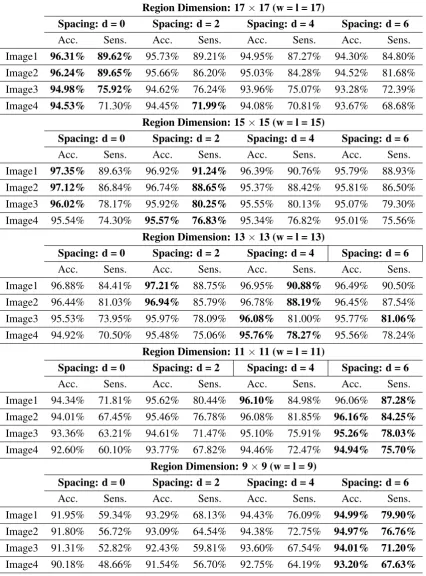
Table 3. Modified ANOVA: sensitivity and accuracy values evaluated on the four synthetic images with varying window and spacing dimensions.
Region Dimension: 17×17 (w = l = 17)
Spacing: d = 0 Spacing: d = 2 Spacing: d = 4 Spacing: d = 6
Acc. Sens. Acc. Sens. Acc. Sens. Acc. Sens.
Image1 96.31% 89.62% 95.73% 89.21% 94.95% 87.27% 94.30% 84.80%
Image2 96.24% 89.65% 95.66% 86.20% 95.03% 84.28% 94.52% 81.68%
Image3 94.98% 75.92% 94.62% 76.24% 93.96% 75.07% 93.28% 72.39% Image4 94.53% 71.30% 94.45% 71.99% 94.08% 70.81% 93.67% 68.68%
Region Dimension: 15×15 (w = l = 15)
Spacing: d = 0 Spacing: d = 2 Spacing: d = 4 Spacing: d = 6
Acc. Sens. Acc. Sens. Acc. Sens. Acc. Sens. Image1 97.35% 89.63% 96.92% 91.24% 96.39% 90.76% 95.79% 88.93%
Image2 97.12% 86.84% 96.74% 88.65% 95.37% 88.42% 95.81% 86.50%
Image3 96.02% 78.17% 95.92% 80.25% 95.55% 80.13% 95.07% 79.30%
Image4 95.54% 74.30% 95.57% 76.83% 95.34% 76.82% 95.01% 75.56%
Region Dimension: 13×13 (w = l = 13)
Spacing: d = 0 Spacing: d = 2 Spacing: d = 4 Spacing: d = 6
Acc. Sens. Acc. Sens. Acc. Sens. Acc. Sens.
Image1 96.88% 84.41% 97.21% 88.75% 96.95% 90.88% 96.49% 90.50% Image2 96.44% 81.03% 96.94% 85.79% 96.78% 88.19% 96.45% 87.54%
Image3 95.53% 73.95% 95.97% 78.09% 96.08% 81.00% 95.77% 81.06%
Image4 94.92% 70.50% 95.48% 75.06% 95.76% 78.27% 95.56% 78.24%
Region Dimension: 11×11 (w = l = 11)
Spacing: d = 0 Spacing: d = 2 Spacing: d = 4 Spacing: d = 6
Acc. Sens. Acc. Sens. Acc. Sens. Acc. Sens.
Image1 94.34% 71.81% 95.62% 80.44% 96.10% 84.98% 96.06% 87.28%
Image2 94.01% 67.45% 95.46% 76.78% 96.08% 81.85% 96.16% 84.25%
Image3 93.36% 63.21% 94.61% 71.47% 95.10% 75.91% 95.26% 78.03%
Image4 92.60% 60.10% 93.77% 67.82% 94.46% 72.47% 94.94% 75.70%
Region Dimension: 9×9 (w = l = 9)
Spacing: d = 0 Spacing: d = 2 Spacing: d = 4 Spacing: d = 6
Acc. Sens. Acc. Sens. Acc. Sens. Acc. Sens.
Image1 91.95% 59.34% 93.29% 68.13% 94.43% 76.09% 94.99% 79.90%
Image2 91.80% 56.72% 93.09% 64.54% 94.38% 72.75% 94.97% 76.76%
Image3 91.31% 52.82% 92.43% 59.81% 93.60% 67.54% 94.01% 71.20%
3.2. Real Images
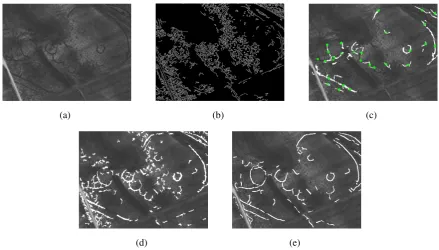
In order to demonstrate the general applicability of the proposed method, experiments carried out on real images of crop marks and comparisons with state-of-the-art approaches are provided in this section. Since the proposed method detects the whole line, we selected two methods among the related literature on wide line detectors: an active contour based approach proposed in [37], and a wide line detection technique based on an isotropic nonlinear filtering (proposed in [31]). Since lines can be extracted by applying methods that use edge information, the results provided by the Canny method [17] are also reported, as it is considered by the related literature [44] one of the methods that produces optimal solutions.
Figure 9 shows a real image acquired using a digital aerial pushbroom scanner ADS40 by Leica Geosystems [45] in the Apulia Tavoliere. The pushbroom scanner is made of 8 parallel linear CCD sensors, of 12,000 pixels each, having size of 6.5µm. The sensor is able to produce orthoimages whose width is equal to 24,000 pixels, since two arrays of CCD elements are shifted each other by 0.5 pixel. Given the focal length of62.5mmand the distance of the sensor from the ground (20,500f t), the spatial resolution is close to 560mm, depending on the morphology of the scanned area. Finally, the radiometric resolution is converted from the initial 16 bits per channel to 8 bits per channel. The smallest image produced by the scanner has the size of the Italian topographic regional maps (Carta Tecnica Regionale, CTR) and covers an area of about7.4×6.6km, which corresponds to an image of
14,800×11,840pixels. Then, the resulting images are divided in smaller pictures, having size600×500
pixels. A sample picture is reported in Figure10a, where some relevant archaeological crop marks are annotated as tombs and Neolithic walls by expert archaeologists. The results obtained with the Canny edge detection approach and the modified Active Contour approach are reported in Figure 10b,c. As the image contains a lot of non-relevant data (such as signs of plowing, trees, and so on) together with significant archaeological traces, the edge information (even with a possible postprocessing) cannot be directly used. The Active contour approach requires an ad-hoc initialization process to select some seed points on the interesting marks (see the green points in Figure10c), and it suffers when the crop marks present some discontinuities that interrupt the growth of the active contours. The results obtained with the isotropic nonlinear filtering and the proposed approach are reported in Figure 10d,e. The proposed approach was applied with a window dimension of5×11pixels, spacingd = 2pixels, andη2 = 0.45.
The results of the isotropic nonlinear filtering were the best ones obtained choosing the parametert= 6
and the radius of the circular maskr= 21(see Ref. [31] for further explanations). In order to avoid small regions, all results reported in Figure10are obtained after a morphological closing of one pixel, and the suppression of connected regions with a small area (under 50 pixels). In this way, the application of the same post-processing deletes possible sources of error, thus improving equivalently the overall outcomes. The results obtained by the proposed approach are shown in Figure 10e and are easily interpretable: unbroken long lines are detected with high accuracy. In terms of artifacts, the resulting image contains few regions that can be due to the presence of noise or to irrelevant signs of crops.
dimensions for the treatment analysis have been set equal to w = 3 and l = 5, whereas the statistical parameterη2 is equal to0.6. Outcomes clearly prove that theη2 test is able to effectively highlight only those image pixels which actually belong to significant crop marks, keeping out the detection of possible lines of the ground pattern.
Figure 9. Example of an aerial image obtained with the pushbroom scanner ADS40 by Leica Geosystems.
(a) (b) (c)
(d) (e)
On the other hand, the main limitation of the proposed approach is the dependence between the line width and the total window dimension (i.e., w + d). Large windows may preclude the detection of lines with a width much lower than the window size. However, the proposed approach can be iterated more times using different window sizes. Figure12reports the result obtained on the aerial image of Figure10a by iterating two times the proposed approach with the same window dimension but with two different spacingsd= 2andd= 0pixels. The yellow circles highlight the areas in which finer lines were detected. In this case, it is evident that an higher number of archaeological traces are detected, without introducing false positives.
Figure 12. The results obtained after the application of two iterations of the proposed methodology with two different spacings on the real image of Figure10. The yellow circles highlight the lines which are detected after the second iteration with a smaller window size.
4. Conclusions
In this paper we propose a wide line detection approach for the extraction of archaeological crop marks that uses the analysis of variance to decide if a point belongs to a mark or to the background. The method has been applied to process large aerial images and provide to the archaeologists a set of candidate regions which probably correspond to un-excavated archaeological sites. The knowledge of the expected appearance of crop marks has been used to modify the ANOVA approach and provide a more selective wide line detection approach. In order to decide if a point belongs to a line three regions around this point are considered and the variance with respect to a fitted shape model is evaluated. The
Acknowledgement
This work was developed under grant "Progetto Strategico Regione Puglia Archaeoscapes" PS061.
Author Contributions
Tiziana D’Orazio and Paolo Da Pelo settled the analytical model of the modified ANOVA; Paolo Da Pelo and Roberto Marani set up the numerical code and performed the experiments; Cataldo Guaragnella supervised the mathematical development and the interpretation of results, together with Tiziana D’Orazio, who wrote the manuscript.
Conflicts of Interest
The authors declare no conflict of interest.
References
1. Jaynes, C.; Riseman, E.; Hanson, A. Recognition and Reconstruction of Nuiling from Multiple Aerial Images; Computer Vision and Image Undestranding: 2003; Volume 90, pp. 68–98
2. Verhoeven, G.J. Near-Infrared aerial crop mark archaeology: From its historical use to current digital implementations. J. Archaeol. Method Theory2012,1, 132–160.
3. Lasaponara, R.; Masini, N. Beyond modern landscape features: New insights in the archaeological area of Tiwanaku in Bolivia from satellite data. Int. J. Appl. Earth Observ. Geoinf. 2014, 26, 464–471.
4. Lasaponara, R.; Masini, N. Detection of archaeological crop marks by using satellite QuickBird multispectral imagery. J. Archaeol. Sci.2007,34, 214–221.
5. Agapiou, A.; Alexakis, D.; Sarris, A.; Hadjimitsis, D. Orthogonal equations of multi-spectral satellite imagery for the identification of un-excavated archaeological sites. Remote Sens. 2013, 5, 6560–6586.
6. Aqdus, S.A.; Hanson, W.S.; Drummond, J. Finding archaeological cropmarks: A hyperspectral approach. Proc. SPIE2007,6749, doi:10.1117/12.738007.
7. Chen, F.; Masini, N.; Yang, R.; Milillo, P.; Feng, D.; Lasaponara, R. A space view of radar archaeological marks: First applications of COSMO-SkyMed X-band data. Remote Sens. 2015, 7, 24–50.
8. Luo, L.; Wang, X.; Guo, H.; Liu, C.; Liu, J.; Li, L.; Du, X.; Qian, G. Automated extraction of the archaeological tops of qanat shafts from VHR imagery in google earth. Remote Sens. 2014, 6, 11956–11976.
9. Scott, D.; Boyd, D.; Beck, A.; Cohn, A. Airborne LiDAR for the detection of archaeological vegetation marks using biomass as a proxy. Remote Sens.2015,7, 1594–1618.
11. Atzberger, C.; Wess, M.; Doneus, M.; Verhoeven, G. ARCTIS—A MATLAB toolbox for archaeological imaging spectroscopy. Remote Sens.2014,6, 8617–8638.
12. Mueller, M. Edge- and region-based segmentation technique for the extraction of large, man-made objects in high-resolution satellite imagery. Pattern Recognit. 2004,37, 1619–1628.
13. Fradkin, M.; Maitre, H.; Roux, M. Building detection from multiple aerial images in dense urban areas. Comput. Vis. Image Underst. 2001,83, 181–207.
14. Jaynes, C.; Riseman, E.; Hanson, A. Recognition and reconstruction of building from multiple aerial images. Comput. Vis. Image Underst. 2003,90, 68–98.
15. Wang, Y.; Tupin, F.; Han, C. Building detection from high resolution PolSAR data at the rectangle level by combining region and edge information. Pattern Recognit. Lett.2010,31, 1077–1088. 16. Gautama, S.; Goeman, W.; Haeyer, J.D.; Philips, W. Characterizing the perfor mance of automatic
road detection using error propagation. Image Vis. Comput. 2006,24, 1001–1009.
17. Wang, Y.; Tupin, F.; Han, C. Building detection from high resolution PolSAR data at the rectangle level by combining region and edge information. Pattern Recognit. Lett.2010,31, 1077–1088. 18. Canny, J. A Computational Approach to Edge Detection. IEEE Trans. Pattern Anal. Mach. Intell.
1986,8, 679–698.
19. Moon, H.; Chellappa, R. A rosenfeld, optimal edge-based shape detection. IEEE Trans. Image Process. 2002,11, 1209–1227.
20. Pellegrino, F.A.; Vanzella, W.; Torre, V. Edge detection revised. IEEE Trans. Syst. Man Cybern. Part B: Cybern. 2004,34, 1500–1518.
21. Yu, Y.; Acton, S.T. Edge detection in ultrasound imagery using the instantaneous coefficient of variation. IEEE Trans. Image Process. 2004,13, 1640–1655.
22. Rakesh, R.R.; Chaudhuri, P.; Murthy, C.A. Thresholding in edge detection: A statistical approach. IEEE Trans. Image Process. 2004,13, 927–936.
23. Duda, R.O.; Hart, P.E. Use of the Hough Transformation to Detect Lines and Curves in Pictures; Comm. ACM: New York, NY, USA, 1972; Volume 15, pp. 11–15.
24. Illingworth, J.; Kittler, J. A survey of the Hough transform. Comput. Vis. Graph. Image Process. 1988,44, 87–116.
25. Leavers, V.F. Which Hough transform? CVGIP Image Underst. 1993,58, 250–264.
26. Ballard, D.H. Generalizing the Hough transform to detect arbitrary shapes. Pattern Recognit. 1981, 13, 111–122.
27. D’Orazio, T.; Leo, M.; Guaragnella, C.; Distante, A. A visual approach for driver inattention detection. Pattern Recognit. 2004,40, 2341–2355.
28. Li, Z.; Liu, Y.; Walker, R.; Hayward, R.; Zhang, J. Toward automatic power line detection for a UAV surveillance system using pulse coupled neural filter and an improved Hough transform. Mach. Vis. Apll. 2010,21, 677–686.
29. D’Orazio, T.; Guaragnella, C.; Leo, M.; Distante, A. A new algorithm for ball recognition using circle Hough tranform and neural classifier. Pattern Recognit.2004,37, 393–408.
31. Liu, L.; Zhang, D.; You, J. Detecting wide lines using isotropic nonlinear filtering. IEEE Trans. Image Process. 2007,16, 1584–1595.
32. Koller, T.M.; Gerig, G.; Szekely, G.; Dettwiler, D. Multiscale detection of curvilinear structures in 2-D and 3-D image data. In Proceedings of the 5th International Conference on Computer Vision, Boston, MA, USA, 20–23 June 1995; pp. 864–869
33. Steger, C. An unbiased detector of curvilinear structures. IEEE Trans. Pattern Anal. Mach. Intell. 1998,20, 113–125.
34. Chan, T.F.; Vese, L.A. Active contours without edges. IEEE Trans. Image Process. 2001, 10, 266–277.
35. Kass, M.; Witkin, A.; Terzopolulos, D. Snakes: Active contour model. Int. J. Comput. Vis. 1988, 1, 321–331.
36. Caselles, V.; Kimmel, R.; Sapiro, G. Geodesic active contour. Int. J. Comput. Vis.1997,22, 61–79. 37. D’Orazio, T.; Palumbo, F.; Guaragnella, C. Archaeological trace extraction by a local directional
active contour approach. Pattern Recognit.2012,45, 3427–3438.
38. Lankton, S.; Tannenbaum, A. Localizing region-based active contours. IEEE Trans. Image Process. 2008,17, 2029–2039.
39. Darolti, C.; Mertins, A.; Bodensteiner, C.; Hofmann, U. Local region descriptors for active contour evolution. IEEE Trans. Image Process. 2008,17, 2275–2288.
40. Genello, G.; Cheung, J.; Billis, S.; Saito, Y. Gaeco-Latin squares design for line detection in the presence of correlate noise. IEEE Trans. Image Process. 2000,9, 609–622.
41. Behar, D.; Cheung, J.; Kurz, L. Contrast techniques for line detection in correlated noise environmnt. IEEE Trans. Image Process. 1997,6, 625–641.
42. Xue, J.H.; Titterington, D.M. t-test, F-test and Otsu’s methods for image thresholding.IEEE Trans. Image Process. 2011,20, 2392–2396.
43. Keeping, E.S.Introduction to Statistical Inference; Dover Pubblication, Inc.: New York, NY, USA, 1995.
44. Lopez-Molina, C.; de Baets, B.; Bustince, H. Quantitatve error measures for edge detection. Pattern Recognit. 2013,46, 1125–1139.
45. Sandau, R.; Braunecker, B.; Driescher, H.; Eckardt, A.; Hilbert, S.; Hutton, J.; Kirchhofer, W.; Lithopoulos, E.; Reulke, R.; Wicki, S. Design principles of the LH Systems ADS40 airborne digital sensor. Int. Arch. Photogramm. Remote Sens. 2000,33, 258–265.
c