15thInternational Conference on Applied Mechanics and
Mechanical Engineering.
Military Technical College Kobry El-Kobbah,
Cairo, Egypt.
DYNAMIC BEHAVIOUR OF PAPER HONEYCOMB SANDWICH
PANELS
M. R. Said*, M. K. Ismail** and H. Md Akil***
ABSTRACT
Low velocity impact tests have been conducted on paper honeycomb sandwich panels. Two panel thicknesses with span length of 100 mm are used; these are 35 mm and 41 mm, respectively. The dynamic behavior of each paper honeycomb thickness is investigated using two types of indentors: hemispherical and bar. The effect of indentor, and specimen length are studied. This includes the pattern of load-displacement curve collapse load and energy absorbed. It concludes that the dynamic collapse load on 41 mm thickness for hemispherical indentor increases by 5% compared with 35 mm. The impact energy absorbed for hemispherical indentor increases by 36%.
KEYWORDS
Low velocity impact, paper honeycomb sandwich panel, dynamic loading.
*
Professor, Faculty of Mech. Engineering, Universiti Teknikal Malaysia Melaka, Malaysia. **
Postgraduate Student, Faculty of Mech. Eng., Univ. Teknikal Malaysia Melaka, Malaysia. *** Associate Professor, School of Material and Mineral Resources Eng., Engineering
INTRODUCTION
A sandwich structured composite is a special class of composite materials that is fabricated by attaching two thin but stiff skins to a lightweight but thick core. The core material is normally low strength material, but its higher thickness provides the sandwich composite with high bending stiffness with overall low density. The separation of the skins by the core increases the moment of inertia of the panel with little increase in weight, producing an efficient structure for resisting bending and buckling loads. The strength of sandwich panels depends on the size of the panel, facing material used and the number or density of the honeycomb cells within it. Honeycomb composites are used widely in many industries, from aerospace industries, automotive and furniture to packaging and logistics.
Sandwich panels with honeycomb cores have been studied by many researchers. Yang and Qiao [1] have done a quasi-static indentation behavior of honeycomb sandwich materials which applied in impact simulations and found that the corresponding global stiffness changes in the load versus displacement curve clearly depict the three loading stages of failure process (i.e., initial core yielding load, global transition load, and ultimate failure load). The honeycomb panels offer high strength-to-weight ratio and are produced in thicker panels than the conventional wood-based panels [2].
Crupi and Montaini [3] performed static and dynamic three-point bending on aluminium foam sandwich to determine the collapse modes of the panels. From their study, three different collapse modes (Modes I, IIA and IIB) can be obtained depending on the support span distance and on the own properties of Aluminium Foam Sandwich (AFS) panels. Paik et. al. [4] has studied the strength characteristics of aluminium honeycomb sandwich panels using a series of strength tests, namely three-point bending tests, buckling/collapse tests and lateral crushing tests. They also carried out a theoretical study to analyze the elasto-plastic bending behavior, buckling/ultimate strength and crushing strength of sandwich panels subject to the corresponding load component.
Herup and Palazotto [5] investigated the low velocity impact and static indentation test on sandwich plates to characterize damage initiation as a function of facesheet thickness and loading rate. This research is to compare the damage when using static indentation test and impact test. Static indentation test show damage that is similar to that produced by low-velocity impact.
Hazizan and Cantwell [7-8] are investigated the low velocity impact response for aluminium honeycomb and foam based sandwich structures using an instrumented falling-weight impact tower. The rate-sensitivity of the specimen was investigated through the series of flexure, shear and indentation tests. The impact response test resulted in a number of different failure modes, energy absorbed in bending, shear and contact effects. It has been shown that a simply energy-balance model based on the dissipation of energy during the impact can be used.
The objective of this study is to investigate the dynamic behavior of collapse load
One type of paper honeycomb sandwich panels with different thicknesses has been investigated. The paper honeycomb sandwiches (PHS) are supplied in the form of honeycomb sandwiches are selected: 35 mm and 41 mm.
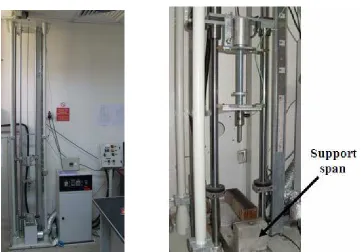
The samples dimension also follow the ASTM International standard (C 393-00) that state the test specimen will have a rectangular cross section. The standard states Resources Engineering, Engineering Campus, Universiti Sains Malaysia. Impact test were conducted using instrumented falling-weight impact tower as shown in Fig.2(a). The impact force was measured using a Kistler 9333A piezo-electric load cell located just above the indentor head of the impactor and variation of this signal with time was recorded by a dedicated computer. The specimens were supported on two 10 mm diameter steel cylinders positioned on movable right angle supports as shown in Fig. 2(b). The support span for this experimental are fixed at 100mm.
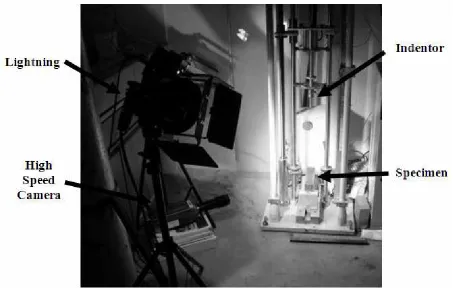
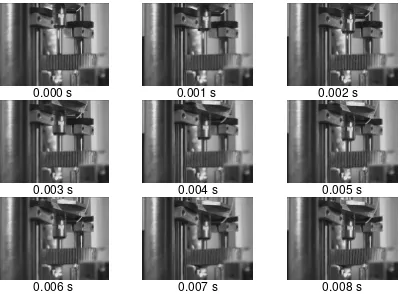
impact tower were lubricated to minimize any friction generated during the descent of the carriage. The deforming mode of paper honeycomb sandwich is captured by using High-speed camera. Figure 4 shows the set up of High-speed camera in the drop impact test.
RESULTS AND DISCUSSION
Low velocity impact of the Paper honeycomb sandwich
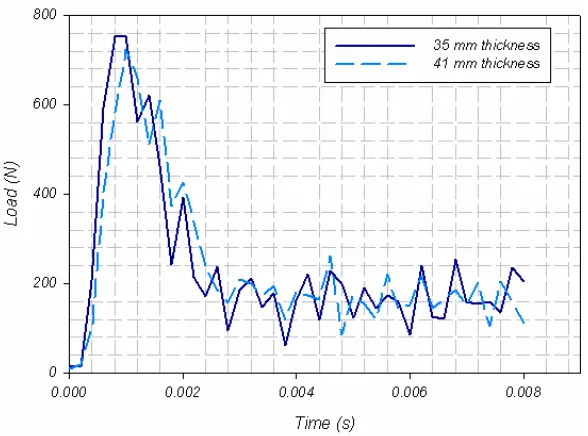
Figure 5 shows the load-time history of the bar indentor for sandwich panel with different thicknesses. The curve shows that the first peak is the collapse load, Pc of sandwich panel and followed by subsequent peaks. This might be due to the stiffness of skin and low strength of core material. Failure due to face yield, core shear, face wrinkling might also to produce the secondary peak and valley. The collapse load for 35 mm and 41 mm are 1055 N and 1378 N, respectively. This indicates that the thicker the panel, the higher is the peak load. However, the form of Load-time curves is similar for both panels.
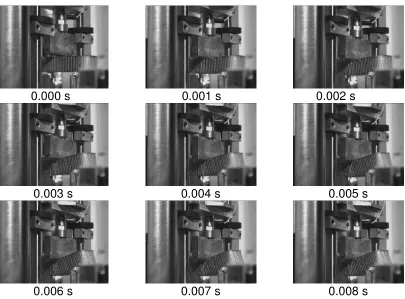
The failure processes in the impact-damaged sandwich panel were investigated by sectioning a number of samples through the High speed camera. Fig 6 shows the deforming mode of sandwich panel when bar indentor come into contact to the top face sheet. The both thickness failed as a result of a top surface buckling failure of the skin directly under the point of impact. Here, it is likely that the different thickness did not offer significant collapse load to the composite skin under impact loading conditions. As expected, an increase the thickness of sandwich from 35 mm to 41 mm resulted in an increase the collapse load.
The deformation and failure at core and facesheet of the paper honeycomb sandwich panel when load are applied can be observed using the Bar indentor as shown in Fig.7.
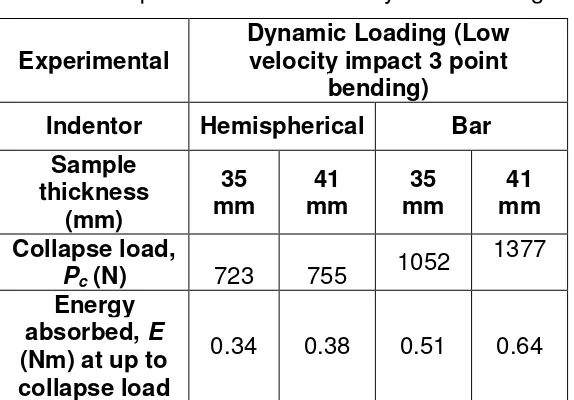
For the case of hemisphere indentor, Fig 8 shows the measured load-time history for the similar panel thicknesses (35 mm and 41 mm). Fig 8 is associated with Fig 9 for deforming. This shows the collapse loads are almost the same value, with deviation less than 5%. This might be due to the penetration of indentor, completely, in both
13%-23% for both thicknesses. This is not seen in bar indentor. This is due to bending failure.
However, in Table 1 shows the collapse load in hemispherical and bar indentors in 41 mm thickness are higher by 32 N(5%) and 325 N(24%), respectively when comparing with 35 mm. The lower goes hemispherical indentor due to penetration completely. It is not seen in bar indentor. Comparing with quasi-static result in 35 mm thickness [9], the energy absorbed in dynamic increases by 36%. The same also goes for 41 mm. This may be due to the effect of strain rate.
CONCLUSIONS
Paper Honeycomb sandwich panel; Nomex honeycomb core and woven carbon prepregs skin with different thicknesses under low velocity impact using two different indentor (hemispherical and bar) are studied and presented. The hemispherical indentor shows the penetration compared with bar indentor. The collapse load in 41 mm thickness increases by 5% for hemispherical indentor and 24% for bar indentor. The experimental result shows that the impact energy absorbed for hemispherical indentor increases by 36%.
ACKNOWLEDGEMENT
The authors would like to thank University Teknikal Malaysia Melaka and Ministry of Higher Education, Malaysia for providing the support and fund for accomplishment of this project. The project is funded under Fundamental Research Grant Scheme, FRGS/2010/FKM/TK01/8- F 00096
REFERENCES
[1] M. Yang, P. Qiao. “Quasi-static indentation behavior of honeycomb sandwich materials and its application in impact simulations”. J. Aerosp. Engineering. Volume 21, Issue 4, pp. 226-234 (2008).
[2] Barboutis I. and V. Vassiliou. “Strength properties lightweight paper honeycomb panels for furniture” Proceedings of International Scientific Conference 10th Anniversary of Engineering Design (Interior and Furniture Design). pp17-18 (2005)
[3] V. Crupi and R. Montanini. “Aluminium foam sandwiches collapse modes under static and dynamic three-point bending”. International Journal of Impact Engineering 34, pp 509-521 (2007).
[4] Joem Kee Paik, Anil K. Thayamballi and Gyu Sung Kim. “The strength characteristics of aluminum honeycomb sandwich panels”. Thin-Walled Structures 35, pp 205-231 (1999).
[6] L. Gibson, M. F. Ashby-"Cellular solids--Structures and Properties--second edition", Published by the Press Syndicate of the University of Cambridge, (1997).
[7] Md. Akil Hazizan and W.J. Cantwell. “The low velocity impact response of foam-based sandwich structures”. Composites Part B: Engineering 33, pp 193-204 (2002).
[8] Md. Akil Hazizan and W.J. Cantwell. “The low velocity impact response of an aluminium honeycomb sandwich structure”. Composites Part B: Engineering 34, pp 679-687 (2003).
[9] Said, M.R., Ismail, M. K, and Syed Putra S.A “ Paper honeycomb sandwiche panels under static 3-point bending” Proceeding of International Conference and Exhibition Sustainable Energy and Advanced material, Solo, 3-4 Oct 2011, pp271-278 (2011).
Figures:
Fig. 1. Sample of the paper honeycomb sandwich panel with thickness of 35 mm and 41 mm.
Fig. 3. (a) Hemispherical indentor, (b) Bar indentor.
Fig. 4. High-speed camera set up.
Fig. 5. Load-time history due to the pierce of bar indentor into different thicknesses of panels.
0.000 s 0.001 s 0.002 s
0.003 s 0.004 s 0.005 s
0.006 s 0.007 s 0.008 s
Fig. 7. The deformed honeycomb sandwich panel using bar indentor.
0.000 s 0.001 s 0.002 s
0.003 s 0.004 s 0.005 s
0.006 s 0.007 s 0.008 s
Fig. 9. The deforming mode Hemisphere indentor for 35 mm thickness.
Table 1. Experimental results for dynamic loading.
Experimental
Dynamic Loading (Low velocity impact 3 point
bending)
Indentor Hemispherical Bar
Sample thickness
(mm)
35 mm
41 mm
35 mm
41 mm
Collapse load,
Pc (N)
723
755 1052
1377
Energy absorbed, E
(Nm) at up to collapse load