Lecture
Notes in Management Science
Volume
53
;:t :6
f,
.:
_-€nil#e*s
*6'rut*#*-t*-tr
@
{ir:-"Ef-4d
;t
Published
by
Singapore
Management and
Sports Science
lnstitute
Humanities,
Social Sciences and
Global
Business
2016 3rd International
Gonterence
in Humanities,
Social
Sciences
and
Global
Business Management
(ISSGBM 20
t
6),
May
4-5, 2016,
Singapore, Singapore
Lecture Notes in Management Science
Lecture
Notes
in
Management
Science
2016
3rd International
Conference
in Humanities,
Social
Sciences
and
Global
Business
Management (ISSGBM
2016)
May 4-5,
20l6,Singapore
Edited
by
Harry
Zhang
Singapore
Management
and Sports
Science
Institute
Copyright © Singapore Management and Sports Science
Institute PTE.LTD
All rights reserved. No part of the contents of this publication may be reproduced or transmitted in
any orm or by any means without the written permission of publisher.
Singapore Management and Spots Science Institute, PTE.LTD
28 Ceylon Road, #02-01 Leville !suites, Singapore 429621
ISBN: 978-981-09-8614-8
Volume 53 of
Lecture Notes in Management Science 1 vol-set
ISSN: 2251-3051
Singapore Management and Sports Science Institute PTE.LTD
28 Ceylon Road, #02-01 Leville !suites, Singapore 429621
E-mail: [email protected]
ISSGBM 2016 Preface
2016 3rd Intenational Conerence in Humanities, Social Sciences and Global Business Management
(ISSGBM 2016) will be held on May 4-5, 2016, in Singapore. ISSGBM 2016 is co-sponsored by
Singapore Management and Sports Science Institute (SMSSI) and Academic Conerence Institute,
USA. All accepted papers in the conerence proceedings will be published by SMSSI Press and will
be indexed by CPCI-SSH.
At present, ISSGBM 2016 is the 3rd conerence. The 1st ISSGBM 2012 and the 2nd ISSGBM 2014)
have been respectively held on December 30-31, 2012, in Singapore and on June 21-22, 2014, in
London, UK. All accepted papers in the wo conerence proceedings have been indexed by
CPCI-SSH.
ISSGBM 2016 will be one of the most comprehensive conferences, ocusing on the various aspects
of Humanities, Social Sciences and Global Business Management. The goal of this conerence is to
bring together the researchers rom academia and industry as well as practitioners to share ideas,
problems and solutions relating to the multiaceted aspects of Humanities, Social Sciences and
Global Business Management. It is certain that our conerence provides a chance or academic and
industry proessionals to discuss the recent progresses in those areas of tourist indusry, ashion
culture, education, psychology, law, economics, business management and so on.
ISSGBM 2016 has received 65 papers. All accepted papers have undergone a rigorous reviewing
process, which is perormed by the intenational conerence committees. Each submission is peer
reviewed by 3 PC members. The PC members consist of Proessors, Doctors, and leading experts in
ISSGBM 2016 conerence topics. The review process reers to the academic value, experiment
procedure, method and results. What's more, the ormat and requent expression as well as grammar
may afect your paper. Thus, those actors should relect and show in the paper. Whether the paper
will be accepted or not depends on wo members of PC. Both of the PC passed the paper, this paper
can be accepted. Ater the strict review inished and the recommendations from the members of the
organization committee, 21 papers are inally accepted in the conerence proceedings, representing
32.3% accepted rate.
We are extremely grateul or the support of ISSGBM 2016 Intenational Committee here, or their
valuable suggestions to the conference. And we would like to acknowledge the support of the general
chairs and publication chairs, or their great contribution to this conerence. Finally, thank the authors,
or sharing their knowledge in the proceedings and participating in this conference.
Harry Zhang, Singapore Management and Sports Science Institute, Singapore
ISSGBM 2016 Organizing Committee
Keynote Speaker
Gerald Schaeer
General Chairs
Jian Yang
David Chan
Publication Chair
Harry Zhang
International Committee
Muniaty Aisyah
Zehua Feng
Limei Yuan
Chengran Fu
Lei Xu
Ji Song
Xin Gao
Yuan Qi
Xiaowei Yuan
Loughborough University, U.K
Huazhong University of Science and Technology, China
ACM Macau Chapter, Macau
Singapore Management and Sports Science Institute, Singapore
State Islamic University (UIN), Indonesia
Jinan University, China
Qujing Normal University, China
North China Electric Power University (Baoding), China
Shanghai Second Polytechnic University, China
Sanya Aviation and Tourism College, China
College of Electrical & Inormation Engineering of SWUN,
China
Beijing University of Technology, China
Guangdong University of Foreign Studies, China
Table
of
Contents
Volume
53
Chapter
1: Economics and Business Management
The Second-Order
Confirmatory FactorAnalysis
ofMuslim
Consumers' ReligiousBehavior
Muniaty Aisyah
""""""""'
"""""""""""
3 Research on Human ResourceLocalization
of ChineseMultinational
EnterprisesZichaLi
andlunquYuan""""""'
... 10TalkingAbout the
Development ofWal-Martfs Competitive
StrategyChengranFu
"""""""""'15
Research on Development Strategy of
Tourist Industry in Lincang
Retying on ItsWa
Ethnic Culture
Zhisheng Dong and Gusheng
Zhu"""""""'
.'...'...2l
Research on Employees'Incentivein
the Chinese State-Owned EnterprisesJia Deng and Sha
Zhu'
""""""""""'.'."
26Research on Transformation and
Upgrading
Countermeasures of TobaccoPlanting
Industry in
ShuanglongXundian
Yunnan ProvinceGusheng Zhu and
Limei
Yuan""""""'
"""'..""""'...
32Study on Problems and Countermeasures of
Manual Training ofAccounting
Major in Colleges
andUniversities
Limei Yuan and Gusheng Zhu
"""""""
"""""""""""'
37The Scheme and
Implementation
ofFull Return
Logistics Based on O2OModel
Xiaojing
Song
""""""'.'... 42
Chapter 2: Humanities and Social
SciencesThe Positive Role of Speech Errors
in Constructing
the Image ofMovie tr'igures:
A Case Study of the M:ovie Peail
Harbor
Zhiyuan
Li
""""""""'
"""""'."."...".
51On Fashion
Culture
in the
Horizon
of Post-modern TimesLeiXu
""""
56Principles on
theTransformation
of the Overseas ChineseAffairs
Legislativein
China
Zehua Feng, Feng He and Yngjie Wu
"""""".'.'
... 62Legal
Protection
of thePolitical
Rights ofEthnic
Chinese underChina's Public
Diplomacy
towards Overseas Chinesein China
Zehua Fe4g, Xiaowei Yuan
andXiaocongYuan
""""'68
The Application of theProbability Anticipation Model in the
Training
of
Interpreting
Hairuo
Wang""""""
....'.. 74Organizational
Network-Research
on the CoreEnterprise
of the DeveloperJingruYangandYuanQi"""""""
""""
79Study on the
Correlation
between the Development of theBuilding
Industry in
Beijing
and PMjl.S EmissionsYuanQi, Yong-anZhangandShuangYu
""""""""'
""""""""""""'85
Tiacing
theOrigin
ofElectrical Culture
Xin
Gao
...'... 91Exploration
and Practice ofModern Apprenticeship
System as theCultivation
Mode
Hong Chen,
UnSqW
Guo, frnming Chen, Binbin Ren, Sihai Li and Yong Wu""',""""""""""
97 Practice and Research on Principle of TeachinginAccordance
with
Student'sAptitude in Model
ofModern Apprenticeship
SystemJi Song, Qingqing Guo, Zhou Jiang, Binbin Ren, frng Yang and Xiaomin
Lu
" " ' I 02The Social Economic Security of Parents
WhoEave
LostTheir Only Child
PianpianZhenS""';
""""""""""""
107Research on Poverty
Problem
of RearElderly in Rural
AreasHanlei
Du"'.
...".'..'."'..'..110
Study of Psychological Assistancefor Lose
the One-childFamily
Pianpian
Zheng"""""'
""""""""""""'114
Authorlndex
"""""'
"""""118
Humanities, Social Sciences and Global Business Management
The
Second-Order Confirmatory
Factor
Analysis of Muslim Consumers'
Religious Behavior
Muniaty
Aisyahl'"'.
lFacurtv or Economics"i,:
:[:i1",:?,tl?i:r53t,,",y,1';?!1Y
#H.:,'."''t
Hidavaturrah Jakarta [email protected]. id*Corresponding author doi. 1 0.5729/lnms.vol53.3
Keywords: Muslim consumer behavior, Religious, Confirmatory factor analysis
^A.bstract. The purpose of this study was to test the implementation of a second-order Confirmatory Factor Analysis
(CFA)
modelfor
the factorialvalidity of Muslim
Consumers' Religious Behavior (MCRB) framework. To test the proposed theoretical model, 219 data sets were evaluated through asurvey and
were
analyzedby using
structural equation modeling
(SEM)
with
AMOS
22.0application. The findings show that the higher order
CFA
modelfor Muslim consumer's
religious behavior have an acceptable goodness-of-fi1. Thus,by
usinga second-order
CFA model as the
continuity
from
previous research which only implemented the first-orderCFA
model,this study
offers further understanding that supports to produce more accurate parameters and measurementsof
Muslim consumers' religious behavior, especially in Indonesia.
1. Introduction
Consumer behavior
is
a combinationof customers'
buying consciousness
and external incentiveswhich are
likely
to result in behavior remodeling. The society's culture such as norrns, convention, customs religion,festivity, class,
lifestyle and other subculture influence how individual consumers buy and use products, and help explain how groups of consumers behavefl].Studies in the marketingliterature suggest that religion is a key element of culture, influencing both behavior and purchasing decisions [2].Religion as one of particular culture forms which develop among the class
of society,
gives identificationfor
its members. Many scholars would agree that a religion represents a unifiedsystems of beliefs and practices relative to sacred things, religiosity is viewed as the degree to which
beliefs
in
specific religious values and ideals are held and practiced by an individual, affect buyingconsumption pattern in so many ways [3].
Understanding the influence of religion on consumer behavior is complicated. Almost
all factors
related to religion are aggregated to form a religious commitment concept, thus complicating efforts to unravel the components ofreligion's influences
[4]. However concluded that influence of religion on consumer behavioris
foundto
be mediated through several factorsincluding
an individual'sreligious
affiliation, commitment to
religious beliefs and practices, the extent of consumers' religiousknowledge, views and perceptions on societal issues, and the motivation in
following
their religious affiliation and commitment. These factors are mostly used in marketing to explain religion influences in the marketplace [5].Many Islamic cultures as well as some Catholic cultures are much more religiously oriented. Islam
as a way of live is interpreted as a Muslim religious behavior that accordance
with
Islamiclaw whichis derived from the holy
Al
Qur'an and Hadith of the Prophet Muhammad [6]. Religious behavior isattitudes, intensity and a person way
to become
religious
[7].Social-culture system and religiousvalues which develop and grow in a family, schools and societies that gain through a learning process and experiences, either deliberately or not will slowly form one's religious soul or behavior. In other
words, religious behavior
will
showfrom
someone's personalityif
he growsin environments that
cultivating, educating and adapting Islamic teachings on their daily lives.
Islam as a way
of live
is a human effort to achieve welfare in his or her life and hereafter.Allah
already gave guidance through
His messengers that
include everything humans needin
order toobtain their welfare
in
accordanceto
aqidah (faith), akhlak (manner) and shari{Islamic
law).Aqidah and
akhlak are constant and not changingfrom
time totime.
Meanwhile, sharia is alwayschanging
in accordance
to
the people needs andcivilization which
appropriatein
every differentmessengers period of time. Sharia
in
Islamic teaching emphasizes on ibadat (worshiping God) andmuamalat (human interaction)
with a good
and properway by
understandingits
etiquette andimplement
it
in
everydaylife in
orderto be a
goodMuslim lsl.Ibadat
emphasizeson
Islamic provisions and procedures of human interactionwith
God (hablumminallahbehavior). Meanwhile, muamalat emphasizeson Islamic provisions and
proceduresof
human interactionwith
others (hab lumminannasbehaior).
This study provides a better understanding of the statistical measurement of religious behavior
of
Muslim
consumersby tested
the factorialvalidity of Muslim
consumers based religious behavior scale using a second-order CFA model. This studywill
establish whether:.
It is possible
to
validate theMuslim
consumers' religious behavior measurement model byusing a high-order factorial
validity.
'
The second-order CFA modelfor
factorialvalidity of Muslim
consumers' religious behavior has a goodness-of-fit.The objective of this study is relevant for companies in general and for marketing management in
particular.
This
studyis
organized as follows: the first section presents a literaturereview
from previousMuslim religious
behavior research,the
second section providesa
descriptionof
thestructural equation modeling used
in this article
andthe
hypothesized model,the third
section presents the methodology, the data sources, as well as the model estimations, and the last section provides a summary and discussion of the results.2.
Muslim
consumers' religiousbehavior
The criteria which are expected to be owned by Muslim are having a good relationship
with God and
a good Islamic personality. The Muslim behavior that is related to his or her relationshipwith
God is measured by three indicators: 1) having knowledge of the Pillars of Faith and the Pillars of Islam; 2) believe in the truth of Faith and Worship; and 3) practicing the Faith and Worship into everydaylife.
The Islamic
teaching dimensionis
aboutfaith
andworship aspects
which reflect
human beingpraiseworthy behavior
(akhlalail
karimah).A
Muslim who
hasfaith
and obedientin his or her
worship,
will be
a praiseworthy person. Therefore, aMuslim
behavioris
also intemalizedwith
Islamic values in his or her dailylife
[9].The Islamic personality is also measured by three indicators,those are Islamic personality
towards:
1)him or herself 2) fellow
human being, and3) natural
surroundings. Thus,in this study,
theMuslim
consumers' religious behavior frameworkis
formed from two dimensions: consumer's relationshipswith
God (namely as hablumminallahbehavior), and consumer's Islamic personality in dailylife
(namely as hablumminannas behavior) in accordance tothe Islamic teaching.
2,1 Hablumminallah
behaior
The concept
of
hablumminatlahis
precisely aboutMuslim
religious behaviorwhich
formed fromcognition, affection and
conationbehavior in Faith and Worship
aspectsof a Muslim
in
his relationshipwith Go4
which clearlywritten
in the two Islamic foundations, the Pillars of Faith and the Pillars of Islam/ Worship [10]. Hablumminallahbehavior is measured from three indicators, those are knowledge, attitudes and the implementation or practice of Faith andWorshipfi
1,721.Krowledge of
Faith is measurec-:cse
are knowledgeof faith in
-{
i..lah's
providence and hereafter.
lro$ledge
of the five Pillarsof
Isla:a:ih). the mandatory and procedure :.:he). and hajj (pilgrim).Anitudes c '-:-e truth of Islamic teachings as the
:=ctice
of Faith and Worship is me:-.d
desist God's prohibition b1' sta-'r,--'ler
the knowledge, the higherii
: =:'.h and Worship aspects. The hi_sh).2
Hablumminannasbehalior
1e
conceptof
hablumminannasis:::srrnality,
habit, event,
andikhtt
::asured
based on three indicators.::-:gs and
natural surroundingsIi
1.-'.amic
personalitytoward onese
:=:avior.
Islamic personality tou'ari .=:s:osif."-.willing
to
cooperate. r:,;:scralify
toward natural surround:::s3rIe
the nature. The higher the-::-:al
surroundings, the higher the lii
\Iethodology
l
1 Srmctural equation modeling-
--r
=d
Second-order factorial valid:--.: ":plies
a confirmatory approacl:,:
."-
Drocesses which generate obse::.:::
statistically in a simultaneous a-
;:-:h
it fits with
the collected c,z.-:
- .;
r ariables ifgoodness-of-fir is r-:
.-;j
[1-{]. The best-known staris:: .-:
-::ent r.ariables
is
factor analr s::.
:-:'
underlying latent constructsi.-.:eare
rwo basic typesof
fac:o:-::
=a11sis(CFA)
[15]. For the p:---:: -ah
sis is used when the resea--:
',-iable
structure. The resear::--::.:.r ::g
factors a priori and then :e:::
--:
CF.{
model allows thespe:ri
-::::'.s
their
loadings on the rema-:::-r::is to determine the its goodness-, - -^1louing the Muslim consLur.;:s'
::::.:s.
namely hablumminallah:::.
-,--i:pendent variables; each cou.c :e::'n
the observed variables.Su::a
-.ues
for a higher level factor rha: .s-,-1 Social-culture system and religious
r::es that gain through a learning process
::.e's religious soul or behavior. In other
:a.:q'
if
he growsin environments that
: :ai11 lives.
:e
in his or her iife and hereafter.Allah
:e er erything humans need
in
order to.i;.
(manner) and sharia(Islamic law).e :o time. Meanwhile, sharia is always
::
uhich appropriate
in
every different'.asizes on ibadat (worshiping God) and
'a)
b)'
understandingits
etiquette ands'.'-n
l8).lbadaf
emphasizeson
Islamic,: : : lttmminallah behavior). Meanwhile, :--es
of
human interactionwith
others:- measurement
of religious behaviorof
r:i
consumers based religious behavior :,:sh u'hether:;:cus
behavior measurement model bY: \{aslim consumers' religious behavior
=:eral and for marketing management in
:::ion presents
a
literaturereview
from section providesa
descriptionof
the:)
pothesizedmodel, the third
section:rodel estimations, and
the last section:ar ing
a good relationshipwith
God andr::l
to his or her relationshipwith
God is :..ars of Faith and the Pillars of Islam; 2)::
Faith and Worship into everyday life.:.:: aspects which reflect
human being::
ras faith
and obedientin his or
her .s.rm behavioris
also intemalizedwith
:.:1
is also measured by three indicators,I
rfellow
human being, and3) natural
::-igious
behavior framework is formed a:rel1' as hablumminallaft behavior), and.inininannas
behavior) in accordance tor
:e.igious behaviorwhich
formed from\\'orship aspects
of a Muslim
in
his::c
foundations, the Pillars of Faith and: rs neasured from three indicators, those
'
:,: Faith and Worship[11,121.Knowledge
of
Faithis measured from
one's knowledgeaboutthe sixPillars
of
Faithin Islam,
those are knowledge
of faith in Allah, Allah's
angels,Allah's holy
books,Allah's messengers,
Allah's
providence and
hereafter.Meanwhile, knowledge
of
Worship
is
measuredfrom the
knowledge of the
five
Pillarsof Islam, those are
knowledge about shahadqh (Islamic professionof
faith), the mandatory and procedure requirements
in ritual
activities of sholat (pray), fasting, zakah(tithe), and
hajj
{Oilgnm).Attitudes of Faith and Worship is measured from one's belief in receivingthe truth
of
Islamic teachings as the outcomes of his knowledge of Faith and Worship. Meanwhile,practice of Faith and Worship is measured from one's actual actions in following God's commands and desist God's prohibition
by standing firm1y on the
Pillars of Faith and the Pillars of Islam. Thehigher the knowledge, the higher the attitudes. The higher the attitudes, the higher the practice
of
Faith and Worship aspects. The higher the practice, the higher the hablumminallaft behavior.2.2
Hablumminannasbe}avior
The
conceptof
hablumminannasis essentially aboutthe fact
of
natureof
humanlife,
humanpersonality,
habit, event,
and iklrwaU causes[3].
In
this
study, hablumminannas behavior is measured based on three indicators, those are Islamic personality towardsoneself fellow
human beings and natural surroundings [11, 12].Islamic
personalitytoward
oneselfis measured
from oneos
honesty, discipline, and diligencebehavior.
Islamic
personalitytoward fellow
human beingis measured
from
one's sharinghabi!
generosity,
willing
to
cooperate,tolerant, caring, and
respecting others.Meanwhile,
Islamic personalitytoward
natural surroundingis measured
from one's
concemof
nature andeflort to
preserve the nature, The higher the Islamic personality toward oneself,fellow
human beings and natural surroundings, the higher the hablumminannas behavior.3.
Methodology
3.1 Structural equation modeling
First and Second-order factorial
validity structural equation modeling
(SEM) is a statistical techniquertat applies
a confirmatory approachto the
structural analysisof a
theory. The theory represents causal processes which generate observations on multiple variables [14]. The hypothesized model is &sted statistically in a simultaneous analysis ofthe whole system of variables to determine the extentto
which
it
fits with
the collected data. The model supports theplausibility of postulated relations
among variables ifgoodness-of-fit is adequate. In caseofpoor fit, the
plausibility ofsuch relations is rejected [15]. The best-known statistical procedurefor
exploring relations between sets ofobservedud
latent variablesis factor analysis.
Covariation amonga set of observed
variablesis used to
id€ntify underlying latent constructs[ I 6].
Thereare two basic types of factor analysis, exploratory factor analysis
@FA)
and confirmatoryfrctor
analysis(CFA)
[15]. For the purposes of this study only CFA was oonsidered. Confirmatoryfrctor
analysis is used when the researcher has theoretical or empirical knowledge of the underlyingldeut
variable structure. The researcher postulates relations between the observed measures and the underlying factors a priori and then tests the hypothesized structure statistically. Apriori specification
of the
CFA
model allows the specific items measuresto
load on their own postulated factors, butrestricts
their
loadings on the remaining constructsto
zero. The modelis evaluated
by statistical
means to determine the its goodness-of-fit to the sample data [16].Following the
Muslim consumers'
religious behavior introducedin this study
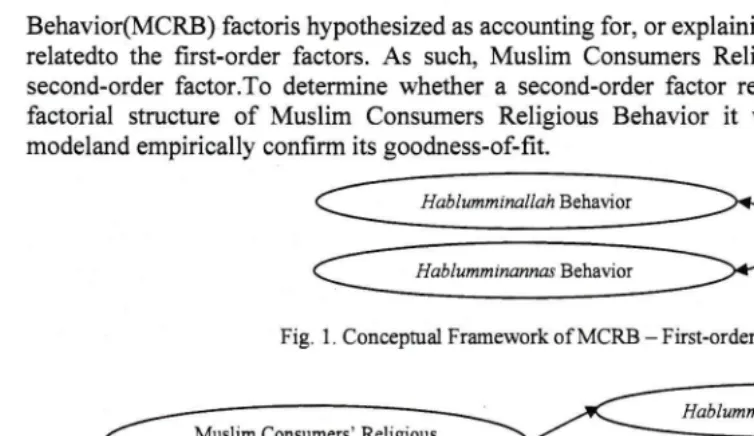
@ig.
1),used twofrctors,
namely hablumminallafibehavior and hablumminannas
behaviorwhich
are operated as independent variables; each could be consideredto be one level, or one unidirectional arrow, awayfrom the observed
variables. Suchfactors are termedfirst-order
factors.In some cases the theoryagues for a higher level factor that is considered accountable for the lower order factors.
Although the model schematically porhayedin
Fig.
2 has essentially the same first-order factorBehavior(MCRB) factoris hypothesized as accounting for, or explaining, all variance and covariance
[image:12.612.59.437.78.296.2]relatedto
the first-order
factors.As
such,Muslim Consumers
Religious Behavior is
termed the second-orderfactor.To
determine whethera second-order
factor represents the most appropriate
factorial
structureof Muslim
ConsumersReligious Behavior
it
was necessary
to speci$
the modeland empirically confirm its goodness-of-fit.Fig. 1. Conceptual Framework of MCRB
-
First-order FactorsFig. 2. Conceptual Framework of MCRB
-
Second-order Factors3.2 Hypothesized model
The
CFA
modelto
be testedin this
study hypothesized apriori that
(a) responsesto theMuslim
Consumers' Religious Behavior
(MCRB)
scale can
be
explained
by
two
f,irst-orderfactors(hablumminallah
behavior and
hablumminannasbehavior)
and
onesecond-order factor(MCRB);
(b)
each indicator hasa
non-zero loading onthe first-order factor
it
was designed
tomeasure, while having zero loadings on the other first-order factors; (c) error terms associated
with
each item are uncorrelated; and (d)covariation among the four first-order factors is explainedfully
bytheir regression onthe second-order factor.
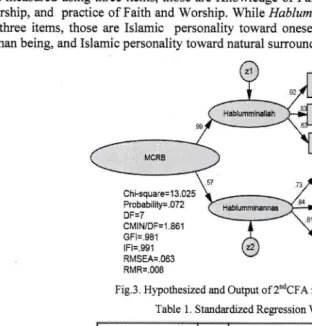
A diagrammatic representation ofthis second-order model
is presented
in Fig.
2.As suggestedin
literature,in an initial
checkof
the hypothesized model,it
isrecommendedto determine a priori
the numberof degrees
of
freedom associated withthe model under test to ascertain its model identification status. In relation to the model shown in Fig. 3, there are 21 pieces of information contained in the covariance matrix, and 14 parameters to be estimated, thereby leaving 7 degrees of freedom. These include the followingl7 variables (6 observed variables
and 1l unobserved variables):.
Observed variables (6): 6 MCRB items.
Unobserved variables (1 1):6
error terms,2
first-order factors,I
second-order factor, and 2 residual terms.
Exogenous variables (9): 6 error terms, 1 second-order factor, and 2 residual terms.
Endogenous variables (8): 6 observed variables and 2 first-order factorsFixed parameters (12):
.
Weights(11):6errortermregressionpaths(fixedto1.0),3factorloadings(fixedtol.0),and2
residual regression paths (fixedto 1.0)
.
Variances(1):
I
second-order factorUnlabeled parameters ( 1 4):
.
Weights (5): 5 factor loadings,I
factor covariance.
Variances (8): 6 enor variances and 2 residual variances.3.3 Sample and procedure
To examine
whether the implementationof a second-order
CFA modelfor
the factorialvalidity
of
MCRB is feasible, data was collected using a standardized survey. The questionnaire was collected
for
6
month,
from July
-
December2015. In total, 350
questionnaireswere
delivered. As recommended in literature, data screening and detecting univariate outliers were performedfl7], and:-cn-valid
questionnaires wereerc:-uestionnaires. The survey was ad:r The items in this study were meE .. as measured using th,ree items. th,
,i'orship,
and practice
of Faith anC:;.
three items, those are Islamic :.:rnan being, and Islamic personall:Chi-square=13 ProbatiEtF-0i nE-? CMlt'UF=1.ff GFI=.98'l IFI=.W1 RMSEA=.6 RMR=.mo
Fig.3. Hypotu
TaHe
:
l.
\Ieasurement
nrocedures and;
..- =:::r e measUfements \\'efe USe; :-'
: --::ed and confirmatory factora:
-.
:'
Cronbach's alpha coefficien-*.!: :
r -.rs. .{11 of the items in each sca.*- :.:e:isional[15].
All factor
loac::---.. -:Cependent and dependen:
::
*
,::
-:
{\1OS 21.0 softri'are. The
Ii
- :: -.i 3:e1 3.025 and 7
(C\{N
DF:
---::r
rGFI)u,as0.981(>0.90i.';t
: -
--::r
rCFI) u'as 0.990 (>0.90r. -;:".
I-:se:-Leu'is
coefficient lnder
-::
- : .--:::a:ion (R\,ISEA) u'as 0,05_:.
. . -: . Therefore, the given va1;es Muslim Consumers' ReligiousBehavior MCRB)
---)+-/
- frsr-order Factors
':
e\plaining, all variance and covariance:ers
ReligiousBehavior is
termed theiiclor
represents the most appropriatear.ior
it
was
necessaryto specifi
the-;: .ummimllah Behavior \
--l- : : . u m m mannasBehavior
-S::::d-order Factors
i ::rcri
that(a) responsesto
theMuslim
.
5e
explained
by
two
first-order:ehavior) and
onesecond-order factor :-e first-orderfactor
it
was designed to: :actors;
(c) error terms associatedwith
;: irst-order
factors is explained fully by '3rresentation of this second-order model :raL checkof
the hypothesized model,it
:s cf freedom associated
withthe model:::cn
to the model shown in Fig. 3, therea::ir. and 14 parameters
to be estimated,-'u ing 17 variables (6 observed variables
:er factors, 1 second-order factor, and 2
: i'actor. and 2 residual terms
:-lrst-order factorsir r. 3 factor loadings (fixed to 1.0), and 2
l3s.
CF-{ model
for
the factorialvalidity
of
sulr.e)'. The questionnaire was coilected5tJ questionnaires
were delivered.
Asr ariate outliers were performed[17], and
non-valid
questionnaires wereexcludedfrom the
analysis,resulting
in
a
total
of
219
validquestionnaires. The survey was administered in Ciputat, South Tangerang.
The items in this study were measured using a five-point
Likert
scale. Hablumminallah behaviorwas measured using three items, those are Knowledge of Faith and Worship, attitude of Faith and
Worship,
and
practice of Faith and Worship. While Hablumminannas behavior was also measuredby
three items, those are Islamic personality towardoneself Islamic
personality towardfellow
human being, and Islamic personality toward natural surrounding.Chi-square=13.025 Prcbabilily=-072 CMllllDF=1.861 GFI=.981 IFI=.991 R[{SEA=.063 Rl\4R:.mB
Fig.3. Hypothesized and Output of 2odCFA model of MCRB
Table 1. Standardized Regression Weights
Estinrate
Hab!arnrninallah MCflB .s86
Hablurrrninan*as MCRB 57?
Kn*wledge Hablurnryrir:allair
Atlitude tlahhsmmireallah .871
Fractice F,ablu*mi*alla* .bJU
Onesalf Hablummir:annes
Fellr,va P'abiumxsi*arz*as .842
5ur-rounding Habiwx,r*inanrtas ena
3,2. Measurement procedures and results
S.eflective measurements were used to evaluate the conceptual model. Cronbach's coefficients were calculated and confirmatory factor analysis was performed to ensure the reliability and validity of the scales. Cronbach's alpha coefFrcients exceed the 0.60 level
for the constructs used
in thereliability
znalysis. A11 of the items in each scale loaded on single factor, suggesting that MCRB constructs are.:ridimensional[15].
All factor loadings approached the 0.50
level (Table 1).All
independent and dependent latent variables were includedin one single
multifactorial
CFA=rodel in
AMOS 21.0 software. The
model demonstrated a goodness-of-fi1. The Chi-square and DF -' alues were 13.025 and 7 (CMIN/DF:
1.861(<2)) with
probability 0.072 (>0.05), the Goodnessof
r it lndex (GFI) was 0.981 (>0.90), the Inuemental Fit Index (IFI) was 0.991 (>090), the Comparativefit
Index (CFI) was 0.990 (>0.90), the Adjusted Goodness-of-Fit Index(AGFI)
was 0.943 (>0.90),=e
Tucker-Lewis coeffrcientIndex
(TLI) was 0.979
(>0.90),the Root Mean Square
Error of
[image:13.612.37.350.145.472.2]4. Summary
The Muslim consumers' religious behavior (MCRB) ramework, introduced and examined in this
study, which used indicators each with total 6 items, was tested using a single second-order actor
CFA model. The two scales used to measure the constructs achieved high levels of cronbach's,
proving to be valid and reliable, and when a high order CF A was performed on the two constructs, the
goodness-of-it and marginal it model was reach. This concludes thatit is possible to validate the
MCRB measurement model by using a high-order actorial validity because the second-order CF A
model or actorial validity of MCRB has a goodness-of-it, thus, the model could measure the
MCRB siniicantly which ofers urther understanding about Muslim religious behavior in
marketplace and societies. For a urther conirmation of the scale and the multidimensionality of the
MCRB constructs, urther researches on higher order CF A and wider study cases should be
considered or analyses.
5. Acknowledgement
This research was inancially supported by the author and the Faculty of Economics and Business,
Statelslamic University (UIN) SyarifHidayatullah Jakarta, Indonesia.
Reerences
[1] Hawkins, Del I. and David L. Mothersbaugh, Consumer Behavior: Building Mareting Stratey,
11
hEd. New York: McGraw-Hill. Inc., 2010.
[2] Essoo, N., & Dibb, S., Religious Inluences on Shopping Behavior: An Exploratory Study.
Journal f arketing Management,
vol.20(7/8), pp.683-713, 2004.
[3] Delener, N., The efects of Religious Factors on Perceived Risks in Durable Goods Purchase
Decision,The Jounal of Consumer Marketing, vol.7(3), pp.27-36, 1990.
[4] Himmelfarb, H.S., Measuring Religious Involvement,
Social Foces,
53(4), pp. 606-618, 1975.
[5] Lawan A. Lawan and Ramat Zanna., Evaluation of Socio-Cultural Factors Inluencing Consumer
BuyingBehavior of Clothes in Bano State, Nigeria,
Intenational Jounal of Basics and Applied
Sciences, vol.01(03), pp. 519-529, Jan 2013.
[6] emporal,
PaulJslamic Branding And Marketing: Creating A Global Islamic Business,
John
Wiley and Sons (Asia) Pte. Ltd., Solaris South Tower, Singapore, 2011.
[7] Magill, F. N. (Editor),
Survey of Social Science: Psycholoy Series,
Vol.16. Pasadena, Calionia:
Salem Press, 1993.
[8] Antonio, Muhammad Syai'i, Islam sebagai Agama yang Lengkap dan Universal,
Bank Syariah
Suatu Pengenalan Umum,
Jakarta: Tazkia Institute, Chap. I, pp.37-40, 2006.
[9] Mansoer, Masri, Perilaku Keberagamaan Remaja pada Siswa SLTA di Jakarta Selatan, Sukabumi
dan Lebak,
Disertasi Pascasajana,
Institut Pertanian Bogor, 2008.
[lO]Husaini, Ardian, Konsep Ilahiah,
Sahabat Mizan Amanah,Jkata,
pp.19-20, Mei 2013.
[l l ]Aisyah, Muniaty, The Inluence of Religious Behavior on Consumers Intention to Purchase
Halal-Labeled Products, Journal Business and Entrepreneurial Review, vol.14(1 ), pp.15-31, Oct
2014.
[12]Aisyah, Muniaty, Peer Group Efects on Moslem Consumer's Decision to Purchase
Halal-Labeled Cosmetics,
Journal Al-lqtisha,
vol.V II (2), pp.165-180, July 2015.
[13]Hidayat, Mohamad, Pengantar Ekonomi Islam, PKES, 2009.
[14]Bentler, P.,
EQS 6 Structural Equations Program Manual,
Multivariate Sotware, Encino, 2006.
[15]Byne, Barbara M., Structural Equation Madelin with AMOS: Basic concepts,applications, and
programming, second Ed., Taylor and Francis Group, New York, 2010.
[16] Schivinski, Bruno, Implementing Second-Order CFA Model or The Factorial Validity of Brand
Equity,
PhD Interdisciplinay Jounal,
DS no.020352, pp. I 05-111, Faculty of Management and
Economics, Department of Marketing, Gdansk University of Technology, 2013.
[
1
7
]Carter, Nancy J., Neil C. Schwertman and Terry L. Kiser, 'A Comparison of Two Boxplot
Methods or Detecting Univariate Outliers which Adjust or Sample Size and Asymmety',
Statistical Methodoloy,
pp. 60---621, 2009.
Author Index
A
Alena Haskova ... 7
Ausrine Lakstutiene·, ... 47, 53
B
Binbin Ren ... 97, 102
c
Chengran Fu ... 15
F
Feng He ···62
G
Gusheng Zhu ... 21, 32, 37
H
Hairuo Wang ... 74
Hanlei Du · · · 110
Hong Chen · · · 97
J
Ji Song ... 102
Jia Deng ... 26
Jingyu Yang ... 79
L
. Lei Xu ... 56
Limei Yuan ... 32, 37
Lunqu Yuan ... 10
M
Muniaty Aisyah ... 3
p
Pianpian Zheng ... 107, 114
QQingqing Guo ... 97, 102
s
Sha Zhu ... 26
Shuang Yu··· ... 85
Sihai Li ... 97
x
XiaocongYuan ... 68
Xiaojing Song···· ... 42
Xiaomin Lu ... 102
Xiaowei Yuan ···68
Xin Gao ... 91
y
Ying Yang ... 102
Yingjie Wu···· ... 62
Yinming Chen ... 97
Yong Wu ... 97
Yong-an Zhang ... 85
Yuan Qi ... 79, 85
z
Zehua Feng · · · 62, 68
Zhisheng Dong · · · 21
Zhiyuan Li ... 51
Zhou Jiang ... 102
Zicha Li ... 10
111 I I
9 789810 986148
ISBN :978-981-09-8614-8