ISSN 1818-4952
© IDOSI Publications, 2013
DOI: 10.5829/idosi.wasj.2013.21.1005
Corresponding Author: Mohd Ahadlin Mohd Daud, Department of Structure and Materials, Faculty of Mechanical Engineering, Universiti Teknikal Malaysia Melaka (UTeM), Hang Tuah Jaya, 76100 Durian Tunggal,
Precipitation Strengthening in Extruded AZ61
Magnesium Alloys During Heat Treatment Process
Mo Ahadlin Mohd Daud, Abdul Talib Din, Kamaruzaman Jusoff and Mohd Zulkefli Selamat
1 1 2 1
Department of Structure and Materials, Faculty of Mechanical Engineering,
1
Universiti Teknikal Malaysia Melaka (UTeM), Hang Tuah Jaya, 76100 Durian Tunggal, Melaka, Malaysia
Department of Forest Production, Faculty of Forestry,
2
Universiti Putra Malaysia, 43400 UPM Serdang, Selangor, Malaysia
Abstract: Magnesium alloys, in particular the commercial wrought alloy, AZ61 has been increasingly
considered as an attractive material in the transportation industry. The objective of this paper is to determine the microstructure change and Mg Al precipitation in the alloy and to evaluate its mechanical properties.17 12 After primary microstructure characterization and mechanical testing in the as-extruded condition the specimens are subjected to heat treatment to the temperature 400°C for one hour followed by quenching in the water. Specimens treated were found to have a coarse grain, homogeneous structure with a substantial increase in grain size. Optical observations also reveal Mg Al precipitations grow in the form of needle shape within the17 12 grain after two hour aging. The mechanical properties and the Hardness Vickers (HV) of the AZ61 magnesium alloy are also found to increase owing to secondary hardening by precipitation strengthening. Therefore, the deformation mechanism improved the materials properties ex-specially in automotive industry. Future work should focus on the improvement of different mechanical properties such as fracture toughness and creep resistance by using precipitation strengthening.
Key words: AZ61 Magnesium Alloy % Heat Treatment % Mg Al Precipitation 17 12 % Aging
INTRODUCTION Despite of these advantages, magnesium alloys,
The use of magnesium alloy in automotive industry because of their hexagonal close pack (h.c.p) structure highly promoted due to the increased emphasis on weight which results in limited deformation mechanism, activated reduction. Magnesium is two-third less dense than at room temperature [3]. Due to this fact, there is a aluminum and one-fourth less dense than iron [1,2]. necessity to improve materials properties parameter, Substantial progress has been made in the last few which can be achieved by alloying or optimizing the years in the development of wrought magnesium alloys process.
produced by thermo mechanical forming. The extrusion Therefore understanding the behaviors and process results in creation of large range of possible properties of wrought magnesium alloys has been the geometries, which are identified due to the effect of a central focus in several recent investigations [4,5]. In this combination of several shapes. This feature eliminates study, the microstructures change of AZ61 magnesium joints and reduces fabrication costs. The wrought forms alloy due to the heat treatment and the precipitation of of magnesium have advantages of higher strength and Mg Al during aging process are investigated. The ductility, as well as better formability, in comparison with effects of the process on the mechanical properties of the
the cast form. magnesium are also examined.
normally exhibit limited mechanical properties
MATERIALS AND METHODS
In this study, the commercial extruded AZ61 magnesium alloys with a diameter of 16 mm were cut into 2 mm thick using the diamonds cutter. The chemical compositions of the AZ61 magnesium alloys are as shown
in Table 1. Before the heat treatments, specimens were Microstructure and Hardness of received and as-wrapped with the anti rust aluminum foils to protect the
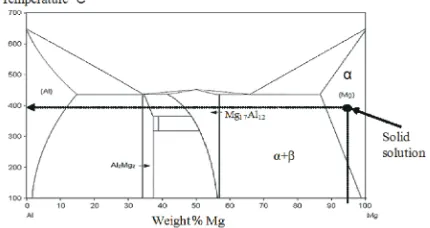
specimens from oxidations. Every specimen was heat treated to 400°C for one hour until the transition of the phase occurred from ("+$) to " [6]. Figure 1 shows the equilibrium phase diagram of Mg-Al [7]. Then, the specimens were quenched in the water. After that, the specimens were put into aging at the temperature of 200°C for 30 minutes and another two hours to form intermetallic $ (Mg Al ).17 12
After the aging process, specimens were quenched in the water to maintain the internal microstructure. In the next process, the specimens were polished with the emery paper grid from No. 200 till No. 1500. The final polishing was done by using synthetic leather cloth with the diamond paste solution size of 0.5 µm. The final stage of metallographic preparation was completed by etching the mirror-like specimens using solutions of 6 gram of picric acid, 100 ml ethanol and 10 ml acetic acid. The etching time for each of the specimens varied from 5 to 15 seconds. Hardness test were conducted using Mitutoyo Vicker Hardness Machine and for every heat treatment process three samples have been prepared to validate the test data.
Tensile and fatigue tests were conducted on a pneumatic fatigue testing machine with a maximum capacity of 14 kN. All fatigue and fracture test were performed under a load control of sinusoidal waveform with a stress ratio R = 0.1 and at a frequency of 10 Hz. The test was stopped when the specimen did not fail up to 107 cycles. The fracture surfaces and specimen surfaces were then observed under a scanning electron microscope (SEM). The tests were conducted in laboratory environment at temperature of 25°C.
Fig 1: The equilibrium phase diagram of magnesium alloy
Table 1: The chemical composition of AZ61 magnesium alloy (wt %)
Al Zn Mn Fe Ni Cu Si Be Mg
5.890 0.7197 0.1565 0.009 0.0006 0.0022 0.0195 0.0006 Bal.
RESULTS AND DISCUSSION
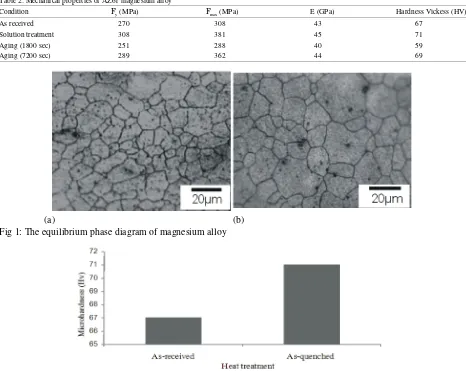
quenched AZ61 Magnesium Alloy: Figure 2 shows the microstructure of AZ61 magnesium alloy in the (a) as-received and (b) as-quenched AZ61 magnesium alloy. The as-quenched sample exhibits a typical stability homogeneous structure, i.e. coarse grain with a substantial increase in grain size. The size is increased from 12 ìm to 15 ìm. The quench reaction in magnesium is the second step in the precipitation-strengthening process. The structure of the alloy consists of a supersaturated solid solution of the á-magnesium phase [8].
The hardness values of as-received and as-quenched magnesium are shown in Figure 3. The as-quenched hardness of magnesium alloy increases mainly owing to the á-solid solution strengthening of Al and the hardness of magnesium containing solute the Al of 6.0wt% reached value of 71HV. The increase of the as-quenched sample’s hardness is suggested to be due to the increase of the á solute content, as a result of the formation of the undissolved Mg Al . 17 12
Microstructure and Hardness of Aging AZ61 Magnesium Alloy: Figure 4 shows the microstructures of aging samples. The samples were aging at 200°C for (a) 1800s and (b) 7200s. The 1800s-sample still contained undissolved precipitation in its microstructure.
After 7200 seconds, the grain boundaries are completely covered by the precipitation of the intermetallic $ (Mg Al ) [9]. The intermetallic ultimately17 12 grows into a needle-like shape within á.
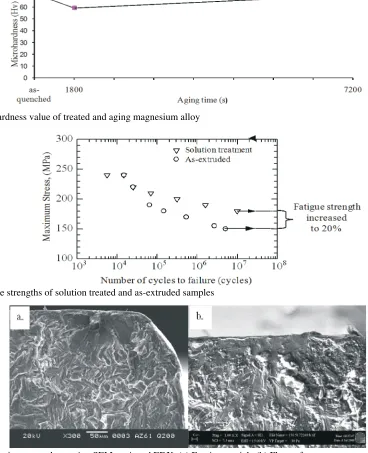
Figure 5 shows the change in the hardness of the magnesium as a result of the holding time of the aging for 1800 seconds,; the hardness of the sample slightly decreased to 59HV. It is well-known that the aging is to relieve the stresses that are set up during the transformation of á to (á+$) and reduce the hardness [10]. The recovery of the dislocation and the decrease in contribution of solid solution strengthening to precipitate Mg Al aging process may cause the decrease in17 12 hardness.
Table 2: Mechanical properties of AZ61 magnesium alloy
Condition Fy (MPa) Fmax (MPa) E (GPa) Hardness Vickess (HV)
As received 270 308 43 67
Solution treatment 308 381 45 71
Aging (1800 sec) 251 288 40 59
Aging (7200 sec) 289 362 44 69
(a) (b)
Fig 1: The equilibrium phase diagram of magnesium alloy
Fig 2: The optical micrograph of the specimens: (a) in as-received condition and (b) in as-quenched condition.
(a) (b)
Fig 3: The hardness values of Magnesium Alloy Fig 4: The optical micrograph of the aging samples at 200°C for (a) 1800s and (b) 7200s
Fig 5: The hardness value of treated and aging magnesium alloy
Fig 6: Fatigue strengths of solution treated and as-extruded samples
Fig 7: Observations were done using SEM equipped EDX. (a) Foreign particle (b) Flat surface
heat treatment process. The yield stress and ultimate respectively. For the solution treated specimen, the yield tensile strength of the materials were significantly stress and the ultimate tensile strength obtained were 289 improved after the solution treatment and aging process. MPa and 362 MPa, respectively. The increment of yield For as-extruded specimen, the yield stress and ultimate stress and ultimate tensile values for solution treated and tensile strength obtained were 270 MPa and 308 MPa aging samples is believed to be due to the hardness respectively. For the solution treated specimen, the yield properties and the Mg Al precipitation hardening. stress and the ultimate tensile strength obtained were 308 The comparison of fatigue strength of solution MPa and 381 MPa, respectively. For the specimen aging treated and extruded AZ61 magnesium alloy is shown in at 1800 second, the yield stress and ultimate tensile Figure 6. The figure shows that fatigue strength of the strength obtained were 251 MPa and 288 MPa, solution treated samples increased in comparison with the
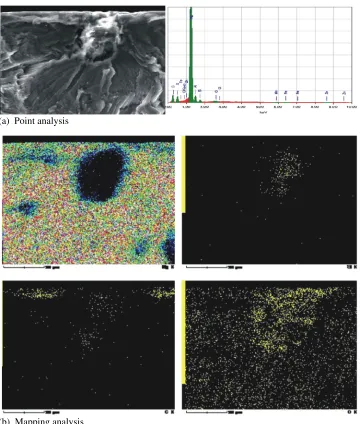
(a) Point analysis
(b) Mapping analysis
Fig 8: EDX point and mapping analysis from the fracture surface of the foreign particle
fatigue strength of the as-extruded AZ61 samples. The The foreign particle size observed was about 20 to 30µm. fatigue limit for solution treated and as-extruded AZ61 The pile-up of the deformation around the foreign particle were 180 MPa and 150 MPa, respectively. The higher during the fatigue cycles contributed to the high stress fatigue strength observed for the solution treated sample concentration around the foreign particles and resulted in is suggested to be caused by the higher tensile strength fatigue crack initiation. In contrast, SEM observation and also the higher hardness properties in comparison results on fracture surface of as-extruded samples showed with the as-extruded sample. that there was no evidence of foreign particle at the
Microstructures Observation from the Fatigue Fracture relatively flat as shown in Figure 7(b).
Surface of AZ61 Magnesium Alloy: Detailed fracture The foreign particles at the fatigue crack nucleation
particle mainly consists of carbon and silicon. It is REFERENCES
suggested that the foreign particle was a SiC particle
which probably exists in the AZ61 alloy powder as an 1. Mordike, B.L. and T. Ebert, 2001. Magnesium:
impurity. Properties-Application-Potential. Journal Material
CONCLUSION 2. Caton, P.D., 1991. Magnesium - An old material with
The change in the microstructure of AZ61 magnesium 3. Kulekci, M.K., 2008. Magnesium and its alloys alloy and the Mg Al precipitation during aging were17 12 applications in automotive industry. The observed to examine the effects on hardness and International Journal of Advanced Manufacturing mechanical properties. The microstructure of the as- Technology, 39(9): 851-865.
quenched sample consists of a supersaturated solid 4. Ming, Z., H. Henry, L. Naiyi and L. Jason, 2005. solution of the á-magnesium phase and retained as á Microstructure and Tensile Properties of Squeeze during the aging process; however, the microstructure Cast Magnesium Alloy AM50. Journal of Materials was completely covered by precipitation of the Engineering and Performance, 14(4): 539- 545. intermetallic $ (Mg Al ). The increase in hardness and17 12 5. Liao, L., X. Zhang and H. Wang, 2005. tensile strength of the aging sample are similar to the Precipitation behavior and damping characteristic of quenched sample. This is due to the formation of Mg-Al-Si alloy. Materials Letters, 59(21): 2702-2705. Mg Al precipitation during aging process. The fatigue17 12 6. Standard practice for heat treatment of magnesium strength of the solution treated samples is higher alloys, 1999. Annual book of ASTM B661-12, compared to the as-extruded samples. It implies that the Philadelphia, USA.
precipitation strengthening is capable to enhance the 7. Callister, W.D., 2007. Material Science and hardness, tensile strength and fatigue resistance. Future Engineering: An Introduction. (7 ed.). New York: work should focus on improvement of different John Wiley & Sons.
mechanical properties such as fracture toughness and 8. William, F.S., 2006. Foundations of Materials Science creep resistance by using precipitation strengthening. and Engineering, (4 ed.). Texas: McGraw-Hill
ACKNOWLEDGEMENT 9. Li, Z.J., X. Dong, Q. Zeng, C. Lu and W.J. Ding, 2007.
The authors would like to thank the Department of hot extruded microstructures and mechanical Structure and Materials, Faculty of Mechanical properties of Mg-9Al-1Zn alloy. Materials Science Engineering and the Centre for Research and Innovation and Engineering: A, 466(1): 134-139.
Management (CRIM), Universiti Teknikal Malaysia 10. Zheng, M.Y., K. Wu, S. Kamado and Y. Kojima, 2003. Melaka (UTeM) for providing the financial and Aging behavior of squeeze cast SiCw/AZ91 infrastructure support for this research. magnesium matrix composite. Materials Science and
Science Engineering: A, 302(1): 37- 45.
new application. Material and Design, 12(6): 309-315.
th
th
International.
Influence of Mg Al intermetallic compounds on the17 12