INDONESIA’S EXPERIENCE
IN THE WAR ON TERROR
DR. ALI MUHAMMAD
The Phinisi Press Yogyakarta
Writer:
DR. ALI MUHAMMAD
Editor: Ahmad Sahide
Cover & Layout: Miftakhul Ulum
First publishing, December 2015
Published by: The Phinisi Press Yogyakarta
Golo street of Nanggolo path, No. 36 A Yogyakarta
Phone number: 085292039650
E-mail address: [email protected]
ISBN: 978-602-6941-02-2
Copyright @ 2015, Ali Muhammad
SUMMARY
This book investigates Indonesia’s war on terror 2001— 2009. It asks three interrelated questions.Firstly, according to the government’s perspective, who was responsible for the major bomb attacks in Indonesia? Secondly, what sort of counterterrorism policies did the government adopt? Finally, what are the main factors that shaped the government’s counterterrorism policy during that
period?To explain the Indonesian government’s counterterrorism
policy, this study adopts “the logic of two-level games” (Putnam, 1988) as the theoretical framework. The model explains how domestic politics and international relations get entangled and inluence the direction taken by the government’s policy. Based on the theoretical framework, government policy is a function of incentives and constraints both on the international and on the domestic level. As “the gatekeeper” between the two levels game, the government simultaneously processes these interdependent incentives and constraints in its policy decision-making.
This book demonstrates that, although it never banned
Al-Jamaah Al-Islamiyah (AJAI) because of domestic considerations, the government believes that the AJAI is a terrorist network mostly responsible for the consecutive bombings in Indonesia. Secondly, the present government has mostly relied on a
“law-enforcement approach” in ighting the terrorist network which has
been incrementally complemented with an “ideological approach”
to ight religious extremism. Finally,the pathway of Indonesia’s
counterterrorism policy was shaped by contradictory pressures originating from the Muslim community and human rights groups in the domestic political environment,on one hand,as well as international pressures originating from the United States and its allies, on the other hand.
This book is dedicated to:
Mrs.Hj. Suhaebah&Mr.H. Karnawan Ferra,Alicia, Farel& Queen
In memory of
ACKNOWLEDGEMENTS
It is only to Allah S.W.T., all praises should be rendered. Without His blessings, it would not have been possible to inish this research. First of all, I would like to extend my profound gratitude to all my colleagues at Department of International Relations, Universitas Muhammadiyah Yogyakarta: Prof Dr Bambang Cipto, Prof Dr Tulus Warsito, Dr NurAzizah, Dr Surwandono, Dr SidikJatmika, Mr Sugeng Riyanto and all lecturers that I cannot mention one by one. I would like to thank to my lectures at International Islamic University Malaysia to whom I owe intellectual debt: Prof. Dr. El-Fatih A. Abdelsalam Prof. Dr Abdul R.Moten, Assoc. Prof Dr.WahabuddinRa’ees, and Assoc. Prof Dr Ishtiaq Hossain.
I am very grateful to these following institutions: the Asia Research Institute, the National University of Singapore (NUS), who generously granted me scholarship to undertake three months library research at the NUS library and the Institute of Southeast Asian Studies (ISEAS). Leiden University also generously granted me four months research fellowship under the scheme of “Training Indonesia’s Young Leader Program”to carry out intensive library re-search at Leiden University and KITLV, the Netherlands.
TABLE OF CONTENTS
Abstract i
Dedication ii
Acknowledgement iii
Table of Content iv
List of Table and Figures viii
List of Abbreviations ix
CHAPTER 1: INTRODUCTION 1
The Problem: Terrorism 1
Terrorism Deined 4
Counterterrorism Policy 9
Organization of this book 13
CHAPTER 2:
GOVERNMENT’S PERCEPTION OF TERRORISM 16
Introduction 16
Origins of Al-Jamaah Al-Islamiyah 18 Exile and Jihadin Afghanistan 25 Organization and Network 29
Guidelines for Struggle 34
The Rise of the Terrorist Faction 37
Bombing Operations 40
Ideological Motives 52
Establishing Daulah Islamiyah Nusantara 53 Muslim Solidarity and (Mis) Interpretation of
Jihad 54
CHAPTER 3:
GOVERNMENT’S COUNTERTERRORISM POLICY 65
Introduction 65
Evolution of Counterterrorism Policy 66 History: Failure of Militaristic Approach 66 Response: Before and After Bali
Bombing 2002 67
Political Context: the Governments 71 Megawati Administration (2001—2005) 71 YudhoyonoAdministration I (2005—2009) 72 Guidelines: National Strategy for
Counterterrorism 73
Counterterrorism: Law Enforcement Approach 75 “Physical Battle” against Terrorist Network 75 Counterterrorist Law 76 Counterterrorism Agencies 78
Principal Agency: Indonesia National
Police 78
Special Detachment 88 81
Intelligence Agencies 83 Supporting Agency: Armed Forces 87 Counterterrorism Coordinating Desk 89 Anti-Terrorism: An :Ideological” Approach 93
“An Ideational Battle” against Religious
Extremism 93 Government’s Commitment 94 Neutralising Extremism: Police and
De-radicalization Programme 97 Cointaning Extremism: Indonesian Ulama
Council 101
Containing Extremism: Partnership with
Department of Religious Affairs: Hesitant Role 110
Conclusion 113
CHAPTER 4: DEMOCRACY, SOCIETAL PRESSURES
AND COUNTERTERRORISM POLICY 117
Introduction 117
Domestic Context: The Rise of Democracy 119 Restoration of Democracy 119 The State, Society and Government Policy 122 Societal Pressures: Muslim Community 123 Democracy and “Islamic Revivalism” 123 Re-emergence of Islamic Political Parties 126 Islamic Revivalist Groups 131 Common Views: Scepticism on Terrorism Issue 135 Global War on Terror: “War on Islam” 136 Terrorism: Foreign Conspiracies 139 Societal Pressures: Human Rights Groups 143 Democracy and Human Rights Groups 143 Apprehension on Anti-Terrorism Law 149 Critiques on Implementation 156 Implications for Counterterrorism Law 161 Hesitancy to deal with Abubakar Ba’asyir 163 Failure to Outlaw the Al-Jama’ah A-Islamiyah
AJAI 164
Indecision to Expand an “Ideological”
Approach 165
Failure to Adopt Tougher Anti-Terrorism Law 168
CHAPTER 5: GLOBAL “WAR ON TERROR,” INTERNATIONAL PRESSURES AND
COUNTER-TERRORIMS POLICY 174
Introduction 174
International COntext: Bush’s War on Terror 176 “Global War on Terror” and the US Strategy 176 Southeast Asia as “the Second Front” 179 Jamaah Islamiyah Uncovered: Pressures on
Indonesia 184
International Pressures: Demands 186 The Adoption of Legal Framework:
Anti-Terrorism Law 186
The Arrest of the “Spiritual Leader” of the
AJAI 189
Proscription of the AJAI 193 International Pressures: Instruments 195 Intensive Diplomatic Channels 196 Anti-Terrorism Assistance 200
Economic Inducements 205
Pledge to Reduce Military Embargo 208 Implications for Counterterrorism Embargo 211 Increasing Government’s Determination 211 Bolstering Government’s Capability 213
Conclusion 215
CHAPTER 6: CONCLUSION 218
Issues Analyzed and Findings 218
Limitations of the Study 223
POSTSCRIPT 227
APPENDIX I. Notes on Methodology 230 APPENDIX II. GRL No. 1/2002 on Combating Criminal
Acts of Terrorism 256 APPENDIX III. GRL No. 2/2002 on the Enactment of
GRL No. 1/2002 281 APPENDIX IV. Explanation of GRL No. 2/2002 284
BIBLIOGRAPHY 287
LIST OF TABLES AND FIGURES
TABLES
Table 1.1 Major Terror Attacks, 2000-2009 3 Table 3.1 Hotel Marriott Bombers and Their Education 111 Table 3.2 The Australian Embassy Bombers and Their
Education 111
Table 4.1 Performance of Islamic Political Parties in
the 1999 and 2004 General Elections 130 Table 5.1 Anti-Terrorism Assistance Program Funding
for Indonesia 202
Table 5.2 Counterterrorism Course Taught at Megamendung Police Training Site 203 Table 5.3 US Assistance to Indonesia, 2004-2009 207
FIGURES
Figure 3.1 Indonesia’s Counterterrorism Structure 80 Figure 3.2 Organization of Detachment 88, Indonesian
LIST OF ABBREVIATIONS
AJAI /JI : Al-Jamaah Al-Islamiyah/JamaahIslamiyah ATA : Anti-Terrorism Assistance
BIN : Badan Intelejen Negara (State Intelligence Agency)
CTCD : Counterterrorism Coordinating Desk DENSUS 88 : Detasemen Khusus 88
(Special anti-terror police unit) DEPAG : Departemen Agama
(Department of Religious Affairs) DI/NII : Darul Islam/Negara Islam Indonesia DPR : Dewan Perwakilan Rakyat
(Indonesian Parliament) FPI : Front Pembela Islam
(Islamic Defender Front)
GRL : Government Regulation in Lieu of Law GWOT : Global War on Terror
HTI : HisbutTahrir Indonesia ICG : International Crisis Group ISA : Internal Security Acts
KONTRAS :Komisiuntuk Orang Hilang dan Korban Kekerasan (The Commission for
MMI : MajelisMujahiddin Indonesia (Indonesian Warrior Council)
MUI : MajelisUlama Indonesia (Indonesian Ulama Council) NU : NahdhatulUlama
PBB : Partai Bulan Bintang (the Moon and Star Party) PKS : Partai Keadilan Sejahtera
(the Prosperous Justice Party) PERPU : Peraturan Pemerintah Pengganti
Undang Undang
(Government Regulation in Lieu of Law, GRL) POLRI : Polisi Republik Indonesia
(Indonesian National Police) PPATK : Pusat Pelaporan dan Analisis
Transaksi Keuangan
(Financial Transaction and Report Analysis Centre) PPP : Partai Persatuan Pembangunan
(the United Development Party) RUU : Rancangan Undang-Undang
(Law proposal, Bill)
TNI : Tentara Nasional Indonesia (Indonesian Armed Forces) TPM : Tim Pengacara Muslim
Indonesia’s Experience in the War on the Terror
CHAPTER ONE
INTRODUCTION
The Problem: Terrorism
This book attempts to examine Indonesia’s experience in the
ight against terrorism during the 2001—2009 period. It asks several
guiding questions: Firstly, according to the Indonesian government’s perspective, who was responsible for the consecutive major bomb
attacks in Indonesia? What was their motivation? Secondly, what sort of counterterrorism policies did the government take during the
2001—2009 period? Finally, what were the main determinants that shaped the direction of the government’s counterterrorism policy
during that period?
After the downfall of “New Order” regime in 1998, the
repressive capacities of the state weakened signiicantly. The world’s
biggest Muslim country slowly moved towards a consolidated
democratic regime.1 During the critical phase, however, a variety of
internal security problems in the peripheral regions emerged such
as, the increasing separatist movements in East Timor, Aceh, and
West Papua2 as well as the protracted communal conlict in West
1 “New Oder” is an authoritarian, military dominated regime during Suharto’s rule,
1961—1998. Rizal Sukma, “Democratic governance and security in Indonesia,”
Japanese Journal of Political Science 4, 2, (2003): 241–55.
2 East Timor ceded from Indonesia after a Referendum in 1999. The Aceh
problem was solved after the agreement between the government and the Free Aceh Movement (GAM) had been signed in Helsinki. The government agrees to give Aceh province a special autonomy status and GAM agrees to stop their armed struggle and aspiration for independence. However, the problem of separatism in West Papua has yet to be solved up to the present time. See, Andrew T.H. Tan,
Introduction
Kalimantan, Ambon and Poso.3 However, the new democratic
governments also had to respond to terrorist threats which had
adversely affected the national stability and security since 2000.4
On Christmas Eve, 24 December 2000, a clandestine network launched coordinated bombing attacks against churches in eleven
cities across Indonesia.5 The coordinated bomb attack used
low-explosive materials and killed 9 and wounded 120 people. With a few exceptions, such as the attack on the residence of the Philippine ambassador in Jakarta in August 2000, the targets were mostly churches and priests. A report states that the motivation for the church bombing was revenge for massacres of Muslims by Christians in the conlict areas: Maluku, North Maluku, and Poso (Central Sulawesi) in 1999 and 2000.6
Since then, deadly bombings have become regular in Indonesia: the Bali Bombings killed mostly foreign tourists on October 12th 2002; the J.W. Marriot Hotel was bombed on 5 August
2003; there was a suicide bomb attack at the Australian Embassy on 9 September 2004, and suicide bombings in Bali on 1 October 2005. On July 17th, 2009, after Indonesia successfully has held a peaceful parliamentary and presidential election, two suicide bombers
3 An excellent analysis on communal violence in the outer islands since the
downfall of the New Order, see Gerry Van Klinken, Communal Violence and Democratization in Indonesia: Small Town Wars, (London and New York: Routledge, 2007).
4 Analysis on instability faced by Indonesia since the downfall of Suharto, see,
Bilveer Singh, Indonesia and the Arch of Instability,” in Australia’s Arc of In-stability: The Political and Cultural Dynamics of Regional Security, edited by D. Rumley, Vivian. L. Forbes and C. Grifin, (The Netherlands: Springer, 2006), 83-100.
5 “Indonesia Backgrounder: How the Jemaah Islamiyah Terrorist Network Oper-ates,” ICG Asia Report no 43, (11 December 2002).
Indonesia’s Experience in the War on the Terror
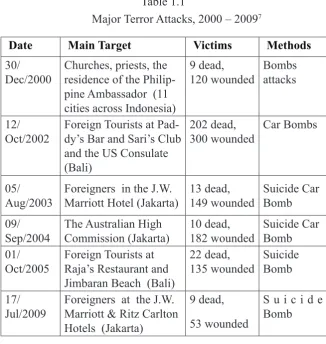
suddenly attacked the J.W. Marriott and Ritz-Carlton hotels, Jakarta. The consecutive terror attacks have damaged political stability, national security and the fragile economy of the world’s biggest Muslim nation on earth. Table 1 lists the major bomb attacks since 2000.
Table 1.1
Major Terror Attacks, 2000 – 20097
Date Main Target Victims Methods
30/ Dec/2000
Churches, priests, the residence of the Philip-pine Ambassador (11 cities across Indonesia)
9 dead, 120 wounded Bombs attacks 12/ Oct/2002
Foreign Tourists at Pad-dy’s Bar and Sari’s Club and the US Consulate (Bali) 202 dead, 300 wounded Car Bombs 05/ Aug/2003
Foreigners in the J.W. Marriott Hotel (Jakarta)
13 dead, 149 wounded Suicide Car Bomb 09/ Sep/2004
The Australian High Commission (Jakarta) 10 dead, 182 wounded Suicide Car Bomb 01/ Oct/2005
Foreign Tourists at Raja’s Restaurant and Jimbaran Beach (Bali)
22 dead, 135 wounded Suicide Bomb 17/ Jul/2009
Foreigners at the J.W. Marriott & Ritz Carlton Hotels (Jakarta)
9 dead, 53 wounded
S u i c i d e Bomb
7 Various sources: Kompas, Detik.com, Jawa pos. This table does not include a
Introduction
“Terrorism” Deined
The word “terrorism” is derived from the Latin word terrere, meaning to frighten, to terrify, to scare away, or to deter. “Terrorism” has no precise or widely accepted deinition and is one of the most controversial concepts in social sciences.8 To deine it is intricate
because the meaning has changed so frequently within social and historical contexts over the past two hundred years.9 The deinition
of the term depends on political power, that is to say, government can increase their power when they label opponents as “terrorists.”10
From a critical perspective, the way the term is selectively applied is only to serve the interests of the powerful.”11 Furthermore, to deine
it is very complicated since a well-known adage says, “one person’s terrorist is another person’s freedom ighter.”12
It is noteworthy that most of the deinitions agree that acts of terrorism are “immoral and abhorred.” However, the controversies have emerged on this point since the deiners seek to exclude groups that they wish to support or to include groups that they wish to denounce. Central to the disagreement is the categorization of
8 Charles W. Kegley, Jr. The New Global Terrorism: Characteristics, Causes,
Controls, (New Jersey: Prentice Hall, 2003), 16.
9 David J. Whittaker, The Terrorism Reader, (London and Now York: Routledge, 2001), 5.
10 Jonathan R. White, Terrorism: An Introduction, 3rd Edition, (Belmont, CA: Wadsworth Thomson Learning, 2002). 6. See also, Walter Laqueur. Terrorism,
(Boston: Little Brown and Co, 1977).
11 From critical perspective, see for instance, Edward Said, ‘The essential
Indonesia’s Experience in the War on the Terror
whether political violence is “lawful” and “legitimate” or “unlawful” and “illegitimate.”13 Some deine terrorism if the perpetrator is only
a sub-national group, but others deine it more broadly to include state actors as well. For instance, the US Department of Defense deines terrorism as “the unlawful or threatened use of force or violence against individuals or property to coerce and intimidate governments or societies, often to achieve political, religious or ideological objectives.”14 Meanwhile, the US State Department
deines terrorism as “premeditated, politically motivated violence perpetrated against noncombatant targets by sub-national groups or clandestine agents, usually intended to inluence an audience.”15 By
using the US State Department’s deinition, political violence can be categorized as acts of terrorism if they are “unlawful” or perpetrated by “sub-national groups.”16
In contrast, Ayatullah Syaikh Muhammad Ali Tashkiri formulated a broader deinition at the international conference on terrorism called by the Organization of the Islamic Conference (OIC) in Geneva in June 1987. He said that ”Terrorism is an act carried out to achieve an inhuman and corrupt objective, and involving threat to security of any kind, and violation of rights acknowledged by
13 Grant Wardlaw, Political Terrorism: Theory, Tactics and Countermeasures, (Cambridge: Cambridge University Press, 1989), 4.
14 Gus Martin, Essentials of Terrorism: Concepts and Controversies, (Los Ange-les: Sage Publication, 2008), 8.
15 Ibid, 9.
16 This deinition creates controversies because the attacks of the Israeli army
Introduction
religion and mankind.”17 Using his deinition, Tashkiri intended to
include “state terrorism,” in particular, the United States being “the mother of international terrorism.” Tashkiri writes:
It is indeed comical that the United States of America, which is the mother of international terrorism, and the author of all the circumstances of oppression and subjection of people, by strengthening dictatorial regimes and supporting occupation of territories and savage attacks on civilian areas, etc. should seek to convene symposia on combating ‘terrorism, i.e., any act that conlicts with its imperialist interests…18
It seems obvious that there is an incompatible perspective on terrorism between “the West” and “the Muslim world.” However, controversies have also emerged within the Muslim world itself. For instance, the Muslim world represented “formally” by the Organization of the Islamic Conference (OIC) also failed excruciatingly to formulate an agreed deinition of terrorism. In the extraordinary session of the Islamic Conference of foreign ministers on terrorism in Kuala Lumpur in April 2002, OIC foreign
17 Ayatullah S.M.A.Tashkiri, “Toward a deinition of terrorism,” Al-Tauhid, vol. V, no. 1 (Muharram 1408 AH/1987CE), <http//www.al-islam.org/al-tawhid/dei-nition-terrorism.html> (accessed on 26 October, 2009). Other Muslim intellec-tuals have also tried to deine terrorism broadly: “An outrageous attack carried out either by individuals, groups or states against the human being (his religion, life, intellect, property and honour). It includes all forms of intimidation, harm, threatening, killing without just cause and everything connected with any form of armed robbery, hence making pathways insecure, banditry, every act of violence or threatening intended to fulil a criminal scheme individually or collectively, so as to terrify and horrify people by hurting them or by exposing their lives, liberty, security or conditions to danger; it can also take the form of inlicting damage on the environment or on a public or a private utility or exposing a national or natural resource to danger.” See, “Terrorism: Islam’s Viewpoint,” The Muslim World League Journal, (July 2002), <http://muslim-canada. org/iqhcouncil.html> (Accessed on 28 January, 2008).
Indonesia’s Experience in the War on the Terror
ministers were divided over whether or not Palestinian suicide bombers can be categorized as “terrorists.”19
Another prominent scholar who studied terrorism is Alex P. Schmidt. He has also examined 109 deinitions of “terrorism” from leading academic researchers from the ield. From these deinitions, he identiies the following deinition elements: violence and force— appeared in 83.5% of the deinitions; political goal—65%; spreading fear and dread—51%; threat of violence—47%; psychological impact of terrorism—41%; discrepancy between target and victims—37.5%; degree of consistency, planning, and organization of terrorism—32%; terrorism as a method of warfare, strategy and tactics—30.5%.20
Apart from those controversies and variety of meanings, however, a clear deinition of the term is required not only for academic purposes but also for practical purposes. To ight against a terrorist group, for instance, we must irst of all be very clear whether the organization we are ighting against is “a terrorist group.” Boaz Ganor‘s deinition of terrorism is useful here. He proposed a simple deinition of terrorism as follows, “terrorism is a form of violent struggle in which violence is deliberately used against civilians in order to achieve political goals.”21 The deinition is based on three
central elements: First, the essence of the action—the form of violent
19 “OIC Leaves It to UN to Deine “Terrorism,” Asian Political News, 8April 2002. <http://indarticles. com/p/articles/mi_m0WDQ/is_2002_April_8/ai_84640350> (accessed on 27 January, 2009).
20 Alex P. Schmidt, Political Terrorism: A Research Guide to Concepts, Theories,
Data Bases and Literature, (Amsterdam: North Holland Publishing Company, 1983).
Introduction
struggle.22 According to this deinition, any action which does not
involve violence is not deined as terrorism.
Second, the goal underlying terrorism, which is always political, that is a goal aimed at achieving something in the political arena: overthrowing a regime, changing the form of governance, replacing those in power, revising economic, social and other policies, dominating and disseminating ideologies. With no political agenda, the action in question is not considered as terrorism.23 Violent action
against civilians without a political goal is, at most, a purely criminal act, a felony, or simply an act of insanity that has nothing to do with terrorism.
Third, the target of the damage is civilians.24 In this way,
“terrorism” can be distinguished from other forms of political violence, such as guerrilla warfare, popular insurrection, and so on.
From the deinition of terrorism elucidated above, it is obvious that
the consecutive bombing attacks against civilians mentioned above can be categorized as acts of terrorism. Using the simple deinition elaborated above, we can argue that the Bali Bombing and other consecutive bombings in Indonesia can be categorized as acts of terrorism.
The Indonesian government has also formulated its own deinition of “terrorism.” According to Law No. 15/2003 (Indonesia’s Anti-Terrorism Laws), the basic deinition of the criminal act of “terrorism” is,
Any person who intentionally uses violence or the threat of violence to create a widespread atmosphere of terror or fear in the general population or to create
Indonesia’s Experience in the War on the Terror
mass casualties, by forcibly taking the freedom, life or property of others or causing damage or destruction to vital strategic installations or the environment or public facilities or international facilities.25
Counterterrorism Policy
Before elucidating the concept of “counterterrorism policy” it is crucial irst to deine the concept of “policy” in the irst place. “Policy” can be deined as a “set of interrelated decisions concerning the selection of goals and the means of achieving them within a speciied situation.”26 Policy may also be considered as a course
of [government’s] action or inaction rather than speciic decisions or actions.27 Smith suggests that the concept of policy denotes a
“deliberate choice of action or inaction, rather than the effects of interrelating forces.”28 It should be emphasized here that inaction
as well as action and attention should not focus exclusively on decisions which produce change, but must also be sensitive to those which resist change.
More speciically, “public policy” can be deined as “anything a government chooses to do or not to do.”29 This simple deinition is
not without merit. Firstly, it means that the agent of public policy-making is a government. When we talk about public policies, we speak of the actions of government. Secondly, public policy involves a fundamental choice on the part of governments to do something
25 Law No. 15/2003, Section 6 [basic deinition of criminal act of terrorism] 26 Jenkin W. I. Policy Analysis, (London: Martison Roberson, 1978), 17 27 Heclo, H, “Review Articles: Policy Analysis,” British Journal of Political
Science, 2. (1972): 85
28 Smith, Policy Making in British Government, (London: Martin Roberson, 1978), 13
29 Thomas Dye, quoted by Michael Howlett and M. Ramesh, Studying Public
Introduction
or to do nothing and the decision is made by individuals stafing the state and its agency. Public policy is a choice made by a government to undertake some course of action.30 The government’s policy to
ight terrorism is deinitely part of “public policy.”
Gus Martin refers to “counterterrorism policy” as “proactive [government’s] policies that speciically seek to eliminate terrorist environments and groups.”31 Because “terrorism occurs when
opportunity, motivation, and capability meet,”32 a multi-pronged
counterterrorism policy approach is required not only to destroy
terrorist networks, infrastructure and operational capability but also
to curb, suppress, and refute their ideological motivation. Regardless of which policy is selected, the ultimate goal of counterterrorism policy is to save lives by proactively preventing or decreasing the number of terrorist attacks.33
Boaz Ganor points out a number of speciic goals that might underlie a nation’s counterterrorism policy. Firstly, eliminating terrorism is likely to be expressed as eradicating the enemy (destroying the terrorist organization itself), removing the enemy’s incentive to commit terrorist attacks and use violence against the state and its citizens, or resolving the controversial issues (since the motive behind terrorism is a political one, the solution is also to be found in the political sphere). Secondly, minimizing the damage caused by terrorism may include sub-goals such as reducing the number of attacks and/or the number of victims, preventing certain type
30 Ibid.
31 Gus Martin, Understanding Terrorism: Challenge, Perspective, and Issues, (Thousand Oaks: Saga Publication, 2003), 345.
Indonesia’s Experience in the War on the Terror
of attacks (suicide bombing, mass killing, etc) lessening property damage etc. Thirdly, preventing the escalation of terrorism is based on two sub-goals: (1) ensuring that the conlict does not spread— stopping the terrorist organization’s growth and development through enlistment of new activists to its ranks, preventing the organization from gaining political ground in the international arena, blocking or neutralizing support from their country, impeding the intensiication of the organizations’ political objectives and effort (2) making certain the scope of attacks does not escalate.34
Art and Richardson also demonstrate that government can use a range of counterterrorism policies to combat groups resorting to terror. These measures can be grouped into three categories: political measures, legislative and judicial measures, and security measures.35
Firstly, political measures include negotiations with groups (in which the government makes compromises and concessions) to bring about the end of resistance; socio-economic and political reforms to win the “hearts and minds” of the people from whom the terrorists draw both armed adherents and more general support; and international cooperation to cut off funds to terrorists, extradite terrorists, police borders, and provide intelligence to the state under siege.36
Secondly, legislative and judicial measures include emergency and other special legislation to expand the government’s powers to arrest, detain, and incarcerate suspects and to gain intelligence about them in ways that involve infringements on citizen’s privacy; use of the courts to empower the state and special magistrates and prosecutors to undertake broad investigative actions; legislation to
34 Ganor, 25-6.
35 Robert J. Art and Louise Richardson, Democracy and Counterterrorism:
Introduction
disrupt the inances of groups employing terrorism; and amnesty and repentance measures designed to wean active armed members away from such groups and to reintegrate them into society.37 Finally,
security measures could include military deployment to protect the population and to seek out and destroy terrorist groups; intelligence operations, especially the use of counterterrorist units to penetrate terrorist networks and disrupt their logistics and support networks; new organizational machinery to coordinate the security instruments and disparate units of governments dealing with terrorism; and preventive actions for defence, such as, the hardening of facilities, control of access, and the like. Of course, not all governments employ every one of the above measures, and each government has its own particular way of utilizing the measures depending on the nature of the threat as well as the political context.38
This study will classify Indonesia’s counterterrorism policy into two main approaches. The irst is a legal or “law-enforcement” approach. The objective of this approach is to promote the rule of law and regular legal proceedings. It can be conducted by the creation of counterterrorist laws which criminalize terrorist behaviour. This approach includes the use of law-enforcement agencies, such as empowering the police, the intelligence as well as criminal investigative techniques in the prosecution of suspected terrorists. The second is an “ideological” approach based on the belief that terrorism is the product of an “evil ideology.” Fighting terrorism, therefore, should include the ight against the extremist ideologies which are conducive to terrorism. In broad terms, this sort of approach involves government policy to curb, refute, neutralize, or suppress
the ideological factor which is supposed to be implicated in terrorist
Indonesia’s Experience in the War on the Terror
acts. Failure to neutralize the ideological motivation would mean
that terrorist networks could suffer losses at the hands of security
forces, but still replenish their ranks with ideologically committed
fresh recruits from the wider constituency.39
Because the ultimate goal of counterterrorism policy is to save lives by proactively preventing or decreasing the number of terrorist attacks,40the effectiveness of the policy can be observed from the two
main criteria: irst, the reduction or disappearance of terror attacks. The signiicant decrease or disappearance of terror attacks means
that the government’s counterterrorism policy is effective. Second,
the neutralization or suppression of “violent ideology,” i.e. to what
extent the spread of “violent ideology” into the wider community
has been prevented and stopped by the government.
Organization of this book
The organization of this book is as follows; the irst chapter
is an introductory chapter consisting of the research problems and
elaboration of two key concepts: terrorism and counterterrorism policy. The second chapter scrutinizes the government’s perceptions of the nature of the terrorist threat. The guiding question here is: who
was responsible for the repeated bomb attacks in Indonesia according
to the government’s perspective? What were the ideological
motivations for their violent actions?
The third chapter examines the ways in which the Indonesian
government responded towards the terrorism problem. The guiding
question is: what sort of policies did the Indonesian government take
to respond to terrorism during the 2001—2009 period? The fourth
39 Kumar Ramakrishna, “It’s the Story, Stupid: Neutralizing Radical Islamism in
Introduction
chapter investigates the societal pressures originating from the
domestic environment and their implications for the government’s counter-terrorism policy. How and to what extent did societal pressures shape the government’s counterterrorism policy? The
ifth chapter examines the opposing pressures originating from the
international political environment. How and to what extent did pressures originating from the international environment shape the
direction of the government’s counter-terrorism policy? The inal