Degradation Kinetic of Oxytetracycline Antibiotic inside UV Reactor in
the Presence of H
2O
2Anisa Ur Rahmah
1,a*, Sabtanti Harimurti
2,b, Abdul Aziz Omar
1,c,
Thanabalan Murugesan
1,d1Department of Chemical Engineering, University Teknologi PETRONAS, Tronoh, Perak, Malaysia
31750
2Pharmacy Department, Faculty of Medicine and Health Sciences, Muhammadiyah Universiti,
Yogyakarta, Indonesia
a[email protected], b[email protected], c[email protected], d[email protected]
*corresponding author
Keywords: oxytetratcycline, degradation, UV/H2O2, kinetic.
Abstract – Oxytetracycline (OTC), a widely used of veterinary antibiotic, was degraded inside a UV/H2O2 system. Kinetic study was conducted at 30oC of temperature and pH 6.37, as suggested by
the previous optimization experiment. About 250, 375 and 500 ppm initial OTC concentration were used for the kinetic studies, at H2O2 concentration of 0.116 M. The experimental data were plotted
against the pseudo zero-th, first and second order of kinetic. Based on regression coefficient value, the data was well fitted with the pseudo first order of kinetic. The calculated value of kobs was 0.181 min-1.
Introduction
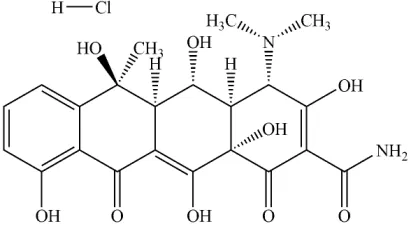
Large amounts of antibiotics are produced, consumed and applied to treat bacterial diseases in humans and animal [1]. The high consumption of antibiotics led to the increasing amount of their contamination to our environment. Antibiotics may enter our water stream from human and animal excretion in metabolized or unmetabolized form, and also subsequent discharge from hospital or other medical facilities [2]. These antibiotic contaminations have been detected in surface and ground water, drinking water, tap water, ocean water, sediments and soil [3-4]. Accumulation of antibiotics in the natural ecosystem could produce antibiotic-resistant bacteria within the bacteria host, modify the indigenous microbiota and also damage the internal organ of aquatic animal [5-7]. Based on their main structure, antibiotics may be classified as: β-lactams, Tetracyclines, Aminoglycosides, Quinolones, Macrolides, Glycopeptides, and Sulfonamides. Tetracyclines, Sulfonamides, Penicillin and Tylosin are the most widely used antibiotic in pig and poultry farm in Semenanjung area of Malaysia [8]. However, the most extensively used antibiotics in animal feeding operations are Tetracycline class, including food additive for systemic bacterial infections therapy in farmed fish, growth simulator in livestock and stress reduction in pig and poultry [8-12].Tetracycline, chlortetracycline, doxycycline and oxytetracycline are tetracycline group of antibiotics that widely used. Due to its consumption as well as it possible high amount of detection in our environment, detailed information on tetracycline group removal method are needed. Therefore, in this degradation study oxytetracycline (OTC) was chosen as the model contaminant of tetracycline group of antibiotics (Fig.1).
Fig.1. Chemical structure of OTC
Extremely resistant to biological degradation process is a distinct characteristic of antibiotics, hence the research have been directed towards the application of non-biological processes for their destruction, one of them is advanced oxidation processes (AOPs) [3]. AOPs are capable of transforming organic pollutant into non toxic substances which relies on the attack of highly reactive species on the organic pollutant, such as hydroxyl radicals (•OH) [3, 12]. The radical attack will be followed by series of degradations oxidation reaction of the organic compound and lead to the formation of CO2 and H2O as the final product. Oxytetracycline degradations have been
achieved by applying Fenton process, ozone process, UV photolysis, UV/H2O2 system, simulated
sunlight irradiation, photocatalytic using TiO2/zeolite, electrochemical oxidation, Mn-peroxidase
and γ-pulse irradiation [13-22].
In this paper, the kinetic of OTC degradation inside a UV/H2O2 system was studied by calculating
the reaction order and kinetic rate constant. These parameters are important to evaluate the system performance as well as the suitable operational parameter for OTC degradation.
Materials and Methodology
Materials. Oxytetracycline hydrochloride (Merck, Germany) was used as the source of organic contaminant. Hydrogen peroxide 30% (Merck, Germany) was used as the source of hydroxyl radical. Acetonitrile (Merck, Germany), Methanol (Merck, Germany) and Oxalic acid (Systerm, USA) were used as the mobile phase for the HPLC analysis.
Methods. The experiments were carried out inside a glass reactor (400 mL volume) which irradiated with low pressure UV lamp (8W, GPH295T5L; Serial no. EC90277, USA). During irradiation, the solution was magnetically stirred and cooled using water flows inside the reactor jacket. Antibiotic and H2O2 were added inside the reactor. To monitor the progress of degradation,
about 5 mL of liquid samples are drawn from the reactor at scheduled times. Initial pH was adjusted by adding drops of concentrated NaOH or H2SO4. For all these experiments, optimum pH and
temperature were then used. These optimum conditions were determined previously by using Box-Behnken experimental design with Response Surface Methodology [23]. Constant irradiation time (30 min) and H2O2 concentration (0.116 M) were employed for all the experiments. In this study,
about 250-500 ppm of OTC concentration was used.
OTC concentrations were measured using HPLC (Agilent 1100 Series) equipped with a Zorbax SB-C18 column (250mm x 4.5 mm, 5 µm) at 30oC. Mobile phase of 70% H
2C2O4 0.01M, 20%
Results and Discussion
The kinetic degradation of OTC was analyzed based on the assumption that the rate of reaction depend on OTC concentration only and hence the rate of OTC degradation expressed as :
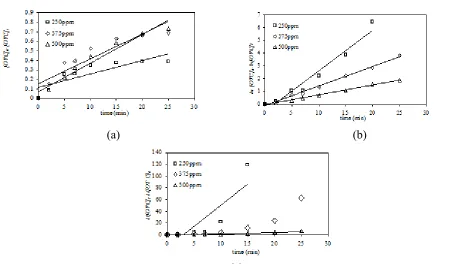
n (Eq. 2), first (Eq. 3) and second (Eq. 4) order of kinetic, following the equation as listed bellow:
t
Fig. 2 Plot of OTC degradation for (a) pseudo zero-th, (b) pseudo first and (c) pseudo second order
Table 1 Regression coefficient of fitted kinetic equation
[OTC] (ppm) Zero-th order First order Second order
250 0.735 0.959 0.719
375 0.840 0.995 0.764
500 0.954 0.997 0.939
In this present study, the experimental data were fitted accordingly based on the pseudo zero-th, first and second order of reaction respectively. The fitted plots of OTC degradation were shown in Fig.2. Table 1 the estimated correlation coefficients (R2) for all the fitted equation. The table indicates that the present OTC degradation data fits well with pseudo first order kinetics with higher R2 values (0.947-0.995) with the calculated k
This result is in accordance with previous results on the degradation of tetracycline groups, such as photolysis of tetracycline hydrochloride and photolysis and hydrolysis of OTC, which also follow the pseudo-first order kinetics [15-19, 21]. However, the ozonation and fenton treatment of OTC extracted from manure sample as well as UV/H2O2 process for 5 µM OTC followed the
pseudo-second order kinetics [9, 21].
The OTC degradation progress was monitored by observing the presence of OTC parent compound peak in the HPLC chromatogram. Then, it was followed by comparing the peak area of partially degraded OTC solution with the standard OTC solution. In this HPLC analysis, the detector used was the UV detector due to capability of OTC parent compound to have high UV absorbtivity at 355 nm. Hence minor structural modification such as the dissociation of hydrogen atom due to pH changes during the reaction will shift the wavelength of maximum absorbance in the UV region [23]. As it mentioned earlier, the initial pH for all experiments were 6.36. As shown by Fig. 3, after 10 min of irradiation, pH value was reduced nearly half of its initial value (pH = 3.8), which could be observed from reduction of OTC parent compound peak area. The total disappearance of OTC parent peak in the HPLC chromatogram was achieved only after 30 min of irradiation for all concentration range investigated. Shorter irradiation time was needed for total disappearance of OTC parent peak in the HPLC chromatogram compared to total organic carbon removal of OTC (180 min) [24].
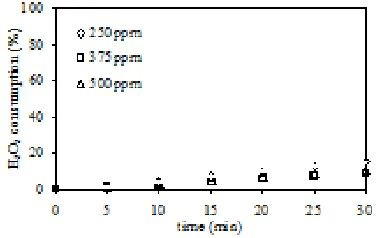
Fig. 3 pH profile of 250 ppm OTC degradation Fig. 4 H2O2 consumption profile
The pseudo order plot based on assumption that only OTC concentration will significantly affects the reaction kinetic. For all OTC concentration range, during 30 min of irradiation, low H2O2
consumptions were observed (Fig. 4), with insignificant difference between 250, 375, 500 ppm. Hence, during the first 30 min, the H2O2 concentration was considered constant and the chosen
pseudo first order of kinetic was deemed appropriate.
Conclusions
Kinetic study on the degradation of OTC inside a UV/H2O2 system was conducted. The
References
[1]. L. Dong, Y. Min, H. Jianying, Y. Zhang, H. Chang, F. Jin, Determination of penicillin G and its degradation products in a penicillin production wastewater treatment plant and the receiving river, Water Res., 42 (2008) 307-317.
[2]. W. Xu, G. Zhang, X. Li, S. Zou, P. Li, Z. Hu, J. Li, Occurrence and elimination of antibiotics at four sewage treatment plants in the Pearl River Delta (PRD), South China, Water Res., 41 (2007) 4526-4534.
[3]. M. Klavarioti, D. Mantzavinos, D. Kassinos, Removal of residual pharmaceuticals from aqueous systems by advanced oxidation processes, Environ. Int., 35 (2009) 402-417.
[4]. K. Kummere, Antibiotics in the aquatic environment, Chemosphere, 75 (2009) 417-434. [5]. J.L. Martinez, Environmental pollution by antibiotics and by antibiotic resistance
determinants, Environ. Poll.¸ 157 (2009) 2893-2902.
[6]. C. Garafalo, C. Viragnoli, G. Zandri, L. Aquilanti, D. Bordoni, A. Osimani, F. Clementi, F. Biavasco, Direct detection of antibiotics resistance genes in specimens of chicken and pork meat, Int. J. Food Microbiol, 113 (2007) 75-83.
[7]. A. Gulkowska, H.W. Leung, M.K. So, S. Taniyasu, N. Yamashita, Leo W.Y. Yeung, Bruce J. Richardson, A.P. Lei, J.P. Giesy, Paul K.S. Lam, Removal of antibiotics from wastewater by sewage treatment facilities in Hongkong and Shenzhen, China, Water Res., 42 (2008) 395-403.
[8]. Y. Wang, J. B. Liang, T.C. Loh, Y. W. Ho, “Use of Antibiotics in Pig and Poultry Farms in Malaysia”, in: Conference on Sustainable Animal Agriculture for Developing Countries, 2009, http://ibs.upm.edu.my/~saadc2009/slides/10-11-09-Corus1-1605-1620.pdf, retrieved on 20 January 2012
[9]. M. O. Uslu, I. A. Balcioglu, Comparison of the ozonation and fenton process performance for the treatment of antibiotic containing manure, Sci. Tot. Environ., 407 (2009) 3450-3458 [10].A. J. Bauger, J. Hensen, P. H. Krogh, Effects of antibiotics oxyteracycline and tylosin on soil
fauna, Chemosphere, 40 (2000) 751-757.
[11].Y. Wang, L. Wang, F. Li, J. Liang, Y. Li, J. Dai, T.C. Loh, Y.W. Ho, Effects of oxytetracycline and sulfachloropyridazine residues on the reductive activity of Shewanella decoloratis S12, J. Agric. Food Chem., 57 (2009) 878-5883.
[12].O. A. Arikan, C. Rice, E. Codling, Occurence of antibiotics and hormones in a major agricultural watershed, Desalination, 226 (2008) 21-133.
[13].I. R. Bautiz, R. F. P. Nogueira, Degradation of tetracycline by photo-Fenton process-Solar irradiation and matrix effect, J. Photochem. Photobiol. A, 187 (2007) 33-39.
[14].K. Li, A. Yediler, M. Yang, S. Schulte-Hostede, M. H. Wong, Ozonation of oxytetrcycline and toxicological assessment of its oxidation by-products, Chemosphere, 72 (2008) 472-478. [15].Y. Chen, C. Hu, J. Qu, M. Yang, Photodegradation of tetracycline and formation of reactive oxygen species in aqueous tetracycline under simulate sunglight irradiation, J. Photochem. Photobiol. A, 197 (2008) 81-87.
[16].J. Shaojun, Z. Shouron, Y. Daqiang, W. Lianhong, C. Liangyan, Aqueous oxytetracycline degradation and the toxicity change of degradation compounds in photoirradiation process, J. Environ. Sci., 20 (2008) 806-813.
[17].R. Xuan, L. Arisi, Q. Wang, S. R. Yates, K. C. Biswas, Hydrolysis and photolysis of oxytetracycline in aqueous solution, J. Environ. Sci. Health B, 45 (2010) 73-81.
[18].C. Zhao, H. Deng, Y. Li, Z. Liu, Photodegradation of oxytetracycline in aqueous by 5A and 13X loaded with TiO2 under UV irradiation, J. Hazard. Mater., 176 (2010) 884-892.
[20].S. Lin, W. Chen, C. Liu, Study on photochemical degradation of Oxytetracycline with UV-H2O2 process, in: 2nd Conference on Environmental Science and Information Application
Technology, (2010) 24-27, doi: 10.1109/ESIAT.2010.5568939.
[21].F. Yuan, C. Hu, X. Hu, D. Wei, Y. Chen, J. Qu, Photodegradation and toxicity changes of antibiotics in UV and UV/H2O2 process, J. Hazard. Mater., 185 (2011) 1256-1263.
[22].N. K. Shammas, L. K. Wang, Hazardous waste deep-well injection, In: L. K. Wang, N. K. Shammas, Y. T. Hung, Y. T., (Eds.), Handbook of Advanced Industrial and Hazardous Waste Treatment, CRC Press, Florida, 2009, pp. 407.
[23].K. A. Loftin, C. D. Adams, M. T. Meyer, and R. Surampalli, Effects of ionic strenght, temperature, and pH on degradation of selected antibiotics, J. Environ. Qual., 37 (2008) 378-386.
[24].A. U. Rahmah, S. Harimurti, A. A. Omar, T. Murugesan, Optimization of Oxytetracycline Mineralization using Box-Behnken Experimental Design inside a UV/H2O2 system, J. App.