AN ANALYSIS ON STUDENTS’ ERROR IN ENGLISH
WRITING
AT THE 9
thYEAR STUDENTS OF SMP ISLAM AL IKHLAS
CIPETE, JAKARTA SELATAN
A “Skripsi”
Presented to the Faculty of Tarbiyah and Teachers Training in Partial Fulfillment of the Requirement
for the Degree of S. Pd in English Language Education
By:
DIAJENG AYU KUSUMAWATI
NIM: 204014003204
DEPARTMENT OF ENGLISH EDUCATION
FACULTY OF TARBIYAH AND TEACHERS’ TRAINING
SYARIF HIDAYATULLAH STATE ISLAMIC UNIVERSITY
AN ANALYSIS ON STUDENTS’ ERROR IN ENGLISH
WRITING
AT THE 9
thYEAR STUDENTS OF SMP ISLAM AL IKHLAS
CIPETE, JAKARTA SELATAN
A “Skripsi”Presented for the Faculty of Tarbiyah and Teachers’ Training In Partial Fulfillment of the Requirements
for the degree of in English Language Education
by
DIAJENG AYU KUSUMAWATI
NIM: 204014003204
Approved by the Advisor
Dr. Didik Santoso, MPd.
NIP: 150 041 070
DEPARTMENT OF ENGLISH EDUCATION
FACULTY OF TARBIYAH AND TEACHERS’ TRAINING
SYARIF HIDAYATULLAH STATE ISLAMIC UNIVERSITY
ENDORSEMENT SHEET
The Examination Committee of the Faculty of Tarbiyah and Teachers’
Training certifies that the ‘Skripsi’ (Scientific Paper) entitled AN ANALYSIS
ON STUDENTS’ ERROR IN ENGLISH WRITING written by Diajeng Ayu
Kusumawati, student’s registration number 204014003204 was examined by the
Committee on June 30, 2009 and was declare to have passed and therefore,
fulfilled one of the requirements for the academic title of Bachelor of Arts in
English Language Education at the Department of English Education.
Jakarta July 6, 2009
Examination Committee
CHAIRMAN : Drs. Syauki, M.Pd (_________________)
NIP.19641212 1991 03 1 002
SECRETARY : Neneng Sunengsih, S.Pd (_________________) NIP.150.293.236
EXAMINER I : Drs. Syauki, M.Pd (_________________)
NIP.19641212 1991 03 1 002
EXAMINER II : Dra. Hidayati, M.Pd (_________________) NIP.19601027 1987 03 2 003
Acknowledged By
Dean of Tarbiyah and Teachers’ Training
ABSTRACT
AYU, DIAJENG KUSUMAWATI. 2009. An Analysis on Students’ Error in English Writing at the 9th Year Students of SMP Al-Ikhlas Cipete, Jakarta Selatan, Skripsi, English Education Department, Faculty of Tarbiyah and Teachers’ Training, UIN Syarif Hidayatullah Jakarta. Advisor: Dr. Didik Santoso, M.Pd
This study is aimed at analyzing the students’ error in English writing, it consist of (1) the kind of lexical errors are commonly made by the students, (2) the kind of grammatical errors are commonly made by the students
This purpose of the research are, (1) to investigate lexical errors that commonly made by the third year students of SMP Al-Ikhlas Cipete in writing, (2) to investigate what kind of grammatical errors are commonly made by the students of 9th grade of SMP Al- Ikhlas Cipete. Moreover, this research using descriptive qualitative design.
The findings of the research stated that the error of tenses (verb tense) are the most frequent of errors in which the ninth grade students at SMP Islam Al- Ikhlas Cipete committed with 163 items of errors. Moreover, it followed by errors of word choice with 56 items of errors, error of spelling are 46 items, error of add a word are 41 item, then, error in capitalization 41 items, followed by error in omit a word 33 items, word order are 17 items, error in plural-singular 11 items, in punctuation 7 items of error, error in word form 3 item, the last is zero in article, incomplete sentence, meaning not clear and run-on sentence.
ABSTRAK
AYU, DIAJENG KUSUMAWATI. 2009. Analisa Kesalahan Siswa dalam Penulisan Bahasa Inggris pada Tingkat 9 SMP Al Ikhlas Cipete, Jakarta Selatan. Skripsi, Pendidikan Bahasa Inggris, Fakultas Ilmu Tarbiyah dan Keguruan, UIN Syarif Hidayatullah Jakarta.
Pembimbing : Dr. Didik Santoso, M.Pd
Penelitian ini bertujuan untuk menganalisa kesalahan peserta didik dalam menulis bahasa Inggris yang terdiri dari 1) Kesalahan secara leksikal yang dibuat murid, 2) kesalahan gramatikal yang dibuat murid dalam penulisan bahasa Inggris.
Tujuan dari penelitian ini adalah 1) meneliti kesalahan leksikal yang sering di buat oleh siswa tingkat 9 SMP Islam Al Ikhlas Cipete, 2) meneliti kesalahan gramatikal yang sering di buat oleh siswa tingkat 9 SMP Islam Al Ikhlas Cipete. Penelitian ini meggunakan metode kualitatif deskriptif.
Dalam penelitian ini ditemukan bahwa tata bahasa adalah area yang paling banyak yang terjadi dalam penulisan bahasa Inggris SMP Islam Al Ikhlas Cipete dengan 163 kesalahan, diikuti oleh 56 kesalahan dalam pemilihan kata, 46 kesalahan dalam ejeen, 41 kesalahan dalam penambahan kata, 41 kesalahan dalam kapitalisasi, kemudian 33 kesalahan dalam pengurangan kata, 17 kesalahan dalam pemilihan kata, kesalahan dalam penggunaan kata benda jamak dan tunggal sebanyak 11 kesalahan, kesalahan pada tanda baca sebanyak 7 kesalahan, kesalahan dalam penggunaan bentuk kata sebanyak 3 kesalahan, dan tearkhir dalam penggunaan artikel, kalimat yang tidak sempurna, arti kalimat yang tidak jelas dan run-on sentence kesalahan tidak ditemukan.
ACKNOWLEDGEMENT
In the name of Allah the most gracious and the most merciful. All praises
be to Allah the lord of the worlds. Peace and blessing be upon to our prophet
Muhammad SAW, his family, his companion, and his followers.
First of all, the writer would like to express her great honor to Dr. Didik
Santoso, M.Pd as the advisor who has guided her in writing this “skripsi”. Her
beloved mother (Yuliatun), father (Kusmin), sister (Utami Dewi Kusumaningsih),
brothers ( Unggul &Tito), Ustadz RAM who have supported her so much. May
Allah bless all of you.
Her Gratitude also goes to :
1. All lectures of English Education Department who has educated her during
her study at UIN Jakarta.
2. Drs. Syauki, M.Pd., as the Head of English Education Department.
3. Prof. Dr. Dede Rosyada, MA., as the Dean of Faculty of Tarbiyah and
Teachers’ Training.
4. Drs. Prasetyo., as the principal of SMP AL Ikhlas Cipete who has allowed
her to do the research in his school.
5. All of the teachers and staff administration of SMP AL Ikhlas Cipete and
SMK YANUSA, Pondok Pinang.
6. Her friends such as De Zifa, Ikah, Syifa, Santi and the others who have
given the spirit. Friendship will never end.
7. Ka Ozzy, Neneng, Dwi, Bang Ade, Mba Rini who have given the support.
Thank you for the togetherness in tears, fun and happiness.
And finally the writer realizes that this skripsi is not perfect yet. Therefore,
the writer would like to accept some suggestion to make this skripsi better.
Jakarta, July 2009
TABLE OF CONTENTS
ABSTRACT... i
ACKNOWLEDGEMENT... ii
TABLE OF CONTENS ... iii
LIST OF TABLE... v
CHAPTER I Introduction A. Background of the Study ... 1
B. Identification of the Problem ... 3
C. Limitation of the Problem ... 3
D. Formulation of the Problems ... 3
E. Objectives of the Study ... 3
F. Significance of the problem ... 4
CHAPTER II Theoretical Framework A....Error Analysis ... 5
B...Engli sh Writing ... 15
CHAPTER III Research Methodology A....Rese arch Design ... 22
B...Time and Location of Research ... 22
C....Subje ct of the research ... 22
D....Instru ment of research ... 23
F....Tech nique of data Analysis ... 23
CHAPTER IV Research Findings
A....Findi ngs ... 25
B....Inter pretation of the Data ... 50
C....Discu ssion ... 59
CHAPTER V Conclusion and Suggestion
A....Conc lusion ... 60
B....Sugg estion ... 61
BIBLIOGRAPHY... 62
LIST OF TABLES
Table 2.1 Three Ways Classification of Errors...8
Table 2.2 Differences in spelling between British English and American English ...18
Table 2.3 Summary of Punctuation Marks...20
Table 4.1 Errors of student 1...25
Table 4.2 Errors of student 2...26
Table 4.3 Errors of student 3...27
Table 4.4 Errors of student 4 ...28
Table 4.5 Errors of student 5 ...28
Table 4.6 Errors of student 6 ...29
Table 4.7 Errors of student 7 ...29
Table 4.8 Errors of student 8 ...30
Table 4.9 Errors of student 9 ...32
Table 4.10 Errors of student 10 ...32
Table 4.11 Errors of student 11 ...34
Table 4.12 Errors of student 12 ...34
Table 4.13 Errors of student 13 ...36
Table 4.14 Errors of student 14 ...37
Table 4.15 Errors of student 15 ...37
Table 4.16 Errors of student 16 ...38
Table 4.17 Errors of student 17 ...39
Table 4.18 Errors of student 18 ...40
Table 4.19 Errors of student 19 ...41
Table 4.20 Errors of student 20 ...42
Table 4.21 Errors of student 21 ...43
Table 4.22 Errors of student 22 ...44
Table 4.23 Errors of student 23 ...44
Table 4.24 Errors of student 24 ...45
Table 4.25 Errors of student 25 ...46
Table 4.26 Errors of student 26 ...47
Table 4.27 Errors of student 27 ...48
CHAPTER I
INTRODUCTION
This chapter presents and discusses the background of the study,
identification of the problem, limitation of the problem, formulation of the
problem, objectives of the study, and significance of the problem.
A. Background of the Study
English has been the most important foreign language in Indonesia.
Instead of other foreign languages that have been taught in Indonesia, English has
been the most popular choice. Moreover, it has a significant role in the various
fields, especially in technology, communication, politics, economy, education,
health, etc.
Furthermore, English has been an important language in our life, it has
important role. English is compulsory subject for students of junior high school
until university level. Therefore, students should be able to master English at least
in four skill areas; Listening, Speaking, Reading Writing, by mastering those four
skills, English can be a means to develop the students’ knowledge, technology,
and culture.
Writing is as one of the basic skills which has a vital part in language
teaching and students’ achievement. The focus of writing is started to arrange the
simple sentence which is connected with conjunction to set the coherent idea from
the sentence to another. Those sentences are arranged logically to be united and
cohesive.
The study of a good basic writing can be measured from the structure or
grammar of student. The result of writing is determined with the number of
frequency of writing exercises. If the frequency of writing exercise is frequently
carried out, certainly the student’s writing skill will be excellent. If writing
exercise is rare, writing skill will not be developed yet.
Writing knowledge and exercise in Junior High School students must be
grammatically accepted or not. The research is intended to give the teacher input
how to teach a good writing. The students are object of the research and teachers
are as the facilitator in teaching learning process.
The knowledge of grammar is very important to express what we would to
say and interpret correctly, not only the basic meaning that someone said but also
to force the utterance of piece of writing. Grammar keeps important role in
writing. However, the students’ ability in writing is still low. This can be proved
that they still make mistakes and errors in writing English such as using
appropriate structure, plural-singular and other.
Therefore, the writer is interested in identifying some students’ errors in
English writing by analyzing students composition of writing, so the writer will
identify, describe and explain what kind of errors are commonly made by the
students in English writing.
According to Corder (1967:167) in Brown stated that ”A learner’s errors
….. are significant in (that) they provide to the researcher evidence of how
language is learned or acquired, what strategies or procedures the learner is
employing in the discovery of the language.”1
Based on the background of study above, the writer is interested in
analyzing the grammatical error in writing which focuses on several areas, Lexical
error and grammatical error. whereas the title of this “skripsi” is “AN
ANALYSIS ON STUDENTS’ ERROR IN ENGLISH WRITING AT THE 9th
YEAR STUDENTS OF SMP ISLAM AL-IKHLAS CIPETE, JAKARTA
SELATAN”.
1
H. Douglas Brown, Principle of Language and Teaching, ( San Francisco : Prentice
B. Identification of the Problem
Referring to background of problem above, there are many problems that
can be identified among others: 1) the difficulties in arranging united and cohesive
sentences 2) using appropriate structure 3) choosing words and conjunctions to
make a coherent sentence and etc., therefore, the writer would like to limit only on
lexical and grammatical errors, the writer would like to analyze them as follows:
a) What kind of mistakes do the students have?, b) How many mistakes do they
have?, c) How to change all the mistakes into the right one?
C. Limitation of the Problem
To avoid misunderstanding and clarify the problems, it is important to set
some limitation of the problems. The writer will limit the problem of the
discussion on the analysis of the students’ errors in writing consist of lexical
errors and grammatical errors. Lexical errors consist of word form and the use of
singular and plural noun.
D.Formulation of the Problem
Based on the background of the study describe above, the writer is
interested in analyzing the error made by the students. The writer would like to
formulate the problem as follow:
1.What kind of lexical errors are commonly made by the students?
2.What kind of grammatical errors are commonly made by the students?
E. The objective of the study in this research are:
Inline with formulation of the problem stated above, the objectives of this
study are as follow :
1. To investigate lexical errors that commonly made by the ninth year students
of SMP Islam Al-Ikhlas Cipete in their English writing.
2. To investigate grammatical errors that commonly made by the ninth year
E.Significance of the Problem
The significances of this research are classified into : a) theory and b) practical
1. Theory
To give information about error analysis that always happen in students’
English writing, also as enrichment for teacher to adopt the concept and
theory.
2. Practical (students, teacher, headmaster)
To deliver useful information for teacher and other researchers who are
interested in analyzing error in writing, in order to lead them to further
research on the same field of study in different aspect. Moreover, students
CHAPTER II
THEORETICAL FRAMEWORK
This chapter presents and discusses about the theoretical framework which
is consist of: Error analysis and English Writing
A. ERROR ANALYSIS
Learning a foreign language is different from learning one’s mother
tongue. Therefore, learners in the teaching learning process often made errors and
it is not only inevitable but also a necessary part of the language learning process.
As the learner of a foreign language, errors can’t be avoided even the most
intelligent, conscientious and motivated students do some errors and sometimes
the native speakers also. The errors made by students indicated that they are in the
process of learning.
What is error? Dullay stated error as “The flawed side of learner speech of
writing. They are those part of conversation or composition that deviate from
some selected norm of mature language performance”2. H. Douglas Brown
defines error as “a noticeable deviation from the adult grammar of a native
speaker, reflects the competence of the learner.”3 It means that an error that
reveals a portion of the learners’ competence.
Errors give the important proof for the process of language learning and
also information for the teachers about the students’ ability. S.P Corder says:
“A learner’s error, then, provided evidence of the system of the language
that he is using (i.e. has learnt) at a particular point in the course (and it must be
repeated that he is using some system, although it is not yet the right system).”4
2
Heidy Dulay,et al, language Two(New york: Oxford University Press, p.138
3
Douglas Brown, Principle of Language Learning and Teaching (New Jersey:
Prentice hall, Inc,1987) p. 205. 4
S.P Corder, Error Analysis and Interlanguage, (New York: Oxford University
Errors made by the students do not mean a failure or in adequacy but they
can be viewed as important evidence of strategies or procedure employed by the
learner in learning a second language. They are also significant to the teacher and
the learner himself. As S.Pit Corder stated in Ellis:
“ They are (errors) significant in three ways : (1) they provide the teacher
with information about how much the learner had learnt; (2) they provide the
researcher with evidence of how language was learnt; and (3) They served as
device by which the learner discovered the rules of the target language”5.
From the statements above it can be seen that error is common and natural
thing made by the student in leaning foreign language process.
Error analysis is part of the methodology of psycholinguistic investigation
of language learning6. Thus, Error analysis is significant in developing student’s
competence. Moreover Brown wrote: the fact that learners do make errors, and
that these error can be observed, analyzed, and classified to reveal something of
the system operation within the learner, led to a surge of study of learner’s errors,
called error analysis7.
Corder, who has contributed enormously to EA, writes thus:
"The study of error is part of the investigation of the process of language learning. In this respect it resembles methodologically the study of the acquisition of the mother tongue. It provides us with a picture of the linguistic development of a learner and may give us indications as to the learning process." (Corder, 1974: 125)
Based on the definitions previously, it can be concluded that error analysis
is an investigation methodology in language learning for analyzing, observing,
and classifying learner’s error to give us indication in learning process.
Every learner has a different type of making errors, but the most common
errors that the learner made are:
5
Rod Ellis, The Study of Language Acquisition, ( New York : Oxford University Press,
1994), p. 48 6
S.P Corder, Error Analysis and Interlanguage, (New York: Oxford University Press,
1981,p.45 7
Brown, Principle of Language Learning and Teaching (New Jersey: Prentice hall,
a. Omitting grammatical morphemes, which are items that do not contribute much to the meaning of sentences as in He hit car. b. Double marking a semantic feature (e.g past tense) when only one
marker is required, as in she didn’t went back. c. Regularizingrules, as in womans for women.
d. Using archforms - one from in place of several- such as the use of her for both she and her, as in I see her yesterday. Her dance with my brother.
e. Using two or more forms in random alternation even though the language requires the use of each only under certain conditions, as in random use of he and she regardless of the gender of the person of interest.
f. Misordering items in constructions that require a reversal of word-order rules that had been previously acquired, as in What you are doing?, or misplacing items that may be correctly placed in more than one placed in the sentence, as in they are all the time late.8
Meanwhile, S. Pit Corder proposed a three-way classification of errors,
based on the students’ ability to correct the errors and to explain them, they are:
1. The post-systematic errors, that is, those mistakes that the students are able to correct and explain when the attention is drawn to them
2. The systematic errors, that is, those mistakes that the students cannot immediately correct but for which they can provide the explanation once the problem is point out.
3. The pre-systematic error, that is, those that the students cannot correct event explain9
From Corder’s three-way classification of errors above, it can be included
that the post systematic errors are less serious pedagogically than the systematic
errors. And post-systematic and systematic errors are present less of pedagogical
problem than the pre-systematic errors. It is presented below:
8
Heidy Dulay,et al, language Two (New york: Oxford University Press p.138-139
9
Rebecca M. Valette, Modern Language Testing(2nd edition),(Boston: Harcourt Brace
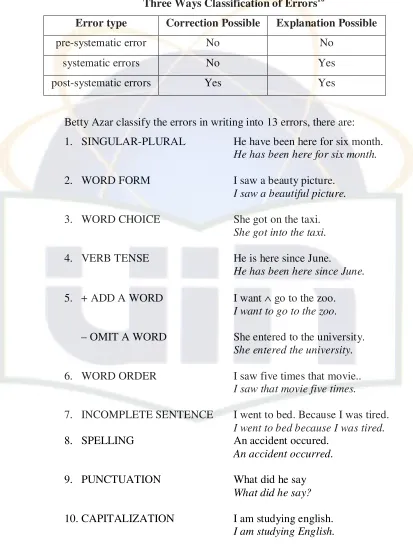
Table 2.1
Three Ways Classification of Errors10
Error type Correction Possible Explanation Possible
pre-systematic error No No
systematic errors No Yes
post-systematic errors Yes Yes
Betty Azar classify the errors in writing into 13 errors, there are:
1. SINGULAR-PLURAL He have been here for six month.
He has been here for six month.
2. WORD FORM I saw a beauty picture.
I saw a beautiful picture.
3. WORD CHOICE She got on the taxi.
She got into the taxi.
4. VERB TENSE He is here since June.
He has been here since June.
5. + ADD A WORD I want ∧ go to the zoo.
I want to go to the zoo.
– OMIT A WORD She entered to the university.
She entered the university.
6. WORD ORDER I saw five times that movie..
I saw that movie five times.
7. INCOMPLETE SENTENCE I went to bed. Because I was tired. I went to bed because I was tired.
8. SPELLING An accident occured.
An accident occurred.
9. PUNCTUATION What did he say
What did he say?
10. CAPITALIZATION I am studying english.
I am studying English.
10
11. ARTICLE I had a accident.
I had an accident
12. MEANING NOT CLEAR He borrowed some smoke.
( ? ? ?)
13. RUN-ON SENTENCE My roommate was sleeping, we
didn’t want to wake up her
My roommate was sleeping. We didn’t want to wake up her11
In error analysis, there are some steps that the researchers must follow.
Those are:
a. Collection of data (either from a ‘free’ composition by students on a given
theme or from examination answers).
b. Identification of errors (labeling, with varying degrees of precision
depending on the linguistic sophistication brought to bear on the task, with
respect to the exact nature of the deviation, e.g. Dangling preposition,
anomalous sequence of tenses, etc).
c. Classification into error types (e.g. Errors of agreement, articles, verb
forms, etc.
d. Statement of relative frequency of error types.
e. Identification of the areas of difficulty in the target language.
f. Therapy (remedial drills, lesson, etc).
In this study, the writer just identify the errors and then For the sake
identification up to point e are needed. 12
Corder (1974) suggests the following steps in Error Analysis research :
1.Collection of a sample of learner language 2.Identification of errors
3.Description of errors 4.Explanation of errors 5.Evaluation of errors
11
Betty Schramfer Azar, Understanding and Using English Grammar, (Prentice-Hall
inc) 1989, p. A29-A30 12
Sn. Sridhar in Jacek Fisiak, Contrastive Linguistic and the Language Teacher, (Oxford
Meanwhile, Gass and Selinker stated that a great deal of the work on
error analysis was carried out within the context of the classroom. The goal was
clearly one of pedafogical remediation, there are a number of steps taken in
conducting an error analysis.
1. Data need to be collected. Although this typically done with written data, oral data can also serve as a base
2. Identify errors. What is the error (e.g) Incorrect sequence of tenses, wrong verb form, singular verb form with plural subject).
3. Classifying errors. Is it an error of agreement? Is it an error in irregular verbs?
4. Quantify errors. How many errors of agreement occur? How many irregular verb form errors occur?
5. Analysis of source.
6. Remediation. Based on the kind and frequency of an error type, pedagogical intervention is carried out
13
Analyzing of students’ error, it has some goals why someone conducted it.
According to S.N Sridhar:
The goals of traditional error analysis were purely pragmatic error analysis was conceived and performed for its ‘feedback’ value in designing pedagogical materials and strategies. It was believed that error analysis by identifying the areas of difficulty or the learners, could help in (i)determining the sequence of presentation of target items in textbook and classroom with the difficult items following the easier ones; (iii) deciding the relative degree of emphasis, explanation and practice required in putting across various items in the target language; (iii) devising remedial lessons and exercises; and finally, (iv) selecting items for testing the learner’s proficiency. The ‘applied’ emphasis in this approach to error is obvious.14
13
Susan M,Gass and Larry Selinker, Second Language Acquisition, (Mahwah, New
jersey : Lawrence Erlbaum Associates, Publisher 2001, p.79 14
Jacek Fisiak, Contrastive Linguistic and the Language Teacher, (oxford :Pergamon
Dullay says that the purposes of studying learners’ error are: (1) it
provides data from which inferences about the nature of the language learning
process can be made. (2) it indicates to teacher and curriculum developers which
part of the target language students have difficulty to communicate effectively.15
The last step in the process of analyzing the learner’s error is
determining the source of error .Brown proposed the source of error, they are:
The last step in the process of analyzing the learner’s error is determining the
source of error .Brown proposed the source of error, they are:
a. Interlingual Transfer
Interlingual transfer is a significant source of error for all learners.
The beginning stages of learning a second language are especially
vunerable to interlingual transfer from the native language, or
interference. In these early stages, before the system of second
language is familiar, the native language is the only previous
linguistic system upon which the learner can draw.
b. Intralingual Transfer
Intralingual transfer (within learning a second language) ia a major
factor in second language learning. Researchers have found that the
early stages of language learning are characterized by a
predominance of interference (interlingual transfer), but once
learner have begun to acquire parts of the new system, more and
more intralingual transfer- generalization within the target
language - is manifested. As learners progress in the second
language, their previous experience and their existing
Context of Learning
In a classroom context, the teacher or textbook can lead the learner
to make faulty hypothesis about the language. Students often make
errors because of misleading explanation of the teacher, faulty
presentation of a structure or word in a textbook, or even because
15
of a pattern that was rottenly memorized in a drill but improperly
contextualized.
c. Communication Strategies
Communications strategies were defined are related to learning
style. Learners obviously use production strategies in order to
enhance getting their messages across, but at times these
techniques can make themselves become a source of error.
While, Jack C. Richard (in Richard 1974) proposed the source of
error differently – such as overgeneralization, ignorance of rule
restrictions, incomplete application of rules, false concepts
hypothesized. However, he claimed that all the source of errors is
connected with learning strategies and teaching material- may lead
us to examine our teaching materials for evidence for the language
learning assumptions that underlie them.
Error happened because of some causes. In order to prevent the students in
making some errors, we can investigate the causes. Pit Corder says that there are
three major causes of errors. Those are mother tongue interference,
overgeneralizations and errors encouraged by teaching material or method.
a. Mother tongue interference
Although young children appear to be able to learn a foreign language
quite easily and to reproduce new sounds very effectively, older
learners experience considerable difficulty. The sound system
(phonology) and the grammar of the first language impose themselves
on the new language and this leads to a ‘foreign’ pronunciation, faulty
grammatical patterns and occasionally, to the wrong choice of
vocabulary.
b. Overgeneralization
Errors are inevitable because they reflect various stages in the
language development of the learner. It claims that the learner
processes new language data in his mind and produces rules for its
c. Errors encouraged by teaching material or method
Errors appear to be induced by the teaching process itself that it has
any positive contribution to make to the learning of any skill. Error is
evidence of failure, of ineffective teaching or lack of control. If
material is well chosen, graded and teaching presented with meticulous
care.
There should never be any error. It is fairly easy to accept this in the
early stages of language learning when controls are applied in the
shape of substitution tables, conversion exercises of a mechanical
nature and guided sentence patterns, but more difficult at later stages.
However, it might be salutary for us to bear in mind the possibility of
some of our students’ error being due to our own teaching.
Unfortunately, these errors are much more difficult to classify.16
Learners of foreign language made errors or mistakes. Mistakes must be
distinguished from errors because both of them are different. It is really important
to know the distinctions between them because some teachers don’t know the
differences between errors and mistakes. It will be useful to distinguish between
error and mistakes.
Jacek Fisiak distinguished between error and mistake as follows:
“Mistakes are deviations due to performance factors such as memory limitations
(e.g. mistakes in the sequence of tenses and agreement in long sentences), spelling
pronunciations, fatigue, emotional strain, etc. Errors, on the other hand, are
systematic consistent deviances characteristic of the learner’s linguistic system a
given stage of learning.17
Furthermore, H. Douglas brown explains that;
A mistake refers to performance error that is either a random guess or a “slip” in that it is a failure to utilize a known system correctly. All people make mistakes, in both native and second language situation. While error
16
Peter Hubbard, et al., A Training Course for TEFL, (New York: Oxford University
Press, 1983), p. 140-143. 17
Jacek Fisiak, Constructive Linguistics and the Language Teacher, (New York:
is a noticeable deviation from the adult grammar of a native speaker, reflects the competence of the learner and an error that reveals of a portion of the learner’s competence in the target language.18
In line with Douglas explanation above, John Norrish stated that;
Error is a systematic deviation, when a learner has not learnt something and consistently ‘gets it wrong’. As mentioned above, a child acquiring his own language sometimes consistently makes the same error. In the same way, when a learner of English as second of foreign language makes an error systematically, it happened because he has not learnt the correct form. Meanwhile, mistake is the inconsistent deviation. Sometimes the learners ‘get it right’ but sometimes he makes a mistake and uses the wrong from.19
Corder made a distinction between a mistake and an error. Whereas a
mistake is a random performance slip caused by fatigue, excitement, etc., and
therefore can be readily self-corrected, an error is systematic deviation made by
learners who have not yet mastered the rules of the L2. A learner cannot
self-corrected an error because it is a product reflective of his or her current stage of
L2 development, or underlying competence.20
James says as quoted from H. Douglas Brown that an error cannot be
self-corrected, while mistakes can be self corrected if the deviation is pointed out to
the speaker. The learner’s capacity for self-correction is objectively observable
only if the learner actually self corrects.21
From the explanation above the writer concludes that error is deviations
made by the learners systematically and consistently which showed the language
18
Brown, Principle of Language Learning and Teaching (New Jersey: Prentice hall,
Inc,1987), p. 205.. 19
John Norrish, Language Learners and Their Errors, (London: The Macmillan Press
Limited, 1983), p. 7-8. 20
Diane Larsen-Freemen and Michael H. Long, An Introduction to Second Language
Acquisition Research, (England : Longman,1991), p.59 21
Brown, Principle of Language Learning and Teaching (New Jersey: Prentice hall,
competence of learners. Meanwhile, the mistake is deviations made by learners
unsystematically and it happened just in the performance.
B. ENGLISH WRITING
People learn a foreign language to communicate with others, to understand
them, to talk to them, to read what they have written and write to them. In writing,
people learn how to communicate when the other person is not around them,
listening to the words they said, and looking at the gesture and facial expressions.
Writing is the language used to express and to communicate with others. It
must be difficult without practicing regularly. Writing is very complex and
difficult to teach. As J.B Heaton stated that:
“The writing skills are complex and sometimes difficult to teach, requiring
mastery not only of grammatical and rhetorical devices but also conceptual and
judgment element”22. Meanwhile Kent stated in his book : “ Writing is expression
and that successful expression is dependent upon the continuity and clarity of the
thought23
Writing is much more than an orthographic symbolization of speech to
writing curriculum devices exercise, while necessitate intense concentration”24
Based on three definitions above writing is the act for expressing the idea
by words that is very complex and difficult because it required thinking and some
aspects to be integrated.
English is known as lingua franca25 that means “vehicular language”.
Vehicular language is a language goes beyond the boundaries of it original
22
J.B Heaton, Writing English Language Test: Longman Hanbook for Language Teacher (New York: Longman: 1975)P.135
23
Sherman Kent, Writing History, (New Yorkc:Appleton Century Crofts, 1941) second
edition,p.56 24
Allen and Campbell, Teaching English as A Second Language,(New Delhi: Mc Graw
Hill,1979)p.200 25
Jeremy Harmer, The practice of English Language Teaching third edition, (Cambridge:
community and used as a second language for communication between
communities. The opposite meaning of vehicular language is “vernacular
language” means a language used as native language in a single community.
Further English is commonly learnt by people from around the world that it can be
considered as both vehicular and vernacular language. As English called as
vehicular and vernacular language, it is easy to understand the reason why English
become a dominant international language in present communication, science,
business, aviation, entertainment, radio and diplomacy, the growing economic and
culture influence of united state after world war II also become a factor which has
significantly accelerated the spread of English. Therefore, it can be a reason why
today English is being taught to over one billion people throughout the world as
their second language to make communication each other. The importance of
learning English for the purpose described above is closely related to the
methodology of its teaching which plays an important role to stimulate students
learning English. Methodology in English teaching also becomes a media for
teacher to investigate proper ways in activating and energizing student’s
behaviour that channelled toward learning English.
Brumfit defined English as an International language in that It is the most
widespread medium of international communication both because of the number
and the geographical spread of its speakers, and because of the large of number of
non native speakers who use it for part at least of their international contact26. It
requires at least three conditions to learn the letter:
a. There must be extensive exposure (some would say system exposure)
to the target language.
b. There must be extensive opportunity use the language so far acquired
as creatively as possible through reading, writing, conversation,
listening activities whichever are most appropriate to particular
learners.
c. Students must be motivated to benefit from (a), (b).
26
C.J. Brumfit. English for International Communication, (England : Pergamon Press
From the three definitions above we can say that English is foreign
language that is learned by the student of junior high school, senior high school,
and university.
British and American English Spelling
Writing is a complex process even in the first language. It is even more
complicated to write in a foreign language. Many studies indicate that, for
beginning EFL students, there tends to be interference from their first language in
the process of writing in English. A better understanding of the L1 influence in
the process of EFL writing will help teachers know students' difficulties in
learning English. It will also aid in the adoption of appropriate teaching strategies
to help beginning EFL students learning English.
Writing (and therefore spelling) is a representation of the spoken word.
The spoken word is not a representation of writing. Because accents and
pronunciation can change easily and quite quickly, whereas what is written in
books and dictionaries remains "fixed" for years, as well as for various historical
reasons, there is often little correspondence between spoken English
(pronunciation) and written English (spelling). English spelling therefore often
appears to be totally illogical. The following rules can help you to decode the
mysteries of English spelling, but remember, even the best rules have their
exceptions.
• Adding -er/-est
quick, quicker, quickest, happy, happier, happiest, hot, hotter, hottest...
• Adding -ing/-ed
work, working, worked, stop, stopping, stopped...
• Adding -ly
loud, loudly, happy, happily, terrible, terribly...
• Adding -s
• -ible or -able
accessible, visible, dependable, networkable...
• -ie- or
-ei-friend, fiend, feint, freight...
British English and American English
colour, color, practise, practice, tyre, tire...
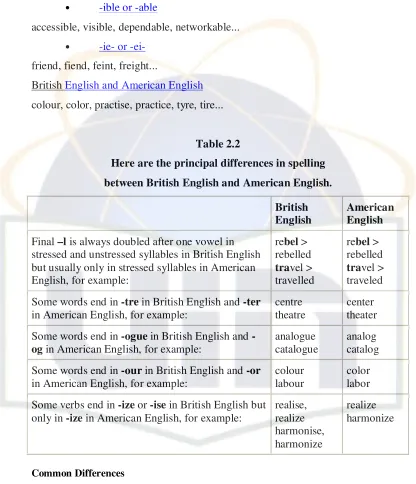
Table 2.2
Here are the principal differences in spelling
between British English and American English.
British English
American English
Final –l is always doubled after one vowel in stressed and unstressed syllables in British English but usually only in stressed syllables in American English, for example:
Some words end in -tre in British English and -ter in American English, for example:
centre theatre
center theater
Some words end in -ogue in British English and -og in American English, for example:
analogue catalogue
analog catalog
Some words end in -our in British English and -or in American English, for example:
colour labour
color labor
Some verbs end in -ize or -ise in British English but only in -ize in American English, for example:
realise,
British English American English
all right all right, alright (disputed)
Analyse Analyze
Centre Center
Cheque Check
Colour color
Counselor Counselor
criticise, criticize Criticize
Defence Defense
Doughnut Donut
Favour Favor
Fibre Fiber
Flavor Flavor
Fulfil Fulfill
Grey gray
Honour honor
Humour humor
Jewellery jewellery, jewelry
judgement, judgment judgment
Kerb curb
Labour labor
license, licence (verb) licence (noun)
license (verb) license (noun)
Litre liter
Metre meter
Mould mold
Neighbour neighbor
Offence offense
practise (verb) practice (noun)
practice (verb) practice (noun)
Pretence pretense
Programme program
Pyjamas pajamas
realise, realize realize
Savour savor
Theatre theater
travelled traveling
travelled, traveled travelling, traveling
Tyre tire
Valour valor
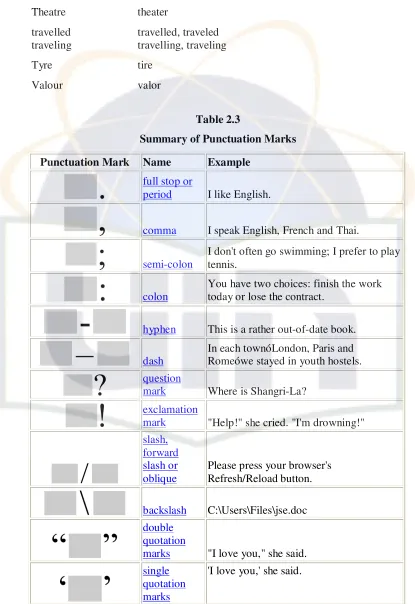
Table 2.3
Summary of Punctuation Marks
Punctuation Mark Name Example
full stop or
period I like English.
comma I speak English, French and Thai.
semi-colon
I don't often go swimming; I prefer to play tennis.
colon
You have two choices: finish the work today or lose the contract.
hyphen This is a rather out-of-date book.
dash
In each townóLondon, Paris and Romeówe stayed in youth hostels.
question
mark Where is Shangri-La?
exclamation
mark "Help!" she cried. "I'm drowning!"
slash, forward slash or oblique
Please press your browser's Refresh/Reload button.
backslash C:\Users\Files\jse.doc
double quotation
marks "I love you," she said.
single quotation marks
'I love you,' she said.
apostrophe This is John's car.
Underline Have you read War and Peace?
Underscore [email protected]
round brackets
I went to Bangkok (my favorite city) and stayed there for two weeks.
Square brackets
The newspaper reported that the hostages [most of them French] had been released. Curly
brackets or braces
{ b := a + 1 RESULTIS b }
Ellipsis
One happy customer wrote: "This is the best program...that I have ever seen."
From explanation above we can conclude that English writing is act or art
of forming letters and characters that is very complex and difficult because
requiring mastery not only of grammatical and rhetorical devices but also
CHAPTER III
RESEARCH METHODOLOGY
This chapter presents the research methodology used in this study. It
comprises of the research design, method of study, time and location of the
research, subject of the research, instrument of research, technique of data
collecting, and technique of data analysis.
A. Research Design
In writing this paper, the writer uses descriptive qualitative design and
uses procedural of error analysis itself, the data for materials are collected from
library research and field research. Many books have been read to support the
library research, while correlate with the ideas, theories and views in the
discussion in order to observe them as a source information.
Field research, the data is collected from the interview the teacher of
English subject and observation in one class only, and to obtain the data, the
writer takes data from writing composition assignment that collected from the
students.
B. Time and Location of the Research
This research was carried out from September 18,2008. Before collecting
data, the writer observed the class of the 9th year students of SMP Islam Al-Ikhlas
Cipete ,Jakarta Selatan, and to get real data the writer collected the composition in
writing assignment, after data collected the writer began to analyze them.
C. Subject of the Research
In this research, the writer took the population from the 9th year students
of SMP Islam Al-Ikhlas Cipete ,Jakarta Selatan Academic Year 2008/2009. The
whole population of the third year class is about 118 regular students, which is
The write chose 3A class consisting of 30 students. Then, the sample is 27
students, because 3 students did not attend the class.
D. Instrument of Research
To collect the data of this research, the writer gives the handout of writing
to the 9th year students of SMP Islam Al-Ikhlas. The students are asked to write
English composition of writing in a piece of paper under certain topic, so that the
result has similarity but also the different case of error.
E. Technique of Data Collecting
The techniques of collecting data used in research are:
a. Documentation
This instrument is needed to obtain the data from English teacher such as
students’ names and students’ English scores.
b. Test
The test consist of 6 items that should be answered by the students in
English writing, the material of writing is based on English syllabus for 9th year
student of Junior high school. The form of the test can be seen in the appendixes.
F. Technique of Data Analysis
To find out what kind of errors that commonly made by the 9th year
students of SMP Islam Al-Ikhlas Cipete in writing?, The writer uses some steps
there are:
1. First, the writer had a meeting with the headmaster
2. Second, getting some information from the English teacher such as the
ability of the student’s writing skill, the material have been given and
English lesson schedule
3. Preparing writing task and arranging the time for doing the writing
task
4. Doing the task in the classroom, the students make short composition
5. Collecting the data, the writer asks the students to make English
composition about their unforgettable experience in a piece of paper
given (see appendixes).
6. Identification of error by classifying the errors using Betty Azhar’s
categories of errors.
7. Description of error
8. Explanation of Error, the writer give the explanation about the error
categories and explain the number of error that student made in their
writing compositions
CHAPTER IV
RESEARCH FINDINGS
This chapter presents and discusses about research findings which is
consist of: Analysis of the data, description of the data and interpretation of the
data.
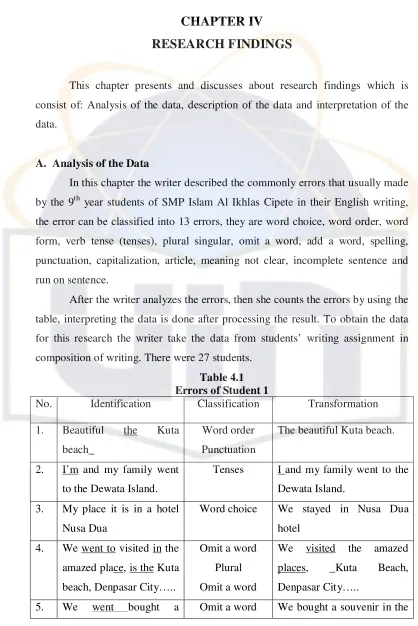
A. Analysis of the Data
In this chapter the writer described the commonly errors that usually made
by the 9th year students of SMP Islam Al Ikhlas Cipete in their English writing,
the error can be classified into 13 errors, they are word choice, word order, word
form, verb tense (tenses), plural singular, omit a word, add a word, spelling,
punctuation, capitalization, article, meaning not clear, incomplete sentence and
run on sentence.
After the writer analyzes the errors, then she counts the errors by using the
table, interpreting the data is done after processing the result. To obtain the data
for this research the writer take the data from students’ writing assignment in
composition of writing. There were 27 students.
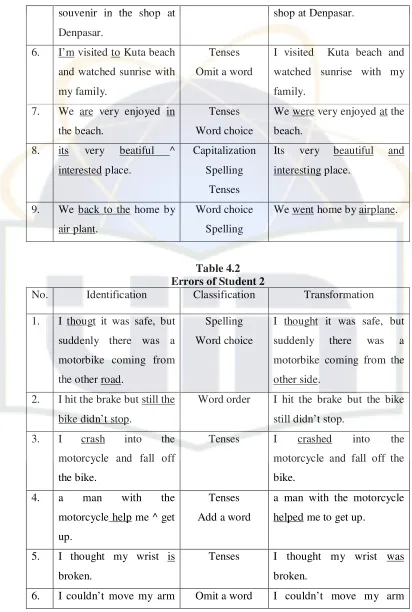
Table 4.1 Errors of Student 1
No. Identification Classification Transformation
1. Beautiful the Kuta
beach_
Word order
Punctuation
The beautiful Kuta beach.
2. I’m and my family went
to the Dewata Island.
Tenses I and my family went to the
Dewata Island.
3. My place it is in a hotel
Nusa Dua
Word choice We stayed in Nusa Dua
hotel
4. We went to visited in the
amazed place, is the Kuta
beach, Denpasar City…..
Omit a word
Plural
Omit a word
We visited the amazed
places, _Kuta Beach,
Denpasar City…..
5. We went bought a Omit a word We bought a souvenir in the
souvenir in the shop at
Denpasar.
shop at Denpasar.
6. I’m visited to Kuta beach
and watched sunrise with
my family.
We were very enjoyed at the
beach.
We went home by airplane.
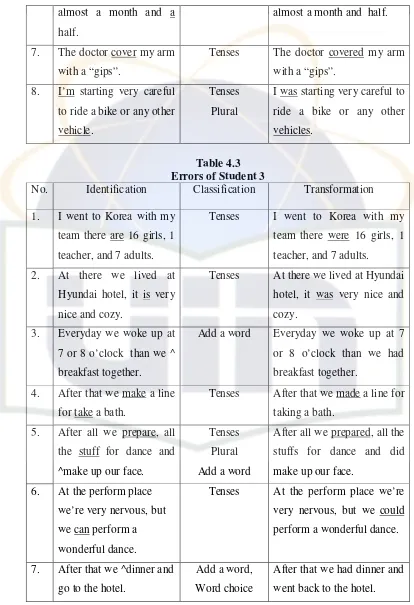
Table 4.2 Errors of Student 2
No. Identification Classification Transformation
1. I thougt it was safe, but
suddenly there was a
motorbike coming from
the other road.
motorcycle help me ^ get
up.
almost a month and a
I was starting very careful to
ride a bike or any other
vehicles.
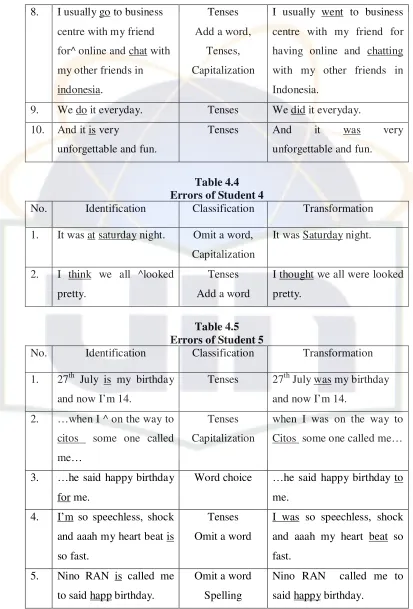
Table 4.3 Errors of Student 3
No. Identification Classification Transformation
1. I went to Korea with my
team there are 16 girls, 1
teacher, and 7 adults.
Tenses I went to Korea with my
team there were 16 girls, 1
teacher, and 7 adults.
2. At there we lived at
Hyundai hotel, it is very
nice and cozy.
Tenses At there we lived at Hyundai
hotel, it was very nice and
After all we prepared, all the
stuffs for dance and did
make up our face.
6. At the perform place
we’re very nervous, but
we can perform a
wonderful dance.
Tenses At the perform place we’re
very nervous, but we could
perform a wonderful dance.
7. After that we ^dinner and
go to the hotel.
Add a word,
Word choice
After that we had dinner and
went back to the hotel.
8. I usually go to business
centre with my friend
for^ online and chat with
my other friends in
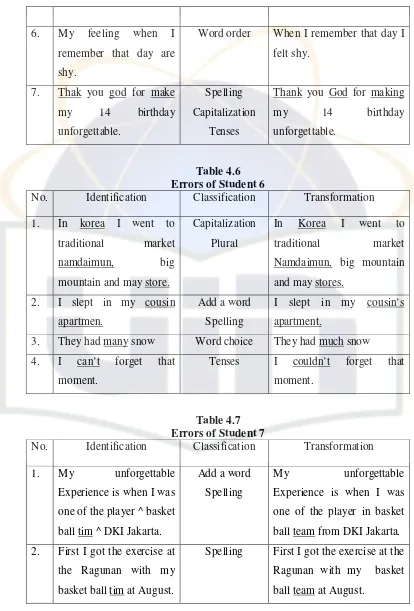
indonesia. Errors of Student 4
No. Identification Classification Transformation
1. It was at saturday night. Omit a word,
Capitalization
It was Saturday night.
2. I think we all ^looked
pretty.
Tenses
Add a word
I thought we all were looked
pretty.
Table 4.5 Errors of Student 5
No. Identification Classification Transformation
1. 27th July is my birthday
to said happ birthday.
Omit a word
Spelling
Nino RAN called me to
said happy birthday.
6. My feeling when I
remember that day are
shy.
Word order When I remember that day I
felt shy. Errors of Student 6
No. Identification Classification Transformation
1. In korea I went to
traditional market
namdaimun, big
mountain and may store.
Capitalization
Plural
In Korea I went to
traditional market
Namdaimun, big mountain
and may stores. Errors of Student 7
No. Identification Classification Transformation
1. My unforgettable
Experience is when I was
one of the player ^ basket
ball team from DKI Jakarta.
2. First I got the exercise at
the Ragunan with my
basket ball tim at August.
Spelling First I got the exercise at the
Ragunan with my basket
ball team at August.
3. My tim is Astrid she is
Svetlana, Tiara, Tia they are
from 19 Junior high school.
5. Dita_she is school in
budaya.
Punctuation
Word choice
Dita, she is from Budaya.
6. I must did the competion. Word choice
Spelling
I started the competition.
7. I feel nervous because
my tim had the
competion with all of tim
at Indonesia. Errors of Student 8
No. Identification Classification Transformation
1. When I was 8 years old, I
Paradise at Kuta Bali.
Tenses
Word order
I spent the night in Paradise
hotel at Kuta Bali.
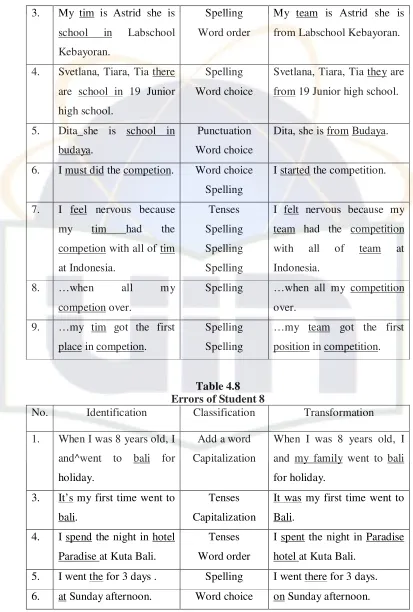
5. I went the for 3 days . Spelling I went there for 3 days.
6. at Sunday afternoon. Word choice on Sunday afternoon.
7. I arrived at denpasar bali. Capitalization I arrived at Denpasar Bali
8. After I arrived at bali. Word choice
Capitalization
After I arrived in Bali.
9. I feel happy and walk
around, with my family
10. After walked around I ^
…we went there by walking
14. At Tuesday afternoon, I
went to airport to go
home
Word choice On Tuesday afternoon, I
went to airport to go home
15. And I went to airport and
I felt very disappointed…
18. I was very bored when waited the plane I just walked around the airport
Tenses I was very bored when
waiting the plane I just walked around the airport
19. I feel so disepointed and
ashamed when remember that situation
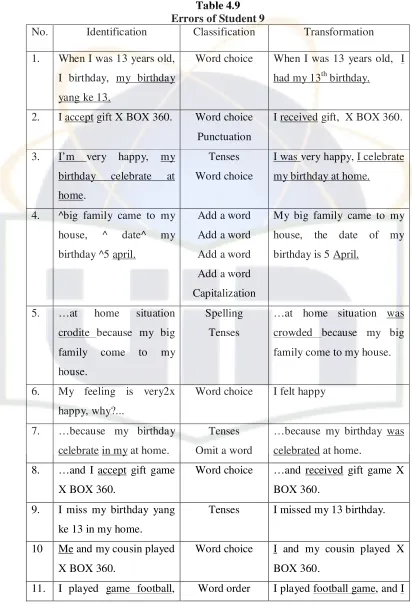
Table 4.9 Errors of Student 9
No. Identification Classification Transformation
1. When I was 13 years old,
birthday celebrate at
home.
Tenses
Word choice
I was very happy, I celebrate
my birthday at home.
4. ^big family came to my
birthday is 5 April.
5. …at home situation
family come to my house.
6. My feeling is very2x
happy, why?...
Word choice I felt happy
7. …because my birthday
celebrate in my at home.
Tenses
Tenses I missed my 13 birthday.
10 Me and my cousin played
X BOX 360.
Word choice I and my cousin played X
BOX 360.
11. I played game football, Word order I played football game, and I
and the winner is me. Tenses was the winner.
12. I very2x happy because I
winner from my cousin
Tenses
indonesia. I bought futsal
shoes, the price is Rp.
No. Identification Classification Transformation
1. Me and other my friends
Pras, Reygi and Yudhis.
Tenses
Word choice
There were I, Adly,Audry,
Ninet, Aca, Pras, Reygi and
Yudhis.
5. We’re very tired after
Word form because there was rainy.
7. The other people just
tari, Aca, Wira, Reygi.
Tenses,
No. Identification Classification Transformation
1. When I was in five grade.
4. the motorcycle throw Tenses the motorcycle thrown away
down to the river.. Word choice to the river
because is the first time…
7. …I was feel fly with my
fine but the biker was angry
to me.
9. I don’t like him. Tenses I didn’t like him
10. Because his fault why he
must dispoint me
Word order Because it was his fault, not
me
No. Identification Classification Transformation
1. I playing with my cousin. Tenses I played with my cousin.
2. I’m feel shy because my
cousin ^laughing at me
Tenses
Add a word
Word choice
I felt shy because my cousin
was laughing on me.
3. I went back Word choice I come back. Errors of Student 13
No. Identification Classification Transformation
1. I went to bali at 10
November 2005, and I went
to Bali with my father,
mother…
2. Next, back to kute beach
at night .
Capitalization Next, back to Kute beach at
night .
3. In the kute beach is so
verry crawded place but
it is so interesththink
Capitalization
fathe and my Brother.
Spelling
Spelling
I played surfing with my
father and my Brother.
Table 4.14 Errors of Student 14
No. Identification Classification Transformation
1. I went to bali with my
…in Kute was so crowded.
7. …but ^ is so intresthing Add a word
Tenses
Spelling
…but it was so interesting
8. …but I want to go ^ with
my friends
Add a word …but I want to go there
with my friends
Table 4.15 Errors of Student 15
No. Identification Classification Transformation
1. On Saturday 12 July Word order On Saturday 12 July
and automaticly I say “
yes I want_
Tenses
punctuation
automatically I said “ yes I
want”
getting 2 months long
9. He is school in SMP
looks really like him
Word order I have a junior who really
looks like him
Table 4.16 Errors of Student 16
No. Identification Classification Transformation
1. On 16 February 2005 Word order On February 16th
time, I feel not so good… time, I felt that I didn’t play
guitarist because I work hard
to be a nice guitarist
7. I was proud for my work
hard to be a nice guitarist
Word choice
Word order
I was proud of my hard
work to be a nice guitarist
Table 4.17 Errors of Student 17
No. Identification Classification Transformation
1. When I was nine years Errors of Student 18
No. Identification Classification Transformation
1. I and my friends ^
playing music in the
studio band.
Add a word I and my friends ^ playing
music in the studio band.
2. The situation is mass Word choice The situation was mass
I sang with lyrics.
6. but I don’t really know a
lyrics without the music .
7. I play a music in FIMAX Errors of Student 19
No. Identification Classification Transformation
1. My unforgettable
experience is when I was
5 years old
fall from mango tree
Tenses When I was 5 years old, I
fall from mango tree
…but luckily I droped at
a garbage can
Spelling …but luckily I dropped at a
garbage can
3. So I didn’t fell ang pain Spelling So I didn’t feeling pain
and see what happen
Tenses
seeing my body unclean
Tenses
Word choice
My mother was shocked
seeing my body dirty
7. So my mother grab my
bathroom then I took a bath
8. My mother told me to not
Errors of Student 20
No. Identification Classification Transformation
1. my unforgettable
was falling in love.
2. After my class is over I
6 I bought 3 Cadbury
Tenses after I finish to buy a present
for him
8. I went home I put that
chocolate in the refigator
Plural I went home I put those
chocolates in the refrigerator
9. next morning I go to
unforgettable experience for
me.
Table 4.21 Errors of Student 21
No. Identification Classification Transformation
1. One day when I celebrate
2. It’s not unforgetable. Spelling It’s not unforgettable.
3 I invite my best
friends,…
Tenses I invited my best friends,…
4. at my birthday I inviting
my friends for watch
movie and eat Wendy’s
Capitalization
Tenses
Tenses
At my birthday I invited my
friends for watching movie
and eating Wendy’s
5. Its not unforgettable
because I’m not have
surprised ^ from my friend
Tenses
Add a word
Its not unforgettable because
I didn’t have surprised
things from my friend
6. …,but I’m so happy
because its my 14th
birthday.
Tenses …,but I was so happy
because its my 14th birthday.
7. My friend Bella give me
saved Bella’s give forever
9. After I afford ceremony
and afford drum band.
Tenses
Tenses
After I afforded ceremony
and afforded drum band.
10. after I afford drum band
at music room my friends
play song “happy
birthday”
Tenses after I afforded drum band at
music room my friends play
song “happy birthday” Errors of Student 22
No. Identification Classification Transformation
1. On alix cup 24
4. at that time I am so Errors of Student 23
No. Identification Classification Transformation
1. My Unforgettable
Experience is Diving
Capitalization
Capitalization
Tenses
My unforgettable
experience was diving
2. When my first time
into the sea, that was
really-really
Everything looked fine there
8. …I’ve seen everything
9. I only can diving one Errors of Student 24
No. Identification Classification Transformation
1. It is 2nd recess, so we
must pray to masjid
Tenses
canteen & bought some food
5. So I walked off from the
canteen
Omit a word So I walked from the
canteen
6. When I walk I saw my
teacher approaching the
canteen
Tenses
Tenses
When I walked I saw my
teacher approached the
canteen
so ashamed ^ that time ashamed at that time Errors of Student 25
No. Identification Classification Transformation
1. My unforgettable
experience was my
birthday party at Sunday,
14th September 2008
Word choice My unforgettable experience was my birthday party on Sunday, 14th September
2008
2. I was celebrate my
birthday at the Pizza Hut
Tenses I was celebrated my birthday
at the Pizza Hut
My friends went to pizza hut to break fast and also celebrated my birthday party
5. Ocha and Khalisa went
..after that I blew a candles
8. …Then we ^ breaking
Table 4.26 Errors of Student 26
No. Identification Classification Transformation
1. The cinema ^ near from
the school.
Add a word The cinema was near from
the school.
2. I watch the movie film
because is new film
Tenses
Tenses
I watched the movie film
because was new film
3. I buy ticket at the locket and snack at the
cafetaria.
Tenses I bought ticket at the locket and snack at the cafetaria.
4. I entrance the cinema
The film was very scary
8. I and my friend is very
scared watched the movie…
9. I and ^ friend close the
when we were full enough, I
and my friend went home.